Why ‘Monsters of God’ is personal for director Eric Goode
This time, it’s personal for Eric Goode.
The director’s first two docuseries — “Tiger King” and “Chimp Crazy” — were smash hits about larger-than-life characters engaging in questionable and illegal activity surrounding the care and ownership of animals. Both had an underlying conservation message but drew viewers in with the colorful and chaotic worlds they depicted.
Goode’s third, “Monsters of God,” premiering Thursday on HBO, is both a direct descendant and forges a new path. While it also features a hugely entertaining menagerie of criminals, who speak frankly about many of their illegal acts and how much they dislike each other, “Monsters” is largely a historical look at reptile smuggling going back more than half a century — unlike the contemporaneous stories in “Tiger King” and “Chimp Crazy.”
Goode had opportunities to bring in current events — one dealer was rearrested shortly after being filmed and there were major smuggling arrests in California in recent years — but realized he couldn’t keep piling on more stories. “We’re just setting the tone of this multibillion-dollar reptile-smuggling industry that you’ve probably never heard of,” says Goode’s producing partner Jeremy McBride.
But the other difference is that Goode has spent his entire life immersed in the world of reptiles, starting long before he even contemplated making a documentary. Goode had a pet tortoise when he was 6 and slept with a tegu lizard in his bed as a teen. He also saw the industry underbelly up close and personal. “In the ’70s and ’80s, I even bought reptiles from some of the very people that I chronicle in ’Monsters of God,’” he says.
“I had personal connections in these worlds, which helped us go much deeper than in my other stories,” he says. “I don’t know if it’ll be anywhere near as successful, but in terms of investigative journalism, we went much further.”

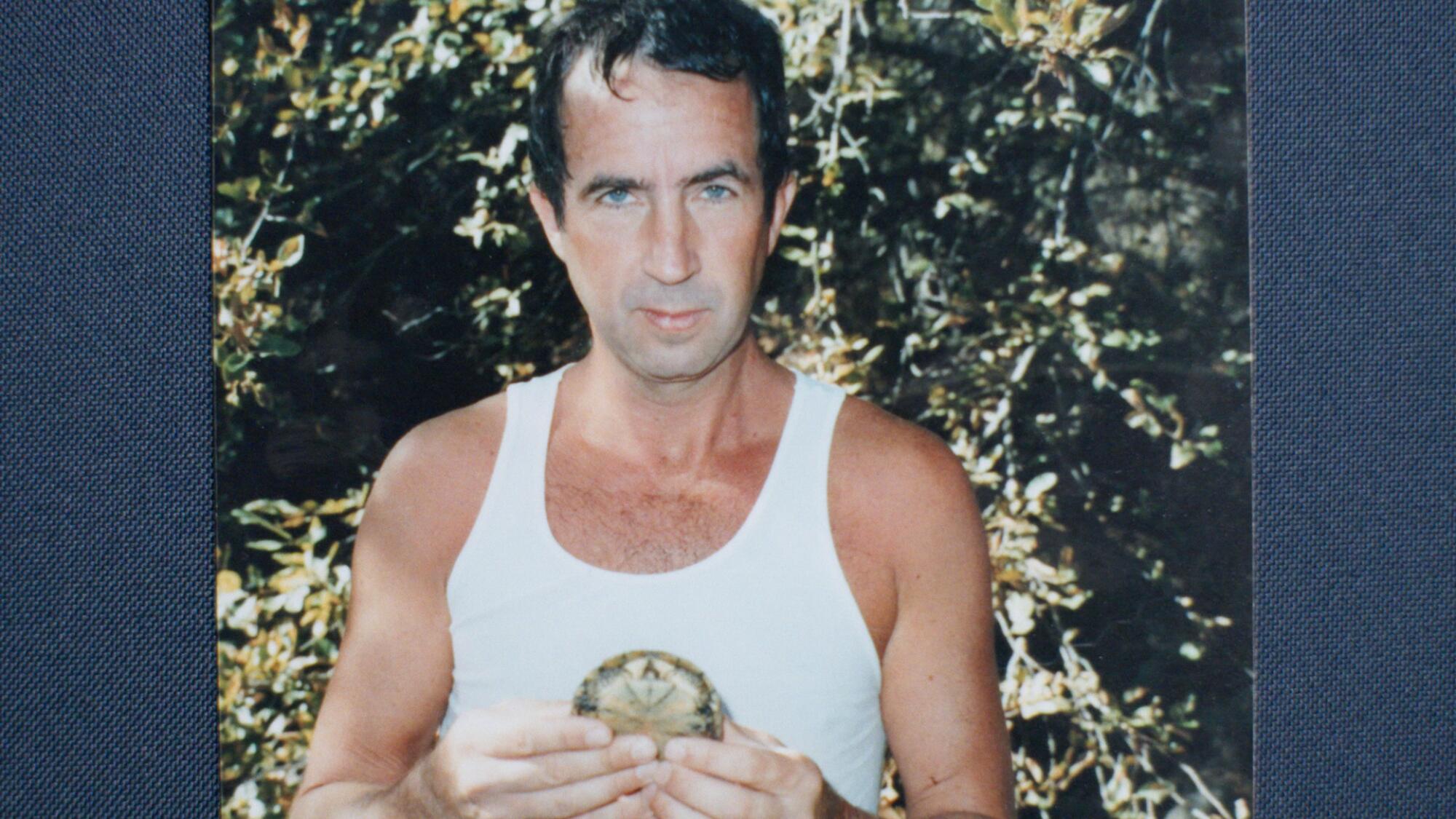
An archival photo of director Eric Goode with a southwestern pond turtle. In addition to filmmaking, he created the Turtle Conservancy in Ojai.
(A24 / Goode Films / HBO)
(He also acknowledges that his earlier series could tilt toward sensationalism and be exploitative. “I was naive when I started all this and learned a lot from ‘Tiger King,’” he says, adding that there was internal friction about what direction to go with the material. “Now we’ve refined the like-mindedness of what we were trying to do.”)
He credits his mother with opening his eyes to the larger issues when he was younger. “She struggled with me keeping things in captivity and would say, ‘You can’t play God, these animals belong in the wild.’”
That said, while he is proud the Big Cat Public Safety Act passed in the aftermath of “Tiger King” and believes people should be banned from raising chimps at home, he views reptiles differently. “Kids should be able to have a bearded dragon or a leopard gecko or ball python. It nurtures a love for nature and for reptiles,” he says, adding that he’s focused more on the harm caused by smuggling.
Despite his love of animals and a high school obsession with making Super 8 film, Goode was not, for much of his life, a likely candidate to be directing these documentaries. “My whole trajectory doesn’t make a lot of sense on paper,” he acknowledges.
After attending the School of Arts and Sciences, which his father founded in Marin County, Goode moved to New York. He worked as a production assistant on big films. “I hated it,” he recalls. “I hated being a cog in a wheel, just moving things around.” (Today, even as his productions have grown more elaborate, he still goes into the field with a small team. “I like that intimacy.”) He also went to art school but was largely bored there.
“I saw the creative energy in New York in the nightlife there,” he says. So while Goode was working as an artist, he also created Area, one of the city’s biggest nightclubs of the 1980s, where he brought in collaborators like Jean-Michel Basquiat, Keith Haring, David Hockney and Kenny Scharf, with rotating themes like a carnival or natural history (which featured snakes and lizards). “Everyone came from somewhere else or were misfits and I was bringing in these interesting characters, which is very similar to what I’m doing in these films,” he says. “I like lifting up the rocks and finding the eccentrics out there.”
Area’s success led to a big career in nightclubs, restaurants and hotels. Then 20 years ago, he took his profits, along with his passion for reptiles, and created the Turtle Conservancy in Ojai. “I realized that the two most endangered groups of vertebrates in the world were primates and turtles,” he says, adding that nearly half of the smuggled animals seized at LAX in the last three years were turtles. When officials recently confiscated 350 turtles there, they brought them to the conservancy to care for them. “I’m going to go feed them after this interview,” Goode says.
The conservancy now has a worldwide reach in protecting turtles and their habitats and has become a leader in trying to stave off extinction for the ploughshare tortoise, whose fate is a major storyline in “Monsters of God.”

Tom Crutchfield, one of the reptile smugglers featured in the docuseries, with a monitor lizard in a photo taken circa 1970s.
(Photograph by Bill Love. Courtesy of Goode Films / HBO)
As filming was finishing, the conservancy became home to the first ploughshare births in captivity. “It was such a coincidence but really meaningful,” McBride says. “It anchors the film’s purpose and gives a little bit of hope in what otherwise feels bleak.”
This docuseries has been in the works for nearly 20 years, since Goode read Brian Christy’s “The Lizard King” in 2008 and tried to option it. “I even filmed him badly back then — the sound was terrible and the camera fell off the tripod during the interview,” he recalls. (Christy appears in the docuseries.)
In 2014, he finally got started but it was always on and off again as other projects got in the way. In “Tiger King,” Goode shows he’s first drawn to that story when he sees a guy with a snow leopard in his van, which happens while he’s filming Tom Crutchfield, one of America’s most notorious reptile smugglers. “But while I was making these other stories, I was always opportunistically filming reptile people,” he says, adding that they interviewed not only the criminals but federal law enforcement and others, seeking a broader scope than his previous films. “It was critical for us to get all sides of the story. Part of the reason it took so long was it sometimes took years to get someone to agree to talk.”
McBride says they finished with 1,500 hours of footage and interviews with a hundred different people, including the most notorious smugglers (some of whom were also murderers and drug dealers) and the law enforcement officials who dedicated years of their life undercover to catch them.
It’s a true crime story on some level but Goode says the series is more layered and complex than his previous projects.
“I don’t want people to think we’re the animal police,” Goode says. “Law enforcement has good intentions but they sometimes backfire with unintended consequences. Often, the more laws you create to prevent people from having a reptile, the more they want them. But sometimes prohibition does work.” (In Asia’s wet markets, the most endangered animals sell for more money with their protected status used as a marketing tool.)
“Hopefully, people come away recognizing that we have to think about doing things differently than maintaining the status quo, because a lot of what we’re doing is not working,” Goode says. “It’s a messy story without easy answers.”