turn

South Korea seeks to turn defense exports into growth engine

1 of 3 | Government officials, lawmakers, researchers and defense industry executives attend a seminar marking the 20th anniversary of South Korea’s Defense Acquisition Program Administration in Seoul on Friday. Photo by Asia Today

June 19 (Asia Today) — South Korea is seeking to transform its defense industry into a national growth engine by integrating military procurement, weapons exports, advanced technology and industrial policy, government and industry officials said Friday.

Officials at a public-private seminar in Seoul rejected the long-standing argument that growing foreign orders could divert production capacity from the South Korean military and delay domestic weapons deliveries.

Instead, they said an analysis of about 2,000 South Korean defense companies found that exports increased factory utilization, encouraged investment in research and production facilities and eventually reduced manufacturing costs.

The findings were presented at a seminar titled “A New Leap Forward in Acquisition and the Defense Industry,” held at the Fairmont Ambassador Seoul in the city’s Yeouido financial district.

The Defense Acquisition Program Administration organized the event as it marked the 20th anniversary of its establishment.

Participants included lawmakers, officials from the defense, industry, science and small-business ministries, defense company executives and academic researchers.

They called for an end to treating military procurement and defense exports as separate policy areas.

Lee Yong-cheol, minister of the Defense Acquisition Program Administration, said South Korea’s annual defense exports had grown from about $250 million when the agency was established to $15.4 billion last year.

“Defense exports are no longer merely a supplement to domestic military procurement,” Lee said. “They have become a central growth engine driving the Republic of Korea as a whole.”

Lee said South Korea also needed to move beyond selling individual weapons.

He proposed combining weapons with energy systems, infrastructure, maintenance, repair and overhaul services and other forms of industrial cooperation.

“The era of selling weapons as stand-alone products is over,” Lee said. “We will transform the K-defense paradigm through cross-industry package cooperation.”

Lawmakers from South Korea’s governing and opposition parties pledged bipartisan legislative support for faster procurement and stronger financing for small and midsized defense companies.

They said a system that can take about 15 years to plan, develop and deploy a weapon is not suitable for an era in which artificial intelligence, drones and robotic systems evolve rapidly.

Participants also cited research indicating that financial instability among smaller suppliers, rather than export production, was a more important cause of delivery delays.

They called for expanded government-backed financing to prevent small manufacturers in the defense supply chain from being overwhelmed by debt and working-capital shortages.

Study links exports to stronger domestic production

South Korea’s defense industry has long debated whether large export contracts weaken or strengthen the country’s own military procurement.

Critics have warned that foreign orders could occupy production lines and delay the delivery of weapons to South Korean forces.

Supporters have argued that exports create economies of scale, preserve production capacity and lower the price paid by the South Korean military.

Research presented at Friday’s seminar supported the second view.

A team led by researchers from Myongji University analyzed data from about 2,000 South Korean defense-related companies.

The analysis found that increasing exports produced an immediate rise in factory utilization. Higher utilization was then associated with greater investment in research, development and production facilities.

Researchers said the benefits became more evident about three years after an export increase.

The analysis identified improvements in operating profit, lower production costs and greater independence in critical technologies after that period.

Repeated production also allowed factory workers and engineers to improve their skills and reduce defects, a process commonly described as a learning effect.

At the same time, producing weapons in larger quantities spread fixed development and manufacturing expenses across more units.

Researchers said those effects increased the competitiveness of South Korean products in foreign markets while potentially lowering the cost of weapons purchased by the South Korean military.

Industry experts cited South Korea’s large exports of K2 tanks and K9 self-propelled howitzers to Poland as an example.

They said the contracts increased domestic production, helped reduce unit costs and accelerated work on upgraded models.

Kim Myung-keun, an executive at Hyundai Rotem, said the company achieved economies of scale after receiving Poland’s large K2 tank order.

“Mass production lowered costs, reduced the acquisition cost for our own military and accelerated the development of upgraded models,” Kim said.

Yoon Byung-jo, an executive at SNT Motiv, said repeated production generated through large export orders also strengthened technical capabilities on factory floors.

“The learning effect accumulated by technicians during repeated production is the most powerful tool for reducing defects in critical components and increasing technological independence and localization,” Yoon said.

Lee Jung-hyun, a Myongji University professor involved in the study, said the analysis did not identify export volume as the principal cause of delayed deliveries.

“The real causes of delivery delays were companies’ debt ratios and financial soundness,” Lee said. “Exports instead improved operating profits and technological capabilities after a time lag of about three years.”

Lee said the government should strengthen the financial stability of smaller defense companies rather than restrict exports.

Officials seek to shorten 15-year procurement cycle

Government officials said South Korea’s traditional weapons acquisition process is too slow to keep pace with civilian advances in AI, drones, robots and human-machine teaming systems.

Weapons programs can take about 15 years from initial planning through development and operational deployment.

Officials said that schedule risks delivering technology that has already become outdated by the time it reaches military units.

Won Jong-dae, an assistant defense minister, said the existing system had become a national security obstacle.

“In the age of AI and drones, an acquisition process that takes 15 years is an impediment to security,” Won said.

He said the government would seek legislation tentatively called the Advanced Defense Capabilities Projects Act to shorten the process from initial requirements planning through deployment.

Kim Seong-su, a senior research and development official at the Science and Technology Ministry, said innovation in the civilian sector was advancing more quickly than military technology.

Kim called for an adaptive research and development system that would allow mature commercial technologies to be introduced into the military without passing through the full conventional development process.

The acquisition agency said it plans to expand rapid-introduction programs, particularly for drones and AI-related technologies.

The programs would allow the military to test and deploy promising civilian products more quickly while making adjustments based on operational experience.

Jeong Hwan, chief executive of infrared sensor manufacturer i3system, said smaller companies with advanced commercial technologies often cannot withstand the military’s complicated testing requirements and lengthy acquisition schedule.

He urged the government to make rapid acquisition programs more flexible and accessible to technology companies.

Financial support sought for smaller suppliers

Officials said South Korea must also strengthen small and midsized companies that produce components and materials for major weapons manufacturers.

Park Yong-soon, a senior official at the Ministry of SMEs and Startups, said the research presented Friday showed that financial weakness was a major source of supply-chain disruption.

Park said the government would shift policy toward stronger financial support for vulnerable suppliers and seek to increase the share of domestic defense revenue generated by small companies.

Smaller companies currently account for about 18% of South Korean defense industry sales. The government aims to raise the proportion to 25%.

Officials said those businesses can face severe cash-flow pressures because defense contracts require lengthy development, testing and certification before companies receive full payment.

The problem can become more serious when a small supplier must expand production rapidly to meet a major overseas order.

Park said the government must ensure that otherwise competitive companies do not collapse because they cannot obtain sufficient operating capital.

Park Dong-il, a senior official at the Industry Ministry, also warned that South Korea’s export portfolio remained concentrated in ground weapons.

More than 60% of the country’s defense exports come from land-based systems, he said.

Park said the government would work to diversify the industry into aerospace, next-generation satellites and advanced naval vessels while strengthening the domestic manufacturing and component ecosystem.

South Korea plans national security export packages

The acquisition agency said future export efforts would go beyond individual tanks, aircraft or artillery systems.

The government plans to package defense products with energy projects, transportation and industrial infrastructure, information and communications technology, maintenance services and technology transfers.

Officials described the approach as exporting an integrated security platform rather than a single weapon.

They cited Poland as a model.

South Korean arms agreements with Warsaw have included not only K2 tanks, K9 howitzers and other weapon systems but also plans for local production, technology cooperation, training and long-term maintenance.

An industry official said future transactions could involve building a partner country’s broader security and industrial system.

“The business will no longer be about exporting one tank,” the official said. “It will become a platform business that exports an entire national security system.”

Such packages can help importing countries create domestic jobs, develop supply chains and maintain weapons locally.

They can also give South Korean companies access to long-term revenue from training, spare parts, upgrades and depot-level maintenance after the initial sale.

The approach, however, requires coordination among several ministries because infrastructure, export financing and industrial cooperation extend beyond the authority of the acquisition agency.

Kim Il-dong, deputy minister of the Defense Acquisition Program Administration, said procurement and exports should be viewed as two sides of the same coin.

Kim said the acquisition agency could not achieve South Korea’s defense industry goals on its own.

He called for coordinated action by the defense, science, industry and small-business ministries to develop the sector as a strategic national industry.

Seoul targets 5% share of global defense market

The Defense Acquisition Program Administration said it aims to increase South Korea’s share of the global defense market to at least 5% and establish the country as one of the world’s four largest defense exporters.

Officials said South Korea’s defense industry had already approached the global top five based on its 2025 export performance.

Future growth will depend on moving beyond the country’s current strength in tanks, armored vehicles and artillery, they said.

The government plans to support companies working in AI, space systems, drones, advanced ships and autonomous and human-machine teaming technologies.

It also wants to foster globally competitive defense startups and companies capable of reaching valuations of more than $1 billion.

Officials and industry representatives said South Korea’s defense sector had completed an initial period of quantitative growth and now needed to focus on technology, productivity and supply-chain resilience.

“The past 20 years were a period of quantitative growth in which K-defense built weapons capabilities from the ground up,” seminar participants said. “The next 20 years should be remembered as an era of qualitative growth centered on AI, space, drones and unmanned systems.”

They said military procurement and the defense industry should no longer be treated as separate areas.

Instead, both should be viewed as parts of a single strategic industry supporting South Korea’s security, technological development and economic growth.

— Reported by Asia Today; translated by UPI

© Asia Today. Unauthorized reproduction or redistribution prohibited.

Original Korean report: https://www.asiatoday.co.kr/kn/view.php?key=20260619010006831

Source link

Maasai women turn drought into income through fodder farming in Tanzania | Agriculture News

Monduli, Tanzania – When drought wiped out most of her family’s livestock, 30-year-old Nesirkar Loongidong’i, a Maasai mother of four from Selela village in northern Tanzania, found herself with very few options. The dry season had already killed most of their animals.

Today, she makes a living growing and selling drought-resistant livestock fodder.

“Before I planted fodder, I lost most of our goats. Now, people come from other villages to buy grass, and I can support my children. I don’t fear drought anymore,” Loongidong’i told Al Jazeera.

With the income, she has built a house and bought five goats.

Loongidong’i’s story is part of a much larger and fast-growing shift. Across northern Tanzania, Maasai women, part of a community of about 430,000 people, are turning fodder production from a survival tactic into a climate-adaptation business. The work is coordinated by the Pastoral Women’s Council (PWC) and is spreading across pastoral districts.

The PWC is a women-led membership organisation working across three northeastern districts, covering more than 28,000 square kilometres (10,810 square miles) and serving about 456,000 people, most of them Maasai pastoralists. Founded in 1997, it now counts around 6,500 members in 90 villages, with years of work focused on land rights, economic empowerment, and girls’ education.

For Loongidong’i, it all comes down to growing pasture grass without irrigation. Because demand remains steady, so does her income, and with it, her household’s stability. Today, she lives in a home with a metal roof, and nearby, her goats graze in a fenced area as their numbers slowly grow again.

According to Tanzania’s Ministry of Livestock and Fisheries, at least 306,358 animals, including cattle, goats, sheep, and donkeys, died between September 2021 and January 2022 due to prolonged drought. In Simanjiro district alone, 92,047 livestock were lost, wiping out livelihoods across pastoral communities.

In response, the PWC established 10 major grass seed banks across eight villages in Monduli and Longido districts. Today, about 75 hectares (185 acres) are under fodder production, with another 37 hectares (90 acres) expected to be added in the 2025-2026 season. Around 250 women directly manage these farms, while thousands of herders now depend on them for feed during dry seasons.

The impact is already visible. In 2025, a single seed bank earned 6.6 million Tanzanian shillings (about $2,500) from seed sales, along with 1,111 hay bales sold at 6,000 shillings ($2.30) each. For many women, this has shifted their role from dependents to economic providers.

Backed by organisations such as the Global Fund for Women and Oxfam, the PWC is now seen as offering a replicable model for protecting a livestock economy worth millions of dollars.

This shift is no longer limited to survival. Across northern Tanzania, it is becoming a quiet but steady form of enterprise, reshaping daily life in pastoral communities.

From survival to business

In Longido and Monduli, deep in northern Tanzania, Maasai life has been slowly changing. As traditional grazing patterns weaken under worsening droughts, women are increasingly taking on roles once tied only to herding, now growing pasture for income on open communal land.

Loongidong’i explains that what began as a way to survive dry years has now become a reliable source of income for many women. In the past, planting hardy grasses such as Cenchrus ciliaris was simply about keeping livestock alive. Today, it is also a business.

To respond to declining rainfall, women grow resilient species such as Rhodes grass (Chloris gayana) and Masai love grass (Eragrostis superba) on designated community plots. These grasses stay green longer than natural pasture during dry periods. Once harvested, they are bundled and sold to local herders as animal feed.

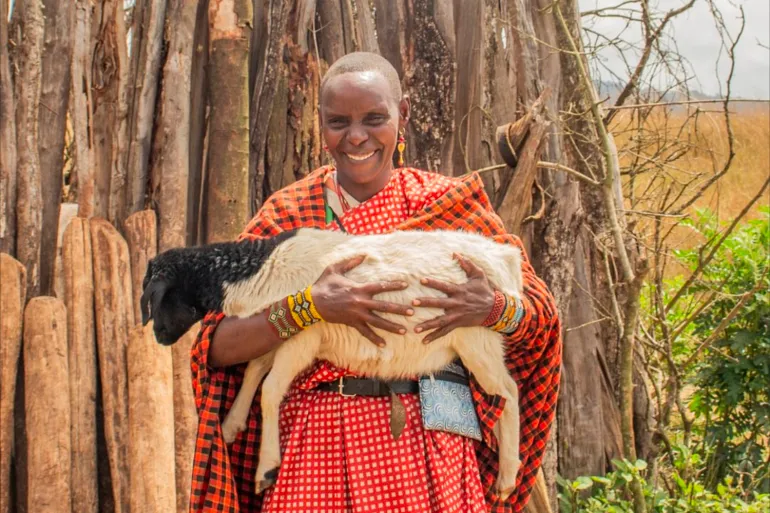
A member of the Naisho women’s group carries a sheep purchased through income earned from harvesting and selling fodder grass in Selela village, Monduli District, northern Tanzania [Courtesy of Pastoral Women’s Council]
A member of the Naisho women’s group carries a sheep purchased through income earned from harvesting and selling fodder grass in Selela village, Monduli district, northern Tanzania [Courtesy of Pastoral Women’s Council]

“Seeds are also saved and traded later when demand rises,” Loongidong’i says, adding that this cycle now supports many households across arid areas.

Herding families also benefit during drought periods, when natural grazing disappears and these managed plots become a lifeline for livestock.

The seed bank project, managed by Naisho, the group Loongidong’i works with under the PWC, generated about 6.6 million Tanzanian shillings ($2,514) from seed sales, alongside more than 1,000 bales of grass. Small in scale, but steady in output, it has proven what organised local production can achieve.

For the Maasai, cattle are more than livestock; they are the centre of daily life, economy, and identity. When rains fail, the impact is immediate: animals weaken, and families struggle.

As in many pastoral communities, women carry much of the responsibility for daily survival, from food preparation to fetching water and caring for children. Now, alongside those roles, they are also becoming earners.

“Women who once depended entirely on their husbands now have their own income,” says Rachel Letiety, a founding member of the PWC. “Families are becoming more stable. Men are beginning to value women’s contributions, especially during droughts.”

Ongoing challenges

Still, the progress comes with challenges.

Loongidong’i says some farms are affected when weeds take over and when fences break, allowing livestock, and sometimes wild animals, to destroy carefully cultivated plots.

“I have seen invasive plants ruin large parts of our farms,” she says. “And sometimes animals enter and destroy what we have worked on for months. It is not easy to guard these fields every day.”

She also points to tensions within groups, where disagreements sometimes arise over responsibilities and how income is shared.

At present, with support from organisations such as Justdiggit, Trees for the Future, and Swissaid, around 200 women are directly involved in the project. Many more benefit indirectly, especially during drought periods when pasture becomes scarce.

Nesirkar Longidongi carries harvested fodder from her group’s grass field in Selela village. Income from fodder production has helped her improve her family's livelihood. [Courtesy of Pastoral Women’s Council]
Nesirkar Loongidong’i carries harvested fodder from the grass field maintained by her group in Selela village [Courtesy of Pastoral Women’s Council]

“This work prevents our cattle from dying and keeps them healthy,” says Nairiyamu Laizer, a mother of three and secretary of the Naisho group. “It also helps sustain the bulls we raise.”

“If all women take up this opportunity, these projects can lift our economy,” she adds.

“We harvest the grass and sell it; some buyers use it for cattle feed, others for thatching houses. We also grind some of it into animal feed,” she says.

For Loongidong’i and many Maasai women, growing fodder is no longer just about surviving difficult seasons. It has become a new beginning, reshaping livelihoods and the place of women in pastoral life.

“Now women help bring money into their homes,” she says, “and families are becoming more stable.”

This article is published in collaboration with Egab.

Source link

Israeli Troops Turn To Fishing Nets For Protection Against Hezbollah FPV Drones

For more than 2,000 years, fishermen in Israel’s Sea of Galilee were famous for using nets to catch St. Peter’s Fish, a form of tilapia with a biblical backstory. Now these anglers have gained new notoriety, helping keep some Israeli troops safe from Hezbollah first-person view (FPV) kamikaze drones. TWZ was among the first to highlight the danger these weapons have posed to Israeli forces in southern Lebanon and how the IDF was racing to install passive defenses, including nets, on its combat vehicles for protection.

The threat is so great and countermeasures so far limited, that some IDF troops are resorting to obtaining nets on their own from fishermen for protection, a senior IDF official confirmed to TWZ on Monday. The issue was first reported by Israel’s KAN public broadcasting network. This is in addition to netting the IDF itself is working to procure, which we will talk more about later in this story.

The IDF’s improvised countermeasure: going to Israeli fishermen and asking to use their nets.

They’re being hung in front of bases and tanks so the drones get tangled. pic.twitter.com/oSUpfoMvyy

— The Jerusalem Post (@Jerusalem_Post) May 26, 2026

“Indeed, IDF soldiers are equipping themselves with fishing nets, most of which are being purchased in the city of Tiberias on the shores of the Sea of Galilee,” a senior IDF official told us. The troops are also buying nets from fishermen at Akko and Haifa on the Mediterranean, the official added.

“The drone threat has become a nightmare for the fighters on the ground,” the high-ranking official explained.

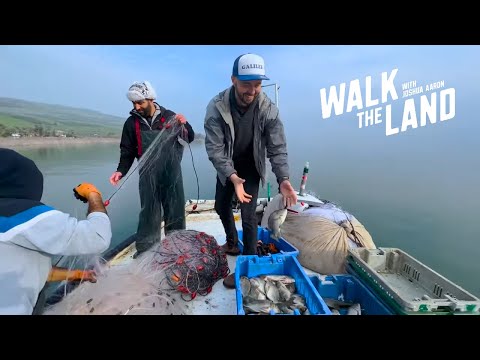
Fishing on the Sea of Galilee! Joshua Aaron / Rather Be in the Galilee thumbnail

Fishing on the Sea of Galilee! Joshua Aaron / Rather Be in the Galilee


In our past reporting, we explained that the idea behind netting is that drones will get caught up in these barriers and become disabled, or, in some cases, the nets will help keep the drones far enough from the troops or equipment before exploding to keep personnel within the vehicles from being killed.

Israel, as we have previously noted, started using netting on vehicles and other equipment as the FPV threat grew.

You can see one example of this in the following video.

Israeli Defense Forces testing a folded anti-drone net installed on a Humvee.

The video emerged amid a surge of Hezbollah strikes with FPV drones against the IDF in Lebanon. pic.twitter.com/PwIyuJQVs4

— Status-6 (War & Military News) (@Archer83Able) April 29, 2026

The use of nets as a defensive measure was first employed in Ukraine as FPV drones became the ubiquitous weapon of choice for both sides.

You can see an early example of Russians using netting in the video below.

To protect themselves from Ukrainian drone attacks, the Russians have fenced off the road from Bakhmut to Chasiv Yar, creating a 2-km mesh tunnel. In this way, the Russians are trying to rescue their equipment and personnel from threats from drones. pic.twitter.com/qbtFvwrAcx

— WarTranslated (@wartranslated) February 9, 2025

In our initial stories about Hezbollah’s FPV arsenal, we noted that the Iranian-backed proxy group was adding a challenge to the IDF by increasing the percentage of FPV drones guided by fiber optic cables. These wires mitigate the effect of electronic warfare efforts to jam radio signals as well as some of the limitations imposed by geographical features that can impede the line-of-sight radio connection between drone and operator.

Videos of these attacks began to emerge online last month, which you can see below.

Hezbollah conducted more fiber-optic FPV strikes on Israeli vehicles in Lebanon, including two ‘Merkava’ Mk.4 tanks, a D9 Caterpillar armored bulldozer, and what appears to be a rare ‘Namer’ heavy IFV equipped with a turret mounting a 30 mm Bushmaster Mk 2 cannon.
1/ https://t.co/ms2nagNHrD pic.twitter.com/WDs6M3SpwW

— Roy🇨🇦 (@GrandpaRoy2) April 5, 2026

Now there’s a new problem for Israel to solve when it comes to FPV drones. Hezbollah has begun using thermal cameras on these munitions so they can be deployed in night attacks, the IDF official told us. Thermal cameras register heat signatures, turning them into thermal images using differences in temperature.

By adding thermal cameras to the FPV drone, Hezbollah “severely restricts [our] movement both during the day and at night,” he postulated.

#Lebanon / #Israel / #Iran / #USA 🇱🇧🇮🇱🇮🇷🇺🇸: Hezbollah’s “THERMAL Ababil” FPV Drone struck an Israeli Army (#IDF) soldiers in Al-Bayada.

Group used FPV Kamikaze Drone with equipped with Thermal Sight and carrying PG-7 / IED —which is a quite significant development. pic.twitter.com/pSHy4JriVA

— War Noir (@war_noir) May 25, 2026

Combined with fiber-optic guidance, the use of thermal cameras on FPV drones “creates an extraordinary level of deterrence against the forces operating inside Lebanon and along the border,” the senior IDF official bemoaned. “It is terrifying, dangerous, and frightening in equal measure.”

“The forces are essentially static,” the official added. “They cannot advance toward the drone-launch areas, nor can they effectively target the drone logistics and operational chain extending through the Beqaa Valley, Tyre, Sidon, and even Beirut.”

“Our operational doctrine must change,” he added. “We need to shift from completely exposed operations, where our soldiers become easy targets for Hezbollah, to covert and concealed activity.”

TOPSHOT - This photograph taken from the northern Israel shows Israeli tanks and military vehicles standing along the road between destroyed houses in southern Lebanon near the border with Israel, on April 29, 2026. Lebanon's army said on April 29 that one of its soldiers was among two people killed in an Israeli strike in the country's south, the latest deadly raid despite a ceasefire in the Israel-Hezbollah war. (Photo by Jalaa MAREY / AFP via Getty Images)
Israeli tanks and military vehicles standing along the road between destroyed houses in southern Lebanon. (Photo by Jalaa MAREY / AFP) JALAA MAREY

Making matters worse, “the political-security cabinet, and more specifically [Israeli Prime Minister Benjamin] Netanyahu, is pushing for overt operations in order to demonstrate an Israeli presence in southern Lebanon,” the senior IDF official posited. “At the same time, due to commitments and demands made by [U.S. President Donald] Trump, the operational freedom of the forces is being heavily restricted. It is a classic Catch-22 situation.”

“The result is severe harm to our soldiers and a weakening of the IDF against an enemy that is bound by no rules or constraints,” our source continued. “This is a dangerous and absurd asymmetry – sheer recklessness.”

His comments came a day before Netanyahu officially ordered a much larger Israeli push into southern Lebanon, despite the ongoing ceasefire, which you can read more about in our story from earlier today here.

Prime Minister Benjamin Netanyahu, today, at the start of the Security Cabinet meeting:
“As per the directive of myself, the Defense Minister and the IDF Chief of Staff, we are deepening our operation in Lebanon. The IDF is operating with large forces on the ground and seizing… pic.twitter.com/GBLuWgEbyl

— Prime Minister of Israel (@IsraeliPM) May 26, 2026

The IDF says about 158,000 square meters of protective nets have already been distributed to units in the field, Israel’s I24 News reported.

“The army says it is in the process of acquiring an additional roughly two million square feet of netting,” the outlet added. “Altogether, the total area ordered is equivalent to roughly 20 football fields, highlighting the scale of Israel’s efforts to adapt its defenses to a rapidly evolving battlefield threat along the northern front.”

Even that much netting does not appear to be enough, given the scope of Israel’s push into southern Lebanon. That may be way some soldiers are looking to fishing nets to fill in the gaps.

Since the war in Ukraine began, troops have done whatever they could, often out of desperation, to develop improvised workarounds to protect against drones, from stacking logs on their vehicles to welding on layers of steel to create so-called “turtle tanks.” These and many other ad-hoc improvements have led to major innovations and a long list of dead-ends. Often times, even simple solutions can be hard to realize due to bureaucracy. Israel’s troops are no different, and their work to find their own solutions is yet another example of even the world’s most capable militaries underestimating and being unprepared for the realities of drones on the modern battlefield.

Contact the author: howard@twz.com

Howard is a Senior Staff Writer for The War Zone, and a former Senior Managing Editor for Military Times. Prior to this, he covered military affairs for the Tampa Bay Times as a Senior Writer. Howard’s work has appeared in various publications including Yahoo News, RealClearDefense, and Air Force Times.


Source link

After San Diego shooting, Muslim Americans aim to turn grief into action | Islamophobia News

Baltimore, United States – Muslim Americans are grieving after two gunmen last week opened fire at the Islamic Center of San Diego, killing three people.

But at the annual conference for the Islamic Circle of North America (ICNA) in Baltimore, community leaders stressed the urgency of turning the sorrow into action.

Recommended Stories

list of 3 itemsend of list

Nearly 25,000 people turned out for the annual event, held on Saturday and Sunday. Speakers addressed the recent shooting, pointing to the courage of the three victims as examples for the broader community in a time of heightened Islamophobia.

“We owe them more than condolences. We owe them resolve,” said Lena Masri, a lawyer at the Council of American-Islamic Relations (CAIR).

She explained how the victims — a security officer, a caretaker and a neighbour — sacrificed their lives to save others. The security officer, Amin Abdullah, exchanged fire with the shooters, while the other two victims, Mansour Kaziha and Nadir Awad, rushed to help and called for emergency services.

“They protected the physical space of our community: the masjid [mosque], the school, the children, the teachers, the worshippers,” Masri explained.

“Our responsibility is to protect the civic space of our community: the right to worship, the right to speak, the right to organise, the right to defend Palestine, the right to build institutions.”

That was the recurring theme of the conference: that the Muslim American community cannot afford to be passive and must draw on its strength to push back against bigotry and hate.

Speakers emphasised voting, organising and donating to community institutions and candidates who align with Muslim Americans. They also underscored the need to hold officials accountable and push for an end to Israel’s atrocities in Palestine.

“We owe Gaza more than grief. We owe Gaza advocacy that cannot be intimidated into silence,” Masri said.

Islamophobia and Palestinians’ dehumanisation

Symbols of Palestine could be seen everywhere at the conference, from bags emblazoned with watermelons and flags to keffiyeh-patterned scarves, shirts and water bottles.

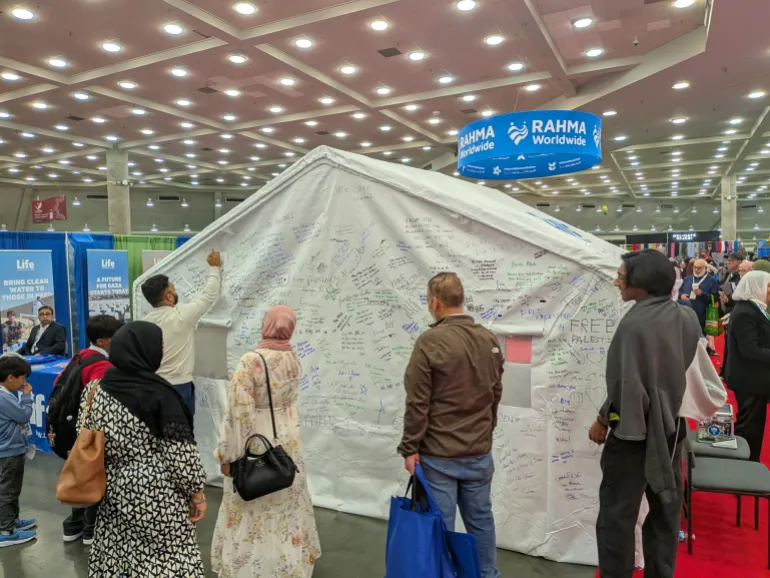
At a bazaar featuring dozens of vendors, conference-goers left messages of solidarity on a tent that will be sent to Gaza by the charity Life for Relief and Development (LIFE).

In speeches and on panels, advocates drew a link between anti-Muslim bigotry in the United States and Israel’s abuses in Gaza, the occupied West Bank and Lebanon.

Some of the loudest promoters of Islamophobia in the US are also staunch Israel supporters, among them right-wing commentator Laura Loomer and Congressman Randy Fine.

Both Loomer and Fine are allies of US President Donald Trump, whose administration has unleashed a crackdown to deport critics of Israel who live in the US but are not citizens.

Altaf Husain, a professor at the Howard University School of Social Work, said anti-Palestinian voices are trying to “scare” Muslims as a means of silencing criticism of Israel.

“They want to shut this down, so it’s a direct connection,” Husain told Al Jazeera.

He said the large turnout at the ICNA conference shows that the community is not intimidated and will not back down.

In the response to the shooting in San Diego, Husain pointed out that the community raised more than $3.5m for the victims’ families and moved to bolster security around Muslim institutions.

People sign tent
ICNA conference attendees on May 24 write messages of solidarity on a tent to be sent to Gaza [Ali Harb/Al Jazeera]

Layers of security

Saad Kazmi, the president of ICNA, said the organisation relied on three layers of protection to secure this weekend’s event: its own security guards, an outside firm and local law enforcement agencies in Baltimore.

While there is anxiety in the community over the rise of Islamophobia and Trump’s immigration crackdown, he said Muslim Americans must take matters into their own hands and work with “sensible” people across the political spectrum to defeat hate.

“We are very thankful that we live in a country that is ruled by the Constitution and law,” Kazmi told Al Jazeera.

Kazmi added that the shooting in San Diego only added to the community’s determination to assert and protect its rights. The Islamic centre in the city, he noted, did not shut down after the attack.

“If anything came out of this, it is that there are more attendees to the masjid, more people who believe that the way forward is to strengthen ourselves, strengthen our community and march on,” Kazmi said.

After the shooting, Loomer doubled down on her anti-Muslim rhetoric, calling on immigration authorities to target the Islamic Center of San Diego.

She also called for the deportation of all Muslims from the US, describing them as an “invasive species”. But few Republicans disavowed Loomer, who maintains close ties to the White House.

Rather, more than 60 Congress members have joined the Sharia-Free America Caucus since it was established in December. CAIR has designated the caucus a hate group.

At the state level, governors and local legislators have disparaged Islam while also pushing to penalise Palestinian rights activism.

Texas and Florida, for example, have labelled CAIR a “terrorist” group, while implementing measures against “Sharia law” that critics consider anti-Muslim dog whistles.

Rights under attack

In March, after CAIR sued Florida Governor Ron DeSantis over its “terrorist” designation, a federal court blocked the label from being imposed.

In his ruling, Judge Mark Walker wrote that DeSantis’s executive order (EO) targets the Muslim community as a whole.

“It should be lost on no one that Defendant’s EO targets one of America’s largest Muslim civil rights organizations for indirect suppression of speech. But, as we all know, it is easy for those in power to target minority groups with little pushback,” Walker wrote.

“Sadly, history teaches that it is often minority religious groups who find themselves in the crosshairs.”

On Saturday, several panels praised the US legal system and the laws that protect freedom of religion and speech. But the panellists argued that human rights do not defend themselves; people must step up to protect them.

“You’ve got to imagine rights are a territory, and you have to occupy that territory. If you do not actively occupy that territory, that territory will be taken from you. And that is exactly what has been happening,” Tom Facchine, an imam from New Jersey, said.

Last year, Palestinian immigrant Leqaa Kordia found her rights in jeopardy when immigration agents knocked on her door and detained her over her activism against Israel’s genocidal war in Gaza.

Kordia spent more than a year in Immigration and Customs Enforcement (ICE) detention before an immigration judge ordered her to be released in March.

But Kordia — who is still fighting deportation — told ICNA conference attendees on Saturday that she has no regrets, encouraging them to remain politically active and engaged.

“Speaking up, it comes with a cost … It cost me my health, my life, literally my freedom, and I’m living in uncertainty that tomorrow I’m going to be here, or I’m going to be deported,” she said.

“It comes with a cost, but it’s worth it. It’s worth it because silence, it costs even way more than speaking.”

Source link

What Eric Lauer is working on to turn things around with the Dodgers

Left-hander Eric Lauer strode up the bullpen mound at Petco Park as the Dodgers-Padres series finale Wednesday transitioned into the late innings.

He had been available to provide length as a reliever, but the plan had been for him to throw either way, he said.

The Dodgers didn’t end up needing him to cover innings, so he tossed a side session. And now Lauer has the weekend to address the mechanical issues that plagued his bumpy first six weeks of the season with the Toronto Blue Jays before making his Dodgers debut Tuesday as a starter against the Rockies at Dodger Stadium.

“It’s nice having a little change of scenery, because it gives me a nice full-blown reset,” Lauer said. “I can get my feet back under me, I can get out of my head a little bit more, understand what makes me good and what’s got me to this point, and run with that.”

Lauer, who landed on waivers at a convenient time for the Dodgers, is their immediate answer to a sudden rotation depth problem.

They don’t expect him to save the day in the absence of Blake Snell (elbow surgery to remove loose bodies) and Tyler Glasnow (back spasms). But the Dodgers saw an opportunity to fill a hole in their roster and ideally help him reverse his early-season regression.

“We’ve had our guys take a look and we’ll sit down and talk through some stuff, see how much we can do on the fly, how much of it is not just subconscious,” general manager Brandon Gomes said. “But we know the makeup is really good, and we’re looking forward to getting our hands on him and helping him be as successful as he’s been in the past.”

As long as Lauer gradually improves, his presence allows the Dodgers to keep their starters on a six- to seven-day rotation, without taxing their relievers with regular bullpen days, at least while they wait for other pitchers to return to health and/or build up their workloads.

Lauer’s only months removed from success. He owned a career-best 3.18 ERA last season and was even better in the postseason, authoring 5 ⅔ scoreless innings against the Dodgers in the World Series.

Dodgers reliever Will Klein, who threw opposite Lauer in the 18-inning Game 3 of the World Series, was one of the first people he met when he joined the team in San Diego.

“He introduced himself, and I was like, ‘All right, I know you, I remember you,’” Lauer said.

Coming off of winning the pennant, Lauer’s ERA ballooned this year to 6.96 ERA. In mid-April, the Blue Jays tried using an opener in front of Lauer when he faced the Diamondbacks. And his reaction made headlines.

“To be real blunt, I hate it,” he told reporters then. “I can’t stand it. But you work with what you got.”

This week, surrounded by different set of reporters in the visitors dugout at Petco Park earlier this week after joining the Dodgers, Lauer gave a knowing smile when the topic of usage with Toronto came up.

“There was no ill will there, there was no hurt feelings,” he said of his comments on openers. “It was a very simple question, I thought, how do you feel about an opener? I think if you ask most starters in the league, they would probably have the same response, that they don’t like it. But it doesn’t mean that I’m not willing to do it. It doesn’t mean that I’m not a team player.”

He said he cleared it up with Blue Jays pitching coach Pete Walker and manager John Schneider right away.

“I’m not going to have a problem if there is somebody in front of me,” he said. “It’s part of the game, it’s become part of the game. And we’re all here to win ballgames. It’s not about any individual player. So that was a lot more than I expected that to turn into.”

So far, Lauer has praised the Dodgers’ communication. And he’s been reunited with pitching coach Mark Prior, who was the Padres’ minor-league pitching coordinator when Lauer began his professional career in San Diego’s system.

When Lauer diagnoses his season, he sees two sets of issues working in concert.

“A couple things had compounded for me, and it was just kind of eating at me a little bit too much,” Lauer told The Times. “And I work with a mental skills coach and stuff, to where that shouldn’t happen. But I wasn’t mentally my best, which was making me not my best physically, which made me start to want to tinker.”

Lauer feels like he has a hold on the mental side. Now it’s working from the ground up to get his delivery back in sync. The goal, as Lauer explains it, is to find positions that create tension in his delivery, and pattern them until they feel like second nature.

Making mechanical adjustments during the season, however, tends to be two steps forward, one step back.

Lauer isn’t expected to have it all figured out for his start Tuesday. The Dodgers just want to see him compete with whatever he has that day.

“We compete, and then we go back to the process,” Lauer said. “…Then hopefully the process over time becomes more patterned, more grooved. And then it becomes less process, more just fine-tuning to compete.”

Source link

‘Rich House, Poor House gave me a life-changing opportunity but I had to turn it down’

The Rich House, Poor House mum had to turn down a job that would change her life

A single mum living on £98 a week was forced to turn down a life-changing opportunity.

Steph recently appeared on Rich House, Poor House and was offered a job but she had no choice but to refuse the offer due to a family issue and unable to take on the long commute.

Alongside her mother Gail and her daughters – 12-year-old Amelia and seven-year-old Darcey, they swapped lives with wealthy Mr Whippy owner Joe Sealey on the Channel 5 series and their worlds couldn’t be more different.

At the time, Joe traded his six-bedroom estate – complete with cinema room, gym and indoor pool – for seven days in Steph’s three bedroom council house with a damaged ground floor and mould spreading through Amelia’s room.

Despite working six days a week from home in telesales, Steph struggles to cover essential costs. Once fundamental household expenses are paid, they’re left with just £98 per week for all other needs.

At the end of the swap, she was given a life-changing opportunity as Joe offered her a position on his sales team with a starting salary of £60,000 a year.

However Steph has revealed that she’s had to make the heartbreaking decision and turn down the job offer after the office moved to a different location.

Giving viewers an update, she took to her TikTok and explained that the relocation means she would have had to do a four hour round commute, which she says wouldn’t work due to being a single mum and her mum’s health deteriorating.

She said: “In relation to the job, I agree with all of you that it’s an amazing opportunity. Sadly due to the main office relocation it would mean a four hour round trip commuting for me, to be able to go there and take that job offer up.”

During the swap, Steph had no choice but to send her mum home after she became too unwell to continue with the programme and it seems her health is still a concern for Steph.

Steph explained: “As you all know I’m a single mum, I’ve got two beautiful girls. My amazing mum, whose health is not great, it’s not massively improved since the show, so it’s not viable for me to be able to travel a four hour round trip.

“I need to be closer to my girls and my mum but again it was an amazing opportunity that was put forward. Sadly the location did change in between and it’s just not viable for me to do that

“But I just again wanted to say a huge thank you to Joe, my production team, Channel 5 and most importantly every single one of you. It’s not easy to put yourself out there.”

Following a successful business meeting on the show, Steth was promised £20,000 from the initial sales proceeds but unfortunately the sale still hasn’t gone thorough.

Steph added: “Since filming last year, Joe has been tirelessly working with Kaspas trying to get the deal across the line, that obviously you would have seen me go and do the sales pitch for. At the moment, that hasn’t been completed but I know Joe is still working in the background trying to get that over the line for us.”

You can stream Rich House, Poor Holiday on Channel 5

Source link