Turkish

‘We are here’: Kurdish club Amedspor shakes up Turkish football | Football

Ten years ago, as parts of Diyarbakir in southeast Turkiye were reduced to rubble in battles between the military and Kurdish fighters, the city’s main football club, Amedspor, became a target.

Diyarbakir is the biggest Kurdish-majority city in Turkiye, and Amedspor, then in the third tier, had become a standard bearer of Kurdish identity.

As fighting raged between the state and groups linked to the outlawed Kurdistan Workers’ Party (PKK), the club was hit with fines and bans on away supporters and outspoken players. Its premises were raided by antiterrorism police, and its fans, players and officials were attacked by rival supporters. In the years that followed, its survival looked uncertain.

A decade on, a peace process is under way between the government and the PKK, and Amedspor – in their first season in the top-flight after successive promotions – are second in the Super Lig after 10 games. A win at league leaders Galatasaray on Saturday would take them to the top.

“Amedspor have achieved a level of success that nobody expected,” said Vahap Coskun, an academic from Diyarbakir who has written a book about the club.

Coskun told Al Jazeera there are several factors behind the success this season; an experienced and canny coach in Besnik Hasi, and a mostly new squad of players performing above expectations, including the 24-year-old Nigerian striker Gift Orban, who has scored nine goals in 10 games so far.

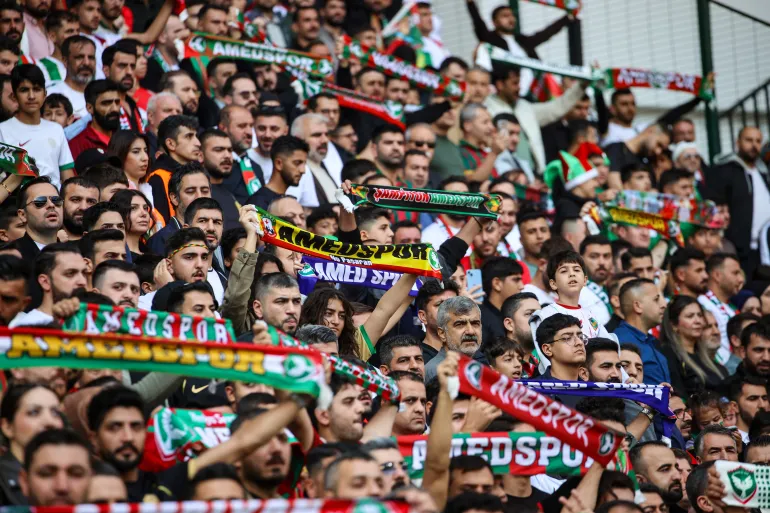
Then there are the passionate, sellout crowds of more than 30,000 that have helped the side win its six home games so far.

But he also said the “softening political climate” was key as it “affects everything from the treatment Amedspor receive in away matches to the refereeing, and it allows Amedspor to compete in fairer conditions”.

Reha Ruhavioglu, director of the Kurdish Studies Center (KSC) and a former member of the club’s advisory board, told Al Jazeera Amedspor’s matches have become a “weekly barometer” of whether Turkish society and state can accept the club as part of the country “with its own colours, culture, language and identity”.

Amedspor regularly attract attendances of more than 30,000
Amedspor regularly attract attendances of more than 30,000 [Omer Yasin Ergin/Anadolu Agency]

From obscurity to the Super Lig

Amedspor was formed as Melikahmet Turanspor in 1972 and later passed through various name changes and was taken over by Diyarbakir’s municipality in 1990. They spent much of their history toiling in the lower leagues.

The club gained promotion to the third tier for the first time in 2013, and the following year caused a stir after renaming themselves with the Kurdish word for Diyarbakir – “Amed” – and adopting the red, green and yellow of the Kurdish tricolour.

Expressions of Kurdish culture and language have long been suppressed in Turkiye, especially after the separatist PKK launched an armed uprising against the Turkish state in 1984. But the club were allowed to use the name Amed and their green and red colours at least, if not the full tricolour.

They were clearly on the up. In January 2015, they claimed a 2-0 victory away at Galatasaray in the Turkish Cup. In 2015-16, as conflict raged in Turkiye’s southeast, they reached the quarterfinals of the Turkish Cup, beating Super Lig sides Basaksehir and Bursaspor along the way.

In the following years, the club was bailed out by local businesses after its funding was cut by government appointees to the municipality. It continued to face significant hostility from rival fans, frequent punishment from the federation and verbal attacks from politicians.

But it was becoming increasingly popular among Kurds across the country, not only in Diyarbakir.

Research published by the KSC in March 2026 found that Amedspor’s support had quadrupled to four million among Kurdish adults in Turkiye over four years – even before the promotion to the Super Lig – and that the club had become the best supported among Kurds in the country.

Amedspor can leapfrog Galatasaray and go top of the league if they beat the Istanbul giants on Saturday
Amedspor can leapfrog Galatasaray and go top of the league if they beat the Istanbul giants on Saturday [Omer Yasin Ergin/Anadolu Agency]

Meanwhile, a new peace process between the state and the PKK had begun in late 2024, and in May 2025 the PKK formally announced its dissolution and the end of its armed struggle.

When Amedspor were promoted to the Super Lig in May, President Recep Tayyip Erdogan and his ultranationalist ally Devlet Bahceli congratulated the club. Erdogan later received Amedspor officials and players at the presidential palace along with those from other promoted clubs.

Bagis Erten, a sports journalist with Oksijen newspaper, said that now the political winds have shifted, the club is not being held back or excessively punished by footballing authorities.

“Especially when we talk about the football federation and referees, [Amedspor] were always treated very badly in previous years. Their penalties were not given, their red cards were not fair,” he told Al Jazeera.

“But now this system at least is not stopping them.”

‘Fragile progress’

At Amedspor’s Diyarbakir Stadium, the crowd in one stand calls out in Kurdish: “Ki ne em?” (Who are we?). Another stand thunders in response: “Kurd in em!” (We are Kurds!) At a recent game against Istanbul giants Besiktas, which Amedspor won 3-2, a tifo featured the words “EM HATIN” (We are here).

Turkish society is now encountering the Kurdish language and other expressions of Kurdish identity more regularly because of Amedspor’s promotion to the Super Lig.

There has been hostility shown by rival fans this season, with some provocatively displaying yellow body bags and images of F16s in reference to the darkest days of the conflict with the PKK.

But Ruhavioglu says that, despite incidents like this, the “barometer” is generally looking positive and that football can help to “normalise” Kurdish identity in Turkiye, as several teams and their fans have now visited the city without incident.

“When you see the bigger picture, it is going well,” he said.

Ruhavioglu says his centre’s research has also challenged some misconceptions around the club and its fans.

“Amedspor’s stands are really not homogenous,” he said, adding that while many fans support the left-wing, pro-Kurdish DEM Party, others are “close to other parties and ideologies. The Kurdish political movement is [generally] a secular movement, but many fans are praying in the stadium.”

And although the research found that a sense of Kurdishness and speaking Kurdish were strongly tied to fandom of Amedspor, he said the club should not be seen as “a national team for Kurds”, but rather more like “the representative of Kurdish identity” in Turkiye. Indeed, 61 percent of Kurds in the survey said they support the Turkish national team when it plays.

Unlike when the club was playing in the lower tiers, Amedspor now rarely features Kurdish or local players in the starting XI – it is mostly comprised of foreign players and some non-Kurdish Turks.

Coskun denied this undermines the club’s sense of Kurdishness.

“I think the fact that few of the players are Kurdish is not of vital importance to the fans, because it is the club that carries the identity, not the players,” he said. “Of course, fans would like to see many more Kurdish players in the team, but what matters most here is success.”

But Erten says the club may end up seeking to dilute its political identity to pursue footballing success or at least avoid trouble.

“Of course, it’s the symbol of Kurdish movement … [but] they are trying to convince Turkish society that it’s a good football project as well.”

Erten says attitudes towards Amedspor show how Turkiye’s state and society have become more tolerant of prominent expressions of Kurdishness on a national level, something that was unthinkable in previous decades.

“It’s progress, but it depends only on the approach of government,” he said. “It’s very fragile progress.”

Source link

Jailed PKK founder Ocalan moved to new section of Turkish island prison | Kurds News

Improving prison conditions for Abdullah Ocalan has been a key Kurdish demand in push to end PKK-Turkiye conflict.

Turkiye has moved the jailed founder of the Kurdistan Workers’ Party (PKK), Abdullah Ocalan, to a newly-built section of the island prison where he has been held for 27 years, pro-Kurdish legislators said as they urged Ankara to speed up the stalled peace process.

Mithat Sancar, a member of the Peoples’ Equality and Democracy Party (DEM) delegation that regularly visits Ocalan, confirmed the transfer on Saturday in an interview with the Kurdish television channel Medya Haber TV.

Recommended Stories

list of 3 itemsend of list

He said the move “necessitates an acceleration of the (peace) process”, which he said had been paused for two months. “The process cannot proceed with unilateral expectations and demands,” he said.

Fellow DEM politician Pervin Buldan said on Sunday that Ocalan himself had announced the transfer, but played down its significance.

“This new facility is part of the prison; it is not somewhere outside the prison,” she said, according to the AFP news agency. “The question of status cannot be defined solely by Mr Ocalan having moved to this location.”

Erbil-based broadcaster Kurdistan24 described the facility as a new house built for Ocalan on Imrali island. It said the move was seen as part of preparations to give him a more active role in the peace process. Better prison conditions for Ocalan have been a key Kurdish demand.

The PKK was founded in 1978 by Ocalan and others, initially fighting for an independent Kurdish state, before shifting its demands to autonomy and greater rights for Turkiye’s Kurds, who make up an estimated 15 to 20 percent of the population. The group launched an armed campaign against the Turkish state in 1984 and is designated a “terrorist” organisation by Turkiye, the United States and the European Union.

The conflict has killed more than 40,000 people. Ocalan has been held on Imrali, in the Sea of Marmara, since his capture in 1999.

In February last year, Ocalan called on the PKK to disband and disarm and the group announced its dissolution that May. Turkiye’s parliament adopted a law offering limited amnesty for PKK fighters in August and the PKK leadership has repeatedly demanded Ocalan’s release as part of the process.

Source link

The Turkish Soap Opera of Venezuela Business Dealings

Turhan Mildon appears to have leveraged is White House connections to retain his Venezuela ventures. (Venezuelanalysis)

In Venezuela, reality feels more and more like a puzzle. We have to look at what officials choose to say and not say, what is leaked, what remains behind the curtain, and try to weave a plausible narrative out of that.

The government’s opacity has become the norm. There are key decisions about the country’s future with little to no public explanation, contradictory statements, figures that are hard to believe or put into context. Affairs that should be debated and familiar to everyone are shrouded in uncertainty.

For years, the justification was that the US blockade forced everything to be kept secret, so that the enemy would not use that information to its advantage. Then, when corruption scandals broke out, we were told it was the price to pay for doing business under sanctions.

Fast forward to the present, and the blockade has given way to US neocolonial tutelage. But opacity has only gotten worse. Sometimes Trump officials are the ones explaining what happens in our country. The greatest example is the recent oil deal, but there is another sector plagued by these dark interests: the cement industry, which is especially important now amid the post-earthquake reconstruction needs.

A few days after the June 24 double earthquake, Acting President Delcy Rodríguez ordered an audit of Vencement, a company belonging to the Miller Holding conglomerate, whose CEO is Turkish businessman Turhan Mildon. In March 2025, the young entrepreneur reportedly received a concession to operate 10 cement plants owned by the Venezuelan state. The factories belong to the Socialist Cement Corporation, created by Chávez in 2009 after nationalizing the industry.

The concession to Mildon was greenlit by former Minister of Industry Alex Saab, who was surrendered to US agencies in May to face money laundering charges. In that case, we likewise did not have the privilege of an official explanation[a] for why a naturalized Venezuelan-Colombian dual citizen could be “deported” to the US, contrary to the constitution.

With the announced review of cement contracts, and in line with Washington’s directive of cutting out the insiders who had privileged treatment during the Maduro government, Rodríguez unilaterally canceled the concession, alleging non-fulfilment of investment targets.

This sector has been mired in controversy due to the shortages of cement and speculation with its prices. Though production costs for a 42-kilo cement bag are around $8, scarcity or hoarding often led to prices above $35. With the official investigation, there was an order to surveil the plants, block any removal of material, and restrict Vencement personnel from doing inventory or fulfilling existing orders.

But Vencement was not Mildon’s only venture in Venezuela. In November 2025, Saab intervened in the Lamar Group, a company from Zulia State that produced and exported shrimp, which was awarded to the Turkish businessman. The official explanation was that Lamar’s former owner, José Enrique Rincón, was involved in financing an alleged coup attempt against Maduro. In parallel, the government handed Café Madrid and Fama de América, two coffee producers nationalized around 15 years ago, to Mildon as well.

According to Forbes Turkey, Miller Holding and its affiliates, particularly in Venezuela and the Democratic Republic of the Congo, where Mildon also became extremely influential overnight, had $2.6 billion in profit in 2025. Nevertheless, because the companies are not publicly traded, it is hard to assess their true value. The business sector in Turkey is hardly a paragon of transparency either.

Mildon stated in the same interview that he felt “very sad” when US forces kidnapped Maduro in January, but added that he was not concerned about his businesses. “In my grandfather’s time, professional experience was key. Nowadays, it’s who you know,” the businessman said.

This prompts  multiple questions. How did Mildon get a concession for a sector as strategic as cement, not to mention his other endeavors? His representatives claimed that there were four other competitors, but government sources told the New York Times that the private businesses that receive state assets to operate under “strategic alliances” are handpicked.

Furthermore, Mildon claims Vencement is currently producing 4.5 million tons of cement per year, whereas the NYT reported that, according to data shared by government insiders, output is actually around a third of that. Maybe authorities would like to clarify?

Another obvious question is, why Mildon? Some mention his family’s ties to the Turkish government and President Recep Tayyip Erdoğan, with Mildon’s conglomerate receiving over a dozen important contracts in recent years. Amid US sanctions against Venezuela, risk-taking Turkish businessmen secured juicy opportunities in Venezuela. Others add that a separate advantage was Mildon getting access to inner circles thanks to his relationship with María Eugenia Ceballos, daughter of Chief Admiral and former Interior Minister Remigio Ceballos. Surely love cannot trump a fair bidding process, or can it?

It looks like it, because Mildon’s Turkish soap opera was not canceled with Maduro’s kidnapping and Saab’s handover. Mildon reportedly managed to preserve his assets in Venezuela after getting engaged and married to Alina Habba, a lawyer with close ties to Trump who worked in the Justice Department.

Habba, who also possesses quite the dubious CV for all the influence she wields, got the US president to pardon Venezuelan banker Julio Herrera Velutini, who had been charged with bribery and fraud before being convicted of a campaign finance violation misdemeanor. Habba received a $50 million contract, while still working in the Justice Department, from Concord Partners, a company created by the Herrera Velutini family in Florida. This honestly looks like Olympic-level competition for lack of transparency and shady deals.

But returning to Mildon and Habba, their lavish wedding at the Waldorf Astoria Hotel in New York featured senior Trump officials such as US Attorney General Todd Blanche, FBI Director Kash Patel, and White House attorney Will Scharf.

Apparently, Mildon’s new romance led Rodríguez to change course, declaring that the cancelation of the cement contracts had been a clerical error. On October 13, the Miller conglomerate issued a press statement clarifying that none of its agreements had been canceled.

Beyond the Turkish soap opera that has taken hold in Venezuela, we go back to the fundamental question: what conditions do private businesses need to clear before getting hold of strategic Venezuelan state companies? Who is following up on the investment, production, and fiscal commitments? What mechanisms ensure that these concessions will lead to any economic benefits apart from corporate profits? It seems like all these questions get trumped by contractors’ White House connections .

One of the characteristics of the Venezuelan political shift in recent months has been the sanctification  of private investment. Amid legislative reforms and commissions charged with determining which “non-strategic” assets should be privatized, key sectors such as electricity or the basic industries might soon be in the hands of multinational corporations.

I’m not a big believer in trickle-down economics, in this case that Venezuelans’ well-being will come once corporate profits are assured. But if on top of that, business is the outcome of the most vulgar influence trafficking, we are truly doomed. This soap opera needs a plot twist.

Jessica Dos Santos is a Venezuelan university professor, journalist and writer whose work has appeared in outlets such as RT, Épale CCS magazine and Investig’Action. She is the author of the book “Caracas en Alpargatas” (2018). She’s won the Aníbal Nazoa Journalism Prize in 2014 and received honorable mentions in the Simón Bolívar National Journalism prize in 2016 and 2018.

The views expressed in this article are the author’s own and do not necessarily reflect those of the Venezuelanalysis editorial staff.

Source link

Turkish FA bans 147 officials for breaching betting rules

Trabzonspor president Ertugrul Dogan has been named among 147 football club officials to receive 45-day bans from the Turkish Football Federation (TFF) for breaching betting rules.

In September, it was announced 448 people had been provisionally suspended and referred to the TFF’s professional football disciplinary board over allegations they had placed bets while in office.

Like players and coaches, match officials are forbidden from participating in betting activities by TFF regulations, as well as those of Fifa and Uefa.

The TFF said the people involved had held posts at clubs in the top two divisions in Turkish football over the previous five years.

Of those, some 147 were found to have breached betting rules and will be barred from carrying out duties within football during the suspension period.

There were insufficient grounds for disciplinary action in the other 301 cases.

The Turkish football authorities have clamped down on betting in the sport over the last year.

In November 2025, 149 referees and 1,204 players were given bans following a TFF investigation.

Source link