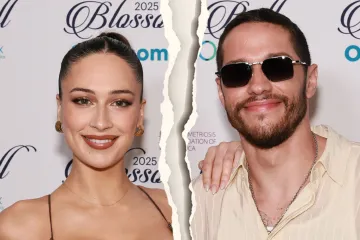
Pete Davidson’s tumultuous dating history
IT’S no secret that Pete Davidson has been quite the ladies’ man in recent years, as evidenced by his string of high-profile partners and Hollywood hookups.
The 32-year-old comedian’s love life often made headlines for its unconventional stories, including impulsive weeks-long engagements and explosive cheating allegations from his famous exes.
It was thought that the Saturday Night Live alum was settling down for good with his latest girlfriend, Elsie Hewitt, after she got pregnant with their first child.
However, things took a turn following the birth of their daughter, Scottie Rose, in December, and the pair parted ways, The U.S. Sun exclusively reported on Thursday.
Now that Pete is back on the market again, interest has piqued about his dating history and the A-listers with whom he’s been romantically linked.
Cazzie David was one of the first well-known names to have dated the comic, and their relationship perhaps had the most surprising ending.


Pete was romantically involved with the actress for two-and-a-half years from 2016 to 2018, but the decision to call it quits wasn’t exactly mutual.
Cazzie opened up about their split in her 2020 memoir, No One Asked for This, claiming that Pete’s mental health had taken a serious toll on her toward the end of their relationship.
Pete has been open about struggling with anxiety, depression, and borderline personality disorder.
She recalled eventually breaking things off after a long internal battle, but changed her mind days later and attempted to reconcile.
Most read in Entertainment
However, Pete said he was “the happiest he had ever been” and wanted to continue their time apart.
“This 180 wasn’t what I’d expected, but it wasn’t unfamiliar. I said okay, and that I loved him, tears streaming down my face, and he hung up quickly,” Cazzie wrote.
The screenwriter alleged that shortly after, she discovered on social media that Pete had covered up his tattoos dedicated to her.
She also spotted a startling image of Pete with his new girlfriend, pop star Ariana Grande.
Pete and Ariana had a whirlwind romance that neither Cazzie nor fans saw coming.
The couple began dating in May 2018 and fell head over heels for one another.
Their relationship blossomed so quickly that they got engaged just three weeks into dating.
However, just like Pete, Ariana was also freshly out of a relationship with her ex, Mac Miller, when they got together.
Ariana dated the rapper for two years before they split the same month she began her romance with Pete.
When Mac passed away in August of that year from an accidental drug overdose, Ariana’s heartbreak put a major strain on her and Pete’s relationship.
The duo eventually broke off their engagement in October after only five months.
This sparked the beginning of Pete’s long list of A-list partners, and more eyes were drawn to the Staten Island native.
In early 2019, the actor briefly dated Kate Beckinsale, who is 20 years his senior.
They were spotted getting cozy at a Golden Globes afterparty and at a New York Rangers game during their time together.
At the time, Kate told Extra that she was most attracted to Pete for his humor, saying, “Funny. I like funny.”
However, after four months of dating, they decided to part ways.
Sources told People that their long distance was the primary reason for their split, though they remained “friendly.”
Months later, The King of Staten Island star struck up a romance with model Kaia Gerber.
While also a brief relationship, the couple were pretty hot and heavy in the beginning, especially during their PDA-filled trip in Miami.
They dated from October 2019 to January 2020, when Kaia began to notice red flags about Pete’s mental state.
An insider told Page Six that Cindy Crawford’s daughter was “overwhelmed” by the relationship and by Pete’s concerning, “intense” behavior.
Multiple sources also claimed that Pete’s mental health and addiction struggles were too much for the young supermodel to handle.
Pete reportedly checked himself into a treatment program shortly after their breakup.
After taking some time away, he was soon back on the dating scene and sparked another unexpected romance with newly single Kim Kardashian.
Kim and Pete began dating in October 2021 after meeting on the set of SNL.
The beauty mogul was a guest star on the show and performed a memorable Aladdin skit with Pete, who was a cast member.
Their feelings intensified into a full-fledged romance, in which they regularly hung out with each other’s families, including Kim’s four children, whom she shares with her ex-husband, Kanye West.
Pete even got a tattoo commemorating their relationship, which read “My girl is a lawyer,” and a branding on his chest that read “KIM.”
Kanye, however, wasn’t thrilled about his ex’s new lover and went on numerous wild rants on social media slamming the Pete Davidson Show host.
Their romance didn’t last much longer, as Kim and Pete split in August 2022 after their relationship “ran its course,” sources told People.
A few months later, Pete fell into the arms of supermodel Emily Ratajkowski, who had recently separated from her husband Sebastian Bear McClard.
Rumors circulated in mid-November 2022 that the pair were an item after reports surfaced that they were in the “very early stages” of a relationship.
They confirmed the chatter later that month when they arrived arm in arm for a New York Knicks game.
Their romance was short-lived as they split in December 2022, around the same time that Pete began dating his Bodies, Bodies, Bodies co-star Chase Sui Wonders.
Pete and Chase met when they were shooting the film in August of that year, though things didn’t turn romantic until later.
The pair were seen at a New York Rangers game and shopping at a Whole Foods Market in Brooklyn in the first days of their relationship.
Although they initially denied their relationship, Chase was caught near Pete’s apartment, and the duo was seen enjoying a date night in New York City in January 2023, further fueling romance rumors.
Chase was also a passenger in the Mercedes that Pete crashed into a Beverly Hills mansion in March 2023, which earned the Bupkis star a reckless driving charge.
The couple eventually ended things in August 2023 after less than a year of dating.
Pete had a few other romantic flings over the last decade, including Carly Aquillino, Margaret Qualley, Phoebe Dynevor, and Madelyn Cline.
However, right now, his suspected closest connection is with his most recent ex-girlfriend, Elsie, with whom he’s navigating co-parenting their less than five-month-old daughter.
A source exclusively told The U.S. Sun that Pete’s hectic work schedule and constant traveling while Elsie was at home with their daughter led to their breakup.
Another insider said, “Finding the best co-parenting solution is their top priority.”
Last summer, The U.S. Sun exclusively revealed the former couple was experiencing challenges in their relationship while Elsie was in the early stages of her pregnancy.
A source claimed that their arguments were “out of control” and that the pair were “secretly recording one another.”
Pete and Elsie began dating in early 2025 and announced their pregnancy that July.
Both have yet to address their split.