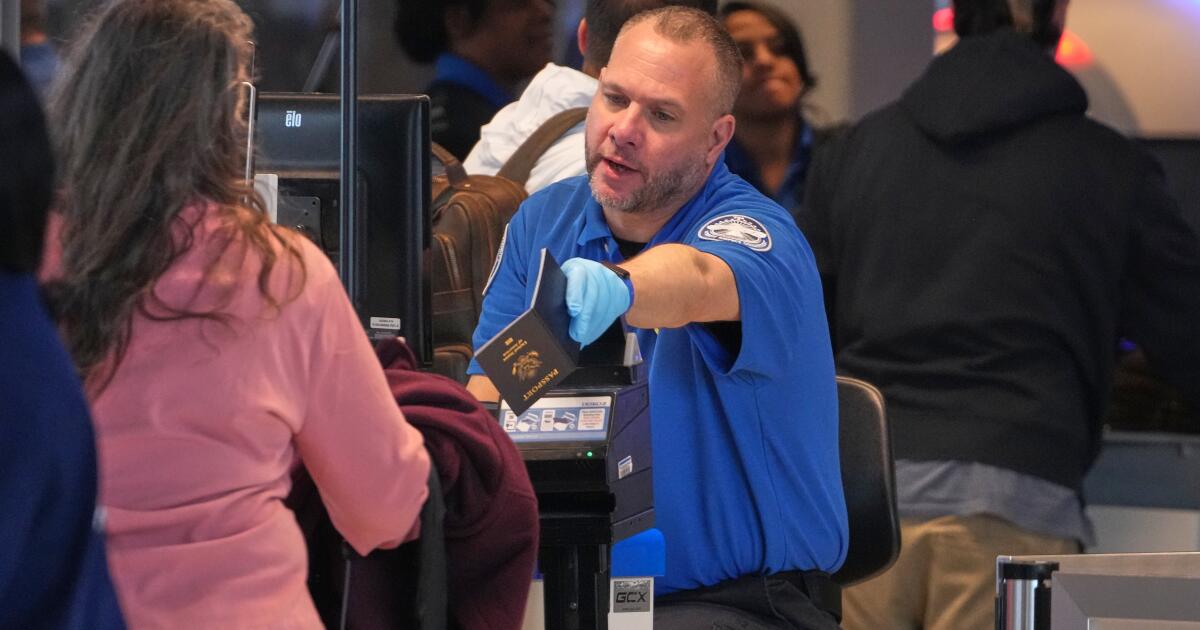
tsa officer

Some wait times at airport bottlenecks are easing with TSA paychecks promised

After weeks of chaos in U.S. airports, the Transportation Safety Administration said the first paychecks in weeks are being sent as early as Monday to its workers, giving the beleaguered aviation system a boost of optimism.

Wait times at some TSA security bottlenecks, such as the airport checkpoints in Atlanta and Houston, improved significantly Monday morning.

But how long it will take for long security lines to consistently return to normal — and how long federal immigration officers will stay in airports — remains unknown as the busy spring break travel season continues.

The DHS shutdown has resulted in not only travel delays but also warnings of airport closures as TSA workers missing paychecks stopped going to work. Those workers were just recovering financially since last fall’s extended government shutdown.

Wait times still pushed beyond two hours at New York’s LaGuardia Airport Monday morning. Baltimore-Washington International Airport had minimal wait-times Monday morning, but continued to advise travelers to arrive three hours before their scheduled departure.

President Trump on Friday ordered the Department of Homeland Security to pay TSA officers immediately to ease the lines plaguing airports. The move came after Trump rejected bipartisan congressional efforts to fund the TSA while negotiations continue with Democrats, who have refused to approve more funding without restraints on Trump’s immigration enforcement and mass deportation operations.

Democrats are demanding better identification for the officers, judicial warrants in some cases and for agents to refrain from conducting raids around schools, churches or other sensitive places. Republicans and the White House have been willing to negotiate on some points, but the sides have yet to reach a final agreement.

On Monday, there were few signs of progress on Capitol Hill, where the Senate held a short session without considering the House bill and resumed its two-week break. GOP Sen. John Hoeven of North Dakota said afterward that Senate Republicans are talking with Democrats and also the House as they try to find a way to funding DHS.

TSA employees had gone without pay since DHS funding lapsed in February. The department’s shutdown reached 44 days on Sunday, eclipsing the record 43-day shutdown last fall that affected all of the federal government.

The DHS shutdown has resulted in not only travel delays but also warnings of airport closures as TSA workers missing paychecks stopped going to work. Those workers had already endured the nation’s longest government shutdown last fall. Multiple airports experienced greater than 40% callout rates, and nearly 500 of the agency’s nearly 50,000 transportation security officers quit during the shutdown.

Trump deployed Immigration and Customs Enforcement agents to some airports a week ago to help with security as TSA callouts rose nationwide. How long they stay, White House border czar Tom Homan said, depends on how quickly TSA employees return to work. A TSA statement said the agency “has immediately begun the process of paying its workforce,” with paychecks arriving “as early as Monday.”

The overall absentee rate among TSA officers scheduled to work dipped slightly on Sunday, according to DHS. The highest were concentrated at major airports that have seen consistently elevated absences lately.

Those included BWI, both of Houston’s main airports; Louis Armstrong International Airport in New Orleans; Atlanta’s Hartsfield-Jackson International Airport; and John F. Kennedy International Airport in New York.

Funk and Seewer write for the Associated Press. AP reporters Rio Yamat in Las Vegas and Mary Clare Jalonick in Washington contributed to this report.

Source link

TSA officers share how they’re scraping by without pay

A woman in Indiana who put off dental surgery because she doesn’t know if she can afford the copay. A Florida couple with young children who are depleting their savings. A grandmother in Idaho who plans to sell her car to pay the rent.

They are among about 50,000 Transportation Security Administration officers expecting to receive another $0 paycheck this week. A dispute in Congress over funding the Department of Homeland Security has held up their salaries since mid-February. With monthly bills coming due, many of these federal employees, who screen passengers and luggage at airports across the U.S., are making difficult choices about how to make ends meet.

High absentee rates at some major airports have produced long lines and frustrated passengers at understaffed security checkpoints. Union leaders and federal officials say empty gas tanks, child care expenses and the threat of eviction keep more screeners from showing up the longer the shutdown continues. At last count, more than 455 had quit instead of weathering the ongoing uncertainty, according to DHS.

“Stop asking me about the long lines. Ask me if somebody’s gonna eat today,” Hydrick Thomas, president of the national American Federation of Government Employees union council that represents TSA employees, told reporters Tuesday.

Indiana TSA agent turns to food pantry for groceries

Before starting her shift at Indianapolis International Airport on Monday, Taylor Desert stopped at a food bank for meat, eggs, vegetables and dairy products.

“I never thought I would be in a position where, working for the federal government, I would need to go to a food bank to supplement my groceries,” she said as she loaded bags into her car.

Desert, who has been a TSA officer for seven years, said her last full paycheck came on Feb. 14, the day the shutdown started.

She had some savings to draw on despite a record 43-day shutdown last fall but put some personal plans on pause.

For example, Desert needs to get her wisdom teeth removed but says the TSA isn’t approving time off during the shutdown. She also worries about costs from the surgery not covered by insurance.

Wednesday was the 39th day of the DHS funding lapse. If it goes another 21 days, Desert said she would seek another job.

“I don’t want to have to spend my entire savings just to afford to keep living,” she said.

Florida TSA couple worry about their young children

Oksana Kelly, 38, and her husband, Deron, 37, both work as TSA agents at Orlando International Airport. They have two young children and don’t know how they will keep supporting their family without any income coming in.

Kelly said they’re dipping into savings for now, but it’s running dry. If the shutdown persists, they will ask relatives for help or take out a loan, which she worries would put them deeper in debt.

Her husband has worked as a DoorDash delivery driver in his spare time since the shutdown in October and November. He’s considered resigning from the TSA to put the couple on more stable financial footing.

“It’s very mentally exhausting,” said Kelly, who is an organizer for the labor union representing TSA workers across central and northern Florida. “How do we even decide between being able to feed our kids or come to work?”

Kelly said strangers might criticize the couple for “putting all eggs in one basket” since both choose to work for the TSA for the past decade.

“All we want is to pay our bills and get the pay we deserve,” she said.

A veteran officer in Idaho fears homelessness

Rebecca Wolf cries every day. She tries to hide it from her grandchildren, ages 11 and 6.

“They don’t understand why grandma’s crying,” Wolf said. “I try not to cry in front of them, but sometimes it’s just too much.”

The 53-year-old TSA officer and union leader in Boise, Idaho, joined the agency soon after its creation in the wake of the Sept. 11 attacks. She was homeless at the time but turned her situation around with steady work and the benefits of federal employment.

Now, Wolf can’t help but dwell on where she was 24 years ago. “I don’t want to be in that position again,” she said.

Her Feb. 28 paycheck amounted to $13.53, sending her “into a spiral right away.”

With no savings to fall back on, she is preparing to sell her car to cover her rent due in a week. She calls nonprofits daily seeking rental assistance, but hasn’t had any luck.

Supporting six family members — four children and two grandchildren — has always been challenging, but the repeated shutdowns have made it nearly unsustainable.

Wolf, who serves as president of AFGE TSA Local 1127, is hesitant to walk away from both the job that turned her life around and her role advocating for fellow officers.

“I worked hard to get to where I am now, and the thought I might lose it all scares me,” she said, her voice breaking as she tried to stifle the sound of weeping.

Massachusetts agent digs into savings to get by

Mike Gayzagian, a TSA officer at Boston’s Logan International Airport, says long stretches without pay have become enough of a “new normal” that he’s prepared for them.

The 56-year-old says he has a financial cushion of about six months to tap but that his situation is “an exception to the rule.”

“The majority live paycheck to paycheck and don’t have those kinds of reserves available,” said Gayzagian, who is president of his local TSA union chapter.

It shouldn’t be this way for federal workers, he said.

“The financial situation adds an additional burden to what is already a stressful job,” Gayzagian said. “I didn’t go into public service to make a lot of money. I went into public service because it has a certain stability and reliability and predictability that other jobs don’t have.”

A father in Utah leaves TSA

Robert Echeverria quit his job as a TSA agent at Utah’s Salt Lake City International Airport about two weeks into the current shutdown.

The 45-year-old, who has a wife and three children, counted five government shutdowns in the nine years he worked for the agency. The toughest was last year’s record shutdown that ended in mid-November around the start of the holiday season.

Echeverria said his family skipped Christmas and took months to recover financially. He began looking for a new job in February when it became clear Congress was headed for another budget battle.

“Emotionally I was already distraught,” Echeverria said last week. “We were barely recovering from the last shutdown.”

He now works for the department that manages the airports in Utah’s capital. Leaving federal service “was a hard decision for me,” Echeverria said.

“I really believed in the mission of the TSA,” he said. “We took an oath, and it was a way for me to give back to the country that gave me so much.”

He’s still based at Salt Lake City International, where his 20-year-old daughter works as a TSA agent, and says that seeing his former colleagues struggling is difficult.

“They all feel betrayed by their government because they’re showing up to work,” Echeverria said. “They’re there, but they feel that the government doesn’t care for them,” he said.

Marcelo, Lamy and Yamat write for the Associated Press. Marcelo reported from New York, Lamy reported from Indianapolis and Yamat reported from Las Vegas.

Source link