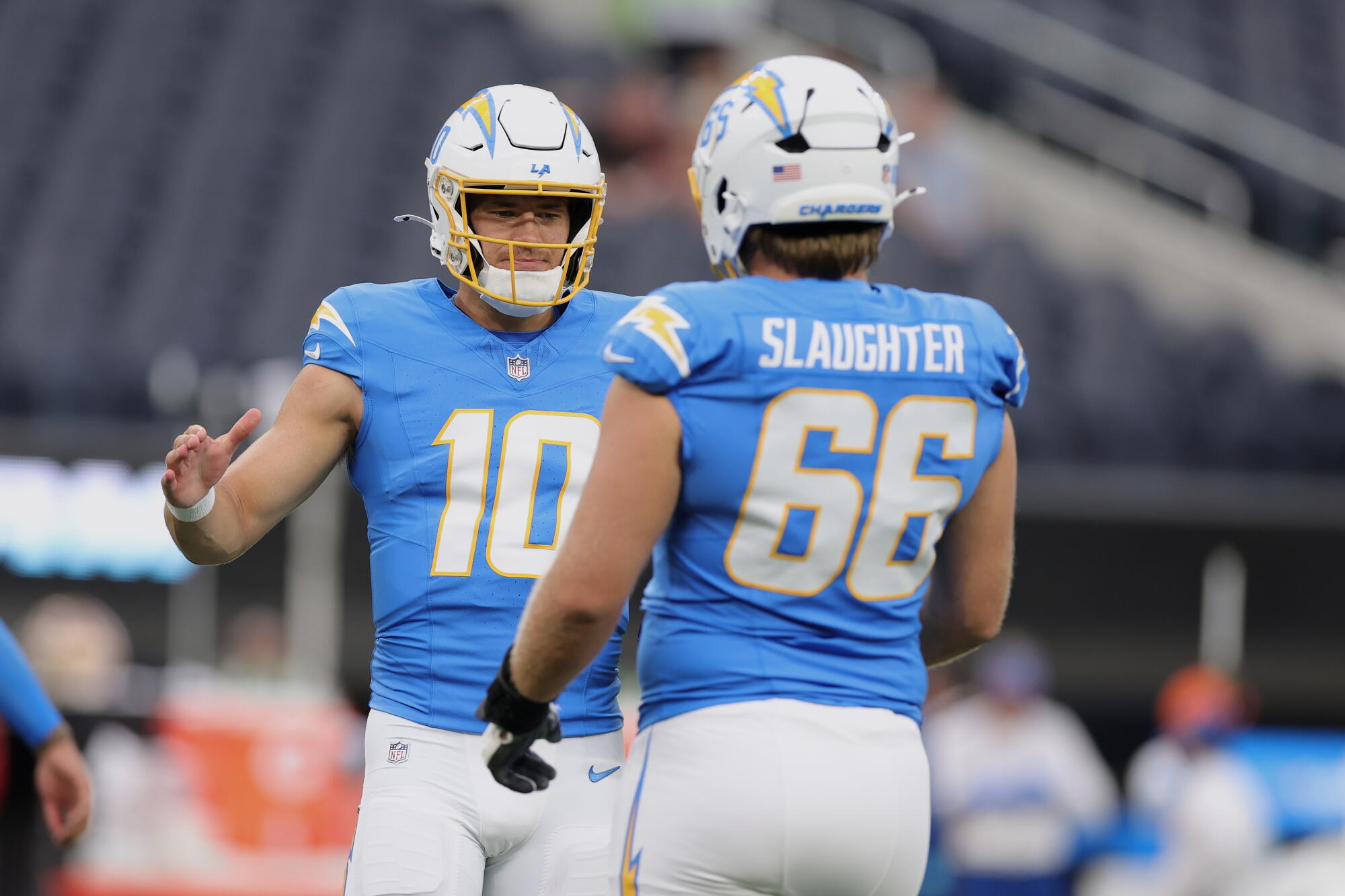
Jake Slaughter’s teammates could only laugh as the rookie center was swarmed by reporters asking him questions in the Chargers’ locker room.
“I don’t think he does too good with the cameras and stuff,” Isaiah World said as he recorded the spectacle with his phone. “He’s real old school.”
Whether he minds it or not, the precocious 23-year-old is living in the spotlight. Slaughter enters the Chargers’ season opener against the Arizona Cardinals as the starting center.
The second-round pick out of Florida took over the role after Tyler Biadasz, who signed a three-year deal with the Chargers last offseason, tore an anterior cruciate ligament in practice last month.
“Jake didn’t bat an eye,” offensive tackle Rashawn Slater said. “The way he’s built … he’s not going to hesitate.”
The 6-foot-4, 308-pound Slaughter, who started 33 games at center at Florida, is ready for his moment.
“You’re kind of foolish if you go into a football season not thinking you’re going to be the guy at some point,” Slaughter said. “You got to prepare like you’re going to play every snap of every series, every game … and that’s kind of been my approach since I’ve been here.”
At the time of Biadasz’s injury, Slaughter was a leading candidate in the team’s left guard competition. But the Chargers knew from the day they drafted him that he was fully capable of playing center if needed.
“Truthfully, I was like, dude, he’s going to be able to do either one,” general manager Joe Hortiz said.
Chargers defensive end Akheem Mesidor isn’t surprised by Slaughter’s seamless adjustment to center. The former edge rusher at the University of Miami remembers Slaughter’s time at Florida well.
“When we would scout him … it was always like … ‘I don’t like him,’” Mesidor said. “But then you get to meet him in person — he’s a great guy, bro. … Nothing like we portrayed him.”
Slaughter has shown the most important trait in new offensive coordinator Mike McDaniel’s system: conviction.
Grasping all of McDaniel’s concepts is no easy feat — even if they’re all Slaughter knows at the professional level. Yet the Chargers’ newest playcaller has been impressed with Slaughter’s comprehension and attention to detail.
“You can’t really compliment him. Not because he turns it down; he’s just not interested in hearing about his good play,” McDaniel said. “He wants to be corrected, and he wants to do the job right for the team. I feel like he’s wise … where he gets that regard, respect and trust of veterans — the end-all, be-all for rookies; he understands that.”
“You can tell he’s confident out there,” offensive tackle Joe Alt added. “We trust him. He trusts us.”
Chargers quarterback Justin Herbert built trust with Slaughter this preseason.
(Ryan Sun / Associated Press)
Slaughter also has built trust with the franchise’s most important player: Justin Herbert.
The Chargers need to do a better job of protecting the seventh-year quarterback — and Slaughter needs to play a key role in that effort.
“He’s been awesome,” Herbert said. “He’s done such a great job of picking up the offense and playing like a veteran out there. Great to have a guy like that. He’s playing a lot earlier than I think he would have thought, but that hasn’t slowed him down.”
Slaughter credits his teammates and coaches for getting him up to speed after he was thrown into the fire.
Wide receiver Ladd McConkey said the locker room has “bought into” the Chargers’ new starting center. Offensive lineman Trey Pipkins III, meanwhile, took his praise for Slaughter a step further.
“He might be one of the smartest rookies I’ve ever seen,” Pipkins said.
Slaughter, however, earned veteran approval long before any cameras were crammed in his face. Coach Jim Harbaugh insisted he knew Slaughter was a starting-caliber player in early August.
“You know when you see it,” Harbaugh said.
But before the rookie can lose himself in any pressure or nerves on Sunday, he’s simply happy for the opportunity.
“That’s an experience I hope I’ll never forget,” Slaughter said about his upcoming NFL debut. “Something I really never thought I’d get to do growing up. It’s a really unique honor, and I’m really thankful I can be out there and play ball.”
WASHINGTON — A former White House teleprompter operator accused of using inside knowledge to make bets on the prediction market Kalshi has been ordered to turn over more than $100,000 in profits and pay a $65,000 fine as part of a settlement with federal authorities.
The settlement with the Commodity Futures Trading Commission, announced Friday, also dealt Gabriel Perez a three-year trading ban. Perez was placed on unpaid leave from his job at the White House after reports emerged that he used his position to make bets on what President Trump would say in speeches.
The White House did not immediately comment on the settlement. A White House official said in July that Perez was no longer in his position but did not say if he had been fired or resigned.
The commission found that Perez made $107,500 on prediction markets by betting on words and phrases that would appear in Trump’s speeches between December 2025 and February 2026.
“In his position, Perez had access to presidential speeches prior to those speeches being delivered and Perez misappropriated that information — in breach of his duty of trust and confidence,” according to a release from the commission.
Perez was ordered to repay his profits in full, along with the $65,000 civil penalty, which the commission said was a reduction because of his “exemplary cooperation.”
As details emerged July 16, then White House press secretary Karoline Leavitt said it was “unfortunate” and “a disgrace.”
Provincial premiers have joined Canada’s Prime Minister Mark Carney, firing back after US President Donald Trump imposed 50% tariffs on about $20bn of Canadian goods. British Columbia Premier David Eby said Trump can’t be trusted.
Jerry Buss put together what was then thought to be a wild business deal to purchase the Lakers and related assets for $67.5 million in 1979.
Buss had a degree in chemistry, but his money came from real estate holdings and loans that moved between third parties to help him obtain the Lakers, Kings and the Forum from Jack Kent Cooke, who was going through a costly divorce.
Buss’ vision was to infuse Hollywood glamour into an NBA team few in Los Angeles seemed to care about, win championships and share that glory with his family.
Buss realized his Hollywood dream in more ways than he ever could have imagined, with his death in 2013 from complications from cancer touching off battles among his six children over control of the Lakers.
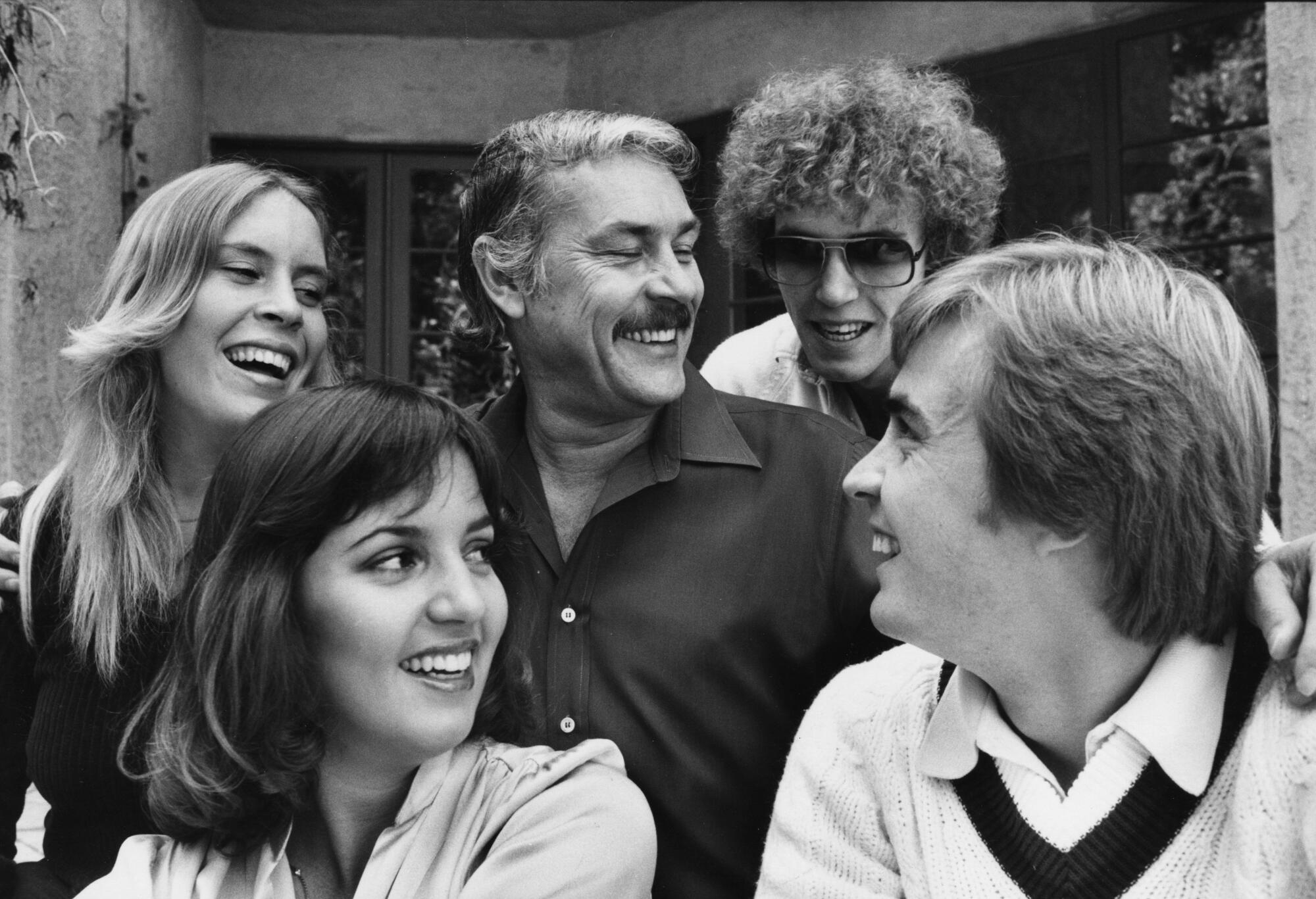
Lakers owner Jerry Buss, center, with children Janie, from left, Jeanie, Johnny and Jim in 1979.
(Gunther/mptvimages.com)
At least two siblings have tried to oust another from a leadership role. One sibling reportedly said two others never should have been born. And one sibling managed to fire the five others from jobs with the team.
The rifts mirror the HBO hit show “Succession.” Buss’ tenure and the family drama has been direct inspiration for two television shows and was chronicled in a docuseries the Lakers produced.
The latest daggers were delivered this week, with attorneys representing Buss’ daughter, Jeanie, admonishing her five siblings — Janie, Johnny, Jim, Joey and Jesse — for announcing the Buss Family Trust was selling its 17.8% ownership of the Lakers to new buyers Bob Iger and Joshua Kushner.
The sale would yield billions for the trust, with Iger and Kushner set to purchase the franchise at a $12.5-billion evaluation for the majority ownership stake of the team and a tagalong provision extending that price to the minority shareholders.
The Buss children are already billionaires following the sale of their majority stake to previous owner Mark Walter in 2025, but in addition to a big jump in share value, the minority stake sale would remove Jeanie from her coveted role as governor.
Neither side is giving up ground, suggesting lawsuits will soon be filed to resolve the family ownership dispute.
How did we get here?
The roots of the infighting date to the early days of Jerry Buss’ team ownership.
Buss focuses on building a family business
For the first 12 seasons Buss owned the team, the Lakers won NBA championships in 1980 and 1982 against the Philadelphia 76ers, 1985 and 1987 against the hated Boston Celtics, and 1988 against the Detroit Pistons.
Former player and shrewd executive Jerry West helped build the Lakers’ rosters, Pat Riley blossomed into an elite coach, and stars Magic Johnson and Kareem Abdul-Jabbar led a collection of elite playmakers during the Showtime era.
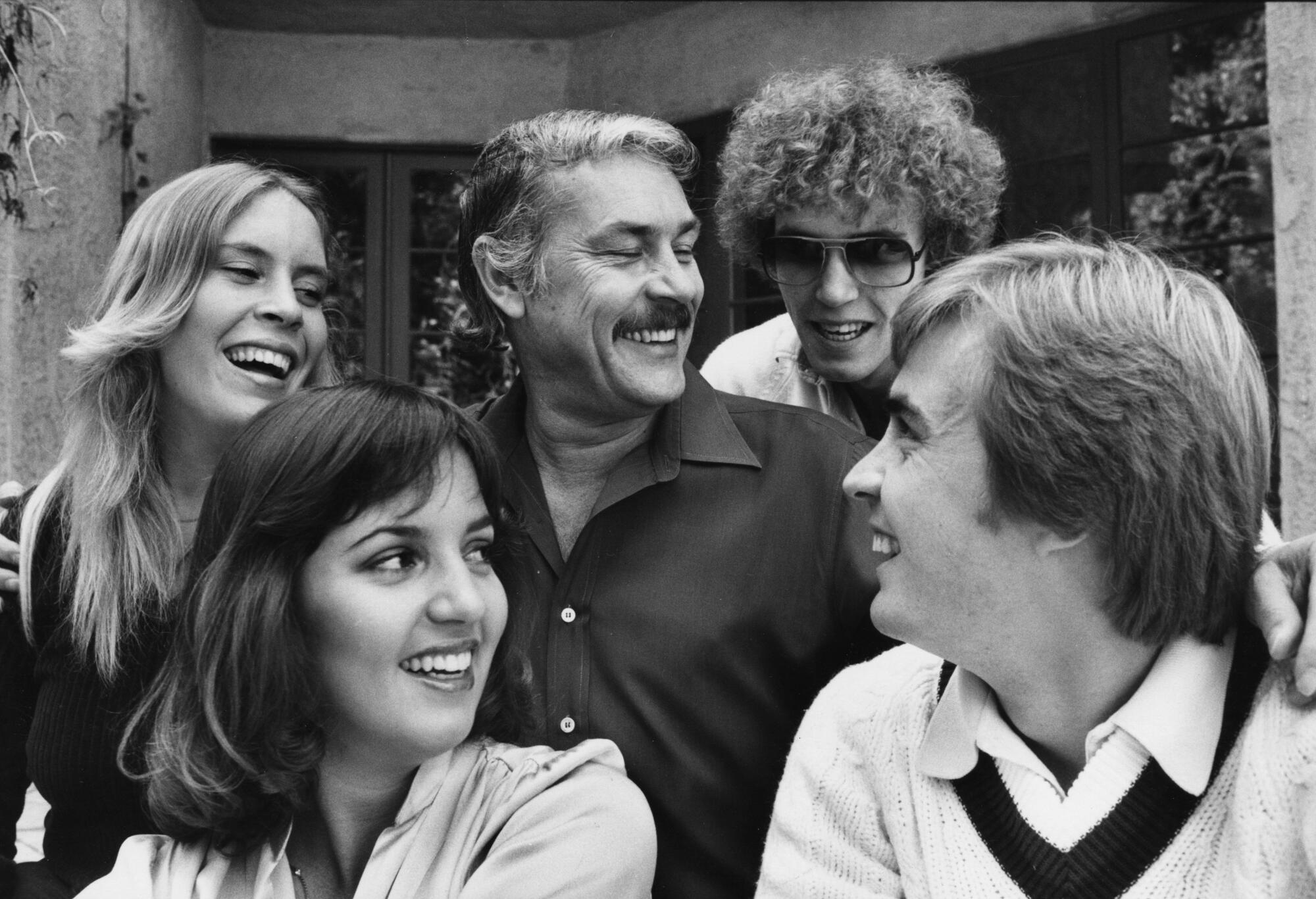
Jerry Buss, right, talks with his children Johnny, Jim, Jeanie and Janie in 1979.
(Gunther / mptvimages.com)
The Buss family came along for the ride, with each child working on some aspect of the family business. Jeanie notably helped organize events at the Forum and was eager to take on more challenges while honoring her father’s ambition. Her father put her in charge of the team’s indoor tennis franchise when she was only 19.
As Jerry aged and new stars emerged, including Kobe Bryant, Shaquille O’Neal and coach Phil Jackson, it was clear the next ownership chapter for the Lakers would be messy.
For one thing, Jerry had trouble letting go of what he built.
“I just can’t visualize myself walking away, relinquishing control,” Jerry told The Times in 2002. “My relationship with this team is a lifelong marriage.”
A clear successor emerges
By the time they reached their 40s, Jeanie took on a greater role on the business side, while Jim became a basketball executive.
Joey and Jesse, the youngest Buss children, learned about scouting and business operations.
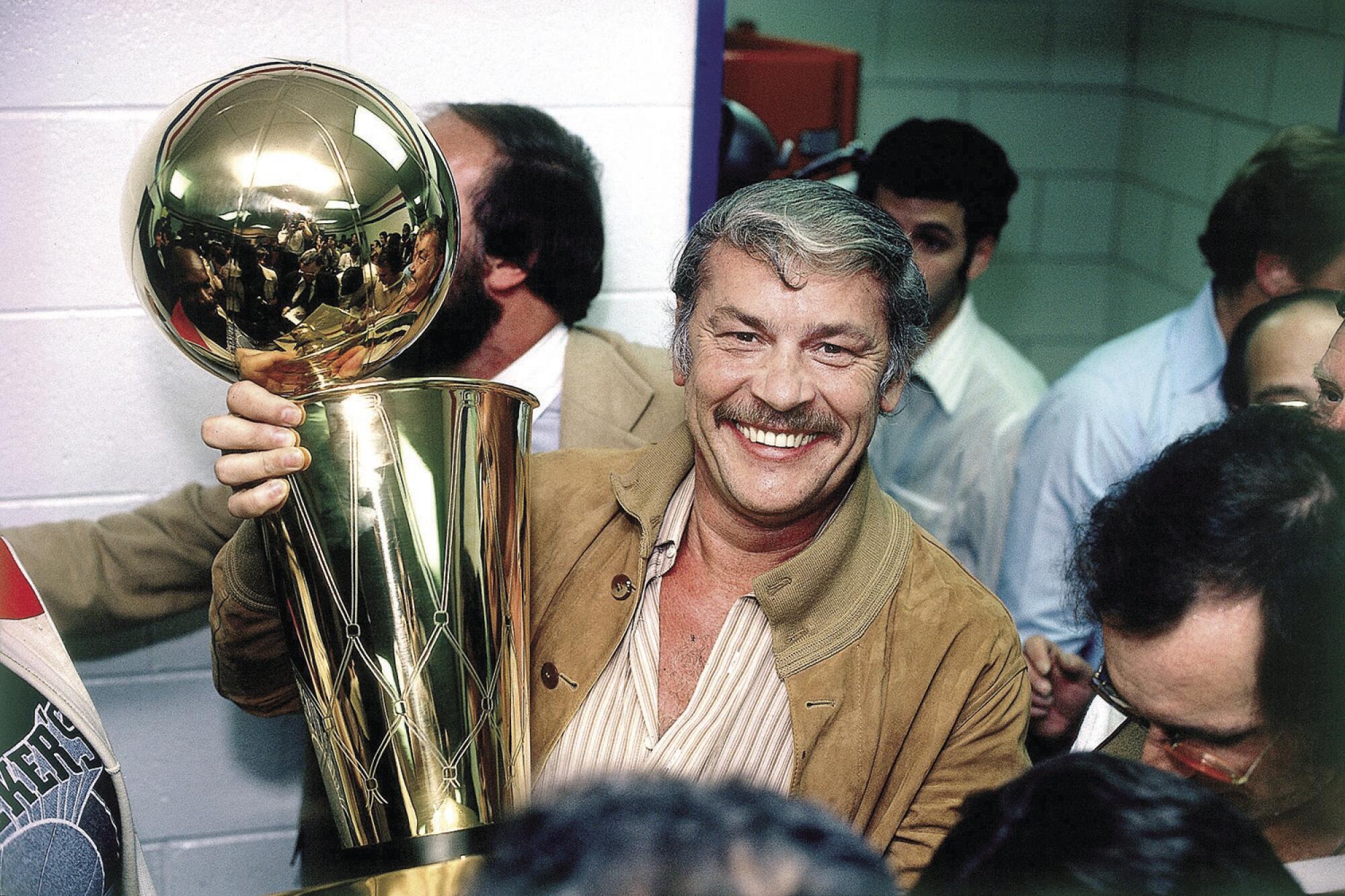
Lakers owner Jerry Buss poses with the NBA championship trophy in 1980.
(NBAE / Getty Images)
Jerry’s health challenges could not be denied and at age 69, he scaled back his involvement.
In 2002, Jeanie emerged as Jerry’s clear successor. At the time, her siblings did not seem interested in the role.
Her biggest challenges seemed to be getting the rest of the NBA to take her seriously after previously partying with her father’s girlfriends and posing nude for Playboy magazine. She told The Times she wished the media hadn’t focused as much on her past and stood by her work moving forward.
Soon after the Lakers hired Jackson in 1999, he asked Jeanie on a date. Their ensuing relationship added challenges to business operations, but The Times reported Jerry didn’t oppose it.
Lakers owner Jerry Buss and his daughter, Jeanie, pose for a photo at the Staples Center.
(Michael Kelley / For the Times)
Jeanie joined her father at NBA board of governors meetings for three years before being the Lakers’ sole representative at the gatherings that featured no other women. She handled an array of business challenges, big and small, and helped supervise the team’s move from the Forum to the Staples Center.
In 2002, all her siblings seemed content with Jeanie emerging as the face of the Lakers’ front office. They either were driven to make a name for themselves in other lines of business or had clearly carved out roles within the Lakers organization.
“My dad likes a system of checks and balances,” Jim told The Times. “Jeanie has more of the administrative part. We all have a good relationship. There’s no jealousy or envy. It’s very smooth.”
Buss family hits troubled waters
The smooth sailing didn’t last forever.
Jeanie helped her father navigate a series of difficult decisions. The Lakers agreed with Jackson to mutually part in 2004 amid a feud between Bryant and O’Neal, the first sign Jeanie was willing to part with someone she loved for the sake of the business. Jackson returned to coach the team in 2005 and held the role until his retirement in 2011, guiding the team to five titles.
In 2013, Jerry died and Bryant ruptured his left Achilles tendon. The Buss children reportedly decided against selling the team immediately after their father’s death, with Jeanie a clear vote against the move.
In 2014, coach Mike D’Antoni’s Lakers won 27 games. In 2015, the team won 21. In 2016, the team hit rock bottom with just 17 wins. Jeanie and Jackson broke up in 2016, ending their four-year engagement. She has since married comedian Jay Mohr.
Lakers star Kobe Bryant and Lakers governor Jeanie Buss stand beside each other on the basketball court.
(Wally Skalij / Los Angeles Times)
In 2017, the Lakers were headed to another losing season when Jeanie fired Jim, the president of basketball operations, and Mitch Kupchak, the team’s general manager. They were replaced by Rob Pelinka, Bryant’s former agent, and Johnson, the former Showtime star turned businessman.
Shortly after the firing, Jim and his brother, Johnny, tried to remove Jeanie from the team’s board of directors, sparking a legal feud that included Jeanie filing a restraining order while she wrestled control of the team.
“It wasn’t like we were trying to get rid of Jeanie as president of the Lakers,” Johnny said during a docuseries the team produced. “We wanted Jeanie to understand that Dad would not have wanted you to just take total control, hire and fire whoever you wanted, without the rest of us being involved.”
Jeanie countered her father created a trust that put her in control.
“They tried to disregard what their father wanted,” Jeanie said in the docuseries. “That’s a betrayal of all the hard work and what he did on our behalf to make this possible. I felt that there was this desire to remove me or stab me in the heart.”
A court ultimately delivered a ruling that Jeanie is still clinging to today as she hopes to retain the family’s minority ownership of the Lakers and her role as governor.
“The co-trustees are bound to vote the Los Angeles Lakers, Inc. shares to ensure that the minimum 15% ownership requirement is maintained in order to ensure that Jeanie Buss may remain controlling owner,” a letter written this week by Jeanie’s attorney reads, citing a 2017 court ruling outlining her role. “Any attempt by the co-trustees to do otherwise and any attempt to aid or abet the co-trustees as such would constitute a breach of trust, breach of fiduciary duty and be in contempt of court.”
The ruling stipulated that co-trustees “would take all actions reasonably available to them, including voting the trust’s shares to ensure that [Jeanie] is elected as the controlling owner of the Lakers on an annual basis during [her] lifetime.”
A title masks more drama
Soon after the ruling, Jeanie included younger brothers Joey and Jesse in the search for a coach to replace Luke Walton. Her siblings continued to hold roles within the team.
With Jeanie’s power firmly defined by the court, the Lakers signed LeBron James in 2018, traded for Anthony Davis in 2019 and won a title during a season shortened by COVID in 2020. It is the sole championship the team has won since Jerry’s death.
LeBron James hugs Lakers governor Jeanie Buss after winning the 2020 NBA championship.
(Douglas P. DeFelice / Getty Images)
The run to the latest title was far from smooth.
ESPN reported that when Jesse called Jeanie to ask a question about a remark Pelinka made during Davis’ introductory news conference in 2019, she told a story of a promise made between her father and mother that Jerry would never have any other children. Jeanie’s mother reportedly was heartbroken when Jerry and his then girlfriend had Joey and Jesse.
The siblings still somehow continued to work in various aspects of the Lakers’ operation.
Jeanie reportedly took intense criticism of the team during the last five years personally and Joey and Jesse wondered whether she might be open to selling the franchise. At the same time, value of NBA teams soared as more billionaires moved into the space. A sale would shift the siblings from millionaires who struggled to invest in growing the Lakers’ operations into billionaires.
A climate opposed to a sale
Jerry created a trust he hoped would prevent his children from feeling pressure to sell the team.
ESPN reported he prepaid inheritance taxes to prevent his children from having to do so upon his death and added provisions to the trust allowing siblings to buy each other out and forcing shares to be redistributed among the siblings when one died rather than passing them on to the next generation of their respective families.
Joey and Jesse began exploring small shares of the team and tried to get other family members on board, ESPN reported. They had not completed their work before Jeanie announced Walter’s offer. Four of the six siblings approved selling 50% of their shares to Walter for a figure that reportedly stunned all of them. Joey and Jesse learned the sale had been approved via a post on X by ESPN’s Shams Charania.
Janie told ESPN the Buss siblings were assured their roles with the team would not change for five years.
Walter’s purchase of the majority stake of the Lakers was approved by four of the six siblings in June 2025, with Jeanie endorsing the deal. She was assured she’d represent the Lakers on the NBA board of governors for at least the next five years.
On Nov. 20, three weeks after the NBA approved the sale to Walter, Jeanie fired Joey, Jesse, Jim, Johnny and Janie, who all worked for the team in various roles.
“I don’t think my dad would be happy with the way things just went down,” Janie told ESPN. “Not at all.”
While she disagreed with the way Jeanie handled the firings, her sister said in an interview with ESPN she didn’t think she meant to hurt her family.
“Jeanie doesn’t have a mean bone in her body, and so she just has to make these tough decisions,” Janie told the network. “And she’s been having to make them … I just wish she would’ve done it differently.”
Firing the last Buss family member
Last week, the family drama flared up again.
When Walter, who is facing multiple investigations into his business practices, reached a deal to sell his majority stake to Iger and Kushner, the family resumed conversations about completely cashing out of the Lakers.
Iger pledged to honor Walter’s agreement with Jeanie to remain as governor for at least five years and spoke highly of the Buss family in multiple interviews and statements released after the deal was announced.
Six days later, five of the siblings voted to approve the sale of their minority stake to Iger and Kushner, effectively firing Jeanie as governor.
Rob Pelinka, from left, Luka Doncic and Jeanie Buss pose for a photo in Katowice, Poland, on Aug. 27.
(Marcin Golba / Associated Press)
“We have decided as a family to sell the remaining Buss Family Trust shares to the Bob Iger group as part of the ongoing transaction,” the family’s statement to ESPN read. “We love the Lakers, Laker fans and will continue to support Los Angeles; but it is time to use this opportunity to move on and exit gracefully while we still can.”
Jeanie’s attorney has contested the sale, citing the 2017 court ruling. The attorney’s letter calls out two of Jeanie’s siblings for sending false information to ESPN: “This is just the latest instance of a years-long pattern whereby Joey and Jesse Buss leak false, defamatory and pernicious ‘information’ to Mr. Charania for the malicious purpose of doing harm to the Los Angeles Lakers so long as Dr. Buss’s chosen successor, Jeanie Buss, carries out her father’s wishes.”
Charania said he stands by his reporting.
The Buss Family Trust issued the following statement to The Times defending the five siblings’ right to sell the team:
“The Los Angeles Lakers have never been just a basketball team. They have been one of the greatest privileges of our lives. Our focus has always been on what we believe is best for the Lakers, the fans who have supported this franchise for generations and the greater Los Angeles community.
“Johnny, Jimmy, Janie, Joey and Jesse have made the decision to sell the family’s remaining stake, and we remain united in that decision. We intend to move forward thoughtfully, respectfully and through the appropriate process.
“We have tremendous respect for Bob Iger and Josh Kushner and believe they understand what the Lakers represent to Los Angeles and our incredibly loyal fan base. We are confident they will honor everything this franchise stands for while building upon the foundation our father created.”
It appears the Buss family will soon be headed back to court to decide their future as Lakers owners.