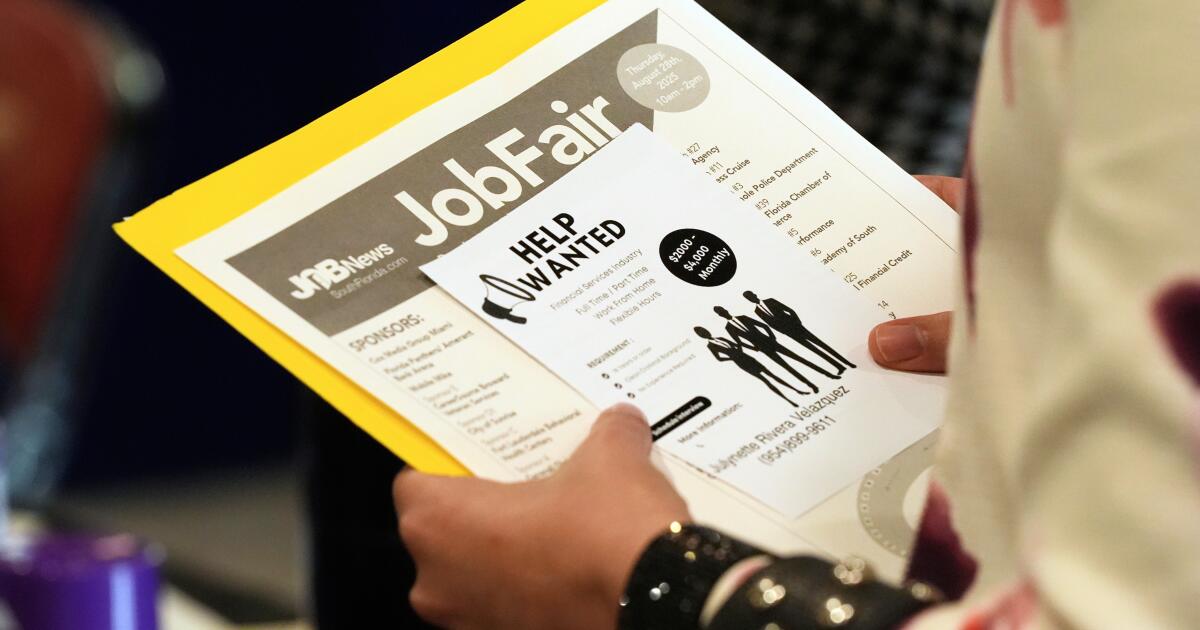
A look at how Trump-era work requirements could affect people who receive public benefits
The Trump administration made work requirements for low-income people receiving government assistance a priority in 2025.
The departments of Health and Human Services, Agriculture and Housing and Urban Development have worked to usher in stricter employment conditions to receive healthcare, food aid and rental assistance benefits funded by the federal government.
The idea is that public assistance discourages optimal participation in the labor market and that imposing work requirements not only leads to self-sufficiency, but also benefits the broader economy.
“It strengthens families and communities as it gives new life to start-ups and growing businesses,” the Cabinet secretaries wrote in a New York Times essay in May about work requirements.
Yet many economists say there is no clear evidence such mandates have that effect. There’s concern these new policies that make benefits contingent on work could ultimately come at a cost in other ways, from hindering existing employment to heavy administrative burdens or simply proving unpopular politically.
Here is a look at how work requirements could affect the millions of people who rely on the Supplemental Nutrition Assistance Program (SNAP), Medicaid and HUD-subsidized housing:
SNAP
What President Trumprefers to as his “Big Beautiful Bill” in July expanded the USDA’s work requirements policy for SNAP recipients who are able-bodied adults without dependents.
Previously, adults older than 54, as well as parents with children under age 18, at home were exempted from SNAP’s 80-hours monthly work requirement. Now, adults up to age 64 and parents of children between the age of 14 and 17 have to prove they’re working, volunteering or job training if they are on SNAP for more than three months.
The new law also cuts exemptions for people who are homeless, veterans and young people who have aged out of foster care. There are also significant restrictions on waivers for states and regions based on how high the local unemployment rates are.
The Pew Research Center, citing the most recent census survey data from 2023, notes 61% of adult SNAP recipients had not been employed that year, and that the national average benefit as of May was $188.45 per person or $350.89 per household.
Ismael Cid Martinez, an economist at the Economic Policy Institute, said the people who qualify for SNAP are likely working low-wage jobs that tend to be less stable because they are more tied to the nation’s macroeconomics. That means when the economy weakens, it’s the low-wage workers whose hours are cut and jobs are eliminated, which in turn heightens their need for government support. Restricting such benefits could threaten their ability to get back to work altogether, Martinez said.
“These are some of the matters that tie in together to explain the economy and [how] the labor market is connected to these benefits,” Martinez said. “None of us really show up into an economy on our own.”
Angela Rachidi, a researcher at the conservative think tank American Enterprise Institute, said she expects the poverty rate to decline as a result of the work requirements but even that wouldn’t ultimately affect the labor force.
“[E]ven if every nonworking SNAP adult subject to a work requirement started working, it would not impact the labor market much,” Rachidi said by email.
Medicaid
Trump’s big bill over the summer also created new requirements, starting in 2027, for low-income 19- to 64-year-olds enrolled in Medicaid through the Affordable Care Act’s Medicaid expansion or through a waiver program to complete 80 hours of work, job training, education or volunteering per month. There are several exemptions, including for those who are caregivers, have disabilities, have recently left prison or jail or are pregnant or postpartum.
The nonpartisan Congressional Budget Office has predicted that millions of people will lose healthcare because of the requirements.
Nationally, most people on Medicaid already work. The majority of experts on a Cornell Health Policy Center panel said that new national requirements won’t lead to large increases in employment rates among working adults on Medicaid, and that many working people would lose healthcare because of administrative difficulties proving they work.
Georgia is currently the only state with a Medicaid program that imposes work requirements, which Gov. Brian Kemp created instead of expanding Medicaid. The program, called Georgia Pathways, has come under fire for enrolling far fewer people than expected and creating large administrative costs.
Critics say many working people struggle to enroll and log their hours online, with some getting kicked out of coverage at times because of administrative errors.
And research released recently from the United Kingdom-based research group BMJ comparing Georgia with other states that did not expand Medicaid found Georgia Pathways did not increase employment during the first 15 months, nor did it improve access to Medicaid.
Kemp’s office blames high administrative costs and startup challenges on delays because of legal battles with former President Biden’s administration. A spokesperson said 19,383 Georgians have received coverage since the program began.
HUD
HUD in July also proposed a rule change that would allow public housing authorities across the country to institute work requirements, as well as time limits.
In a leaked draft of that rule change, HUD spells out how housing authorities can choose to opt in and voluntarily implement work requirements of up to 40 hours a week for people getting rental assistance, including adult tenants in public housing and Section 8 voucher-holders.
HUD also identified two states — Arkansas and Wisconsin — where it could trigger implementation based on existing state laws if and when the HUD rule change is approved. The proposal remains in regulatory review and would be subject to a public comment period.
HUD spokesman Matthew Maley declined to comment on the leaked documents, which broadly define the age of work-eligible people being up to age 61, with exemptions for people with disabilities and those who are in school or are pregnant. Primary caregivers of disabled people and children under 6 years old are also exempted.
HUD’s proposed rule change also notes that it is only defining the upper limits of the policy, allowing flexibility for local agencies to further define their individual programs with additional exemptions.
In a review of how housing authorities have tested work requirements over time, researchers at New York University found few successful examples, noting only one case where there were modest increases in employment — in Charlotte, N.C. — as compared to seven other regions where work requirements were changed or discontinued “because they were deemed punitive or hard to administer.”
Ho and Kramon write for the Associated Press.