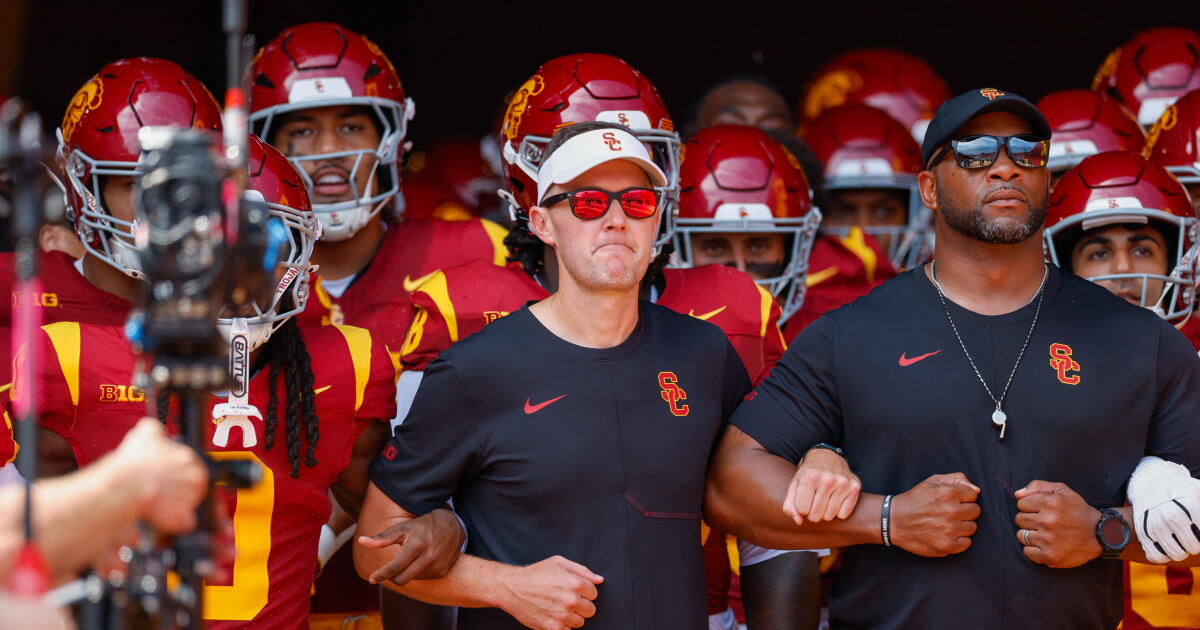
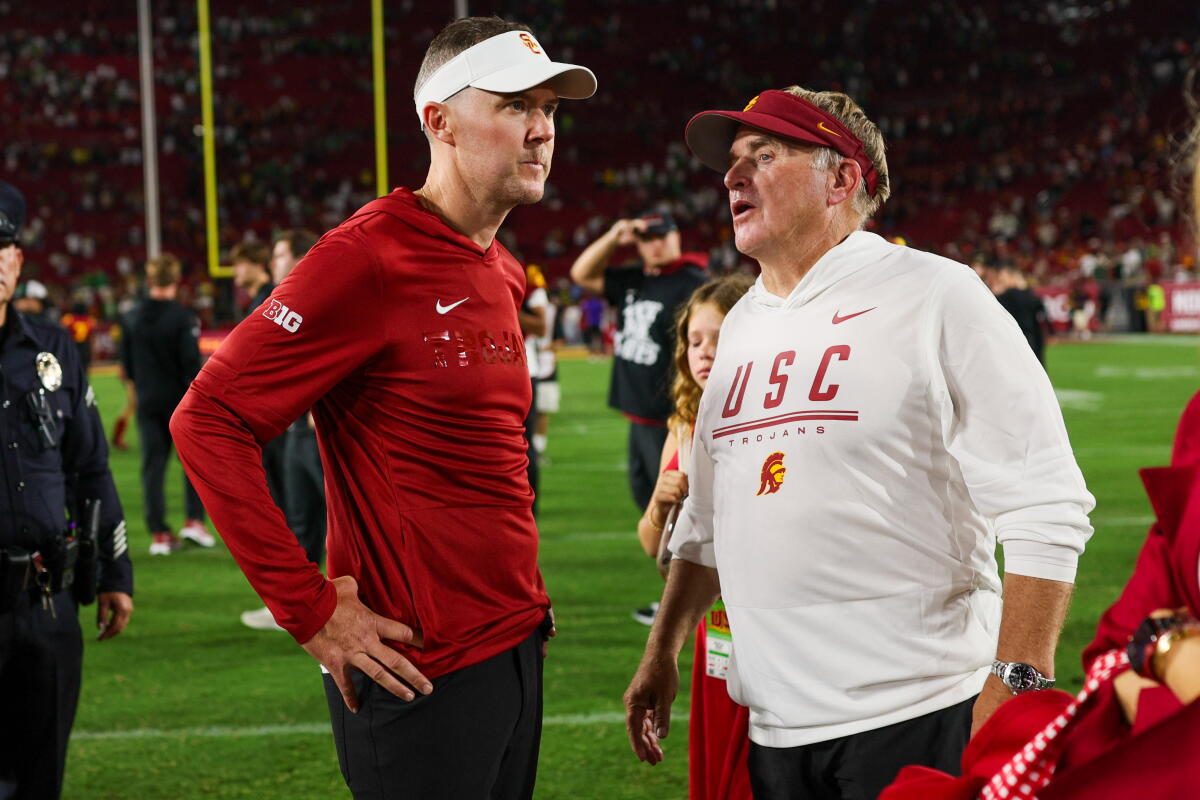
When NBC’s production team came to meet with Lincoln Riley, ahead of a broadcast earlier this month, the USC football coach greeted the group like old friends.
“Look,” Riley joked, “the Trojan Network is back.”
He certainly should be familiar with the group by now, given that this week’s matchup with No. 2 Ohio State marks the sixth time in nine games that USC will be featured on NBC. That’s already tied for the most any one network has aired a Big Ten team since 2024, when the conference expanded to 18 teams.
“We certainly feel like we’re the voice of the Trojans at the moment,” Noah Eagle, NBC’s lead play-by-play announcer, told The Times prior to USC’s loss to Wisconsin last week.
It’s certainly an ironic match, considering NBC’s longtime affiliation with the Trojans’ bitter rival, Notre Dame. But going all-in on the Cardinal and Gold wasn’t necessarily the network’s plan going into the season, according to Justin Byczek, NBC’s executive vice president of programming and rights management. It just worked out that way.
“It’s effectively a draft, and we’re trying to look at different weeks and prioritize,” Byczek said. “One of the first things that jumped out at us was how important that Oregon game is going to be. So that was something that we had in our back pocket going into the draft.”
When the three networks divided up the Big Ten’s TV games last spring, Byczek said NBC also zeroed in on that game, as well as USC’s matchups with Ohio State and Penn State, knowing both would fit well featured in prime time.
Just by virtue of its geography and its brand, USC makes for a natural fit in NBC’s prime time slot (7:30/4:30 p.m. ET/PT), similar to how FOX’s Big Noon Saturday regularly features Ohio State in its early window.
Those prime-time matchups featuring the Trojans, though, have lagged a bit behind other top teams from the Big Ten and SEC. USC’s matchup with Oregon drew the largest audience of its season to date, with 5 million viewers on NBC and Peacock. That’s the only time this season that a USC game has finished in the top five of the week’s most viewed games, according to Nielsen data.
That’s a conference-wide issue. The Big Ten has only had the week’s most-watched game twice this season, once on CBS (Ohio State-Iowa in Week 5) and another time on Fox (Ohio State-Indiana, Week 7). Otherwise, ABC has dominated, with upwards of 10 million tuning in most weeks to the network’s prime-time game.
So, in order to compete with ABC in prime time, NBC is betting on Lincoln Riley and the Trojans as its West Coast anchor.
“Because they’re intriguing — not only in Los Angeles, but nationally,” Eagle said. “College football fans want to see if they can get over the hump. Can Lincoln Riley get them there?”
That question will no doubt come up on the broadcast this week. And with three Big Ten games still left after that, you can bet it won’t be the last time we hear it asked on NBC.
As questions swirl this week about his future at USC and his potential fit elsewhere, Lincoln Riley didn’t mince words about where he wants to be coaching when asked Tuesday.
“I love it here,” the fifth-year coach said.
“Listen if I didn’t want to be at this place, I wouldn’t have come here in the first place. If I didn’t want to be at this place, I’ve had plenty of opportunities to leave. This is where I want to be. This is the right place for me. I’m the right person to be here. And that’s as honest and transparent as I can be with you guys.”
Whether Riley will actually have a say in that decision remains to be seen. After falling 24-7 to Wisconsin in one of the worst defeats of Riley’s tenure on Saturday, USC can’t afford another loss this season if it hopes to make the College Football Playoff for the first time.
Lincoln Riley says he’s “the right person to be [at USC].”
“Listen, if I didn’t want to be at this place, I wouldn’t have come here in the first place. If I didn’t want to be at this place, I’ve had plenty of opportunities to leave.
That was the bar all parties at USC appeared to agree on ahead of Riley’s fifth season with the program. The coach himself said in August that expectations should be “through the roof.”
“We do expect to make the playoff,” USC athletic director Jennifer Cohen said in May. “We do expect to have a championship run. We do expect to be competing for championships every single year. I think that’s what’s awesome about USC, is that that’s what we all expect of it.”
That looks unlikely now, with three of USC’s final four games coming against top-10 teams, beginning with No. 2 Ohio State on Saturday. It has led to speculation that USC is bound for a breakup with its football coach.
But when asked about Cohen on Tuesday, Riley heaped praise on the athletic director. He said they had “an incredible working relationship.”
“She’s a tremendous AD,” Riley said. “Even though she’s not the AD I came here with, and I’m not the head coach she hired, [we have a] fantastic relationship. She’s been a huge part of the progress that we’ve made and has been incredibly supportive.”
It’s unclear how long Riley will hold on to that support if USC’s season starts to slip away. A person familiar with discussions around the coach’s future told The Times after USC’s loss to Oregon that “all options are on the table” with Riley. The trajectory of the Trojans’ season has turned downward since.
That’s led to further speculation that Riley and USC could potentially agree to a mutual parting of ways after this season. And that Riley could land at a program like Baylor, which just fired its coach.
Riley still has six years remaining on his contract at USC, according to a person familiar with the deal, due to an automatic one-year extension he accrued after the Trojans earned a New Year’s Six bowl bid in 2022. Buying Riley out of his deal would mean forking over upwards of $70 million, plus more for his assistants.
If Riley were to find another landing spot, though, it would allow the Trojans to offset the otherwise astronomical cost of his departure.
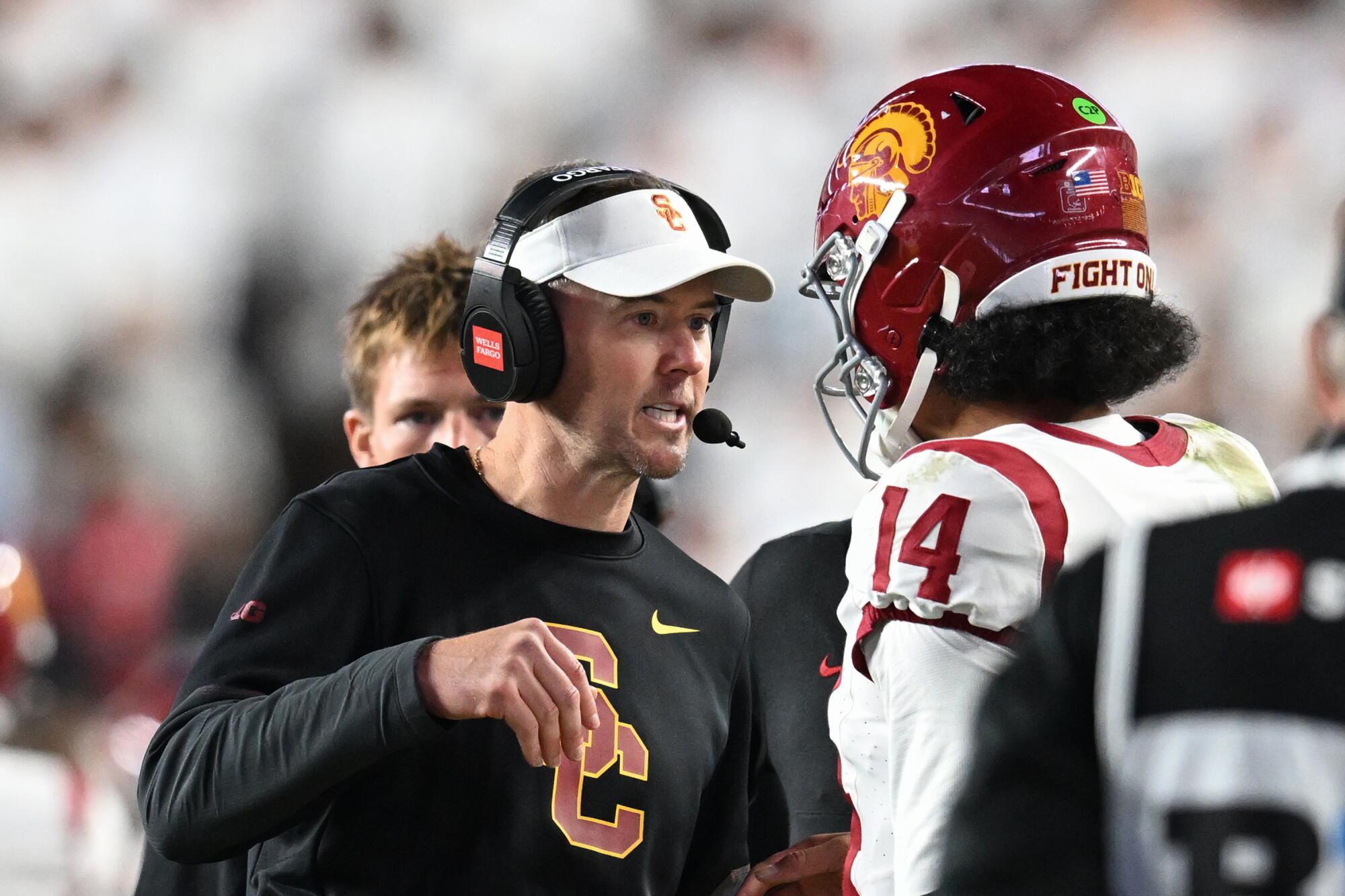
USC coach Lincoln Riley talks with quarterback Jayden Maiava during the team’s win at Penn Sate on Oct. 10.
(Barry Reeger / Associated Press)
Riley said Tuesday that was nowhere near his mind.
“Like I told you guys a lot of times, there’s not a lot of people in college football history that gave up what I gave up to come here,” Riley said. “I came here because this is where I want to be. I came here because I believe in this place. And none of that has changed whatsoever.”
The question is whether USC still believes in Riley.
Inside the locker room, at least, there seems to be no doubt whether Riley should be USC’s coach.
“I know he’s the right guy,” said left tackle Elijah Paige. “I believe there’s not a better leader in the country.”
“He’s the greatest coach I’ve been around,” added freshman wideout Trent Mosley. “We’re all right there with him.”
MADISON, Wis. — Just two short weeks ago, as the Trojans’ marching band roared joyously from the bowels of Beaver Stadium and a cold Pennsylvania rain poured down on a jubilant Lincoln Riley, it seemed like USC and its embattled coach might’ve finally found a foothold, just as they were about to begin a brutal back half of the schedule. They even had a bye to be sure it stuck.
But by Saturday night, any renewed sense of hope in USC’s season had all but slipped away. Maybe for good.
Instead, the Trojans played as poorly as they have all season in a 24-7 loss to Wisconsin. Quarterback Jayden Maiava looked lost. The offensive line was overwhelmed. The rushing attack was worse than nonexistent, with minus-17 yards. And the special teams were an all-too-familiar disaster, with two critical missed kicks.
For one half, it seemed USC’s defense might be the bright spot that kept the Trojans’ hopes alive. It allowed just 78 yards — and just three yards per play — from Wisconsin.
But as the other two phases descended into disaster for USC (6-2, 3-2), its defense could only hold for so long. Wisconsin only managed to rack up 200 total yards, only 58 of which came through the air.
All the Badgers would need in the second half to outlast the Trojans was two successful scoring drives. That was too much for one of the nation’s most high-powered offenses to overcome.
USC certainly didn’t live up to that reputation. Maiava was 31 of 50 for 258 yards, a touchdown and two interceptions. The Trojans’ leading rusher, freshman Shahn Alston, had 28 yards rushing, while their usual starter, King Miller, never found any room against Wisconsin (5-2, 3-1).
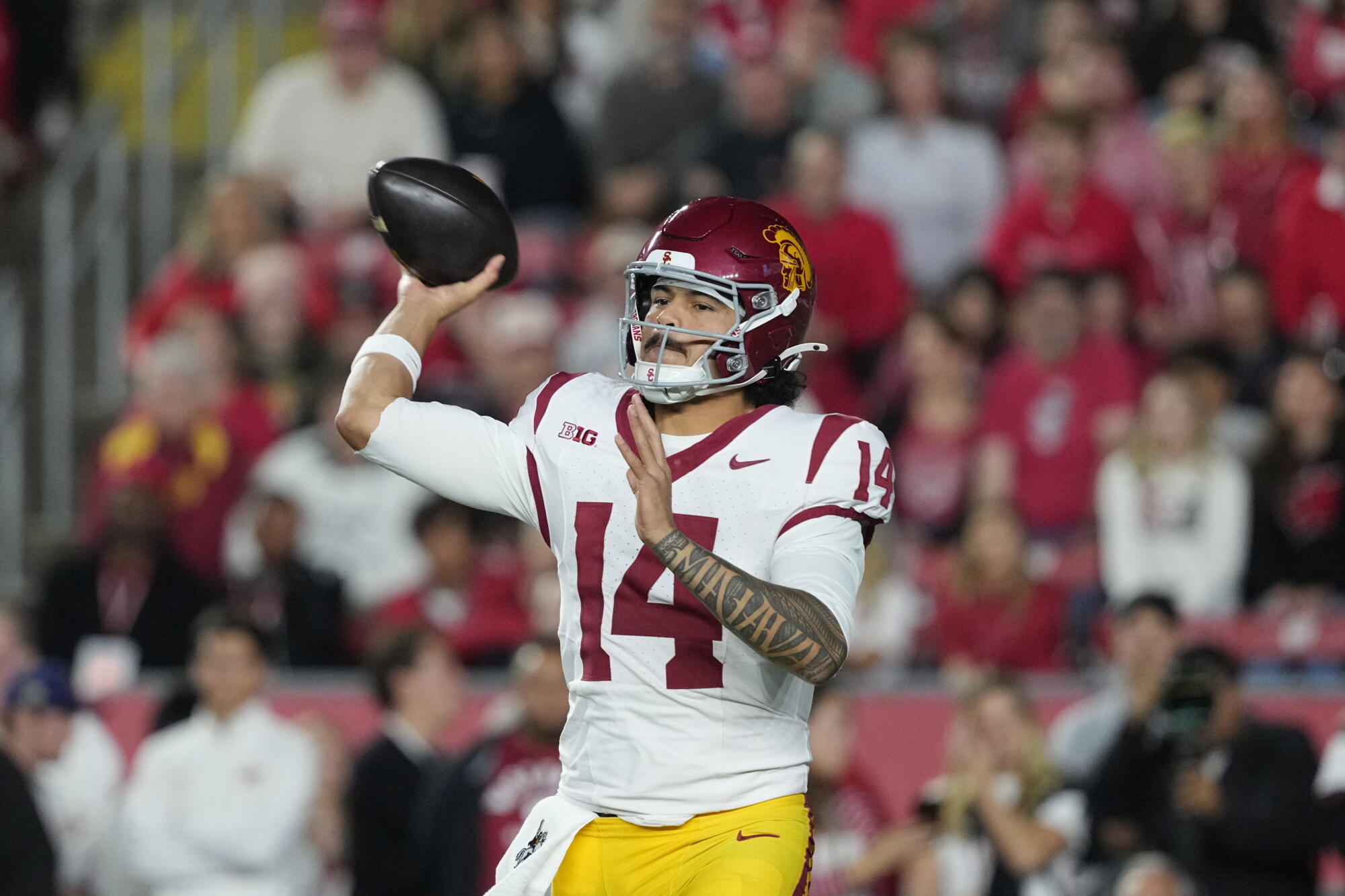
USC quarterback Jayden Maiava passes against Wisconsin on Oct. 24.
(Ross Harried / Associated Press)
That was after USC spent the bye week talking a big game about its renewed focus on the run game.
But nothing about the Trojans’ effort Saturday seemed at all focused.
It was USC’s defense that set the tone early, while its usually high-powered offense struggled to move the ball at all. Wisconsin tallied just eight total yards in the first quarter, as the Trojans swarmed the line of scrimmage and terrorized quarterback Colton Joseph in the pocket.
USC couldn’t do much better on that side of the ball. After an opening three and out, the Trojans were facing the prospect of another empty possession when Maiava threw it downfield on third and 10. But the pass into double coverage was tipped … directly into the arms of Wisconsin cornerback Bryce West.
West returned the interception to the red zone. But USC’s defense clamped down, and the Badgers only managed a field goal.
USC coach Lincoln Riley argues a call during the first half Saturday against Wisconsin.
(Matthew Holst / Getty Images)
Maiava gave it back on the ensuing drive. Under pressure on third down, the senior quarterback scrambled and then threw a late pass over the middle. It was picked off.
USC’s rushing attack wasn’t helping, either. The Trojans didn’t have a single yard on the ground through the first quarter and only managed 10 by halftime.
But the Trojans somehow cobbled together a touchdown drive in the second quarter, thanks to three Wisconsin penalties, all of which handed them first downs. The last of the three — a face mask on what would’ve been an incomplete pass to the end zone — gave USC new life at the one-yard line, and even still, it took the Trojans three plays to punch it in. Maiava eventually found tight end Taniela Tupou for the score.
That’s when the Trojans started to sputter on defense. After being unable to move the ball at all for most of the first half, Wisconsin drove the entire field for a score just before halftime. Then the Badgers marched down the field again and scored to open the third quarter.
Down 17-7, USC drove to Wisconsin’s 12-yard line. But under pressure on third down, Maiava threw it away and was called for intentional grounding. The Trojans tried a field goal, but it was blocked.
The missteps continued. Maiava was sacked again on USC’s next drive, once again pushing the Trojans out of field-goal range. Then, a delay of game pushed them back even farther.
Still, early in the fourth quarter, Riley sent out his kicker, Caden Chittenden, for a 58-yard field-goal attempt. A rain had started to fall over Camp Randall Stadium, eerily similar to State College two weeks earlier.
But Chittenden’s career-long attempt came up well short. And soon enough, USC would follow.
It was a potential nightmare scenario. Starting left tackle, Elijah Paige, had been scratched in pregame warm-ups at Penn State. And in his place stepped a true freshman in his first start at USC, forced to find his way in a White Out, surrounded by a hostile crowd of 114,000 strong.
But when Vlad Dyakonov learned he was stepping in, a couple of hours ahead of kickoff, his coaches were surprised by how little it seemed to faze him.
“Some of us [coaches] were like, ‘Does he realize what he’s getting himself into?’” coach Lincoln Riley said, with a grin. “He didn’t flinch, man.”
You could say the same, generally, about USC’s entire front through the first half of this season. After years of shallow depth, unfortunate injuries, and transfer misfires at the position, USC’s offensive line has been the stabilizing force propelling its high-powered attack to a 6-1 record.
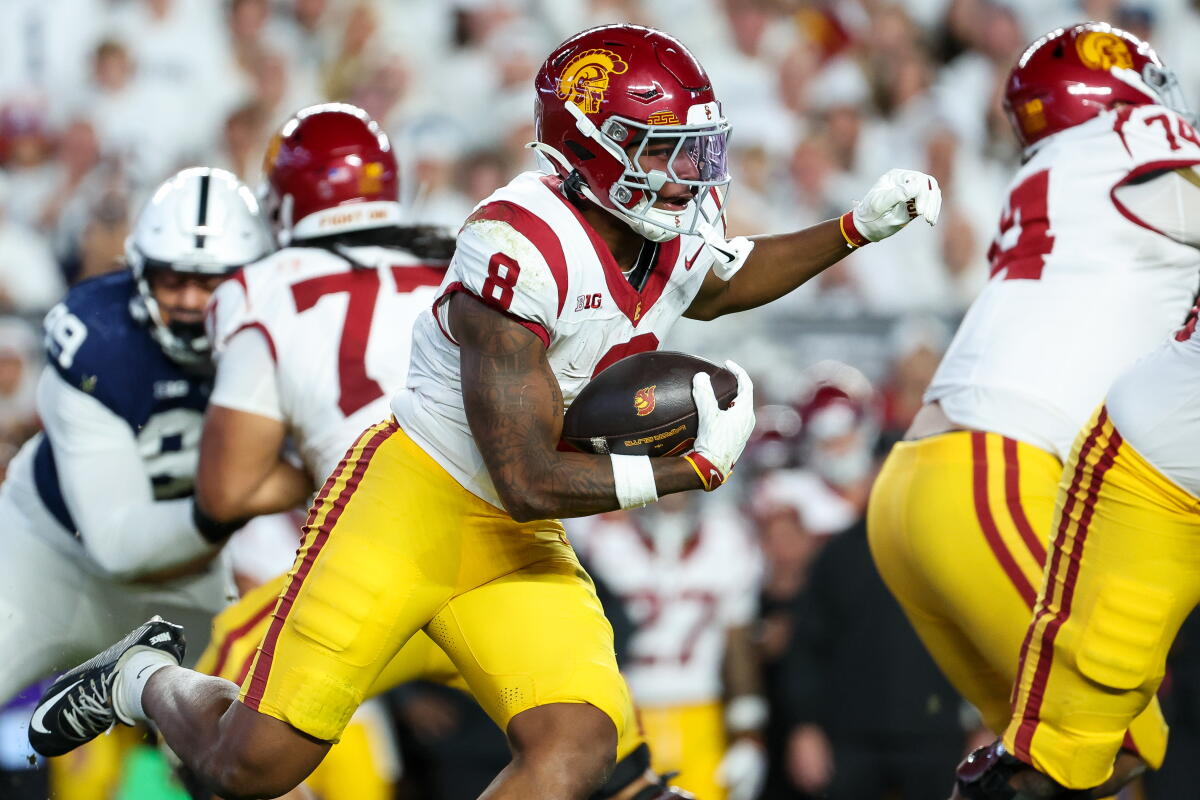
USC running back King Miller carries the ball as the offensive line blocks during a win at Penn State on Oct. 10.
(Isaiah Vazquez / Getty Images)
That’s a testament primarily to offensive line coach Zach Hanson, who, in his fifth season, has now fully rebuilt the room in his image.
“He’s a very steady guy,” Riley said of Hanson. “He’s not a guy who fluctuates a lot day to day, so our players kind of feed off of that. There’s a steadiness to our group.”
USC is also entering the brutal back half of its schedule with that group as healthy as it has been all season. As the Trojans take to the road Saturday looking to build momentum off the big win over Penn State and subsequent bye week, they’ll have all five starters available along the offensive line against Wisconsin. Paige is set to return, as is left guard Hayden Treter, who missed the last two games.
It comes at an ideal time, considering the pass rusher they’ll have to contend with Saturday. The Badgers have just eight sacks as a defense this season, but boast one of the best pass rushers in the Big Ten, senior Sebastian Cheeks. Cheeks leads the conference with 28 quarterback pressures.
Few teams, though, have been better than USC through seven games at protecting the quarterback. The Trojans’ starting offensive line has only given up one more combined pressure (29) than Cheeks has accumulated himself this season, while only allowing seven sacks in seven games.
“We’re a unit,” center Tobias Raymond said. “So everyone is feeding off each other.”
USC offensive lineman Elijah Paige blocks during a game against Oregon at the Coliseum on Sept. 26.
(Ben Liebenberg / Getty Images)
With Cheeks and a handful of other fearsome pass rushers approaching on USC’s upcoming Big Ten slate, right tackle Justin Tauanuu said the Trojans used the bye week to get back to the basics up front.
“Going against great players like that, you have to go back to fundamentals,” Tauanuu said. “Fundamentals will triumph over everything else.”
USC hasn’t looked like a line in need of much instruction this season. Jayden Maiava has faced pressure on just over 20% over his dropbacks, which ranks 10th among all quarterbacks nationally. It’s also a considerably lower rate of pressure than any USC quarterback has faced in recent years. The previous low, under Riley, was 30.5% with Miller Moss at quarterback in 2024.
Part of that success is Maiava’s penchant for getting rid of the ball quickly. But his protection has certainly been a critical aspect of his success this season. Because when pressure has managed to reach him, the USC senior has been much less effective as a passer. According to Pro Football Focus, Maiava has a completion rate of just 39% under pressure versus 79% when he has a clean pocket.
Blitzes also haven’t bothered USC’s passing attack much, either. Another product of the line’s impressive performance to date. Maiava has essentially had the same amount of time to throw when blitzed (2.7 seconds) versus when not blitzed (2.78 seconds).
Creating room in the run game has been a different story. USC has been considerably less effective on the ground this season than in recent years — a fact that Riley said was front of mind during the bye. The Trojans rank ninth in the Big Ten in rush yards per attempt (4.33) and 10th in rush plays of 20-plus yards (5).
“We definitely can run the ball better,” Riley said. “We’re gonna need to run the ball better. Good is not good enough for us.”
As a whole, though, it’s hard to imagine USC being in a better place up front this season. Especially considering where the position stood at the start of Riley’s tenure. The coach tried, at first, to build the room through the transfer portal and saw mixed results. After that, injuries ravaged an otherwise thin room.
But now the depth Hanson has built over the past few years is paying off. USC has already weathered injuries, including a season-ending injury to last year’s starting center, Kilian O’Connor. Meanwhile, several highly touted linemen are still currently buried on the depth chart, among them five-star freshman Keenyi Pepe, whose progression Riley said has been impressive.
“If you just kind of look at the makeup of it, we don’t have transfers,” Riley said. “We have a lot of guys who were kind of homegrown in this program. We have a good healthy young group. Zach has obviously had a big role in putting that whole group together.”
Asked what the return of star freshman wide receiver Trent Mosley brought to the USC offense, Trojans quarterback Jayden Maiava kept his answer simple.
“Score touchdowns,” Maiava said with a smile after practice Tuesday.
In a massive 31-23 road win over Penn State on Saturday, Mosley did just that and more, catching nine passes for 111 yards, including a 19-yard touchdown catch to end USC’s first drive and give his team an early lead.
Mosley was a game-time decision Saturday after he missed the Trojans’ last three games with an injury, including USC’s crushing loss to Oregon in late September.
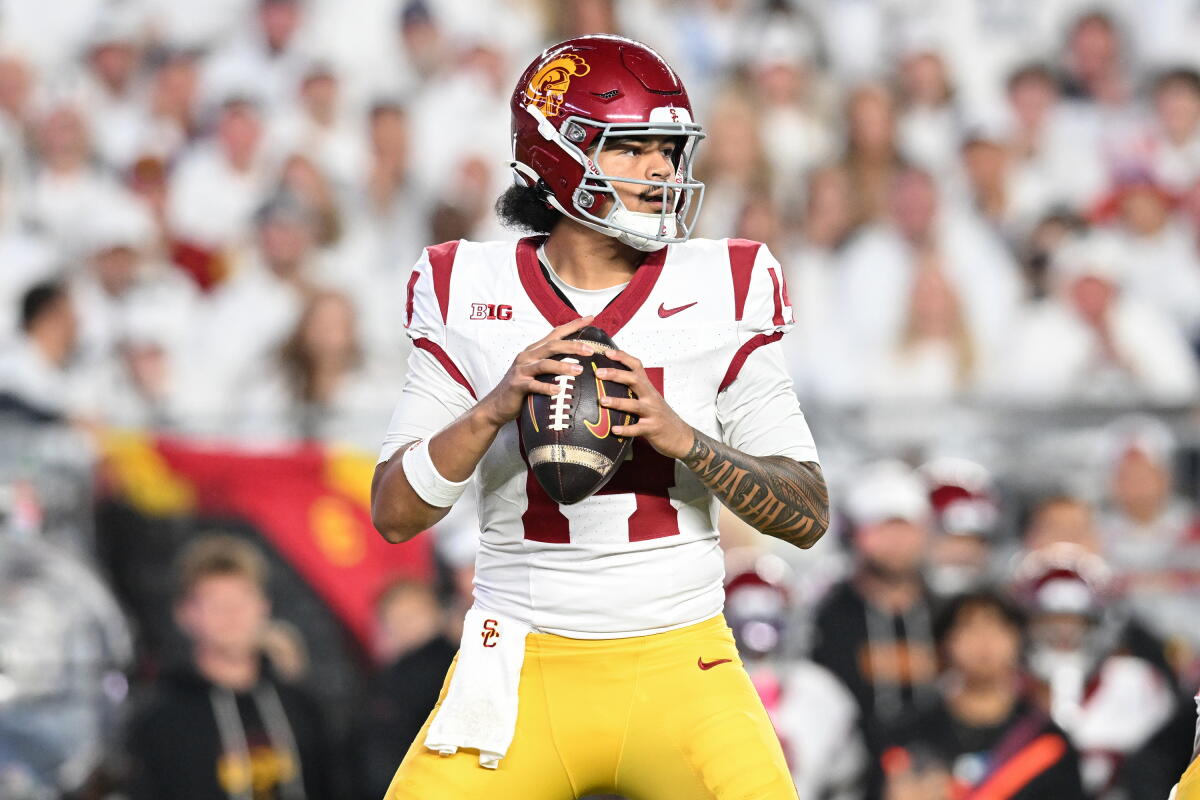
USC quarterback Jayden Maiava looks to throw a pass during a win over Penn State Saturday in State College, Penn.
(Barry Reeger / Associated Press)
For his performance against Penn State, Mosley earned Big Ten Freshman of the Week honors, becoming the fourth Trojan to win the award this season. It was far from his first strong performance for USC.
Mosley caught 13 passes for four touchdown and 255 yards in his first three college games and returned a punt for a touchdown. The only game Mosley has played for USC during which he didn’t earn at least 100 receiving was the Trojans’ win over Louisiana, during which he was injured.
“I’m just trying to do my part,” Mosley said Tuesday.
The freshman, who came to USC in the spring out of Santa Margarita High, rejoined the Trojans ahead of the Penn State game while the team faced a variety of injuries to other key players on both sides of the ball. Fellow freshman standout tight end Mark Bowman and left tackle Elijah Paige were among the Trojans to miss Saturday’s game with injuries, while defensive tackle Jide Abasiri was significantly limited.
“He’s one of our best players,” Trojans coach Lincoln Riley said of Mosley. “Getting him back has added a huge boost for us. He’s a tremendous playmaker. He’s tough to tackle after the catch. We trust him a lot.”
Now, the Trojans are in a bye week before they play at Wisconsin on Oct. 24. During the bye, the first of two for USC this season, Riley said he hopes to see his team get healthier.
Riley did not address the status of any individual players Tuesday besides saying that Bowman is “getting better,” Riley said he would not rule anyone out for the Wisconsin game. USC’s next Big Ten availability report will be released on Oct. 21.
“I’m hopeful, going into Wisconsin, that just from a whole we’ll be as healthy as we’ve been the whole year,” Riley said. “We haven’t been able to see this team quite at full strength yet from a health perspective. So, I’m kind of excited and interested to see what that would look like.”
Vlad Dyakonov bolsters Trojans
With various starters injured, younger players have filled the gaps for the Trojans.
On Saturday, freshman Vlad Dyakonov took center stage filling in for the injured Paige.
Riley on Tuesday praised Dyakonov’s performance and said the lineman didn’t know he was going to start his first college game until pregame warmups. Paige was moved to a game-time decision on USC’s final availability report two hours before the Penn State game after being listed as available the entire week beforehand.
“There’s some young people across the country that if you told them that and they were in that position in that atmosphere and environment, [they] … would be a little wide-eyed,” Riley said of Dyakonov’s debut in front of more than 114,000 fans during Penn State’s annual White Out Game. “Vlad wasn’t. Vlad was like jacked. He was ready to go.”
USC’s King Miller carries the ball during a win over Penn State Saturday in in State College, Penn.
(Isaiah Vazquez / Getty Images)
In an appearance on Trojans Live on Monday, Riley recalled Dyakonov boldly calling out 6-foot-5, 295-pound star defensive tackle Jahkeem Stewart in a one-on-one drill during practice and holding his own.
“I think we all knew, look, he’s not going to play perfect, but I think we all knew like he’s going to go compete his you-know-what off,” Riley said Tuesday. “Nobody doubted that because that’s what he does every day. He’s built a lot of trust in here.”
Maiava echoed Riley’s sentiment when asked about Dyakonov, praising his ability to fill in for Paige on short notice.
“What an unbelievable player,” Maiava said. “He never flinched when he went out there, and we didn’t either.”
Though Dyakonov has become known for his intensity, Trojans running back King Miller, who rushed for 102 yards and a touchdown on 19 carries Saturday behind an offensive line that included Dyakonov, said he also has a sense of humor. Asked what Dyakonov was like off the field, Miller’s first description was “hilarious.”
“It’s great to have a guy like him in this room,” Miller said.
The decision was so confounding, Penn State coach Matt Campbell burned the Nittany Lions’ final timeout with 4:15 remaining. Riley grinned with his team protecting a 31-23 lead in front of a rowdy crowd of more than 106,000 fans decked in all white at Beaver Stadium Saturday night.
USC punted after the timeout and Riley watched his maligned defense recover Penn State receiver Brett Eskildsen’s fumble on the Nittany Lions’ first snap of the ensuing drive.
With no timeouts remaining, Penn State had no room for error while trying to stop USC. The Trojans burned as much clock as they could and were again prepared to snap the ball on fourth down when the Penn State defense jumped offside, effectively sealing the Trojans’ win.
Riley has long been scrutinized for clock management and late-game decision making, but in one of the most hostile environments in the country, he helped the No. 19 Trojans work their way to a 31-23 win.
USC (6-1, 3-1 Big Ten) had the better record and national ranking, but Penn State (3-3, 0-3) was favored to win by 1½ points in a sign of the plunging confidence in Riley and his Trojans.
“We came in here against the odds,” Riley said during his postgame on-field interview with NBC. “Everybody in the country counted us out and said we weren’t going to win a tough road game.
“Trojans came [to] play. Great environment here. Tonight the white-out game went cardinal and gold.”
Quarterback Jayden Maiava, who had struggled at times the past few weeks, completed 21 of 33 passes for 301 yards, three touchdowns and no interceptions. He was sacked once.
Trent Mosley, who returned after missing the past two games with an injury, and Tanook Hines delivered a series of highlight catches to support Maiava. Mosley hauled in nine passes for 111 yards and a touchdown, while Hines added four catches for 82 yards and another touchdown.
King Miller ran for 102 yards in 19 carries and scored off a Maiava option pitch.
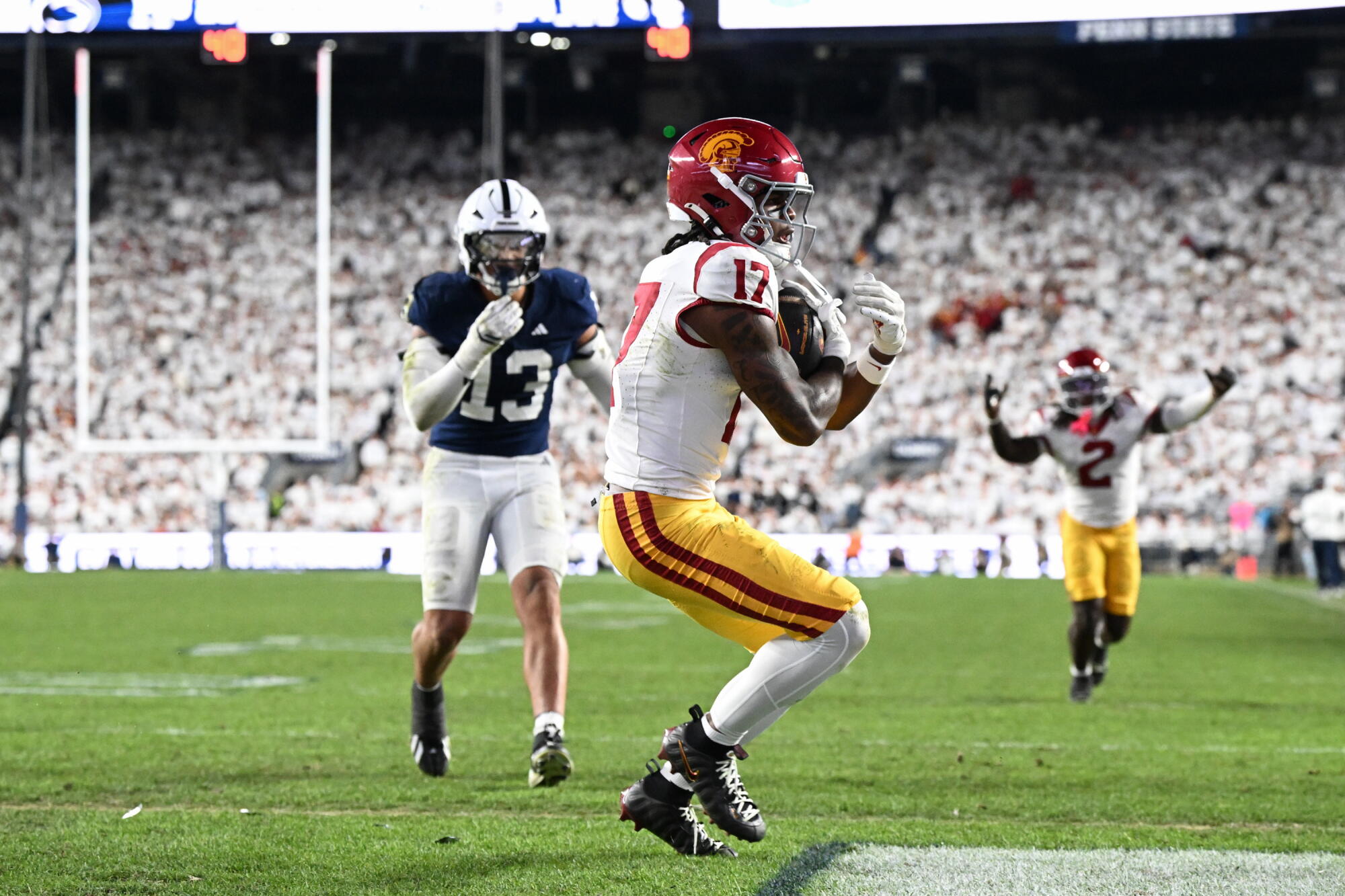
USC wide receiver Kayden Dixon-Wyatt catches a touchdown pass ahead of Penn State linebacker Tony Rojas during the second half of the Trojans’ 31-23 win Saturday.
(Barry Reeger / Associated Press)
The teams traded touchdowns and field goals early, entering halftime tied 17-17.
Riley made the curious decision to open the third quarter with an onside kick, but his defense limited Penn State to a field goal.
Miller ran for a 13-yard touchdown on USC’s next drive.
Penn State mounted a long drive that the Trojans’ defense again limited to a field goal, giving USC a 24-23 lead with 14:52 left in the fourth quarter.
Maiava then led a 10-play, 71-yard scoring drive. On the final snap of the drive, Maiava had time to sit in the pocket, scan the field and connect with Kayden Dixon-Wyatt for a 10-yard touchdown. USC hit the extra point and led 31-23 with 11:11 left in the fourth quarter.
USC’s defense forced a Penn State punt and Riley worked the clock to protect the win.
Desman Stephens II returned from his one-game suspension for his hit on Oregon quarterback Dante Moore and led the Trojans with nine tackles.
Freshman Luke Wafle delivered five tackles and one massively important sack of Penn State quarterback Rocco Becht for a loss of 10 yards with six minutes left in regulation.
It was raining in State College late in the fourth quarter. The Trojans’ defense danced on the sideline as the song “Umbrella” played in the stadium and the Trojans lingered on the field to soak up a big road victory.
USC quarterback Jayden Maiava has been playing above-average football, but the signal-caller’s deep throws have not been as sharp lately and he has shied away from some contact after taking a big hit to his shoulder during a 39-0 shutout of Fresno State on Sept. 4.
When asked about his quarterback on Tuesday, Trojans coach Lincoln Riley quickly replied that Maiava is not injured.
“Jayden has been pretty healthy,” Riley said. “They’ve kept him upright all season long.”
Maiava has adapted to shifting receiving options, calling it a learning experience as he connects with new pass catchers. USC freshman Trent Mosley was an early breakout star, but Maiava has had to look to others with Mosley out the past two games because of injury.
“I’ve been trusting myself, trusting the plan and trusting those guys on the perimeter,” Maiava said
He credits co-offensive coordinator Dennis Simmons for having his receivers ready whenever their names are called.
“It’s the next-man up mentality and we are all going to do the same thing,“ Maiava said.
A key building block
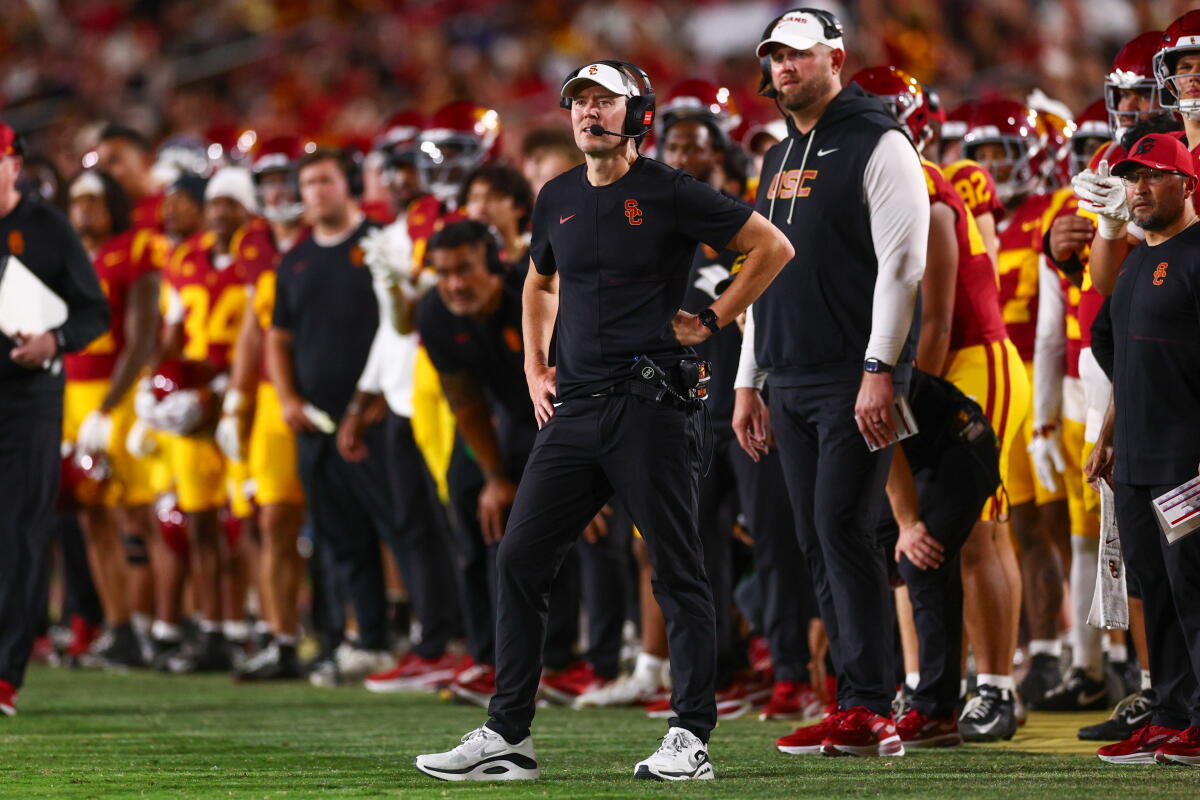
USC coach Lincoln Riley watches from the sideline during the fourth quarter of a win over Washington at the Coliseum on Oct. 3.
(Ronaldo Bolaños / Los Angeles Times)
As USC chases the program’s first win over Penn State in Happy Valley, Riley said he expects the Trojans to draw on the resilience they showed against Washington.
He called the rally for a victory over the Huskies a potential turning point for a program that can’t afford another loss if it hopes to reach the College Football Playoff for the first time during Riley’s tenure.
“It wouldn’t shock me if six to eight weeks down the road you’re going to look back at us and see that’s the game that was critical in the season,” Riley said of the Washington win. “Those are important. It helps develop the personality of your team. Most importantly, the biggest thing it shows is the brotherhood within our locker room right now.”
Supporting the defense
USC cornerbacks Chasen Johnson and Prophet Brown break up a pass intended for Washington receiver Dezmen Roebuck in the end zone to secure the Trojans’ win at the Coliseum on Oct. 3.
“[Patterson] is one of the best coaches of our generation. One of the best defensive minds in college football history,” Riley said, backing up his coordinator when asked about his progress.
Riley, however, did not defend poor tackling on Washington’s final touchdown drive that put the Trojans on the brink of a loss.
When asked whether the mistakes were addressed with the players, Riley responded, “Oh yeah. … It was a bad play. Not near our standard.”
He later added, “I bet we don’t see it again.”
While the Huskies’ scoring drive exposed some problems, the defense held its ground late in the fourth quarter to seal the win.
Stephens served a one-game suspension for a late hit to the head on Oregon quarterback Dante Moore and his behavior celebrating as Moore was being treated by medical staff before leaving the Coliseum in an ambulance.
USC released an apology from Stephens a day after the game. Riley was asked Tuesday whether Stephens would get his starting job back after Robinson’s strong play. While he didn’t specifically address the starting role, Riley did suggest Robinson earned more snaps.
“It was an opportunity for some other guys to step up and they did. … When you see guys that are there for that opportunity and rise to the occasion, it’s going to create more opportunities for some of those guys, there’s no question about it,” he said. “But Des is a good player and an important part of this football team. We view this a lot like just we’re coming back off any normal football game, like nothing else happened. … I think what we learned this week is we have a handful of guys who can go out there and play really, really well. … We look at it as a positive.”
The knives were already out. The boos were already ringing.
At the end of an already brutal week at USC, during which the nation was ready to dance on the graves of the Trojans and their coach, it seemed for much of Saturday that any last shreds of faith in coach Lincoln Riley might melt away in the beating Southern California sun. Not only had the aftermath of their Oregon loss gone as poorly as possible, but now the Trojans were tripping over themselves again, trailing Washington, a middling Big Ten team down to its fourth-string running back, and a chant began to rise above the fray, from the USC student section.
“FIRE LINCOLN!” they roared.
That refrain had only been heard in hushed tones until this past week. But Saturday, before the No. 18 Trojans pulled away with a 25-21 victory, it felt as if their embattled coach stood at the edge of a certain Rubicon, one he may not return from with one wrong step.
That tension still hung thick over the Coliseum until late in the third quarter, when linebacker Elijah Newby came roaring around the edge toward Washington quarterback Demond Williams Jr. He swatted the ball out of his right hand, and defensive tackle Jahkeem Stewart scooped it up. He sprinted 48 yards on a sore foot for a go-ahead score — and joked afterward that he hit 22 mph on his scoring scamper.
Just two minutes earlier, the Trojans had been down 21-10, and it wasn’t hard to envision how their season could continue spiraling from there. One mistake, one missed opportunity, one penalty after another brought them to this point, despite the fact that the Huskies actually struggled to move the ball on USC’s defense throughout.
It looked, for most of Saturday, like that unit took a step forward after the past two weeks, when both Rutgers and Oregon marched on them. Through one half, USC held Washington to just 44 passing yards. Through three quarters, Washington was averaging fewer than six yards per play.
“The bounce back was huge for us,” freshman defensive end Luke Wafle said.
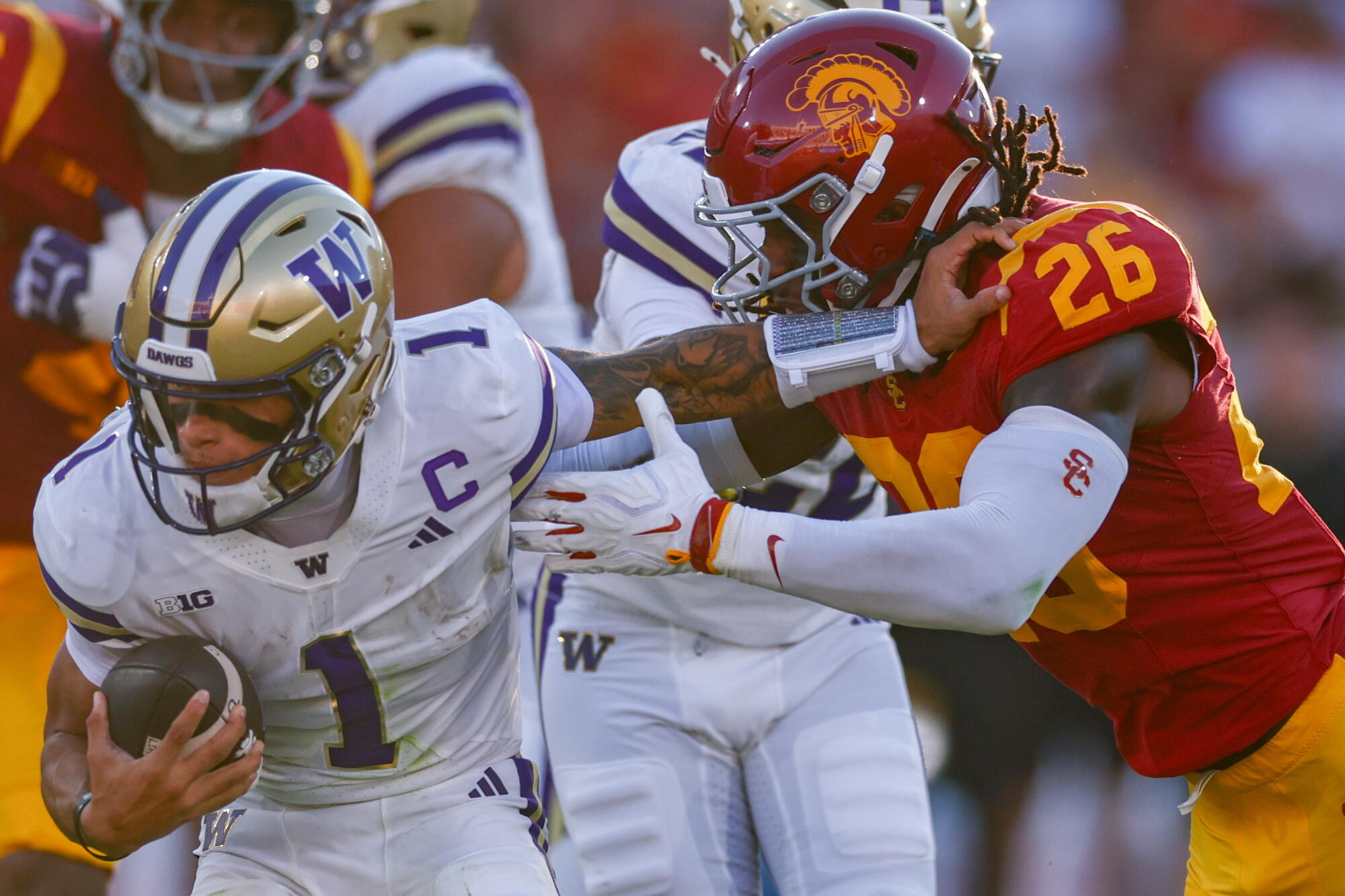
Washington quarterback Demond Williams Jr., left, tries to fend off USC linebacker Elijah Newby during the second quarter Saturday at the Coliseum.
(Ronaldo Bolaños / Los Angeles Times)
USC’s defense nearly came apart in the fourth quarter, though, at the worst possible time. Washington hadn’t converted a single third down until its final drive, when Williams converted a third-and-11 pass, then hit a fourth-and-two bomb for 43 yards. The Huskies got as close as the USC 12-yard line, before the Trojans finally shut the door.
“We had to dig deep for this one,” Riley said. “Especially as sloppy as we played.”
USC (5-1, 2-1) did try something a little different on defense, with defensive coordinator Gary Patterson calling the game from the press box instead of the sideline. Riley said the decision was akin to “trying to just move the chess pieces to get everyone in the right position.” He also added that Patterson’s former staff at Texas Christian had a lot more familiarity with Patterson’s scheme, and thus he handled things differently with that staff.
But the communication issues of past weeks appeared less of a problem on defense. The real concerns Saturday actually came on offense, where the Trojans uncharacteristically sputtered. Jayden Maiava was 21 of 34 for 245 yards, with a touchdown and an interception.
Still, judging by the box score alone, you’d be hard-pressed to understand how USC could have nearly squandered a game in which they piled up far more yards (360 to 319) and had the ball for far longer (34:58 to 25:02) and dominated on third down.
“We’re gonna fix it,” Stewart said. “No team comes out perfect. It takes time.”
After a disappointing few weeks on the defensive end, USC actually opened the game by forcing Washington (3-2, 0-2) into back-to-back three and outs.
But the Trojans managed a measly three points from those stops. Their first drive, stalled in the red zone. The next one backed up USC to the one-yard line after wideout Terrell Anderson muffed a punt.
Washington took advantage of the field position on its next drive. Faced with a fourth and seven in USC territory, Williams slipped past pressure and scampered to a first down. It was the first sign of life from the Huskies’ offense, which found its way into the end zone four plays later.
Then, USC gave the ball right back. On the run, Maiava launched a pass off his back foot under heavy pressure. It fell well short of its target and was picked off.
USC’s defense held strong, forcing a third three and out in the Huskies’ first four drives. And its offense finally held up its end of the bargain, with Waymond Jordan punching in an eight-yard touchdown.
USC quarterback Jayden Maiava scrambles during the first half against Washington at the Coliseum on Saturday.
(Ronaldo Bolaños / Los Angeles Times)
Washington continued to struggle moving the ball, but mistakes from USC helped its cause. An illegal formation penalty wiped away a deep Trojan touchdown pass to Kayden Dixon-Wyatt. Then on the ensuing possession, Wafle grabbed Williams’ face mask as he pulled him down for a sack.
USC had more penalty yards (50) than Washington had passing yards (44) in the first half. And those penalties gave the Huskies life at the end of the half, as they drove the length of the field and scored again.
“We felt like we were outplaying them,” Riley said. “We just couldn’t get out of our own way a little bit. That’s probably going to be a defining thing for this team going forward, how much we can do that.”
With a chance to regroup, the Trojans tripped over themselves out of the half too. An unsportsmanlike penalty killed their opening drive. Then, Washington tight end Decker DeGraaf caught a pass and took off down the sideline, running through two feeble-arm tackles on the way to an inexplicable 42-yard touchdown.
After that, the Riley chants rang out from the student section. But the Trojans’ offense mounted a 13-play scoring drive in response. Tanook Hines tore the ball away from a Washington defender in the end zone.
USC coach Lincoln Riley walks back to the sideline after speaking with his players during a timeout in the first half Saturday.
(Ronaldo Bolaños / Los Angeles Times)
Less than two minutes later, Stewart scooped up the fumble and took off. His 48-yard return completed a 12-point swing for the Trojans.
“To overcome all that and still win shows me some of the guts and toughness and culture in this room right here,” Riley said. “We could’ve folded.”
Still, USC couldn’t put Washington away. Down to their last drive, the Huskies converted a third and 11 and two fourth downs to drive deep into Trojan territory late.
But Kameryn Crawford pulled Williams down for a sack — the Trojans’ fifth of the game — and the defense held. And USC, at the end of a long, brutal week, breathed a sigh of relief.
When Lincoln Riley hired Gary Patterson to be his third defensive coordinator in five seasons, the USC head coach naturally pointed to Patterson’s impressive track record.
His reputation, after all, was as one of the great defensive minds in the modern history of college football, a coach who, at Texas Christian, knew how to get more out of lesser talent. It stood to reason that he could do the same at USC, where they’d just signed the nation’s No. 1 recruiting class. And through the spring and summer, that appeared to be the case, as coaches and players alike raved about their new coordinator, who earlier this year was enshrined in the College Football Hall of Fame.
But as the Trojans approach the midway point of an increasingly tense campaign, Patterson and his defense have fallen drastically short of those expectations.
As USC welcomes Washington to the Coliseum with its season on the brink, its defense is currently allowing more than 6.14 yards per play, good for 115th nationally. The secondary, which has struggled with consistent miscommunication, is allowing 8.4 yards per pass play — more than either of former coordinator Alex Grinch’s defenses allowed at USC. And big plays are becoming a big problem. Only three defenses the country have allowed more explosive plays of 20-plus yards than USC (23), which is also in line with Grinch’s defenses.
USC coach Lincoln Riley and defensive coordinator Gary Patterson talk after a loss to Oregon at the Coliseum on Saturday.
(Ronaldo Bolanos/Los Angeles Times)
And all this despite the fact four of the Trojans’ first five games were against opponents who were expected to struggle against USC’s far superior talent.
Patterson has yet to answer questions about those early results. That’s because unlike Riley’s first two defensive coordinators at USC, who spoke at least weekly, Patterson has not spoken to reporters since the preseason.
Without any explanation from him for USC’s early issues, the numbers don’t exactly paint a promising portrait of Patterson’s season. But while Riley acknowledged that the defense has “had some breakdowns at all levels” and must “play tighter in all areas,” the coach insisted Thursday that the Trojans were close to reaching their potential on defense, again reassuring that there was “a lot of good on tape” on that side of the ball.
“We don’t necessarily need any level of the defense to make this massive jump,” Riley said. “We just need each level to play a little bit better and each level to play a little bit better together.”
Outside of USC’s Week 1 shutout of Fresno State, though, the Trojans haven’t looked particularly good at any level of the defense. The pass rush has been lacking, with only three sacks across USC’s four other games. And on the back end, the Trojans continue to be caught flat-footed, with defensive backs out of position.
One former USC defensive back, Max Williams, posited on social media that the Trojans’ secondary appeared to be getting the defensive calls too close to the snap of the ball. In another social media breakdown by a former Trojan player, former quarterback Max Browne suggested that USC’s defensive backs were often out of position before the play began, putting them behind.
Those problems have seemingly been exacerbated the past two weeks in Big Ten play, as Rutgers and Oregon combined to pile up 964 yards on USC’s defense. And the Ducks did it with a backup quarterback at the helm in Dylan Raiola, who converted all seven of his third- and fourth-down pass attempts.
Patterson’s defense will have another tough test this week in Washington quarterback Demond Williams Jr., who’s just as much a threat with his legs as his arm. The Trojans already had trouble with a dual-threat quarterback earlier this season, allowing Louisiana’s Lunch Winfield to rush for 94 yards during a Week 2 Trojans win.
Any further struggles from here for USC’s defense could spiral in a hurry. The Trojans travel to Penn State next weekend and still have No. 5 Indiana and No. 6 Ohio State on the schedule. They’ll have to win two of those three, plus all their other games, if they still hope to contend for the College Football Playoff.
Those hopes hinge largely on Patterson, who Riley bet before the season would finally bring him salvation on the defensive end.
Riley still has faith that bet will pay off. Mostly because “there’s very few that have been through as much as he has.”
“Trust me, nobody takes it more personal than him or takes more responsibility than he does,” Riley said of Patterson. “He’s done this for a long time. He’s done it at a high level. And there’s nobody, you know, more committed to getting it fixed.”