The most important college football story in these parts is about the downtrodden program from Westwood and whether it will leave its dump of a stadium in Pasadena.
UCLA’s incompetence has overshadowed every team in this market outside of the Dodgers and Lakers, and that includes USC.
Which speaks to where USC stands right now.
The Trojans have become afterthoughts in a market they once owned, and they only have themselves to blame.
The 17th-ranked team in the country, the Trojans are by no means a bad team.
They’re something worse.
They’re stuck.
USC coach Lincoln Riley congratulates tight end Walker Lyons after a successful two-point conversion attempt against UCLA at the Coliseum on Saturday.
(Gina Ferazzi/Los Angeles Times)
USC literally can’t afford to buy out coach Lincoln Riley’s contract, which means that until further notice the Trojans will be known as the team that’s good enough to not embarrass itself but not good enough to reach the College Football Playoff.
In this particular time in this particular market, that pushes USC to the margins of Los Angeles’ congested sporting landscape.
About to complete his fourth season with the Trojans, Riley seems to be aware of the perception of his program, or at very least what this market expects of a program defined by championships.
“I understand Los Angeles is a place where people aren’t going to show up just because,” he said. “You have to win. You have to give them something. And when you do, there’s no sports town better.”
Riley pointed to the packed Coliseum on Saturday night as evidence the Trojans were doing something right. Almost 70,000 tickets were distributed for the UCLA game.
The loyalty of USC’s fans, however, shouldn’t be mistaken for excitement. In the eyes of the program’s most fervent supporters, the team has underachieved.
Riley talked up the Trojans’ 7-0 home record, which included victories over Michigan and Iowa, but the truth is that the season will be defined by the games that weren’t won.
The loss at Illinois.
The loss at Notre Dame.
The loss at Oregon, which effectively knocked USC out of CFP contention.
As a program that defines itself by championships, the Trojans measure success on a binary scale. They’re either competing for a national title or they’re not. These Trojans aren’t.
Riley made the case that this season helped establish a foundation on which future teams will be built.
“This year was better than last year, and then next year is going to be better, even better than this, just going to keep growing and growing,” he said.
USC backup quarterback Gage Roy leaps into the arms of offensive lineman Tobias Raymond after Roy completed a two-point conversion pass against UCLA at the Coliseum on Saturday.
(Gina Ferazzi/Los Angeles Times)
He’s made similar statements before, and USC’s fans are still waiting for the return to glory that he promised.
By now, words alone won’t convince many people about the program’s future. Riley will have to deliver results, and he will have to deliver them soon.
The team Riley will coach next season will look a lot like the team he coached this season but almost certainly without receiver Makai Lemon. No. 2 receiver Ja’Kobi Lane could also declare for the NFL draft.
As much as Riley spoke about USC’s improved physicality, the Trojans couldn’t stop the run in any of their three defeats, which raises legitimate concerns about whether he will be able to address the problem in the coming months.
The Trojans will welcome the country’s top-rated recruiting class, but how many freshmen could they realistically count on to produce right away?
Ryan Kartje, the Times’ USC beat reporter, wrote a story last week about a situation at quarterback involving starter Jayden Maiava and five-star freshman Husan Longstreet. Kartje raised the possibility of Longstreet entering the transfer portal if Maiava returns for his senior season.
In another time or place, this would be a major story. That’s basically Riley’s job now, to return USC’s profile to where the next quarterback controversy is front-page news. The Trojans aren’t close to that at the moment.
By midweek, as a handful of reporters watched his every move, Nico Iamaleava looked like someone on the verge of the offseason, not a rivalry game.
In the early stages of practice Wednesday, the UCLA quarterback threw one pass softly before shifting into observer mode for the rest of the open viewing period.
Three days later, as thousands of probing eyes watched his every move, Iamaleava was slinging passes with considerably more zip.
His efficiency in completing one pass after another against No. 17 USC on Saturday helped the Bruins take a halftime lead, silencing a Coliseum crowd and triggering a brouhaha between the teams on one corner of the field as they headed for the tunnel.
UCLA quarterback Nico Iamaleava (9) scampers for a first down against USC at the Coliseum on Saturday.
(Gina Ferazzi/Los Angeles Times)
It was the kind of moment Iamaleava had dreamed of growing in Long Beach and attending the cross-town rivalry as a kid.
“Meant a lot, man,” Iamaleava said of being able to compete against the Trojans.
But in keeping with the trajectory of a down-and-up-and-down-again season, the dream ended amid a flurry of sacks and failed third- and fourth-down conversions. There was no way Iamaleava could grit his way to victory, the Bruins eventually succumbing during a 29-10 loss to the Trojans in which their quarterback was sacked four times — all in the second half.
And so a season that started with Iamaleava being the talk of the college football world after his contentious departure from Tennessee ended with him taking a solitary walk up the Coliseum tunnel toward an uncertain future.
“It was a great learning year for me,” Iamaleava said after completing 27 of 38 passes for 200 yards with one touchdown and no interceptions against the Trojans. “You know, a lot of firsts for me throughout the season. Just the way we started off, and then dealing with little, minor injuries, there’s a lot. And I think, man, it just showed that I’m willing to go out there and put my life on the line for my teammates, man, whatever is needed.”
Iamaleava showed many sides in fighting to the end of a 3-9 season. There was accountability, Iamaleava facing reporters after every loss. There was leadership, Iamaleava telling teammates that if they wanted to leave amid the dismissal of their head coach and the departure of their offensive coordinator, go ahead. Nobody did.
Over the last few weeks, there was resolve, Iamaleava coming back from one injury after another. He missed only one game after sustaining a concussion against Nebraska and sat out only a few practices after taking a crunching hit against Washington last weekend that led to neck spasms.
“Every day he got better and better,” UCLA interim coach Tim Skipper said, “and then today he went out there and gave it his all, so I love that kid, he’s a battler. He fought and he kept leading us all the way to the end. … He’s a tough dude, man, and he’s a competitor. That’s what I’ll say about him.”
LOS ANGELES, CA – NOVEMBER 29, 2025: Southern California Trojans linebacker Eric Gentry (18) tackles UCLA Bruins quarterback Nico Iamaleava (9) for a loss in the second half at the Coliseum on November 29, 2025 in Los Angeles, California.(Gina Ferazzi / Los Angeles Times)
(Gina Ferazzi/Los Angeles Times)
For more than a half, it appeared that Iamaleava might go down in rivalry lore.
Orchestrating a short, efficient passing attack, Iamaleava pulled UCLA into a 7-7 tie early in the second quarter when he found wide receiver Kwazi Gilmer for a two-yard touchdown on a crossing route.
Then came a rarity from someone usually happy to absorb contact as the Bruins drove for a go-ahead score. On third-and-seven at the Trojans’ 26-yard line, Iamaleava scrambled before sliding into a ferocious hit from cornerback Alex Graham.
Coming up a yard short of the first down, Iamaleava tried to draw USC offsides with a hard count on fourth down before kicker Mateen Bhaghani trotted onto the field for a 38-yard field goal.
Little went Iamaleava’s way during the second half. One third down ended in an eight-yard sack. Another fell short on a pass that was broken up.
Things somehow deteriorated further. With UCLA having fallen behind 21-10 and clinging to faint hopes midway through the fourth quarter, the Bruins faced a fourth-and-15 at USC’s 45-yard line. A short pass to Gilmer went for only 10 yards.
Drive over. Game over.
That left Iamaleava to contemplate his future. Back in late July, he acknowledged wanting to go to the NFL if he put together a successful season. It was hard to say if this qualified after he finished the season completing 64.4% of his passes for 1,928 yards with 13 touchdowns and seven interceptions.
What’s next?
“I haven’t really even thought about that, man,” Iamaleava said. “I’m right here where my feet are, man. You know, we just lost a tough game and my mind is still on that one — what we could have done better to go out there and win that game.”
After answering a final question, Iamaleava glanced at a bottle of orange sports drink in front of him on a table.
“Can I have this?” he asked.
Granted permission to take the bottle, he grabbed it, rose from his seat and walked out the back of the interview tent, the offseason finally having arrived.
Red Sanders, the legendary UCLA football coach, once said the rivalry with USC wasn’t life or death, it was more important than that.
Now, some 70 years later, almost half the Bruins roster needed a primer on what it means to play the Trojans.
“We have so many transfers and things,” interim coach Tim Skipper said, “so I wanted to make sure everybody knew how significant this game was.”
That could make Ciaran Dooley, the team’s creative content producer, a rivalry hero rivaling John Barnes, Anthony Barr and Dorian Thompson-Robinson. Dooley produced a video that tried to pack the essence of a nearly century-old rivalry into about five minutes.
Putting aside any worries about where college sports are headed when one needs to explain anything about his biggest rival, the video had its intended effect, sparking cheers nearly a week before kickoff.
Starting with a minutelong hype reel narrated by Barr, the video explained some of the rivalry basics, such as both teams wearing their home uniforms and the winner getting to take possession of the 295-pound Victory Bell before painting it in their primary school color — preferably blue.
“A lot of it was like clips I’ve already seen being from L.A. and around the game,” freshman linebacker Scott Taylor said, “but a lot of the guys who haven’t been here don’t understand how big a deal this is to L.A. and how special this win can be.”
Rivalry lexicon such as “It’s always 8:47 in Westwood” — a reference to the Bruins’ 13-9 upset of No. 2 USC in 2006 — and “Eight more years!” — a chant that broke out at the Rose Bowl in 1998 at the end of the Bruins’ eighth consecutive victory over the Trojans — might need some explaining to a roster that includes 57 newcomers, 52 transfers and 42 players from out of state.
“I made this video to show what the rivalry is really about — the history, the passion, the bragging rights,” Dooley told The Times. “I know everyone on the team already knows what it is, but if there’s anything that I can do to motivate the guys just that much more for the game, I’m going to do it every time.”
Linebacker Isaiah Chisom, a transfer from Oregon State, said the coaching staff also brought in several former players to explain the significance of the rivalry before the Bruins (3-8 overall, 3-5 Big Ten) face the No. 17 Trojans (8-3, 6-2) on Saturday afternoon at the Coliseum. Veteran offensive lineman Garrett DiGiorgio and defensive back Cole Martin also talked about what the rivalry meant to them.
Utah quarterback Devon Dampier (4) holds the ball and pushes Bruins linebacker Isaiah Chisom (32) on Aug. 30 at the Rose Bowl.
(Allen J. Schaben/Los Angeles Times)
“I think they’ve done a pretty good job at kind of bringing everybody together,” Chisom said, “so we all know how important this game is.”
Chisom didn’t need a refresher, having grown up in Southern California and played for Bishop Allemany High and Chaminade College Prep. He said he’s already attended a rivalry game and learned about the Bruins’ hatred for the Trojans from Chaminade assistant coach Reggie Carter, a former Bruins linebacker.
“He didn’t like anybody wearing any red,” Chisom said of Carter. “It’s been something I’ve been told for a long time.”
Skipper said he grew up watching the rivalry no matter where he lived — his father, Jim, was a coaching lifer who moved from one city to another and his older brother, Kelly, was DeShaun Foster’s running backs coach at UCLA.
“It’s awesome to finally be part of this thing,” Tim Skipper said. “You watch it so much, I’ve never been to one of these games, and to be able to work it and coach it is going to be awesome.”
Signs of rivalry week have greeted anyone who walked past the boarded-up John Wooden and bear statues on campus, though it’s been a little quieter than the Bruins would have preferred. That’s because they haven’t been able to ring the Victory Bell that’s residing across town after USC won last year’s game, 19-13, at the Rose Bowl.
“We want to get it back, we want to ring it after the game,” DiGiorgio said. “The [USC] guys, they planted flags on our field last year. I don’t know if we’re going to reciprocate that energy because I don’t know if that’s going to start anything, but we’re definitely looking forward to getting that bell back.”
The Bruins have won their last two trips to the Coliseum, giving DiGiorgio motivation to make it three in a row and end his college career 3-2 against the Trojans. There was a consensus at the team meeting Sunday that a victory over USC would make up for all the frustrations the team has endured during a season in which Foster was fired after only three games.
UCLA offensive lineman Garrett DiGiorgio (72) is confident a video the Bruins’ staff produced helped his teammates understand the importance of winning the USC rivalry game.
(John McCoy / Associated Press)
“Beating ‘SC would undo every wrong that has happened this season — that and the Penn State win [over the then-No. 7 Nittany Lions],” Chisom said. “I don’t think we could ask for anything more.”
Even those making their rivalry debut will know what they’re getting into thanks to the handiwork of a content creator whose video might help produce an upset.
“I believe that it enlightened, lit a fire under the guys,” DiGiorgio said, “to be a little excited for this week.”
When Lindsay Gottlieb put together a nonconference schedule she believed to be the hardest in the country, USC’s coach knew it would be an uphill climb. But that was the point. She wanted her team to be tested nightly, to play on “the biggest stages.”
“It’s not a schedule designed to win every nonconference game by an average of 40 points,” Gottlieb said earlier this month.
But after losing twice through a five-game gauntlet to start the season, a blowout nonconference win was precisely what the doctor ordered for USC.
“It was a really tough loss the other night,” Gottlieb said. “No doubt about that, for all of us. But the only thing you can do is utilize those lessons that are painful to get better.”
It was a particularly big night for freshman Jazzy Davidson, who bounced back from an eight-turnover performance in South Bend to tally her first collegiate double-double. Davidson nearly crossed that threshold before halftime Tuesday, and she finished the game with 20 points, 16 rebounds, 4 assists and two blocks.
The 16 boards, Davidson said, was the most she could remember having in a single game.
“She has a will to go get that thing,” Gottlieb said.
Davidson and Londynn Jones were once again USC’s most reliable options on offense. Jones, who was held scoreless in the loss to Notre Dame, poured in a season-high 20 points. Together, they made16 of 23 from the field, while the rest of the team shot a combined 17 of 40.
USC also got a critical contribution from sophomore big Vivian Iwuchukwu, whose work inside gave the Trojans their most consistent frontcourt threat of the season on Tuesday. After playing strictly a reserve role a year ago, Iwuchukwu scored 11 points on five-of-six shooting in a performance Gottlieb said was indicative of her progress so far this season.
But it was USC’s defense that really overwhelmed Tennessee Tech. The Trojans were especially suffocating underneath, blocking 15 shots — their most since 1984, when they tallied a program-record 18.
“What was impressive about this is our length that we can put in a number of different places,” Gottlieb said. “Laura [Williams] had a couple. Kai [Milton] had a couple. But you also had Jazzy and [Kennedy Smith].”
USC’s length was so difficult for Tennessee Tech to deal with that it managed just nine total buckets inside the arc.
“There was an emphasis for us just being the hardest-working team tonight,” Davidson said. “I think our defense really showed that.”
USC held Tennessee Tech scoreless for the first five minutes of the game, then the first six minutes of the second quarter. Midway through the second, Davidson had more total points than the Golden Eagles had as a team.
It didn’t get any easier for Tennessee Tech from there, as the Trojans rolled to a resounding victory, bouncing back as best as they could have hoped.
EUGENE, Ore. — The last time he made it here, to the doorstep of the College Football Playoff, Lincoln Riley could only watch as USC’s hopes slipped away with a single hamstring tweak. Without its Heisman-winning quarterback healthy, USC fell painfully short, left to wonder over frustrating seasons that followed what might have been.
It would take Riley nearly three years — and plenty of ups and downs in between — to return to that same place with USC, only to have the door slammed shut once again, this time in a 42-27 loss to No. 7 Oregon.
With its playoff hopes dashed by a third defeat, barring an unlikely sequence of events, USC (9-3) appears to be heading to a second-tier bowl game, while the Ducks are one of three Big Ten teams likely to host a home playoff matchup. That’s an especially bitter pill to swallow, considering the progress Riley has trumpeted this season, four years into his tenure at USC.
“This is USC — the standard here is incredibly high,” Riley said. “We’ve won a bunch of games this year. The ones we haven’t won, we’re right there.”
It was a familiar refrain from Riley, who has lost all five of his games against top-10 teams as USC’s coach. But the Trojans’ losses this season each left little doubt about how and why they’d fallen short. At Illinois, it was penalties and costly mistakes. At Notre Dame, a bone-headed play call and ill-timed turnovers did them in.
Against Oregon (10-1), it was more of the same lapses in discipline. Except this time, the back-breaking mistakes came largely on special teams. The most glaring of which Riley would look back on as the turning point Saturday.
It was just a few minutes into the second quarter. Tied 14-14, USC had sputtered short of midfield. So the Trojans punted away to Oregon’s Malik Benson.
The punt flew on a line drive to Benson, who found the edge and flew past USC’s last line of defense, 85 yards untouched into the end zone. The return’s impact would only reverberate from there.
“Obviously, it was a huge, huge play in the game,” Riley said. “You definitely don’t want to give them something like that.”
You certainly wouldn’t want to let those missteps snowball either. But that’s precisely what happened as quarterback Jayden Maiava faced heavy pressure on a third down on USC’s ensuing possession and threw a prayer into traffic. Oregon intercepted the pass.
USC’s defense would hold initially, and Oregon sent a field-goal attempt off the goalpost. Had the Trojans taken over from there, what followed could have altered the path of USC’s season — and the college football season writ large.
But in trying to block the field goal, linebacker Desman Stephens leaped over the Ducks’ line and was flagged for a 15-yard penalty. Riley said that Stephens “just kind of panicked a little bit.” Three plays later, Oregon punched in a touchdown to take a lead it would never relinquish.
“We’re playing good enough right now that we’re a sequence like that [away] from beating anybody,” Riley said. “That’s just how it feels.”
USC wide receiver Makai Lemon attempts to hurdle Oregon defensive backs Dillon Thieneman (31) and Jadon Canady, right, during the first half Saturday.
(Lydia Ely / Associated Press)
The series of special teams mistakes ultimately sunk USC, yet it was hardly the only error the Trojans made in that aspect of the game. USC also missed a field goal, kicked a kickoff out of bounds and was called for catch interference.
Other mistakes made matters worse. The Trojans were called for eight penalties for 103 yards, the fourth time this season they’ve been penalized that much.
The Trojans’ defense certainly didn’t help matters, in spite of assurances that it had ironed out its issues over three standout, second-half performances. Against Oregon, though, that progress was tough to spot, as USC gave up 436 yards, just shy of a season-worst mark.
The loss wasn’t for a lack of effort from its passing attack. After a questionable performance on the road in each of USC’s first four trips, quarterback Jayden Maiava hit big throws to keep the Trojans alive. Seven of his 25 completions went for 15 yards or more. He finished with 306 yards and three touchdowns, while freshman Tanook Hines (141) and fellow wideout Ja’Kobi Lane (108) turned in standout performances.
With its rushing attack unable to move the ball, the passing game was all that really worked for USC.
USC quarterback Jayden Maiava looks toward the scoreboard in the second half of a 42-27 loss to Oregon on Saturday.
(Lydia Ely / Associated Press)
King Miller had been stellar in the five weeks since being thrust into the lead role in USC’s backfield. But the Trojan walk-on was totally neutralized by Oregon’s stout defensive front. He rushed for just 30 yards, the longest of his 15 carries going for just five yards. The Trojans managed just 52 yards on the ground total, their fewest since a November 2023 loss to UCLA.
“We didn’t run the ball nearly as well as we have or nearly as well as we expected to,” Riley said.
After USC coaches reiterated all week the importance of starting fast, USC did make an immediate statement. On its first drive, USC marched down the field, and Maiava found Makai Lemon on an eight-yard swing pass that he took into the end zone.
But while USC’s running game struggled, Oregon faced little resistance, racking up 179 rushing yards and three scores.
At the start of the second quarter, Maiava found Lemon again on a swing pass in the backfield, only for Lemon to throw the ball on a double pass. Waiting for the pass was Hines, who leaped for an acrobatic 24-yard touchdown in traffic.
The fireworks didn’t stop there. But the special teams gaffes would change the tenor of the game, as Oregon opened up a 28-14 lead by halftime.
Just before the half, USC drove to the 10-yard line with seconds remaining, only for kicker Ryon Sayeri to clank a 27-yard field goal attempt off the goalpost.
A third-quarter interception from Kennedy Urlacher, one of two USC reserves starting at safety, gave the Trojans some life. But there would be no stalwart second-half stand from USC’s defense, like it managed the last three weeks. Nor could its electric offense climb back in time.
As the final seconds ticked away, there was only the realization that, once again, its hopes of a special season had been dashed right on the doorstep.
Four years after Lincoln Riley arrived at USC amid gaudy promises to return the football program to national prominence, well, two words.
Still waiting.
Needing a win at Oregon’s Autzen Stadium Saturday to have a chance at its first college football playoff berth, the Trojans once again fell short, fell deep and basically fell on their faces.
Still waiting.
In front of jubilant fans roaring like USC fans once roared, Oregon used an 85-yard punt return, a terrible Trojan penalty and awful Trojan play calls to roll to a 42-27 victory.
Still waiting.
With the win, the seventh-ranked Ducks almost certainly have earned a playoff spot.
With the loss, the 15th-ranked Trojans have definitely been eliminated for the fourth time in Riley’s four seasons while hanging an equally damning number on the embattled coach.
Under Riley’s leadership, the Trojans are 0-5 against top-10 teams.
Nearly as bad, in four years the Trojans have won just three road games against teams that finished the season with records better than .500. Before beating Nebraska earlier this year, Riley’s Trojans had not recorded a quality road win since his first season.
If USC beats UCLA next weekend as expected, the Trojans will finish with a 9-3 record and a nice vacation in some anonymous bowl game.
And that will not be enough. That cannot be enough.
One wonders how long the USC deep-pocketed people will endure such failed expectations, such fruitless autumns, such … mediocrity.
Heck, if UCLA can buy its way out of the Rose Bowl, one imagines that USC could buy its way out of a head football coach.
Just saying. Just saying, because at this point, there really isn’t anything more to say.
USC coach Lincoln Riley, center, walks on the sideline during a 42-27 loss to Oregon on Saturday.
(Lydia Ely / Associated Press)
USC began Saturday’s game with strength and style, forging a 14-all tie on the first play of the second quarter on a trick play that didn’t work against Notre Dame, receiver Makai Lemon throwing 24 yards to Tanook Hines to tie the game at 14-all.
If only the swaggering Trojans weren’t also so sloppy.
One possession later, a line-drive punt was returned 85 yards for a touchdown by Malik Benson to give Oregon a 21-14 lead.
Then at the end of the first half, everything fell apart for USC, just like everything always seems to fall apart in big games.
The breakdown began when USC seemed to regain momentum on a missed 44-yard field-goal attempt by the Ducks’ Atticus Sappington. But on the play, the Trojans’ Desman Stephens II leaped over the line for an unsportsmanlike conduct penalty. Given new life, the Ducks quickly took advantage with a one-yard touchdown run by linebacker Bryce Boettcher to give the Ducks a 28-14 lead with 1:52 remaining in the half.
Then USC looked even worse on its ensuing drive when, on first and goal from the Oregon 8-yard line, Riley inexplicably called two running plays by Lemon that were both stuffed. The Trojans were eventually forced to attempt a field goal, but Ryon Sayeri bounced it off the right upright and the Trojans ended up with zilch.
At halftime, the 14-point Ducks lead seemed a lot larger and, it turns out, was insurmountable.
At the start of the second half, the Trojans held Oregon on fourth and one from around midfield, stole the Ducks’ next possession on an interception by Kennedy Urlacher, converted their own fourth down, and eventually scored on a four-yard pass from Jayden Maiava to Lemon to make it 28-21.
But then Oregon used several bruising runs to set up a 28-yard touchdown pass to Kenyon Sadiq to make it 35-21 late in the third quarter and that was that.
The Trojans made it a one-possession game again on a nine-yard touchdown pass to Lake McRee early in the fourth quarter, but Oregon drove down the field and scored on another bruising run by Noah Whittington to clinch it.
Before he took the reins at USC, Lincoln Riley had a reputation as something of a road warrior. It wasn’t until his third season at Oklahoma that Riley’s team had lost a true road game with him as head coach. During five years with the Sooners, he won 17 of 21 on the road.
But four years into his tenure as the Trojans’ coach, Riley’s once-sterling road reputation feels like a relic of a past life. Until USC won at Nebraska earlier this month, Riley hadn’t beaten a team on the road that finished better than .500 since November 2022, when his Trojans toppled UCLA at the Rose Bowl. Otherwise, outside of L.A., USC’s only road victory against a quality team under Riley came against Oregon State … in his fourth game leading the Trojans.
Never have the stakes been so high for Riley than they are this week, as No. 15 USC heads to No. 8 Oregon with its College Football Playoff hopes hinging on a huge road victory. Still, it’s hard to ignore how starkly different Riley’s Trojans have looked when challenged away from home.
USC has been the best offense in college football when inside the Coliseum. But in four road games, USC is averaging 18 fewer points and two fewer yards per attempt on offense. Its red zone touchdown rate plummets 25%, while its third-down conversion rate drops 16% on the road. Simply put, by any measure, Riley’s offense has been much worse away from home this season.
USC quarterback Jayden Maiava throws a pass during a win over Iowa on Nov. 15 at the Coliseum.
(Eric Thayer/Los Angeles Times)
That disparity starts at quarterback. At home, Jayden Maiava has been one of the best quarterbacks in all of college football this season. The junior has completed 74% of his passes at home and averaged 10.7 yards per attempt at the Coliseum, both of which rank top 10 in the nation. He’s accounted for 18 total touchdowns to just two turnovers at home, while his quarterback rating puts him in the rarefied air of Heisman contenders such as Indiana’s Fernando Mendoza and Ohio State’s Julian Sayin.
That version of Maiava, however, has yet to take his show on the road. In five true road games as the Trojans’ starting quarterback, Maiava has completed fewer than 57% of his passes. His average yards per attempt tumbles nearly three yards. He’s committed more turnovers and been sacked more often.
USC can’t afford for that to be the case Saturday, if it hopes to hold onto its Playoff hopes. But while recent history might be against his Trojans, Riley reminded this week that he’s not new to contending like this late in November.
“This is what I’m used to, man,” RIley said. “It’s good to be right there again, no question.
”… This is the time of year that I enjoy most.”
Here’s what to watch as USC clashes with Oregon on Saturday at 12:30 p.m. PST (CBS, Paramount+):
Last month, in the span of a single half, USC’s top two running backs were lost to serious injuries. For Eli Sanders, the knee injury he suffered against Michigan prematurely ended his season. For Waymond Jordan, ankle surgery meant missing most of the Trojans’ critical stretch run.
It made for a particularly cruel one-two punch. Through the first six games, the Trojans duo had been a top-10 rushing attack in the nation, trending toward the best rushing season USC had seen in two decades. Then, in less than an hour’s time, a promising start had been derailed by injury.
“That could almost be a death sentence,” coach Lincoln Riley said Wednesday.
But with just two games left in the season, the Trojans’ rushing attack still is very much alive. And USC still is clinging to College Football Playoff hopes because of it.
“It’s gone remarkably well,” Riley said of USC’s rushing attack since. “I don’t know that anyone could have predicted that to be completely honest.”
No one anticipated the arrival of redshirt freshman walk-on King Miller, who has been a season-saving revelation since being thrust into the role of the Trojans’ lead back. Miller is averaging 113 yards per game since Jordan and Sanders went down, which, extrapolated over the course of a full season, would tie Nebraska’s Emmett Johnson for best in the Big Ten. Miller also is one of just two Power Four running backs with more than 90 carries to average better than seven yards per rush.
His unexpected coronation, coming at the most critical point of USC’s season, is part of why the Trojans could be just two wins away from their first playoff bid. And if they have any hope of continuing that run, Miller will have to lead the rushing attack into its toughest battle yet Saturday at Autzen Stadium, where No. 7 Oregon has held opposing offenses to 90 yards rushing per game.
There was a brief glimmer of hope leading into this week that Jordan, who underwent tightrope surgery on his ankle five weeks ago, might be able to return for USC’s trip to Eugene. Jordan was listed as questionable on the injury report last Saturday and dressed for practice this week, both signs of progress. But Riley acknowledged Tuesday it was unlikely Jordan would be ready for the game, as he’s still getting comfortable cutting on his surgically repaired ankle.
“He’s getting closer,” Riley said. “But for a back, that’s not a great injury.”
There were a number of other injuries too that presumably should have led to USC’s undoing on the ground. In addition to their battered backfield, the Trojans have been without left tackle Elijah Paige for several games because of a knee injury and could be without him again Saturday. Center Kilian O’Connor missed three games because of his own knee issue, and guard Alani Noa was sidelined for most of the Nebraska win.
But the Trojans have yet to take a step back. The offensive line has shuffled positions with surprising success, and Miller has exceeded all expectations, earning a place in USC’s future plans.
“Just trying to learn to be confident in whatever I’m doing,” Miller said this week. “You’ve got to be confident no matter what it is.”
Miller may, however, have met his match this week with Oregon. While USC has remained near the top of the Big Ten, even after losing its top two backs, the Ducks have boasted arguably the best rushing attack in the nation. Only Navy averages more yards per carry than Oregon (6.33) or has more 20-plus-yard carries (28).
Two of Oregon’s trio of backs, senior Noah Whittington and freshman Dierre Hill Jr., are averaging better than eight yards per carry. The other, Mater Dei product Jordon Davison, is averaging seven yards as a freshman and has 12 touchdown runs.
The numbers aren’t exactly encouraging for the Trojans, who have been distressingly vulnerable against the run for long stretches of this season. USC is giving up more than 200 yards on the ground on average over its last four games, none of which came against offenses that rank among the top 25 nationally in rushing.
The best backfield USC faced during that stretch, Notre Dame, rolled over the Trojans for 306 yards. And the Irish are averaging 41 fewer yards per game on the ground than Oregon.
But in each of its three games since that Notre Dame nadir, the Trojans have come out looking like a totally different defense in the second half. None of their last three opponents — Iowa, Northwestern or Nebraska — managed more than a field goal after halftime.
USC won’t have the luxury of waiting that long this week, up against one of the few offenses in college football scoring at a more efficient clip. For the Trojans to keep their playoff hopes alive, it starts with dictating how things go on the ground.
So far that’s gone better than expected.
“We’ve had some big challenges,” Riley said. “We’ve been able to respond. It’ll obviously be important in games like this. Being able to run the football, being able to stop the run is always key, no matter who you’re playing, where you’re playing, what year it is.
“We’ve been clutch there. We’ve been able to do it. Hopefully we can get it done this time.”
Welcome back to the Times of Troy newsletter. Hopefully, by the time you read this, you will have finally dried off. Or maybe it’s still pouring rain where you are. But whatever the weather, things are looking pretty sunny for Lincoln Riley and USC right now.
The Trojans are now just two wins away from a trip to the College Football Playoff. But the bigger statement Saturday, while rallying in the rain to beat a team like Iowa, wasn’t so much about this season, but rather the program’s trajectory after next week’s marquee matchup at No. 8 Oregon.
Riley said later that he sensed this shift at halftime, just as the team’s Playoff hopes were hanging by a thread. His Trojans were trailing Iowa, 21-10, once again having succumbed to the same slow start that plagued them the last two games. They’d been outplayed, outworked, outsmarted. The run defense was awful. The offense was stuck in the mud.
Fight on! Are you a true Trojans fan?
Still, as Riley looked out over the locker room, he saw something he hadn’t last season or the season before that.
“You could tell from the look in their eye,” Riley said. “I felt very strongly we were going to come back out and make a run.”
We saw it for ourselves in the second half. USC’s defense shut out Iowa from that point on. It was the third game in a row in which the Trojans allowed three points or fewer after half. The offense came roaring back, scoring 16 unanswered points. The comeback felt almost run-of-the-mill in the moment. As if falling behind was just a part of the plan all along.
That it came in the pouring rain, against a team whose style is so quintessentially Big Ten, made it particularly meaningful.
“If there ever was one, that was a culture win,” Riley said. “Our team’s resilience, their response at halftime … we just keep coming, we have all year.”
Think of how different that feels from this time last season, when it was a foregone conclusion that USC would fold in the fourth quarter. Now, instead, there’s a sense of swagger and confidence that hasn’t been there since before Caleb Williams hurt his hamstring in the 2022 Pac-12 championship game.
Even that 2022 season, as magical as it may have been, was propped up by a Heisman winner at quarterback, one capable of willing his team to wins unlike anyone before him at USC. Riley has said on several occasions that that team, coming off a 4-8 campaign, overachieved relative to where the program actually stood.
Two frustrating seasons followed. There were times, during that stretch, where it seemed USC found something. But nothing felt quite as earned as Saturday’s breakthrough in the second half.
Eric Gentry was there for that first season under Riley. The senior linebacker has been an emotional leader ever since and a good barometer of where things stand in the locker room.
“It’s win or go home right now, and there’s no go home,” Gentry said after the game. “We’ve got to win. I think the whole team is understanding of what the culture is. Just fight to the last second, not feel like something bad is going to happen.
“Coach [Riley] said: ‘Don’t hope for [anything]. Make it happen.’”
Hope won’t be enough to win at Oregon, where it hasn’t won in 14 years. It will have to iron out its issues against the run to have any shot against the Ducks, who boast the best rushing attack in the Big Ten. It will need to start faster on both sides of the ball. And it will have to play up to its potential on the road against a very good team, which it hasn’t done … umm … ever during Riley’s tenure.
That’s not to say this can’t happen. (Which I may have suggested in this space three months ago.) If not for a game-winning field goal in the rain, Oregon would have lost to Iowa last week. But very few people will give USC a shot at Autzen, for reasons that are totally rational and understandable.
College football, though, is rarely ever rational or understandable. If USC is somehow able to upend Oregon, on the road, it would be the biggest win at the school not just since Riley started as coach, but well before that.
No matter what happens, we’ve seen enough this season to say that the team and the program are in a better place than they were a year ago. The question now is whether they’re ready to take that final step.
Makai Lemon
(Eric Thayer/Los Angeles Times)
—Waymond Jordan was listed as “questionable” against Iowa. Could that hint at a return vs. Oregon? When Jordan underwent surgery last month, the hope was that his injury would only keep him out for four to six weeks. We’re basically at five-week mark right now, and by next weekend, will be near the end of that original timeline. Getting Jordan back was for this game was always a priority, and while King Miller has done great in his stead, Jordan was one of the best backs in America when he went down. His potential return would be huge news for USC’s offense. Some of this disparity is a factor of playing better defenses, but since Jordan departed the win over Michigan, USC’s offense has averaged just over six yards per play in its last four games, down from 8.3 yards in the previous six games with him.
—Give Makai Lemon the Biletnikoff already. How much more does anyone need to see to be convinced that Lemon is the best receiver in college football? Saturday was the third time in six weeks that Lemon has had 10 or more catches. And the afternoon started with Iowa double-teaming him. His leaping grab over the middle, as an Iowa defender knocked his legs out from under him, was truly something to behold. “He’s a fearless player,” Riley said. “Always has been.” But his game has gone to another level as a junior. I expect he’ll be a primary focus of Oregon’s secondary next week, which should open up opportunities for the rest of USC’s receiving corps.
Jazzy Davidson controls the ball against DeAvion Wilson of New Mexico State earlier this month.
(Ronald Martinez / Getty Images)
—The USC women need time. Their schedule doesn’t exactly allow for it. Without JuJu Watkins, the Trojans are still trying to figure out their identity. They had no shot keeping up with No. 2 South Carolina on Saturday shooting 7% from deep. Jazzy Davidson is still getting the hang of things, just three games into her true freshman season, while USC’s frontcourt was pretty much non-existent against the Gamecocks. I agree with Lindsay Gottlieb that tests like this one, even when failed, help a team get better. But three of the Trojans’ next eight games come against top-25 teams, including a matchup with No. 1 Connecticut.
—Rodney Rice is better than advertised. When Eric Musselman put his roster together for Year 2 at USC, it wasn’t the plan for Rice to fully take on primary point guard duties. Freshman Alijah Arenas was presumed to be USC’s primary ballhandler. But his injury left Musselman with no choice but to trust Rice. And boy, has he delivered on that trust. Rice turned in a triple-double Friday in a win over Illinois State. But it’s his command of USC’s offense that was especially encouraging. He makes others better, which is going to be critical if the Trojans hope to be a tournament team this season.
—AD Jen Cohen laid out her perspective on non-conference scheduling in her State of Troy address. She never said the words “Notre Dame,” but the message might as well have been addressed to Irish athletic director Pete Bevacqua. Cohen wants to play the game in the first month of the season, as we’ve reported in this newsletter. In her letter to fans, she pointed out that no other Big Ten teams in the last two years have played a non-conference road game after Week 4. “Intentionally making our road to the CFP significantly more difficult than our Big Ten peers does not align with our goal to win championships,” Cohen wrote. That might make some fans bristle, but it’s the same sentiment that Riley has expressed for the last two years.
—Here’s what Cohen said on the Big Ten’s proposed private equity plans. In the same address, Cohen gave her first public comments on the private equity plan that USC and Michigan currently remain against. She didn’t reject the idea of a private equity deal outright, but noted that the school, in any deal, would need to consider USC’s “long-term value and flexibility” versus the benefit of a short-term payout. But the payout itself is part of the problem: USC is slated to get less than not just Michigan and Ohio State, but also Penn State. I still don’t see USC budging on its issue with that disparity, which could amount to something like a $10 million difference, per On3’s reporting. That’s led to some alarm bells about USC going independent. But there’s no reason to think we’re anywhere close to that. Let’s pump the brakes.
—You may have noticed that the Sams made another number change. Punter Sam Johnson and third-string quarterback Sam Huard were both listed as No. 0 this week, after both deceptively wore No. 80 a week ago. Watching USC line up for a punt this week, it dawned on me another brilliant layer to USC’s controversial fake punt ploy. From now on, every team the Trojans play will have to think to themselves, “Is that actually the punter?” Whether you thought USC’s ploy was bush league or not, Riley has only reaped benefits since. Though, maybe it’s no coincidence that Johnson’s first punt this week was a 24-yard shank. Karma? Perhaps.
Cynthia Erivo is Elphaba and Ariana Grande is Glinda in “Wicked: For Good.”
(Giles Keyte / Universal Pictures)
After waiting patiently for a year since the first installment, “Wicked: For Good” hits theaters this weekend, and I am counting down the days.
The first movie was tremendous, and the second has maybe the best song from the original musical (the name of which just happens to be in the title of the film). Early reviews suggest that Ariana Grande is given a lot more to do dramatically in this film, and I, for one, am here for it after her stellar performance the first time around.
With the early kickoff in Eugene, I may have no choice but to go see it that night — and thus, incur the wrath of my wife, who’s also waiting to see it, later.
Until next time …
That concludes today’s newsletter. If you have any feedback, ideas for improvement or things you’d like to see, email me at [email protected], and follow me on X at @Ryan_Kartje. To get this newsletter in your inbox, click here.
No. 1 Nebraska displayed every skill that’s made it a powerhouse program — the offense attacked every part of the court, defense never gave up on the ball and the fans showed up at the Galen Center.
In front of a sellout crowd of 9,072, USC’s nine-match win streak came to an end with a straight-set loss to Nebraska (26-0, 16-0 Big Ten).
“I just felt like the game was a little too fast for us today,” USC coach Brad Keller said. “I thought it was slow for them and fast for us.”
The No. 17 Trojans never led and were limited to a 20% point scoring percentage throughout the match. USC (20-6, 11-5) led in attacks, but its 16 errors were costly during the 25-13, 25-16, 25-20 loss to the Cornhuskers.
USC’s Adonia Faumuina taps the ball over the net against Nebraska at the Galen Center on Sunday.
(Kim Ly / USC Athletics)
“Nebraska is the real deal,” Keller said. “They are really, really good and they showed that today from point one to the very end. They’re hitting .400 and they held us down to .156, that kind of shows you a lot of where they were.
“Go Big Red Nation deserves credit and they deserve the fact that they travel and they support their team.”
USC outside hitters London Wijay, with 10 kills, and Adonia Faumuina, with nine kills, kept the Trojans in as much as possible throughout the three sets. After a break, the Trojans came out with some extra gusto to make things a little interesting for the Cornhuskers.
“We literally had nothing to lose,” Faumuina said.
During the match, Nebraska made 10 errors, with five spread across the first two sets. The Huskers moved the ball quickly around the court and if they made a mistake, the team quickly adjusted. In the third set, a ball bounced in the air close to the floor seats. Nebraska saved the ball and it later led to a kill by Virginia Adrian that put the Huskers three points from closing out the game.
Nebraska kept USC guessing, while exploiting the weaker USC back court and capitalizing on attacking errors. Throughout the match, they kept hitting the ball to the back, usually resulting in a point for them.
“There were some plays they made that I haven’t seen in a while and that was normal for them,” Keller said.
As the Trojans look ahead to their next match against Oregon on Wednesday, Keller doesn’t have a silver lining take-away from the loss.
“I love my team, I don’t care what their age is,” Keller said. “There needs to be a standard and we need to execute and if we don’t execute, we go back to the drawing board, we work on those things, we get better and we execute.”
Wijay said the loss exposed how much harder the Trojans must work to achieve their goals.
“I don’t want to brush off this loss,” Wijay said. “I think it’s good to use as fuel for the next game. It was a good test to see how far we are to get to that level. And I feel like the silver lining is to make sure that we’re all gonna be in the gym working even harder to make sure that we pursue the balls.”
“I think it made me more hungry to want to win,” Wijay added.
South Carolina guard Ta’niya Latson drove into the paint in the third quarter. As she went up for the layup, she was met by USC guard Kennedy Smith, who rose up and swatted the ball so hard into the stands that it knocked the hat off a fan sitting a couple rows deep in the Crypto.com Arena crowd.
That ended up being the highlight of the Trojans’ second half.
They had been in this situation before. In their most recent game at No. 9 North Carolina State, USC trailed by eight with 9:48 left to play before pulling off a comeback victory. And on Saturday night, the Trojans found themselves here again: down 10 to South Carolina, the No. 2 team in the country, heading into the final frame.
No. 8 USC didn’t make it easy on South Carolina. They forced turnovers. They made their free throws. But it wasn’t enough as South Carolina did just enough of the little things to escape with a 69-52 win at Crypto.com Arena.
Smith led USC in scoring with 12 points to go along with three assists. Kara Dunn was the only other Trojan in double figures with 10 points and three rebounds. South Carolina had four starters score in double figures, led by Joyce Edwards (15 points).
The Gamecocks came out sloppy with six first half turnovers and shooting just 33% from the floor, but the Trojans couldn’t capitalize. Their shooting percentage (36%) was almost as bad through the first two quarters and they were out-rebounded 27-20 as South Carolina scored nine second chance points on nine first-half offensive boards.
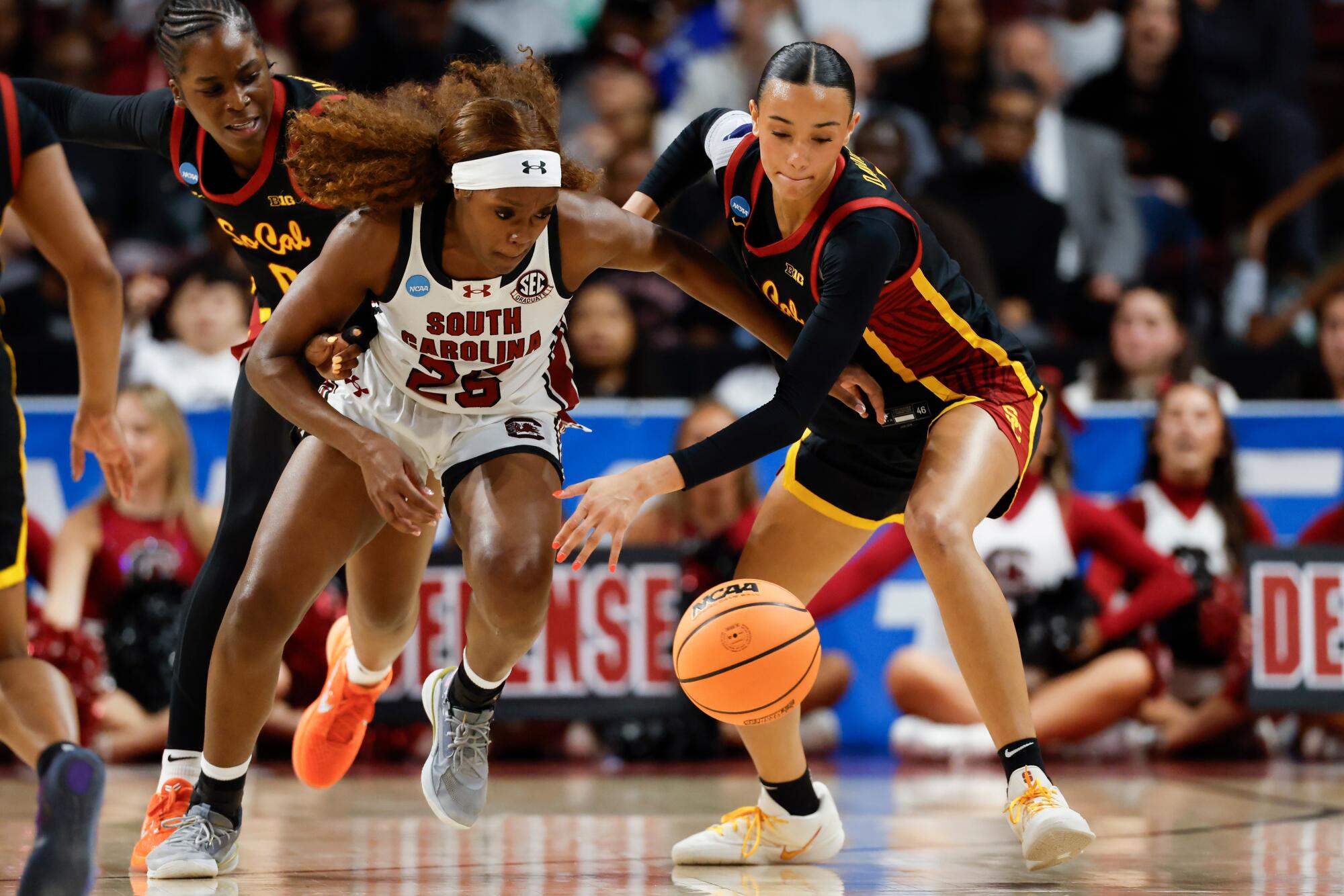
USC guard Jazzy Davidson loses the ball while driving to the basket against South Carolina on Saturday night.
(Gina Ferazzi / Los Angeles Times)
The cracks started to show in the second half, when South Carolina opened with a 10-2 run to give USC a double-digit deficit. The Gamecocks outscored the Trojans 23-15 in the third.
South Carolina built on every advantage they had from the first half. Their plus-seven in rebounds ballooned to plus-24. They went from nine offensive rebounds to 21, and while they still finished the game with 16 turnovers, they forced with 16 points off USC’s 13 turnovers.
They were battered, they were bruised, they were soaking wet and covered in stereotypes.
They’re not tough enough. They’re not resilient enough. They’re not Big Ten-enough.
Late in the second quarter Saturday afternoon at the Coliseum, a USC football team fighting for a playoff berth was crumbling beneath the weight of its worst national perception.
It was wilting under the weather and the weight of a team from Iowa.
Then, with big swings from a deep strength that few thought a Lincoln Riley team possessed, everything changed.
It’s raining wins, hallelujah.
Trailing 21-7, the Trojans got muddy and chilly and just plain mean, winning the line of scrimmage, winning the battle of skill, and eventually winning the game 26-21.
Yeah, afterward, that was Riley dancing in a downpour.
And, yes, USC is still in the national championship hunt, needing wins in its final two games at Oregon and against UCLA to qualify for the College Football Playoff.
Few will believe they can beat sixth-ranked and one-loss Oregon in Eugene. But then again, few believed they would survive Iowa after the Hawkeyes took that big second-quarter lead.
During the last 10 years, Iowa had an 83-5 record when leading by eight points or more. Translated, this is a program that knows how to protect a lead, and the Trojans were seemingly cooked.
But Makai Lemon made 153 yards worth of spectacular catches, King Miller ran for 83 bruising clock-killing yards, Jahkeem Stewart made a game-changing interception, Jayden Maiava held it together with a touchdown pass and no turnovers, and the game essentially appropriately ended with USC just being stronger.
On a fourth-down pass in the final minute, Kennedy Urlacher shoved Kaden Wetjen out of bounds as he was making a grab deep in Trojan territory.
No catch, game over, and in the end, the Trojans were as hearty as that section of fans that witnessed the game shirtless.
The afternoon started with groundskeepers drying the field with leaf blowers, the first rainy game at the Coliseum in nine years.
USC coach Lincoln Riley celebrates with wide receiver Prince Strachan during the second half of a 26-21 comeback win over Iowa at the Coliseum on Saturday.
(Eric Thayer / Los Angeles Times)
But for USC under Riley, it felt the same, a late-season game requiring the sort of grimy toughness that his Trojans had yet to show.
Blew five fourth-quarter leads last season. Blew four of their last five games two seasons ago. Blew the Pac-12 championship game and a shot at the playoffs three seasons ago.
It looked like they were going to blow it again.
Iowa took the opening kickoff and drove 69 yards in seven plays in a bruising drive punctuated by a fourth-down, two-yard touchdown pass from Mark Gronowski to Dayton Howard in the back of the end zone.
Yes, the FBS’s 133rd ranked passing offense — out of 136 teams — had just scored on a pass play.
And Iowa was just getting started.
After stopping the Trojans’ Miller on a fourth-down run around just inside Iowa territory — a terrible Riley call against the nation’s best fourth-down defense — the Hawkeyes drove 45 yards in nine plays to score on a Gronowski one-yard push to take a 14-0 lead.
The Trojans came back while finally finding their groove, driving 74 yards on 11 plays featuring a leaping catch by Ja’Kobi Lane and ending with a one-yard touchdown run out of the wildcat formation by Bryan Jackson.
So USC had the momentum? Not so fast.
USC defensive tackle Jide Abasiri holds up the ball while celebrating with cornerback Decarlos Nicholson during the second half of the Trojans’ win Saturday over Iowa.
(Eric Thayer / Los Angeles Times)
Iowa took the possession and pounded and pounded and nine plays and 75 yards later scored on a five-yard, trick-play pass from receiver Reece Vander Zee to Gronowski.
That gave Iowa a 21-7 lead that was shortened only by a Ryon Sayeri 40-yard field goal after a dropped pass and penalty stopped the Trojans.
USC took the ball at the start of the third quarter and seemed to be destined for a touchdown after a leaping sideline catch by Lemon. But a holding call against Lane ruined a long run by Miller, two failed pass plays stalled the drive, and the Trojans had to settle for a 29-yard field goal by Sayeri to close the gap to 21-13.
After the Trojans defense stiffened, the offense went back on a roll, using another leaping grab by Lemon — this one for 35 yards — to set up a 12-yard TD pass between three defenders to Lemon. Maiava overthrew Lemon on the two-point conversion attempt, but this time, the Trojans didn’t blow the momentum.
On Iowa’s next possession, with 1:52 left in the period, the powerful freshman Stewart grabbed a deflected pass for an interception to give the Trojans the ball on the Iowa 40-yard line.
From there, Maiava drove them 40 yards in six plays on a possession that was assisted by a pass interference penalty and gave them an eventual 26-21 lead after Jackson’s one-yard touchdown run.
With just three weeks left in the college football season, Lincoln Riley finds himself in a place he hasn’t been since his first year at USC. His Trojans are still within reach of the College Football Playoff in mid-November. Their fate is still in their hands: Win out from here, and USC should be in the CFP for the first time.
The stakes are incredibly high. And Riley isn’t hiding that fact from his team as it prepares to face No. 21 Iowa Saturday. In fact, he says, he wants them to “embrace” the opportunity at hand.
“This game coming up this weekend, it’s not the same. It’s just not,” Riley said. “The more you win, the more important these become and the bigger the opportunities become. So our team is very well aware of that.”
Pressure hasn’t always brought out the best in Riley’s teams at USC. Last season, the Trojans blew five fourth-quarter leads and lost five of their last seven games in devastating fashion down the stretch. In 2023, they dropped four of five to close out the regular season. Even the 2022 run ended on a sour note in the Pac-12 title game after USC lost a second time to Utah, this time with a playoff berth on the line.
USC quarterback Jayden Maiava throws the ball downfield against Michigan on Oct. 11 at the Coliseum.
(Gina Ferazzi/Los Angeles Times)
The path ahead isn’t exactly smooth this season, either. Iowa boasts one of the nation’s best defenses and a ball-control style different from any team USC has faced so far. Lane Kiffin was USC’s coach when the Trojans last won on the road at Oregon (in 2011) — they’ve lost four straight there since. Even UCLA, in the midst of a strange season, is very capable of playing spoiler in their rivalry matchup.
It’s a delicate balance for any coach to strike at such a critical time of the season, emphasizing the larger stakes at hand while also keeping his team focused on the task ahead. But it’s a tightrope that Riley walked this week.
“I think the biggest thing is just being where your feet are, being in the moment, not getting too far down the road,” quarterback Jayden Maiava said this week. “Just focus on what’s happening right now.”
Here’s what you should watch when No. 17 USC takes on No. 21 Iowa on Saturday:
Before she came to USC, it had never occurred to Jazzy Davidson how charmed her basketball upbringing had been. Growing up outside of Portland, nearly all of her years playing the game were spent with the same tight-knit group of girls — girls who’d been best friends since before the fifth grade and who, after all that time, could anticipate her every move before she made it.
“They’re basically my sisters,” Davidson says.
They’d been that way pretty much as far back as she could remember. Allie, she met in kindergarten. She and Sara joined the same squad in second grade. By 10, Dylan, Reyce and Avery were on the club team, too. For the next eight years or so, up through March’s Oregon girls 6A state championship, they were inseparable, the six of them spending almost every waking moment together.
But now, a few days before the start of her freshman season at USC, Davidson is in Los Angeles, while her former teammates are scattered across the Pacific Northwest playing with various other Division I schools. It’s an odd feeling, she admits, but a thrilling one, too — to be here with a new team, continuing her basketball journey without the girls who’d been there the whole way.
Reyce Mogel, left, Avery Peterson, Dylan Mogel and Jazzy Davidson played together on youth and high school teams.
(Courtesy of Reyce Mogel)
“Being here made me realize how comfortable I was with them,” Davidson said. “It’s definitely different now, definitely a learning experience.”
Within that well-worn dynamic, Davidson developed into one of the top women’s hoops prospects in the nation, all while she and her friends led Clackamas High on an unprecedented, four-year run of success. Now, early in her freshman season at USC, Davidson steps into circumstances that no one would have anticipated when she signed with the school.
At the time, the expectation was that she could be brought along as a talented No. 2 while the Trojans’ generational star JuJu Watkins commanded all the outside noise and nightly double teams. But then Watkins injured her knee in March, forcing her to sit out the 2025-26 season. Suddenly, the Trojans’ top prospect also became their saving grace.
No one, for the record, is saying that out loud at USC. Nor does anyone in the building expect Davidson to step seamlessly into Watkins’ shoes.
“Those are very unique shoes,” USC coach Lindsay Gottlieb says. “But the fact that Jazzy can step into our program and already just make a really unique and incredible impression on everybody is pretty wild.”
By her own admission, Davidson has never been the fastest to warm up with new people. Most outside of her circle would probably describe her as “quiet” or “reserved.” It’s only once you get to know her that you really see who she is and what she’s capable of.
USC got a brief glimpse Sunday, with the Trojans trailing by a point to No. 9 North Carolina State and 10 seconds on the clock. Coming out of a timeout, the 6-1 Davidson cut swiftly through two defenders toward the basket, caught an inbound pass and, without taking a step, laid in the game-winning bucket.
The stage gets even bigger on Saturday, when No. 8 USC meets No. 2 South Carolina at Crypto Arena in the first of several grueling tests awaiting on a slate that includes four games against the top three teams in the Associated Press preseason top 25 poll. Any hope of the Trojans reaching the same heights as last season hinges in part on their star freshman quickly finding her potential.
No one has seen Davidson fulfill that promise like the girls who have been there since the start. As far as they’re concerned, it won’t be long before the world sees what they have.
“If you know Jazzy,” says Allie Roden, now a freshman guard at Colorado State, “you know she can do anything she wants, pretty much.”
When Davidson’s mother saw that her 5-year old daughter was unusually tall, she signed Jasmine — who would later be known as Jazzy — up for basketball. Roden was on that first team. She has seen the video evidence of the two of them, both still in kindergarten, launching basketballs over their heads at the backboard.
“We were terrible,” Roden says with a laugh, “but we thought we were really great.”
Davidson moved down the street from Roden in the fourth grade, and by that point, she’d figured something out. Enough at least to catch the attention of Clackamas High coach Korey Landolt, whose daughter played for the same club program.
“I saw [Davidson] working with a trainer and just thought, ‘Huh, this kid is different,’” Landolt says.
From left to right, Avery Peterson, Sara Barhoum, Dylan Mogel, Jazzy Davidson, Reyce Mogel, Allie Roden played together for years, leading Clackamas High in Oregon to a state championship.
(Courtesy of Reyce Mogel)
Once the others joined forces a year later on the club team Northwest Select, there wasn’t much anyone could do to stop them. The six girls seemed to fit seamlessly together on the court. Off it, Roden says, “we were inseparable pretty much as soon as we met.” She doesn’t recall their team losing a game against their age group for two full years at one point.
It was around that time that Davidson separated herself from the pack as a prospect. She’d grown to 5-foot-10 by the seventh grade, only for the pandemic to shut down essentially the entire state, including all high school sports.
So Davidson threw herself into basketball. She and Sara Barhoum, who’s now a freshman at Oregon, started working out together during free time between online classes, doing what she could to add strength to her spindly frame. Then they’d shoot together at night, each pushing the other to improve.
“It was a big time for me,” Davidson says. “That was when I honed in on everything.”
Two or three times per month, the team would travel out of state to test themselves. On one particularly memorable trip, just the six of them entered a tournament in Dana Point. They ended up winning the whole thing, beating some of the nation’s best teams, despite the fact they’d stayed up late playing Heads Up and were sunburned from a beach visit the day before.
Those middle school trips only cemented their bond — as well as Davidson’s place as a top prospect. By her freshman season, with all of them together at Clackamas High, the secret was out. College coaches came calling. Gottlieb, who had just taken the job at USC, was one.
Even then, there was a certain grace with which Davidson played the game — as if it flowed from her naturally. “She’s so fluid,” Gottlieb explains. “She glides.” But there was also a fearlessness in getting to the rim against much older, stronger players.
“She had to hold her own,” Landolt says. “But people couldn’t stop her inside. They couldn’t stop her outside. She was just so versatile. She could do everything.”
As a gangly freshman, Davidson stuffed the stat sheet with 22 points, eight rebounds, four steals, three assists and one block per game on her way to being named Oregon’s Gatorade Player of the Year. She won the award again as a sophomore … as well as the next two years after that.
When those four years were up, Davidson was the all-time leading scorer in Oregon Class 6A girls basketball history with 2,726 points. Still, some of her teammates contend she was even better on the defensive end.
“Jazzy is good at everything she does,” Barhoum said. “But she’s probably the best defender I’ve ever seen.”
USC guard Jazzy Davidson blocks a shot by North Carolina State’s Devyn Quigley on Nov. 9 in Charlotte, N.C.
(Lance King / Getty Images)
The girls played on the same team for six years when Clackamas made a run to the 6A state championship game. They’d spent so much time with each other, their coach says, that it could be “a blessing and a curse.” Sometimes, they bickered like sisters, too.
Landolt would urge them to hang out with other friends, only half-kidding. But all that time together made their connection on the court pretty much telepathic.
“There were so many passes I threw to Jazzy that no one else would’ve caught, but she was just there.” said Reyce Mogel, who now plays at Southern Oregon. “We were always on the same page. And not just me and Jazzy. Everybody.”
Davidson was on the bench, in foul trouble, for a long stretch of the state championship game against South Medford. But she delivered two key blocks in the final minute as Clackamas won its first state title.
Two years later, when they returned to the state championship as seniors, Davidson was again forced to sit for a long period after twisting her ankle. This time, her absence “took the wind out of everyone’s sails,” Landolt says. Clackamas blew a 19-point, third-quarter lead from there, even as a hobbled Davidson tried to give it a go in the final minutes.
The six girls found each other after the final buzzer, heartbroken. They knew it would be the last time.
Their final record together at Clackamas: 102-14.
“We all were hugging,” Barhoum says, “and just saying to each other, we’re all off to do better things. We all made history. And now everybody is going to make history somewhere else.”
They may live apart now, but the six girls, all now playing on separate for college basketball programs, still talk all the time.
“I FaceTime one of them at least every day,” Davidson says.
Her Trojan teammates are still getting to know her, still learning her tendencies. That will come with time. But the reason she ultimately chose USC, over every other top program, was how much it felt like home.
Through two games, Davidson seems to have settled seamlessly into a starring role at USC, inviting the inevitable comparisons to Watkins that Gottlieb would rather avoid.
USC guard Jazzy Davidson puts up a three-point shot against North Carolina State on Nov. 9 in Charlotte, N.C.
(Lance King / Getty Images)
“You do not need to be anything other than what your best self is,” Gottlieb insists.
Her friends have seen up close how far Davidson can take a team at her best. But no one, not even the six of them, understand the circumstances Davidson has stepped into quite like Watkins.
Her advice was simple. But it still resonated with Davidson on the doorstep of the season.
“She just told me not to be anxious about any of this,” Davidson says. “You’re good. Just go play how you play, and you’ll be fine.”
Chad Baker-Mazara scored 20 of his career-high 26 points in the first half to lead seven USC players in double figures and start the Trojans off and running to a 114-83 victory over Manhattan on Sunday.
Baker-Mazara made seven of 13 shots, including three of four from three-point range, and all nine of his free throws to help the Trojans (2-0) score more points than they’ve had since 1998. He added seven rebounds.
Ezra Ausar scored 17 points on seven-for-10 shooting for USC and Rodney Rice pitched in with 14 points, six rebounds and four assists. Jacob Cofie totaled 10 points, 10 rebounds and five assists, while Terrence Williams II added 10 points and seven boards. Reserves Jaden Brownell and Jordan Marsh scored 13 and 11, respectively.
USC jumped out to a 7-2 lead before Anthony Isaac’s layup capped a 5-0 spurt for Manhattan to tie it. From there neither team had a two-possession lead until Baker-Mazara hit a three-pointer to put USC up 28-23 with 7:48 left before halftime. The Trojans sank four of their next five shots to push their advantage to double digits and upped it to 55-37 at the break.
USC led by as many as 35 in the second half and topped the century mark on a layup by Brownell with 6:16 left to play.
Junior guard Jaden Winston scored a career-high 29 to pace the Jaspers (1-1). The fifth-year senior guard made nine of 14 shots with three three-pointers while making all eight of his free throws. Terrance Jones had 18 points and fellow reserve Isaac scored 16.