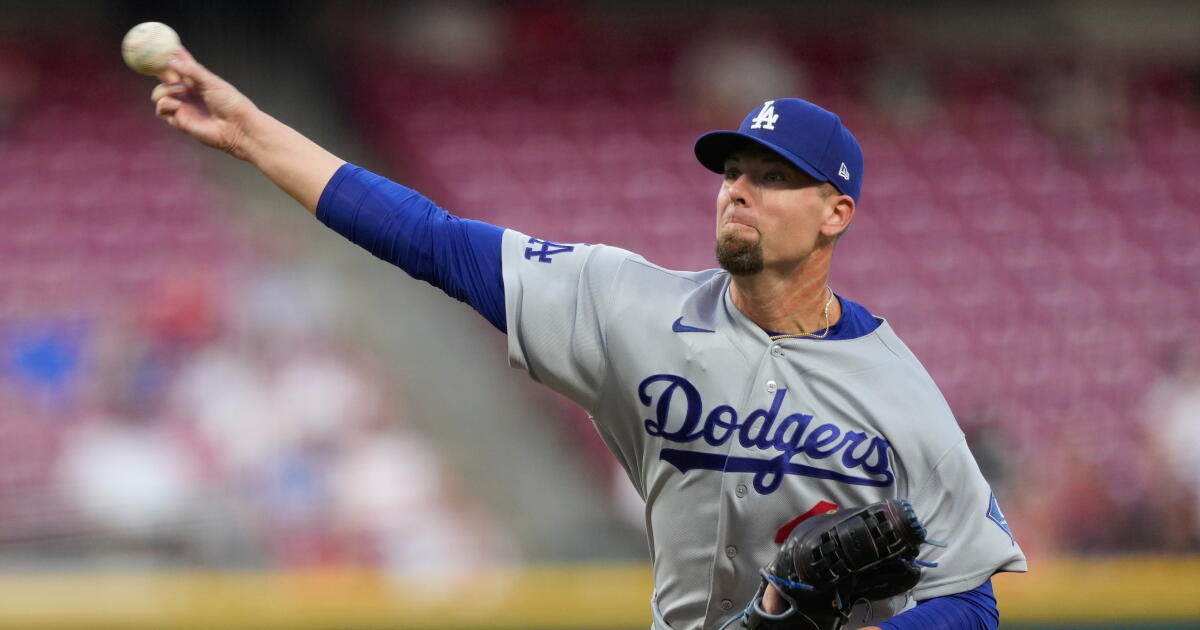
treinen

MLB’s Pride Night cap condemnation is not an anti-Christian crackdown

Amid the first days of grief after Alex Vesia and his wife lost their newborn daughter last fall, Vesia noticed something as he watched the World Series on television. He paused the broadcast, then checked the video, then texted another player to make sure.

51.

Dodgers teammates wore his number on their caps. So did players from the Toronto Blue Jays.

“It was awesome,” Vesia said. “It was a very heartwarming moment.”

Moving.

Touching.

And, under baseball’s rules, illegal.

Who knew, really, until this week? Three pitchers from the San Francisco Giants wrote the name of a Bible verse on their Pride Night caps and, amid an uproar, Major League Baseball said it had warned the players that “writing of any kind, with any message” on any playing apparel is not permitted. The issue, the league said in a statement, was not what they wrote on their caps but simply that they wrote on them at all.

Said MLB in the statement: “We have given the same warning numerous times in the past to players for messages such as ‘Dad’, ‘Happy Mother’s Day, I Love Mom’ and names of family members.”

To its credit, the league did not enforce the rule when Vesia’s number started appearing on caps in the World Series. But, if you’re going to draw a line on enforcement, where should you draw it?

In San Francisco, the actions of the Giants’ pitchers were widely condemned.

“They were in for a rude awakening with the response, and it wasn’t just from the gay community,” Giants broadcaster and former pitcher Mike Krukow told KNBR, the team’s flagship radio station. “It was from the Northern California community that supports the gay community.”

In response to media inquiries, and as first reported by Outsports, MLB confirmed it had warned the three players. I asked the league whether warnings had been issued in two other instances in which players had written on their caps, including Clayton Kershaw last year writing the same Bible verse on his Pride Night cap that the Giants’ pitchers wrote this year. MLB declined to comment.

“I got chastised by the league when I put Charlie [Kirk]’s name on my hat last year, because a man was murdered in cold blood,” Dodgers pitcher Blake Treinen told me, “and now these gentlemen who are relievers in San Francisco are getting chastised by the league for putting a Bible verse on their hat. It’s crazy to me.”

Treinen said league officials had told him the rule is strictly enforced.

“I straight up asked Clayton last year, ‘Did they call you when you put that on your hat?’” Treinen said. “He said, ‘No.’”

The Pride caps feature team logos decorated in the colors of the rainbow, a symbol long associated with the gay community. In the Bible verse cited by the pitchers (Genesis 9:12-16), the rainbow represents “the everlasting covenant between God and all living creatures.”

That the league would warn players against writing a Bible verse on their caps ignited a wave of conservative outrage, from Vice President JD Vance to Texas Gov. Greg Abbott.

Missouri Sen. Josh Hawley fired off a letter to MLB commissioner Rob Manfred, alleging apparent discrimination “against baseball players who profess their Christian faith” and threatening the league’s antitrust exemption. Assistant U.S. Atty. Gen. Harmeet Dhillon said on national television that players might be able to file a claim for employment discrimination.

That is complete nonsense. This is what you want: When employees raise an issue to their employer, the employer listens and addresses their concerns.

In 2023, the year after five Tampa Bay Rays players declined to wear rainbow logos for Pride Night, Manfred said the league would no longer compel players to do so.

“We have told teams, in terms of actual uniforms, hats, bases that we don’t think putting logos on them is a good idea just because of the desire to protect players: not putting them in a position of doing something that may make them uncomfortable because of their personal views,” Manfred said then.

Dodgers teammates congratulate Freddie Freeman after his walk-off home run.

Teammates congratulate Freddie Freeman after his walk-off home run gave the Dodgers a 1-0 win on June 5, when the Dodgers held their annual Pride Night. Blake Treinen, the winning pitcher that night, elected to wear his regular Dodgers cap instead of the Pride version.

(Katelyn Mulcahy / Getty Images)

Manfred said the Pride Night celebrations could go on, however a team wished to stage them — or not, in the case of the Texas Rangers, the only one of the 30 MLB teams that declines to hold a Pride Night. And the league still sells Pride gear on its website for all teams, including the Rangers.

In the cases of the Giants and Dodgers, MLB grandfathered each team’s long-running use of a rainbow logo on the cap, with this accommodation to players: If you don’t feel comfortable wearing the Pride cap, just wear your regular cap.

That is what Treinen and outfielder Alex Call did when the Dodgers celebrated Pride Night. That is also what a fourth Giants pitcher did.

“My job is to abide by the rules,” Treinen said. “Ultimately, the only rule we have is to wear our team-issued uniform. So that’s what I chose to do.”

To Treinen, the decision over whether to wear a Pride cap is not about passing judgment on anyone else but about what he sees as the push “to force something on people that you know that is controversial to their faith — and, in fact, straight up against their faith.”

He expressed his support for the Giants pitchers.

“Kudos to those men over there who are standing strong in their faith,” he said. “It’s a sad thing to corner someone and try to make them feel bad about their convictions.”

I respect Treinen for explaining his viewpoint. To me, wearing a Pride cap for one night does not diminish your faith at all. It might sharpen your convictions. More important, it signals a welcome to everyone in the community that buys the tickets and broadcast subscriptions that help pay your salary.

“I think a few people made it about themselves and not about the community,” San Francisco Mayor Daniel Lurie told the Bay Area Reporter.

We always proclaim the life lessons of sports. One of them: Sometimes you have to put the team’s interests ahead of your own.

Source link