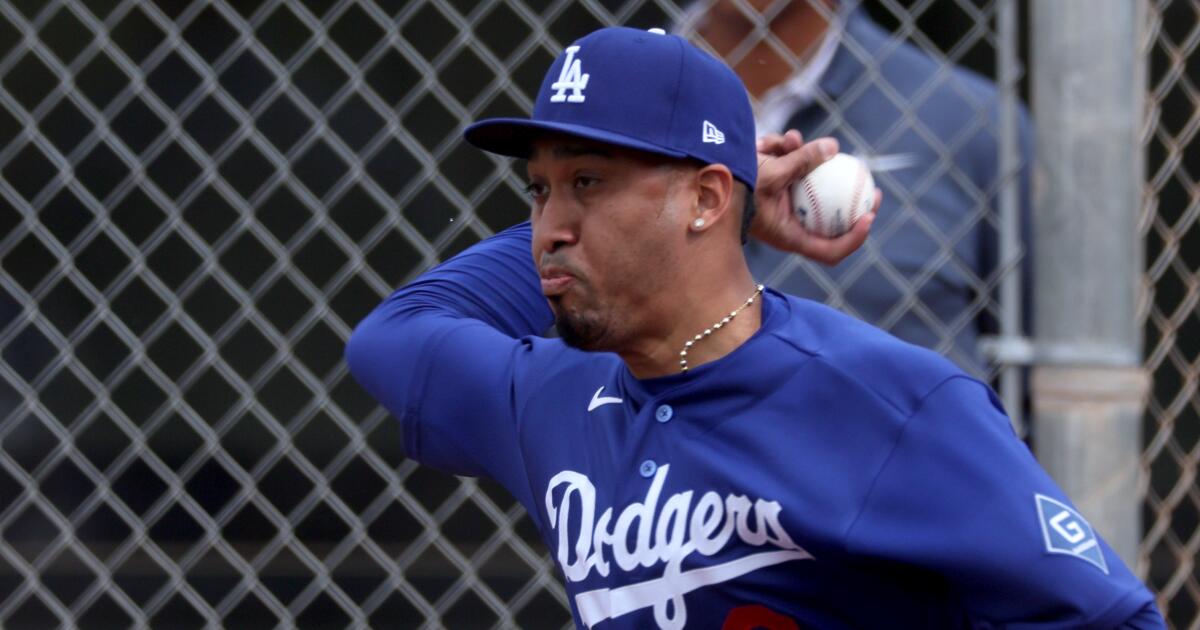
treinen

Edwin Díaz is the Dodgers’ closer. How rest of the bullpen shapes up

p]:text-cms-story-body-color-text clearfix”>

By Game 7 of last year’s World Series, the Dodgers’ faulty bullpen issues were apparent even in the midst of dramatic triumph.

Not only did the Dodgers use all four starters in their postseason rotation — Shohei Ohtani, Blake Snell, Tyler Glasnow and Yoshinobu Yamamoto — they also tapped Justin Wrobleski and Emmet Sheehan, who combined to start 14 games in the regular season, to navigate the 5-4, 11-inning win that secured the team’s second consecutive championship.

The Dodgers shored up the bullpen over the winter, signing three-time all-star Edwin Díaz to a three-year, $69-million contract. With the closer role firmly defined for the first time since Kenley Jansen was on the team in 2021, how the rest of the bullpen falls into place remains a work in progress during spring training.

“Obviously, adding Díaz to the back end is huge for us and getting Alex Vesia [back] is going to be good, and also Blake [Treinen],” Dodgers manager Dave Roberts said. “Blake wasn’t right last year, clearly. He’s throwing the baseball really well. Having guys that you trust is everything for the pen. … You’ve got to count on those veteran guys for sure.”

Now included in that veteran group is left-hander Tanner Scott, who joined the Dodgers before last season on a four-year, $72-million deal. Scott struggled to find his footing, primarily as a closer, before a left elbow injury placed him on injured list in mid-July, causing him to miss a month of action. He returned the final week of August, and never looked quite right. Scott posted a 4.74 ERA across 61 appearances and 57.0 IP in his first year with the Dodgers.

On Saturday against the Chicago Cubs in a split-squad game at Camelback Ranch, Scott made his Cactus League debut and pitched a scoreless inning, recording a strikeout and giving up one hit on 17 pitches. With the ninth inning spoken for, Roberts believes this will allow for Scott to bounce back this season.

“I think being able to use Tanner in any inning of leverage, is going to be good for him,” Roberts said. “And it’s going to be good for us.”

Díaz, for his part, has settled in, making his second appearance of the spring on Saturday. He worked around two walks to pitch a scoreless inning, striking out one. Vesia, who missed the World Series due to the death of his newborn daughter, has pitched two scoreless innings while Treinen pitched a perfect inning on Thursday against the Chicago White Sox in his first Cactus League outing.

The 37-year-old Treinen, who’s been on all three of the Dodgers’ recent World Series teams and was a stalwart in the 2024 postseason, struggled last season, going 1-5 with a 9.64 ERA in September.

“You never know what the body throttles back,” Treinen said earlier in camp. “I had a UCL injury, so I don’t know if that’s part of the problem, but something was different. I mean, velocity was there, movements were there, execution wasn’t, and when pitches were in the zone, it was a harder-hit rate. So, that tells me something was different, how to handle hitters. So, just trying to go back and cleaning things up to where the ball does more of what it has done most of my career.”

On the flip side, right-hander Brusdar Graterol — who has not pitched since the 2024 World Series — remains in a holding pattern during spring training as he works his way back from right labrum surgery. And right-hander Evan Phillips is not expected back for several months after Tommy John surgery ended his season last June. But for the most part, the relievers who are healthy have shown glimpses of what it could look like this season.

“I don’t think that there’s one way to manage a pen,” Roberts said. “But when you have a guy like Edwin Díaz as your closer, I do think it frees up other guys. … I think that’s freeing for me and allows for getting the matchups we need in the prior innings.”
Source link

‘Maybe you’re in the wrong business.’ Blake Treinen fires back at Dodgers’ critics

p]:text-cms-story-body-color-text clearfix”>

Much has been made of the Dodgers’ exorbitant spending, magnified by a pair of World Series titles for the franchise, as Major League Baseball enters the final year of the current collective bargaining agreement.

The Dodgers open 2026 with a record $381 million payroll, while having over $1 billion in deferrals. As if signing Shohei Ohtani, Teoscar Hernández and Blake Snell, and extending Tyler Glasnow and Will Smith weren’t enough, the club once again opened up its wallet this winter, spending a combined $309 million on four-time All-Star outfielder Kyle Tucker and three-time reliever of the year Edwin Díaz.

Relief pitcher Blake Treinen, one of the longest-tenured players on the Dodgers heading into his seventh season with the team, did not mince words when asked about how outsiders view the organization.

“Perception is built from the media and maybe owners that don’t like what the Dodgers are doing because they would have to do something similar,” Treinen said earlier this week. “And I say to that, ‘Maybe you’re in the wrong business.’”

Treinen thinks more teams should spend the way that the Dodgers do.

“Is it a bad thing that the people who pay our checks and our salaries want a winning product?” Treinen said. “If you’re going to complain about a team willing to do what it takes to win, then I think you’re in the wrong business. And, if you win, to say that you lose money by winning is a wild statement, so I think the perception is more or less if you don’t like what the Dodgers are doing, either take a look in the mirror or look at the people who aren’t putting a product on the field.”

Treinen went on to say that teams don’t necessarily need to be lavish spenders in order to compete, pointing to how the Milwaukee Brewers posted baseball’s best record a season ago, with the 22nd-highest payroll. The Brewers bested the Chicago Cubs in the NL Central by five games, despite having a payroll nearly $100 million lower than their rival, and reached the National League Championship Series.

“You don’t always have to spend money to be great, look at the Brewers,” Treinen said. “But to say that you can’t compete — like they did — is a wild thing, because [they had] the best record in baseball last year. Draft and development is a big deal, a lot of teams have leaned into it. So, if you either invest heavily in one or the other, and the Dodgers have done a great job of doing both and that’s why players sign here. If you don’t like it, then maybe find a new business model.”

How the Dodgers operate has garnered some praise — the Padres’ Manny Machado and the Phillies’ Bryce Harper weighed in on the subject early in spring training — but the front office wasn’t really seeking it out.

“We’re not looking externally for validation,” Dodgers general manager Brandon Gomes said earlier this month at Camelback Ranch. “The validation is winning championships and putting out as good a team as we can each and every year, and all we’re trying to do is get a little bit better each and every season, with the goal of winning championships. [Our] coaching staff, our players I think view it as that. Good, bad or indifferent, the external stuff is something we can’t worry about.”

Dodgers manager Dave Roberts, speaking at Cactus League media day earlier this month, said the fixation on the money spent makes people miss the things they do well.

“It does get lost, the things that we do well,” Roberts said. “Scouting and player development, I think we do as well as anybody in baseball … to get superstars to play well every night, to put out a good product every single night, I think we do a good job at that.”

“That’s why the biggest conversation should be that instead of a payroll question,” Roberts added. “Why are we good for baseball? Because our players play the game the right way.”

Source link