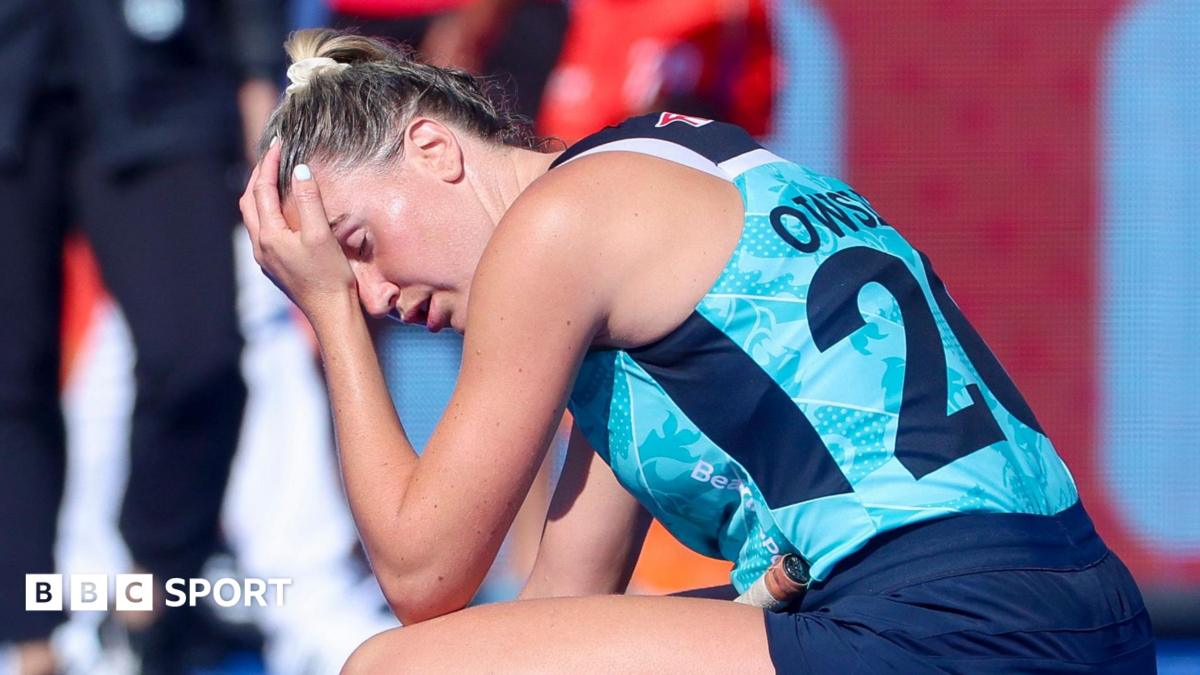
England women’s hopes of success at the FIH Hockey World Cup ended at the group stage after a 0-0 draw with India.
David Ralph’s side finish third in Pool D on four points, with two teams moving forward to the next round, and will now play in a classification phase that sees teams placed from 9th to 16th.
England won their opening match 4-0 against South Africa on Sunday but lost to China two days later, conceding four before Tess Howard and Sophie Hamilton reduced the deficit.
The national side have not challenged in tournaments since winning Commonwealth gold in 2022, finishing fourth in the 2023 EuroHockey Nations Championship, and fifth last year.
Teams from England and Great Britain have finished no higher than sixth in the FIH Pro League since a third place in 2020-21, while Great Britain also finished eighth at the 2024 Paris Olympics.
Meanwhile England’s men are through to the second stage of the men’s World Cup, topping Pool D with three wins out of three.
They defeated Pakistan 4-1 and India 4-2 prior to beating Wales 8-2 in their final group stage match on Wednesday.
They move in a second stage pool with India, with their 4-2 win carried forward, and will face two qualifiers from Pool A on Saturday and Monday as they attempt to reach the semi-finals.
England women play Chile on Friday and Japan on Sunday in their classification pool, with both World Cups being held in Wavre in Belgium and Amstelveen in the Netherlands.
Taryn Brasher and Kristen Cruz clinched an AVP Manhattan Beach Open three-peat on Sunday, sweeping Kelly Cheng and Megan Kraft.
It was the tournament’s first three-peat since Misty May-Treanor and Kerri Walsh Jennings won four straight titles from 2005-08.
Brasher and Cruz, the top-ranked women’s pro beach volleyball team out of Louisiana State, rolled past Cheng and Kraft 2-1 (21-18, 21-16).
Brasher and Cruz took a commanding 4-1 lead to start the first set, the first of back-and-forth surges by both sides. Cheng and Kraft tied the set at 15, but Brasher and Cruz pulled ahead for the 21-18 win.
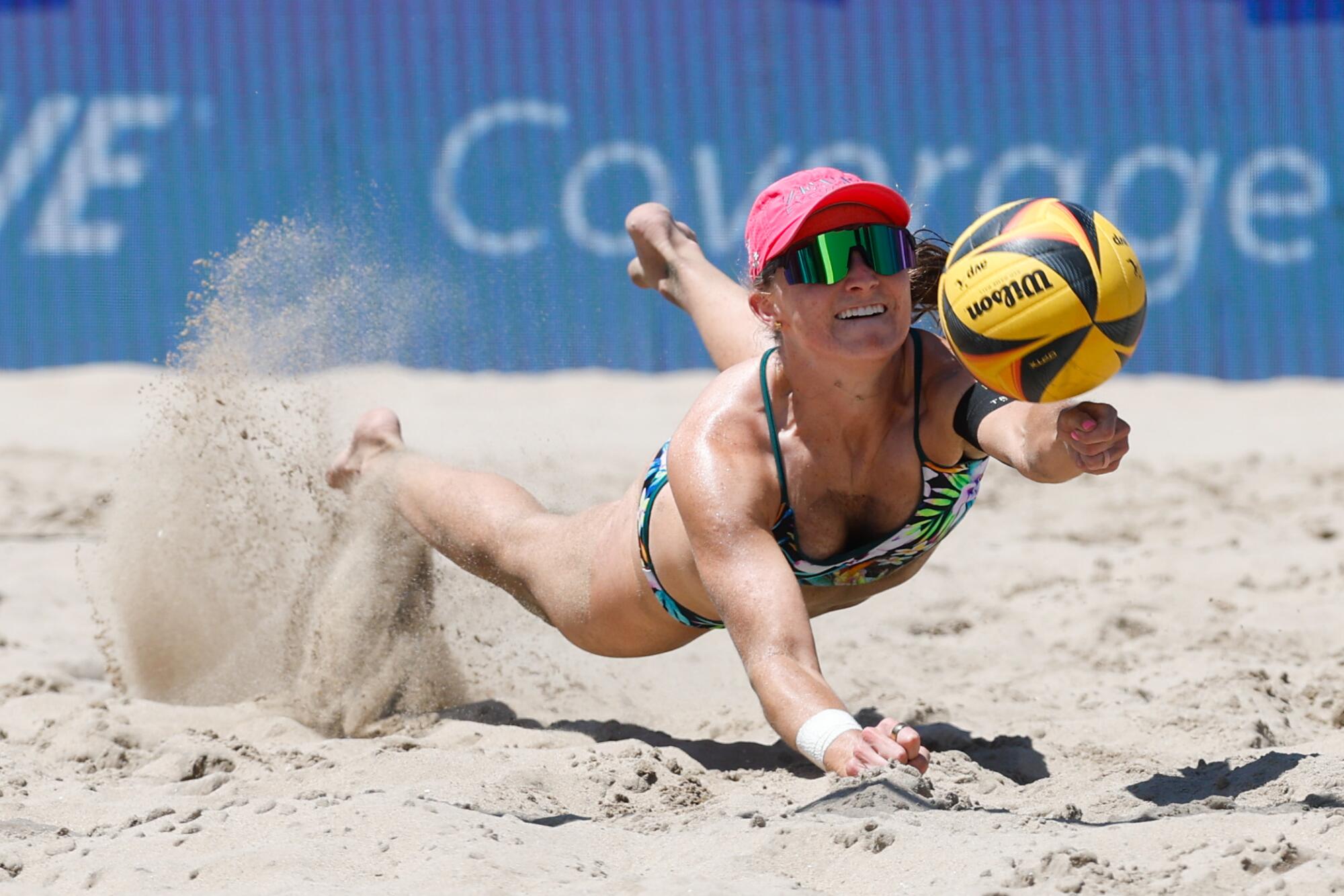
Kristen Cruz dives for a dig during the AVP Manhattan Beach Open women’s final at Manhattan Beach Pier on Sunday.
(Ronaldo Bolaños / Los Angeles Times)
Taryn Brasher, left, and Kristen Cruz celebrate after defeating Kelly Cheng and Megan Kraft during the AVP Manhattan Beach Open women’s final Sunday.
(Ronaldo Bolaños / Los Angeles Times)
Brasher and Cruz kept the pressure on during the second match, pulling ahead early 8-6 and leading by as much as 17-12 before closing out the victory.
On the men’s side, Andy Benesh and Taylor Crabb defeated Thomas Hurst and Gage Basey in two sets (21-14, 21-13) to clinch the tournament title.
Crabb previously clinched a Manhattan Beach Pier bronze plaque, but it was Benesh’s first time winning the open.
Crabb and Benesh took a commanding 8-3 lead in the first set with all of the energy flowing on their side. Hurst and Basey rallied to cut the deficit to 8-7, but Benesh ended the scoring drought with a monster block.
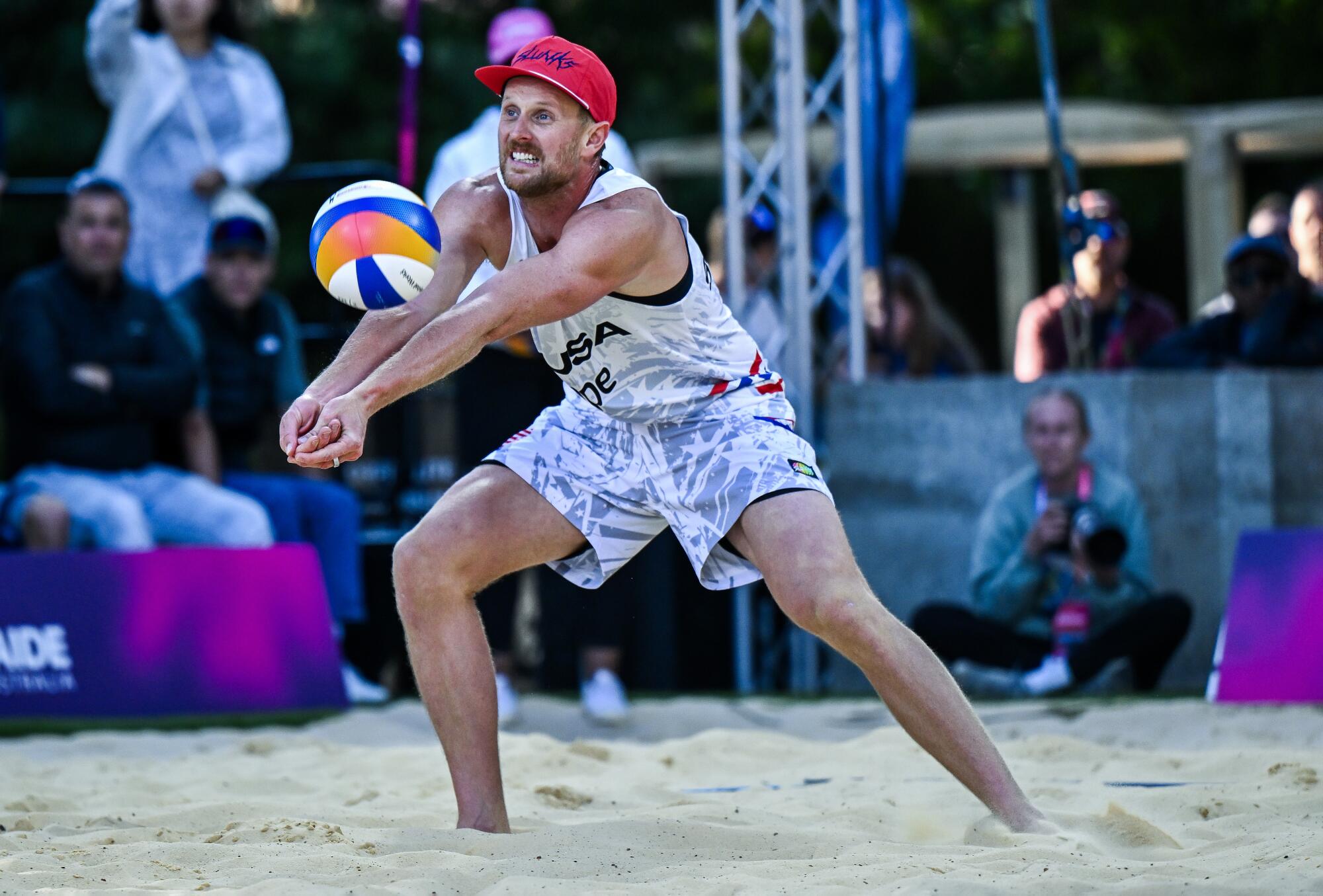
Taylor Crabb dives for a ball during the AVP Manhattan Beach Open men’s final at Manhattan Beach Pier on Sunday.
(Ronaldo Bolaños / Los Angeles Times)
Andy Benesh, left, spikes the ball under pressure from Thomas Hurst.
(Ronaldo Bolaños / Los Angeles Times)
Andy Benesh and Taylor Crabb stand alongside friends and family after winning the AVP Manhattan Beach Open on Sunday.
(Ronaldo Bolaños / Los Angeles Times)
Benesh and Crabb added to their lead to 13-8 with back-to-back blocks and rolled to a 21-14 win.
The duo led early in the final set and had little trouble delivering a 21-13 victory.
Crabb had 10 kills and 14 digs during the match, with many of the kills coming during the second set. Benesh closed with 14 kills and eight blocks.
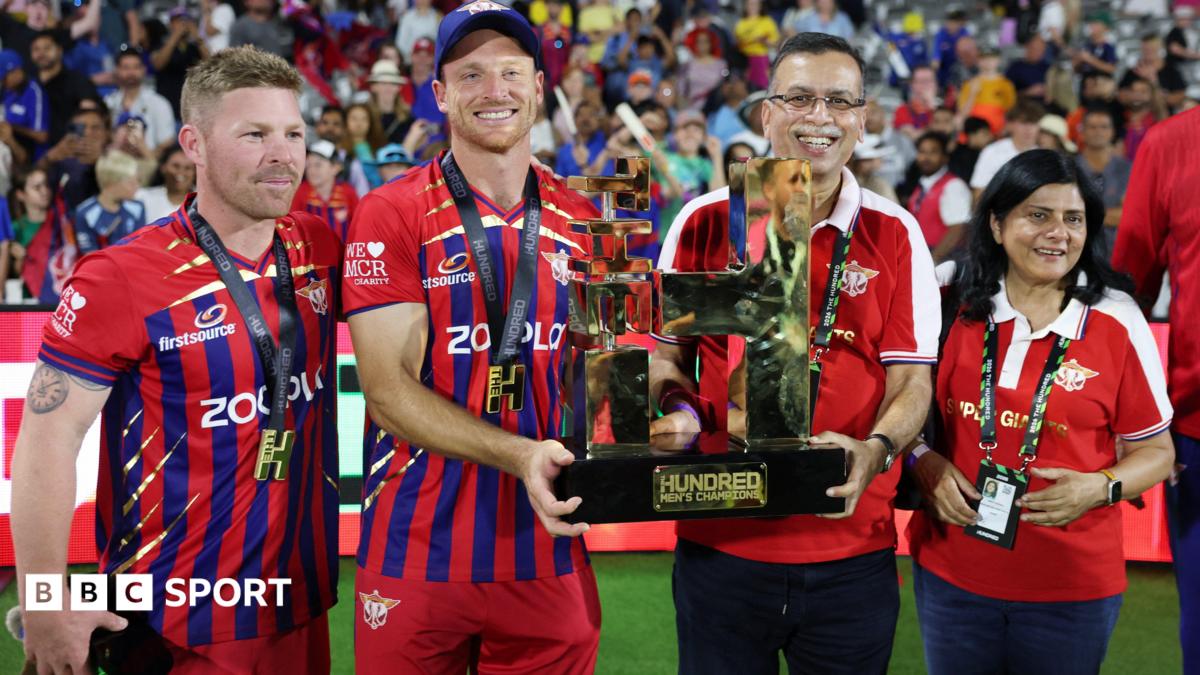
Manchester Super Giants (MSG) rebranded from the Originals, also changing their team logo and colours, after RPSG group – led by Indian billionaire Sanjiv Goenka – bought a 70% stake in the franchise, with Lancashire having 30% ownership.
Goenka’s Indian Premier League (IPL) side Lucknow Super Giants have yet to reach that competition’s final since being founded in 2022, but his Hundred investment has resulted in immediate success as Jos Buttler’s side sealed the Manchester franchise’s first title for either men or women.
Lancashire chief executive Daniel Gidney, also on the board of MSG, says there’s no choice but to be bold in a rebrand.
“If you’re trying to launch a new brand in a new market, in the UK particularly, in a city that is dominated by football, you’ve got to go big and loud,” Gidney told BBC Sport.
One daring ‘brand activation’ resulted in almost 30,000 free shirts being given to Super Giants fans.
“To give everybody a free jersey who bought a ticket is extraordinarily different,” said Gidney.
“You can’t normally do it because a kit manufacturer will go, ‘No, no, no. I’ve got to sell that kit for £60-80.’
“You never get anything for free. It’s had a massive impact, much more than I thought.”
The decision was made this first year to forego a potentially lower kit deal for the opportunity to build the MSG brand, get fans in the team colours, and then strike a more lucrative supplier deal in years to come.
But how does that benefit Lancashire more broadly? The county’s merchandise continues to be sold at Old Trafford on matchdays, while at the moment you won’t find MSG products in the club shop.
Gidney says Lancashire were able to “retain effectively 50% merchandise arrangements” with MSG, who they can use as a “bit of a pilot” – possibly bringing some of what they learn into the T20 Blast competition.
The franchise will now hope to have acquired new fans and take momentum from their first on-field triumph, while they also pocket £275,000 in prize money.
They were dealt the blow of losing captain Aiden Markram halfway through the group stage as he returned to South Africa for personal reasons, but Buttler seamlessly stepped up, while the appointment of Tom Moody as their director was another savvy decision.
Former Australia player Moody was at the helm for Oval Invincibles’ previous dominance in the men’s Hundred, with three consecutive titles. He will hope for further success at Old Trafford alongside compatriot Justin Langer, hired as coach from this season, the same role he has at Lucknow.
There are positives for their women’s side too, who just missed out on a knockout spot, but look likely to be in a good place if they can keep legendary former Australia captain Meg Lanning in charge.
People look for love wherever their heart takes them, but for Assn. of Volleyball Professionals players Chaim Schalk and Toni Rodriguez, they didn’t have to look far to find it.
“I said ‘I love you’ first,” Schalk said.
The beach volleyball power couple is competing in the AVP Manhattan Beach Open this weekend, continuing to focus on the competitive volleyball circuit that first brought them together.
The couple met briefly while playing at various beach volleyball events, but they really got to know each other and clicked while spending three weeks together during tournaments in China, India and the Philippines. Schalk told Rodriguez he would take her out to dinner at her favorite restaurant, but there was a catch. Rodriguez had to win her upcoming tournament in order to go out with Schalk.
American Chaim Schalk digs the ball during a match against Cubans Nosien Diaz Amaro and Jorge Luis Alayo Moliner during the 2025 Beach Volleyball World Championships at on Nov. 20 in Adelaide, Australia.
(Mark Brake / Getty Images)
Rodriguez made Schalk live up to his promise. The couple went to their favorite fast-food joint, Cafe Rio, because it was something they bonded over during their overseas trip.
“She texted me, ‘Cafe Rio on you?’ after winning,” Schalk said. “And then she flew back [to California] the next day, and we went there.”
Rodriguez didn’t need any motivation to win gold to go out with her future fiancé, but it didn’t hurt. She said that Schalk keeps her level-headed when it comes to playing on the beach.
Schalk has played on the biggest beach volleyball stages. He represented Canada at the 2016 Summer Olympics in Rio. One of his proudest moments was defeating a Brazil team on its home soil.
Chaim Schalk and Ben Saxton of Canada play beach volleyball against Pedro Solberg and Evandro Goncalves Oliveira Junior of Brazil during the 2016 Olympics in Rio.
(Ezra Shaw / Getty Images)
“Beating Brazil in front of 15,000 fans is something that I’ll never forget,” Schalk said.
He called playing in the Olympics the pinnacle of any sport and making Team Canada has been the highlight of his career.
Schalk has had dual-citizenship since birth and has switched his affiliation to Team USA. He hopes to qualify for the 2028 Olympics in Los Angeles and play alongside Rodriguez. He is a two-time AVP League Champion and three-time winner on the AVP Tour.
His love for volleyball dates back to his time in Canada as a young boy playing with his brothers in their massive grassy backyard.
“I personally love volleyball. I love competing and love trying to win,” Schalk said.
Rodriguez grew up in St. Amant, La., and was focused on volleyball from a young age before playing the sport in high school and at Louisiana State.
American Toni Rodriguez plays a shot against Reika Murakami and Suzuka Hashimoto of Japan during a Volleyball World Beach Pro Tour match in 2022.
(Matt Roberts / Getty Images)
The LSU graduate wanted to play indoor volleyball in college, but she couldn’t because of injuries and instead joined the beach volleyball team.
“Once I got to the LSU beach team and started learning the game and actually playing, I just came to find a new love for the sport,” Rodriguez said. “Once I started playing, there were a lot of opportunities to leave Louisiana and potentially play professionally.”
After three seasons at LSU, Rodriguez moved to California to begin her beach volleyball career. Schalk also left Alberta, Canada, to focus on his beach volleyball career.
“I moved in 2013 to California to train full time and play beach volleyball full time,” Schalk said, who along with Rodriguez lives in Gardena. “I didn’t know I would be here for this long, so it’s definitely different. I love California, and I think it’s a beautiful place to live and we’re lucky to live close to L.A.”
Rodriguez has won two FIVB gold medals. In 2024, she was part of the the first AVP League championship team and joined Molly Shaw winning silver, bronze and gold medals during three consecutive Challenger events in three different countries during a three-week span.
Schalk and Rodriguez have great affection for a sport that took them around the world before they met each other. Schalk said competing in Switzerland near the Swiss Alps was special.
“I have been there about eight times, but that place, for me, is my favorite place I’ve ever played at,” Schalk said.
While they chase AVP and Olympic wins, the couple also are planning a wedding after Schalk surprised Rodriguez with a bold question early in their relationship.
After only officially dating for two days following Rodriguez’s tournament, Schalk invited Rodriguez to Kauai, Hawaii, in January.
Rodriguez had a hunch he might propose because they had formed such a tight bond during their overseas trip.
They went on a hike with Schalk’s brother and kids to a spot with a beautiful jungle view and large swing.
Schalk’s family set up the proposal spot while everyone was walking to the site. Once they arrived, Schalk turned to Rodriguez, got down on one knee and asked her to marry him.
“I blacked out. It was perfect,” Rodriguez recalled.
The couple is set to get married this fall in El Segundo.
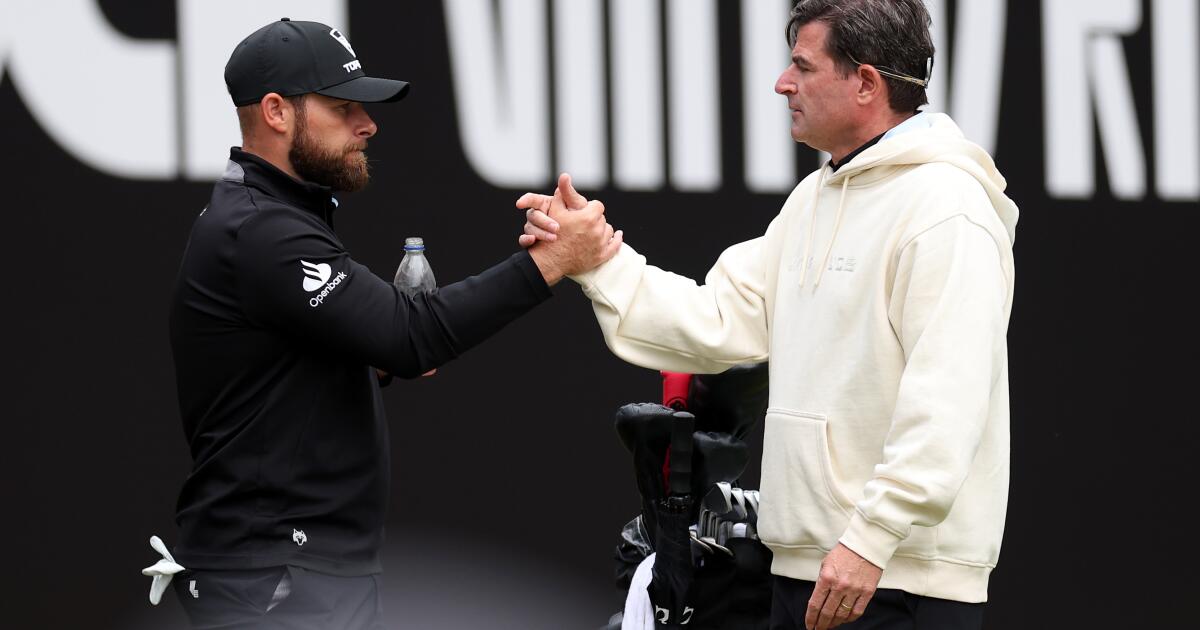
One day after a LIV Golf players-only meeting failed to produce a resolution, CEO Scott O’Neil announced Wednesday that a lead investor plans to fund the tour beyond this season and that the golfers will become the majority equity holders in the league.
The LIV Golf board of directors approved the term sheet, O’Neill said, giving the league new life after the Saudi Public Investment Fund decided in April to cease its financial backing at the end of the current season. The PIF had backed LIV Golf since its inception in 2022, spending an estimated $6 billion.
O’Neil, who made the announcement at Trump National Golf Club in Bedminster, N.J., the site of this week’s tournament, did not identify the investor or terms. He said the league hopes to finalize the transaction in September and that “our next chapter will make our players the majority equity holders in LIV Golf, a first for a major global sports league.”
“LIV Golf has an agreement in place with a lead investor, signed by the investor and approved by the board, to anchor the transaction and play a key role in supporting the path forward for the league’s next era, driven by and for the players,” O’Neil said in a statement. “We’re also seeing strong interest from more than a dozen additional parties to potentially serve as minority investors, creating a multi-partner model built for long-term stability and growth.”
The players-only meeting on Tuesday at Trump National came soon after O’Neil and other LIV Golf executives spoke to the players. The only player to speak at length with the media after the meeting was Richard Bland, who told the Athletic that Bryson DeChambeau had led the discussion to follow O’Neil’s lead, but that nothing definitive had been determined.
“We’re in this together. We’re fully backing Scott,” Bland said. “I think probably in the next two to three weeks we’ll have a bigger picture. We’re just in that kind of stage at the minute that we’re positive with what’s going on, but we just need everything to be fully signed off so you can go forward.”
O’Neil said in June that LIV Golf needed to secure roughly $300 million from outside private equity or institutional investors to sustain operations through 2027 and beyond. He has been pitching “LIV 2.0” with a streamlined business model.
“What we don’t have is a lot of time,” he said in June. “So we’re very urgently out there talking to those who are interested. We like the pool, but we have to get this done through the summer.”
It appears O’Neil might have met the deadline, although questions remain unanswered. LIV has been mulling whether to cancel its Team Championship on Aug. 27-30 at the Cardinal in Plymouth, Mich., the final tournament of the season. The purse is $40 million, cash that instead could be earmarked for 2027.
O’Neil said that making players the majority equity holders “gives the league the foundation to keep growing the game worldwide…. In the meantime, our focus is on delivering a great week for fans and players at Bedminster and finishing the 2026 season strong.’’
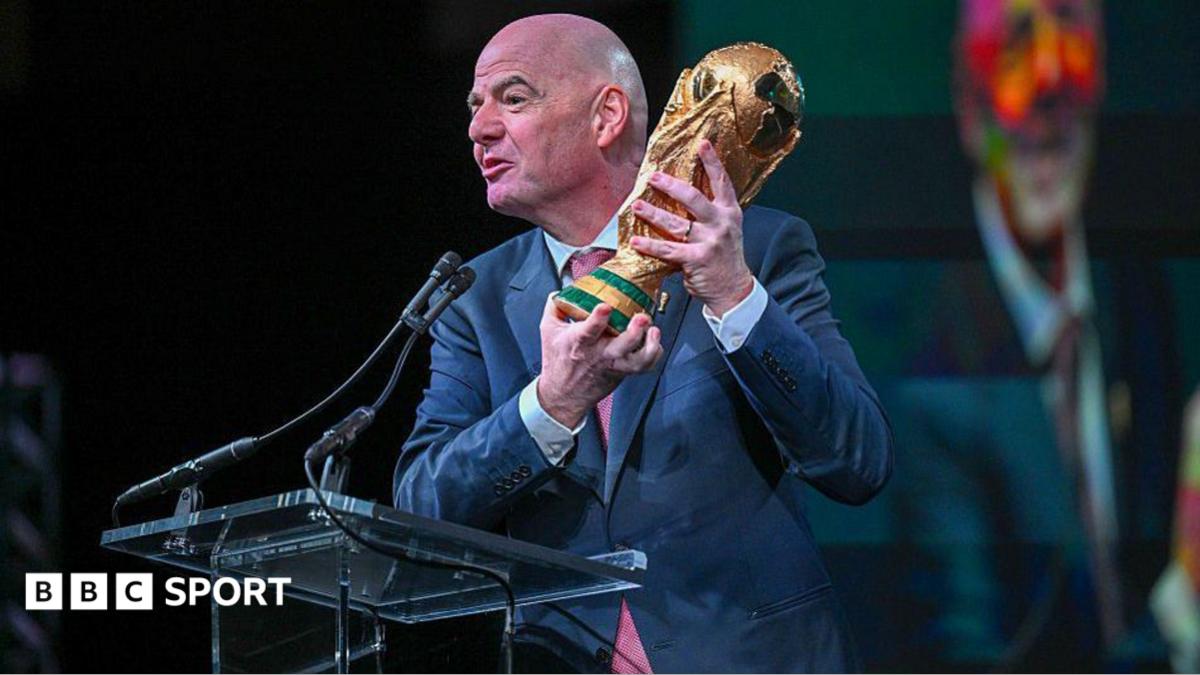
Heading into the final weekend of this summer’s World Cup, The Guardian reported that support for FIFA president Gianni Infantino had climbed to record levels. More than 200 of FIFA’s 211 member associations formally endorsed Infantino’s bid for a fourth term as head of world soccer’s governing body, the paper reported, making next March’s vote more of a coronation than an election.
Two weeks later, that support disappeared. Not only is Infantino’s reelection campaign in tatters, but there’s a chance he won’t survive until the spring, with British Prime Minister Andy Burnham and Javier Tebas, president of Spain’s soccer association, calling for his resignation and close confidants such as Carlos Cordeiro, the former president of U.S. Soccer, and Kevin Lamour, FIFA’s chief operating officer, publicly breaking with their boss.
At the center of that reversal was a closely guarded scheme to raise $4.2 billion by selling a 20% stake in the World Cup to private investors, who would be given influence in planning and executing future events, including broadcasting and commercial deals tied to the tournament.
In short, Infantino was planning, in secret, to sell shares in the World Cup. And once details began leaking in the media, he was forced Friday to scrap the whole thing, an embarrassing retreat that has left him vulnerable just two weeks after he had seemingly reached the heights of his third term as FIFA president.
Infantino’s idea, called the FIFA Forward Enterprise, was intended to turn the World Cup, FIFA’s milk cow, into a golden calf. But to do so, he needed the approval of at least 106 of FIFA’s 211 member countries, so he promised countries that backed him that they would receive $20 million each by mid-September. Those who declined would get just a fraction of that.
Infantino was certain the piles of cash would buy the acquiescence — or at least the silence — of enough members for the plan to go through. Instead, the bribe blew up in his face and FIFA issued a statement late Friday, under Infantino’s name, that basically said “never mind.”
“Having listened carefully to all the views, it has become clear that the project has created divisions of a nature that, regardless of the level of support, are no longer in the interest of the objective set out in the first place,” the statement read.
The question now becomes whether Infantino’s presidency will proceed.
He wouldn’t be the first FIFA president to be grievously wounded by unbridled ambition, but the speed and depth of his fall is staggering. The 2026 World Cup was, by nearly every measure, wildly successful. The largest and most complex sporting event in history the tournament, hosted by the U.S., Mexico and Canada, exceeded expectations, drawing more than 6.8 million live fans and a global TV audience of more than six billion. The four-year World Cup cycle brought FIFA revenues of about $15 billion, making it the first sporting event in history to earn more than $10 billion.
Infantino has never been shy about pushing boundaries despite heading a Swiss-based organization that, its wealth notwithstanding, is officially a nonprofit. Nor was this the first time he tried to bring private equity into the World Cup: In 2018, two years into his first term as FIFA president, he considered a plan to raise $25 billion to fund tournaments, only to cave in the face of massive opposition.
He didn’t give up the idea of squeezing more money out of the World Cup, though.
This summer, he introduced three-minute hydration breaks in the middle of each half — ostentatiously a nod to the heat and humidity, but in reality a ruse that allowed broadcasters to generate millions in additional revenue through TV commercials. FIFA also staged a halftime show for the first time ever during the final, sold VIP tickets priced at more than $1 million each and introduced dynamic pricing for the tournament’s 104 games, driving prices for some seats to four times what fans paid four years ago in Qatar.
That pushed the tournament beyond the reach of many of the sport’s most loyal supporters — and soccer, more than any other sport, belongs to the fans. It’s why teams are called clubs and fans are called supporters.
The World Cup, then, wasn’t Infantino’s to sell. So the pushback to his latest idea was immediate and unsparing.
“Football does not belong to investors,” Burnham said in an Instagram post. “Once you have sold a piece, you have sold out. Football belongs to the fans. It always has, and it always will.”
What really angered stakeholders, however, was Infantino’s brazen move to develop the FFE in secret, only to have its details leak out.
Bernd Neuendorf, president of the German soccer association and a member of the FIFA Council, the group’s most influential body, said he first learned of the FFE by reading about it.
“I was very surprised, and also annoyed, that we had to find out about something like this from the press,” he told a German news outlet last week.
Another self-inflicted wound was Infantino’s decision to launch the project with Thrive Eternal, a venture capital firm founded by Joshua Kushner, the 41-year-old brother of Jared Kushner, President Trump’s son-in-law and a kind of all-purpose White House advisor and negotiator. Thrive Eternal focuses on long-term investments in scarce cultural institutions that technology cannot replace, but it has little relevant experience in managing something as large and complicated as a World Cup.
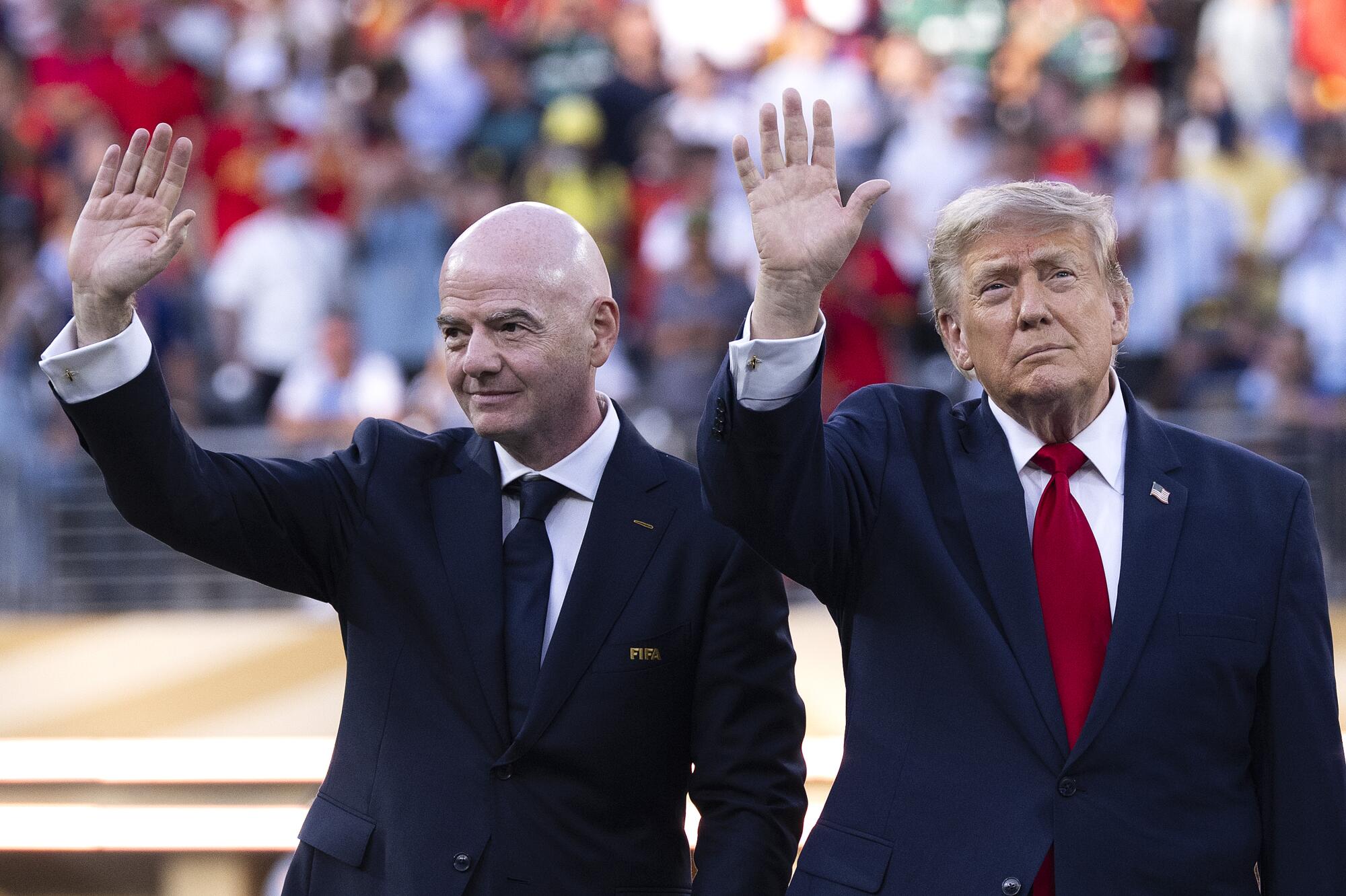
FIFA president Gianni Infantino, left, and President Trump wave during an award ceremony following Spain’s win over Argentina in the World Cup final July 19.
(David Ramos / Getty Images)
Moreover, the partnership would draw Infantino further into the orbit of Trump, whom the FIFA president has openly courted for years. Infantino, who has been a frequent visitor to the Oval Office and Trump’s Mar-a-Lago estate in Florida, attended the president’s inauguration and accompanied him on visits around the world.
Trump’s relationship to Infantino was questioned when Infantino presented him with the first FIFA Peace Prize last December, then became even more controversial when Trump phoned Infantino three times to lobby to have the red-card suspension of U.S. forward Folarin Balogun overturned ahead of a World Cup elimination game last month.
FIFA eventually cleared Balogun to play, marking just the second time in tournament history a red card ban has been lifted. For some, Infantino’s decision to partner with someone close to Trump on his latest venture was a bridge too far.
“It’s a really bad look for Infantino given the concerns about political interference that were already there after Balogun,” said Steven A. Bank, a professor of business law at UCLA who has written and lectured extensively on the economics of soccer. “Especially with the fund led by Jared Kushner’s brother.”
Once details of Infantino’s secret plan began to leak, UEFA, the confederation that governs European soccer, held an emergency meeting during which all 55 members — including Spain, the reigning men’s and women’s World Cup champion — voted to boycott all FIFA competitions.
“Some things are simply too important to sell. The FIFA World Cup belongs to football. It always will,” UEFA, the largest and most powerful of FIFA’s six continental confederations, said in a statement.
CONCACAF, which oversees soccer in North America, Central America and the Caribbean, said its 41 countries also rejected the plan, an opinion the U.S. Soccer Federation backed in a sparse post on X.
“U.S. Soccer stands with CONCACAF and its members,” it wrote.
The Asian Football Confederation joined in, saying in a statement its 47 members stand “in solidarity with UEFA and CONCACAF in expressing serious concerns over FIFA’s proposal to introduce private investment into FIFA’s flagship competitions.”
When it became obvious Infantino would not get the votes he needed to go forward, he pulled the plug on his plan. But it may not have been so much that the idea was bad as it was the execution.
Soccer is awash with private investors. The biggest clubs are owned by billionaires or sovereign wealth funds and many leagues — including Spain’s La Liga, which Tebas oversees — have sold commercial stakes to private equity firms in much the same way FIFA proposed.
Alan Rothenberg, a former U.S. Soccer president and the driving force behind the 1994 men’s World Cup and 1999 women’s World Cup, among the most successful tournaments in history, said the idea of selling a private equity stake in the World Cup isn’t a bad idea. But the way Infantino tried to implement his plan led it to failure.
“What is proposed is not that revolutionary,” Rothenberg said. “There have been private equity investors in MLS, in one of the subsidiaries of the NFL, in F1.
“But I think the combination of everything has doomed it. It does raise the possibility that Infantino, he’s finally become Icarus and gotten too close to the sun. It actually may doom him politically.”
Others including Cordeiro, a former vice chairman at Goldman Sachs, questioned the need to bring in outside investors.
“FIFA already has access to extraordinary financial resources. The organization sits on billions of dollars in reserves and no debt,” Cordeiro pointed out in his resignation letter. “If member associations believe additional investment is needed to develop the game, FIFA already has the financial capacity to provide that support from its existing resources.”
Infantino has flaunted consensus before without significant consequence, cozying up to autocrats while overseeing the 2018 World Cup in Vladimir Putin’s Russia and the 2022 tournament in Qatar before being accused of awarding the 2034 tournament to Saudi Arabia in a rigged vote.
This time, however, the stakeholders within FIFA were pushed too far by Infantino’s penchant for wielding unilateral power, so they pushed back and the president blinked. Hours before he backed down, an ally of Infantino’s told the Financial Times that he would not bend, seeing the standoff as “a fight to the death.”
Infantino’s presidency might not be dead, but it is surely in critical condition.
Uefa’s 55 member associations have voted to boycott the World Cup if Fifa proceeds with its plan to sell stakes in its competitions to private investors.
The decision was made at an emergency meeting on Thursday to discuss the proposals announced by Fifa – world football’s governing body – on Tuesday.
Uefa, which governs European football, had made its opposition clear by releasing two damning statements about the plans – and that strength of feeling has now been reaffirmed.
The boycott would cover all Fifa competitions, including the men’s and women’s World Cups and Club World Cup and be triggered if Fifa president Gianni Infantino’s proposals are voted through by member associations.
The first time this stance will be tested is October, when the Women’s World Cup play-offs are due to be held.
Chaibasa, India – As the world celebrates Spain winning its second FIFA World Cup and the “GOATS” of football who headlined the month-long tournament, a remote Indian village has also joined in – albeit with an indigenous touch.
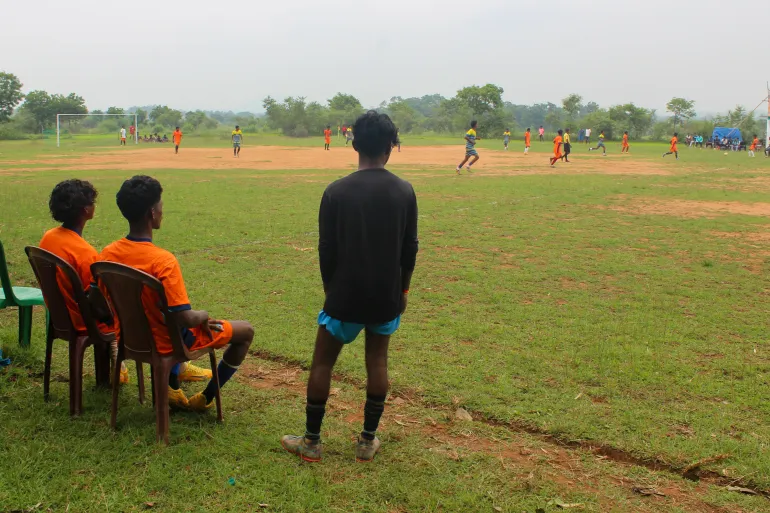
To coincide with the FIFA event, residents of Tirilbasa village in Chaibasa, a tribal-dominated district in eastern India’s Jharkhand state, organised a football tournament from July 14 to July 17, featuring teams from 64 nearby villages.
Recommended Stories
list of 4 itemsend of list
But the star attraction at the Rangila Star Tirilbasa tournament (“rangila” means “colourful” in Hindi), besides relatively handsome prize money, was a herd of goats to be handed as trophies to the best-performing teams.
The finals were played on Friday, with NCS Maudi beating Kumbaram 1-0, a dramatic prediction of what happened between Spain and Argentina two days later in New York.
Competing teams play a football match at the Rangila Star Tirilbasa tournament in Chaibasa, Jharkhand, India [Shweta Desai/Al Jazeera]
NCS Maudi carried home prize money of 15,000 rupees ($156) and three male goats (locally known as “khassi” for their castration at a young age). Runners-up Kumbaram won 12,000 rupees ($125) and two khassis, while Kobra FC Nimdhi and Galubasa FC, the third and fourth rankers, won 9,000 rupees ($93) and one khassi each. There are also cash prizes for the man of the match, man of the series and the best goalkeeper, but they don’t get any khassi.
NCS Maudi’s captain Sachin Devam, whose team arrived on two-wheelers to play the game, told Al Jazeera he would have to arrange for an autorickshaw to carry the goats home, 10km (6 miles) away.
“It’s the first win for our team, and we are going to celebrate it with everyone in the village,” he said with a beaming smile. “It’s going to be a khassi picnic.”
‘Khassi important part of our culture’
This year was the fifth edition of the Rangila Star Tirilbasa tournament.
The organisers say they follow the FIFA rulebook and invite popular commentators and referees certified by the state football association to ensure compliance with the guidelines and “avoid fights as players can get aggressive on the field”.
But the rest of the setup is markedly different from the conventional game. Rather, it is adapted to the ancient tribal traditions of the Ho community, which is native to the Chaibasa region.
The Ho people, numbering a little more than a million across India, genetically belong to the Austroasiatic group and identify themselves as tribal (“aadivasi” in Hindi) people inhabiting the forests. The word “ho” in their language means “human” or “people” of the Kolhan region in Jharkhand, one of India’s poorest states despite being home to some of India’s biggest coal and mineral mines.
The Austroasiatic tribes such as Santhals, Ho and Munda organise their traditional, religious and sporting activities like a close-knit community. Football events are an opportunity to invite fellow tribal kin to celebrate their bond.
For the Ho people, no celebration is complete without the khassi. The animals are used for ceremonial sacrifices during religious events and rituals, and their meat is shared among the community members.
“Khassis are part of the prize as they are an important part of our culture. Their meat is tasty, and everyone loves good mutton. Most teams slaughter the goats, but some also keep them as livestock and trophy prize,” Manish Kudada, an 18-year-old player and one of the organisers of the tournament from Tirilbasa, told Al Jazeera.
Manish Kudada with his prized khassi at his home in Tirilbasa, India [Shweta Desai/Al Jazeera]
Kudada has preserved the black khassi he won in another football tournament in February, but his friends joke that the goat is being fattened up for a feast. The khassi goats are prized for their meat quality. In Chaibasa, the goats can be spotted everywhere, especially during the weekly Tuesday markets, where a baby goat costs up to 8,000 rupees ($83).
“Without khassi, our celebrations are half-hearted. At weddings, even if the hosts serve double the amount of chicken and no khassi meat, it will upset the villagers,” Raj Keshri, goalkeeper for the Tirilbasa team and one of the organisers of the tournament, told Al Jazeera.
“We therefore decided to offer cash and goats as the prize. Players get to keep their money, but with the khassis, they also get to celebrate the victory with the entire village.”
Raj Keshri with the goat his team won at the tournament [Shweta Desai/Al Jazeera]
The Ho practice what they call the Munda-Manki governance system, under which the hereditary head of a village upholds all social, legal and customary rights of the people. Their tribal codes and customs take precedence over the Indian government’s panchayat (village administration) and police systems.
The Rangila Star Tirilbasa tournament is conducted at the “ek munda” (“ek” means “one” in Hindi) level, which means that a team’s members must belong to the same village. Instead of 11 players, each team has nine, of which at least six must belong to the same village to qualify for the tournament. Organisers say the rule is strictly followed to reinforce a sense of unity among the players.
The rules of the game have also been modified. There is no offside, and players are free to score from anywhere on the field.
“This kind of match setup provides an opportunity for players like us from small villages who never get a chance to qualify in open tournaments which are dominated by seasoned players,” Sudarshan Tiu, who plays for Galubasa FC, told Al Jazeera.
Suvir Kumar Tanti, the commentator for the tournament, travels widely across the Kolhan region during the monsoon football season, when most male members return home for cultivation and agricultural festivals.
At the finals at Tirilbasa on Friday, his high-pitched, lyrical play-by-play commentary boomed through the loudspeaker, helping the spectators keep track of the fast-paced action on the football field.
“The Rangila Star tournament reflects the culture of the Ho community. And khassi goats as prizes make it even more unique. Very few tournaments in the region follow this and prefer to conduct events in a professional manner, with trophies and medals as rewards,” he told Al Jazeera.
Spectators enjoy a football game at the Rangila Star Tirilbasa tournament in Chaibasa [Shweta Desai/Al Jazeera]
The tournament offers entertainment for the villagers, who pour in and out of the grounds through the day, squatting by the sides of the field or finding a place on the trees.
Nearby, food stalls sell fried dough balls, potato chops, yellow peas, and hooch. Men sit in circles, taking a break in between the matches to drink “madia”, a fermented rice beer that locals say helps them stay cool in the hot and humid weather.
In the evenings after the matches, men also play a rooster-catching game, which spectators can bet their money on.
Keshri, goalkeeper for the Tirilbasa team, explains the spirit behind the tournament’s eccentric name: Rangila Star Tirilbasa.
“The name was chosen because it embodies the identity of our village. ‘Rangila’ [colourful] signifies our enthusiasm to do something unique while ‘Star’ represents talent. Through our football tournament, we hope Tirilbasa will become the ground for local talent.”
The tribal-dominated state of Jharkhand has been a sports powerhouse for decades. It has produced globally-awarded field hockey players and athletes, the most famous being India’s former cricket captain, Mahendra Singh Dhoni.
The state government helps local football and hockey clubs like Rangila Star with financial grants, resulting in the rise of some of football’s next generation of players. Many such clubs, including Rangila, also hold tournaments for female teams.
But until over a decade ago, Chaibasa was not on the sporting map.
Located among remote forests and hills, the district was cut off from mainland India due to the Maoist insurgency – a tribal-led armed revolt against the Indian state over large-scale felling of forests and selling of lands to private corporates for mining and related activities.
The government regained control of Chaibasa from Maoists only in 2011. Still, until last year, private vehicles avoided taking roads crossing the district at night. Commercial buses operated from 4am to 4pm, and the region remained on the government’s list of “sensitive areas”.
In March this year, India’s Home Minister Amit Shah declared the end of the armed Maoist rebellion after a series of top commanders were killed or arrested by the security forces in Jharkhand and the surrounding states, mainly Chhattisgarh.
A football match in progress at the tournament in Chaibasa [Shweta Desai/Al Jazeera]
As violence ebbed, Chaibasa turned into a busy town. Shops selling pizza, burgers and laptops, alongside offices and warehouses of mining companies extracting coal and iron ore, have come up. Christian missionary schools and colleges are dotted across the region, providing educational opportunities to tribal people.
Sporting activities are also thriving, with Chaibasa fast emerging as a football hot spot, producing players like female midfielder and forward Malati Munda.
Munda, who found national fame through local tournaments, ended up playing in league matches in Kolkata, the capital of neighbouring West Bengal state, where football is extremely popular.
“I had no coach to guide me or provide training. No one had even heard about me. After coming to Chaibasa town for higher studies, I met several brothers and sisters who taught me and improved my game,” Munda told Al Jazeera.
The weekly local tournaments gave Munda experience and skills to improve her game. They also brought rewards. “I have played at several such games where we won cash, and yes, khassi as well,” she said with a laugh.
Munda currently plays for the Home Guard paramilitary in Jharkhand’s capital city of Ranchi – a route many players from poorer families take to secure a government job in India.
Harish Hembram from Chaibasa began his career as a football content creator by covering local matches and uploading their videos on social media. His YouTube channel today has more than 211,000 subscribers, and livestreams key matches across Jharkhand.
“Football has always been popular in the villages, and many like me would attend matches at different venues. I started uploading the videos for fun for those fans who couldn’t attend. But soon the videos clocked high viewership, and I started my YouTube channel. Now organisers call me to cover their tournaments,” he told Al Jazeera.
Hembram said he earns about 20,000 rupees ($208) a month through his YouTube channel alone. He has moved to Ranchi, where he has also opened a sports shop selling football, jerseys, shoes and other accessories. Many players from Chaibasa visit his shop.
The grassroots football culture in Chaibasa defies the stereotype that India is not a football country.
Sandeep Menon, author of Sacred Grounds: A Journey Through People’s Football in India, says he has discovered and documented a football subculture across the country. He said while India does not figure prominently on the global football map, the love for the sport in the country is “unparalleled”.
“At the grassroots level, football is played with great interest across the country. And everyone has their own version of the game, to make it palatable and adaptable depending upon the availability of space, local geographical surroundings, weather and social conditions,” Menon told Al Jazeera.
Menon said hyper-local village tournaments like the Rangila Star Tirilbasa attract young players and provide them an opportunity for overnight fame. “There is a high emotional investment in playing for a village and representing it,” he said. “For some players, football becomes their identity and pride.”
EAST RUTHERFORD, N.J. — The largest, longest and most complex World Cup in history came to a close Sunday, with Spain beating Argentina 1-0 in extra time. But FIFA president Gianni Infantino didn’t bother waiting for the final result before passing judgment on the tournament.
“By all means this World Cup has exceeded all expectations,” he said during a reception at Trump Tower two days before the final kicked off. “This has not just been the greatest FIFA World Cup of all time. It is the greatest human social and cultural event that mankind has ever witnessed.”
No, but it was pretty good, with FIFA emerging as the World Cup’s biggest winner, allowing Infantino to reportedly shore up support within the organization despite a number of norm-shattering decisions during the tournament.
Attendance topped 6.8 million, a World Cup record averaging more than 65,000 fans a game. FIFA estimated the cumulative global TV audience topped 5 billion people across linear television, digital streaming and social platforms while more than 1.8 billion people were expected to watch the final, according to the BusinessStats website, making it the most-viewed sporting event in history.
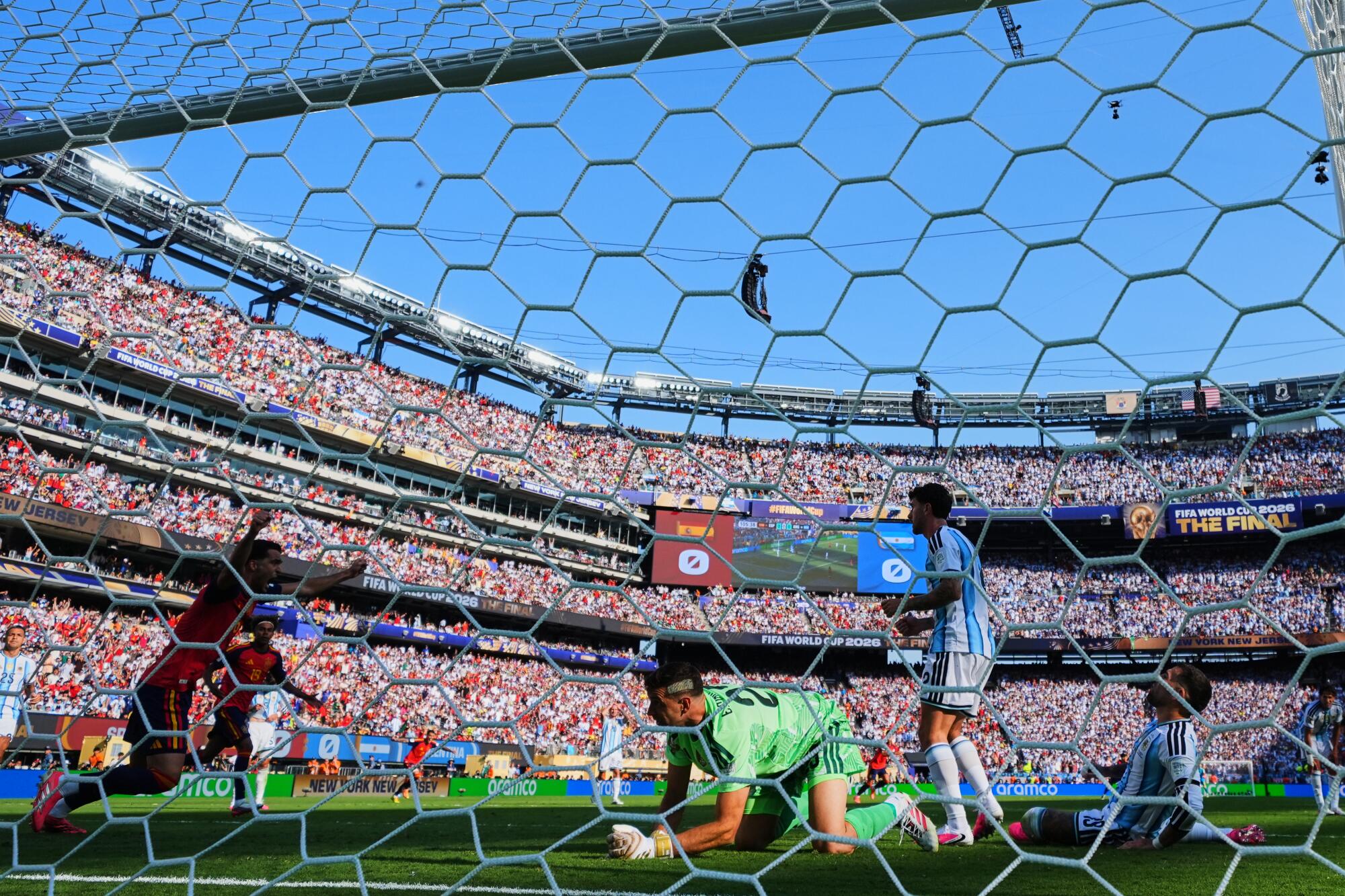
Argentina goalkeeper Emiliano Martínez reacts as Spain’s Ferran Torres scores during the World Cup final in East Rutherford, N.J., on Sunday.
(Julio Cortez / Ap Photo/julio Cortez)
Exact figures won’t be known for a few days.
Revenue for the four-year World Cup cycle is anticipated to reach $13 billion, making it the first $10-billion sporting event in history — bolstering Infantino’s case for reelection as FIFA’s president next year.
The final was among the most expensive U.S. sporting events of all time, with the get-in asking price for a single ticket on the secondary market peaking at about $7,400 three hours before kickoff and the average purchase price topping $10,800. One seat sold for $32,502, which is either a good thing or a bad thing, depending on whether you’re buying the ticket or selling it.
Inglewood’s SoFi Stadium hosted eight games, including two of the U.S. team’s three group-stage games and Spain’s quarterfinal win over Belgium. The matches had a total attendance of 561,656 people, about 99.6% of capacity — that’s more than each of the first three World Cups drew for the entire tournaments.
U.S. and Paraguay oversized flags are featured on the pitch before a World Cup group stage match at SoFi Stadium on June 12.
(Allen J. Schaben/Los Angeles Times)
Weather disrupted just a handful of matches, not the dozen or more that were feared, and the logistical nightmares of staging the 39-day tournament across three countries for the first time — the U.S. co-hosted the event with Mexico and Canada — never materialized. The expansion to 48 teams and 104 games, meanwhile, made room for a number of surprises that gave the tournament its life and sparkle.
Tiny Cape Verde, the second-smallest country to qualify for a World Cup, made a memorable debut, playing Spain to a scoreless draw in its opener, then taking Argentina to extra time before falling in the cruelest way possible, on an own goal, in the knockout rounds.
Norway, playing in the tournament for the first time this century, made it to the quarterfinals behind its hulking striker Erling Haaland, who quickly became a fan favorite while the team’s supporters saw their synchronized “Viking Row” celebration go viral.
Canada and Egypt both won World Cup games for the first time, advancing to the Round of 16, with Egypt becoming one of nine African teams to make it to the knockout rounds. Of FIFA’s six continental confederations, only UEFA, representing Europe, did better than Africa, sending 13 teams beyond the group stage.
Argentina’s Lionel Messi erased any doubt that he’s the greatest player in World Cup history — if not soccer history — by willing his team to the final and winning the Silver Ball, runner-up for the tournament’s most outstanding player. On Sunday, Messi was thwarted in his attempt to win a second straight World Cup and third Golden Ball, but he walked off the field at MetLife Stadium as only the second man to play in three World Cup finals.
And he finished his record-setting sixth tournament as the all-time leader in games (34), assists (12) and goal contributions (33), more than standing the test of time. Two of the players Spain started against Argentina in the final hadn’t even been born when Messi, 39, made his World Cup debut in 2006.
But if those were the highlights, there were also lowlights.
This was by far the most political World Cup in history and the first in which a host country, the U.S., was actively at war with a participating one, Iran.
Iran defender Ramin Rezaeian celebrates with teammates after scoring during a World Cup match against New Zealand at SoFi Stadium on June 15.
(Allen J. Schaben/Los Angeles Times)
That had all kinds of ramifications, starting with the State Department’s refusal to grant visas to more than a dozen members of Iran’s official delegation. Iran was also forced to move its base camp from Tucson to Tijuana, and though it played all its games in the U.S., it was denied permission to remain in the country after each match, an option granted to every other team.
Despite the harassment, Iran did not lose a game, playing to three draws despite having three goals — any of which would have sent it to the knockout rounds — erased by video reviews.
The State Department also denied entry to Omar Abdulkadir Artan, a decorated Somali referee, turning him away at Miami International Airport in June, citing “vetting concerns.” Artan, named Africa’s top referee last year, had a valid entry visa and was selected by FIFA to work the tournament last April.
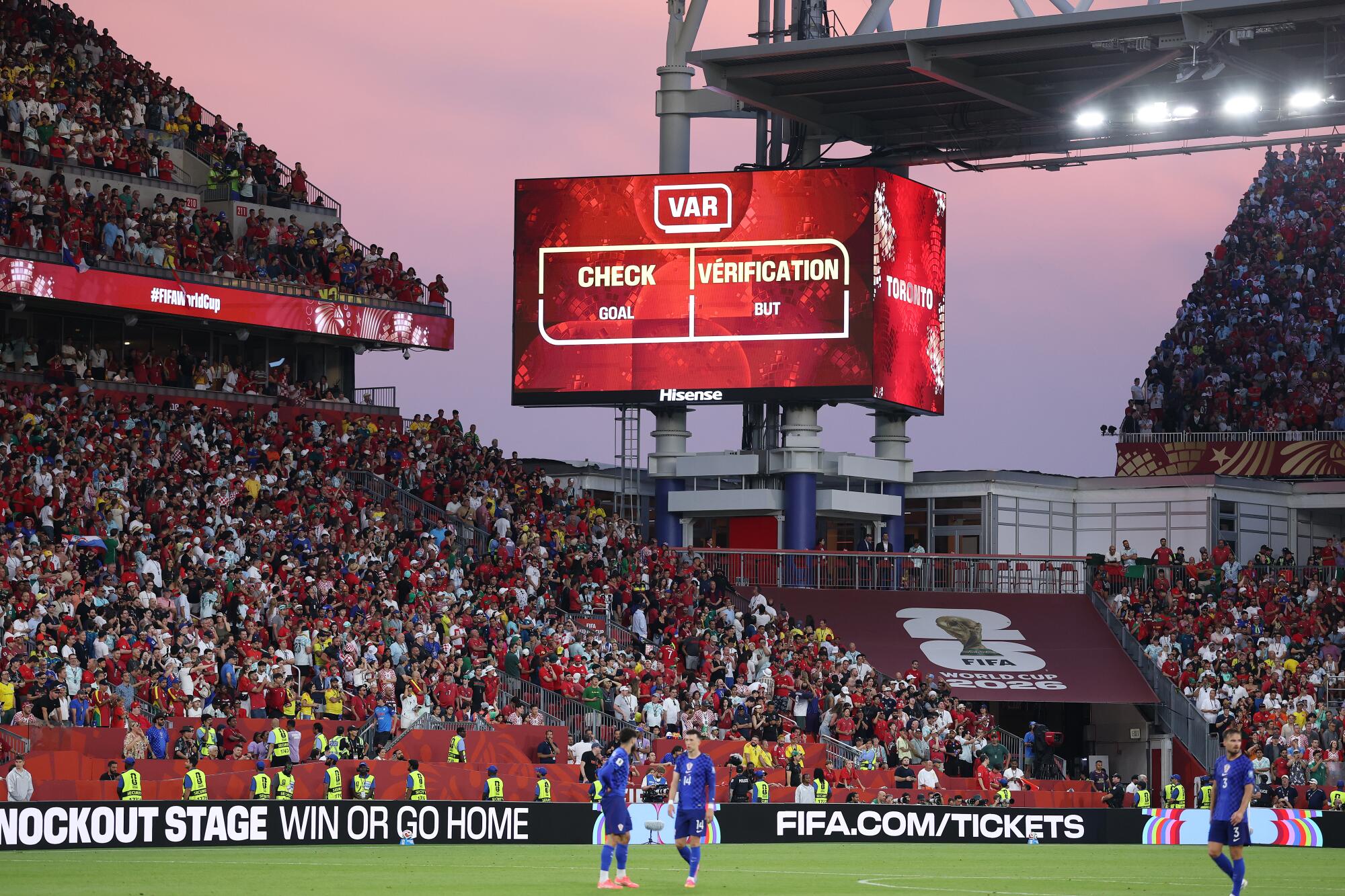
Iran wasn’t the only team to have its World Cup ended early by technology. Although the video assistant referee (VAR) system was adopted primarily to alert the head official to potential clear and obvious errors or serious missed incidents, in this tournament it became intrusive, eliminating Croatia on evidence from a NASA-level ball sensor and costing Egypt what would have been a game-winning score for a perceived foul that took place nearly 100 yards from the goal.
Coaches and players are still allowed to make mistakes, but the technology now has referees making calls on things that are imperceptible to the naked eye, something critics say has removed any sense of judgment or nuance, robbing the game of much of its drama.
“Football is an art. That’s why we love it,” said Christina Unkel, a former FIFA referee and a rules of the game analyst for multiple TV networks. “When you do pursue black and white — objectivity is what they’re trying to get to, and I get it; they want to eliminate as much subjectivity as possible — what everyone is hating is this perfection thing.”
Then there was the official’s call that President Trump took credit for overruling from 2,800 miles away.
When striker Folarin Balogun, the U.S. team’s leading scorer, was given a red card in the second half of his team’s Round of 32 win over Bosnia-Herzegovina, he was immediately suspended from the Americans’ next elimination game with Belgium. But Trump admitted he phoned Infantino three times, lobbying for the suspension to be rescinded.
U.S. forward Folarin Balogun stepped on Bosnia-Herzegovina defender Tarik Muharemovic’s foot during a World Cup match and received a red card at Levi’s Stadium on July 1.
(Robert Gauthier/Los Angeles Times)
Less than 30 hours before the Belgium game, the card penalty was suspended and Balogun was placed on one year’s probation by FIFA’s disciplinary committee, marking just the second time in World Cup history that a player who received a red card was allowed to play in his team’s next game. The international uproar that followed overwhelmed the U.S. team, which played its worst game of the tournament against Belgium.
Trump, who was booed as he saluted the national anthem Sunday from a luxury box before the game, was booed again by the crowd of 80,663 when he strode onto the pitch for the awards ceremony afterward.
UEFA, the FIFA confederation in which Belgium plays, protested the decision to let Balogun play, saying it had “crossed a red line.” It was far from the only bright red line Infantino crossed in this tournament. And some of that line crossing could set dangerous precedents.
Allowing the U.S. to turn away the Somali official and limit the Iranian team’s time in the country, for example, could embolden future World Cup hosts to do the same. What’s to stop Morocco, co-host of the 2030 tournament, from banning officials and players from Algeria over the two countries’ territorial dispute in the Western Sahara? And if a red card is handed to a player from Spain, another 2030 co-host, would the Spanish prime minister call Infantino to try to get it rescinded? Despite FIFA’s insistence that the disciplinary committee works independently, many believe Trump’s meddling worked.
But as always with FIFA, money speaks the loudest, so Infantino’s norm-shattering behavior over the last year doesn’t seem to have cost him much support. The Guardian reported last week that as the World Cup neared its successful conclusion, nearly 200 of FIFA’s 211 member associations are endorsing Infantino’s bid for reelection to a fourth term as president next March.
Which is why Spain wasn’t the only winner in this tournament.
EAST RUTHERFORD, N.J. — This summer’s World Cup will be remembered for a lot of things.
It was the first to be played in three countries, the first with 48 teams and the overall attendance nearly doubled the previous record. Norway’s Erling Haaland and Cape Verde’s Vozinha were captivating while Egypt and Canada both won World Cup games for the first time, advancing to the Round of 16.
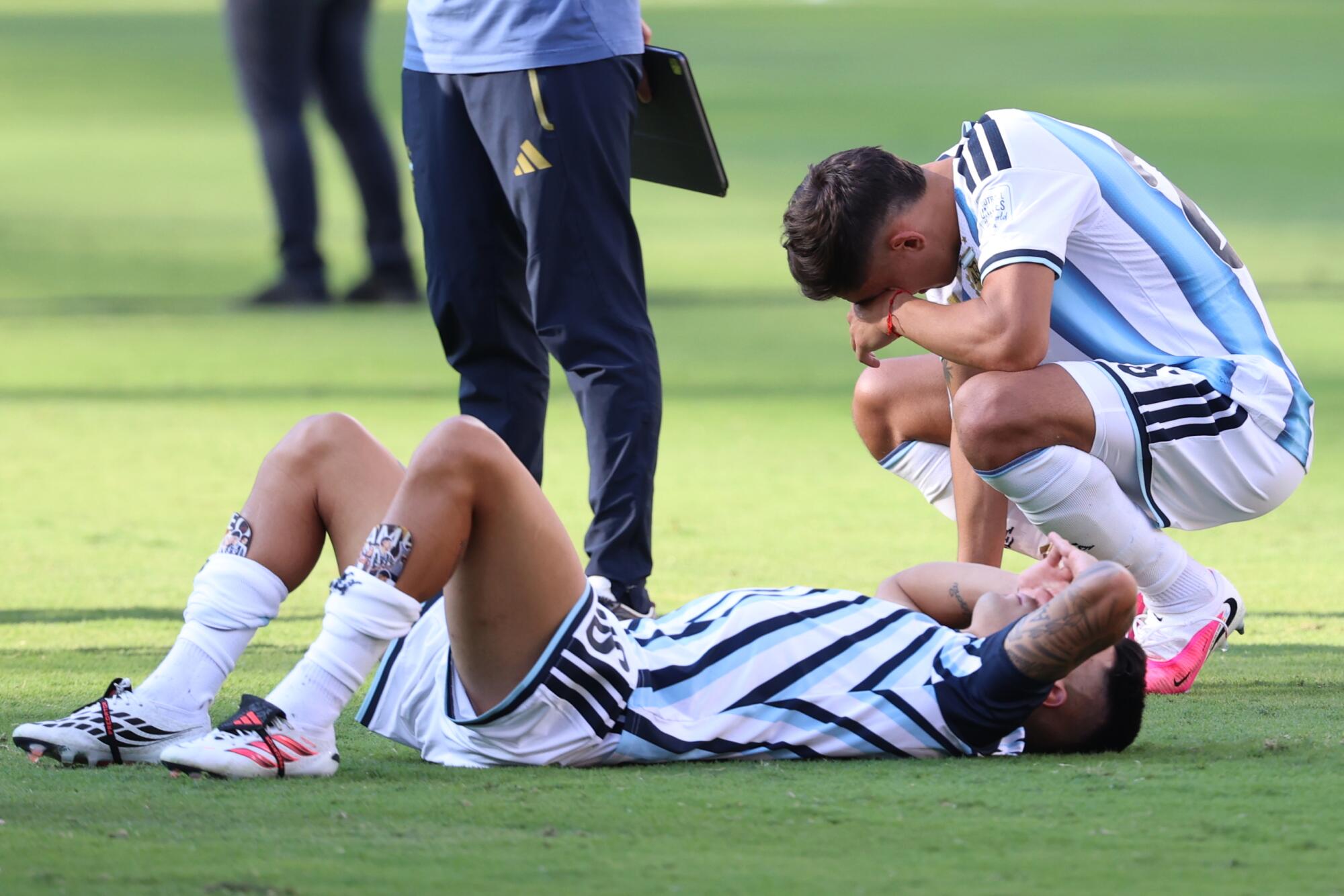
But the tournament will also be remembered for a classless and churlish Argentina, which forever stained itself with a thuggish performance in the game and an ungracious one afterward.
If La Albiceleste had simply kept its composure it would have secured a place next to Brazil and Germany, the only other countries to reach three finals in four World Cups, as one of the greatest teams of all time. Instead, some of its players turned the postgame handshakes into a brawl, with Argentine midfielder Leandro Paredes drawing a red card for grabbing Spain’s Eric Garcia by the throat and shoving him to the turf.
It was believed to be the only red card ever handed out after a World Cup final, and the ignominy it brought was well-deserved. But the childishness was just beginning. When Spain assembled on the podium to accept the World Cup trophy, which had been Argentina’s moments earlier, the South Americans turned their backs.
More than an hour later Lionel Messi, who has cemented his stature as the greatest player in World Cup history, soiled that status by leading the players out of the locker room and through a back exit to the team bus, avoiding the media many had been so eager to speak with during the team’s unbeaten run to the final.
Argentina’s Nahuel Molina, top, reacts after Spain won the World Cup final between Spain and Argentina in East Rutherford, N.J.
(Pamela Smith / Associated Press)
It was an attack on class and decorum as well as violation of FIFA rules, which require players to leave the stadium through a “mixed zone” accessible to media. They are not required to stop or speak, but certainly someone owed some accountability to the tens of thousands of fans in Argentine jerseys who packed Times Square and MetLife Stadium over the weekend and the millions in Argentine who filled plazas and town squares to watch the team play.
“We’ve been great in victory and we need to be great in defeat,” Argentine coach Lionel Scaloni said moments after Paredes was booked for assault. “We have shown today that we know how to lose, too. We lost the game and we accept that.”
Scaloni, who did address the media, later broke down in tears.
“I already cried all the tears I had in the dressing room,” he said in Spanish.
Scaloni, 48, may be out of a job when his contract expires in December, but his message for the fans was don’t cry for me, Argentina.
“It is hard to ask people to enjoy this equally. It is very hard to convince people that this is a triumph,” said Scaloni, who has lost just twice in 15 World Cup games.
“When you win, not everything is good. When you lose, not everything is bad.”
But while Argentina was being petty and petulant, Spain was practically perfect in every way. Not only did it concede just one goal in the tournament, it held Argentina without a shot into extra time Sunday — the first time that’s ever happened in a World Cup final — and ran its unbeaten streak to a record 38 games overall.
The win, which came on substitute Ferran Torres’ goal moments into the second extra-time period — and less than 20 minutes after Argentina was reduced to 10 men when Enzo Fernández was given a second yellow card for a foolish tackle — not only made Spain the first country to be the men’s and women’s world champion at the same time, it also made it the first to be the men’s world, European and Olympic champion at the same time.
No country in history has dominated the sport as Spain is dominating it now. And since Spain is the second-youngest team to win the World Cup in 56 years, La Roja could be on top for some time.
“After the match, some of the players who have been with us the longest asked me ‘coach, what is left for us win? We’ve won everything,’” said Spain’s manager Luis de la Fuente. “I told them, well the next match in September.”
That’s a UEFA Nations League match with England, which finished third in this World Cup. A little further down the road is the 2030 World Cup, which Spain will co-host, making it the first country in history to defend its title at home.
“When you arrive at a moment like today and think about the journey we’ve taken, you realize the importance of that process,” said De la Fuente, a former youth national team coach who managed many of the players on the World Cup team — among them Dani Olmo, Mikel Merino, Mikel Oyarzabal, Unai Simón, the tournament’s top goalkeeper, and Rodri, tournament’s top player — to U-19 and U-21 European titles.
“We certainly wouldn’t be here today — we wouldn’t have achieved anything — without the journey we’ve shared with these players,” the coach continued. “We have that raw material, those wonderful Spanish footballers. And they way they compete, that is what brought us here.
“That goes back many years.”
De la Fuente, soft-spoken and professorial, is also scrupulously polite, an example many of his players follow. And while it is undoubtedly easier to display grace and dignity in victory than it is in defeat, the difference in the way Argentina and Spain exited the World Cup was far greater than the gap that separated them on the scoreboard, something De la Fuente unwittingly highlighted in speaking about his team late Sunday.
“It seems people were surprised that, alongside talent and brilliance, good people can also play the game,” he said. “This proves that it is possible; that good, supportive, generous people with strong values can form a genuine team.
“We played against the best national teams in the world, yet we were the best team. We demonstrated that a team built on good people — supportive people, people who hold values and principles that prioritize the common good over individual interests. Traveling with people like that makes for a better, safer journey.”
In Spain’s case, it also makes a World Cup champion.
Staff writers Eduard Cauich and Jad El Reda contributed to this story.
Fifa faced criticism before the tournament, with suggestions the additional teams would not be competitive.
Then Cape Verde drew with Spain and Uruguay to finish second in their group. And the Blue Sharks gave Argentina an almighty scare by taking them to extra time in the last 16, before losing 3-2.
But the fairytale stories must be balanced with the competitive edge of the tournament.
Haiti, Iraq, Jordan, Panama, Tunisia and Uzbekistan failed to pick up a point – and this summer’s group stage had minimal jeopardy for the top nations.
Add more teams and it would be difficult to see a repeat of top-four seeds like Belgium (2022), Germany (2018), Spain (2014), Italy (2010) and France (2002) failing to make to knockout stage.
Then there is the question of where the extra places would go.
Based on this year’s qualifying, these are the additional countries who would have made it into a 64-team World Cup 2026 (with their Fifa ranking at the start of the tournament in brackets):
AFC: Indonesia (118), Oman (79), United Arab Emirates (68).
Nine of Africa’s 10 countries got out of the group stage. But only two of nine Asian countries advanced, and just three of the six Concacaf countries – the co-hosts – made it through.
New Zealand, who got one point and finished bottom of their group, are the only country from Oceania in the world’s top 150.
There is an argument that if you extend again, you should give a greater weight of places to Europe just for competitive balance.
But, on the other hand, there are those who would argue that bringing more teams into the World Cup ultimately allows the game to develop further in those countries.
Infantino will sell the expansion as being good for the global game, but there have to be doubts that it is good for the competition.
Almost a third of Fifa’s 211 nations would be present.
Would the group stage not simply become a glorified pan-confederation qualifying competition for what is, essentially, a knockout tournament?
Ezri Konsa: The Aston Villa defender featured in every game and continued to show he has the quality for international football. A starting centre-back and also played at right-back in the win over Norway in the quarter-finals. He ended the tournament with a goal in the third-place play-off. 7
John Stones: It was considered a gamble by Thomas Tuchel to take Stones considering his fitness issues. He started the first game, had some shaky moments and dropped out for the next couple. But he regrouped and started the quarter-final win over Norway and semi-final defeat by Argentina. The 32-year-old showed his quality but was caught under the ball for Lautaro Martinez’s winner. 7
Marc Guehi: A staple of the England backline at major tournaments. Guehi did not start the opening game against Croatia but when he came in he showed his usual calmness and quality. Guehi put in an excellent performance against Manchester City team-mate Erling Haaland in the quarter-final against Norway and performed well until England went out. 8
Trevoh Chalobah: The Chelsea defender was called up as a replacement for Tino Livramento. It was a decision that prompted a lot of debate as it was felt it left England short in the full-back areas.Chalobah was brought on in the closing stages of the win over France for his only minutes of the tournament. 5
Jarell Quansah: This was Quansah’s first major tournament and he was arguably a surprise pick in the 26-man squad. But the Bayer Leverkusen defender did show why Tuchel was so keen to have him as a full-back option. Quansah started well against Panama before getting injured, then did likewise against Mexico before he was sent off. He returned for the third-place play-off, and has a bright international future. 6
Dan Burn: The Newcastle defender’s inclusion was the subject of much debate but his performance against Mexico underlined the reasoning. Burn’s aerial prowess gave England a way to see out games, though Tuchel turned to that tactic too early when trying to see out a win against Argentina. 6.5
Nico O’Reilly: This was the 21-year-old’s first tournament and he grew into it after a nervy opening match. O’Reilly only became England’s first-choice left-back in November, and to go from that to a World Cup and start five of the eight matches is very impressive. O’Reilly is very good on the ball but could improve defensively. 6.5
Reece James: The Chelsea captain said it was “boring” when people discussed his fitness, but the first-choice right-back missed three games after sustaining a hamstring injury against Ghana. He recovered to play in the quarter-final and semi-final, and showed his quality. 6.5
Djed Spence: The Tottenham full-back was one of England’s breakout players of the tournament. Spence’s ability to play at both left-back and right-back is extremely valuable in tournament football. He is a very good one-v-one defender and his pace gives an outlet to the team. He produced two of his best performances in the quarter-final and semi-final. Spence also played well against France, winning a penalty. 8
EAST RUTHERFORD, N.J. — The list of men who have won a World Cup final is less than 500 names long, making it among the most exclusive in sports.
Jurgen Klinsmann’s name is on that list. And if he had known what a special club he would join when he stepped on the pitch for the 1990 final, he might have taken more time to enjoy it.
“How big that actually was, you only realize when when you start traveling the world and you get basically approached everywhere in the world about those moments,” Klinsmann said Friday. “It’s pretty crazy.”
Several new names will be added to that list Sunday, when Spain and Argentina meet at MetLife Stadium to decide the winner of the largest, most complex World Cup in history. A record 48 teams started the tournament 39 days and 103 games ago. Now just two remain: Spain, the reigning European champion, a team that hasn’t lost in 37 games and 27 months, and top-ranked Argentina, the reigning World Cup champion seeking to become the first team to repeat in 64 years.
Argentina leads the tournament in goals with 19, 12 of them coming in the 75th minute or later. In all four of Argentina’s wins in the knockout stages, the go-ahead goal came in stoppage time or extra time. Its captain, Lionel Messi, finished the semifinals leading the tournament with contributions on 12 goals — eight goals and four assists. He‘s also the all-time World Cup leader in goals, assists and games played and seems a shoo-in for a third Golden Ball, which goes to the tournament’s best player. No one else has won that award more than once.
But if Argentina is the unstoppable force, Spain is the immovable object. It has given up just one goal in the tournament with its goalie, Unai Simón, pitching shutouts in seven of his last eight World Cup games, dating to 2022. Slowing Messi won’t be up to Simón alone, however. Midfielder Rodri, Spain’s captain and the 2024 Ballon d’Or winner as the best player in the world, is the team’s defensive anchor. He said the best way to try to control Messi is to keep him out of the box — although Messi’s two decisive assists in Argentina’s semifinal comeback against England came from outside the penalty area.
And while Klinsmann’s one-and-done experience in a World Cup final is typical of most players, Messi, 39, is the exception: When the whistle blows Sunday, he’ll become just the second player, after Brazil’s Cafu, to play in three World Cup finals. When he made his World Cup debut in 2006, two starters on Spain’s team — center back Pau Cubarsí and winger Lamine Yamal — had yet to be born.
East Rutherford was hit with heavy thunderstorms Saturday, which helped knock down the hazardous smoke from Canadian wildfires that had blanketed the tri-state area for days. The poor air quality, which is dangerous for both players and fans, led FIFA and the White House to hold informal discussions over moving the World Cup final.
So while the air won’t be clear Sunday, the greatest risk appears to have passed and the threat of rain or lightning interrupting the game has also decreased, with the forecast calling for temperatures in the mid- 80s and 55% humidity at kickoff.
President Trump is expected to attend the game, after which he will present the World Cup trophy to the victor. And Klinsmann’s advice to the players who will walk across that stage to get their winners’ medals is to savor every moment because they might not come again.
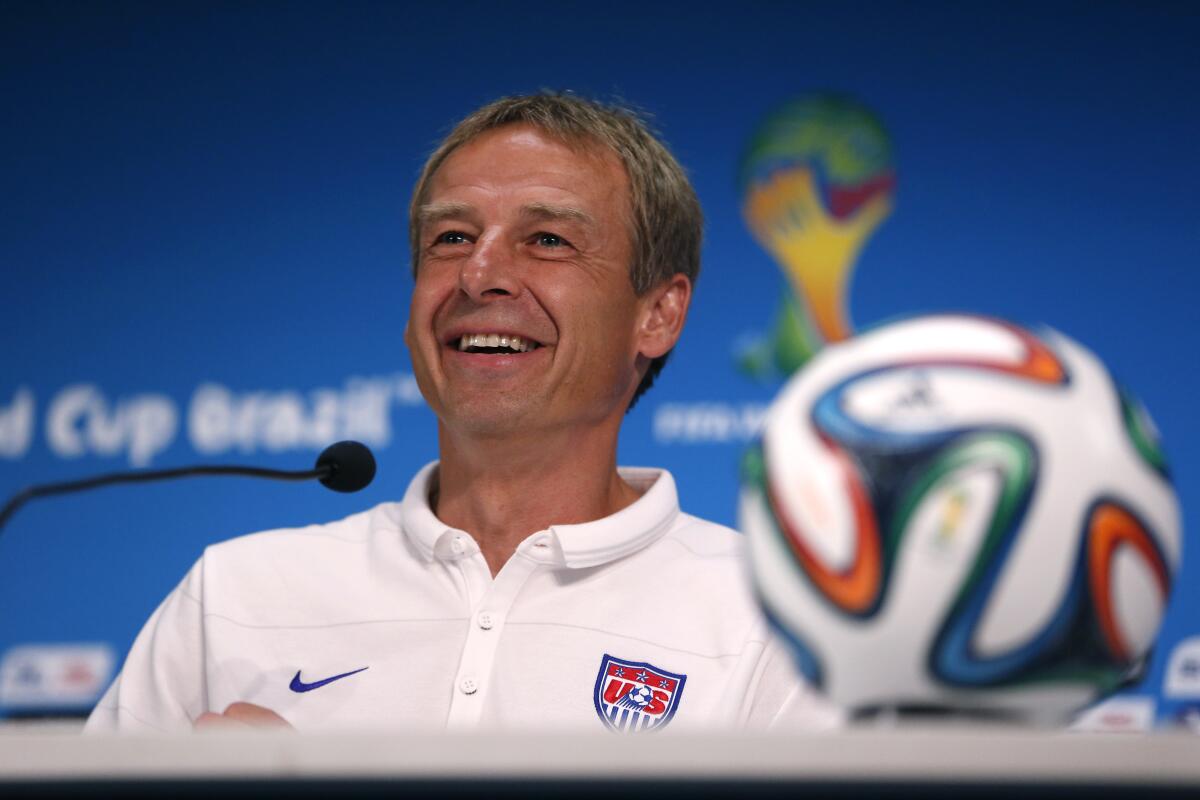
Jurgen Klinsmann, a World Cup champion with West Germany and the former U.S. men’s national team coach, understands players often forget to savor the moment of playing in soccer’s biggest game.
(Julio Cortez / Associated Press)
“Take it all in to and really enjoy every second of it,” he said. “Make it special. Don’t miss out on anything.”
Klinsmann was 25 and less than three years into his international career when he helped West Germany win the World Cup in 1990. So naturally he figured there would be more to come.
“I said, ‘Well, if this is so cool to win a title, then I want to win more titles,” he said. “The magnitude of it, I did not understand.”
In two more tournaments as a player, he never got past the quarterfinals and in two World Cups as a manager he made the semifinals once. Never again would he hold the most cherished trophy in sports, though his 11 World Cup goals are tied for ninth all-time, tied with Cristiano Ronaldo and one behind Pelé.
Mario Gotze scored only two goals in his World Cup career but the last one will never be forgotten. In the 88th minute of the 2014 final against Argentina, just before sending Gotze on as a sub, German manager Joachim Löw called Gotze over and said, “Show the world you are better than Messi and can decide the World Cup.”
With seven minutes left in extra time he did just that, chesting down a cross, then lobbing a volley into the net for the game’s only score, giving Germany its first title since Klinsmann’s team in 1990. It was a moment Gotze, then 22, had long dreamed of and one he had rehearsed as a kid.
Spain goalkeeper Unai Simon, shaking hands with France’s Kylian Mbappe after the World Cup semifinal, has given up only one goal in the tournament.
(Julio Cortez / Associated Press)
Yet it was also one he was not prepared for.
“That was a dream come true. But you can’t prepare for these kind of moments,” he said. “I get reminded about that goal and even speaking nowadays with people in Germany, and they say, ‘I still remember where I [was] in that moment.’ That’s very special. You have that connection to a lot of different people. I’m very happy about that.
“When I look back now, OK, I was there. I played 30 minutes of football in a World Cup final and I scored one goal. That impact is huge and to even be in that moment is rare.”
So rare Gotze never held the World Cup trophy again either. As a result he, like Klinsmann, would urge the players in Sunday’s game to drink in the memories, because win or lose, if your name isn’t Messi the odds are great you’ll never be back.
“You can’t describe the feelings because everything happens so fast,” he said. “You’re in the zone, you do a lot of things out of instinct, especially on the pitch. And then, at least with me, I had that relief after the final whistle.
“You get to understand over the years how special that moment was. Because in the end you only can play every four years. And then to be in the final and score a goal? That, of course, was very special.”
The final weekend of the 2026 FIFA World Cup is here, with France and England playing for third place on Saturday before defending champion Argentina takes on 2010 winner Spain for the title on Sunday.
Here’s everything you need to know about the last two matches of the 39-day, 48-team tournament in North America (all times Pacific).
Saturday’s third-place game
France vs. England
France star Kylian Mbappé smiles during a World Cup semifinal match against Spain on Tuesday.
(David Ramos / Getty Images)
Where: Hard Rock Stadium, Miami Gardens, Fla. Time: 2 p.m. TV: Fox, Telemundo | Streaming:Fox One, Peacock
The buzz: This is a game neither team really wants to play. The disappointment of missing the final is fresh and the weather report calls for temperatures in the high 80s with 68% humidity and a chance of thundershowers — a brutal South Florida summer day. The $2-million difference in prize money between third and fourth place isn’t likely to make any of that more palatable. Still, the game will have meaning for France since it will be the final match for coach Didier Deschamps, the winningest World Cup manager in history. And captain Kylian Mbappé, tied with Argentina’s Lionel Messi for most goals in the tournament (8), has a chance to become the first player to win consecutive Golden Boots. England is playing in the consolation final for the second time in three World Cups; it lost to Belgium 2-1 in 2018. But this one will probably sting even more since the Three Lions were five minutes away from their first final in six decades before collapsing against Argentina. This could be the last World Cup game for England’s Golden Generation of Harry Kane, Jordan Pickford, John Stones and Jordan Henderson.
Sunday’s championship game
Spain vs. Argentina
Argentina star Lionel Messi celebrates after a win over England in the World Cup semifinals on Wednesday.
The buzz: Argentina has a chance to become the first repeat World Cup champion since Brazil in 1962, which would give Messi another grand achievement in his sixth and likely final World Cup. Messi enters the weekend as the all-time leader in goals, assists and games played in tournament history. But unbeaten Argentina hasn’t made things easy, with its winning goals in the four knockout-round games coming in the 92nd minute or later. Spain, the reigning European champion, will be playing to put a second star on its jersey to match the one it won in 2010. La Roja, with the sixth-youngest roster in the World Cup, got to the final on the strength of spectacular defense led by Unai Simón, who has six clean sheets in seven games. Mikel Oyarzabal is the team’s leading scorer with five World Cup goals. The teams had one common opponent in this tournament, tiny Cape Verde, a World Cup debutante. It played Spain to a scoreless draw in its opener, then held Argentina to a 1-1 standoff into extra time before falling.
Away from the football itself, one of the major stories out of the 2026 World Cup has been the conditions that players – and fans – have faced during matches.
While England did benefit from some fixtures being played in air-conditioned stadiums with roofs, such as in Atlanta against DR Congo, other conditions were less forgiving. Those included the stifling humidity and soaring temperatures in Miami for their quarter-final against Norway.
The much-discussed altitude of Mexico’s Azteca stadium for England’s round of 16 match against the co-host nation was perceived to be a major hurdle for the squad to overcome. That was before you took into account Mexico’s fearsome home record and notoriously raucous atmosphere at the ground.
Despite this, England adapted well and never seemed to be struggling due to the external factors imposed on them during games – or at least, managed to struggle less than their opponents.
While pre-tournament training camps to adjust to the conditions will have helped with preparation, it is testament to the players’ mental and physical strength that they managed to persevere in oppressive conditions better suited to opponents accustomed to playing in extreme weather. That could stand them in good stead for the more familiar conditions that will be present at Euro 2028.
ATLANTA — The jury is still out on whether Lionel Messi is the greatest soccer player ever. But there should be no doubt he’s the greatest to ever play in a World Cup.
And you don’t need the records, the wins or the goals to prove that — although he certainly has enough of those. You just need to see Messi at his most magical, as he was Wednesday, setting up a pair of game-changing goals in a seven-minute span to lift Argentina to a 2-1 win over England and into Sunday’s World Cup final with Spain.
“It’s really hard to speak right now, but I’m going to try not to cry,” Lautaro Martínez, who scored the winning goal two minutes into stoppage time, said in Spanish. “I’m already overwhelmed inside. It’s incredible. Everything we’ve achieved is just incredible.”
Like their 13-game World Cup unbeaten streak, dating to the opening game of the 2022 tournament in Qatar. Or back-to-back trips to the final, which gives them a chance to become the first repeat champion in the men’s tournament since Brazil in 1962.
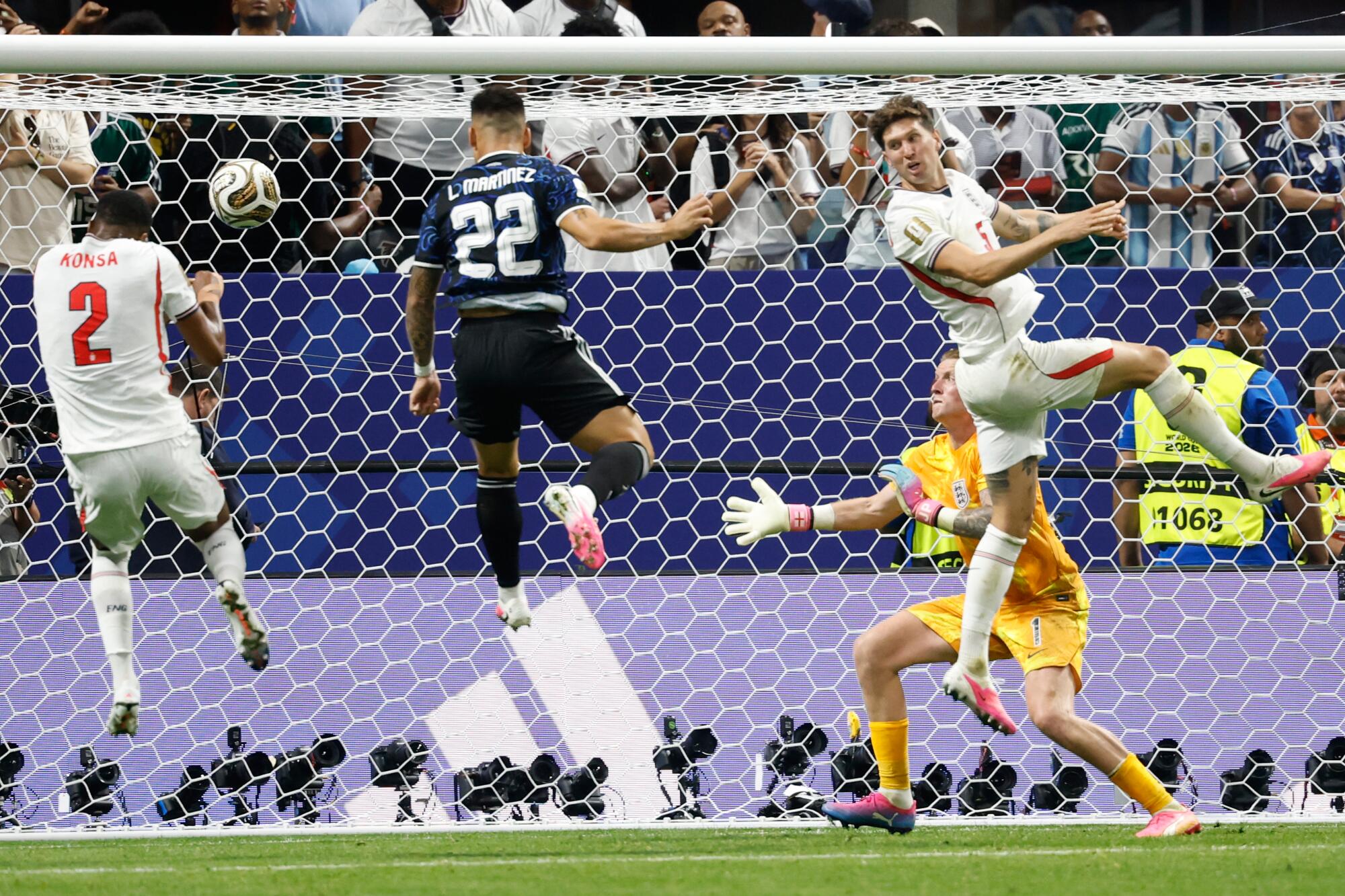
Argentina’s Lautaro Martinez scores his team’s second goal in front of England goalkeeper Jordan Pickford (1) and fellow England players Ezri Konsa (2) and John Stones (5) during a World Cup semifinal in Atlanta on Wednesday.
(Erik S. Lesser / Associated Press)
But it hasn’t been easy. Eleven of Argentina’s 19 goals — including both scores in Wednesday’s semifinal — have come after the 75th minute. They trailed in the 80th minute or later in two of their last three knockout games, only to rally both times.
And Messi has either scored or assisted on three of the four goals that rescued Argentina.
“This group, in the face of adversity, keeps going, keeps going, and never gets tired,” Martínez said. “And we have the best in the world as our example.”
On Wednesday that meant heartache for England, which was as close to a World Cup final as it has been in six decades, leading 1-0 on Anthony Gordon’s second-half goal with just five minutes left in normal time.
But after taking the lead, England turned strangely conservative, dropping all 11 players behind the ball at times, daring Argentina to score. Eventually it did, with Enzo Fernández curling a right-footed shot from about 20 yards past England keeper Jordan Pickford and in at the left post to tie the game.
It was a pass from Messi that found Fernández in space at the top of the box, earning the Argentine captain his record 11th World Cup assist.
“The opponent doubted themselves,” Argentine coach Lionel Scaloni said. “We smelt blood and went for it. We all felt it. “
The tie didn’t last for long though, with Messi threading a perfect cross from the right wing to Martínez, who found space between English defenders John Stones and Ezri Konsa at the far post. Messi’s pass just cleared the leaping Stones, then dipped to Martínez, who nodded it home.
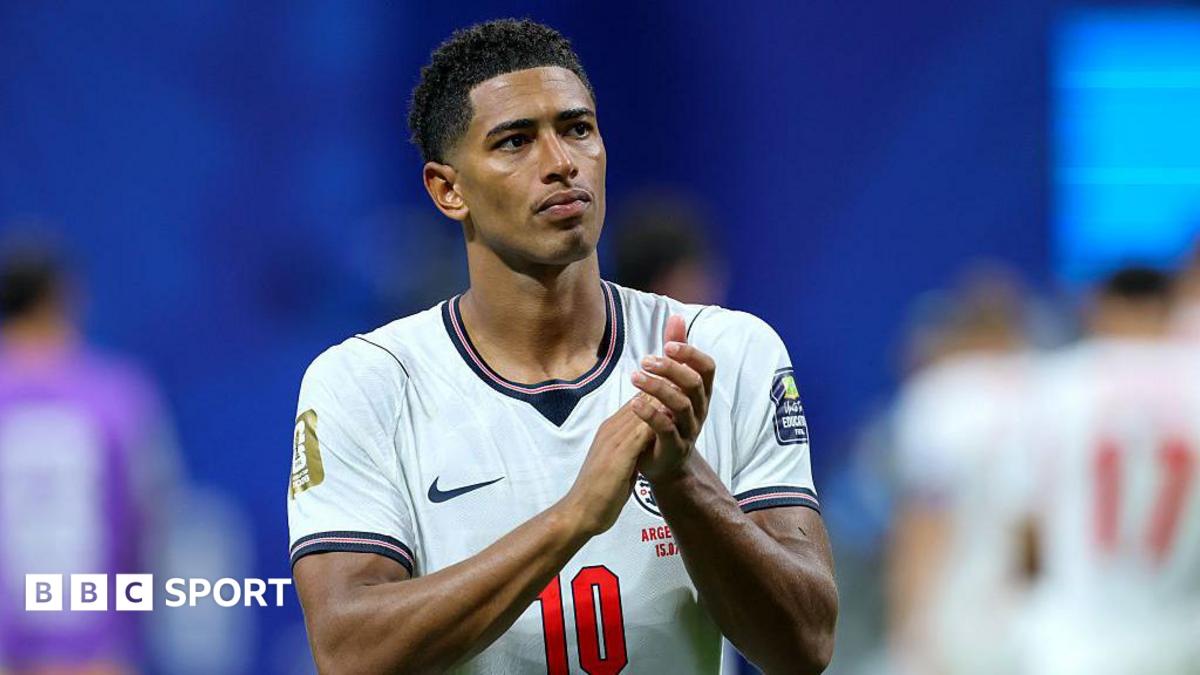
England’s Harry Kane and England’s Jude Bellingham are dejected after losing to Argentina during a World Cup semifinal on Wednesday in Atlanta.
(Jeff Roberson / Associated Press)
When the ball hit the net, the sellout crowd at Atlanta’s massive Mercedes-Benz Stadium erupted.
“Once again, despite falling behind, we managed to turn the game around in stoppage time. That speaks volumes about this group, about this team that never settles, always wants more, always strives for more,” Martínez said.
It also gives Messi a chance to strive for more in Sunday’s final. He has already played in more World Cup games, scored more World Cup goals and had more World Cup assists than any man in history. With a win over Spain, he can join another elite group of men: those who have won back-to-back World Cup titles.
History will eventually decide if it was Messi’s brillance or the tactical surrender of England coach Thomas Tuchel that truly turned the game around. Tuchel, however, said he had no regrets.
“We played the matches how they were,” he said. “We overcame every obstacle. We were very, very close today. It’s not a moment now to analyze the full tournament because we lost a crucial match.”
His captain, Harry Kane, who lost in the semifinal of a World Cup for the second time in three tournament, was also not interested in second-guessing.
Argentina’s Lionel Messi sits on the shoulders of a teammate and celebrates after beating England in a World Cup semifinal on Wednesday in Atlanta.
(Rebecca Blackwell / Associated Press)
“We had a lot of good moments in this tournament, a lot of good games,” he said. “We talked about knocking on the door. We’re close, we just have to find that missing piece in the final stage of the tournament.”
They may be closer than they think: England is the only team this century to score the first goal in a World Cup semifinal but not reach the final, according to the OptaJoe statistical service.
Argentina’s team, meanwhile, is missing nothing — except maybe a second title,
“The people of Argentina should celebrate being in a final,” Scaloni said. “This group of players is difficult to describe in words. They are so special. I’m getting emotional. They fight for everything.
“We’re going to try to win the final. But what else does this team need to do? There isn’t much else to say. I’m eternally grateful to this group of players.”
Sports editor Iliana Limón Romero contributed to this report.
While every World Cup introduces viewers to new young stars, this tournament featured eight players who were older than 40 — one more than the number of over-40 players in the previous 22 World Cups combined.
Among them were Portugal’s Cristiano Ronaldo, 41, and Mexico’s Memo Ochoa, 40, who were playing in their sixth World Cups alongside Argentina’s Lionel Messi, a relative youngster at 39. No one has played in more men’s World Cups.
But while Ronaldo and Ochoa have gone home, Messi will be playing in his third semifinal in four tournaments Wednesday when Argentina, the reigning champion, faces England at Mercedes-Benz Stadium in Atlanta.
The newfound longevity of elite soccer players has been made possible by advances in sports medicine, diet and analytics that measure everything from biomechanics and heart rate to muscular output and sleep cycles, all in real time. And injuries that once ended careers can now be repaired through outpatient procedures.
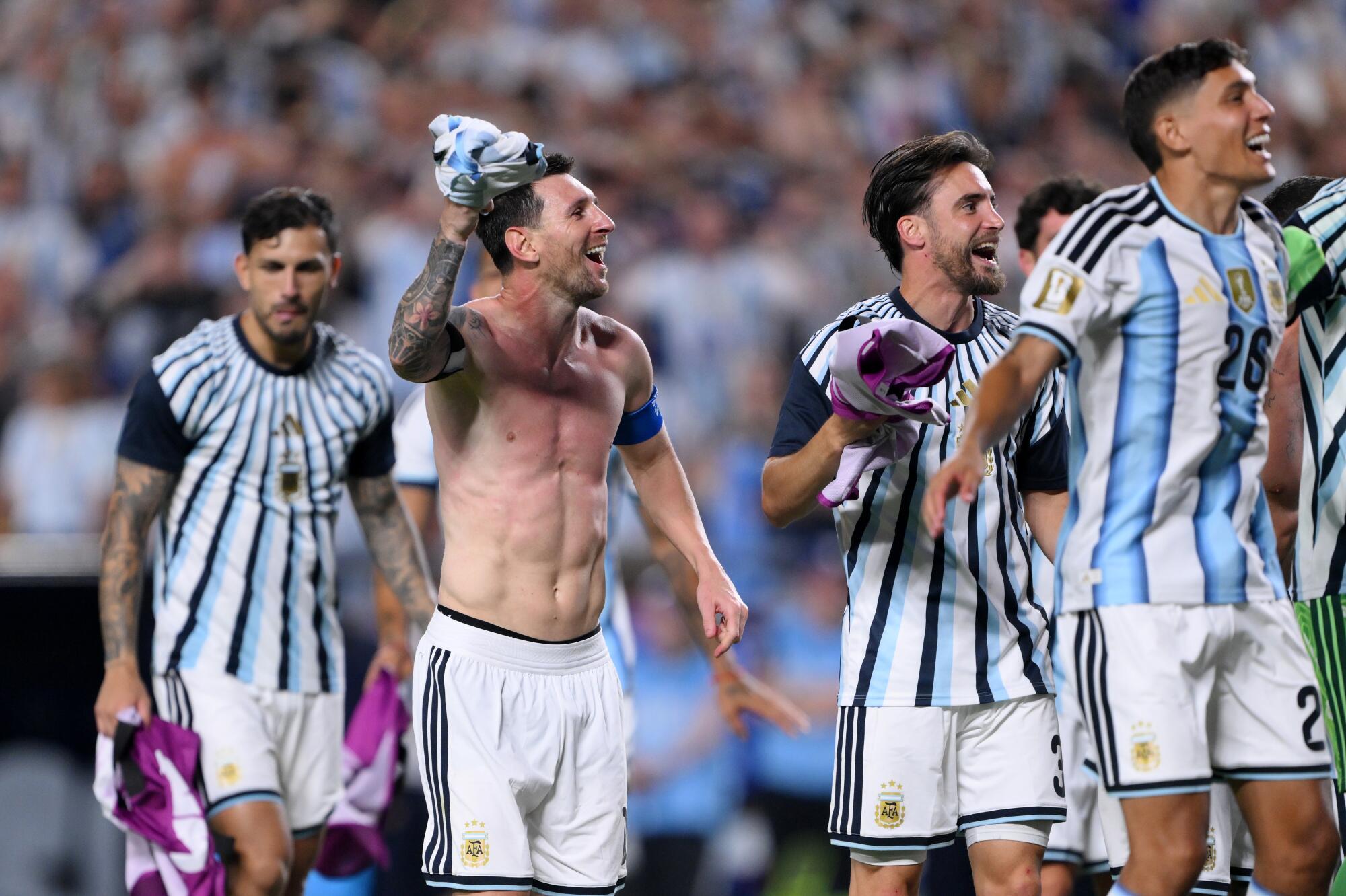
Argentina star Lionel Messi holds his jersey up and celebrates with teammates after a World Cup quarterfinal win over Switzerland on Saturday in Kansas City, Mo.
(David Ramos / Getty Images)
“Over the past 10, 20 years, the sports science within the game has changed a lot,” said Liam Anderson, an exercise physiologist at the University of Birmingham in England, who has worked as an applied practitioner in top-flight professional soccer for more than a decade.
“Players are now definitely more aware of their bodies and I think the professionalism has changed quite a lot as well. But they’re also in tune with the things which are helping them recover, manage their training load and ultimately stay fitter and healthier for longer.”
Gone are the days when chain-smoking Dutch legend Johan Cruyff would light up a cigarette on the bench, French world champion Zinedine Zidane would smoke in the locker room and George Best would party and drink so hard he would disappear for days at a time.
“There’s a couple of reasons,” Dr. Michael Joyner, a specialist in the physiology of elite athletes at the Mayo Clinic, said of the growing lifespan of soccer players. “The first is that people just make a lot more money and as a result, there’s tremendous incentive to keep playing. The second is people are taking much better care of themselves.”
“You just don’t hear about people like George Best anymore,” said Joyner, speaking for himself and not the clinic where he works.
“Diet is huge,” Anderson added. “High-protein diets and fueling with carbohydrates for matches. Nutritional strategies have changed considerably in the last 10-15 years.”
And those diets are tailored by position since a midfielder, who may run more than seven miles in a match, burns more calories than a goalkeeper.
As the eldest player in Major League Soccer, Diego Chara has had to make some concessions to age.
“It’s a little detailed,” said Chara, a midfielder with the Portland Timbers. “Talking about recovery time, it maybe takes a little bit longer than before. Nutrition. Working in the gym, it’ll be longer than other players.”
But if Chara, 40, is an old man in a league where the average age is younger than 26, he would have been something of whippersnapper in this summer’s World Cup.
The Portland Timbers’ Diego Chará passes the ball under pressure from the Columbus Crew’s Wessam Abou Ali on Feb. 21in Portland, Ore.
(Amanda Loman / Associated Press)
Soccer isn’t the only sport in which 40 is the new 30.
Serena Williams returned to Wimbledon this summer at age 44 and at least half a dozen athletes 40 and older showed up at the Milan-Cortina Olympics last February hoping to medal. Four of them succeeded, including American Elana Meyers Taylor, 41, who became the oldest athlete to win an individual gold in Winter Olympics history in the women’s monobob.
It isn’t unheard of for athletes to be golden in their golden years. Ted Williams hit .316 at 41 and Gordie Howe played 80 games and had 41 points in his final NHL season at 52. Nolan Ryan threw a no-hitter and pitched 173 innings at 44 while Tom Brady quarterbacked the Tampa Bay Bucs to a Super Bowl title at 43.
But if those age-defying performances were outliers, playing into your mid-40s and even early 50s may soon become, if not common, at least less unusual.
“People are just staying in better shape, taking care of themselves,” Joyner said. “Career-changing or career-ending injuries are no longer career-ending injuries. It just goes on and on, all of this stuff combined.”
American Serena Williams, 44, serves against Australian Maya Joint during a match at Wimbledon on June 30.
(Cameron Spencer / Getty Images)
State-of-the-art training centers and access to top-line sports medicine have also become more accessible, even in poor countries.
“The elite level has spread and really become global, as opposed to where there used to be pockets,” Joyner said. “The opportunities to compete are so great.”
Few team sports are as physically demanding as soccer, though, which makes both the growing number of seasoned citizens and their performances noteworthy. Messi has averaged nearly a game a week for club and country during the past 23 years, yet he entered the semifinals of this tournament tied for the scoring lead with France’s Kylian Mbappé, who is 12 years younger.
Ronaldo has played even more games yet he became the oldest player to score in a World Cup knockout game when his penalty kick helped eliminate Croatia and midfielder Luka Modric, who will be 41 in less than two months.
“They’ve probably lost a little bit off the top, but their experience and their mind make up for that,” said Scott Trappe, a professor of human bioenergetics at Ball State. “So the overall package of them as a sports person is really they’re contributing at a high level. I think we’re going to continue to see this movement.
Portugal’s Cristiano Ronaldo celebrates scoring a World Cup group stage goal against Uzbekistan on June 23 in Houston.
(Charlotte Wilson / Getty Images)
“They like playing the sport and as long as they can and contribute and they make these teams, they’re going to do it. I don’t see the trend going away.”
And that will not only change the way we think of sports and athletes, it will completely rewrite the record book. Messi, for instance, entered the semifinals of this World Cup as the tournament’s all-time leading scorer with 21 goals. But that was just one ahead of Mbappé, who could appear in another three or four World Cups.
“No question,” Trappe said. “You look what’s going on in pro cycling. We’ve got some guys in their upper 30s competing in the Tour de France, but we also have a teenager competing. So this lifespan, what used to be a five- to eight-year period for cycling at the at the highest levels is turning out to be, you know, double or triple that.”
Both Messi and Ronaldo have benefited from how they play as well, walking rather running for long stretches of the game to conserve energy for the burst they need to lose a defender. It’s a strategy Mbappé, Norway’s Erling Haaland and other young players have adopted and if they do that over enough games, the wear and tear it saves could add years to the end of their careers.
“We are expanding. The age will start moving up a little bit further up and players’ careers will definitely be longer,” Anderson said. “The sort of normal distribution of playing age will begin to move forward and that experience within the squad will be key.’
Argentina’s Lionel Messi dribbles the ball during the World Cup quarterfinal match against Switzerland on Saturday in Kansas City, Mo.
(Charlie Riedel / Ap Photo/charlie Riedel)
Consider Wednesday’s semifinalists. In its quarterfinal win, Argentina used six players older than 32 and two — Messi and defender Nicolas Otamendi — who are over 38. The spine of England’s team runs from goalkeeper Jordan Pickford through defender John Stones to striker Harry Kane, who are all 32.
“We’re coming up with new ways on how to improve and maximizing potential,” Anderson said. “God gave us what we are and it’s maximizing that, not necessarily changing that.”
That knowledge won’t stay in the stadiums and locker rooms for long, expanding to others who choose to adopt the same wellness discipline as professional athletes.
“It cycles down,” Trappe said. “We’re studying that in the lab at a pretty high level. This sort of healthy lifestyle in terms of functionality and extending into our later years and having a higher quality life, there’s data starting to emerge there.
“These types of things are going to trickle into that for sure.”
MEXICO CITY — Argentina may be the last Latin American team standing in the World Cup, but don’t expect many fans in Mexico to be cheering for La Albiceleste — the lads sporting the classic white and blue stripes.
“There’s no way I want the Argentines to win,” said Roberto García, 55, who owns a clothing shop in the Mexican capital. “How can one sympathize with a team that has such a supremacist, racist discourse?”
The Argentine squad — reigning world champions led by seemingly ageless superstar Lionel Messi — faces off Wednesday in a semifinal match against England. Argentina is seeking its fourth World Cup, which would put it in a second-place tie for global titles with Germany and Italy, trailing only Brazil and its five cups.
But Argentina’s performance in the 2026 World Cup has again put the spotlight on a contentious fact of life in world soccer: The current of disdain that the Argentine side has long inspired among a certain segment of Latin American fans, especially those in Mexico.
Reynaldo Flores Jr., 10, center, reacts during the final minutes of a round of 16 knockout match between Mexico and England during a World Cup watch party at Chapter One in Santa Ana on July 5.
(Ronaldo Bolaños / Los Angeles Times)
A combination of factors are to blame: Mexico’s repeated World Cup losses to Argentina, a series of questionable refereeing decisions seeming to favor Argentina, Messi’s massive media presence and ongoing discourse on social media — where legitimate analysis coexists with passionate opinions and misinformation.
Deeper cultural resentments are also a factor. Many in the region have long complained that Argentines, many of whom have predominantly European ancestry, think they’re better than the rest of Latin America.
Critics say that Eurocentric superiority complex was on display this summer when Argentine journalist Eduardo Feinmann declared on air, after Mexico was eliminated in a close match with England: “I detest Mexicans, I detest them with my soul. … The envy they feel for us, not only in football but in everything.”
Feinmann’s comments sparked such widespread ire that Mexican President Claudia Sheinbaum weighed in, calling his remarks “appalling.”
Later, Feinmann said his words were not directed at the Mexican people — while musing that Sheinbaum had bigger things to worry about, like combating narco-trafficking, violence and corruption.
The World Cup by its nature stokes nationalism, and the deployment of stereotypes and even outright racism has long been a feature of the tournament. Last week, for example, a former Spanish prime minister, Mariano Rajoy, sparked outrage when he said that the French national soccer team, which includes members with African immigrant backgrounds, “does not have any French players.”
At two Argentina matches during this year’s tournament, fans from the country were recorded hurling racist slurs at an African American streamer. Online critics were quick to dredge up comments by a former Argentinian leader as proof of the country’s bias. “The Mexicans came from the Indians, the Brazilians came from the jungle, but we Argentines came from the ships … from Europe,” former Argentine President Alberto Fernández said in 2021.
A boy wearing an Argentina jersey waves American flags as fireworks explode during the annual Independence Day Celebration in the predominantly Latino community of Lynwood on July 3.
(Mario Tama / Getty Images)
Many Argentines say they, too, are appalled by such comments. “We reject it completely,” said actress Karenina Ivankovic, 37. “But you’ll find rude people everywhere.”
She moved from her native Argentina to Mexico City 13 years ago, and said she is shocked by the wave of “xenophobia” directed at her countrymen during this year’s tournament.
People have sent her nasty messages online, and strangers have stopped her on the street to tell her they hope Argentina loses. And she said several Argentine friends were physically attacked at a festival in Mexico City organized by FIFA, soccer’s world governing body.
People love Argentine music, Ivankovic said. They love Argentine beef.
“But during the World Cup,” she said, “they hate us.”
She thinks that may in part be because of how serious Argentines take their fútbol.
“Argentina lives in crisis,” she said. “Economic crisis, political crisis. Soccer is something that unites us. We say there’s no better hug than after Argentina has scored a goal.”
But at the end of the day, she said, people need to relax and remember that what’s at stake is just a tournament trophy.
“It’s become very political and personal,” she said. “But it’s just a game.”
Even some fans in Mexico express remorse about the wave of anti-Argentine sentiment — much of which has been playing out, sometimes crudely, online.
“It’s too bad that all this hate directed at the Argentines doesn’t allow us to appreciate that they have the best player in the world, Messi,” said Carlos Romero Díaz, 37, a car salesman here who was rooting for the South Americans. “Yes, Argentina generates a lot of anger, but at the end of the day, they score goals and win games.”
While Mexico has never won a World Cup, Mexico City’s iconic Estadio Azteca has been the site of some of Argentina’s greatest soccer triumphs, notably its championship in the stirring 1986 World Cup.
Argentina player Diego Maradona outjumps England goalkeeper Peter Shilton to score with his “Hand of God” goal as England defenders Kenny Sansom (top), Gary Stevens (center) and Terry Fenwick look on during the 1986 FIFA World Cup at Estadio Azteca in Mexico City.
(Getty Images)
A quarterfinal match between Argentina and England featured two of soccer legend Diego Maradona’s greatest hits: the so-called “Goal of the Century,” by all accounts a masterpiece strike; and Maradona’s infamous “Hand of God” goal, an illegal hand-goal that was allowed to stand because no referee saw the infraction.
But Mexico’s losses to Argentina have left a strong mark too. No other team has eliminated Mexico as many times in a World Cup.
After Argentina defeated Mexico 2-0 during group play in the 2022 World Cup, a video from inside the Argentine locker room began circulating, showing Messi — who scored one of the goals — taking off a soccer boot while a Mexican jersey lay on the floor.
Mexican boxer Saúl “Canelo” Álvarez interpreted the scene as the Argentine captain deliberately kicking the jersey and accused him of disrespecting Mexico — an allegation that Messi denied.
Years later, Messi acknowledged that the incident had altered the perception some Mexican fans had of him.
“I’ve always felt very loved by the people of Mexico. I’ve never disrespected anyone,” he said during an interview with “Simplemente Fútbol.”
Although Mexico is at the center of much of the debate, critical sentiment toward Argentina has taken hold among fans from other Latin American countries.
Social media has been flooded with posts from users in Colombia, Chile, Uruguay, Ecuador and Peru questioning refereeing decisions or expressing disapproval of Argentina, while messages mocking rival teams also proliferated from Argentine accounts.
As Argentina continues its quest for another World Cup title, the debate over whether it has simply been the best team in the tournament or also the one most favored by circumstances will continue to dominate soccer conversation in Latin America.
Staff writers Linthicum and El Reda reported from Mexico City and McDonnell from Boston. Special correspondent Sánchez Vidal reported from Mexico City and special correspondent Andrés D’Alessandro from Buenos Aires.
ARLINGTON, Texas — In a World Cup boasting a galaxy of stars, a lunch-bucket team of blue-collar everymen may wind up outshining them all.
Spain punched its ticket to the final Tuesday by smothering France 2-0 at AT&T Stadium, running its unbeaten streak to 37 games while eliminating a team that had run roughshod through the tournament.
And it wasn’t even close. France came into the game with 16 goals, second only to Argentina in the tournament, then failed to put a shot on goal in the first 81 minutes
It had Kylian Mbappé, who is tied with Lionel Messi for the scoring lead this summer and was the Golden Boot winner four years ago in Qatar. He was all but invisible until, frustrated, he felled Spanish keeper Unai Simón with a cheap shot in the final minutes, drawing a well-deserved yellow card.
France couldn’t even score into an open net, with Desire Doue lining a low shot right at a rapidly retreating Simón, who had come well off his line and left the goal unattended. For Simón, Tuesday’s clean sheet was his sixth in seven games in this tournament.
Spain will meet the winner of Wednesday’s second semifinal between England and reigning champion Argentina on Sunday at MetLife Stadium in East Rutherford, N.J.\
France’s Kylian Mbappé reacts after losing to Spain during a World Cup semifinal in Arlington, Texas, on Tuesday.
(Julio Cortez / Associated Press)
“Whoever comes, comes,” teenage center back Pau Cubarsí said in Spanish. “I don’t think I want any of them. Let it be God’s will. We’re going to New York and then we’ll figure out who needs to come.”
Winning with defense may not be attractive, but it’s certainly been effective. And for Spain, the approach certainly fits with its team-first mentality.
“There was some talk that our defense and goalkeeping weren’t up to par. But I think we’ve silenced a lot of critics,” Cubarsí said. “We’ve only conceded one goal and we’re in the final.
“This is a team effort, both those who play and those on the bench.”
Added right back Pedro Porro: “We’re just continuing to work with humility. We’ve been doing things right and building on our strengths. We’ve also been correcting the things we haven’t done well. We’re just taking it step by step.”
It wasn’t so much that France played poorly, although they did. It was that Spain forced them to play that way.
France had never trailed in the tournament, but it fell behind in this one on Mikel Oyarzabal’s successful penalty shot in the 22nd minute. Lucas Digne was called for the foul when he chested down an errant pass from Spain’s Marc Cucurella on the edge of the 18-yard box, then reached out his left boot to control it, only to catch the leg of Spain’s Lamine Yamal who was charging in from the blind side.
Salvadoran referee Iván Barton immediately pointed to the spot and Oyarzabal stepped up and obliged, beating French keeper Mike Maignan into the side netting at the right post for his fifth goal of the tournament. The score was the first Maignan had allowed in the knockout rounds, snapping a 360-minute scoreless streak and it would be all Spain would need to get to the final for the first time since 2010, when it won its only World Cup.
Spain goalkeeper Unai Simon makes a save in front of France’s Theo Hernandez during a World Cup semifinal in Arlington, Texas, on Tuesday.
(Jessica Tobias / Associated Press)
Maignan didn’t do any better on the second shot he faced, this one coming 13 minutes into the second half when Porro came in alone on the keeper, then used his right foot to flick the ball by the goalkeeper to double Spain’s lead.
“My son couldn’t come today because he’s feeling a little under the weather with a fever,” said Porro, who dedicated his goal to the boy. “It was a mix of emotions because he couldn’t be here, and then his dad scored a goal.
“I wanted to look out at the stands and the only people there were my partner, my father-in-law and my physical therapist.”
For Porro, the goal was a measure of redemption as well. There were doubters when coach Luis de la Fuente named him to the World Cup team and those critics grew louder when De la Fuente made him a starter.
But those critics fell notably silent Tuesday.
“I don’t have to prove anything to anyone,” Porro said. “Obviously, I never imagined — not even in my wildest dreams — that I’d be playing in this World Cup the way I am.
Spain’s Pedro Porro celebrates after beating France during a World Cup semifinal Tuesday in Arlington, Texas.
(Florencia Tan Jun / Getty Images)
“But it’s also thanks to my teammates, and thanks to the coach for the confidence he’s shown in me from the very beginning.”
Spain hasn’t lost a game in the knockout phase of a World Cup since 2006 — when it fell to France — playing to draws in the round of 16 in the last two tournaments before being eliminated both times on penalties. They didn’t let it come down to that this time.
“We’re in a final. It’s a once-in-a-lifetime experience,” said Cubarsí, 19. “Maybe I’m still too young for everything I’m going through right now. But soccer is something to be enjoyed. Opportunities will come your way if you’re willing to make sacrifices and all that.”
For French coach Didier Deschamps, meanwhile, the loss marked his penultimate game with a team he’s taken to two World Cup finals in 15 years as coach. He had earlier announced he would be stepping aside after the tournament. Instead of capping raucous Bastille Day celebrations in France with a trip to the World Cup final, Deshamps and his squad will travel to Miami to play in the third-place game.
Some players knelt at the final whistle, head down, staring at the turf.
“There’s obviously a lot of disappointment,” Deschamps said. “The players are devastated because we had high hopes. Even so, we have to be realistic and acknowledge that today we were a step behind technically against a team that played very well.
France – the best player and the most frightening attack.
Argentina – the best idea: doing more with less than anyone else.
England – two world-class players on form.
All four semi-finalists have what is needed to win the tournament.
If Spain take the ball off France and stop their counters – plus if they are more efficient than they have been – they have a very good chance of making it to the final.
But they have to play the perfect game, with the perfect (or a very good) Lamine Yamal.
Argentina will try to make the game against England uneventful, and then wait for a moment of brilliance from Lionel Messi or Julian Alvarez. But they have been playing with fire.
England are still trying to find their identity but they have a huge amount of personality and two world-class stars.
A final of Spain v England would be incredible. And in a way a win-win for me, but I would like England to win a World Cup soon. This could be the summer.
Spanish fans in the United States:
Lionel: France will be tough but I think we can beat them and, if we do, we have a strong chance. We are strong in attack and strong in defence. The only downside is Pedri hasn’t played at this top level yet.
Jack: Argentina are looking strong but England can’t be ruled out. They have Harry Kane, who is one of the most difficult strikers in the world.
Michel: Spain will win the tournament, I have no doubt. No one is giving us a chance against France but we will control the match and beat them. The winners of that game will win the tournament.
Croatia’s World Cup was seconds away from being over and Portugal was seconds away from the round of 16 when Ivan Perisic sent a long, desperate cross into the penalty area. The ball bounced off bodies like a pinball before magically, unbelievably, caroming into the net.
Gooooooallllllll!!!!
Fate had given Croatia a reprieve.
But as pandemonium broke out in the stands and on the pitch, Norwegian referee Espen Eskas stood in the middle of the celebration in Toronto, hand to his ear, listening to a voice half a continent away in Dallas.
So Eskas trotted over to a TV monitor, watched a video replay over and over again, and more than 2½ minutes after the goal was recorded, he took it off the board. Perisic’s cross had brushed the hair of teammate Igor Matanovic, leaving Mario Pasalic in an offside position when the ball reached him near the far post. The contact was imperceptible to the naked eye, but a space-age sensor in the ball had confirmed it.
A VAR review led a referee to overturn a Croatia goal during its 2-1 World Cup loss to Portugal in Toronto, eliminating Croatia from the tournament.
(Dan Mullan / Getty Images)
Croatia’s World Cup was over, another victim of VAR, which has had an outsized influence on this summer’s tournament.
It wasn’t supposed to be this way. When VAR was introduced to soccer nine years ago, its mission was clear: to alert the head referee to potential clear and obvious errors or serious missed incidents. At least that’s what Major League Soccer, one of the first leagues to use the system, wrote in the news release introducing it.
“It was really to stop the headlines,” said Mark Geiger, who helped implement VAR as an MLS referee. “These super-egregious errors in a game that impact the outcome. The mantra for VAR was always minimum interference but maximum benefit.”
Under the VAR system, officials sitting before a bank of monitors in a centralized control room review match footage in real time and advise the on-field referee of potential errors. If the video assistant referees believe a mistake has been made, they communicate that through an earpiece the match referee is wearing. If the match official agrees, they will stop play, signal a review by motioning their hands in the shape of a rectangular TV screen, then watch the play themselves on a pitch-side monitor before either confirming or reversing the original decision.
It is comparable to the Automated Ball-Strike review added this year in Major League Baseball, tennis’ Hawk-Eye line-calling system and long-standing centralized instant replay review in the National Football League and National Basketball Assn., systems that have both corrected errors and stoked debate.
But VAR has morphed into something far greater. In this World Cup, there have been more than 100 VAR interventions, encompassing both confirmed on-field calls and overturned decisions, through the end of the round of 16, according to Antonio Vuksanovic, a publication relations and communications professional at Sofascore, a Croatian technology company and sports statistics website.
“When it comes to actual overturned decisions, we’re looking at roughly 0.5 per match, which is higher than the last World Cup and higher than what we saw across the most recently completed club season,” Vuksanovic said.
Even though the officials have gotten most of those calls right, many of the infractions reviewed have been so imperceptible yet so consequential, it has raised a question: if human error on the part of players and coaches is part of the sport, is allowing a game to be decided by electronic evidence of a touch detectable only through NASA-level technology violating the spirit of the game?
Iran’s Shoja Khalilzadeh shoots past Egypt’s Mostafa Shobeir, but the goal was overturned after VAR review during a World Cup match in Seattle on June 26.
(Maddy Grassy / Associated Press)
Christina Unkel, a former FIFA referee, state referee administrator in Florida and a rules of the game analyst for multiple TV networks, believes it does.
“Football is an art. And that’s why we love it,” she said. “It truly isn’t the referee’s fault. We’re not the ones seeking more advanced technology. We don’t want to look like robots out there. But the stakeholders are like ‘more, more, more.’
“When you do pursue black and white — objectivity is what they’re trying to get to, and I get it; they want to eliminate as much subjectivity as possible — what everyone is hating is this perfection thing.”
FIFA, the major stakeholder in the World Cup, declined multiple requests to answer questions about the officiating, but it has clearly doubled down on the technology for this tournament, introducing the semi-automated offside system which uses player-tracking cameras, computer-generated offside lines and, in some cases, data from a measuring instrument inside the match ball, to identify everyone’s position on the pitch when the ball is played.
“The whole genesis of VAR was not to fix every mistake or to make the referees perfect,” said Geiger, the first American to officiate a World Cup knockout game and now general manager of the Professional Referees Organization (PRO), which oversees referees for MLS and the NWSL. “Is the referee correct? That’s not the right question. They should be asking themselves, ‘is the referee clearly and obviously wrong?’”
Geiger, however, remains a huge proponent of the system and was careful not to criticize how it’s been used in this World Cup.
Belgium’s Youri Tielemans on a penalty kick that sails by Senegal goalkeeper Mory Diaw during a World Cup round of 32 match in Seattle on July 1. The game-deciding penalty kick was awarded after VAR review.
(Manu Fernandez / Associated Press)
Still, the frequent use of VAR and other technologies has clearly robbed the World Cup of much as its drama, with spontaneous celebrations of game-winning goals turning to grief moments later when the referee steps away from the monitor and takes away a score.
Reviews not only ended Croatia’s tournament, but they showed Shoja Khalilzadeh was a toe offside when he scored the goal that would have sent Iran to the knockout stages, one of three goals Iran had disallowed by VAR in the tournament; it gave Belgium a late penalty, based on light contact, that Youri Tielemans converted to end Senegal’s World Cup; and it cost Egypt a goal for a perceived foul that took place nearly 100 yards away from the ball in its 3-2 loss to Argentina.
“What happened to us wasn’t fair,” Egypt coach Hossam Hassan said.
Unkel agreed with that sentiment too.
“Everyone hates it,” she said. “According to VAR, that’s correct to take that goal away. That’s not the spirit of the game. But it’s the correct decision by law.”
What Unkel would prefer — and she believes a majority of officials are on her side — is for referees to have discretion to ignore or even overrule VAR if common sense and their understanding of the game suggest they should, just as judges have discretion to use common sense in applying the law.
“A lot of our game, the majority of it, is very subjective,” she said. “When we’re all sitting there saying, ‘No, that doesn’t gain an unfair advantage,’ then that’s when we have to start reconsidering things back to the spirit of the law. That’s the catchall loophole for saying, ‘Do we want this to be part of our game?’
“And I think everyone’s universally saying there a lot of different kinds of decisions we do not want part of our game. Toenail offsides, hair follicle arguments.”
Without the use of video replays, its unlikely any of those calls would have been made and the World Cup quarterfinals would probably look quite different.
England players react as referee Alireza Faghani shows a red card to England’s Jarell Quansah during a World Cup match against Mexico on July 5.
(Natacha Pisarenko / Ap Photo/natacha Pisarenko)
England coach Thomas Tuchel, upset about a penalty call on captain Harry Kane and a red card given to defender Jarell Quansah, both following video reviews in his team’s round-of-16 win over Mexico, said rulings were being overturned in the tournament “in a very questionable way.”
“The referees can send any team out in any moment,” he added. “It’s just not good enough. It’s just erratic. It’s just unreliable.”
An apparent misuse of the technology also led to the most controversial incident in the tournament. In the second half of an elimination game between the U.S. and Bosnia-Herzegovina, American Folarin Balogun stomped on the ankle of Bosnia’s Tarik Muharemovic, something Brazilian referee Raphael Claus initially decided did not merit even a caution. But after VAR official Juan Soto of Venezuela urged him to watch a replay, Claus flashed a red card at Balogun, expelling him from the game and banning him from the next match in the round of 16.
Claus had watched the replay in slow motion, allowing him to see what wasn’t apparent at game speed. FIFA later intervened by lifting Balogun’s one-game suspension, igniting ever greater controversy because it was just the second time that has happened in a World Cup.
U.S. forward Folarin Balogun steps on Bosnia-Herzegovina defender Tarik Muharemovic’s foot and received a red card after VAR review during the World Cup.
(Robert Gauthier/Los Angeles Times)
The heavy use of VAR has also interrupted the flow of games by halting matches that weren’t meant to be halted, leaving everyone standing on the field while the referee goes off to watch TV, sometimes for minutes at a time.
“When calls are reviewed and when goals are reviewed, sometimes it could take away from the momentum,” U.S. defender Chris Richards said. “Look under anything with a microscope, you could probably find something. But ultimately it was meant to be helpful for the game.”
And it has been. Because if officials have become over-reliant on VAR to review decisions that were not, or could not, be seen in real time, at least they’re getting those decisions right.
“I wish we had it in the 2002 World Cup,” said Bruce Arena, who coached the U.S. in that tournament. “We might have made it to the semifinals.”
In the quarterfinals of that tournament, with Germany leading 1-0 in the 40th minute, an obvious handball by Germany’s Torsten Frings kept out a shot from American Gregg Berhalter. If VAR had been available, Scottish referee Hugh Dallas could have corrected the missed call, awarding a penalty and giving Frings a red card, expelling him for the final 40 minutes.
“Look at every sport now in the world,” said Arena, coach of the San José Earthquakes. “They have some version of VAR. Why not make decisions correct?”
“There are still plenty of opportunities for the referees to control the game and make mistakes and not make mistakes,” he continued in reference to the human element. “It’s not like every moment is evaluated. But key moments are.”
As for interrupting the flow of play, Arena says the three-minute hydration breaks FIFA has introduced each half — ostensibly for player welfare, but in practice to give the TV networks additional commercial breaks — have been more disruptive.
“You don’t want VAR to officiate the game completely,” Arena said. “You have to pick your spots. For the most part, I think VAR is good.”
U.S. forward Christian Pulisic heads to the locker room at halftime during the loss to Belgium.
(Allen J. Schaben / Los Angeles Times)
More Americans are playing for bigger clubs and having more success in Europe than ever before, but that pipeline has yet to produce a true superstar. Many of the teams that have had success in this tournament have at least one player — Mbappé, Haaland, Lionel Messi, Harry Kane — who can change the game on their own.
The U.S. doesn’t have anyone who would be sure to start on any of the World Cup semifinalists and until it does, closing the gap will be difficult.
“We are USA and [we’re] competing against Belgium, Portugal,” Pochettino said last March. “I think for sure Belgium and Portugal have [players] in the top 100. We don’t.”
He is right. When the Guardian published its annual list of the world’s top players last winter, Christian Pulisic, the top American, didn’t make the top 100. And he didn’t play a full game in this tournament, missing one to injury, leaving three early and entering another as a late second-half substitute. He played just 223 minutes — 19 more than Ricardo Pepi — and finished with one assist.
Landon Donovan was arguably the closest thing to a game-changing player the U.S. had, so it’s no surprise he scored key goals in the team’s most important World Cup games in the last 32 years: one against Algeria in stoppage time in 2010 that allowed the Americans to finish atop their group for the first time since 1930, and another against Mexico in the round of 16 in 2002, sending the team to the quarterfinals for the only time.
If those are structural things that have long held U.S. Soccer back, there also were issues specific to this team, a supposed Golden Generation whose core was formed in the wake of the failure to qualify for the 2018 World Cup.
The talent was undeniable, which led to great expectations. But what has this generation accomplished? Two round-of-16 exits in the World Cup, one Gold Cup title in the last four tournaments — the team’s worst stretch this century — a fourth-place finish in the last Nations League and a group-stage departure in the last Copa América.
Impressive wins over Paraguay and Australia to start the World Cup gave the Golden Generation a bit of a shine and suggested progress. But when the Americans met a top-10 team in Belgium, the matchup proved a mismatch.
“We want to have higher hopes,” Pulisic said. “We want to be able to go and compete with some of the best in the world. We just still have that next step to climb.”
Against Belgium, that step looked as steep as Mt. Everest.