The 9 best movies we saw at the Toronto International Film Festival
Julianne Moore, Kate and Rooney Mara and Amanda Seyfried captivated in their showcases, while more young horror directors continue to rise worldwide.
Source link
Julianne Moore, Kate and Rooney Mara and Amanda Seyfried captivated in their showcases, while more young horror directors continue to rise worldwide.
Source link

TORONTO — An actor from last year’s Toronto International Film Festival has been turning heads around town this week: Inde Navarrette, whose “Obsession” went from a modest 2025 Midnight Madness slot to a box office behemoth.
But if you had to pick this year’s Navarrette, who would it be? Among the breakout names of TIFF 2026 is unquestionably Rosalind Eleazar, the London-born 38-year-old star of “Misty Green,” the first film written and directed by Chris Rock since 2014’s “Top Five” and among the most notable world premieres at this year’s festival.
Misty is a Hollywood survivor who was never able to make the most of her own success, winning an Emmy a few years back but now losing the apartment she has been living in because the widow of the man she was cheating with wants it back. With her bad attitude and personal problems, Misty has burned many bridges along the way. There’s a chance she could be cast in a remake of “Dreamgirls” that would turn everything around for her, but Misty’s brother, Jay (Daniel Kaluuya, in his first major screen role since 2022’s “Nope”), was recently released from a mental facility and needs monitoring.
Though there are comedic moments along the way, “Misty Green” is very much a character study, as well as an unsparring examination of the systemic pressures on Black women in Hollywood — one executive interrupts Misty’s audition to ask if she is “mixed.” She does herself no favors, frequently self-sabotaging and getting in her own way.

“Being an actor is hard,” Eleazar said in an interview at The Times’ photo and video studio in Toronto on Sunday with a sense of well-earned candor. “I could totally relate to Misty’s journey and the setbacks and the constant picking yourself back up after multiple rejections and just going again. And trying not to have armor because as an actor you want to keep yourself open and you don’t want to harden too much. But it can be easy to harden yourself to an industry that can be unforgiving.”
Though “Misty Green” is Eleazar’s first lead in a film, she has had a steadily building career. She is probably most familiar to American audiences from her role as an MI5 agent on the Apple TV series “Slow Horses.” But soon she will likely be known for the explosive announcement that is “Misty Green.” The film will go on to play at the New York Film Festival and the London Film Festival and be released by distributor A24 on Oct. 9.

“It can be easy to harden yourself to an industry that can be unforgiving,” Eleazar says.
(Jason Armond / Los Angeles Times)
After her movie’s TIFF world premiere in a coveted Saturday night slot at Roy Thompson Hall, Eleazar was included among those celebrated at the annual TIFF Tribute Awards, a fundraising gala put on by the festival. She was recognized alongside such actors as Helen Mirren, Penélope Cruz and Isabelle Huppert, whom she called “extraordinary company.”
“I grew up watching them and admired their work,” Eleazar says earlier in the day. “It’s just such an honor to be considered amongst heavyweights like that. Dame Helen Mirren. Crikey.”
With a warm smile she adds, “Just went very British.”
In accepting the prize, Eleazar recalled how when she came to Toronto for the premiere of her first feature film, 2019’s “The Personal History of David Copperfield,” she stepped away from a party to call her mother at 4 a.m. London time. Not wanting to make that same mistake again, she made sure her mother was there with her in Toronto for this year’s Sunday gala, sitting at a table with Eleazar’s husband, the actor and producer Gabriele Lo Giudice.
Eleazar performs two songs in the film, a heartbreakingly vulnerable cabaret version of Radiohead’s “Creep” and a stripped-down, tender reading of “One Night Only” from “Dreamgirls.” (Eleazar does not consider herself a singer and took vocal lessons before shooting.) Then, in a scene in which Misty demands she be allowed to finish an audition, she flashes into someone else in a bit of pure craft that leaves those in the room astonished.
It was important that Misty be seen as someone who is in fact immensely talented, who may even be worth all the bother and strife that she brings along with her.
“I think we’ve seen movies before where the character isn’t talented and it’s about the hustle and the dream of making it in Hollywood,” says Eleazar. “But I think it’s really interesting seeing someone that cannot get out of their own way — someone that is railing against the industry and is fighting Hollywood, fighting herself, fighting the people around her. It becomes quite a universal subject. It is about our industry but it’s also just about someone who is trying to escape herself.”
Despite Misty’s obvious talents, acting simply may not be the best career for her anymore; it strains her emotional and mental health and enables her substance abuse. Over the course of her own career, Eleazar has at times had to check in with herself to make sure she was heading down the right path.
“There are definitely times that I’ve questioned it,” she says. “For me it does really feed my soul and therefore, at my low points, I’ve managed better. But it can be really heavy. And maybe I shouldn’t but I feel like I’m pretty happy being an actor.”

Chris Rock and Rosalind Eleazar in the movie “Misty Green.”
(A24)
To land the role, after a few meetings with Rock over Zoom, Eleazar flew herself from London to Los Angeles so she could read in the room. As it happened, it made for an intense few days: First she had a chemistry read with Ralph Fiennes in the U.K. for a stage role (she would appear opposite Fiennes in “Small Hotel” in 2025) and then immediately flew to L.A. to read with Rock.
“What a mad, amazing three days,” she recalls. Similarly, Eleazar would be ending her whirlwind few days in Toronto by heading to Los Angeles to be with the “Slow Horses” team for the Emmys on Monday.
In introducing her tribute on Sunday night, Rock recalled when Eleazar auditioned for the part.
“The room just changed,” he said. “She was funny, she was dangerous, she was moving and completely in command. Misty Green is a woman whose life is coming apart. Rosalind never played her as a victim. She made you see the intelligence, the appetite and the fight underneath all the chaos. The audition was supposed to help me decide who to play Misty, but halfway through, the decision had already been made.”

“It becomes quite a universal subject,” Eleazar says of Chris Rock’s latest movie. “It is about our industry but it’s also just about someone who is trying to escape herself.”
(Jason Armond / Los Angeles Times)
There is something poetic about the fact that playing a mid-career actress struggling to land her next job may be the very thing that brings Eleazar wider recognition.
“It’s kind of meta, isn’t it?” she says with a laugh. “Look, I’m so happy that people are responding to the film and my performance. That really is the cherry on top because for me — I know it sounds rather cheesy — but I literally felt like I won once I did that film. I had such a great time exploring who she was and working with Chris and Daniel and Adam [Driver] and that cast. So everything else is just so lovely.”
In accepting her own tribute award on Sunday, Helen Mirren went off-script from her prepared remarks to say how moved she had been by Eleazar’s earlier speech, adding, “It’s exciting to see the generations coming up, especially women.”
As Rock succinctly added in his speech, “Misty Green wishes she could be Rosalind Eleazar.”
Regardless of what happens with “Misty Green” commercially or throughout awards season, Eleazar will continue tending her steady climb. Production will begin soon on season 7 of “Slow Horses” and Eleazar is currently shooting a film role that she isn’t yet allowed to talk about.
But Misty and the experience of bringing her to life on the screen will remain transformative.
“It almost reminded me of like a Shakespearean character in a way,” Eleazar says. “She’s so self-destructive and flawed and contradictory and at times it’s hard to get onside with her. We see it a lot of the time with male roles and I’d love to see it more with female roles — these really complex and messy characters.”
TORONTO — Greetings from the Great White North, where the Toronto International Film Festival rolls to the end of its first weekend.
As packed as our viewing schedules have been, Amy Nicholson notices something lacking at this year’s festival: big Hollywood. In her first critical dispatch, she sees no “Frankenstein” or “Wake Up Dead Man” in the lineup.
Toronto has even resorted to rebooking the under-the-radar smash “Obsession,” the little movie that grew from a 2025 midnight TIFF launch into a global phenomenon.
Director Curry Barker and star Inde Navarrette delighted festgoers who lined up around the block to watch a special conversation.
There’s still plenty of time left. Amy is finding indies to like. Some of her early recommendations are here.

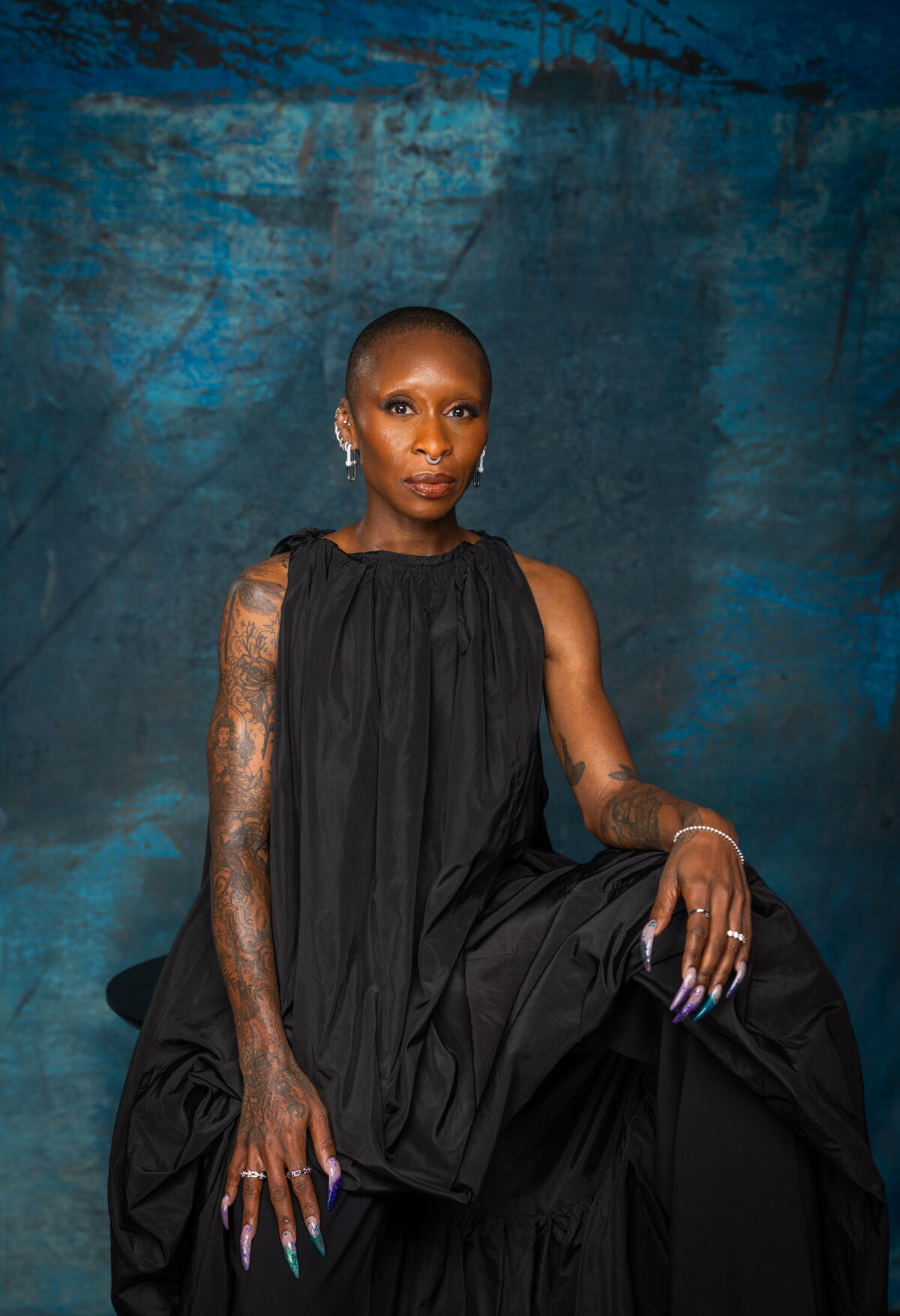
Cynthia Erivo of the film “Prima Facie,” photographed in the Los Angeles Times Studio at RBC House during the 2026 Toronto International Film Festival.
(Jason Armond / Los Angeles Times)
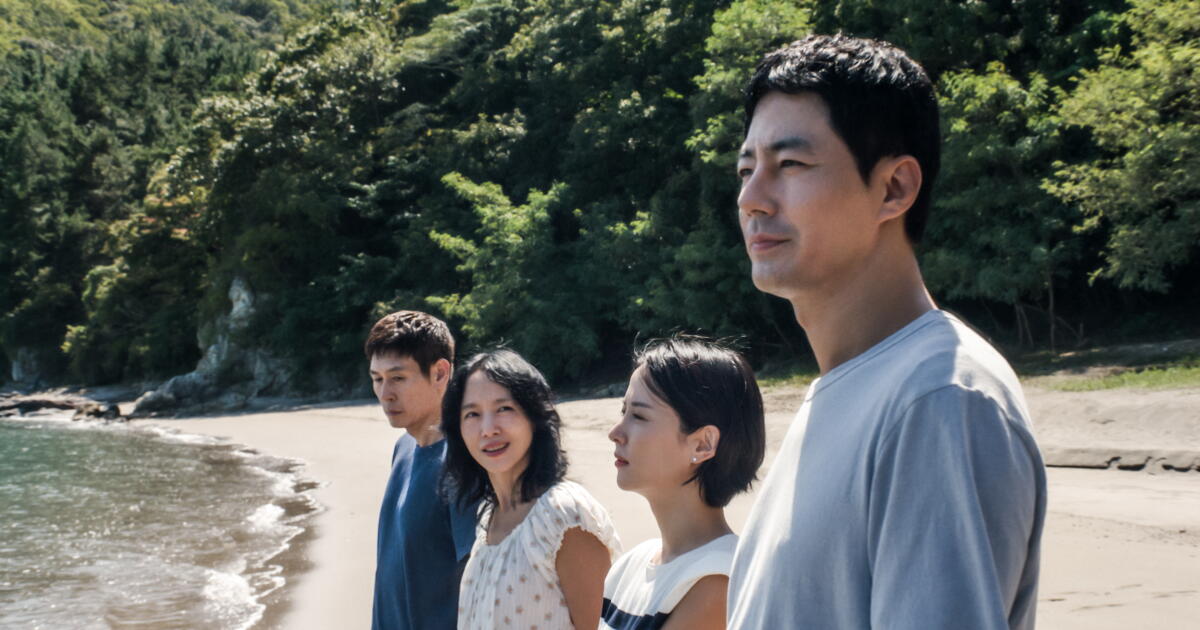
Cynthia Erivo stunned us in our studio space, looking fierce in a dark ensemble and scary nails. We also saw the likes of the luminous Laura Linney and the dapper Korean cast of “Possible Love.” Click through for more celebrity photos and daily surprises.
And do we have video interviews? Do we.
Sarah Paulson, Naomi Watts, and director Cody Fern discuss their new film, “Closing Night.” Chase Infiniti of “One Battle After Another,” Jason Isaacs and more talk “The Julia Set.”
And only minutes after they won the grand jury prize at Venice, we were speaking to the cast of “Possible Love.”

Jordan Firstman, center, in the movie “Club Kid.”
(A24)
It takes thermonuclear moxie to write, direct and star in your debut feature — and cast yourself as the cad. No wonder Jordan Firstman‘s uproarious dramedy “Club Kid” blew away expectations at Cannes and has landed in Toronto ready to shake up awards season.
Firstman plays Peter, an aging New York City party promoter whose scene-y shindigs and subsequent hangovers are starting to feel old.
Enter Arlo (a self-possessed Reggie Absolom) the 9-year-old kid he never knew he had and never fathomed he would have, given that women aren’t his thing (except for that one drug-fueled night with a British girl he barely remembers).
You may think you know where the story is headed and you aren’t entirely wrong, but the route there is a riot. — Amy Nicholson

A scene from the movie “Alpha Gang.”
(TIFF)
The latest from filmmaking siblings Nathan and David Zellner rolls into Toronto after having just had its world premiere at Telluride.
Their oddball sensibilities and elastic imagination means that you never quite know what to expect from one of their films and this is no exception: a wholly unpredictable story of an alien invasion told from the aliens’ point-of-view that is inscrutably absurd and touched by a startling romantic fatalism.
Two alien cadres, having assumed the looks of 1950s biker gang members, bicker and fight with one another even as they largely overlook their common enemy, the humans.
The cast is likewise a preposterous mash-up of performers you would not wholly expect to see together, including Cate Blanchett, Kelvin Harrison Jr, Léa Seydoux, Riley Keough, Chris Pine, Dave Bautista and others, making the film’s very existence seem like something dropped from outer space. — Mark Olsen

A scene from the movie “The Spiral.”
(TIFF)
Italian horror is my happy place and this is where I’ll be tonight at midnight, sopping up what many early viewers have already described as stylish and vicious.
Director Paolo Strippoli’s domestic drama got sharp reviews out of Venice; it sounds like a cross between a Bava film and “Parasite.” I’ll investigate. — Joshua Rothkopf
For 10 days, the center of the cinematic universe is the Toronto International Film Festival, whose closest geographical landmark is currently a ludicrous controversy.
“Welcome to TIFF and welcome to the beautiful shore of — say it with me — Lake Ontario,” festival CEO Cameron Bailey said on opening night as he introduced “Being Heumann,” director Sian Heder’s crowd-pleasing follow-up to her best picture Oscar-winner “CODA.”
The crowd said it back. Google Maps, however, insists that the festival is actually a 15-minute stroll to Lake America. I’ve yet to hear a single person call it that without an eyeroll.
What’s in a name? Last year in the spirit of patriotism, my favorite Toronto coffee shop taped over the menu listing for its Americano to re-dub it a Canadiano. This fall, the sign has returned to Americano. Taking a pause from politics, I ordered a flat white.
Yet, the festival’s programmers seem to be decentralizing their attention-hogging neighbors to the south. Typically, TIFF is a launch pad for awards contenders. But there are fewer high profile Hollywood filmmakers this year than usual — which was also the case in Cannes. Perhaps these international festivals are testing their own waters to see if they’re obliged to invite Americans to their party.
Instead, the Toronto line-up boasts pointed films about fascism. On its surface, Michaël R. Roskam’s “Le Faux Soir” is a procedural account of how a network of rebels in occupied Belgium published its own parody issue of a pro-Nazi newspaper on the 25th anniversary of Armistice Day in 1943. Most of the script’s energy goes to talking about typesetting and rotary press flongs, but right before the end credits roll, “Le Faux Soir” blurts out its timeliness about combating Le Fox News with comedy. Metaphorically alluding to the satirical newspaper “The Onion,” the narrator says that to pull off this operation, the team had to stick together like layers of an onion: “Never forget, onion is strength.”
Plenty of local comedies abound, including “The Stunt Driver” by Michael Dowse (“Goon”), an energetic biopic about Ken “The Mad Canadian” Carter, the ’70s speedster who vowed to vault across the mile-wide river between Ottawa and New York in a rocket-powered Lincoln Continental. The site of Carter’s jump is four hours away from the fest, although at his car’s top speed of 280 mph, you could get there in less than one. Safer just to enjoy Jay Baruchel’s funny and endearing portrait of a reckless risk-taker who hates being called a daredevil as much as he resents Ben Foster’s Evel Knievel attempting to give him some advice. “Canadians are God’s chosen people,” Carter growls defiantly. “The last thing we need is a Yankee doodle dandy telling us how to do our jobs.”
It’s also possible that this year’s lack of big films — unlike 2025’s “Frankenstein,” “The Smashing Machine” and “Wake Up Dead Man: A Knives Out Mystery” — is just a reflection of the industry’s changing tides. Two of the buzziest guests at this year’s fest have been Inde Navarrette of the micro-budget horror hit “Obsession,” which premiered at last year’s TIFF, and British Columbia-born Hudson Williams of the TV hockey romance “Heated Rivalry.” Twelve months ago, both actors were anonymous Gen Z-ers who could have easily popped into Tim Hortons for a maple-glazed donut without causing a stir. Now they’re stars.
Personally, I’m all for fresh talent. Audiences and critics alike are bored of film executives clinging to the same proven names and proven plots as tightly as worry beads. Yes, I’m hoping to see some Oscar contenders while I’m here and have my fingers crossed for a few movies I’ll be seeing shortly. But for the sake of filmgoing at large, I’d be more thrilled to spot another under-the-radar “Obsession.”
So far, I haven’t found one. However, I have seen ingenuity made for peanuts, like Jenna Cato Bass’ “Future Tense,” a South African sci-fi drama about a travel service that allows the wealthy to blip back to the 1600s to hot tub under the clear skies before the land was ruined by centuries of trash, trade and colonization. Mismatched new couple Tara and Lwando (Kristen Raath and Lawrence Maleka) — she’s white and sunny, he’s Black and snide — take a blistering vacation that their relationship might not survive.
The script gets screwy in the last act, but Bass proves she can pull off a bold time travel premise using only tastefully bland décor, gorgeous nature footage and a couple of menacing brutes with guns. As a bonus, Raath, her lead, has the spunk, charm and smile of Karen Allen, giving a breakout performance that’s such a delight that you could almost swear the “Raiders of the Lost Ark” ingenue had leapt back four decades to star in the film.

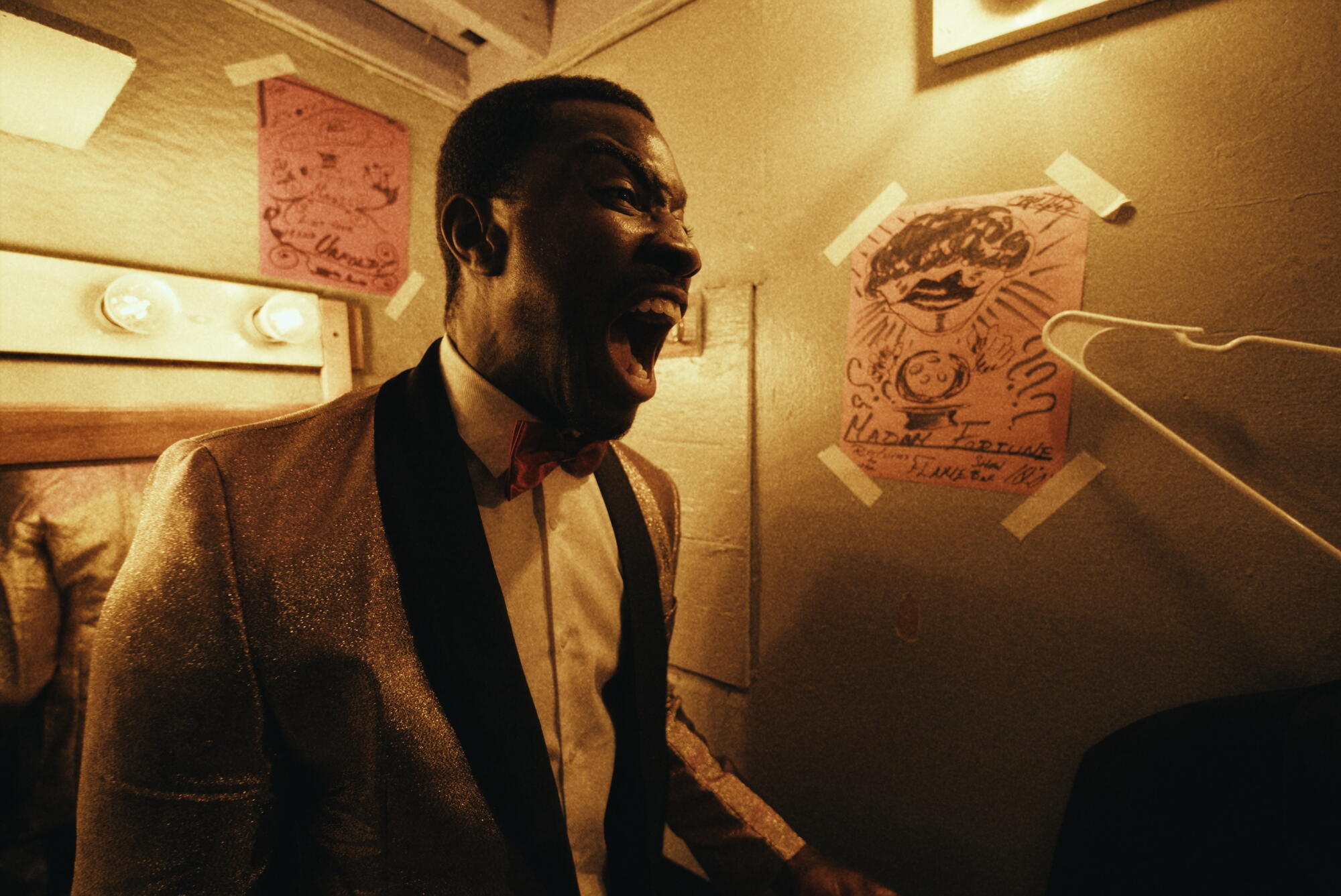
An image from “Voices,” a musical drama set in the 1960s.
(TIFF)
While we’re talking about pivotal moments in personal histories, nine years ago Deanté Gray was a rookie wide receiver for the Houston Texans. He tore his ACL in practice and, after muscling through that disappointment, is now a first-time feature director with “Voices,” a lean and loud musical-thriller about thwarted dreams. Set in one tatty motel room in 1967 Detroit, “Voices” is a vicious flick about rising two soul acts hellbent on getting on stage that night to impress Motown Records’ Barry Gordy.
Technically, only the Harmony Brothers, Bubbles and Melvin (Joe Maye and Jamal R. Averett), are booked to play the gig. But a fame-hungry bellboy, Jordan (Francis C. Edemobi), and his cousin Derrick (Ezekiel Ajeigbe) hatch an impulsive, half-baked plan to perform in their rivals’ place. Egged on by Derrick’s ambitious girlfriend Mia (Raél Ba), who’s angling to be the duo’s opening act, this bad idea crescendos with a half-dozen original songs — and a body count.
The sound design of “Voices” is raw and the rumored $50,000 budget so strapped that minor period piece inconsistencies like cheap plastic trash cans sneak into the frame. Who cares? Sam Buckner III and Charlie T. Savage’s smart and surprising screenplay is crowded with scenes that let its cast shine. Someone — ideally, several people — in here will wind up getting their own major break.
Admittedly, I’m biased. Morbid musicals are one of my favorite micro-genres, from “Little Shop of Horrors” and “All That Jazz” to “A Star Is Born” and “Cabaret.” (If you haven’t seen Steve Martin’s 1981 Depression-era hoofer “Pennies From Heaven,” do that this week.)
Add Theo Rhys’ “Stuffed” to that list. Jodie Comer (“Killing Eve”) plays a goth taxidermist; Harry Melling (“Pillion”) is a lonely man terrified of dying, buried and forgotten. Can she convince the sad sack to kill himself now to become a piece of her permanent collection?
The plot alone gives you the shivers, nodding to predatory internet meet-ups and that volatile mix of victimization and egomania that causes people to hurt themselves and/or others. Dark as the story is, though, co-writer Joss Holden-Rea’s tunes are stunners with limber melodies and creatively off-kilter lyrics. “My past is still before me,” Melling belts, picturing himself proudly mounted in a velvet suit and bronze plaque.
“Stuffed” isn’t for everyone. But my fellow sickos are going to love this bleak and lovely tragicomedy once it sets sail from these shores (whatever they’re called by then) to a theater near you.
TORONTO — It’s not everyday that we take photos of Oscar winners, unless we happen to be at the Toronto International Film Festival, when it is everyday.
On Friday, during our first session of operations alone, we had the pleasure of shooting Academy Award winners Michelle Yeoh and “Boyhood” mom Patricia Arquette, not to mention two-time Cannes Palme d’Or winner Cristian Mungiu, most recently of the upcoming “Fjord.”
You should bookmark this link and check it regularly to see Jason Armond’s beautiful portraits. Courteney Cox? Jodie Comer? Sebastian Stan doing his serious face? It’s all here.
Want a quick hit of festival buzz? How about Courteney Cox, Arquette and David Harbour getting scrappy over their favorite pizza toppings? They’re here to promote the Cox-directed “Evil Genius,” about the notorious pizza bomber incident.
Ten years after “The Love Witch” rocked audiences, writer-director Anna Biller is back with “The Face of Horror,” a medieval ghost story and a Technicolor-styled riot of design. She dropped by and mixed it up with our Mark Olsen.
Being a scream queen is a serious honor for Jane Levy and Jessica Rothe, in town with the excellent new slasher “River” but already our favorites for, respectively, “Evil Dead” and “Happy Death Day.”

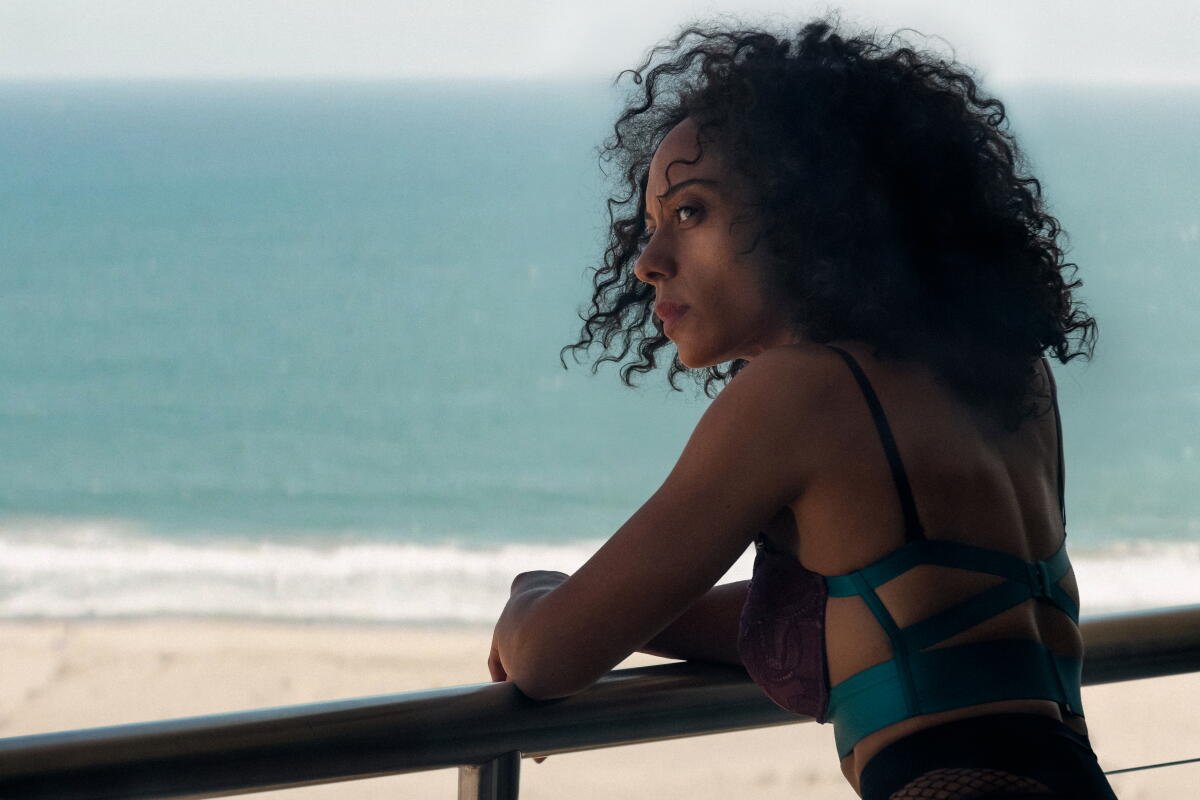
Rosalind Eleazar in the movie “Misty Green,” directed by Chris Rock.
(Merrick Morton / TIFF)
Misty Green is an actor — played with searing conviction by Rosalind Eleazar in a star-making performance — who may have missed her moment.
Though the industry has not made things easy for her as she suffers racist and sexist slights both big and small, Misty has not done herself any favors either, at times self-sabotaging with a careless attitude toward her undeniable talent and the work that must go with it.
The past few films Chris Rock has written and directed himself, including 2014’s “Top Five,” have felt distinctly personal, as if he is working out his own feelings about his career and the world.
“Misty Green” points toward redemption and hope on the other side of darkness: a pitiless examination of contemporary Hollywood and the difficulty of holding it all together. — Mark Olsen

Sarah Paulson in the movie “Closing Night.”
(TIFF)
The first half of Cody Fern’s strong debut is about the sweet schadenfreude of watching estranged sisters Sandra (Sarah Paulson) and April (Naomi Watts) scream at each other.
The second half pivots to ask if it’s as cathartic to leave things unsaid. Sandra, a stern Broadway actor, has hit the end of her career. April, an anxious Michigan hairdresser, is in Manhattan to see her dopey son Theo (Toby Wallace) and his pregnant girlfriend Lucy (Odessa A’zion) — who, after the family’s controlling matriarch Diane (Dianne Wiest) shows up, should start having second thoughts about passing down their dysfunctional DNA.
Both Fern and his co-screenwriter Devon are actors themselves, so they’ve written their leads one show-stopper scene after another.
Impressively, Paulson even manages to steal the climax away from Watts’ flighty kleptomaniac as her hard luck character takes her lumps with the courage of someone facing down a firing squad, chin held high. — Amy Nicholson

Andrew Scott in the movie “Elsinore.”
(Anthony Dickenson / Focus Features)
Already becoming a must-see out of Telluride and now Toronto, this extraordinary actor’s showcase (arriving in theaters Nov. 20) is carried by a fascinatingly complex turn by Andrew Scott, who just might finally earn some of the hardware he deserved for 2023’s “All of Us Strangers.”
Scott plays real-life Scottish actor Ian Charleson, the bright presence of “Chariots of Fire” and “Gandhi” who never quite had the movie career he deserved. But near the end of his career, in defiance of an AIDS diagnosis, he took on the stage role of Hamlet and left a burning impression.
It’s a performance that consistently elevates “Elsinore” from its recognizable trajectory. Scott deepens Charleson’s race against his own mortality with notes of humor, desperation, guilt, self-delusional avoidance and ultimately the deftness of someone who likes playing pretend. — Joshua Rothkopf
Get exclusive awards season news, in-depth interviews and columnist Glenn Whipp’s must-read analysis straight to your inbox.
By continuing, you agree to our Terms of Service, which include arbitration and a class action waiver. You agree that we and our third-party vendors may collect and use your information, including through cookies, pixels and similar technologies, for the purposes set forth in our Privacy Policy such as personalizing your experience and ads.