Top Stories

Secretary of State Marco Rubio designates Iranian-American Kamran Hekmati wrongfully detained by Iran

March 17 (UPI) — U.S. Secretary of State Marco Rubio has designated a Jewish Iranian-American imprisoned for nearly a year in Iran as wrongfully detained, according to his family.

Kamran Hekmati, a jeweler and longtime resident of Great Neck, N.Y., was detained by Iranian authorities at Tehran’s Imam Khomeini International Airport on May 17, according to the Bring Kamran Home website.

He was in the country for a family matter, and was detained while attempting to return to the United States. The website states he was formally arrested on July 28, less than two weeks after the United States bombed Iran’s nuclear facilities.

His family told UPI in a statement that they were notified on Monday of Rubio’s designation, an official recognition that the United States believes Hekmati is being held in Iran on false charges.

“We are so grateful to President [Donald] Trump and Secretary Rubio for their designation of Kamran Hekmati as a wrongful detainee,” Shohreh Nowfar, Hekmati’s cousin, said in a statement provided to UPI by Global Reach, a U.S. nonprofit that advocates for Americans imprisoned abroad.

“It reassures us that our government has our back in the effort to get Kamran home safely.”

UPI has contacted the State Department for comment and confirmation. Its Office of the Special Presidential Envoy for Hostage Affairs becomes involved once an American citizen is determined to be wrongfully detained.

Hekmati emigrated to the United States following the 1979 revolution.

According to his website, Hekmati was charged with allegedly visiting Israel within the last 10 years based on photos found on his phone of a trip he took to the country for his son’s bar mitzvah. He was sentenced to two years in Iran’s notorious Evin Prison. Advocates said the trip took place 13 years ago.

Hekmati was detained amid growing tensions between the allies, the United States and Israel, and Iran. Iranian authorities formally charged him two weeks after the Trump administration bombed Iran’s nuclear facilities.

He was again charged by Iran in December as tensions rose in the Middle East. Tehran authorities accuse him of meeting with agents of Mossad, Israel’s intelligence agency.

He is reportedly a bladder cancer survivor but requires regular medical testing and preventive medical procedures to guard against its recurrence.

“Kamran appears to be caught up in Iran’s traditional approach of detaining Americans to obtain political concessions from the U.S.,” his advocacy website states.

The announcement comes months after Reps. Tom Suozzi, a Democrat, and Claudia Tenney, a Republican, both from New York, urged Rubio in an early December letter to secure Hekmati’s release and to designate him as wrongfully detained.

Rubio designated Iran a state sponsor of wrongful detention on Feb. 27, a day before the United States and Israel launched their ongoing war with Tehran.

Iranian-American journalist Reza Valizadeh — arrested by Iran’s elite Islamic Revolutionary Guard Corps in September 2024 and sentenced to 10 years in prison — was also officially designated as wrongfully detained in May.

Nowfar told UPI that the wrongfully detained designation made clear “that the senior-most people in the White House know that Kamran, Reza and the others are being held by the Iranians and conveyed to the Iranians that they will be held accountable for their safety.”

Source link

On This Day, March 17: British evacuate Boston amid American Revolution

1 of 8 | On March 17, 1776, the Continental Army under Gen. George Washington forced British troops to evacuate Boston. The historic moment was depicted in the 1911 painting The Evacuation of Boston by William James Aylward. File Image courtesy of the New York Public Library

March 17 (UPI) — On this date in history:

In 1762, New York City staged its first parade honoring the Roman Catholic feast day of St. Patrick, the patron saint of Ireland. It was led by Irish soldiers serving in the British army. In 2002, President George W. Bush became the first sitting U.S. president to take part in the event, more than six months after the Sept. 11, 2001, terror attacks on the city.

In 1776, the Continental Army under Gen. George Washington forced British troops to evacuate Boston. The Boston area marks Evacuation Day along with its St. Patrick’s Day parade each year.

In 1901, 71 paintings by the late Dutch painter Vincent van Gogh were shown at the Bernheim-Jeune gallery in Paris and caused a sensation across the art world.

File Photo by Bill Greenblatt/UPI

In 1917, Russia appeared headed toward a republic following the end of the 300-year-old rule of the Romanoff family.

In 1958, the U.S. Navy launched the satellite Vanguard 1 into orbit around Earth.

In 1959, the Dalai Lama fled Tibet for India.

File Photo by John Eggitt/UPI

In 1969, Golda Meir, a 70-year-old former Milwaukee schoolteacher, was elected first female prime minister of Israel.

In 1974, the oil-producing Arab countries agreed to lift a five-month embargo on petroleum sales to the United States. The embargo, during which gasoline prices soared 300%, was in retaliation for U.S. support of Israel during the October 1973 Middle East War.

In 1990, Lithuania rejected the Soviet Union’s ultimatum to renounce its declaration of independence a week prior. The Soviets implemented sanctions against Lithuania and conducted a military operation in 1991 before other Soviet republics eventually declared their independence.

In 1992, South African Whites, by a margin of 68.7% to 31.2%, voted to end minority rule. Nelson Mandela was elected two years later as the first president in a fully representative democratic election.

In 2003, as war with Iraq seemed a certainty, U.S. President George W. Bush gave Iraqi President Saddam Hussein and his sons 48 hours to leave the country. The ultimatum was rejected.

In 2024, Russian President Vladimir Putin won a fifth term in office, making him the longest-serving leader of the country in about two centuries. A Russian election watchdog called the election unconstitutional.

File Photo by Maxim Shipenkov/EPA-EFE

Source link

White House chief of staff Susie Wiles diagnosed with breast cancer

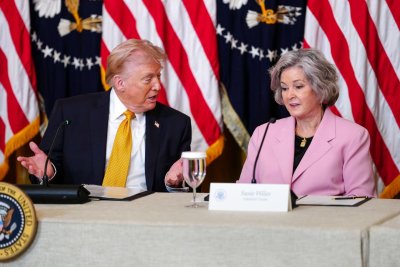
1 of 5 | President Donald Trump speaks with White House chief of staff Susie Wiles during a meeting with trustees of the John F. Kennedy Center for Performing Arts in the East Room of the White House in Washington, D.C., on Monday. Photo by Aaron Schwartz/UPI | License Photo

March 16 (UPI) — White House chief of staff Susie Wiles has been diagnosed with breast cancer and has an “excellent” prognosis, President Donald Trump announced Monday.

In a post on Truth Social, Trump said Wiles has “early stage breast cancer” and will be undergoing treatment “immediately.”

“She has a fantastic medical team, and her prognosis is excellent!” Trump wrote. “During the treatment period, she will be spending virtually full time at the White House, which makes me, as President, very happy!”

Wiles confirmed her diagnosis hours later in a statement on X.

“Nearly one in eight women in the United States will face this diagnosis. Every day, these women continue to raise their families, go to work and serve their communities with strength and determination,” she said.

“I now join their ranks.”

The diagnosis was made last week, she added, while expressing her gratitude to the doctors who “detected the cancer early.”

“I am encouraged by a very good prognosis,” she said.

“I am also deeply thankful for the support and encouragement of President Trump as I undergo treatment and continue serving in my role as White House chief of staff.”

The Hill reported that Wiles was seated next to Trump during Monday’s John F. Kennedy Center for the Performing Arts board meeting at the White House.

Vice President JD Vance also voiced his support for Wiles in a post on X.

“The Vance family is praying for our dear friend as she takes on her next fight!” he wrote.

Trump ally Elon Musk said he was “hoping for the best,” while rapper Nicki Minaj said, “God will get the glory for your testimony, my sister.”

Source link

Air traffic snarled due to winter weather, government shutdown

March 16 (UPI) — Even before a round of mid-May blizzards started blanketing an area stretching from South Dakota to northern Michigan on Saturday, a partial government shutdown already was making air travel miserable for Americans.

Extreme winter weather snarled all manner of transportation across the Midwest, while airports in Atlanta, Charlotte and elsewhere on the East Coast were slowed by pounding rain, on top of an increasing number of TSA employees either calling out sick or quitting their jobs because they are not getting paid.

As of early evening on Monday, there were 21,549 total flights delayed in the United States and 5,159 flights that were canceled, Flight Aware reported.

The Department of Homeland Security, which is home to the Transportation Security Administration, has not been funded since Jan. 30 amid a debate in Congress over funding the Department of Homeland Security, of which TSA is a part.

Democrats and Republicans in Congress disagree on adding guardrails for DHS agencies involved with immigration amid a crackdown by the Trump administration, which has left TSA unfunded.

The nation’s air traffic controllers, customs agents and TSA agents missed their first paycheck over the weekend, which has led to hundreds of TSA employees quitting their jobs, the New York Post reported.

The partial shutdown already had affected security and other services at airports, leading to long lines and advice that travellers arrive at the airport even earlier because of how backed up they have been.

On Sunday afternoon, as airports, travellers and millions at home prepared for winter weather to roll through overnight, the trade association Airlines for America, which represents both passenger and cargo airlines, sent an open letter to Congress pleading for them to fund TSA on predictions of what is already happening.

The CEOs, which include the leaders of the biggest U.S. passenger airlines, as well as FedEx and UPS, said that without funding TSA they expect travel issues during spring break, the World Cup and other national travel dates to be as chaotic as they were last year during the longest government shutdown in history.

Making matters worse has been a wide range of extreme weather across the country, from steady showers and a tornado watch shutting down Charlotte Douglas International Airport several times this morning — with the same occurring at major airports in Atlanta, Newark, Washington, D.C., Chicago, Detroit and Minneapolis, the Charlotte Observer reported.

The weather is not expected to let up, either, with the National Weather Service predicting that while the Midwest will get a bit of a break, severe thunderstorms with damaging winds and some tornadoes — as of early afternoon more than 34 million people were under tornado watches between Florida and New Jersey — expected later into the evening.

Melody Ashby jumps into a snow pile as her sister and mother look on, Sunday in Wadsworth Ohio. Photo by Aaron Josefczyk/UPI | License Photo

Source link

Illinois primary Tuesday looks to fill six open congressional seats

March 16 (UPI) — Illinois will have busy primary elections Tuesday as voters select a candidate to replace retiring U.S. Sen. Dick Durbin and fill five U.S. House seats without incumbents.

Three House seats are open due to retirements, and two others have incumbents running for Senate. All seats are expected to be filled with Democrats.

There will also be primaries for governor of the state, but there are no Democrats running against incumbent Democrat JB Pritzker.

Illinois voters “have an opportunity for generational turnover — where a boomer senator is stepping down, and you’ve got three Gen-Xers, who’ve been around on the scene for quite some time, trying to get the seat,” Northwestern University political science professor and Democratic strategist Alvin Tillery told ABC News. Tillery is not involved in any Illinois races.

“It could be another 20 or 30 years before we have a Senate race this competitive in Illinois,” he added.

Key Republicans running for Senate are attorney Jeannie Evans and former Illinois GOP chair Don Tracy.

There are 11 Democrats vying for the seat, but the top three are Rep. Raja Krishnamoorthi, Lt. Gov. Juliana Stratton and Rep. Robin Kelly.

Krishnamoorthi has raised the most money — more than $30 million — while Stratton has the benefit of Pritzker’s endorsement.

All three have run on fighting President Donald Trump and opposing Immigrations and Customs Enforcement, which operated heavily in Chicago during Operation Midway Blitz.

“Fighting ICE has become synonymous with opposing and fighting back against Trump,” Brandon Davis, a Democratic consultant who worked on Chicago Mayor Brandon Johnson’s 2023 campaign, told NBC News.

“I’m the only one with the background of standing up to bullies and bad actors, and successfully doing so, and now I have to stand up to Donald Trump,” Krishnamoorthi told ABC News in an interview. He would be the second Indian-American to hold a seat in the Senate.

Stratton is the first Black lieutenant governor in Illinois and told ABC News: “I have the best path in the nation to elect another Black woman to the United States Senate.”

Kelly has the endorsement of longtime Congressional Black Caucus member Rep. Jim Clyburn, D-S.C. He campaigned with Kelly on Tuesday, telling WLS-TV she is “our go-to person on healthcare issues.”

But all three have focused their ads against ICE.

Stratton has said she wants to “abolish” the agency because, “I don’t believe that this agency can be reformed. I want ICE and CBP out of our American cities.”

Krishnamoorthi said he wants to “abolish Trump’s ICE.” He explained he’s pushing for reforms to stop them from wearing masks and stop “roving gangs of ICE and CBP agents stirring up trouble in our cities.”

Kelly has called to dismantle ICE and the whole of the Department of Homeland Security, saying it’s “too big, too unwieldy and they’re not accountable.”

Source link

Kennedy Center board to vote on 2-year shuttering for renovations

March 16 (UPI) — The board of trustees for the John F. Kennedy Center for the Performing Arts in Washington, D.C., is set to attend a meeting Monday to determine whether to shutter the facility to carry out renovations that some critics worry could result in a structural overhaul akin to the White House’s East Wing.

The agenda for Monday’s meeting, obtained by The New York Times, indicates the board will vote on whether to begin renovations starting July 6. President Donald Trump announced last month that he wants to close the Kennedy Center for two years for construction amid artist cancellations and boycotts over his cultural agenda.

Trump said the decision to close the facility came after a yearlong review in consultation with contractors, musical experts, arts institutions, and advisers and consultants. He had initially considered a partial project that would permit shows to continue, but decided the best option for the venue was a temporary closure.

Rep. Joyce Beatty, D-Ohio, an ex officio member of the board who sued to have access about the details of renovations, said she believes Trump wants to shutter the Kennedy Center in response to dozens of individuals and cultural organizations who have canceled appearances there in response to Trump trying to rename the center after himself. Beatty said the documents she received about the renovations were “inadequate.”

She said “the documents prove that there is absolutely no basis to shutter this precious living memorial and beloved institution,” she said in a statement. “It certainly looks like President Trump is shutting down the center because he is embarrassed that ticket sales are down and artists are fleeing since his illegal renaming.”

Beatty’s lawyers said she was concerned Trump might use his hand-selected board to push through wholesale changes at the Kennedy Center to design a facility more to his liking. In October, Trump had the East Wing of the White House demolished to make room for a $250 million ballroom.

In a post on Truth Social on Friday, Trump shared renderings of what he expected the so-called Trump-Kennedy Center to look like after the renovations. He said he’s not planning to rip out the facade.

“I’ll be using the steels. So we’re using the structure, we’re using some of the marble, and some of the marble comes down,” he said.

A Washington Post analysis of the renderings show very few changes to the exterior of the building, including altered cornices, updated roof and some windows, painted columns, new signage and landscaping changes.

The group Hands Off the Arts has held weekly protests outside the Kennedy Center over the changes. A participant, drag queen Tara Hoot, said “there’s no need for it to close.”

“The carpet’s brand new, right? They already have some things planned in the works to redo the Kennedy Center and parts of it, maintenance, so there’s no reason to close it,” Hoot said, according to WUSA-TV in Washington, D.C.

“There are jobs, lots of jobs, and people are going to lose their jobs. The economy is terrible right now. Why do we want more people to lose their jobs?”

President Donald Trump speaks during an event celebrating Women’s History Month in the East Room of the White House on Thursday. Photo by Bonnie Cash/UPI | License Photo

Source link

Senate prepares to debate SAVE Act amid partisan split

March 16 (UPI) — Senate Republicans are trying to pass the SAVE America Act this week, as both the GOP and Democrats are gearing up to fight over the election reform bill that would require those registering to vote to show proof of citizenship with passports or birth certificates.

The Safeguard American Voter Eligibility Act already has broad public support, but Democrats are strongly against it. Republicans and President Donald Trump want a prolonged fight, forcing Democrats to defend their opposition.

Republicans say it will make elections safer, but Democrats call it a “voter suppression act.”

The bill would force people registering to vote to show proof of citizenship with a passport or certified birth certificate. People who have legally changed their name, including transgender people and most married women, would have a more difficult time.

According to State Department statistics, around half of Americans have a valid passport, and a first-time applicant would have to pay $165 to get one. The University of Maryland’s Center for Democracy and Civic Engagement said that 2.6 million Americans do not have a government-issued photo ID.

A recent Harvard CAPS/Harris poll showed that 71% of voters support the SAVE Act.

House Republicans passed a version of the bill along party lines in February. But the Senate needs 60 votes to avoid a filibuster. Right now, Republicans have a 53-47 majority, and Sen. John Fetterman, I-Pa., who usually votes with the GOP, has said he’s against the bill.

On Thursday, Senate Majority Leader John Thune, R-S.D., said he wants to bring the bill to a vote to “put Democrats on the record.”

Sen. Mike Lee, R-Utah, told The Hill that Trump wants to see an epic fight, similar to the two-month battle to pass the 1964 Civil Rights Act.

“What I want to do is try to maximize the period of time in which we debate it,” Lee said.

“They faced a 32-vote cloture deficit at the time it came over from the House in March of ’64,” Lee told The Hill. “They were able to close a 32-vote cloture deficit. It took them 60 days, but they got there.”

He said taking a longer time gives lawmakers clarity.

“Debating a bill that continues to get more popular even as people are trying to slow it down and stop it and obstruct it sometimes sharpens the minds of individual lawmakers and makes them more amenable in the end to negotiation,” Lee added. “That’s what we’re looking at here.”

Trump and other conservative Senators want to force Democrats to do a talking filibuster, but Thune has said there just aren’t enough votes to do so. He said the Republicans aren’t unified enough to table potential Democratic amendments.

“The votes aren’t there, one, to nuke the filibuster and the votes aren’t there for a talking filibuster. It’s just a reality,” The Hill reported Thune said last week. “I’m the person who has to deliver sometimes the not-so-good news that the math doesn’t add up but those are the facts and there’s no getting around it.”

Senate Minority Leader Chuck Schumer, D-N.Y., said Democrats are prepared for the battle.

“We don’t yet know what Thune is doing … but we’re prepared for every possible scenario,” Schumer told reporters Sunday.

“My caucus really feels strongly that this would be a horror … one of the worst things that’s happened in the history of this country in terms of allowing people to vote,” he said.

Trump has said he will not sign any legislation until the act passes the Senate.

President Donald Trump speaks during an event celebrating Women’s History Month in the East Room of the White House on Thursday. Photo by Bonnie Cash/UPI | License Photo

Source link

10 aviation CEO’s ask Congress to fund TSA, avert air travel chaos

March 15 (UPI) — A group of aviation CEOs sent a letter to Congress asking it to end the partial government shutdown and pay TSA, customs and air traffic controllers, as they said the overwhelming number of Americans wants them to.

Airlines for America, a trade association for passenger and cargo airlines, sent an open letter to Congress asking it to fund the Department of Homeland Security so that government employees at airports responsible for the safety of air travel receive their salaries.

This is the second time in six months that the federal government has at least been partially shutdown and follows a 43-day shutdown of nearly all of the government that was the longest in U.S. history.

The letter includes a plea to end the shutdown, on behalf of travel and shipping services that are essential to the nation, and to pass laws that guarantee air traffic controllers, customs agents and TSA agents all continue to be paid in the event of future shutdowns.

“Americans — who live in your districts and home states — are tired of long lines at airports, travel delays and flight cancellations caused by shutdown after shutdown,” the CEOs wrote in the letter. “Yet, once again, air travel is the political football amid another government shutdown.”

The CEO’s who sign the letter include those from Alaska Air, American Airlines, Atlas Air, Delta Air Lines, FedEx, JetBlue Airways, Southwest Airlines, United Airlines, UPS and Airlines for America.

The CEO’s predict that with spring break, the World Cup, America’s 250th birthday and anything else that an expected 171 million passengers will travel for in the coming months, the chaos similar during the shutdown last fall is likely to happen again.

“TSA agents just received $0 paychecks,” they wrote in the letter. “That is simply unacceptable. It’s difficult, if not impossible, to put food on the table, put gas in the car and pay rent when you are not getting paid.”

Last year’s shutdown was ended when Congress agreed to fund the government through Jan. 30, with plans to pass appropriations bills to then fund the government through the rest of the year.

Amid the Trump administration’s immigration crackdown, after the deaths of two U.S. citizens in three weeks at the hands of U.S. Customs and Border Control agents, Democrats and some Republicans in Congress held back an appropriations bill for the Department of Homeland Security.

While the agencies handling the administration controversial crackdown are under DHS, the department also is responsible for the Transportation Security Administration, which handles air travel.

Democrats have refused to vote for the funding until guardrails are put in place with the funding for the department’s immigration enforcement efforts, including limits and certain tactics and requiring officials in the field to wear body cameras.

TSA employees missed their first paycheck of the current shutdown this weekend, after Republicans refused a proposal to fund TSA, the Coast Guard, the Federal Emergency Management Agency and the Cybersecurity and Infrastructure Agency, while continuing to hold back funding for those for immigration-related agencies for further debate.

In addition asking the government to fund TSA, the CEOs asked Congress to pass the Aviation Funding Solvency Act, the Aviation Funding Stability Act and the Keep America Flying Act would guarantee that federal aviation workers get paid in the face of future government shutdowns.

President Donald Trump speaks during an event celebrating Women’s History Month in the East Room of the White House on Thursday. Photo by Bonnie Cash/UPI | License Photo

Source link

Pentagon identifies six service members killed in refueling mission

March 15 (UPI) — The Department of Defense has identified the six U.S. service members killed during a refueling mission as part of the Iran war as three members of an Air Force refueling wing and three from the Ohio Air National Guard.

The six crew members were aboard a Boeing KC-135 Stratotanker — a refueling aircraft — when it crashed Thursday in western Iraq, which was considered friendly airspace.

Among the dead were four airmen assigned to the 6th Refueling Wing at MacDill Air Force Base in Tampa, Fla.: Maj. John A. Klinner, 33, of Auburn, Ga.; Capt. Ariana G. Sabino, 31, of Covington, Wash.; and Tech Sgt. Ashley B. Pruitt, 34, of Bardstown, Ky. The three were part of the 99th Air Refueling Squadron based out of Sumpter Smith Joint National Guard Base in Birmingham, Ala.

Shortly after their identities were made public, Alabama Gov. Kay Ivey offered her condolences on X.

“Three of the service members who lost their lives in duty to our nation were stationed at the 117th in Birmingham,” she posted. “They were not only outstanding Airmen. They were our neighbors — our fellow Alabamians. May their service and that of their families never be forgot.

Three others were assigned to the 121st Refueling Wing at Rickenbacker Air National Guard Base in Columbus, Ohio: Capt. Seth R. Kobal, 38, of Mooresville, Ind.; Capt. Curtis J. Angst, 30, of Wilmington, Ohio; and Tech Sgt. Tyler H. Simmons, 28, of Columbus, Ohio.

Ohio Gov. Mike DeWine and his wife, Fran DeWine, were mourning the loss of the three airmen who operated out of Ohio and were trained to do work that was “critical in long-distance missions in defense of our nation.”

“Every mission they undertook involved risks that they were willing to take and the courage to put the lives of others above their own,” he wrote in a post on X.

“They served with honor.”

The Pentagon said the crash that led to the service members’ deaths was under investigation. A second Boeing Stratotanker involved in the incident declared an emergency before landing in Tel Aviv with no one on board injured.

Thirteen U.S. service members have died in connection to the Iran war, which began in late February.

An Iranian flag stands amid the destruction in Enghelab Square following the attacks carried out by the United States and Israel on Tehran, Iran, on March 4, 2026. Photo by Nahal Farzaneh/UPI | License Photo

Source link

Google Doodle shows Pi Day some love

Saturday’s Google Doodle shows how the mathematical constant pi is useful for easily calculating the area of a circle, the formula for which is A=πr2. Image courtesy Google

March 14 (UPI) — Saturday’s Google Doodle celebrates everyone’s favorite math holiday, Pi Day.

The Doodle features an animated illustration of how the mathematical constant is used in equations dealing with a circle’s circumference and diameter.

“Long before modern technology, the Greek mathematician Archimedes popularized an innovative approach: He approximated the value of pi by sandwiching a circle between two 96-sided polygons to determine its precise upper and lower bounds,” a Google post about the Doodle reads.

“Today, we honor this mathematical legacy as enthusiasts worldwide celebrate with pi-reciting contests and slices of pie.”

The value of pi is roughly 3.14, but since it’s irrational, the number of decimal places beyond .14 go on infinitely. There are contests worldwide in which math lovers memorize and recite as many digits of pi as possible.

Last Pi Day, in 2025, a 10-year-old British boy recited 280 digits of pi from memory in 1 minute, breaking a Guinness World Record.

Pi Day is celebrated March 14 each year because the date is typically expressed as 3/14. Those less interested in math often choose to celebrate the day by eating a slice of their favorite pie.

Source link

President Donald Trump says U.S. ‘totally obliterated’ military targets on Kharg Island

March 14 (UPI) — President Donald Trump announced that U.S. forces “totally obliterated” every military target on Iran’s Kharg Island, a key port that exports the vast majority of Iran’s oil.

In a post on Truth Social on Friday evening, Trump described the attack as “one of the most powerful bombing raids in the History of the Middle East.”

He said he directed U.S. Central Command to carry out the bombings after Iran halted ships’ passage through the Straight of Hormuz. About 20% of the world’s crude oil passes through the strait.

“For reasons of decency, I have chosen NOT to wipe out the Oil Infrastructure on the island,” Trump wrote.

“However, should Iran, or anyone else, do anything to interfere with the Free and Safe Passage of Ships through the Strait of Hormuz, I will immediately reconsider this decision.”

Kharg Island is about 15 miles south of the Iranian mainland through which about 90% of the country’s oil exports pass, The Washington Post reported. It’s a critical piece of Iran’s economy and a full attack on the oil infrastructure there could hinder Iran’s ability to pay its military.

Iranian officials said the site was “proceeding normally” after the U.S. attack.

In response to Friday’s bombings on Kharg Island, Iran threatened its own attack on key oil infrastructure in the United Arab Emirates, CNN reported.

Oil has been a key factor in the war in Iran, which began Feb. 28 with surprise U.S. and Israeli airstrikes on dozens of Iranian sites. AAA reported Saturday that the average price of a gallon of gasoline was $3.68 in the United States, up 23% since the start of the war.

This could, in turn, have a dramatic impact on other aspects of the U.S. economy, including food prices, jet fuel and fertilizer.

An Iranian man raises a portrait of new supreme leader Mojtaba Khamenei during a rally on Revolution Street in Tehran on March 9, 2026. Photo by Hossein Esmaeili/UPI | License Photo

Source link

Michigan Gov. Whitmer calls synagogue attack anti-Semitism

March 13 (UPI) — Michigan Gov. Gretchen Whitmer on Friday thanked security personnel for risking their lives to thwart a potentially deadly attack on a temple this week.

Whitmer spoke at a news conference one day after a person drove a vehicle into Temple Israel in West Bloomfield, Mich., calling the attack “anti-Semitism at its absolute worst.”

Her comments followed the attack at the temple on Thursday, where more than 100 children were attending school at the time.

“I want to thank Temple Israel’s security personnel — they were selfless in their courage and they saved lives,” Whitmer said. “Let’s be very clear: Yes, this is a place of worship, but at the time that this attack occurred, it was a school. One hundred and four children aged 5 and younger.”

The attacker, according to police, drove through the doors of the temple and down a hallway “with purpose” when a fire started inside the vehicle.

A security guard was hit by the vehicle, but security guards also responded to the driver with gunfire and the driver died.

Temple Israel is one of the largest reform Jewish congregations in the country, Whitmer noted, attracting more than 1,000 people for Friday night Shabbat services.

“Parents bring their children to daycare and school, and it’s a place of peace, unity, light and life,” Whitmer said. “Yesterday’s attack was anti-Semitism. It was hate, plain and simple.”

“We will fight this ancient and rampant evil,” she said.

There has been an uptick in anti-Semitic incidents in recent years and, according to the American Jewish Committee, roughly 70% of all religiously motivated hate crimes in the United States are committed against Jewish people.

President Donald Trump speaks during an event celebrating Women’s History Month in the East Room of the White House on Thursday. Photo by Bonnie Cash/UPI | License Photo

Source link

Judge quashes subpoenas for Fed Chair Jerome Powell

March 13 (UPI) — A federal judge this week quashed subpoenas the Department of Justice had issued to Federal Reserve Chair Jerome Powell because they were issued to pressure him into adjusting interest rates.

Judge James Boasberg redressed the DOJ for the subpoenas, saying that their purpose had nothing to do with a probe about renovations at the Federal Reserve in Washington, D.C.

The DOJ in January launched a criminal investigation into Powell’s testimony last year about the renovations, which Powell at the time said were “pretexts” to punish him and the Fed after they did not set interest rates at levels demanded by President Donald Trump.

“The Government has produced essentially zero evidence to suspect Chair Powell of a crime; indeed, its justifications are so thin and unsubstantiated that the Court can only conclude that they are pretextual,” Boasberg wrote in the opinion.

The department in January issued grand jury subpoenas in reference to Powell’s comments about the multi-year project to renovate the Fed’s office buildings during his June 2025 testimony before the Senate Banking Committee.

During a tour of the renovations, Powell disputed Trump’s over-estimates of the renovation’s cost, and threatened to sue him for the “horrible and grossly incompetent job” Powell had done on the project.

Overall, however, Trump has repeatedly ripped into and mused about firing Powell, which he cannot do, because the Fed chair has repeatedly said that interest rate changes would be dictated by only the market, rather than the preferences of any one person.

In the opinion, which was unsealed Friday, Boasberg said he blocked the subpoenas because “a mountain of evidence suggests that the Government served these subpoenas on the Board to pressure its Chair into voting for lower interest rates or resigning.”

President Donald Trump speaks during an event celebrating Women’s History Month in the East Room of the White House on Thursday. Photo by Bonnie Cash/UPI | License Photo

Source link

Hegseth on Strait of Hormuz: ‘Don’t need to worry about it’

March 13 (UPI) — Secretary of Defense Pete Hegseth downplayed the shutdown of the Strait of Hormuz during a press briefing Friday and claimed 15,000 Iranian targets have been struck.

Hegseth said the U.S. and Israeli air forces are flying over Iran and Tehran Friday, the 13th day of the operation. He claimed that Iran’s air defenses, navy and munitions supply have been defeated.

Iran’s missile volume was down by 90% and its one-way attack drones were down by 95% on Thursday, Hegseth said.

“Today as we speak we fly over the top of Iran and Tehran,” Hegseth said. “Fighters and bombers, all day picking targets as they choose.”

The defense secretary opened Friday’s briefing at the Pentagon, joined again by Gen. Dan Caine, saying that the United States is “decimating the radical Iranian regime’s military in a way the world has never seen before.”

“We said it would not be a fair fight and it has not been,” he said.

Caine lauded the use of the first precision-strike missiles used in combat by the United States, praising the troops that fired them. One of those soldiers was 20 years old and has only been in the U.S. Army for six months.

Caine’s comments on the precision of U.S. strikes come as the military is investigating a deadly strike on an elementary school for girls in Iran that took place on Feb. 28. The preliminary investigation has found that the United States is likely responsible for the attack that killed more than 170 people, most of them children.

“They’ve done all of this with the precision and determination that comes from relentless training and trust in each other and their weapons systems,” Caine said.

Hegseth said the United States is “dealing with” Iran’s attacks on vessels on the Strait of Hormuz, which has dramatically disrupted the oil trade.

“It’s something we’re dealing with, we have been dealing with it and don’t need to worry about it,” Hegseth said. “We’re on plan to defeat, destroy and disable all of their meaningful military capabilities on a pace the world has never seen before.”

Caine later said that there is some traffic moving through the strait.

As Iran’s military capabilities weaken, Hegseth said, more importantly, it does not possess the capability to build more weapons.

“Soon and very soon all of Iran’s defense companies will be destroyed,” Hegseth. “For example, as of two days ago, all of Iran’s ballistic missile production capacity, every company that builds every component of those missiles, has been functionally defeated, destroyed.”

As for Iran’s new supreme leader, Mojtaba Khamenei, Hegseth said he is “likely disfigured.” Khamenei was wounded during the initial strikes by the United States and Israel on Tehran on Feb. 28, which killed his father, former supreme leader Ali Khamenei.

President Donald Trump shared similar speculation about the new supreme leader on Fox News on Friday, saying he believes he is alive but “damaged.”

“I think he probably is,” Trump said. “I think he’s damaged but I think he’s probably alive in some form.”

President Donald Trump speaks during an event celebrating Women’s History Month in the East Room of the White House on Thursday. Photo by Bonnie Cash/UPI | License Photo

Source link

4 American servicemen killed after U.S. refueling jet crashes in Iraq

March 13 (UPI) — The U.S. military confirmed Friday that four of six crew members of a refueling jet on combat operations in the Iran war were killed when it went down over western Iraq in an incident with another U.S. military aircraft.

A rescue operation mounted following the crash on Thursday night was ongoing. The second aircraft landed safely following the incident, which involved neither enemy or friendly fire, U.S. Central Command said in a news release.

“The circumstances of the incident are under investigation. The incident occurred in friendly airspace during Operation Epic Fury, and rescue efforts are ongoing. More information will be made available as the situation develops,” CENTCOM said

The identities of the service members were being withheld until 24 hours after their next of kin had been notified, it added.

CBS News said that the second aircraft, also a Boeing Stratotanker, declared an emergency before landing in Tel Aviv.

The BBC reported that there were six crew on board — a pilot, co-pilot, a boom operator responsible for operating the refueling arm and three others.

An Iraqi intelligence source told CBS the aircraft crashed on the border with Jordan, near the town of Turaibil.

The Iranian military claimed responsibility, saying that an allied militia group in Iraq had downed the aircraft with a missile.

Thursday’s crash came 10 days after three U.S. F-15E Strike Eagles crashed in Kuwait in a friendly-fire incident in which Kuwaiti air defenses “mistakenly shot down” the fighter jets. All six aircrew were rescued after safely ejecting.

The U.S. military’s Stratotanker fleet is a critical asset in its in-flight refueling capability, enabling aircraft to remain airborne for extended periods during missions without having to land to take on more fuel.

The crash in Iraq brings to 11 the number of U.S. military personnel killed since the United States and Israel launched their airborne offensive against Iran on Feb. 28.

Iranians attend a funeral for a person killed in recent U.S.-Israel airstrikes at Behesht-e Zahra cemetery on the southern outskirts of Tehran in Iran on March 9, 2026. Photo by Hossein Esmaeili/UPI | License Photo

Source link

Retired U.S. Air Force major general missing in New Mexico for 2 weeks

Retired U.S. Air Force Maj. Gen. Neil McCasland has been missing since February 27. File Photo courtesy of the FBI

March 12 (UPI) — Law enforcement officials in New Mexico said they’ve been searching for a 68-year-old retired U.S. Air Force major general who was reported missing last month.

William “Neil” McCasland was last seen at his Albuquerque home Feb. 27, the Bernalillo County Sheriff’s Office said in a post on Facebook. The department issued a silver alert searching for the man, saying it wasn’t clear what kind of clothing he was wearing nor what direction he might have traveled.

“Due to his medical issues law enforcement is concerned for his safety,” the sheriff’s office said.

The FBI’s Albuquerque field office said it was unusual for McCasland to be out of touch from his family for this length of time. The FBI said it believes he left his home on foot and doesn’t expect foul play.

“We are, however, utilizing all possible resources including advanced technologies, and still considering all possible scenarios as we follow up on leads towards locating Neil,” the FBI said in a Facebook post on March 6.

The sheriff’s office said it had searched McCasland’s neighborhood, speaking to more than 600 homeowners in the area.

Source link

Moon project delays among barrage of challenges for NASA

March 12 (UPI) — The recent, new delay in NASA’s moon landing program represents the latest in a string of technical, budgetary, workforce and public perception challenges that plague the space agency, a UPI analysis shows.

When flight officials pulled the Artemis II Space Launch System and Orion spacecraft off the launch pad at Kennedy Space Center on Feb. 25 after a recurrence of helium flow problems and pushed the launch back to April at the earliest, it served as another reminder of the space agency’s current assortment of formidable problems.

Those issues include a moon program whose timeline keeps slipping; recurring technical failures and cost overruns with its flagship SLS rocket; a commercial lander — SpaceX’s Starship — that has yet to demonstrate reliability; the effective grounding of the Vulcan Centaur rocket made by United Launch Alliance; the departures of thousands of NASA workers and turnover in its top leadership positions.

The agency announced March 3 it had identified the latest problem with Artemis II as a faulty helium seal in the SLS upper stage, and that it is repairing the assembly, as well as making other fixes to the spacecraft.

But meanwhile, the lag time since the last crewed U.S. spaceflight has now stretched to three full years. This lengthy drought has prompted outside analysts and NASA officials to worry about how public support for the space program is being affected.

“When missions occur every few years, it is easy for people to lose interest,” said Burt Dicht, a leader of the National Space Society, who added he backs a newly announced NASA effort to increase the frequency of launches.

The latest delay has prompted a fresh look at some of the major challenges facing the space agency’s moon effort, as well as more general problems.

Headwinds with partners, personnel issues

One of the more pressing issues with the Artemis program is its dependence on SpaceX’s Starship Human Landing System, or HLS, as the initial human lander that will put the first U.S. astronauts on the lunar surface.

Elon Musk’s company signed a contract with NASA in 2021 to provide the lander, but struggled in 2025 to perfect the mammoth Starship V3 rocket necessary for a key element of the HLS mission, according to a report issued by NASA’s Aerospace Safety Advisory Panel and released last month.

The Starship V3 incorporates upgraded Raptor engines to provide it with the required performance for low-Earth orbit flight and on-orbit operations, and its development is deemed crucial for transferring fuel to an orbiting tanker.

How it performs will “ultimately determine the number of refueling missions required for the HLS mission,” which is now pegged at roughly 12 fueling flights, the report’s authors wrote.

“The development and test progress necessary for a version of Starship that has not yet flown in time to support a human lunar landing mission within the next few years appears daunting and, to the panel, probably not achievable,” they wrote.

SpaceX announced Feb. 26 that the first Starship V3 had left its build site at Boca Chica, Texas, and had begun prelaunch testing.

In 2023, NASA selected Blue Origin, owned by Amazon founder Jeff Bezos, to develop a second human landing system to compete with the HLS. Its Blue Moon Mark 2, to be launched aboard a New Glenn rocket, is to be tested twice and then carry a crew to the moon in late 2028.

New critical report

But NASA’s Office of Inspector General, in a report issued Tuesday, looked at both programs to carry astronauts to the moon and advised that the agency faces significant technical and programmatic risks that threaten mission timelines and crew safety.

The report said NASA is not fully adhering to “test like you fly” principles, particularly for uncrewed demonstration missions, and has not yet ensured that SpaceX’s Starship lander will meet manual control requirements for astronauts.

The inspector general also noted gaps in hazard‑mitigation planning and insufficient testing of critical systems, especially given the complexity of both SpaceX’s and Blue Origin’s lander architectures.

The report also warned that NASA the capability to rescue astronauts in the event of a life‑threatening emergency during lunar surface operations, echoing limitations from the Apollo era.

And it concluded that SpaceX and Blue Origin face technical challenges likely to cause additional delays, with SpaceX’s schedule slipping beyond its earlier 2027 target and even the revised 2028 goal remaining uncertain.

The report recommends stronger risk‑management practices, more realistic scheduling and more rigorous testing to ensure crew safety and mission success.

Meanwhile, NASA’s larger operations also could be affected by problems encountered in the new Vulcan Centaur rockets made by United Launch Alliance.

Vulcan launches halted

The U.S. Space Force last week temporarily halted all national security launches using the rocket after the same booster malfunction occurred twice, according to comments made by Col. Eric Zarybnisky at a meeting last month in Colorado.

The Vulcan Centaur program was established by ULA to reduce costs and eliminate reliance on the current workhorse Atlas V Russian-supplied RD-180 engine and is primarily meant to meet U.S. military needs.

But the program benefits NASA as well, giving it greater flexibility and transport capability for launching of payloads, the space agency said.

NASA also continues to struggle with an exodus of workers, including thousands of crucial senior staff, which some analysts believe is impacting its moon and Mars exploration goals due to a loss of expertise.

Nearly 4,000 agency employees last year chose to accept “deferred resignations” as part of the Trump administration’s efforts to slash the federal workforce — a move that reduced NASA’s employee roster by more than 20% to some 14,000, NASA spokesperson Cheryl Warner told NPR in June.

Still, even amid all of those issues, the agency was able to dodge the biggest potential bullet of them all — a proposed 24% reduction in its budget issued by the White House, which would have been the biggest cut in agency history.

That threat all but evaporated when Congress agreed on a $24.4 billion NASA spending bill in January, representing a mere 1.7% budget reduction.

The NASA administrator’s job itself remained unfilled throughout 2025, as President Donald Trump withdrew his nomination of Isaacman. Trump ultimately changed course, and Isaacman was confirmed by the Senate on Dec. 17.

Major changes for the Artemis program

Of all the difficulties faced by NASA, the technical problems and cost overruns of the Artemis program itself have emerged as perhaps the most high-profile.

The Feb. 25 postponement was the second recent delay for Artemis II, which is to send four astronauts on a “slingshot” fly-by around the moon. Last month, NASA pushed back the launch to March after engineers discovered what they called a significant hydrogen leak during a wet dress rehearsal.

NASA said Thursday it plans to roll the Artemis II Space Launch System rocket and Orion capsule back out to the launchpad next week, aiming for a launch in April.

The rollout wis to begin March 19, with an eye at launching as early as the evening of April 1, NASA officials said during a press briefing.

The original target date for landing astronauts on the moon — 55 years after the United States first did it — was 2024. When that was announced in 2019, many observers thought the target date was too optimistic.

The effort’s total cost after NASA recently added nine new elements now exceeds $20 billion, the Government Accountability Office reported last summer. Three of those elements have racked up a total of $7 billion in cost overruns.

NASA has made efforts to get a handle on the overruns through its Moon to Mars Program Office, the GAO said, but warned that each new delay to mission dates can create a cascading effect of increased costs across multiple programs that function independently of each other.

Clear warnings

And in its report from last month, the NASA safety panel sounded clear warnings about the “ambitious timeline” for developing the Human Landing System, given its “intricate operational design” and :complex concept of operations,” as well as other serious safety concerns surrounding the Artemis program.

Taken together, the issues posed a “high safety risk,” the panel concluded, which “casts doubt on the current Artemis III timeline and the feasibility of the Artemis III mission goals.”

In the wake of the latest issues, Isaacman announced a major revamp of Artemis under which the expected moon landing was pushed back from Artemis III in 2027 to Artemis IV in 2028.

“We have to rebuild core competencies,” he told reporters Feb. 27, blaming the repeated delays on too-infrequent launch schedules (known as the “launch cadence”), which he said causes “muscle memory” to “atrophy.”

“This is just not the right pathway forward,” he asserted, while revealing that a moon landing with Artemis III in 2027 has been deemed too ambitious and will instead now be attempted with Artemis IV in 2028.

Artemis III will instead now serve as a mission to perform tests on connecting with lunar landers in low-Earth orbit, as well as to test equipment that will go on Artemis IV.

Meanwhile, to bump up the launch cadence to once every 10 months rather than every three years, Isaacman announced a standardization of the SLS rocket fleet to “essentially near ‘Block-1’ configuration.”

The idea, he said, is to reduce the complexity of the massive rocket and to “accelerate manufacturing, pull in the hardware and increase launch rate, which obviously has a direct safety consideration to it, as well. You get into a good rhythm launching with greater frequency, you get that muscle memory.”

To do that, he added, “we need to rebuild and strengthen the workforce here at NASA. … We have to rebuild core competencies. The ability to turn around our launch pads and launch with frequency greater than every three years is imperative,” he said, pointing to the histories of the Mercury, Gemini, Apollo and Space Shuttle programs, when “the average launch cadence was closer to three months.”

The decision to simplify and standardize the SLS starting with Artemis IV also means the agency will no longer need to use the $1.5 billion Mobile Launcher 2 at Kennedy Space Center, which is still under construction and has faced its own cost overruns and delays.

Experts’ reactions

Experts who have been closely following the development of Artemis expressed a range of opinions about whether the latest moves are the right ones for the moon program and the U.S. space program generally.

Kenny Evans, a fellow in science, technology and innovation policy at Rice University’s Baker Institute for Public Policy in Houston, told UPI the glitches and the resulting negative perceptions of the program are indeed tied to the drawn-out launch cadence.

“The extended periods between SLS launches have given NASA fewer chances to test out hardware — and less cover for when things go wrong,” he said. “That has long been a valid criticism of the SLS program and a source of bad press — for example, the fueling issues in prior wet dress rehearsals.

“Working out kinks, as visible and expensive as they are, should be seen as net positives rather than programmatic failures,” he said.

“Frankly I’m relieved to see the timeline revamp,” Evans added. “The Artemis schedule Isaacman inherited had absolutely no chance of meeting its prior targets, and I’ve been impressed by his willingness to address the hard truths about the program.

“In terms of safety, making Artemis III a system test will provide NASA a much needed opportunity to remove as much risk as possible before attempting a lunar landing for Artemis IV,” he said while noting he is “particularly enthusiastic” about the NASA leader’s stated commitment to strengthening its workforce, “especially in light of cuts to agency staff.”

Meanwhile, the National Space Society’s Dicht, said his interactions with students, engineers, long-time space advocates and the public have shown him there is “real enthusiasm for progress in the space program,” but that new momentum is needed.

“I believe NASA Administrator Isaacman’s proposals to improve launch cadence, strengthen the workforce and standardize the SLS are positive steps that can help stabilize the Artemis program and move it toward a sustained return to the moon,” Dicht said.

“Whether it is SLS or any other rocket, these are extraordinarily complex machines,” he said. “Increasing the cadence of launches and ensuring the workforce is well-trained and consistently engaged helps build the operational experience, or ‘muscle memory,’ that improves reliability and the likelihood of mission success.”

While there is steady and palpable excitement over humankind’s first return to the moon since 1972 among committed enthusiasts, “there remains a segment of the public, including some social media influencers, who interpret technical issues as a sign that the program is failing,” he said.

“When missions occur every few years it is easy for people to lose interest,” Dicht said. “If the program can move toward a more regular rhythm, possibly two flights per year, it will attract attention and reinforce the sense that progress is being made.”

Similar to Apollo 9

Spaceflight historian and science author Amy Shira Teitel, creator of The Vintage Space YouTube channel, said the revamp “doesn’t particularly surprise me,” noting the decision to change Artemis III’s moon landing mission into a test flight is reminiscent of Apollo 9 in March 1969.

In that mission, a three-astronaut crew carried out vital tests while in low-Earth orbit to prepare for the historic Apollo 11 moon landing four months later.

“The plan to land Artemis III while still not having the lander ready or even chosen, from what I could tell, seemed like trouble waiting to happen, so the idea of going back to Apollo 9 and testing the hardware/mission in Earth orbit seems both safe and like it should have been the first step before going to the moon,” she told UPI in emailed comments.

The author of Breaking the Chains of Gravity: The Story of Spaceflight before NASA has questioned the overall purpose, cost and broader implications of the moon-to-Mars effort, contending it lacks a compelling justification other than “going for the sake of going” while the highly successful and popular International Space Station is scheduled to be scrapped in 2030.

All of the Artemis changes, Teitel said, are “emphasizing how hard it is, and how insane it is to be looking at canceling the ISS without a replacement and just focusing on the moon-to-Mars pipeline without any kind of long-term infrastructure or planning.

“And the endless issues with SLS — why are we adding more launches?” she asked. “We know this system is flawed. It feels like retrofitting a mission into the hardware to justify the … launch cost.”

NASA’s Space Launch System rocket emerges on Saturday morning from the Vehicle Assembly Building to start its journey to Launch Complex 39B at the Kennedy Space Center in Florida. Photo by Joe Marino/UPI | License Photo

Source link

Rep. Jim Clyburn, 85, to seek re-election

1 of 5 | Rep. James E. Clyburn, D-S.C., speaks at the 2024 Democratic National Convention in Chicago. Clyburn, 85, announced Thursday that he will run for re-election. File Photo by Tannen Maury/UPI | License Photo

March 12 (UPI) — Rep. Jim Clyburn, D-S.C., announced Thursday that he will run for his 18th term in the House of Representatives.

Clyburn, 85, said he is going to run a “very vigorous campaign.”

“Today I’m going to answer a question that’s always asked: What is there unfinished or what more do you need to do? Well, it’s in the preamble of our Constitution: We exist in pursuit of a more perfect union,” he said. “And I’m here today to say I do believe that I am very well-equipped — and healthy enough — to move into the next term, trying to do the things that are necessary to continue that pursuit of perfection.”

About his age, Clyburn said, “If I were not up to it, I would not do it. But in response to some extensive surveys, some intense consultations with my three daughters, they finally got to a unanimous opinion that I should be here today and make this announcement.”

Clyburn, who has served in the House for more than 30 years, was the No. 3 Democrat in the chamber until he stepped down as Democratic whip in 2023. He then became assistant Democratic leader to House Democratic leader Hakeem Jeffries, D-N.Y.

Reps. Nancy Pelosi, D-Calif., and Steny Hoyer, D-Md., recently announced their retirements from the House, leaving Clyburn as the only one left of that leadership trio from 2007-2023.

Clyburn joined the House in 1992 as the first Black congressman from South Carolina since Reconstruction.

Clyburn endorsed then-presidential candidate Joe Biden just before the South Carolina primary, which helped him win the state and boost his candidacy after struggling in other early primaries.

Antjuan Seawright, Clyburn’s longtime adviser, said he is still needed in Congress to “help shape the direction and future of our country.”

Seawright added that the party needs “a little hip-hop and R & B, Old Testament and the New Testament.”

South Carolina’s primary will be June 9.

President Donald Trump speaks to the members of the media on the South Lawn of the White House before boarding the Marine One helicopter to Hebron, Ky., on Wednesday. Photo by Yuri Gripas/UPI | License Photo

Source link

Gen. Joshua Rudd confirmed to lead NSA, Cyber Command

March 11 (UPI) — Gen. Joshua Rudd was confirmed by the Senate to lead the National Security Agency and U.S. Cyber Command Tuesday.

Rudd is already the deputy chief of the U.S. Indo-Pacific Command. The Senate voted to confirm him in a 71-29 vote.

Sen. Ron Wyden, D-Ore., voiced his objections to Rudd because he doesn’t have cybersecurity experience. He had put a procedural hold to block Rudd’s confirmation but the chamber was able to get around it.

“He is not qualified for this job,” Wyden wrote in a letter addressed to President Donald Trump that was submitted to the Congressional Record. “And, when it comes to the cybersecurity of this country, there is simply no time for on-the-job learning. The threat is just too urgent for that. For these reasons, I oppose the nomination.”

The position of NSA director had been vacant since April, when retired Gen. Timothy Haugh and his civilian deputy Wendy Noble were ousted.

Lt. Gen. William Hartman has been acting head and plans to retire when Rudd is sworn in. No date has been announced yet.

“General Rudd is a war hero with a lifetime of service to our nation. He is the right choice to lead the protection of our nation from cyberattacks by Iran, Russia and China,” Sen. Tom Cotton, R-Ark., said in a statement.

During nomination hearings before Senate committees, Rudd defended Section 702 of the Foreign Intelligence Surveillance Act, a data-collection law that is set to expire in April.

Source link

Attorneys for LA superintendent deny wrongdoing after FBI raid

Los Angeles Unified School District Superintendent Alberto Carvalho interacts with students in a classroom at Marlton School, a public special school for the deaf and hard of hearing students in Los Angeles. File Photo by Etienne Laurent/EPA-EFE

March 11 (UPI) — A superintendent in Los Angeles whose home and office was raided by the FBI last month released a statement Wednesday denying any wrongdoing.

Attorneys for Alberto Carvalho, the superintendent who is on administrative leave following the raid, said in the statement that they hope he is reinstated promptly. Carvalho is the superintendent of the Los Angeles Unified School District

“Mr. Carvalho remains confident that the evidence will ultimately demonstrate that he acted appropriately and in the best interests of students,” the law firm Holland & Knight said in a statement. “Mr. Carvalho respects the rule of law and the investigative process and has always acted in the best interest of students and within the bounds of the law.”

The attorneys and FBI have not clarified why Carvalho’s home and office were raided or what sparked the investigation into the superintendent.

“While the government’s investigation remains ongoing, no evidence has been presented by prosecutors supporting any allegation that Mr. Carvalho violated federal law,” the statement said.

The Los Angeles Unified School District is scheduled to hold its first regular school board meeting since the raid on Tuesday. It will be a closed session meeting. The agenda for Tuesday’s meeting includes a discussion about labor agreements.

Former teacher, principal and superintendent Andres E. Chait is serving as acting superintendent.

Source link

Iran-linked hackers claim responsibility for cyberattack Stryker

Medical device maker Stryker is experiencing a “global network disruption” Wednesday from a cyberattack by a group of pro-Iranian hackers. File Photo by Sascha Steinbach/EPA

March 11 (UPI) — Medical device maker Stryker is experiencing a global tech issue Wednesday from a cyberattack by a group of pro-Iranian hackers.

Employees found their work devices locked up with the symbol of the hacker group Handala displayed on their screens. It is being described as a “wiper attack,” not meant to extort money but to cause maximum damage to Stryker’s systems.

Handala has claimed responsibility for the cyberattack in a social media post, writing that it is retaliation for the deadly strike on the Shajareh Tayyiba girls school in Minab, Iran.

“We announce to the world that, in retaliation for the brutal attack on the Minab school school and in response to ongoing cyber assaults against the infrastructure of the Axis of Resistance,” the post reads. “In this operation, over 200,000 systems, servers, and mobile devices have been wiped and 50 terabytes of critical data have been extracted.”

The cyberattack has not only impacted employees in the United States but also employees in Ireland.

“Stryker is experiencing a global network disruption to our Microsoft environment as a result of a cyberattack,” Stryker said in a statement. “We have no indication of ransomware or malware and believe the incident is contained. Our teams are working rapidly to understand the impact of the attack on our systems. Stryker has business continuity measures in place to continue to support our customers and partners.”

Stryker is headquartered in Portage, Mich., and employs 50,000 people worldwide, including about 1,000 at its headquarters. It manufactures an array of medical equipment including orthopedic implants, surgical instruments and imaging systems. It is one of the largest medical technology manufacturers in the world.

The headquarters closed for the day on Wednesday with signs posted on its doors warning workers not to access Stryker’s network, use its devices or connect to its WiFi.

Source link

Senators seek review of Trump administration handling of Epstein files

March 11 (UPI) — A bipartisan group of senators penned a letter to the Government Accountability Office on Wednesday calling for an investigation into the Justice Department over its handling of the Jeffrey Epstein files release.

The letter accuses the Justice Department of noncompliance with the Epstein Files Transparency Act, the bipartisan law overwhelmingly passed by both chambers of Congress last year. The lawmakers shared concern that the department has still not released all of the files it is required to by the law, despite a December deadline.

Sens. Dick Durbin, D-Ill., Ben Ray Lujan, D-N.M., Jeff Merkley, D-Ore., and Lisa Murkowski, R-Alaska, signed the letter. They also shared concerns about the files that have been released, including victims’ names not being redacted and alleged coconspirators’ names being redacted.

The Government Accountability Office is an independent and nonpartisan agency in the legislative branch. Its purpose is to operate as a watchdog over the federal government, with the authority to investigate and perform audits.

“Contrary to Congress’s explicit directive to protect victims, these records included email addresses and nude photos in which the names and faces of publicly-identified and non-public victims could be identified,” the letter said. “But when it came to information identifying powerful business and political figures who are alleged coconspirators or material witnesses, DOJ appears to have heavily redacted those.”

The senators are requesting that Comptroller General Orice Williams Brown reviews the department’s process it used to review, redact and release the files. They specify that they want the Government Accountability Office to investigate whether the release of the files “has serve to cover up child sexual abuse.”

The Epstein files have continued to be a source of contention between lawmakers and the Trump administration more than two months after the Justice Department was required by law to release the files.

Lawmakers have pushed for answers about the delayed and mistake-filled release from Attorney General Pam Bondi, leading to fiery exchanges in a House Judiciary Committee hearing last month.

The House Oversight Committee issued a subpoena for Bondi’s testimony last week. Five Republicans joined all of the Democrats in the committee in voting for the subpoena.

“This horrific scandal is one where powerful, wealthy men groomed, abused, and raped young women, men, and children,” the letter from the senators reads. “It is critical to understand what led to DOJ’s failure to redact the victims; information and re-victimize those individuals while violating the Epstein Files Transparency Act in its redactions of information related to their alleged abusers.”

Source link