tolerance

Venezuelan Parliament Approves Amnesty Law, Rodríguez Calls for ‘Peace and Tolerance’

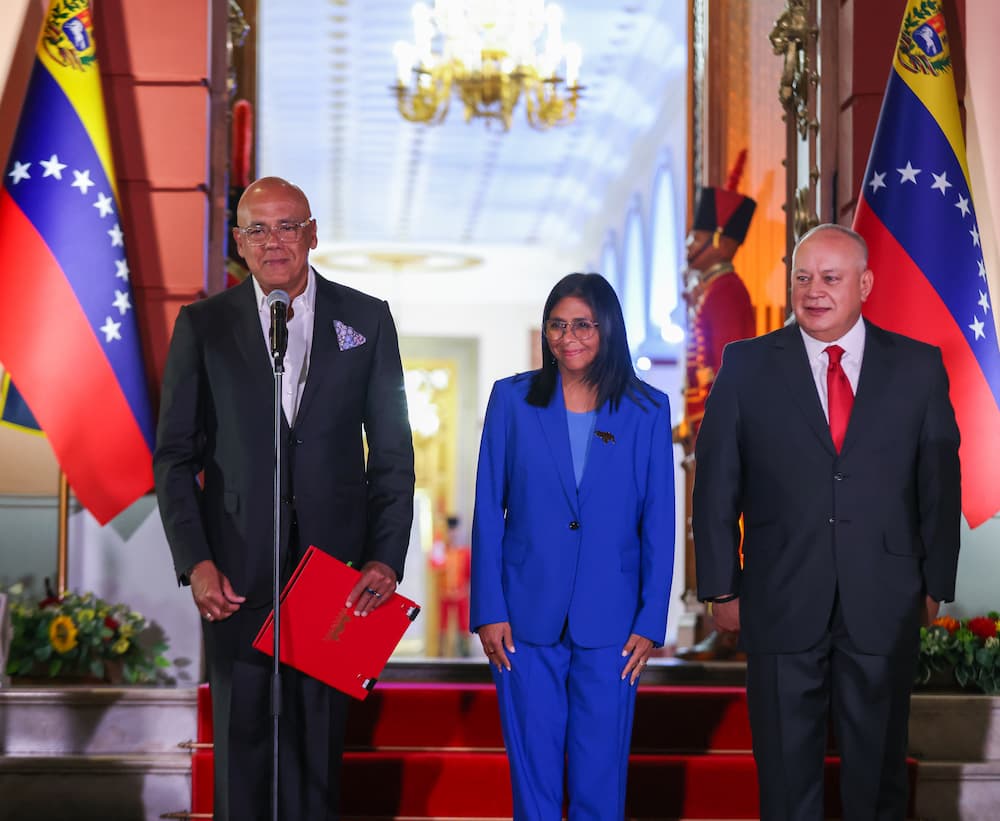
A special ceremony in Miraflores to deliver the amnesty law to Acting President Delcy Rodríguez. (Presidential Press)

Mérida, February 23, 2026 (venezuelanalysis.com) – The Venezuelan National Assembly passed the Amnesty Law for Democratic Coexistence on Thursday, January 19. 

The government, led by Acting President Delcy Rodríguez, immediately enacted the legislation and presented it as a step toward “peace and tolerance.”

The law establishes mechanisms that aim to promote political reconciliation through a blanket amnesty for crimes or offenses committed in the context of political violence between 1999 and 2026. The final document explicitly lists high-profile contexts, including the 2002 coup against then-President Hugo Chávez, the 2014 and 2017 opposition-led violent “guarimba” street protests, and the unrest following the July 2024 presidential elections.

“This law is guided by principles of freedom, justice, equality, […] the primacy of human rights, and political diversity,” article 3 reads.

Article 7 of the amnesty bill defines the ethical and constitutional scope of the pardon, expressly excluding those who have participated in serious human rights violations, crimes against humanity, or war crimes, in accordance with Article 29 of the Venezuelan Constitution.

The legislation also excludes those prosecuted for or convicted of homicide, corruption offenses while in public office, and drug trafficking with sentences exceeding nine years.

During a press conference at the National Assembly, the head of parliament Jorge Rodríguez stated that the new law represents “a step forward to avoid the mistakes of the past.” 

“I believe that this law recognizes the victims in its articles and represents a step toward avoiding the mistakes of the past,” he told reporters. “This sends a powerful message that we can live, work, and grow politically within the framework established by the Constitution of the Bolivarian Republic of Venezuela.”

During the Thursday session, opposition Deputy Henry Falcón from the Democratic Alliance affirmed that “amnesty is an opportunity that the state offers to forget. We cannot cling to past differences in the face of a higher interest: the country itself.”

After twenty days of consultations and debates and three two legislative debates, Jorge Rodríguez presented the final text that was unanimously endorsed by all 277 deputies. He also announced the creation of a Special Monitoring Commission, chaired by Jorge Arreaza (United Socialist Party of Venezuela, PSUV) and Nora Bracho (A New Era, UNT). This commission is responsible for ensuring the law’s implementation and addressing requests for release.

At a special ceremony held at Miraflores Palace on Thursday evening, Acting President Delcy Rodríguez formally received the Amnesty Law for Democratic Coexistence following approval by the legislature and called for national reconciliation.

“This amnesty law opens an extraordinary door for Venezuela to come together again, to learn to live together democratically and peacefully, and to rid itself of hatred and intolerance,” she expressed. “ 

Regarding the exclusions contemplated, Rodríguez asked the Commission for the Judicial Revolution, chaired by Interior Minister Diosdado Cabello, to review cases not covered by the amnesty and formulate recommendations to “heal wounds.”

The president of the legislature’s special commission, Jorge Arreaza, stated on a televised interview that the first 379 amnesty applications had been processed, primarily in Caracas.

“Both the Supreme Court and the Attorney General’s Office have received 379 requests for amnesty,” he explained. “These individuals should be released in the coming hours. This process will continue in the coming days.”

Parliamentary leader Jorge Rodríguez said on Saturday that there are a further 1,500 cases being revised.

Meanwhile, Ernesto Villegas, minister of culture and coordinator of the Program for Peace and Democratic Coexistence, reported on his Telegram channel a meeting with campesino, tenant, and labor organizations to discuss cases of activists facing legal proceedings due to social struggles over land, housing, and employment. These groups were not explicitly contemplated among the direct beneficiaries of the law.

The grassroots collectives denounced the criminalization of their social demands and provided concrete information that will be forwarded to the relevant authorities in coordination with the National Assembly’s special commission.

The meeting hosted by Villegas also saw relatives of individuals imprisoned for alleged corruption in the public sector criticize the penal system and advocate for their loved ones’ rights.

The Program for Peace and Democratic Coexistence promised to promptly send the complaints to the relevant bodies and encourage corrective actions.

Edited by Ricardo Vaz in Caracas.

Source link

Lee vows zero tolerance in alleged reporter front-running probe

South Korean President Lee Jae Myung speaks during a cabinet meeting at the presidential office Cheong Wa Dae in Seoul, South Korea, 27 January 2026. File. YONHAP / EPA

Feb. 6 (Asia Today) — President Lee Jae-myung reaffirmed a zero-tolerance stance on stock manipulation Thursday, warning that those who undermine market order face severe consequences, as authorities intensify an investigation into alleged front-running by journalists.

Lee posted the message on X after sharing a report that investigators searched the headquarters of Korea Economic Daily, writing that stock manipulation leads to “total ruin.” His remark was widely interpreted as a warning against unfair trading practices as the government’s joint crackdown gains momentum.

Financial authorities said the joint task force raided the newspaper’s Seoul office Wednesday. Five reporters are suspected of front-running – allegedly obtaining market-moving information in advance, purchasing shares, publishing related articles and then selling the stock after prices rose to secure profits.

Front-running is prohibited under South Korea’s Capital Markets Act and is classified as a fraudulent trading practice when information obtained through reporting or other nonpublic means is used for personal gain. Authorities said they are reviewing seized materials to determine whether criminal charges apply.

Lee’s comments align with his repeated warnings in recent weeks. Last month, after the KOSPI index surpassed the 4,700 level for the first time, he cautioned that stock manipulation would bring irreversible consequences, pledging to foster a “healthy capital market.”

At the time, Lee also shared news that the joint task force would expand from one team to two and urged investors to “invest properly.” The move followed his directive to strengthen enforcement by introducing multiple response teams. The Financial Services Commission, the Financial Supervisory Service and the Korea Exchange later agreed to reorganize and expand their market surveillance units.

In a policy briefing last December, Lee cited distrust in market transparency as a key factor behind the chronic undervaluation of South Korean equities and called for tougher enforcement to ensure that illegal trading is met with decisive punishment. He also ordered an expansion of enforcement personnel after learning that fewer than 40 staff members were handling stock manipulation cases at the time.

Thursday’s message was seen as reinforcing the administration’s principle that market abuses will be dealt with strictly and without exception, regardless of the individuals or institutions involved, signaling heightened scrutiny as stock prices continue to rise.

— Reported by Asia Today; translated by UPI

© Asia Today. Unauthorized reproduction or redistribution prohibited.

Original Korean report: https://www.asiatoday.co.kr/kn/view.php?key=20260206010002371

Source link