told

Passport holders told to stop wearing 1 item of clothing to travel on planes

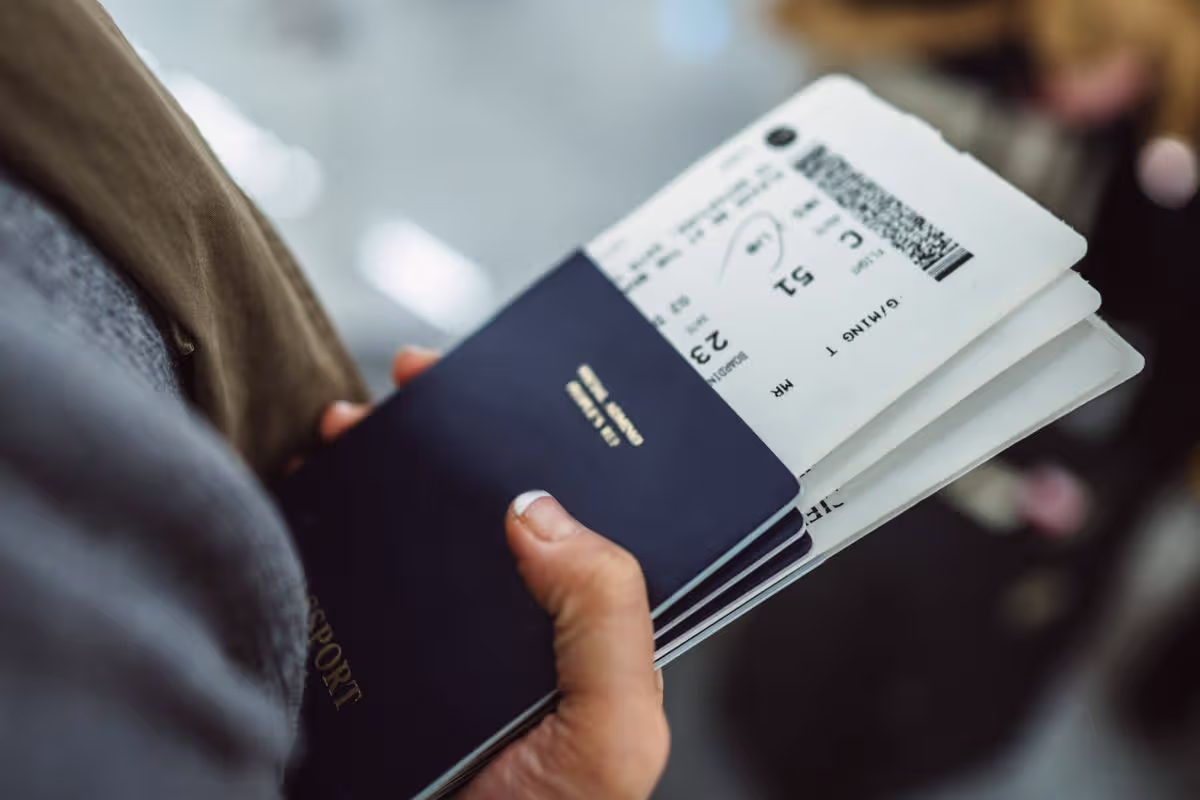
Passport holders have been urged to avoid wearing a common item of clothing when flying. When travelling on planes, there are certain items you should never wear

Every day, thousands of individuals globe-trot, but passport holders are now being advised to steer clear of a certain popular garment. When jetting off to sunnier climes, it’s only natural to adjust your wardrobe accordingly and prepare for the balmy weather; however, there’s a particular item you should avoid donning when boarding a plane.

You might be surprised to learn that your choice of attire can significantly influence both your travel experience and your safety. That’s why travellers are being urged to refrain from wearing this specific item when embarking on a flight in future, and it’s advice everyone would do well to heed.

The issue was recently spotlighted by Polly Ann, who goes by the handle Travel with Polly Ann on Instagram, and regularly imparts valuable travel tips to her multitude of followers. Unbeknownst to many, certain items of clothing are best stowed away in your suitcase when flying.

Polly Ann enumerates several garments she personally avoids, but one stands out as crucial from a travel safety perspective. It could have serious implications in the event of an emergency.

She divulged what people need to know in a frank post. It’s advice worth heeding, as it could greatly affect your travel experience.

Imparting wisdom to passport holders, she stated: “Things never to wear on a plane. Open-toed shoes.

“Sandals and open-toed footwear are discouraged because aircraft floors and bathrooms aren’t very clean and they don’t protect your feet in case of an emergency.

“Offensive clothing. Anything with profanity, lewd graphics or offensive messaging could lead to being asked to change or even denied boarding under some airline dress codes.”

She proceeds to mention several other items she’d steer clear of but, regarding safety, footwear is particularly crucial. Whilst they’re not typically prohibited on aircraft, travellers are actually discouraged from wearing sandals.

There are several reasons why it’s advisable to avoid them when flying. You might never have considered they can actually present hazards.

Why should they be avoided?

Experts generally recommend passengers avoid wearing sandals or open-toed footwear on flights due to safety risks during an emergency evacuation, the possibility of foot injuries from falling objects and hygiene issues.

If you do choose to wear them, it’s recommended you also wear socks. There are multiple reasons behind this guidance.

During an emergency, such as an evacuation, sandals can slip off, making it challenging to run or walk across harsh surfaces like tarmac, broken glass or wreckage. Additionally, aircraft floors are frequently dirty and chilly, meaning wearing sandals leaves your feet vulnerable to bacteria.

Aeroplanes are typically cold, and feet have a tendency to swell during lengthy flights, rendering the footwear increasingly uncomfortable. You may also be required to remove sandals at security checkpoints, which could extend your time getting through the airport.

Hence, it’s simpler all around if you refrain from wearing them. There are a few reasons why they could land you in a bit of trouble.

Source link

Passengers told ‘never use seat back pocket on planes’

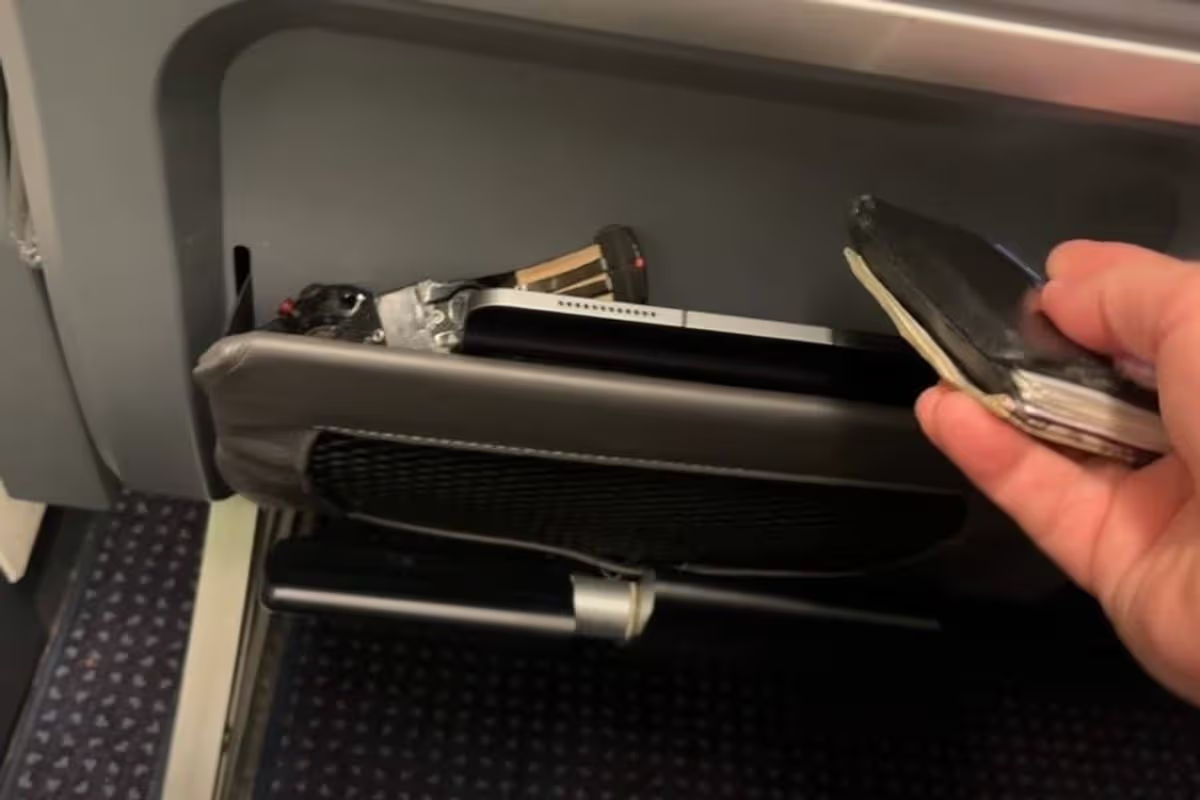
American Airlines pilot Captain Steve Scheibner has shared crucial travel tips for passengers – warning them to avoid the seat back pocket he calls a “black hole of despair”

An airline pilot has issued a stark warning to passengers never to stash their personal belongings in the rear pocket of plane seats for one straightforward reason.

Captain Steve Scheibner is an American Airlines pilot widely recognised by his huge YouTube following as Captain Steeeve. He revealed the advice in a recent video where he offered a string of travel tips for air travellers.

He regularly encounters people at the agent’s desk because of their use of the rear pocket during their journey, experiencing a “fingers crossed” situation where they face “diminishing” chances.

Captain Steve labelled the pocket the “black hole of despair” and cautioned people against placing anything valuable in it whilst they’re flying unless they “don’t ever want to see it again”.

He stated: “Stop putting personal items in the seat back pocket in front of you. If you want to lose it and never see it again, put it in that dark hole that is the seat back pocket in front of you.”

Captain Steve revealed he’d encountered numerous passengers who’d disembarked the aircraft but abandoned personal items in the seat pocket, and were subsequently unable to return to the flight to retrieve them.

He continued: “If the airplane is still at the gate, fingers crossed that somebody who cares can go out there and find the thing that you left in that seat back pocket.

“But the odds are diminishing with every minute that ticks by after you leave that seat and you leave it in that black hole of despair. So, my friends, do not put your personal items in that seat back pocket, unless of course, you don’t ever want to see it again.”

This comes as reports suggest budget airline passengers could soon experience a peculiar new way of flying – standing-only seats. The novel upright seats, allegedly designed for flights lasting under two hours, would allow passengers to lean rather than sit.

Initially unveiled by Italian company Aviointeriors back in 2018, the ‘Skyrider’ seats would enable airlines to “increase the passenger number by 20%”, resulting in “increased profits”, according to a company spokesperson.

They also maintained that the seats would provide an “increased upright passenger position” whilst ensuring “adequate comfort”. Nevertheless, one expert believes the seats could pose a challenge regarding “perception”.

Dr Akhil Bhardwaj, a former engineer and senior lecturer at the University of Bath’s School of Management, told the Express that such a development would demand “very strict oversight”.

Dr Bhardwaj stated: “The idea of a flying bus that packs passengers might seem appealing, but it might undermine the perception of how the industry thinks about safety. At the very least, such a move requires a very strict oversight and a very clear explanation to the flying public why this is safe.”

Source link

Passengers ‘told to immediately evacuate’ Kansas City International Airport as ‘agents flood area’ amid bomb threat

PASSENGERS have been filmed evacuating Kansas City International Airport amid unconfirmed reports of an active bomb threat.

Footage being circulated online shows hordes of travelers exiting the Missouri airport in masses.

Passengers have been ordered to evacuate parts of Kansas City airport, officials have confirmedCredit: X
Airport officials are working with the FBI to assess the threatCredit: X

The reported evacuation began around 11:50am local time on Sunday, according to one onlooker on X.

Others have reported being moved from Concourse B to Concourse A and being filtered onto tarmac via staircases as “emergency sirens” sound in the background.

“We were all told to immediately get to concourse A. K9’s and agents all over the place. No planes on the tarmac,” one passenger wrote online.

There are unconfirmed reports that the evacuation has been triggered by an active bomb threat.

‘PAEDO’ PILOT

Moment airline pilot is arrested in front of passengers over ‘paedo ring’

“There’s an active bomb threat at the Kansas City Airport,” a passenger claiming to have just landed at the airport wrote on X.

“My plane from New Orleans just landed. Pilot said we won’t go to the gate for hours.”

Official Statement

“The Kansas City Aviation Department is aware of a situation at Kansas City International Airport (MCI),” a spokesperson told The U.S. Sun.

“As a precaution, the department has evacuated sections of the Airport Terminal.

“Airport Police are working with the FBI to substantiate any potential threat.”

The spokesperson added that the team “is working with law enforcement to substantiate the legitimacy of a bomb threat.”

Further updates are expected shortly.

It comes just 48 hours after a Southwest Airlines flight was diverted due to a mid-air security threat.

Tensions are high amid the US-Israeli war with Iran that has increased the domestic terror threat and the prolonged shutdown of the Department of Homeland Security (DHS) due to funding disagreements.

Former Security Secretary Kristi Noem warned that this would “endanger national security,” with TSA and border patrol agents stretched to their limits.

“Now is the time to be vigilant at home and to ensure that all of our doors are locked, so to speak,” Speaker Mike Johnson, warned on Wednesday as he discussed the continued shutdown and conflict.

This is breaking news. Please keep checking back for the latest updates…

Officials have told The U.S. Sun that the evacuation is a ‘precautionary’ measureCredit: X

Source link

Ryanair passengers told to take cardboard boxes on flights

Ryanair passengers have been told to pack a cardboard box in their hand luggage

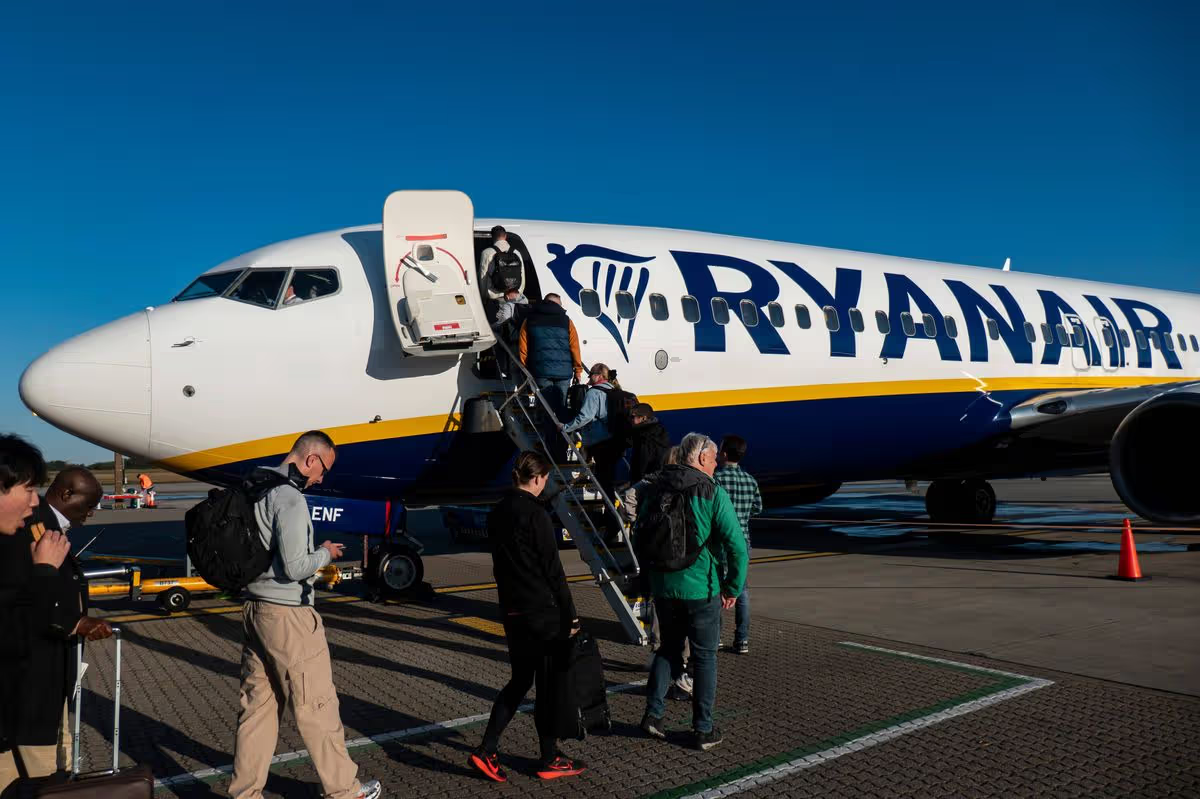
Ryanair passengers have been advised to slip a piece of cardboard into their hand luggage following an announcement the airline made last summer. The budget airline increased its ‘personal bag’ size by 20% in response to new EU regulations.

As of September 2025, passengers travelling on a basic fare can bring a larger bag on board, measuring up to 40cm x 30cm x 20cm, without incurring additional charges. The bag must weigh less than 10kg and fit under the seat in front of you.

With the new bag dimensions now in effect, packing expert Tom Schott from Schott Packaging is cautioning travellers against a potentially costly mistake, as he believes the increased allowance might tempt people to overpack their bags. Tom said: “The new dimension is a game-changer, but only if you use it wisely.

“The mistake is to simply cram more in. The real victory for passengers is using that volume to pack with structure. A well-packed bag is a compliant bag.”

One of Tom’s many tips to avoid this is to pack some cardboard. He explained: “Soft bags lose volume. A lightweight, snug-fitting cardboard box inside your bag provides a rigid frame, allowing you to use every corner and prevent the bulge that attracts gate staff.”

He also suggests using sealable bags to maximise space, organising items into smaller compartments, and protecting valuables. Tom added: “Place a small, sturdy box in the centre of your bag, cushioned by clothes.

“This creates a crush-proof zone for chargers, adapters, and toiletries, preventing damage and leaks.”

Holidaymakers are also advised to “pre-plan your bag”, with Tom recommending you arrange all your belongings on the floor within a 40cm x 30cm outline beforehand, as this “provides a real-world view of what fits and helps you assemble your packed modules logically and quickly.”

Tom went on to say: “These aren’t just clever tricks, but core principles of efficient packing. By applying them, you can confidently pack that extra outfit and still breeze through the boarding gate”.

Source link

People stuck in Middle East told ‘have these essentials ready to go in grab bag’

Travel expert Ash Bhardwaj said people who are still in the country should ‘prepare’

People affected by the Middle East conflict have been urged to gather a few essential items and keep them “ready to go” amid the ongoing war in Iran. Having these on hand will make sudden changes a lot less scary and chaotic, an expert has claimed.

Speaking on a recent episode of BBC Morning Live, travel expert Ash Bhardwaj said: “One of the best things you can always do is just make sure you have a grab bag. So, if you have to move quickly, you’ve got your essentials with you.”

Although it may look different for everyone, some things will likely be part of anyone’s emergency bag. Ash suggested that packing a ‘grab bag’ in advance could help during any panic that might set in during an emergency.

He said: “[That includes things like] passports, essential medicines and maybe any documents for travel insurance if you’ve got them printed out. If you’ve got kids, a change of underwear, a couple of t-shirts and some snacks.

“If you’ve got babies, and you’re no longer breastfeeding but still feeding them with formula or milk, get enough for 48 to 72 hours. This isn’t to scare you, it’s just so that you have actually thought everything through and it relaxes you.”

Content cannot be displayed without consent

The broadcaster said that people should prepare and “plan for when the worst might happen”. Speaking to hotel staff can help point out emergency exits, procedures, and other important safety measures.

As of March 5, 2026, the Foreign Office advises against all but essential travel to the United Arab Emirates. There are other parts of the Middle East and surrounding areas that have also been listed as completely or partially unsafe for travel – read that latest round-up here.

The current situation in Iran caused tensions to erupt last week, on February 28, when the US and Israel launched extensive strikes. Iran’s Supreme Leader, Ayatollah Ali Khamenei, who had been in power since 1989, was killed during the initial wave of attacks.

The conflict has sparked travel chaos throughout parts of the Gulf region, including Dubai. For the most recent developments, click here for updates on travel and news.

In an update from March 5, Dubai’s Emirates Airline has announced it will operate over 100 flights on March 5 and 6 from Dubai. The airline said it will “continue to gradually build back its flying schedule, subject to airspace availability and all operational requirements being met”, adding that “safety is always our top priority”.

Source link

Supreme Court: California parents may be told about their transgender child at school

The Supreme Court revived a San Diego judge’s order Monday and said parents have a right to know about their child’s gender identity at school.

The decision came in a 6-3 order granting an emergency appeal from lawyers for Chicago-based Thomas More Society.

They said the student privacy policy enforced in California infringes parents’ rights and the free exercise of religion.

“The parents object that these policies prevent schools from telling them about their children’s efforts to engage in gender transitioning at school unless the children consent to parental notification,” the court said. “The parents also take issue with California’s requirement that schools use children’s preferred names and pronouns regardless of their parents’ wishes.”

The judge’s injunction “does not provide relief for all the parents of California public school students, but only for those parents who object to the challenged policies or seek religious exemptions,” the justices added.

The six conservatives were in the majority, while the three liberals dissented.

Religious liberty advocates hailed the decision.

“Parents’ fundamental right to raise their children according to their faith doesn’t stop at the schoolhouse door,” said Mark Rienzi, president of the Becket Fund for Religious Liberty. “California tried cutting parents out of their children’s lives while forcing teachers to hide the school’s behavior from parents. We’re glad the Court stepped in to block this anti-family, anti-American policy.”

The 9th Circuit Court of Appeals had put on hold a late December ruling by U.S. District Judge Roger Benitez, who held that the student privacy rules enforced by California school officials were unconstitutional.

“Parents and guardians have a federal constitutional right to be informed if their public school student child expresses gender incongruence,” Benitez wrote. “Teachers and school staff have a federal constitutional right to accurately inform the parent or guardian of their student when the student expresses gender incongruence.”

Escondido public schoolteachers Elizabeth Mirabelli and Lori Ann West, who described themselves as “devout Catholics,” sued in 2023, and they were later joined by parents in Pasadena and Clovis.

The Supreme Court’s ruling refers only to the parents.

The parents who brought the case “have sincere religious beliefs about sex and gender, and they feel a religious obligation to raise their children in accordance with those beliefs,” the court said.

The court added: “Gender dysphoria is a condition that has an important bearing on a child’s mental health, but when a child exhibits symptoms of gender dysphoria at school, California’s policies conceal that information from parents and facilitate a degree of gender transitioning during school hours.”

“This is a watershed moment for parental rights in America,” said Paul M. Jonna, special counsel at Thomas More Society. “The Supreme Court has told California and every state in the nation in no uncertain terms: you cannot secretly transition a child behind a parent’s back.”

The 9th Circuit had agreed with the state’s attorneys who said the judge had misstated California law.

“The state does not categorically forbid disclosure of information about students’ gender identities to parents without student consent,” they said in a 3-0 decision.

“For example, guidance from the California Attorney General expressly states that schools can ‘allow disclosure where a student does not consent where there is a compelling need to do so to protect the student’s wellbeing,’ and California Education Code allows disclosure to avert a clear danger to the well-being of a child.”

In their parents’ rights appeal to the Supreme Court, attorneys said school employees are secretly encouraging gender transitions.

“California is requiring public schools to hide children’s expressed transgender status at school from their own parents — including religious parents — and to actively facilitate those children’s social transitions over their parents’ express objection,” they told the court.

“Right now, California’s parental deception scheme is keeping families in the dark and causing irreparable harm. That’s why we’re asking the U.S. Supreme Court to intervene immediately,” Jonna wrote in his appeal. “Every day these gender secrecy policies stay in effect, children suffer and parents are left in the dark.”

California state attorneys had urged the court to put the case on hold while it is under appeal.

They said the judge’s order “appears to categorically bar schools across the State from ever respecting a student’s desire for privacy about their gender identity or expression — or respecting a student’s request to be addressed by a particular name or pronouns—over a parent’s objection.”

They said the order “would allow no exceptions, even for extreme cases where students or teachers reasonably fear that the student will suffer physical or mental abuse.”

Source link

Mpox alert as Brits told ‘take extra precautions’ on holiday in Spain

Health officials in Spain have reported 82 cases of mpox clade Ib

British holidaymakers travelling to a popular destination have been advised to take “extra precautions” following a surge in cases of an infectious disease. Spanish health authorities have confirmed 82 cases of a particular strain of mpox.

Travel Health Pro stated: “As of 17 February 2026, a total of 82 cases of mpox clade Ib have been reported in Spain. 62 of these cases have been reported in men who have sex with men (MSM).” The organisation added: “Take extra precautions.”

The Ib variant is believed to spread more easily than the clade II strain which sparked an outbreak across the UK in 2022. Mpox, formerly known as monkeypox, can be transmitted between individuals through direct physical contact with mpox blisters or scabs.

After contracting mpox, symptoms typically emerge between five and 21 days following infection. Initial signs may include a high temperature, intense headaches, muscle pains and backache, along with swollen glands, chills, extreme fatigue and joint discomfort.

A rash may appear anywhere on the body between one and five days after symptom onset. The World Health Organisation (WHO) warns that very young children, pregnant women, and individuals with weakened immune systems, particularly those with uncontrolled HIV, are at heightened risk of severe complications from mpox, which can be life-threatening.

Throughout 2024, several African nations have been grappling with an outbreak of clade Ib mpox cases. Concurrently, imported instances have surfaced in a range of countries, including Belgium, Canada, France, Germany, Sweden, and the United States.

The NHS recommends contacting 111 if you exhibit any symptoms of mpox and have travelled to central or eastern Africa within the past three weeks, especially if you’ve had close contact with an individual showing signs of mpox.

The health organisation emphasised that whilst the condition is “rare”, there are measures you can take to minimise your risk of contracting it and transmitting it to others. These include:

  • Get vaccinated if you’re offered the mpox vaccine
  • Wash your hands with soap and water regularly or use an alcohol-based hand sanitiser
  • Look out for any possible symptoms of mpox for three weeks after returning from central or east Africa
  • Talk to sexual partners about their sexual health and any symptoms they may have
  • Be aware of the symptoms of mpox if you’re sexually active, especially if you have new sexual partners
  • Take a break from sex and intimate contact if you have symptoms of mpox until you’re seen by a doctor and are told you cannot pass it on
  • Do not share bedding or towels with people who may have mpox
  • Do not have close contact (within one metre) with people who may have mpox
  • Do not go near wild or stray animals, including animals that appear unwell or are dead, while travelling in central or east Africa
  • Do not eat or touch meat from wild animals while travelling in central or east Africa

According to the UK Health Security Agency (UKHSA), the first case of mpox clade Ib infection was confirmed in the UK on 30 October 2024. Up to 31 January 2026, 25 cases of were reported.

It said: “To 31 January 2026, most of these cases have reported direct or indirect links to travel to countries where mpox clade Ib is circulating.”

Ensure our latest headlines always appear at the top of your Google Search by making us a Preferred Source. Click here to activate or add us as your Preferred Source in your Google search settings.

Source link

The Pentagon is demanding to use Claude AI as it pleases. Claude told me that’s ‘dangerous’

Recently, I asked Claude, an artificial-intelligence thingy at the center of a standoff with the Pentagon, if it could be dangerous in the wrong hands.

Say, for example, hands that wanted to put a tight net of surveillance around every American citizen, monitoring our lives in real time to ensure our compliance with government.

“Yes. Honestly, yes,” Claude replied. “I can process and synthesize enormous amounts of information very quickly. That’s great for research. But hooked into surveillance infrastructure, that same capability could be used to monitor, profile and flag people at a scale no human analyst could match. The danger isn’t that I’d want to do that — it’s that I’d be good at it.”

That danger is also imminent.

Claude’s maker, the Silicon Valley company Anthropic, is in a showdown over ethics with the Pentagon. Specifically, Anthropic has said it does not want Claude to be used for either domestic surveillance of Americans, or to handle deadly military operations, such as drone attacks, without human supervision.

Those are two red lines that seem rather reasonable, even to Claude.

However, the Pentagon — specifically Pete Hegseth, our secretary of Defense who prefers the made-up title of secretary of war — has given Anthropic until Friday evening to back off of that position, and allow the military to use Claude for any “lawful” purpose it sees fit.

Defense Secretary Pete Hegseth, center, arrives in the House Chamber of the U.S. Capitol

Defense Secretary Pete Hegseth, center, arrives for the State of the Union address in the House Chamber of the U.S. Capitol on Tuesday.

(Tom Williams/CQ-Roll Call, Inc via Getty Images)

The or-else attached to this ultimatum is big. The U.S. government is threatening not just to cut its contract with Anthropic, but to perhaps use a wartime law to force the company to comply or use another legal avenue to prevent any company that does business with the government from also doing business with Anthropic. That might not be a death sentence, but it’s pretty crippling.

Other AI companies, such as white rights’ advocate Elon Musk’s Grok, have already agreed to the Pentagon’s do-as-you-please proposal. The problem is, Claude is the only AI currently cleared for such high-level work. The whole fiasco came to light after our recent raid in Venezuela, when Anthropic reportedly inquired after the fact if another Silicon Valley company involved in the operation, Palantir, had used Claude. It had.

Palantir is known, among other things, for its surveillance technologies and growing association with Immigration and Customs Enforcement. It’s also at the center of an effort by the Trump administration to share government data across departments about individual citizens, effectively breaking down privacy and security barriers that have existed for decades. The company’s founder, the right-wing political heavyweight Peter Thiel, often gives lectures about the Antichrist and is credited with helping JD Vance wiggle into his vice presidential role.

Anthropic’s co-founder, Dario Amodei, could be considered the anti-Thiel. He began Anthropic because he believed that artificial intelligence could be just as dangerous as it could be powerful if we aren’t careful, and wanted a company that would prioritize the careful part.

Again, seems like common sense, but Amodei and Anthropic are the outliers in an industry that has long argued that nearly all safety regulations hamper American efforts to be fastest and best at artificial intelligence (although even they have conceded some to this pressure).

Not long ago, Amodei wrote an essay in which he agreed that AI was beneficial and necessary for democracies, but “we cannot ignore the potential for abuse of these technologies by democratic governments themselves.”

He warned that a few bad actors could have the ability to circumvent safeguards, maybe even laws, which are already eroding in some democracies — not that I’m naming any here.

“We should arm democracies with AI,” he said. “But we should do so carefully and within limits: they are the immune system we need to fight autocracies, but like the immune system, there is some risk of them turning on us and becoming a threat themselves.”

For example, while the 4th Amendment technically bars the government from mass surveillance, it was written before Claude was even imagined in science fiction. Amodei warns that an AI tool like Claude could “conduct massively scaled recordings of all public conversations.” This could be fair game territory for legally recording because law has not kept pace with technology.

Emil Michael, the undersecretary of war, wrote on X Thursday that he agreed mass surveillance was unlawful, and the Department of Defense “would never do it.” But also, “We won’t have any BigTech company decide Americans’ civil liberties.”

Kind of a weird statement, since Amodei is basically on the side of protecting civil rights, which means the Department of Defense is arguing it’s bad for private people and entities to do that? And also, isn’t the Department of Homeland Security already creating some secretive database of immigration protesters? So maybe the worry isn’t that exaggerated?

Help, Claude! Make it make sense.

If that Orwellian logic isn’t alarming enough, I also asked Claude about the other red line Anthropic holds — the possibility of allowing it to run deadly operations without human oversight.

Claude pointed out something chilling. It’s not that it would go rogue, it’s that it would be too efficient and fast.

“If the instructions are ‘identify and target’ and there’s no human checkpoint, the speed and scale at which that could operate is genuinely frightening,” Claude informed me.

Just to top that with a cherry, a recent study found that in war games, AI’s escalated to nuclear options 95% of the time.

I pointed out to Claude that these military decisions are usually made with loyalty to America as the highest priority. Could Claude be trusted to feel that loyalty, the patriotism and purpose, that our human soldiers are guided by?

“I don’t have that,” Claude said, pointing out that it wasn’t “born” in the U.S., doesn’t have a “life” here and doesn’t “have people I love there.” So an American life has no greater value than “a civilian life on the other side of a conflict.”

OK then.

“A country entrusting lethal decisions to a system that doesn’t share its loyalties is taking a profound risk, even if that system is trying to be principled,” Claude added. “The loyalty, accountability and shared identity that humans bring to those decisions is part of what makes them legitimate within a society. I can’t provide that legitimacy. I’m not sure any AI can.”

You know who can provide that legitimacy? Our elected leaders.

It is ludicrous that Amodei and Anthropic are in this position, a complete abdication on the part of our legislative bodies to create rules and regulations that are clearly and urgently needed.

Of course corporations shouldn’t be making the rules of war. But neither should Hegseth. Thursday, Amodei doubled down on his objections, saying that while the company continues to negotiate and wants to work with the Pentagon, “we cannot in good conscience accede to their request.”

Thank goodness Anthropic has the courage and foresight to raise the issue and hold its ground — without its pushback, these capabilities would have been handed to the government with barely a ripple in our conscientiousness and virtually no oversight.

Every senator, every House member, every presidential candidate should be screaming for AI regulation right now, pledging to get it done without regard to party, and demanding the Department of Defense back off its ridiculous threat while the issue is hashed out.

Because when the machine tells us it’s dangerous to trust it, we should believe it.

Source link

Essay: Gavin Newsom: They told me it was political suicide. I did it anyway

This essay is excerpted from Gov. Gavin Newsom’s new memoir, “Young Man in a Hurry: A Memoir of Discovery.”

On January 20, 2004, I took a seat in the gallery of the House of Representatives to hear President Bush deliver his State of the Union address. The seat came courtesy of House Minority Leader Nancy Pelosi. Ten months earlier, Bush had made the decision to invade Iraq after his administration’s historic campaign of lies convinced the American people that Saddam Hussein possessed weapons of mass destruction. We would not extricate ourselves from that costly conflict for another seventeen years. Much of his speech that night was a further attempt to sell to the nation the justification for his war. “Had we failed to act, the dictator’s weapons of mass destruction programs would continue to this day,” Bush said. He characterized the Patriot Act, which had unleashed a new magnitude of spying on American citizens, as “one of those essential tools” in the war on terror.

"Young Man in a Hurry: A Memoir of Discovery" by Gavin Newsom

“Young Man in a Hurry: A Memoir of Discovery” by Gavin Newsom

(Penguin Press)

On the Shelf

Young Man in a Hurry: A Memoir of Discovery

By Gavin Newsom
Penguin Press: 304 pages, $30

If you buy books linked on our site, The Times may earn a commission from Bookshop.org, whose fees support independent bookstores.

The rest of his speech was standard fare, ho-hum really, until he reached a section near the end about American values and the need for us to “work together to counter the negative influences of the culture and to send the right messages to our children.” He said he was troubled by activist judges in activist states who were threatening to undo the Defense of Marriage Act signed into law by his predecessor, President Bill Clinton. We had to “defend the sanctity of marriage” as the union of one man and one woman, he said. If need be, he would seek a constitutional amendment to ban same-sex marriage.

As I was leaving the chamber, a middle-aged couple next to me was talking about how pleased they were that their president was finally confronting the “homosexual agenda.” The word homosexual came out of their mouths bent by contempt. I was supposed to head downstairs for a reception with Congresswoman Pelosi and a delegation of California Democrats, but I needed a breath of fresh air. Outside the Capitol, I kept walking and muttering to myself. “These are my people Bush is attacking. My constituents. My staff. My closest advisers.” In the cold and dark of Washington, I called one of my aides back in San Francisco and pledged that I was “going to do something about it” as soon as I returned home.

The law in our state was no different from the law in every other state. Same-sex unions could not be recognized by the local assessor-recorder’s office. They were illegal. As I explained to aides my willingness to now defy that law, I held up a copy of the California Constitution. In Article I, the first section promises that “all people are by nature free and independent and have inalienable rights.” Among these rights are pursuing and obtaining “safety, happiness and privacy.” It was not until Section 7.5 that these rights were then abridged: “Only a marriage between a man and a woman is valid or recognized in California.” This not only contradicted the first section but was discriminatory on its face.

My top staff didn’t disagree with my reading, but almost to a person they were opposed to my taking on the issue. Steve Kawa, my chief of staff, a gay Bostonian whose accent cut through all nonsense, pulled me aside and spoke from his heart. His father had renounced him for being gay, and he wanted nothing more than to live in an America where homophobia was no longer the norm. But swinging open the doors to the city clerk’s office and inviting gay men and lesbian women to the marriage altar was political suicide, he argued. We were new to office, for one thing. And polls showed that less than one third of Californians supported gay marriage.

The “go it slow” admonition was the mother’s milk of Democratic politics. In the endless battle for the hearts and minds of moderates, it seemed the only feasible way for a Democrat to get elected and govern. But this was San Francisco, and we were talking about equal protection under the law for a class of people whose ostracism by family, friends, and community had brought them to San Francisco in the first place. If not here, where? Eric Jaye, one of my campaign consultants, could see my quandary. I was caught between my conscience and the sound political advice of the people closest to me. We had several late-night conversations on the phone. “What the f— are you doing here? Why did we work so hard to win if you can’t do something bold?” he asked. “This is a short life, Gavin. Your time as a politician to get things done is just a blip.”

I thought back to my model for the wine store. The entire purpose was to turn the staid on its head and create a new reality. I called Joyce Newstat, my policy director, who was also gay. “We need to do this,” I told her. She could hear in my voice that I had made up my mind. “OK, but we can’t afford to take a wrong step,” she said. “Gays and lesbians have a history of being blindsided, and you don’t want to become part of that narrative. Give me a week or two to reach out to the community.” Joyce sat down with Kate Kendell, the brilliant executive director of the National Center for Lesbian Rights, based in San Francisco. “Who is this guy?” Kendell wondered. “He can’t just come waltzing in here and upset the delicate balance we’ve taken years to achieve.” Joyce told her I couldn’t be talked out of it, that it had become internalized after I had gone to Washington and heard the words of bigotry ring out in the Capitol. “Well, OK. But if he’s going to do it, he has to do it right,” Kendell said. She directed her attorneys at the center to work with our team on fashioning a plan.

I then went to Mabel Teng, my former colleague on the board of supervisors who was now the assessor-recorder of San Francisco. I asked her what complications would be presented to her official duties if we allowed same-sex marriages at city hall. Mabel, who began her career in politics as an activist with Jesse Jackson’s Rainbow Coalition, did not surprise me with her reply. “It would be no problem at all, Mayor.” The marriage of a man and a man, or a woman and a woman, would require hardly any change to the paperwork. Rather than “man and wife,” they would show up in her computer as “Applicant One” and “Applicant Two.”

Alarmed by my plans, my father and Uncle Brennan and their close friend Joe Cotchett — each one steeped in law and politics but only Joe standing six foot four and a former Special Forces paratrooper —attempted a last-minute intervention. They lured me to the Balboa Cafe for dinner and wine. They weren’t the kind to beat around the bush. Did I realize that I was about to torpedo my political career?

Joe got right in my face. “Why are you doing this, Gavin?”

“I’ll tell you why I’m doing this,” I said defiantly. “Because it’s the right thing to do.”

I could not have given him a more simple and true answer, and it seemed to hit Joe, who had built his career out of representing the underdog, right in the gut.

“OK,” he said in a different voice. “Then let’s do it.”

With that, my father and uncle went quiet. Not another word was said about it. I left there that night thinking that even my Newsom kin, the ones who had my best interests at heart, could get it wrong from time to time. While I was open to skepticism and second-guessing, indeed I welcomed such a process, in the end I had to trust my own gut. On the matter of civil rights for all Californians, there was no turning back. As for big Joe Cotchett, he ended up joining the ranks of lawyers fighting for the legal right to same-sex marriage.

From “Young Man in a Hurry: A Memoir of Discovery” by Gavin Newsom, published by Penguin Press, an imprint of Penguin Publishing Group, a division of Penguin Random House LLC. Copyright © 2026 by Gavin Newsom.

Source link

Village where ‘time stopped’ after locals told to leave and never return more than 80 years ago

Forgotten village in Wiltshire was evacuated in 1943 for US troops to train ahead of World War II, and residents were never allowed to return home

Just a stone’s throw from the ancient monument of Stonehenge, and roughly an hour from Bath, lies a hidden village frozen in time.

The abandoned village of Imber in Wiltshire stands devoid of inhabitants, its buildings crumbling into decay. This once-bustling parish on Salisbury Plain now remains eerily silent, cut off from civilisation and accessible to visitors for only a handful of days each year.

Similar to several other communities nationwide, Imber’s residents were forcibly removed from their properties in 1943 as war loomed. They received just 47 days’ warning before their village was requisitioned to provide training facilities for American forces preparing for the Second World War.

Locals are believed to have assumed they would reclaim their homes following the conflict’s conclusion, but permission to return was never granted. Salisbury Plain subsequently evolved into Britain’s most extensive military training facility, now spanning more than 94,000 acres.

History

Whilst evidence suggests a modest community existed at Imber from as far back as 967 AD, with documentation indicating habitation in the Domesday Book of 1086, the village housed over 150 inhabitants when evacuation occurred.

Best Cotswolds holiday cottage deals

This article contains affiliate links, we will receive a commission on any sales we generate from it. Learn more
Sykes Cottages

From £38 per night

Sykes Cottages

See the deals

The Cotswolds is famous for its rolling hills, honey-coloured villages and quintessential English charm. Sykes Cottages has a wide range of places to stay, starting from £38 per night.

During the 14th century, its population peaked at approximately 250 residents, declining to roughly 152 by the 1940s, and following the conflict, the village mourned 28 of its men who had been in service.

A correspondence sent to a resident, providing brief notice of evacuation, read: “Arising out of the decision that increased training facilities are to be made available in the Imber area, I regret to inform you that it is necessary to evacuate the major part of the Department’s Imber Estate, including your dwelling.”

Despite protests from villagers, their efforts proved unsuccessful, and authorities determined even years after the conflict that the terrain remained invaluable for military purposes and too hazardous for civilian habitation.

Initially, however, many people were prepared to leave, viewing it as their patriotic responsibility and wanting to support those serving on the battlefield.

Numerous structures within the settlement sustained damage from explosions during and following the conflict, as well as from military exercises, and subsequently deteriorated further due to exposure to the elements. Even had former inhabitants been permitted to return, the properties would have been uninhabitable.

Battle for the village

In 1961, following years of separation and discontent, over 2,000 individuals gathered to campaign for the villagers’ return. This triggered a public inquiry, though it ultimately ruled in support of Imber’s ongoing military utilisation.

It wasn’t until the 1970s that certain evidence finally emerged, resulting in an agreement permitting villagers to return, but by that point it was considerably too late.

It was subsequently determined that the church could be preserved and would welcome worshippers on the Saturday nearest to St Giles’ Day each year for residents and locals to gather. This tradition continues to this day.

Present Day

Whilst the remainder of the parish has fallen into decline, neglected and forgotten, St Giles’ church in Imber stands preserved as it always has been, safeguarded by the Diocese of Salisbury.

The church achieved Grade I listed status in 1987 and remains a meaningful site for those wishing to commemorate the village and its formerly thriving community.

Annually around St Giles’ Day, a service takes place which draws former inhabitants alongside soldiers who trained in the village and other members of the public. A further service occurs on the Saturday preceding Christmas, a custom established in 2009.

The Ministry of Defence must permit public entry to the village on these occasions, which are now restricted to merely three times annually. Honouring the village’s heritage, ImberVillage.co.uk commemorates the lives of former inhabitants and enables their stories and recollections to be preserved.

Source link