Attack comes a day after an Israeli army reservist in civilian clothes rammed his vehicle into a Palestinian man praying on the roadside.
Published On 26 Dec 202526 Dec 2025
Share
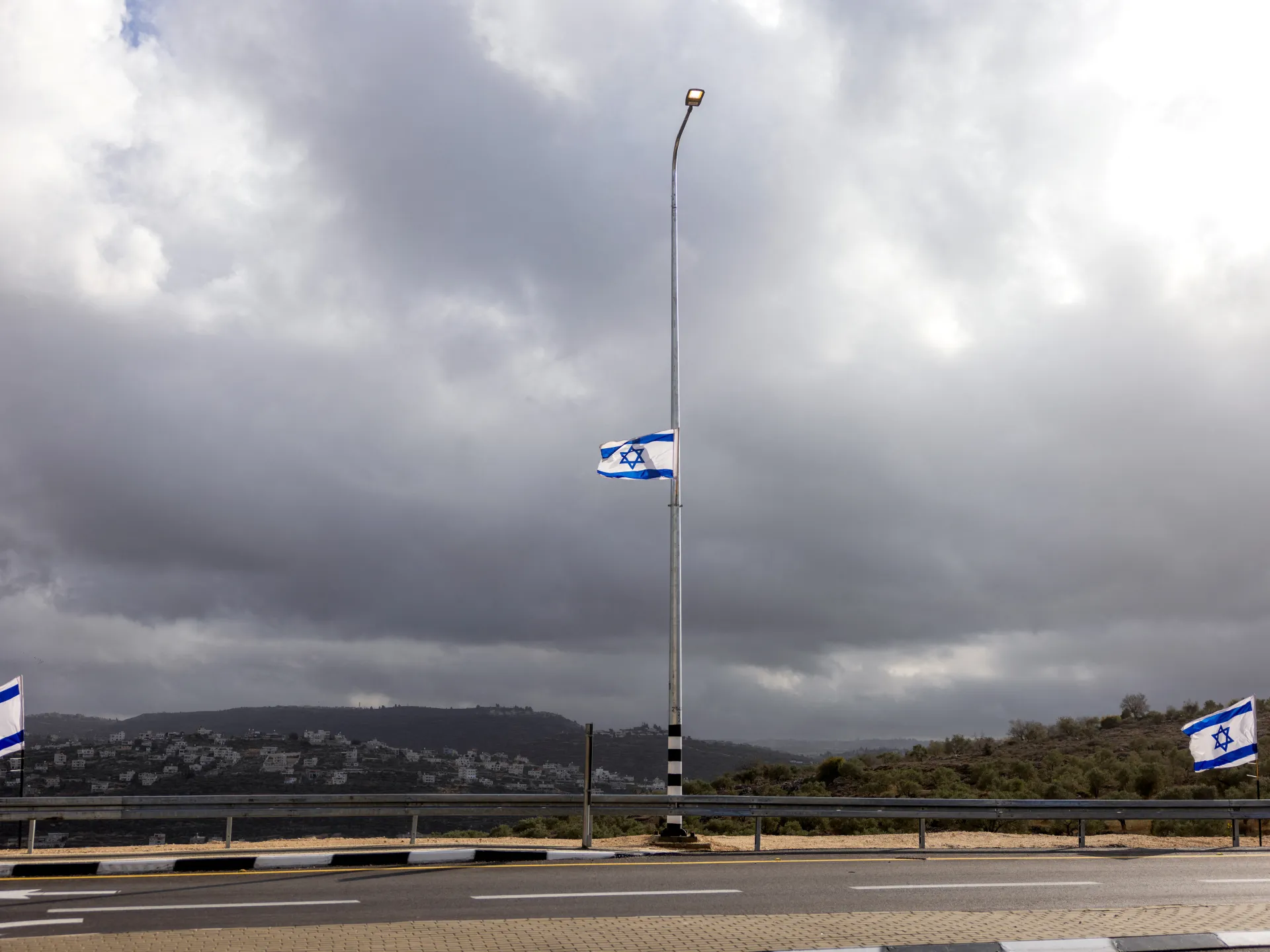
Two people have died in a stabbing and car-ramming attack in northern Israel, officials say.
Israeli police and emergency workers said a Palestinian from the Israeli-occupied West Bank attacked and killed a man and a woman on Friday before he was shot and wounded.
Recommended Stories
list of 3 itemsend of list
The attack came a day after an Israeli military reservist dressed in civilian clothes rammed his vehicle into a Palestinian man who was praying on a roadside in the West Bank after earlier firing shots in the area.
“Footage was received of an armed individual running over a Palestinian individual,” the Israeli military said in a statement about Thursday’s attack, adding that the Israeli reservist’s military service had been terminated. The Palestinian man went to hospital for checks after the attack before returning home.
In Friday’s incident, Israeli police said the attacker first crashed his vehicle into people in the northern city of Beit Shean, killing a 68-year-old man, and then sped onto a highway.
Later, he fatally stabbed a 20-year-old woman near the highway, “and the suspect was ultimately engaged with gunfire near Maonot Junction in Afula following intervention by a civilian bystander,” police said, adding that the attacker was taken to a hospital.
Both the victims were pronounced dead at the scene by paramedics, Israel’s rescue services said. A teenage boy was hospitalised with minor wounds sustained in the car-ramming, according to bystanders.
The Israeli military said the attacker had “infiltrated into Israeli territory several days ago”.
Since Israel’s genocidal war in Gaza began in October 2023, tens of thousands of Palestinians have been killed there.
At the same time, Israeli settlers have escalated violence in the West Bank, seizing Palestinian land and harassing civilians while Israeli forces conduct regular raids and arrests.
More than 1,000 Palestinians have been killed in the West Bank since October 7, 2023, mostly in operations by security forces and some by settler violence, according to the United Nations.
In the same period, 57 Israelis have been killed in Palestinian attacks.
After Friday’s incident, Israeli Defence Minister Israel Katz said he had instructed the military to respond forcefully in the West Bank town of Qabatiya, where he said the assailant came from.
The Israeli military said it was “preparing for an operation” in the area.
Suspect is in police custody; no information about potential motive.
Published On 26 Dec 202526 Dec 2025
Share
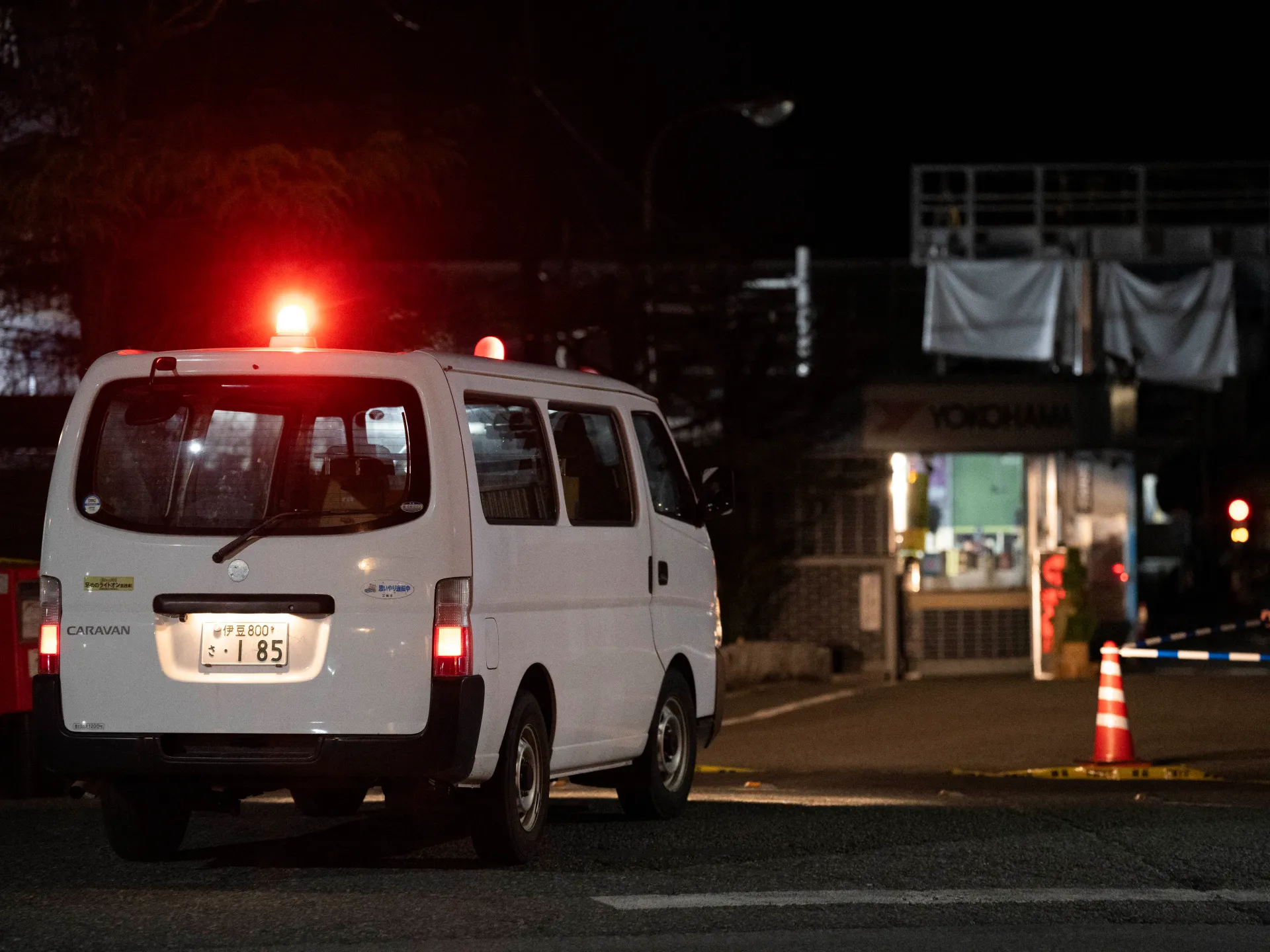
A man has carried out a mass stabbing attack at a Japanese tyre factory, also spraying victims with a chemical substance, according to local officials.
Eight people were stabbed and seven others were injured after being sprayed by a bleach-like agent at the Yokohama Rubber Co tyremaker in Japan’s Mishima, southwest of Tokyo, on Friday, said the Fujisan Nanto Fire Department.
Recommended Stories
list of 3 itemsend of list
Japanese media named the suspect as a 38-year-old who is now in custody. He is being charged with attempted murder, reported Japan’s Asahi Shimbun newspaper, citing the Shizuoka prefectural police.
The suspect was carrying a survival knife and wearing what appeared to be a gas mask, according to investigators cited in the Asahi report. He is believed by police to have acted alone, the report added, though there was no immediate information about a potential motive.
The Associated Press news agency cited the fire department as saying five of the stab victims are in serious condition, but conscious.
An employee of a nearby car dealership said she was “shocked” to learn of the attack in what is generally a “quiet” area.
“I’m scared, but I’m also shocked that it could have happened in a place like this,” the unnamed employee told Asahi Shimbun.
Violent crime is relatively rare in Japan, which has a low murder rate and some of the world’s toughest gun laws.
In June, Japan executed a man dubbed the “Twitter Killer”, after he was convicted of killing and dismembering nine people he met on social media. The execution was the country’s first use of capital punishment in nearly three years.
A Japanese man was also sentenced to death in October for a shooting and stabbing rampage that killed four people, including two police officers, in 2023.
Tensions are flaring along the Tajikistan-Afghanistan border in Central Asia with the Tajik government reporting multiple armed incursions this month, straining its fragile relationship with Afghanistan’s Taliban leaders.
More than a dozen people have been killed in attacks by men whom Tajik authorities call “terrorists” and the resulting clashes with Tajik forces, officials in Dushanbe and Beijing said. Victims include Chinese nationals working in remote areas of the mountainous former Soviet republic.
In the latest fighting this week, at least five people were killed in Tajikistan‘s Shamsiddin Shokhin district, including “three terrorists”, officials said.
Tajikistan has long opposed the rise of the Taliban in Afghanistan, a country it shares a largely unsecured 1,340km (830-mile) border with.
Despite cautious diplomatic engagement between the two countries to adjust to new regional realities, analysts said, the frequency of the recent border clashes risks eroding the Taliban’s credibility and raises questions about its capacity to enforce order and security.
Here is all we know about the clashes along the Tajik-Afghan border and why they matter:
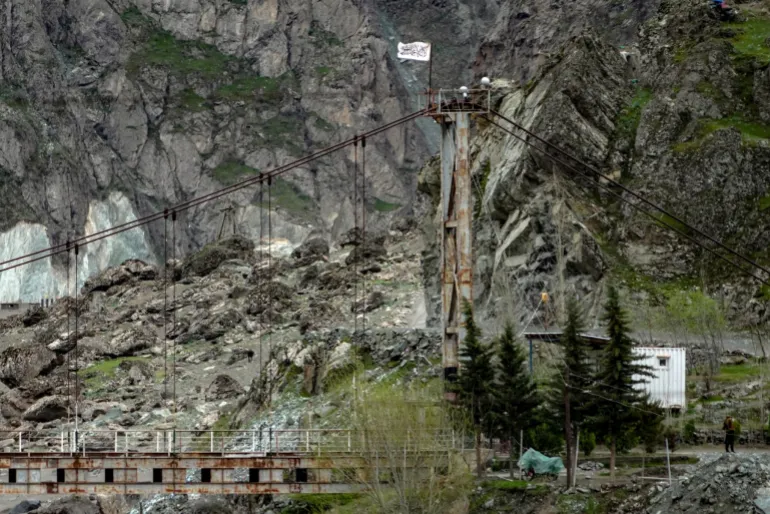
A Taliban flag flies on top of a bridge across the Panj river on the Afghan-Tajik border as seen from Tajikistan’s Darvoz district [File: Amir Isaev/AFP]
What’s happening on the Tajik-Afghan border?
The border runs along the Panj river through the remote, mountainous terrain of southern Tajikistan and northeastern Afghanistan.
On Thursday, Tajikistan’s State Committee for National Security said in a statement that “three members of a terrorist organisation” crossed into Tajik territory on Tuesday. The committee added that the men were located the following morning and exchanged fire with Tajik border guards. Five people, including the three intruders, were killed, it said.
Tajik officials did not name the armed men or specify which group they belonged to. The officials, however, said they seized three M-16 rifles, a Kalashnikov assault rifle, three foreign-made pistols with silencers, 10 hand grenades, a night-vision scope and explosives at the scene.
Dushanbe said this was the third attack originating from Afghanistan’s Badakhshan province in the past month that has resulted in the deaths of its personnel.
These attacks, Tajik officials said on Thursday, “prove that the Taliban government is demonstrating serious and repeated irresponsibility and non-commitment in fulfilling its international obligations and consistent promises to ensure security … and to combat members of terrorist organisations”.
The Tajik statement called on the Taliban to “apologise to the people of Tajikistan and take effective measures to ensure security along the shared border”.
Tajikistan has not suggested what the motive for the attacks may be, but the assaults have appeared to target Chinese companies and nationals working in the area.
Workers of Talco Gold, a joint Tajik-Chinese mining firm, speak in front of a poster of Chinese President Xi Jinping and Tajik President Emomali Rahmon at the Saritag antimony mine in western Tajikistan [File: AFP]
How is China involved in all this?
Beijing is Tajikistan’s largest creditor and one of its most influential economic partners with a significant footprint in infrastructure, mining and other border-region projects.
China and Tajikistan also share a 477km (296-mile) border running through the high-altitude Pamir Mountains in eastern Tajikistan, adjacent to China’s Xinjiang region.
Two attacks were launched against Chinese companies and nationals in the last week of November. On November 26, a drone equipped with an explosive device attacked a compound belonging to Shohin SM, a private Chinese gold-mining company, in the remote Khatlon region on the Tajik-Afghan border, killing three Chinese citizens.
In a second attack on November 30, a group of men armed with guns opened fire on workers employed by the state-owned China Road and Bridge Corporation, killing at least two people in Tajikistan’s Darvoz district.
Tajik officials said those attacks had originated from villages in Afghanistan’s Badakhshan province but did not disclose any affiliation or motive behind the attacks.
Chinese nationals have also come under attack in Pakistan’s Balochistan province and along the Afghanistan-Pakistan border.
China’s embassy in Dushanbe advised Chinese companies and personnel to evacuate the border area. Chinese officials demanded “that Tajikistan take all necessary measures to ensure the safety of Chinese enterprises and citizens in Tajikistan”.
Who is carrying out these attacks?
While the attackers have not been identified, analysts and observers believe the attacks carry the hallmarks of the ISIL (ISIS) affiliate in Khorasan Province (ISKP), which, they said, aims to discredit Afghanistan’s Taliban leaders.
“The ISKP has attacked foreigners inside Afghanistan and carried out attacks on foreigners inside Afghanistan as a key pillar of their strategy,” said Ibraheem Bahiss, a Kabul-based analyst at the International Crisis Group think tank.
“The aim is to shatter the Taliban’s image as a security provider with whom the regional governments should engage,” Bahiss told Al Jazeera.
Taliban members participate in a rally to mark the third anniversary of the Taliban’s seizure of Kabul in the Afghan capital on August 14, 2024. [Sayed Hassib/Reuters]
How has the Taliban reacted to these attacks?
Kabul expressed its “deep sorrow” over the killings of Chinese workers on November 28.
The Taliban blamed the violence on an unnamed armed group which, it said, is “striving to create chaos and instability in the region and to sow distrust among countries”, and it assured Tajikistan of its full cooperation.
After this week’s clashes, Sirajuddin Haqqani, the Taliban’s interior minister, said Kabul remains committed to the 2020 Doha Agreement, its deal with the United States for a phased foreign troop withdrawal from Afghanistan in exchange for Taliban commitments to prevent Afghanistan from being used as a base for attacking other countries.
Addressing a police cadet graduation ceremony at the National Police Academy in Kabul on Thursday, Haqqani said Afghanistan posed no threat to other countries and the door to dialogue remains open.
“We want to address problems, distrust or misunderstandings through dialogue. We have passed the test of confrontation. We may be weak in resources, but our faith and will are strong,” he said, adding that security had improved to the extent that Taliban officials now travel across the country without weapons.
The Taliban insists that no “terrorist groups” are operating from Afghanistan. However, in a recent report, the United Nations sanctions-monitoring committee cited the presence of multiple armed groups, including ISKP, Tehreek-e-Taliban Pakistan, al-Qaeda, the Turkistan Islamic Party, Jamaat Ansarullah and Ittehad-ul-Mujahideen Pakistan.
Jamaat Ansarullah is a Tajik group linked to al-Qaeda-aligned networks and active primarily in northern Afghanistan near the Tajik border.
Afghans travel along a border road as seen from Tajikistan’s Darvoz district [File: Amir Isaev/AFP]
How are relations between Tajikistan and the Taliban?
For decades, the relationship between Tajikistan and the Taliban has been defined by deep ideological hostility and ethnic mistrust with Dushanbe one of the group’s fiercest critics in Central Asia.
In the 1990s, Tajikistan aligned with the anti-Taliban Northern Alliance, led by Afghan military commander and former Defence Minister Ahmad Shah Massoud.
After the Taliban’s return to power in Afghanistan in August 2021, Tajikistan stood as the lone holdout among its neighbours in refusing to officially recognise the new government.
However, pragmatic diplomatic engagement quietly began about 2023, driven by economic necessity and shared security fears over the presence of ISKP. Stepping up the restoration of relations, a high-level Tajik delegation visited Kabul in November, the first such visit since the Taliban’s return to power.
But the two governments continue to trade accusations that the other is harbouring “terrorists”, the major thorn remaining in their bilateral relationship, and that drug smuggling is occurring across their border.
The Tajik-Afghan border has long been a major trafficking route for Afghan heroin and methamphetamine into Central Asia and onwards to Russia and Europe, exploiting the area’s rugged terrain and weak policing.
“The rising frequency [of the clashes] is new and interesting and raises a point: whether we might be seeing a new threat emerging,” Bahiss said.
Badakshan province, from which Tajik authorities said the attacks on Chinese nationals originate, presents a complex security situation for the Taliban as it has struggled to stem the threat from armed opposition groups, Bahiss added.
This security issue has been further complicated by the Taliban’s crackdown on poppy cultivation in the province, he said. The Taliban has faced resistance to this policy from farmers in the north. This is largely because the terrain of Badakshan means poppies are the only viable cash crop.
Afghanistan’s Taliban Foreign Minister Amir Khan Muttaqi called his Tajik counterpart early this month to express regret about the attacks on Chinese nationals and say his government was prepared to boost cooperation between their border forces [Anushree Fadnavis/Reuters]
How is the Taliban faring with other neighbours?
Since the Taliban retook control of Afghanistan in 2021, some of its neighbours have maintained a pragmatic transactional relationship while others have not.
Relations with Pakistan, previously its patron, have particularly deteriorated. Islamabad accuses Kabul of harbouring fighters of Tehrik-i-Taliban Pakistan, also known as the Pakistan Taliban. Tensions over this issue boiled over in November when Pakistan launched air strikes in Kabul, Khost and other provinces, prompting retaliatory Taliban attacks on border posts.
Dozens of people were killed before a ceasefire was brokered by Qatar and Turkiye. However, both sides have engaged in fighting since, blaming each other for breaking the fragile truce.
The Taliban denies Islamabad’s allegations and has blamed Pakistan for its “own security failures”.
Meanwhile, the Taliban is now invested in developing a new relationship with Pakistan’s archrival, India, with delegations visiting Indian cities for trade and security discussions. New Delhi was earlier part of the anti-Taliban alliance. However, that approach has changed with the deteriorating ties between Pakistan and the Taliban.
In a revamp of the 1973 mixed singles match, Aryna Sabalenka will play Nick Kyrgios on Sunday in Dubai.
Who: Aryna Sabalenka vs Nick Kyrgios What: “Battle of the Sexes” exhibition tennis match Where: Coca-Cola Arena in Dubai, United Arab Emirates When: Sunday at 7.45pm (15:45 GMT) How to follow: We’ll have all the build-up on Al Jazeera Sport from 13:00 GMT in advance of our live text commentary stream.
Women’s world number one Aryna Sabalenka will take on Australian maverick Nick Kyrgios in a “Battle of the Sexes” exhibition tennis match in Dubai on Sunday.
Recommended Stories
list of 4 itemsend of list
Sabalenka, 27, will face the 30-year-old former Wimbledon finalist in a modern rendition of tennis icon Billie Jean King’s 1973 showdown with fellow American Bobby Riggs, which turned out to be a watershed moment for both tennis and the women’s movement.
Here is all to know before their much anticipated showdown:
How did the Sabalenka-Kyrgios match come about?
Kyrgios, who was ranked as high as 13 in the world in men’s singles, threw down the gauntlet to Sabalenka during the US Open in September, saying in an interview he would easily dispatch the Belarusian without having to try “100 percent to win”.
He said women cannot return professional men’s serves and claimed he would defeat the world’s top-ranked female player.
Sabalenka responded by saying she was ready to “kick a**”, which eventually led to Evolve, the marketing agency that represents both players, organising this weekend’s matchup.
Aryna Sabalenka hits a backhand in the women’s singles final of this year’s US Open, which she won against Amanda Anisimova on September 6, 2025 [Mike Frey/Imagn Images via Reuters]
What’s the history behind the ‘Battle of the Sexes’?
The original “Battle of the Sexes” took place in 1973 between King, then 29, and Riggs, 55, at the Houston Astrodome.
King, a 12-time singles Grand Slam champion, made history when she defeated the former men’s world number one amateur player 6-4, 6-3, 6-3 in a matchup that drew an estimated 90 million TV viewers worldwide.
King’s straight-sets victory was considered a pivotal moment for women’s sport at the time and solidified her status as a sports and feminist icon of her generation.
What are the rules for ‘Battle of the Sexes’?
Sabalenka, speaking on the Piers Morgan Uncensored YouTube show on December 9, said it would be “really tough” to compete against a male player of Kyrgios’s standard using a full court and standard rules.
As a result, there are several rule modifications for this match:
The players will be limited to just one serve instead of two.
Sabalenka’s side of the court will be 9 percent smaller than a normal tennis court.
It will be a best-of-three-sets contest – with a 10-point tiebreaker in the final set if required.
What has Sabalenka said about the match?
“I’m proud to represent women’s tennis and to be part of this modern take of the iconic Battle of the Sexes match,” Sabalenka said in a news release.
“Dubai is my home, and I know this city loves big, entertaining events. I have a lot of respect for Nick and his talent, but make no mistake, I’m ready to bring my A-game.”
What has Kyrgios said about the match?
Kyrgios said he’ll defeat the four-time Grand Slam champion without having to try hard.
“I think she’s the type of player who genuinely thinks she’s going to win,” Kyrgios said.
“She is not gonna beat me. Do you really think I have to try 100 percent? I’m gonna try because I’m representing the men’s side. I’d say like 6-2 maybe.”
“I think I’m going to be OK. I’m going to go there, and I don’t want her to win. That’s for sure,” he added.
Nick Kyrgios, right, finished runner-up to Novak Djokovic at the 2022 Wimbledon men’s final [File: Peter van den Berg/USA Today Sports via Reuters]
Is oft-injured Kyrgios planning a return to professional tennis?
Kyrgios will compete at next month’s Brisbane International after receiving a wildcard entry, organisers said on Sunday, as he works towards a potential return to the 2026 Australian Open.
His career has been ravaged by injury over the past couple of years, and he played only five singles matches in 2025, the most recent at the Miami Open in March.
Kyrgios, the 2018 Brisbane champion, is now ranked 673rd in the world with no protected ranking and will also need a wildcard to compete at Melbourne Park.
How to watch the ‘Battle of the Sexes’
The match is being broadcast live and free in the United Kingdom on BBC 1 and streamed on BBC iPlayer.
Please check local guides for access in other countries.
Al Jazeera will provide live text commentary of the match.
Beijing urged the US to cease ‘dangerous’ efforts to arm the island, which it claims as its own.
Published On 26 Dec 202526 Dec 2025
Share
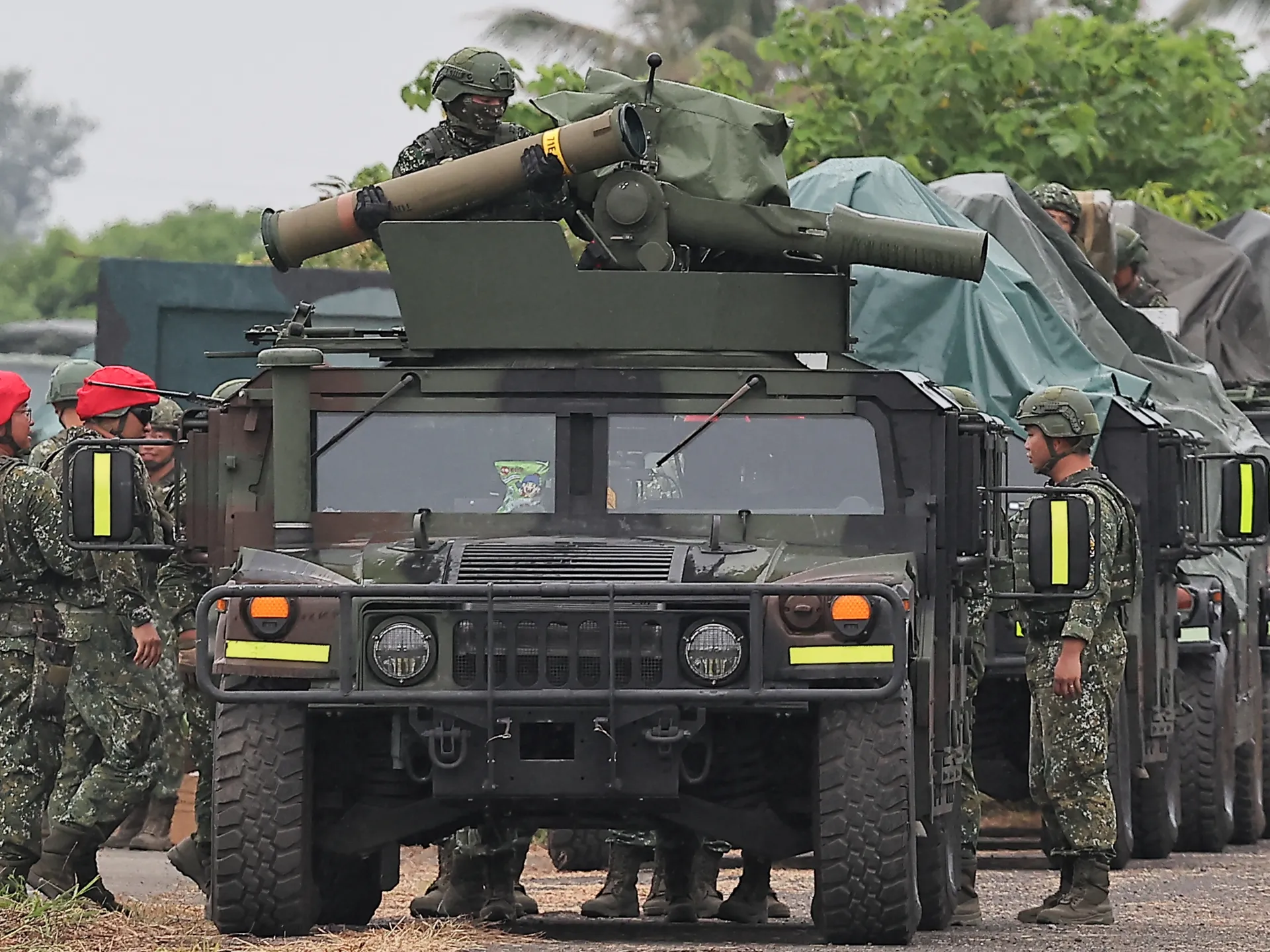
China has sanctioned a group of United States defence companies and senior executives over weapons sales to Taiwan, the latest move against Washington’s support for the self-governed island that Beijing claims as its own.
China’s Ministry of Foreign Affairs announced the measures on Friday, targeting 20 US defence firms and 10 individuals. It said the sanctions are retaliation for the US’s newly announced $11.1bn weapons package for Taiwan, one of its largest ever for the territory.
Recommended Stories
list of 3 itemsend of list
“Any provocative actions that cross the line on the Taiwan issue will be met with a strong response from China,” said a statement from the ministry, urging the US to cease “dangerous” efforts to arm the island.
The sanctioned companies include Boeing’s St Louis branch, Northrop Grumman Systems Corporation, L3Harris Maritime Services and Lazarus AI.
The measures freeze these companies’ assets in China and bar domestic organisations and individuals from working with them, according to the ministry. They also seize the China-held assets of sanctioned individuals and ban them from entering China.
Targeted individuals include the founder of defence firm Anduril Industries and nine senior executives from the sanctioned firms. The measures take effect on December 26.
The US is bound by law to provide Taiwan, which rejects Beijing’s claim to the territory, with the means to defend itself. But US arms sales to the island have deepened tensions with China.
The latest US weapons deal with Taiwan, announced by President Donald Trump on December 17, includes the proposed sale of 82 High Mobility Artillery Rocket Systems, or HIMARS, and 420 Army Tactical Missile Systems, or ATACMS – worth more than $4bn.
The defence systems are similar to what the US had been providing Ukraine to defend against Russian aerial attacks.
The deal also includes 60 self-propelled howitzer artillery systems and related equipment worth more than $4bn and drones valued at more than $1bn.
Taiwan’s Ministry of National Defence praised the US for assisting Taiwan “in maintaining sufficient self-defence capabilities and in rapidly building strong deterrent power”.
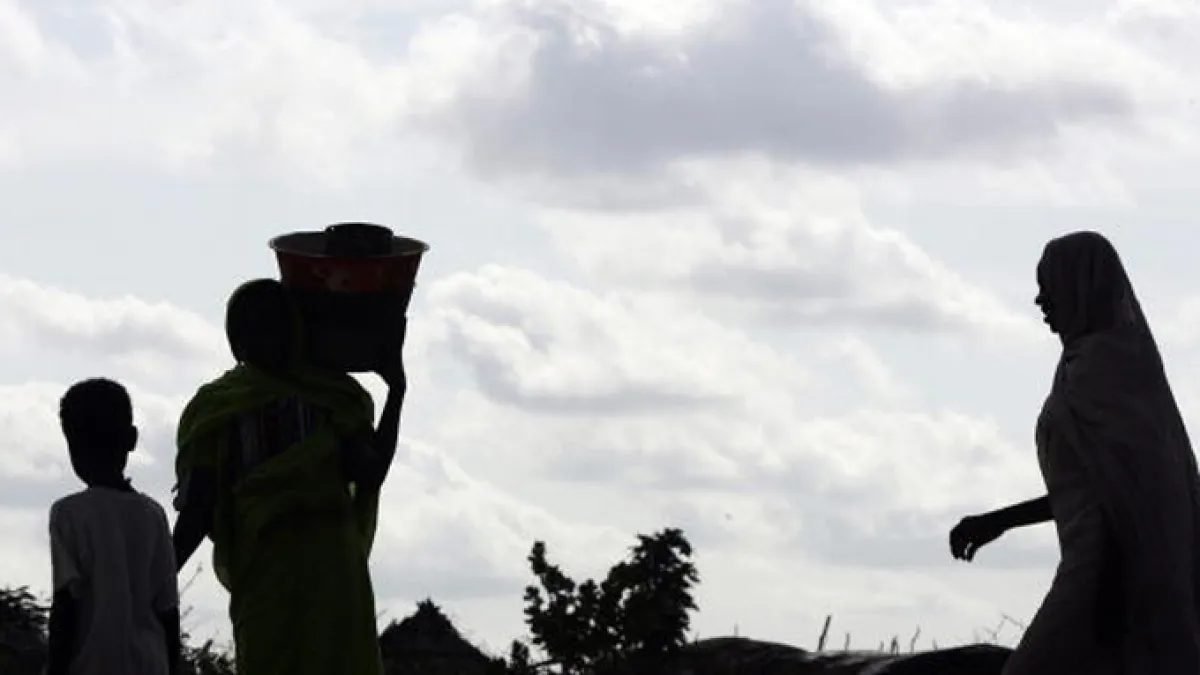
Drone attacks hit fuel market in city that serves as headquarters for RSF’s alternative government.
Sudan’s Rapid Support Forces (RSF) paramilitary group says the country’s army struck a fuel market in the city of Nyala, the RSF’s administrative capital, as part of an intensified aerial campaign against its positions in South Darfur.
For three consecutive days ending Thursday, military drones and warplanes pounded strategic RSF sites across Nyala, including the international airport, military positions and training facilities.
Recommended Stories
list of 2 itemsend of list
The strike on the fuel market triggered a huge blaze as barrels of fuel exploded, according to footage circulated on social media, sending thick plumes of black smoke into the air.
Youssef Idris Youssef, who heads the RSF’s civil administration in South Darfur, accused the army of deliberately targeting civilians. He described the attack as part of “a systematic policy” to punish Darfur residents for not resisting the RSF presence in their communities.
The Sudanese military has not issued any statement regarding the strikes.
Casualties were reported among both civilians and RSF members involved in the fuel trade.
In the aftermath, RSF intelligence services conducted mass arrests near the targeted site and Nyala’s main market, detaining civilians and military personnel on accusations of providing coordinates to the army, according to local sources.
Nyala holds particular strategic importance as the seat of the RSF’s parallel government, known as TASIS, which the group declared in July. Led by RSF commander Mohamed Hamdan “Hemedti” Dagalo, the alternative administration has been widely condemned as possibly fracturing Sudan, but controls significant territory across Darfur.
The city was struck by the army in October when it targeted the RSF and Nyala airport, which has been reportedly used by the RSF as a logistics hub for its forces.
Fighting continues across Darfur
Fighting has raged across Darfur since the RSF captured el-Fasher in October, an offensive marked by atrocities documented by rights groups.
The United States has said the RSF has committed genocide in Darfur.
This week, the RSF announced it had seized the Abu Qumra region in North Darfur and claimed advances towards Um Buru, though joint forces allied with the army disputed RSF assertions that they had also taken the town of Karnoi.
The attack on Nyala came just two days after Sudan’s prime minister, Kamil Idris, presented a peace proposal to the United Nations Security Council calling for RSF withdrawal from captured areas, disarmament in camps, and eventual elections.
The RSF rejected the plan, with spokesman Alaa el-Din Naqd telling Sudanese outlet Radio Dabanga it amounted to “wishful thinking”.
Sudan’s de facto leader, Abdel Fattah al-Burhan, was in Ankara for talks on Thursday with Turkish President Recep Tayyip Erdogan, at which Erdogan expressed his support for peace efforts and his opposition to dividing Sudan.
Hours earlier, a senior official in Sudan’s Transitional Sovereignty Council ruled out any negotiations, declaring there could be “no truce and no negotiation with an occupier”.
The war, which erupted in April 2023, has killed more than 100,000 people and displaced nearly 14 million, in what the UN describes as one of the world’s worst humanitarian crises.
Since the RSF seized el-Fasher – the last major army stronghold in Darfur – the conflict has shifted to Central Kordofan, splitting Sudan between territories controlled by the military and the RSF.
Syrian state media says security forces have imposed a cordon around the area and are investigating.
Published On 26 Dec 202526 Dec 2025
Share
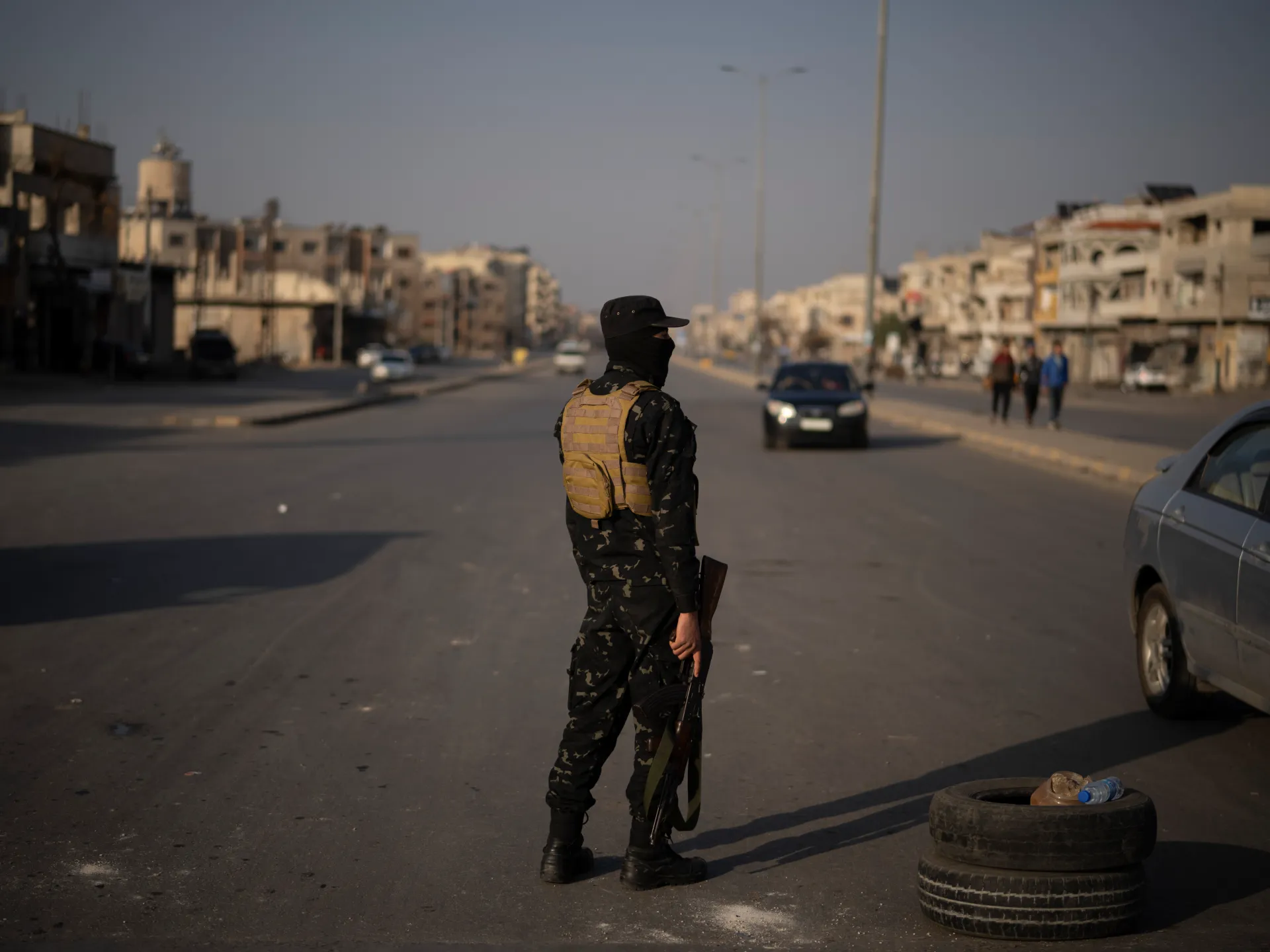
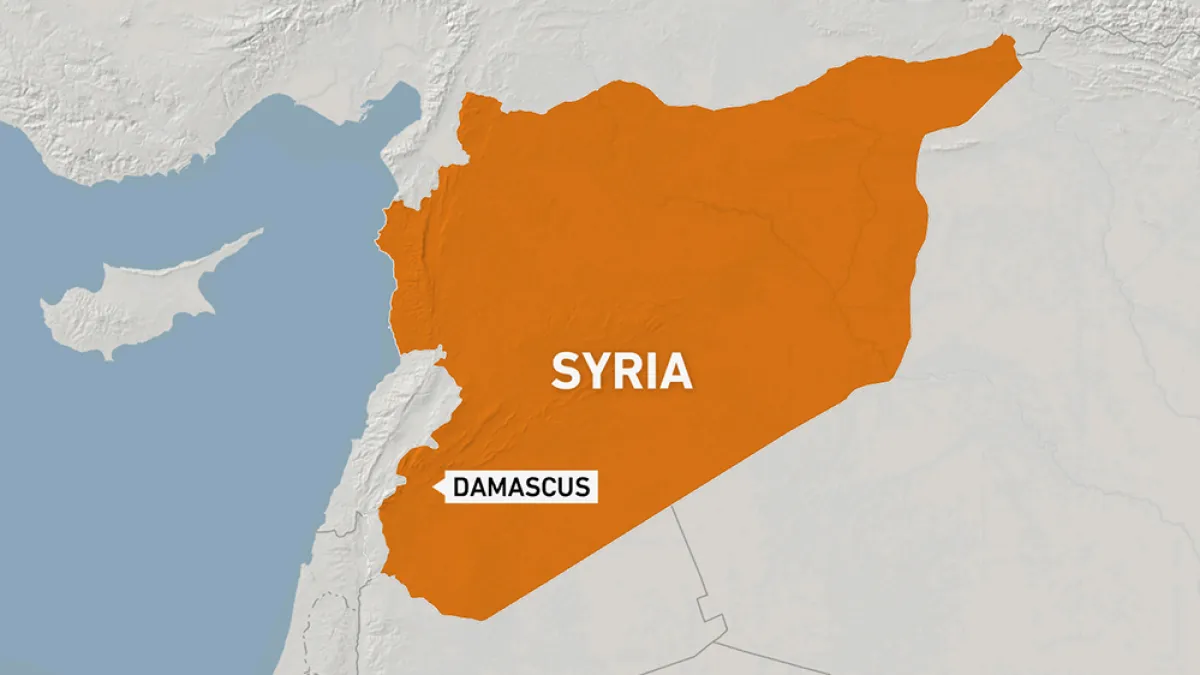
At least six people have been killed and more than 20 were injured when an explosion struck a mosque in Syria’s Homs province.
The attack targeted the Imam Ali bin Abi Talib Mosque in the Wadi al-Dahab neighbourhood of Homs shortly after Friday prayers, the Syrian Arab News Agency (SANA) reported.
Recommended Stories
list of 3 itemsend of list
Footage verified by Al Jazeera showed people fleeing the mosque in panic, placing some victims on stretchers and carrying others, wrapped in cloaks, to ambulances.
The blast appeared to have taken place in the corner of the mosque’s main prayer hall, leaving a small crater in the wall and scorching the surrounding area, with prayer carpets ripped and strewn with debris, and books and fragments scattered across the floor.
Local officials told the Reuters news agency the blast may have been caused by a suicide bomber or explosives placed there.
State media said security forces had imposed a cordon around the area and were investigating.
Ayman Oghanna, Al Jazeera’s correspondent in Aleppo, noted that Homs is home to a diverse population of Alawites, Christians and Sunni Muslims. He said the attack targeted an Alawite mosque, warning it could “inflame sectarian tensions” across the country.
He said no group had claimed responsibility for the strike, but noted a recent surge in ISIL (ISIS) activity in Syria. He added that government forces had carried out an operation near Aleppo, arresting three alleged ISIL members.
Last week, the United States bombed ISIL positions in Syria in retaliation for the killings of two US soldiers and a civilian interpreter. Damascus also joined a global anti-ISIL alliance in November, pledging to crush the remaining elements of the group.
Friday’s attack underscores the country’s fragile security situation, as the new authorities in Damascus struggle to assert control.
In 2025, HumAngle’s journalism did more than document suffering caused by conflicts in Nigeria, Congo, and Sudan, and other African countries, or analyse climate-driven disasters and evolving extremists in Nigeria and the Sahel; we also shaped destinies, shifted policies, and reopened pathways to justice and dignity for people long abandoned by the system.
Across Nigeria’s most vulnerable communities, our stories became catalysts for action, prompting governments, institutions, and ordinary citizens to intervene. This year, lives were rebuilt, promises were revived, and ignored crises finally received the attention they deserved.
We also won or were shortlisted for many awards this year. Our investigation into how IPOB uses online fundraising marathons to sustain its activities won the Illicit Financial Flow Category at the West Africa Media Excellence Conference and Awards. It also earned the journalist, Kunle Adebajo, the 2025 West Africa Journalist of the Year title, a title HumAngle has now clinched two years in a row. The same story earned second place in the online category at the 20th Wole Soyinka Award for Investigative Reporting, while our report on the lack of aid for IDPs in North Central Nigeria received a commendation at the awards.
At the CJID Excellence in Journalism Awards, we won two awards: first place in the health reporting category and first runner-up in the sexual and gender-based violence reporting category.
On the global stage, our report on how social media narratives fuel ethno-religious crises in Plateau State was shortlisted for the highly prestigious Fetisov Award, under the outstanding contribution to peace category.
The full scope of our impact is still unfolding, but the list below represents some of the significant results documented by our reporters:
1. Punished Without Guilt, Released Without Support
In September, HumAngle published the story of a young man who spent ten years in detention under the custody of Nigerian security forces following accusations of having links with a Boko Haram terrorist. After enduring immense hardship, he was found innocent and released through the terrorist deradicalisation programme also known as Operation Safe Corridor due to the time he spent with Boko Haram members in jail. But he struggled to rebuild his life after regaining freedom. The Kano State government also failed to fulfil its promise to support him and others.
However, after we published his story, a German-based Nigerian offered him financial support to start or strengthen his trade. The victim also said that after the story, the Kano State government, through the Hisbah Board, promised to fulfil its promise. As it stands, HumAngle’s report has become a catalyst in helping him rebuild his life after a decade in detention.
2. What Life Could Have Been For Leah Sharibu
HumAngle’s deeply human and creatively crafted feature to mark the 22nd birthday of Leah Sharibu, who was kidnapped by the Islamic State West Africa Province (ISWAP) three months shy of her 15th birthday and has since remained in captivity. The story has travelled far beyond the newsroom, now being used as a teaching material at the University of Jos. Taye Obateru, a professor of journalism, media, and cultural studies, selected it as a model text for a final-year undergraduate class on advanced feature writing. Through this story, HumAngle is not only shaping public understanding of conflict and human suffering but also shaping the next generation of Nigerian journalists — inspiring them to pursue writing that is both empathetic and rigorous.
For the students, the lesson was transformative. Treasure Ajifa, a final-year mass communication student, told HumAngle: “During our Advanced Feature Writing class, we stumbled upon a challenging concept regarding the application of creativity in storytelling. As we wrestled with understanding it, our professor cited HumAngle’s story on what should have been Leah Sharibu’s 22nd birthday celebration as a quintessential example. It was a moment of revelation for the 200 students who sat listening to him. It left us aspiring to become better storytellers who could blend creative excellence with impactful reporting.”
3. The Unknown Flesh-Eating Disease in Nigeria’s Adamawa
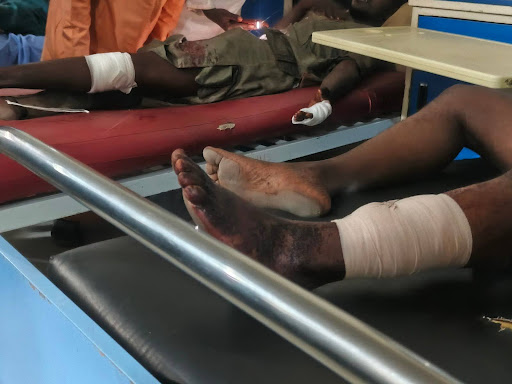
After HumAngle’s feature on the mysterious flesh-eating disease affecting residents of Malabu in Adamawa State, North East Nigeria, authorities moved swiftly in response. A month after the report highlighted the rising number of cases and the community’s plea for urgent intervention, the government deployed vehicles to Malabu to evacuate all affected persons for proper medical care. Health officials also confirmed that a dedicated ward had been created at the Adamawa State Specialist Hospital, where victims are now receiving free treatment. According to Stella Samuel, a staff member at the hospital, this intervention was directly influenced by the attention the report generated, ensuring that dozens of vulnerable residents finally gained access to the care they desperately needed.
4. Malnutrition Is Affecting Displaced Mothers’ Ability to Breastfeed Newborns in North East Nigeria
HumAngle’s reporting on malnutrition and the deepening humanitarian crisis in Dalori settlement, Borno State, did far more than highlight the struggles of nursing mothers. It exposed a worsening mobility crisis that had quietly crippled the community since its relocation. For months, displaced families trekked long distances between Dalori and Maiduguri because transportation was scarce, expensive, and often completely unavailable. Menial workers could no longer reach the city for jobs, children missed school, and nursing mothers walked kilometres under the sun to fetch water or seek healthcare. The story laid bare how this mobility barrier was deepening hunger, unemployment, and vulnerability among people who were already uprooted from their homes.
Within days of the story’s publication, the Borno State government responded. Two buses were deployed to serve the Dalori–Maiduguri route, dedicated solely to helping displaced residents move safely and affordably between the settlement and the city. For a community that had been cut off both economically and physically, the impact was immediate. Movement to hospitals, markets, job centres, and schools suddenly became possible again.
The chairman of the settlement, Mohammed Bintube, acknowledged the development with relief and gratitude. “We are very happy that the government has responded to our transportation problems,” he said. “Our people used to trek from the village into the town before because transportation was scarce, and even when it was available, many could not afford it. We are happy we now have two dedicated buses that transport our people from Dalori Village to Maiduguri.”
5. The Deadly Consequences Of Blasphemy Allegations In Nigeria’s North
In Northern Nigeria, allegations of blasphemy can be extremely dangerous. Many people have lost their lives due to such accusations, often through what is commonly known as ‘jungle justice.’ In 2024, HumAngle published the stories of individuals accused of blasphemy, some of whom were detained without any attempt to ensure fairness or justice. But after the publication, two of them, Mallam Abba Gezawa and Mubarak Bala, regained their freedom. Mubarak Bala himself confirmed that HumAngle’s decision to spotlight his case played a key role in reviving his trial, which eventually gave him the right to reunite with his family. Other people detained for the same allegation, such as Sheikh Abduljabbar Kabara, have also received significant attention, with rights activists and lawyers promising to support their cases.
6. From Elephants to Warthogs: The Shadow Wildlife Trade Financing Boko Haram in Nigeria
This investigation has created a notable impact across policy, public discourse, and security analysis in 2025. As we uncovered how the disappearance of elephants in Sambisa Forest has shifted trafficking networks toward warthog tusks and created a new micro-economy exploited by Boko Haram, the story broadened national understanding of terror financing beyond ransom payments, cattle rustling, and informal taxation. It sparked widespread online conversation among journalists, conservationists, academics, and counterterrorism experts, who shared the report as a reference point for discussions on the environmental dimensions of insecurity in the Sahel. Civil society groups and wildlife-protection advocates cited the story to highlight enforcement gaps and the need for coordinated conservation efforts between Nigeria and Cameroon, while the revelation of unregulated forest corridors around Molai and Konduga renewed debate on patrol capacity and resource allocation.
7. Secrets, Silence, Survival: Inside a Nigerian Military Prison
This exposé broke through years of silence surrounding Wawa Barracks in Niger State, exposing a hidden world of arbitrary arrests, incommunicado detention, and severe human rights abuses. Using rare eyewitness accounts, OSINT, and satellite imagery, the investigation revealed how civilians, minors, protesters, Boko Haram suspects, and mentally ill detainees were held together in degrading, overcrowded cells where torture, starvation, and deaths were common. The story ignited nationwide debate, spreading quickly across social media and prompting activists, lawyers, and affected families to demand answers.
When Omoyele Sowore, a rights activist in Nigeria, used images from the story to demand the release of everyone held in the prison on Nov. 8, it fueled even wider public outrage and revived conversations about military secrecy and abuses in Nigeria’s counterinsurgency operations. For many families across the South East, Middle Belt, and North East, the investigation confirmed the fate of loved ones who had disappeared for years. Within security and human rights circles, the report may now be seen as one of the consequential exposés of the year.
8. Nigerian Graduates Struggle as JAMB Withholds Admission Validation
This story sparked outrage, especially among the affected graduates, by exposing how a bureaucratic breakdown at JAMB trapped thousands of graduates, unable to proceed to the mandatory national service (NYSC) or begin their careers. The feature story exposed a system where students were punished for institutional failures beyond their control. After the story circulated, the National Association of Nigerian Students (NANS), previously stalled, faced renewed public scrutiny and was compelled to push. Their efforts, driven in part by the visibility HumAngle created, directly contributed to the reopening of the affected JAMB portal, finally giving stranded graduates a pathway to resolve their cases.
“Hi, JAMB has opened my portal,” excited Loveth Adam told HumAngle in July.
9. What Does War Do to a Boy?
Ten years ago, Amir’s parents were arrested at the peak of the Boko Haram insurgency in Nigeria’s northeastern region. He was three. Now, he is 13, out of the orphanage, and living with his grandmother. What has been the consequence of war for him? We reported his story in 2024. We also wrote to the army with the details and circumstances of his mother’s detention, asking for updates on the case. Though they did not respond, they went ahead to release her this year. We published her story here.
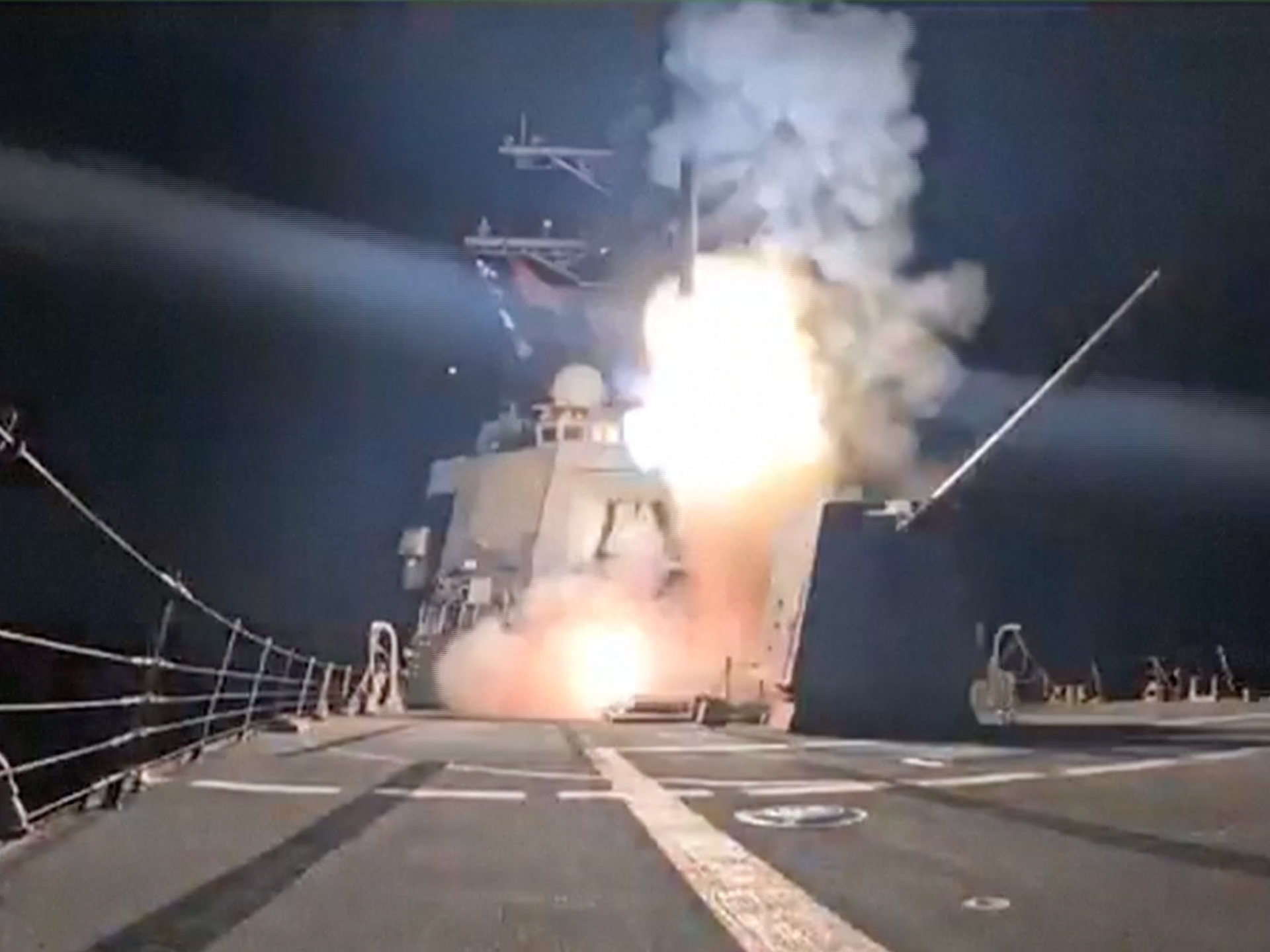
The US defence department posted a short video that appears to show a missile being launched from a military vessel
President Donald Trump has said the US launched a “powerful and deadly strike” against the Islamic State (IS) group in north-western Nigeria.
The US leader described IS as ” terrorist scum”, accusing the group of “targeting and viciously killing, primarily, innocent Christians”.
Trump said the US military “executed numerous perfect strikes”, while the US Africa Command (Africom) later reported that Thursday’s attack was carried out in co-ordination with Nigeria in the Sokoto state.
Nigerian Foreign Minister Yusuf Maitama Tuggar told the BBC it was a “joint operation” targeting “terrorists”, and it “has nothing to do with a particular religion”.
Without naming IS specifically, Tuggar said the operation had been planned “for quite some time” and had used intelligence information provided by the Nigerian side.
The minister did not rule out further strikes, adding that this depended on “decisions to be taken by the leadership of the two countries”.
In his post on Truth Social late on Thursday, Trump said that “under my leadership, our Country will not allow Radical Islamic Terrorism to prosper”.
He did not say at the time which killings he was referring to, but claims of a genocide against Nigeria’s Christians have been circulating in recent months in some right-wing US circles.
Meanwhile, US Defence Secretary Pete Hegseth said on Thursday that he was “grateful for Nigerian government support & cooperation”.
“Merry Christmas!” he added, writing on X.
AFP via Getty Images
President Trump last month ordered the US military to prepare for action in Nigeria
The US Department of Defense later posted a short video that appeared to show a missile being launched from a military vessel.
On Friday morning, the Nigerian foreign ministry said in a statement that the country’s authorities “remain engaged in structured security co-operation with international partners, including the United States of America, in addressing the persistent threat of terrorist and violent extremism.
“This has led to precision hits on terrorist targets in Nigeria by air strikes in the North West,” the statement said.
Groups monitoring violence say there is no evidence to suggest that Christians are being killed more than Muslims in Nigeria, which is roughly evenly divided between followers of the two religions.
An adviser to Nigerian President Bola Tinubu told the BBC at the time that any military action against the jihadist groups should be carried out together.
Daniel Bwala said Nigeria would welcome US help in tackling the Islamist insurgents but noted that it was a “sovereign” country.
He also said the jihadists were not targeting members of a particular religion and that they had killed people from all faiths, or none.
President Tinubu has insisted there is religious tolerance in the country and said the security challenges were affecting people “across faiths and regions”.
Trump earlier announced that he had declared Nigeria a “country of particular concern” because of the “existential threat” posed to its Christian population. He said “thousands” had been killed, without providing any evidence.
This is a designation used by the US state department that provides for sanctions against countries “engaged in severe violations of religious freedom”.
Following this announcement, Tinubu said his government was committed to working with the US and the international community to protect people of all faiths.
Jihadist groups such as Boko Haram and Islamic State West Africa Province have wrought havoc in north-eastern Nigeria for more than a decade, killing thousands of people – however most of these have been Muslims, according to Acled, a group which analyses political violence around the world.
In central Nigeria, there are also frequent clashes between mostly Muslim herders and farming groups, who are often Christian, over access to water and pasture.
Deadly cycles of tit-for-tat attacks have also seen thousands killed – but atrocities have been committed on both sides.
Human rights groups say there is no evidence that Christians have been disproportionately targeted.
The US Central Command (Centcom) said fighter jets, attack helicopters and artillery “struck more than 70 targets at multiple locations across central Syria”. Aircraft from Jordan were also involved.
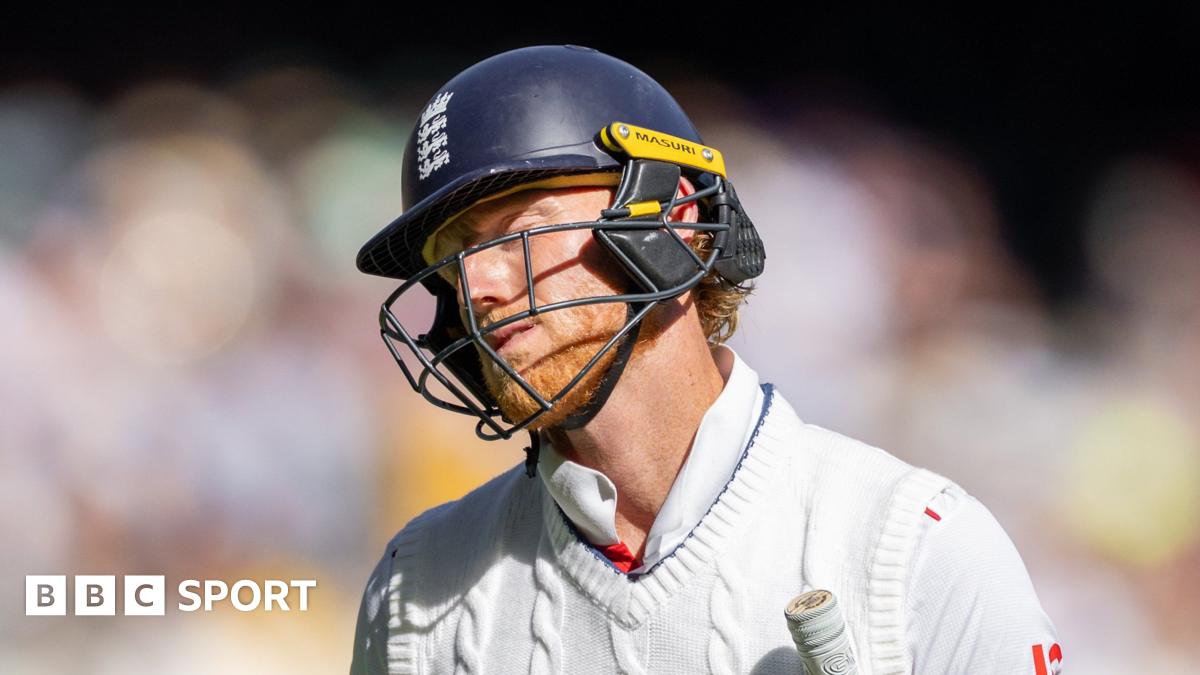
England’s Ashes tour teetered on another crisis as they were bowled out for 110 by Australia on an almost farcical first day of the fourth Test at the Melbourne Cricket Ground.
The 20 wickets to fall is the most on the opening day of an Ashes Test since 1909 and surpassed the 19 of the first day of the first Test of this series in Perth.
Steve Smith, standing-in as Australia captain, said the 10mm long grass on the pitch would mean batters had to be “on their game” in the Boxing Day Test.
Smith was right. His side were hustled out for 152, then England were decimated in a single session after tea.
There was still time for Australia to face one over of their second innings before the close, only the third time in Test history the third innings of the match has begun on day one. The hosts are 4-0, leading by 46 runs.
Perth was the first two-day Ashes Test in 104 years. Melbourne could be the second in the space of five weeks.
The havoc of the evening made England’s improved performance with ball and in the field a distant memory. Pace bowler Josh Tongue was excellent in claiming 5-45.
But England were bowling again before the end of the day as their batting was flattened in 29.5 overs.
England were 8-3 and 16-4. Harry Brook’s dance, swipe and miss at Mitchell Starc from his first ball seemed witless in the moment, yet it was Brook’s audacity that kept England from a complete implosion.
Brook swatted 41, including two sixes. Ben Stokes and Gus Atkinson were the only other men to reach double figures.
Michael Neser claimed four wickets, Scott Boland three, with the silliness of the day summed up by Boland then opening the batting as nightwatchman.
Ramallah, occupied West Bank – The Palestinian economy is undergoing a severe downturn, driven by Israel’s continued assault on Gaza, intensified restrictions on movement and trade in the occupied West Bank, and a sharp decline in both domestic and external financial resources.
As the Palestinian government struggles to manage an escalating fiscal crisis, official data and expert assessments warn that the economy is approaching a critical threshold – one that threatens the continuity of state institutions and their ability to meet even basic obligations.
Recommended Stories
list of 3 itemsend of list
A joint report by the Palestinian Central Bureau of Statistics (PCBS) and the Palestine Monetary Authority (PMA), published in the Palestinian Economic Monitor for 2025, found that the economy remained mired in deep recession throughout the year.
According to the report, gross domestic product (GDP) in Gaza contracted by 84 percent in 2025 compared with 2023, while GDP in the occupied West Bank declined by 13 percent over the period. Overall GDP levels remain far below their pre-war baseline, underscoring the fragility of any potential recovery and the economy’s inability to regain productive capacity under current conditions.
The report documented a near-total collapse of economic activity in Gaza, alongside sharp contractions across most sectors in the West Bank, despite a modest improvement compared with 2024. It also recorded a decline in trade volumes to and from Palestine compared with 2023, while unemployment in Gaza exceeded 77 percent during 2025.
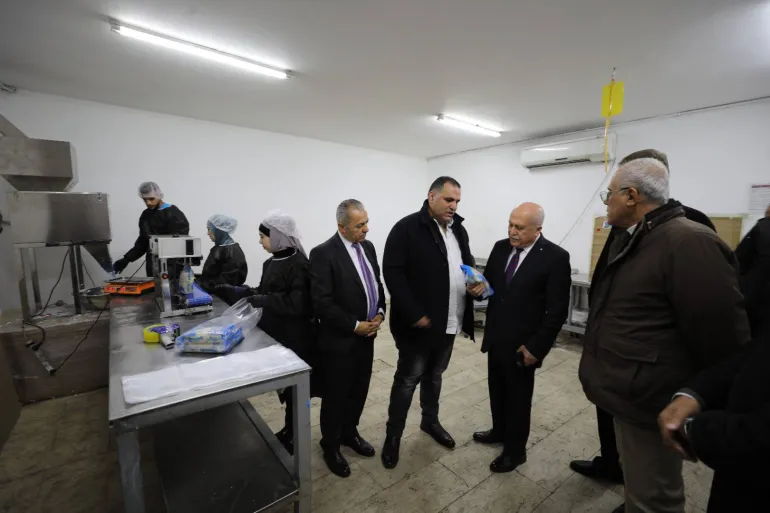
Palestinian Economy Minister Mohammed al-Amour visits the Bethlehem Industrial Zone to assess the state of Palestinian industries, December 10, 2025 [Handout/Palestinian Ministry of National Economy]
Withheld revenues and mounting debt
Palestinian Economy Minister Mohammed al-Amour said Israeli authorities are withholding approximately $4.5bn in Palestinian clearance revenues, describing the move as a form of “collective punishment” that has severely undermined the Palestinian Authority’s (PA’s) ability to function.
“The total accumulated public debt reached $14.6bn by the end of November 2025, representing 106 percent of the 2024 gross domestic product,” al-Amour told Al Jazeera.
The minister said the debt includes $4.5bn owed to the International Monetary Fund, $3.4bn to the Palestinian banking sector, $2.5bn in salary arrears to public employees, $1.6bn owed to the private sector, $1.4bn in external debt, and $1.2bn in other financial obligations.
“These pressures have had a direct impact on the overall performance of the public budget,” al-Amour said, contributing to a widening deficit and sharply reduced capacity to cover operational spending and essential commitments.
All of that has led al-Amour to conclude that the Palestinian economy is undergoing “its most difficult period” since the establishment of the PA in 1994.
Official estimates show GDP contracted by 29 percent in the second quarter of 2025, compared with 2023, while GDP per capita fell by 32 percent over the period. These figures align with a recent report by the United Nations Conference on Trade and Development (UNCTAD), which concluded that the Palestinian economy has regressed to levels last seen 22 years ago.
In response, al-Amour said the government was implementing an “urgent package of measures”.
“The government is rolling out a series of actions that include strengthening the social protection system, supporting citizens’ resilience in Area C [of the West Bank], and backing small and medium-sized enterprises and productive sectors, particularly industry and agriculture,” al-Amour said.
Official data show a sharp drop across nearly all economic activities. Construction contracted by 41 percent, while both industry and agriculture declined by 29 percent each. Wholesale and retail trade fell by 24 percent.
The tourism sector has been among the hardest hit. Following the start of Israel’s genocidal war on Gaza in October 2023, the Ministry of Tourism reported daily losses exceeding $2m, as inbound tourism nearly collapsed. By the end of 2024, cumulative losses were estimated at approximately $1bn.
The Palestinian Economic Policy Research Institute (MAS), citing PCBS data, reported an 84.2 percent drop in hotel occupancy in the West Bank during the first half of 2024 compared with the same period a year earlier. Losses in accommodation and food services alone amounted to roughly $326m.
Despite the downturn, al-Amour said the Ministry of Economy is focusing on sustaining the private sector, substituting Israeli imports across seven key sectors, developing the digital and green economies, and improving the business environment. He noted that about 2,500 new companies continue to be registered each year.
Tourism collapsing
Samir Hazbun, a lecturer at al-Quds University and board member of the Palestinian Federation of Chambers of Commerce and Industry, said repeated crises have hollowed out the economy.
“Over the past five years, all economic sectors have entered successive crises, starting with the COVID-19 pandemic and followed by the war on Gaza,” Hazbun said. “Tourism, one of the most important sectors, has been especially affected, exhausting the local economy and weakening its ability to recover.”
Hazbun said preliminary estimates indicate tourism has suffered direct losses exceeding $1bn, alongside extensive indirect losses resulting from the paralysis of hotels, souvenir shops, travel agencies, tour guides and street vendors.
He added that hotel investments alone are estimated at $550m, with no financial returns for owners, forcing many workers out of the sector due to the absence of job security and safety nets.
Economic expert Haitham Daraghmeh described Palestinian debt as “accumulated debt that increases monthly”, owed to banks, suppliers, contractors, and the telecommunications and health sectors.
“The withholding of clearance revenues is no longer a temporary financial crisis; it has become a factor of complete economic paralysis,” he said.
With external aid frozen and domestic revenues at historic lows, Daraghmeh warned that the government was “no longer able to cover salaries or operational costs”.
“The government is operating like an ATM, with no real capacity for investment or economic stimulus,” Daraghmeh added.
Economic warnings
Daraghmeh said World Bank reports warn that continued failure to pay salaries and meet obligations could trigger comprehensive economic collapse. While some countries, including France and Saudi Arabia, have pledged support, he said none of that assistance has materialised.
He outlined three possible scenarios; the most likely is a continued gradual decline, driven by ongoing revenue withholding and shrinking resources. The second involves international intervention to prevent total collapse, particularly at a decisive political moment. The third scenario could see a conditional breakthrough, tied to European demands for financial reform, anticorruption measures, curriculum changes and elections.
Taken together, the data and expert assessments suggest the Palestinian economy is approaching a dangerous tipping point. Analysts warn that without an end to revenue withholding, renewed international financial support, and a shift in the political context, the economy risks sliding from prolonged crisis into outright collapse.
The question facing Palestinian officials and economists alike is how long the system can endure under siege-like conditions – and whether political and economic shifts will arrive in time to halt what many now describe as a slow and deliberate economic unravelling.
The US Department of War published footage of a missile being fired from a military vessel after Washington said it carried out a strike in northwest Nigeria. President Donald Trump said the attack targeted ISIL and was carried out at Nigeria’s request.
A US judge has temporarily stopped the Trump administration from detaining British activist Imran Ahmed after he sued officials over an entry ban for alleged online censorship.
The founder of the Center for Countering Digital Hate is among five people denied US visas after the state department accused them of seeking to “coerce” tech platforms into censoring free speech.
The move brought a backlash from European leaders defending the work of organisations monitoring online content.
Mr Ahmed, a US permanent resident, had warned that being detained and possibly deported would tear him away from his American wife and child.
Praising the judge’s decision, he told BBC News he would not be “bullied”.
Secretary of State Marco Rubio had said online that the individuals were blocked over concerns that they had organised efforts to pressure US platforms to censor and “punish American viewpoints they oppose“.
Mr Ahmed filed a legal complaint on Wednesday against officials including Rubio and US Attorney General Pamela Bondi over the decision to have him sanctioned.
In court documents seen by the BBC, US District Judge Vernon S Broderick said on Thursday he had granted Mr Ahmed’s request for a temporary restraining order.
The judge also temporarily blocked the officials from detaining Mr Ahmed without the chance for his case to be heard.
The BBC has contacted the state department and White House for comment.
When approached by AFP news agency, a state department spokesperson was quoted as saying: “The Supreme Court and Congress have repeatedly made clear: the United States is under no obligation to allow foreign aliens to come to our country or reside here.”
Mr Ahmed said: “I will not be bullied away from my life’s work of fighting to keep children safe from social media’s harm and stopping antisemitism online.”
His lawyer, Roberta Kaplan, said the speed of the judge’s decision was telling.
“The federal government can’t deport a green card holder like Imran Ahmed, with a wife and young child who are American, simply because it doesn’t like what he has to say,” she said.
In 2023, Mr Ahmed’s centre was sued by Elon Musk’s social media company after it reported on a rise in hate speech on the platform since the billionaire’s takeover of the firm, now called X.
Four members of the advocacy group Palestine Action have pledged this week to continue their hunger strike amid grave medical warnings and the hospitalisations of their fellow protesters.
The group’s members are being held in five prisons in the United Kingdom over alleged involvement in break-ins at a facility of the UK’s subsidiary of the Israeli defence firm Elbit Systems in Bristol and a Royal Air Force base in Oxfordshire. They are protesting for better conditions in prison, rights to a fair trial, and for the UK to change a July policy listing the movement as a “terror” group.
Recommended Stories
list of 4 itemsend of list
Palestine Action denies charges of “violent disorder” and others against the eight detainees. Relatives and loved ones told Al Jazeera of the members’ deteriorating health amid the hunger strikes, which have led to repeated hospital admissions. Lawyers representing the detainees have revealed plans to sue the government.
The case has brought international attention to the UK’s treatment of groups standing in solidarity with Palestinians amid Israel’s genocidal war in Gaza. Thousands of people have rallied in support of Palestine Action every week.
Hunger strikes have been used throughout history as an extreme, non-violent way of seeking justice. Their effectiveness often lies in the moral weight they place upon those in power.
Historical records trace hunger strikes back to ancient India and Ireland, where people would fast at the doorstep of an offender to publicly shame them. However, they have also proved powerful as political statements in the present day.
Here are some of the most famous hunger strikes in recent world history:
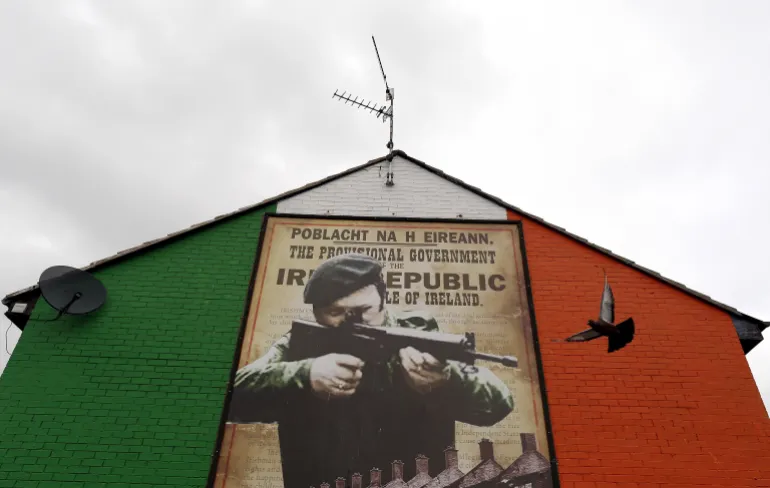
A pigeon flies past a mural supporting the Irish Republican Army in the Ardoyne area of north Belfast, September 9, 2015 [Cathal McNaughton/Reuters]
Irish Republican Movement hunger strikes
Some of the most significant hunger strikes in the 20th century occurred during the Irish revolutionary period, or the Troubles. The first wave was the 1920 Cork hunger strike, during the Irish War of Independence. Some 65 people suspected of being Republicans had been held without proper trial proceedings at the Cork County Gaol.
They began a hunger strike, demanding their release and asking to be treated as political prisoners rather than criminals. They were joined by Terence MacSwiney, the lord mayor of Cork, whose profile brought significant international attention to the independence cause. The British government attempted to break up the movement by transferring the prisoners to other locations, but their fasts continued. At least three prisoners died, including MacSwiney, after 74 days.
Later on, towards the end of the conflict and the signing of the Good Friday Agreement, imprisoned Irish Republicans protested against their internment and the withdrawal of political prisoner status that stripped them of certain rights: the right to wear civilian clothes, or to not be forced into labour.
They began the “dirty protest” in 1980, refusing to have a bath and covering walls in excrement. In 1981, scores of people refused to eat. The most prominent among them was Bobby Sands, an IRA member who was elected as a representative to the British Parliament while he was still in jail. Sands eventually starved to death, along with nine others, during that period, leading to widespread criticism of the Margaret Thatcher administration.
India’s Mohandas Karamchand Gandhi, who was later popularly known as Mahatma Gandhi, used hunger strikes as a tool of protest against the British colonial rulers several times. His fasts, referred to as Satyagraha, meaning holding on to truth in Hindi, were considered by the politician and activist not only as a political act but also a spiritual one.
Gandhi’s strikes sometimes lasted for days or weeks, during which he largely sipped water, sometimes with some lime juice. They achieved mixed results – sometimes, the British policy changed, but at other times, there were no improvements. Gandhi, however, philosophised in his many writings that the act was not a coercive one for him, but rather an attempt at personal atonement and to educate the public.
One of Gandhi’s most significant hunger strikes was in February 1943, after British authorities placed him under house arrest in Pune for starting the Quit India Movement back in August 1942. Gandhi protested against the mass arrests of Congress leaders and demanded the release of prisoners by refusing food for 21 days. It intensified public support for independence and prompted unrest around the country, as workers stayed away from work and people poured out into the streets in protest.
Another popular figure who used hunger strikes to protest against British rule in colonial India was Jatindra Nath Das, better known as Jatin Das. A member of the Hindustan Socialist Republican Association, Das refused food while in detention for 63 days starting from August 1929, in protest against the poor treatment of political prisoners. He died at the age of 24, and his funeral attracted more than 500,000 mourners.
Palestinian kids wave their national flag and hold posters showing Khader Adnan following his death on May 2, 2023 [Majdi Mohammed/AP Photo]
Palestinian prisoners in Israeli prisons
Palestinians held, often without trial, in Israeli jails have long used hunger strikes as a form of protest. One of the most well-known figures is Khader Adnan, whose shocking death in May 2023 after an 86-day hunger strike drew global attention to the appalling treatment of Palestinians by the Israeli government.
Adnan, who was 45 when he starved to death at the Ayalon Prison, leaving behind nine children, had repeatedly been targeted by Israeli authorities since the early 2000s. The baker from the occupied West Bank had once been part of the Palestinian Islamic Jihad group as a spokesperson, although his wife later stated publicly that he had left the group and that he had never been involved in armed operations.
However, Adnan was arrested and held without trial multiple times, with some estimates stating that he spent a cumulative eight years in Israeli prisons. Adnan would often go on hunger strike during those detentions, protesting against what he said was usually a humiliating arrest and a detention without basis. In 2012, thousands in Gaza and the West Bank rallied in a non-partisan show of support after he went 66 days without food, the longest such strike in Palestinian history at the time. He was released days after the mass protests.
In February 2023, Adnan was once again arrested. He immediately began a hunger strike, refusing to eat, drink, or receive medical care. He was held for months, even as medical experts warned the Israeli government that he had lost significant muscle mass and had reached a point where eating would cause more damage than good. On the morning of May 2, Adnan was found dead in his cell, making him the first Palestinian prisoner to die in a hunger strike in three decades. Former Palestinian Information Minister Mustafa Barghouti described his death as an “assassination” by the Israeli government.
Hunger strikes at Guantanamo
Following the 2002 opening of the Guantanamo Bay detention camp of the United States in Cuba, where hundreds of “terror” suspects were held prisoners, often with no formal charges, they used hunger strikes in waves to protest against their detention. The camp is notorious for its inhumane conditions and prisoner torture. There were 15 detainees left by January 2025.
The secret nature of the prison prevented news of earlier hunger strikes from emerging. However, in 2005, US media reported mass hunger strikes by scores of detainees – at least 200 prisoners, or a third of the camp’s population.
Officials forcefully fed those whose health had severely deteriorated through nasal tubes. Others were cuffed daily, restrained, and force-fed. One detainee, Lakhdar Boumediene, later wrote that he went without a real meal for two years, but that he was forcefully fed twice a day: he was strapped down in a restraining chair that inmates called the “torture chair”, and a tube was inserted in his nose and another in his stomach. His lawyer also told reporters that his face was usually masked, and that when one side of his nose was broken one time, they stuck the tube in the other side, his lawyer said. Sometimes, the food got into his lungs.
Hunger strikes would continue intermittently through the years at Guantanamo. In 2013, another big wave of strikes began, with at least 106 of the remaining 166 detainees participating by July. Authorities force-fed 45 people at the time. One striker, Jihad Ahmed Mustafa Dhiab, filed for an injunction against the government to stop officials from force-feeding him, but a court in Washington, DC rejected his lawsuit.
Protests against apartheid South Africa
Black and Indian political prisoners held for years on Robben Island protested against their brutal conditions by going on a collective hunger strike in July 1966. The detainees, including Nelson Mandela, had been facing reduced food rations and were forced to work in a lime quarry, despite not being criminals. They were also angry at attempts to separate them along racial lines.
In his 1994 biography, Long Walk to Freedom, Mandela wrote that prison authorities began serving bigger rations, even accompanying the food with more vegetables and hunks of meat to try to break the strike. Prison wardens smiled as the prisoners rejected the food, he wrote, and the men were driven especially hard at the quarry. Many would collapse under the intensity of the work and the hunger, but the strikes continued.
A crucial plot twist began when prison wardens, whom Mandela and other political prisoners had taken extra care to befriend, began hunger strikes of their own, demanding better living conditions and food for themselves. Authorities were forced to immediately settle with the prison guards and, a day later, negotiate with the prisoners. The strike lasted about seven days.
Later, in May 2017, South Africans, including the then Deputy President Cyril Ramaphosa, who was imprisoned in a different facility during apartheid, supported hunger-striking Palestinian prisoners by participating in a collective one-day fast. At the time, late Robben Island veteran Sunny “King” Singh wrote in the South African paper Sunday Tribune that hunger strikes in the prison never lasted more than a week before things changed, and compared it with the protracted situation of Palestinian strikers.
“We were beaten by our captors but never experienced the type of abuse and torture that some of the Palestinian prisoners complain of,” he wrote. “It was rare that we were put in solitary confinement, but this seems commonplace in Israeli jails.”
Bolsonaro’s operation addressed a painful double hernia; doctors anticipate five to seven days of hospitalisation.
Published On 25 Dec 202525 Dec 2025
Share
Former Brazilian President Jair Bolsonaro, who is serving a prison sentence for an attempted coup, underwent a “successful” surgery for an inguinal hernia, his wife has said.
The 70-year-old former leader left prison on Wednesday for the first time since late November to undergo the procedure on Thursday at the DF Star Hospital in Brasilia.
Recommended Stories
list of 3 itemsend of list
“Successful surgery completed, without complications. Now we wait for him to wake up from anaesthesia,” his wife Michelle announced in an Instagram post.
Bolsonaro has been serving a 27-year term since November for an attempted coup. He was granted court permission to leave prison after federal police doctors confirmed that he needed the procedure.
Doctors say Bolsonaro’s double hernia causes him pain. The former leader, who was in power between 2019 and 2022, has gone through several other surgeries since he was stabbed in the abdomen during a campaign rally in 2018. He was also diagnosed with skin cancer recently.
Doctors for the far-right president from 2019 to 2022 anticipated that his hospitalisation would last between five and seven more days.
The surgery was to repair an inguinal hernia – a protrusion in the groin area due to a tear in the abdominal muscles.
“It is a complex surgery,” Dr Claudio Birolini said on Wednesday. “But it is a standardised … scheduled surgery, so we expect the procedure to be carried out without major complications.”
After the operation, doctors are to assess whether Bolsonaro can undergo an additional procedure: blockage of the phrenic nerve, which controls the diaphragm, for recurrent hiccups, Birolini said.
Brazil’s Supreme Court sentenced Bolsonaro to prison in September after he was found guilty of having led a scheme to prevent President Luiz Inacio Lula da Silva from taking office and to retain power.
Bolsonaro has maintained his innocence, declaring he was a victim of political persecution.
He has been confined to a small room with a minibar, air conditioning and a television at the federal police headquarters in Brasilia.
Succession
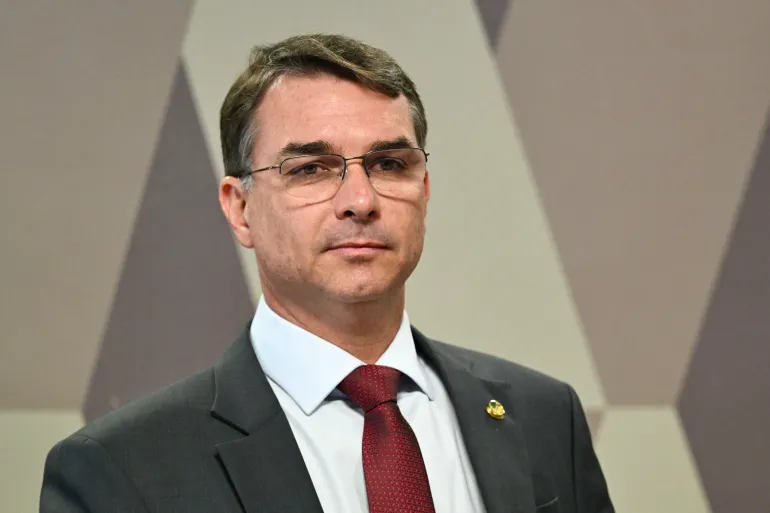
Early on Thursday, his eldest son, Senator Flavio Bolsonaro, told reporters before the surgery that his father had written a letter confirming he had appointed him as the Liberal Party’s presidential candidate in next year’s election. Flavio announced on December 5 that he would challenge Lula, who is seeking a fourth nonconsecutive term, as the party’s candidate.
The senator read the letter to journalists, and his office released a reproduction of it to the media.
“He represents the continuation of the path of prosperity that I began well before becoming president, as I believe we must restore the responsibility of leading Brazil with justice, resolve and loyalty to the aspirations of the Brazilian people,” Bolsonaro said in the handwritten letter, dated Thursday.
Senator Flavio Bolsonaro, son of former President Jair Bolsonaro, in Brasilia, on December 17, 2025 [AFP]
According to Flavio, the letter sought to clarify any “doubt” about his father’s support for his presidential bid.
“Many people say they had not heard it from his own mouth or had not seen a letter signed by him. I believe this clears up any shadow of doubt,” he said after reading the letter.
The former president and several of his allies were convicted by a panel of Supreme Court justices for attempting to overthrow Brazil’s democratic system following his 2022 election defeat.
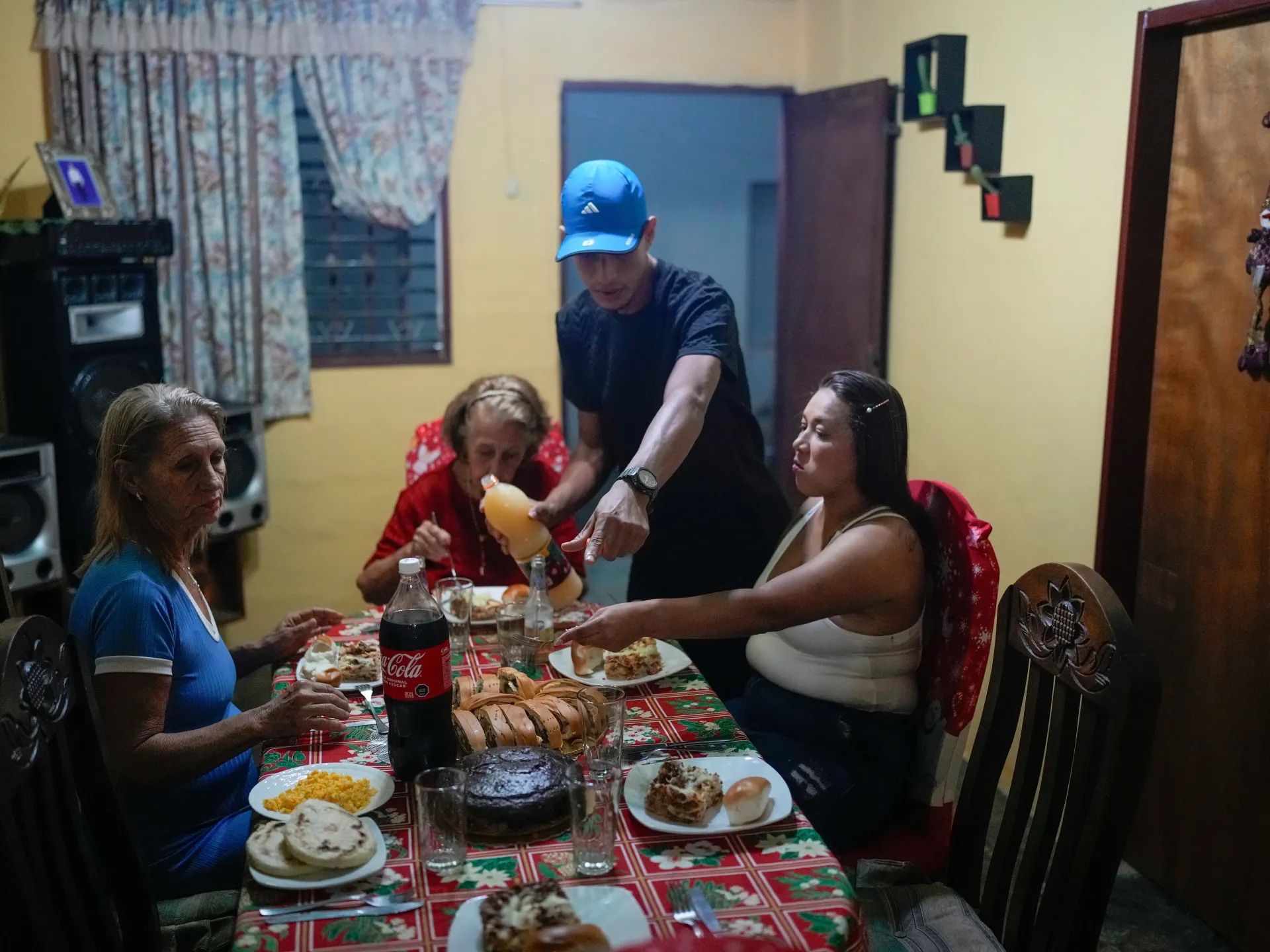
This was not the Christmas that Mariela Gomez would have imagined a year ago.
Or the one that thousands of other Venezuelan immigrants in the United States would have thought. But Donald Trump returned to the White House in January and quickly ended their US dream.
Gomez found herself spending the holiday in northern Venezuela for the first time in eight years. She dressed up, cooked, got her son a scooter and smiled for her in-laws. Hard as she tried, though, she could not ignore the main challenges facing returning migrants: unemployment and poverty.
“We had a modest dinner, not quite what we’d hoped for, but at least we had food on the table,” Gomez said of the lasagne-like dish she shared with her partner and in-laws instead of the traditional Christmas dish of stuffed corn dough hallacas. “Making hallacas here is a bit expensive, and since we’re unemployed, we couldn’t afford to make them.”
Gomez, her two sons and her partner returned to the city of Maracay on October 27 after crossing the US-Mexico border to Texas, where they were quickly swept up by US Border Patrol amid the Trump administration’s crackdown on immigration. They were deported to Mexico, from where they began the dangerous journey back to Venezuela.
They crossed Central America by bus, but once in Panama, the family could not afford to continue to Colombia via boat in the Caribbean. Instead, they took the cheaper route along the Pacific’s choppy waters, sitting on top of sloshing petrol tanks in a cargo boat for several hours and then transferring to a fast boat until reaching a jungled area of Colombia. They spent about two weeks there until they were wired money to make it to the border with Venezuela.
Gomez was among the more than 7.7 million Venezuelans who left their home country in the last decade, when its economy came undone as a result of a drop in oil prices, corruption and mismanagement. She lived in Colombia and Peru for years before setting her sights on the US with hopes of building a new life.
Steady deportations
Trump’s second term has dashed the hopes of many like Gomez.
As of September, more than 14,000 migrants, mostly from Venezuela, had returned to South America since Trump moved to limit migration to the US, according to figures from Colombia, Panama and Costa Rica. In addition, Venezuelans were steadily deported to their home country this year after President Nicolas Maduro, under pressure from the White House, did away with his longstanding policy of not accepting deportees from the US.
Immigrants arrived regularly at the airport outside the capital, Caracas, on flights operated by a US government contractor or Venezuela’s state-owned airline. More than 13,000 migrants returned this year on the chartered flights.
Gomez’s return to Venezuela also allowed her to see the now 20-year-old daughter she left behind when she fled the country’s complex crisis. They talked and drank beer during the holiday, knowing it might be the last time they shared a drink for a while – Gomez’s daughter will migrate to Brazil next month.
Gomez is hoping to make hallacas for New Year’s Eve and is also hoping for a job. But her prayers for next year are mostly for good health.
“I ask God for many things, first and foremost life and health, so we can continue enjoying our family,” she said.
Comments come days after PM Kamil Idris presented a plan to end the country’s nearly three-year war.
Published On 25 Dec 202525 Dec 2025
Share
A senior official in Sudan’s Transitional Sovereignty Council (TSC) has ruled out any negotiations with the paramilitary Rapid Support Forces (RSF) as fighting continues to devastate the country.
“There is no truce and no negotiation with an occupier, and that the just peace that Sudan desires will be achieved through the roadmap and vision of its people and government,” Malik Agar Ayyir, deputy chairman of TSC, said in a statement on Thursday posted by the Ministry of Culture, Media and Tourism.
Recommended Stories
list of 3 itemsend of list
Speaking to ministers and state officials in Port Sudan, the eastern city where the government is based, he dismissed the narrative that the war is aimed at achieving “democracy”. Instead, he described the war as a “conflict over resources and a desire to change Sudan’s demographics” and emphasised an opportunity to strengthen national unity.
This comes days after Sudan’s Prime Minister Kamil Idris presented a plan to end the country’s nearly three-year war before the United Nations Security Council.
Consistent with the Sudanese army and the government’s position, the plan stipulates that RSF fighters must withdraw from vast areas of land that they have taken by force in the western and central parts of Sudan.
They would then have to be placed in camps and disarmed, before those who are not implicated in war crimes can be reintegrated into society.
The RSF has repeatedly rejected the idea of giving up territory, with Al-Basha Tibiq, a top adviser to commander Mohamed Hamdan “Hemedti” Dagalo, describing it as “closer to fantasy than to politics”.
RSF reports gains
The war, which has forcibly displaced about 14 million people, shows no signs of stopping as the RSF consolidates its hold over captured territory and expands attacks.
RSF fighters have continued to commit mass killings, systematic sexual violence, and the burying and burning of bodies in Darfur to cover up the evidence of war crimes over the past several months, according to international aid agencies working on the ground.
The humanitarian situation on the ground has only turned more disastrous after the capture of el-Fasher, capital of North Darfur state, in October.
The RSF announced on Thursday that its forces established control over the Abu Qumra region in North Darfur.
They “have continued their successful advancement to the Um Buru area, where they have completely liberated these areas”, the group claimed in a statement.
Despite the mounting evidence of widespread atrocities committed in western Sudan, the RSF claimed that the primary duty of its fighters is to “protect civilians and end the presence of remnants of armed pockets and mercenary movements”.
The group also released footage of its armed fighters, who claimed they were making advances towards el-Obeid, a strategic city in North Kordofan state.
Sydney Sweeney plays housemaid Millie Calloway in The Housemaid
Sydney Sweeney wants to make films that will “impact and hopefully save people’s lives”, she has told the BBC.
The 28-year-old US actor has this year appeared in psychological thriller The Housemaid and boxing biopic Christy, which both address issues around domestic violence.
Sweeney calls the topic “prevalent” and says she takes a “lot of care” when playing these types of roles.
“Being able to have a film that’s on a more commercial level talk about a very difficult topic is important,” she adds.
Lionsgate
Sweeney and Amanda Seyfried were cast in The Housemaid due to their physical similarities
Sweeney is currently starring as Millie Calloway in The Housemaid, which is based on the 2022 novel of the same name by Freida McFadden.
The novel is an international bestseller and has generated a large following, especially among the reading community on TikTok.
Sweeney says she is “a huge fan of the book” and that she “loved all the characters”.
“I love complex, juicy, crazy, twisted stories. This is a dream project,” she adds.
The film also features Amanda Seyfried and Brandon Sklenar, as Nina and Andrew Winchester, who employ Sweeney’s character in their home.
Seyfried and Sweeney were chosen to play the two female leads in The Housemaid because of their physical resemblances, but Seyfried says the similarities do not end there.
“There’s a similarity between us that is uncanny, and it’s really fun to work with people [who] are doing life in a similar way, have similar ideals about the job and life,” she tells the BBC.
Sweeney also says the pair have developed a “dynamic” where they “can enjoy being around” each other – and their relationship means they can “go to these crazy places and discover so much more within your character”.
Lionsgate
Amanda Seyfried plays Nina Winchester, a housewife who appears to have complex mental health issues
‘Getting the tone right’
Seyfried’s character Nina grapples with complex mental health issues throughout the film, which at times make it a difficult watch.
“You have to play it as realistic as possible because it needs to reflect real life,” she says.
The Housemaid has been compared to domestic thrillers of the 1990s, like The Hand That Rocks the Cradle, Fatal Attraction and Basic Instinct. But it has a markedly modern twist with the physical and mental abuse plot lines in the film.
Seyfried, who is known for her roles in Mamma Mia! and Mean Girls, believes the cast “nailed getting the tone right” and hopes that despite the movie being entertainment, that people “come out with a better understanding of domestic violence” and “broaden their horizons”.
She adds that this is “especially” true for “people who haven’t thankfully had to deal with it”.
This is echoed by director Paul Feig, who admits he was “nervous” about handling the subject sensitively.
“I made sure there wasn’t any physical abuse, that it was more psychological abuse,” he says.
Domestic abuse in film has become a hot topic for Hollywood, sparked by the promotional tour for 2024 film It Ends With Us, which was criticised by some for packaging it as a romantic story rather than one of abuse.
Sklenar, who appears in both The Housemaid and It Ends With Us, says it is “challenging” to take on the role of an abuser.
He describes his characters – Andrew Winchester in The Housemaid and Atlas Corrigan in It Ends With Us – as “polar opposites”.
“When it comes to acting, you can try all you want, but ultimately sometimes it just affects you,” he says.
“It’s intense and it’s ultimately going to affect you in certain ways.”
Lionsgate
Brandon Sklenar also appeared in It Ends With Us, a film adaptation of the Colleen Hoover novel of the same name
The film has received mostly positive reviews, including four stars from the Guardian, which said Feig and his cast “deliver with terrific gusto; this is an innocent holiday treat”.
The reception will be welcome for Sweeney after being at the centre of much drama and discussion in 2025.
And her career was under scrutiny after a string of box office flops – but The Housemaid opened with a healthy $19m (£14m) in North America last weekend.
That’s no surprise given that the original novel was a huge hit, selling more than 1.6 million copies worldwide.
Two sequels have also been published, meaning further film adaptations could be on the cards.
Feig, whose previous films include Bridesmaids and The Heat, believes novels will become an even more fertile source of material for Hollywood because “studios always want something that is a known quality” to “justify their ability to put a lot of money” into the project.
But he says he tries not to let books with a huge audience and fanbase dictate what projects he makes, because “there are plenty of books that are really popular that just don’t work as movies”.
Feig adds that it has been “fun” to work with Rebecca Sonnenshine’s adapted screenplay for The Housemaid, but that he has “restored” some parts of the book that “readers really would miss if they weren’t in there”.
There is also an “extra ending that’s not in the book”, he says, “so readers can get something new that they didn’t expect”.
Weekly insights and analysis on the latest developments in military technology, strategy, and foreign policy.
We had a feeling we would be in for another round of weapons ‘reveals’ out of China this Christmas, following last year’s ‘leaks’ of not just one, but two tailless stealth tactical jet designs, among other developments. It appears we are getting at least one installment of this in the form of a medium-sized cargo ship packed full of containerized vertical launchers, along with sensors and self defense systems. The message is clear, China is making it known that it could, and likely will, turn ships from its behemoth of a commercial fleet into not just shooters, but arsenal ships.
The vessel has containers packed on its deck, both used for containing weapons and for mounting them, along with sensors. In other words, the layout appears to be designed as something of an improvised superstructure in order to turn the cargo ship into a heavily-armed surface combatant of sorts. This includes the mounting of a large rotating phased-array radar forward of the bridge atop three containers, as well as another domed radar or communications system across the deck from it mounted on two containers.
A closer look at the radar and CIWS installation on the vessel. (Chinese internet)
Near the bow of the vessel, high-up mounted on above two containers, we see an Type 1130 30mm close-in-weapon system (CIWS) for last-ditch defense against incoming threats, especially cruise missiles. One container lower, on both sides, we see Type 726 decoy launchers mounted on top of another pair of containers. The large cylindrical pods appear to be emergency life rafts, likely required because of the expanded crew size to make a concept like this work.
A closer look at the radar and CIWS installation on the vessel. (Chinese internet)
Then we get to the real eyebrow raiser, a deck literally covered with containerized vertical launchers. Installed five wide and three deep, each packing four large launch tubes, this arrangement gives the vessel a whopping 60 vertical large launch cells. This is two-thirds the VLS capacity of a Arleigh Burke class Flight I or II destroyer.
Due to the large radar installation, it appears this ship’s mission is something of a picket ship, rather than just an arsenal ship, providing area air defense, but that doesn’t mean its containerized launchers couldn’t pack other weapons. Still, something like this could be useful for persistently providing air defense over a given area.
8x Z-10 attack helicopters from the 🇨🇳PLAGF Aviation during an exercise ready to take off using the deck of a semi-submersible transport vessel as offshore relay platform (via wb/沉默的山羊 & 枕戈观澜) pic.twitter.com/XJMY6JSC8i
The images of China’s cargo ship turned floating missile farm offer a lot to look at, but the question has to be raised just how real this configuration is? It very much looks like it was made photo ready for these images. Is this a proof of concept demonstrator or just a mockup? How sturdy are the radar and CIWS installations, for instance? On closer examination of the images, the radar installation looks relatively robust, but takeaways are limited at this time. The radar would have an issue with being close to inline with the ship’s actual aft superstructure, although there are ways to mitigate this. And just because you can bolt all this to a commercial ship, it doesn’t mean it can employ these sensors and weapons effectively. What combat information system exists on the ship to integrate all these systems and effectively use them in combat?
We just don’t know at this time.
That isn’t to say that fully developing bespoke weapons configurations for commercial vessels isn’t a good strategy. Some will take major issue with this as it would supposedly ‘turn every ship into a target’ during a time of conflict, and certainly maritime lawyers would have insightful opinions on it, but the advantage of such a ready-to-go capability is clear. China, with its massive fleets of cargo ships and gargantuan shipbuilding capacity could leverage this concept to a degree that it would become a huge problem for the U.S. and its allies. On the other hand, as we have suggested before, going a similar route will likely become necessary for the U.S. Navy, which is being overrun in shipbuilding by the People’s Liberation Army Navy, and that delta will likely only widen as time goes on. This reality is only exacerbated by one failed surface combatant program after another.
There will be much more to discuss about China’s weaponized cargo ship concept in the days to come, and, if last year was any indication, this may not be the only ‘surprise Christmas gift’ that Beijing delivers in the hours ahead.
A suicide explosion occurred at Al-Adum Jummat Mosque in Gamboru Market area of Maiduguri, northeastern Nigeria, on Wednesday, Dec. 24.
The bomb went off around 6:00 p.m., shortly after residents and traders began observing the evening prayers.
The Borno State Police Command confirmed that 5 persons lost their lives while 35 others sustained varying degrees of injuries.
“Preliminary investigations further suggest that the incident may have been a suicide bombing, based on the recovery of fragments of a suspected suicide vest and witness statements recorded, while investigations are ongoing to establish the exact cause and circumstances,” said ASP Nahum Kenneth Daso, Police Public Relations Officer of the Borno State Police Command.
People praying outside the mosque were also wounded after debris and shattered glass were scattered across the area.
Security personnel and emergency responders arrived to evacuate victims and sealed off the site.
The explosion marks the most serious incident reported in Maiduguri in recent times. Since the Boko Haram insurgency began over a decade ago in the city, suicide bombings like this one have been recorded across major cities in public places like worship areas and motor parks. The insurgency has killed over 35,000 people directly so far.
HumAngle observed several ambulances transporting the injured and the deceased to hospitals, while the police and military personnel maintained guard around the site of the explosion.
While some of the victims were taken to the Maiduguri Specialist Hospital, others were taken to the University of Maiduguri Teaching Hospital. At the Specialist Hospital, HumAngle counted 17 victims, with injuries on the arms and legs, admitted at the Weapon Wound Ward.
Some of the victims who were admitted at the Specialist Hospital. Photo: Al’amin Umar/HumAngle.
A trader at Gamboru Market said, “I was performing ablution when the blast occurred, and I ran away.” He confirmed that the explosion came from inside the mosque.
Gamboru Market is one of Maiduguri’s busiest commercial hubs, drawing traders and shoppers from Borno State and neighbouring countries like Chad, Cameroon, and Niger. The market hosts a variety of businesses, including stalls for fresh produce, textiles, clothing, household goods, and other everyday commodities.
It also serves as a centre for small-scale services like tailoring, food vending, and transport, making it a key economic lifeline for the local market, operating long into the night, sometimes until 9:00 p.m., even after the main market closes at 6:00 p.m.
Police operatives at the scene.
ASP Nahum Kenneth Daso also stated that “Police EOD personnel have cordoned off the area to ensure public safety, while investigations are ongoing.”
He urged members to remain calm and vigilant as security operations are ongoing.
Some of the eyewitnesses who helped in transporting the victims to the Specialist Hospital. Photo: Al’amin Umar/HumAngle.
A suicide explosion at Al-Adum Jummat Mosque in Gamboru Market, Maiduguri, northeastern Nigeria on December 24, claimed five lives and injured 35 others. The Borno State Police, suspecting a suicide bombing, found fragments of a possible suicide vest. Witnesses reported debris causing injuries to people praying outside, while security and emergency teams managed the site.
The location is significant; Gamboru Market is a major commercial hub in Maiduguri, frequented by locals and people from neighboring countries. The attack is one of the deadliest incidents in Maiduguri, which has suffered from Boko Haram insurgency-related suicide bombings over the past decade. Authorities, urging calm, continue their investigations as police and military maintain a guard around the explosion site.
Fourteen countries, including France, Britain, Canada,Germany and Japan, condemned on Wednesday Israel’s recent decision to approve new Jewish settlements in the occupied West Bank. They called on the Israeli government to reverse the decision and to stop expanding settlements.
In a joint statement published by the French Foreign Ministry, the countries said: “We, States of Belgium, Canada, Denmark, France, Germany, Italy, Iceland, Ireland, Japan, Malta, the Netherlands, Norway, Spain and the United Kingdom condemn the approval by the Israeli security cabinet of 19 new settlements in the occupied West Bank.”
The statement added: “We recall our clear opposition to any form of annexation and to the expansion of settlement policies.”
Earlier, the Israeli government’s security cabinet approved the establishment of 19 new settlements in the occupied West Bank. This brings the total number of settlements approved over the past three years to 69.
Interior Ministry says the raid killed Mohammed Shahadeh, describing him as one of ISIL’s senior commanders in Syria.
Published On 25 Dec 202525 Dec 2025
Share
Syrian authorities say security forces have carried out a second operation against ISIL (ISIS) fighters near Damascus, killing a senior figure described as the group’s governor of Hauran.
In a statement on Thursday, the Ministry of Interior said the raid killed Mohammed Shahadeh, also known as Abu Omar Shaddad, calling him one of ISIL’s senior commanders in Syria and a direct threat to local security.
Recommended Stories
list of 3 itemsend of list
Officials said the operation followed verified intelligence and extensive surveillance and was carried out by specialised units, operating in the Damascus countryside, that conducted a targeted raid in the town of al-Buweida, near Qatana, southwest of the capital.
The operation also involved the General Intelligence Directorate and took place in coordination with international coalition forces, the ministry said.
‘Crippling blow’
The announcement came a day after Syrian internal security forces arrested another senior ISIL figure in a separate operation near Damascus, according to the state-run SANA news agency.
SANA reported that forces arrested Taha al-Zoubi during what it described as a “tightly executed security operation” in the Damascus countryside. The agency said officers seized “a suicide belt and a military weapon” during the arrest.
Brigadier General Ahmad al-Dalati, head of internal security in the Damascus countryside, told SANA that the raid targeted an ISIL hideout in Maadamiya, southwest of the capital.
ISIL, which considers the current authorities in Damascus illegitimate, has largely focused its remaining operations on Kurdish-led forces in northern Syria.
At the height of its power, the armed group controlled vast areas of Iraq and Syria, declaring Raqqa its capital.
Although ISIL suffered military defeat in Iraq in 2017 and in Syria two years later, its cells continue to carry out attacks in the region and beyond, including in parts of Africa and Afghanistan.