Anduril Brings The Thunder With Autonomous Tiltrotor Attack Drone Concept
Anduril has revealed a new hybrid-electric-powered tiltrotor combat drone called Thunder, which it has developed in partnership with Archer Aviation. Thunder is envisioned as a highly autonomous pilotless wingman able to fly fast and low in formation with crewed helicopters and tiltrotors like the AH-64 Apache and MV-75 Cheyenne II. The drones could help hunt down targets, including fleeting ones, while allowing their human teammates to stay further away from threats. Thunder is also being designed to help provide an extra layer of close-in defense for friendly rotorcraft, including against the growing threat of air-to-air drone attacks. All of this is part of a detailed teaming concept Anduril has outlined to fill what it says are critical operational gaps in current and future conflicts.
Anduril and Archer rolled out Thunder today, around the biennial Farnborough International Airshow in the United Kingdom. A mockup, which Anduril says reflects a “mature” outer mold-line of the design, will be on display at the show.
“Thunder is very much an attack aircraft, so it is designed for very high performance, [and] low-level [flight],” Shane Arnott, Senior Vice President of Maneuver Dominance at Anduril, told TWZ and other outlets during a press call ahead of today’s announcement. “Very much in that Apache space, say, versus a high-flying surveillance aircraft.”

At the time of writing, Anduril has only released relatively broad details about the expected performance and other specifications of the drone, which has been under development for around three years now. A first flight is currently targeted for some time next year, and full-scale production could be underway by the end of the decade, depending on demand. The company has also already been working on Thunder together with “government customers,” but has explicitly declined to name any of them.
It’s also worth noting that a version of Thunder configured for commercial applications is also in the works, with Archer Aviation set to release more details on that later this week.
What we know about the Thunder design
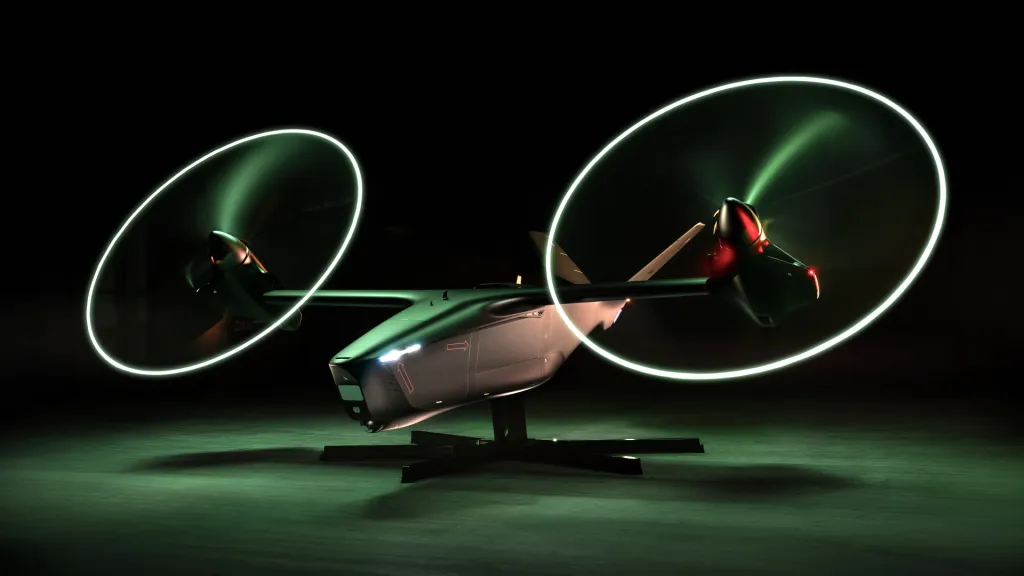
Thunder is a clean-sheet design with a relatively traditional tiltrotor layout featuring a high-mounted, straight main wing on top of the fuselage. The wing has a single tilting rotor pod at each tip. It also has a V-tail.
In terms of overall size and performance, Anduril describes Thunder as a Group 5 design. The U.S. government breaks uncrewed aerial systems into five categories. Group 5 is the highest tier, covering anything with a maximum takeoff weight of 1,320 pounds or more, and that can fly at altitudes of 18,000 feet or higher.
“It will have the ability to work at that at [18,000 feet], but the intent is for it to be nap-of-the-earth for most of its life,” Anduril’s Arnott noted. “That’s where it’ll be spending its time. Think about the Apache kind of profile. So you’ll hit certain altitudes to get your ferry ranges, etc. But when you’re in the AO [area of operations] and in combat, you’re as close to the dirt as you can get.”

Arnott also described Thunder as having the same general top speed and range as the MV-75 Cheyenne II, which is now under development for the U.S. Army. The Army is reportedly expecting the MV-75 to boast a top speed of 320 miles per hour and have an unrefueled range of 920 miles. This is far above the range and speed offered by any current Army helicopter. Beyond teaming with Apaches and similar attack helicopters, being able to keep pace with the Cheyenne II could be an especially important feature for the Thunder, as we will touch on again later.

Anduril has also described Thunder as being smaller than the Apache and able to be broken down for transport inside a standard 40-foot shipping container. As an aside, it is unclear exactly how much time is necessary to get the tiltrotor drone out of a container and flying again. Getting it loaded in the first place does require separating the wing structure from the fuselage, at least in the design’s current form, according to the company. The drone will also have the speed and range necessary for self-deployment.
When it comes to propulsion, “a series hybrid-electric powertrain enables Thunder to achieve significant range and endurance, while still maintaining the necessary precision to closely optimize power through the full range of flight conditions,” according to a press release from Anduril. “Meanwhile, Optimum-Speed Tiltrotors (OSTR) vary rotor RPM [rotations per minute] to maintain efficiency across flight regimes, reducing power demand and fuel burn in cruise and minimizing acoustic signature to enhance survivability during low-altitude ingress.”
“From a survivability standpoint, one of the big tells for helicopters today, is just they’re very noisy, and the threat can hear when they’re coming,” Anduril’s Arnott also added when speaking to TWZ and other outlets. “We’re at orders of magnitude below the sound level with this particular system than the current systems that are out there today.”
The partnership with Archer Aviation, a company whose public profile is focused on crewed fully electric-powered vertical takeoff and landing aircraft, has been key here. Anduril also cited Archer’s motor technology as being a key feature of the hybrid-electric Omen tail-sitting vertical takeoff and landing drone, which was unveiled last year.

Tech Short | Midnight’s Proprietary eVTOL Engine Dynos
During the press call ahead of today’s unveiling, Chris Brose, Anduril’s President and Chief Strategy Officer, said that he felt that leveraging the immense investment by companies like Archer in the electric vertical takeoff and landing (eVTOL) development space had “made Thunder possible in a way today that it just wouldn’t have been possible five, 10, certainly 15 years ago.”
“So this is not electric, this is a hybrid-electric system,” Anduril’s Arnott also stressed. “But in doing so, it actually reduces the complexity of the drive trains, etc.”
Rotor technology for another firm, Karem, has also been leveraged in the development of Thunder. Karem has a long history in the tiltrotor design space, including work done for the U.S. Army and the Defense Advanced Research Projects Agency (DARPA).

“Karem’s military-grade rotor systems are among the most advanced Army-validated technologies in the world,” Adam Goldstein, Archer Founder and CEO, said in a press release about a new collaboration between the two companies in December 2025. “Integrating them into our next-gen hybrid VTOL [vertical takeoff and landing] platform positions Archer to move faster and deliver capabilities that legacy systems simply can’t match.”
The unnamed “next-gen hybrid VTOL platform” at the center of Archer’s December announcement has now been confirmed to be Thunder.
Modular capabilities and advanced autonomy
Capability-wise, Thunder is a highly modular design with reconfigurable payload bays in the nose and the center of the fuselage.
The drone can carry up to 10 air-to-ground missiles, 16 ‘launched effects,’ four 19-shot pods holding a total of 76 70mm laser-guided Advanced Precision Kill Weapon System II (APKWS II) rockets, or a mix thereof, on launchers that extend to either side from the main bay, according to Anduril. Air-to-ground missiles here could include AGM-114 Hellfires, AGM-179 Joint Air-to-Ground Missiles (JAGM), or Anduril’s Barracuda-100M.
The term launched effects is used today to collectively refer to drones configured to perform a variety of missions, including serving as loitering munitions, which can be fired from air, ground, and/or maritime platforms. Anduril specifically mentioned its ALTIUS-600 design as one potential option for Thunder. ALTIUS-600 can be set up to perform surveillance and reconnaissance and electronic warfare tasks, act as a decoy, and launch kinetic attacks.

The company has also specifically highlighted the ability of the bay in the nose to hold launchers for kinetic interceptors to take down incoming drones, something we will come back to later on. It is worth noting that APKWS II is already a combat-proven, lower-cost counter-drone weapon, including in the air-to-air mode. However, it is employed in more traditional counter-air applications, like intercepting one-way attack munitions and cruise missiles, not for defending the shooting platform itself against incoming high-speed anti-aircraft drones.
Both the nose and main payload bays could accommodate other systems, such as electronic warfare suites, additional sensors, and/or communications packages. Each Thunder will also have its own built-in sensor suite to support surveillance and reconnaissance, as well as target acquisition tasks.
In addition, Thunder will have passive sensing capabilities to support general operation and navigation. This will be especially important for enabling high-speed nap-of-the-earth flight profiles. It will also be essential for providing situational awareness and flight safety margins while operating in relatively close proximity to crewed teammates, as well as other drones.

“We’ve spent the last couple of years working with technologies that are coming out of the self-driving car industry, plus some of that are coming out of the Anduril sensor/imaging kind of groups, in order for us to detect a terrain, [and] do that in a passive sense, so we’re not giving away our position,” according to Anduril’s Arnott. The sensors will also “be able to detect weapons coming at us, power lines, that type of thing, and have it such that you can have three to six of these things flying with a two-ship [group] of Apache, for instance, to provide that loyal wingman nature.”
“Thunder’s multi-modal machine perception stack and sensor suite combines passive and selective active sensors with onboard computer vision, map data, and edge compute, enabling Thunder to continuously detect, classify, and track terrain, obstacles, and threats,” Anduril has also explained in a blog post accompanying today’s announcement. “That sensor data provides the inputs necessary to facilitate the visual navigation, inertial positioning, and terrain feature mapping that enable Thunder to remain on course when GPS, visibility, and communications are degraded or denied.”
“With sophisticated onboard machine perception, vehicle autonomy, and flight-proven collaborative mission autonomy software, Thunder can maneuver with the formation, share data in real time, coordinate effects, and act on pilot intent, delivering a trusted autonomous wingman that can keep up with, defend, and empower the pilots flying the most congested airspace on the battlefield,” the blog post adds.
Anduril’s Lattice proprietary artificial intelligence-enabled software package will underpin Thunder’s overall autonomous capabilities. The company says other autonomous software could also be integrated to meet particular customer demands. Anduril has already conducted testing of some components of Thunder’s autonomy and sensing systems using unspecified surrogate aircraft.

Lattice for Mission Autonomy: An Unfair Advantage for Unrivaled Deterrence
Just one part of a full concept of operations
What has been shared so far about Thunder’s capabilities brings us to the larger concept of operations Anduril envisions for the drone. The company says the war in Ukraine has had an especially heavy influence on its thinking around the design. This is very interesting, as this particular conflict has prompted serious questions about the future relevance of traditional helicopters on modern battlefields where the threat ecosystem continues to grow in scale and scope.
Anduril acknowledges the breadth of dangers that helicopters and tiltrotors already face. This is perhaps best evidenced by the touting of Thunder’s ability to defend against air-to-air drone attacks, something the ongoing fighting in Ukraine has shown to be a real threat, as seen in the video below. Anduril’s Arnott also explicitly mentioned the threat posed by shoulder-fired surface-to-air missiles, also known as man-portable air defense systems (MANPADS), while speaking to TWZ and other outlets.
At the same time, Anduril argues that there are critical missions rotorcraft perform today that cannot be fully transposed onto other kinds of platforms, and that drone wingmen like Thunder will therefore be an essential addition to the equation. The company has not yet shared a projected unit cost for the drone, but has also stressed that it fits in with a broader understanding of a need for platforms that are lower cost and more readily producible to create sufficient operational capacity, or ‘mass,’ for forces to succeed in future conflicts. Anduril’s Brose said that Thunder will be a “fraction” of the cost of something like an Apache or an MV-75, and operators will be able to “afford to lose it if you have to.”
“Many of the things that we’ve designed and engineered into Thunder are really based on the lessons that the United States and our European allies are learning in Ukraine, and this whole question of how do you bring mass to the battlefield in a tactical environment where you have to be able to engage in the deep fight,” Brose explained in more detail about Anduril’s overall thinking around Thunder. “We’re looking at the proliferation of robotic systems, and drones, and sensors, and that’s all very good and very important. But you also raise the question of, well, how are you going to get that stuff farther downrange into the environments where you need it to be able to conduct those more sophisticated and more challenging missions, again on behalf of U.S. and NATO militaries?”
To meet those operational needs, “you have to have the ability to launch and recover combat power without runways. You have to be able to do this in expeditionary environments,” he continued, underscoring the value of a VTOL platform. “When your runways get cratered, you have to have the ability to conduct the mission.”

Runway independence, or at least reducing dependence on traditional runways, has become an increasing mantra across the U.S. military, in particular, in recent years, as TWZ regularly highlights. The U.S. Marine Corps and the U.S. Air Force, as well as the special operations community, have put particular emphasis on this in new and still evolving concepts of operations in recent years.
So, “in terms of how you then get a greater quantity of sensors and weapons into the fight to support those manned systems, to support the ground force to be able to conduct those long-range missions from a maneuver warfare standpoint, and really make maneuver central to warfare again, we really see this system in Thunder being absolutely central to that,” Brose added.
Brose specifically took aim at the idea that lower-cost, long-range one-way attack drones could fill the same kinds of mission requirements. The U.S. military just recently began fielding this capability in the form of the Low-Cost Uncrewed Combat Attack System (LUCAS) drone, which made its official combat debut in Operation Epic Fury against Iran.
“A lot of those longer-range one-way attack missions, they’re going after fixed targets,” he said. “They’re slower flights out. It’s [the total duration of the strike mission] going to play out over a longer period of time. They’re hitting critical infrastructure, military installations, production capacity, et cetera. Basically, GPS points that aren’t moving.”
“What this is focused on is the ability to transit through the operational environment,” he continued. “To survive and then to persist once you get there, so that you can provide effects to attack aviation elements in the air that are conducting missions or ground forces that are conducting missions on the land. That immediately gets into a time-sensitive, dynamic targeting kind of mission space that a system like this has to be able to survive and persist and operate effectively in.”
It is important to note here that new targeting capabilities have already been emerging in the realm of longer-range one-way attack drones. LUCAS and many Ukrainian designs now have satellite communications-enabled man-in-the-loop functionality, allowing them to hit dynamic/moving targets. Driven by advances in artificial intelligence-driven technologies, drones are set to steadily gain greater ability to find and choose targets autonomously, something TWZ has previously explored in detail. This being said, they are still single-use weapons that offer very different capabilities from what Anduril is aiming for with Thunder.
Anduril’s Arnott also questioned the relevance of existing higher-flying armed drones to meet these kinds of operational needs. The MQ-9 Reaper has been very much in public consciousness recently due to its heavy use in the conflict with Iran, but also substantial combat losses. The U.S. Air Force has described the MQ-9 as a star player in operations against Iran, despite having lost dozens of them.

“As we got further and further up and higher and higher, [we] got comfortable because we own the air, but things have changed,” Arnott said. “We’re seeing that in [Operation] Epic Fury, the Iranians, etc. have got systems that are just knocking that type of CONOP off its feet, and it’s just not relevant anymore. So that’s why we’ve gone back to the surface. That’s where the survivability is for these types of systems, to fly low and fast.”
“Right now, we don’t see another solve [sic; solution] for that, and this is probably the ugliest of all the warfighting domains, where you still need a human … to do the sorting of the targets on friend and foe, etc,” he added. “The only way you can do that is to have a quarterback, say, with an Apache, and then these loyal wingmen, if you will, to enable their survivability, but also to project a lot more mass in the deep [fight].”
Despite all the talk of lessons learned from contemporary conflicts, Anduril has made clear that its view of future ‘deep fights’ goes well beyond Europe and the Middle East. He said that Thunder’s speed and range, and the basic choice of a tiltrotor conflict, were also intended to make it very relevant for a conflict in the broad expanses of the Pacific. The U.S. Army’s decision to acquire the MV-75 was notably driven by the same general factors.
“This is a gap. There is actually no way when you fast forward into full theater conflicts in the Pacific, even the Taiwanese, if you play through the war games and things get entrenched, there isn’t a way in other than these types of techniques,” Arnott told TWZ directly in a separate interview about Thunder ahead of today’s announcement. “If Russia does start their activity into the High North [in and around the Arctic region,] as well as China, you get to the same situations. You can’t do all your warfare from 30 or 15,000 feet. It just does not work, apart from the fixed targets.”
A more detailed notional Thunder vignette
Anduril’s Arnott also described more detailed notional operational scenarios involving Thunder to us during that interview:
“The concepts to date have been primarily driven around that you’ve got a two-ship [of] Apache, very traditional formation. You would then, depending on the mission, whether it’s a protective mission for the two ship, whether it’s a deep strike mission, or an ISR [intelligence, surveillance, and reconnaissance] type mission, you’d have between three and six thunders for every two ship ARH [armed reconnaissance helicopter], and the intent there being that that’s a lot of metal in the air and a lot of things to manage.”
“So very much for it to be the command as opposed to control, where in effect, the way that the team presents to the Apache cockpit, whoever’s kind of got the leash, is it looks like another Apache. So it basically comes across [on] very similar data links to what the aircraft has. We call this concept ‘polite participant.’ So we don’t force any new software onto the host aircraft, or the mothership, or the quarterback, I should say. And in doing so, those teammates or wingmen are smart enough to be able to navigate and aviate in such a way that you don’t get in the way to be able to give them the similar level of command that you would to a wingman, wing person, if you will, and that they’re able to array themselves.”

“And whether it’s a chevron formation in front, whether it’s some sort of formation around the outside at cardinal points around the aircraft for a protective – a force protection mission, where you’re utilizing the counter-UAS systems that are on thunder and also electronic protection. But basically, you would put them into postures, and you command these postures that reflect themselves in formation, and then activation of various payloads that they have on board, and that may change also through the mission.”
“So you may have a setup where you’ve got the Apaches at the FOB [forward operating base]. You’ll have either at the FOB or somewhere nearby the Thunders. These guys come together and they form up. They move out. Initially, you’re just in [a] train, so you’re tracking into the AO [area of operations]. You come into … the forward line of troops. You then may move into a configuration where you’re at the cardinal points around the outside of the Apache, because part of the problem with the land domain is that the threats can come at any angle to you, and [you] have activated the counter-UAS systems and the electronic protect systems, for instance. So the Thunders would be either radiating or waiting for irradiation [sic] from an electronic attack standpoint, based on certain signals, or having their doors open as it relates to the counter-UAS, the kinetic kill payloads, that are on there, as you then transit through certain areas.”

“That may then change, where the counter-UAS payloads are in the nose, for instance, they would close, and then you go into the direct attack, which would be the main payload bay that you’ve seen the doors that are coming out. They may be fitted with direct attack weapons like Hydras [70mm unguided rockets], APKWS, or Hellfires, for instance, and then be in fire support to the Apaches in a similar way that the Apaches work together to – one set of aircrew can designate and shoot off the other[‘s targeting data]. For instance, it’s a very similar workflow, so it’s not a new workflow for direct attack.”
“Or it could be, ‘hey, I need to go and find something out there.’ So today, they’ll use the M-TADS [Modernized Target Acquisition and Designation Sight] for the video. They’ll use the fire control radar to scan an area. It’s a similar kind of workflow where they’re like, “Hey, I need to find out about something out there. The Thunders could release launched effects, for instance, like the ALTIUS product that we have, but it could be [an AeroVironment] Switchblade, it could be something else, and they would then talk back to the Thunders. So we’d have that concept of tiering out in front. The ALTIUS are then out there, and they’re finding targets autonomously with their computer vision. They’re then providing back a track picture, so icons, if you will, that come back to the Thunder. The Thunder then talks back to the Apache via the Apache data link, and the symbols appear on their map display or their FCR [fire control radar], just like they would if they were self-identified or coming from one of their formation, as well.”

Apache Fire Control: Modernized Target Acquisition Designation Sight/Pilot Night Vision Sensor

Boeing AH-64D Longbow Apache
“So the intent is these workflows are exactly the same. How it presents to the warfighter is the same. It’s just more. You can see further. You can shoot more. But the workflow, in effect, is effectively the same. So that is the whole concept of this polite participant construct that we have.”
Arnott stressed that his use of Apache here was as a generic example and that this overall concept could work with other helicopters serving in the quarterback role. Anduril also envisions command and control of the Thunders being executed by helicopter crews through existing cockpit displays rather than a tertiary device, such as a tablet. There has been much debate over the years about the physical user interface that is most suitable for use on crewed aircraft of any kind to direct uncrewed teammates.
Competition in a growing market space
Anduril is certainly not alone in seeing a market space emerging for this kind of teaming with existing and future crewed helicopters and tiltrotors, at least in broad strokes. Boeing and Sikorsky (a subsidiary now of Lockheed Martin) both unveiled vertical takeoff and landing capable loyal wingman-type drone designs around the Association of the U.S. Army’s (AUSA) main annual conference last year. Boeing’s Collaborative Transformational Rotorcraft (CxR) is also a tiltrotor.


In addition, almost a decade ago now, Bell announced it was working on a Group 5 tiltrotor drone called the V-247 Vigilant. The V-247 was originally developed in response to a U.S. Marine Corps requirement, but Bell has since shown renderings depicting it operating together with versions of its crewed V-280 Valor tiltrotor design, on which the MV-75 was based.

“So, last fall, we actually asked industry what they can provide for a Group 4 VTOL/STOL [vertical takeoff and landing/short takeoff and landing] perspective,” Brig. Gen. David Phillips, head of the Army’s Program Executive Office for Aviation (PEO-Aviation), said at a roundtable at AUSA. “So we use that as a great set of information on what the state of the art of technology is from a range, speed, payload, and really effects perspective. What can we bring to bear, given modern technology versus some of our older UAS [uncrewed aerial systems].”
The only difference between the Group 4 and Group 5 drone categories is operating altitude, with the designs in the former tier not being able to fly above 18,000 feet.
“When you look at a CCA role for – really linked to rotary wing, that is a different dynamic than you have at 20-to-30,000 feet,” Brig. Gen. Phillips added at that time. “So it’s a whole set of different behaviors, a whole set of different capability you need to marry that up with an aircraft that’s flying at 100 feet, at 150-plus knots, at night. So that is what we’re really looking at, is what is the state of technology right now to develop a requirement that we can deliver.”
In the context of the U.S. Army, specifically, the concepts of operations Anduril has outlined for Thunder have also prompted comparisons to the previous pairing of Apaches with crewed OH-58D Kiowa Warrior armed scout helicopters. The Army retired the very last of its OH-58Ds in 2017 without a direct replacement. Several unsuccessful attempts were made before and after the Kiowa’s retirement to find a direct successor, the most recent of which was the Future Attack Recon Aircraft (FARA) program. The Army cancelled FARA in 2024 as part of a larger shakeup of aviation programs that put renewed emphasis on new uncrewed capabilities.

“We’re looking to recreate similar concepts to be able to enable deep strike missions, all the things that Apache was originally designed for with the Kiowa,” Anduril’s Arnott said.
Thunder, like the other designs emerging in space now, could also be of interest to the U.S. Marine Corps and U.S. special operations forces, which are facing the same kinds of operational realities. The Army’s elite 160th Special Operations Aviation Regiment is already in line to acquire a version of the MV-75, which could also benefit very much from a drone wingman able to keep pace in terms of range and speed. The 160th has already been working to expand crewed-uncrewed teaming concepts using its existing helicopters and the MQ-1C Gray Eagle drone.
This all goes beyond the U.S. military, too. Last year, the U.K. Ministry of Defense also picked Anduril and three other companies to develop drone demonstrators that could be paired with British Army Apaches. Anduril’s press release at the time mentioned a partnership on that effort, which is called Project NYX, with Archer Aviation and several other firms. Anduril has explicitly declined to confirm or deny whether Thunder is its offering for that program.

The Apache, in particular, has a substantial and still growing global operator base, opening the door to other potential customers for drones like Thunder. As already noted, uncrewed wingmen could be valuable for extending the operating reach and reducing the vulnerability of other helicopter types, too.
Anduril is clearly putting a major foot forward in this space with Thunder, and the detailed concepts of operations it already has in mind to go with it. At the same time, the company has never built a tiltrotor, let alone a full-size helicopter, at least that we know of, unlike some of the other companies already in this space. Pairing with Archer and Karem on this project does offer major benefits. Archer has yet to bring an aircraft to production, as well.
Still, these same issues were often highlighted when Anduril joined the competition for the extremely high-profile and critical first phase, or Increment 1, of the U.S. Air Force’s Collaborative Combat Aircraft (CCA) program. Anduril had submitted a design called Fury, which TWZ previously explored the full history of in an extensively detailed feature you can find here. Widely considered an underdog in the competition, Anduril was subsequently chosen as one of two firms in the final Increment 1 down-select, with the other being General Atomics. The Air Force has now decided to order production examples of both Increment 1 designs.

Now we’ll have to see if a similar story repeats itself for Thunder, as competition in the market space for drone wingmen for crewed helicopters and tiltrotors continues heating up.
Contact the author: joe@twz.com