A scenic train journey from London to Geneva via Paris offers some of Europe’s best views – and can cost half the price of a plane ticket at around £135 return
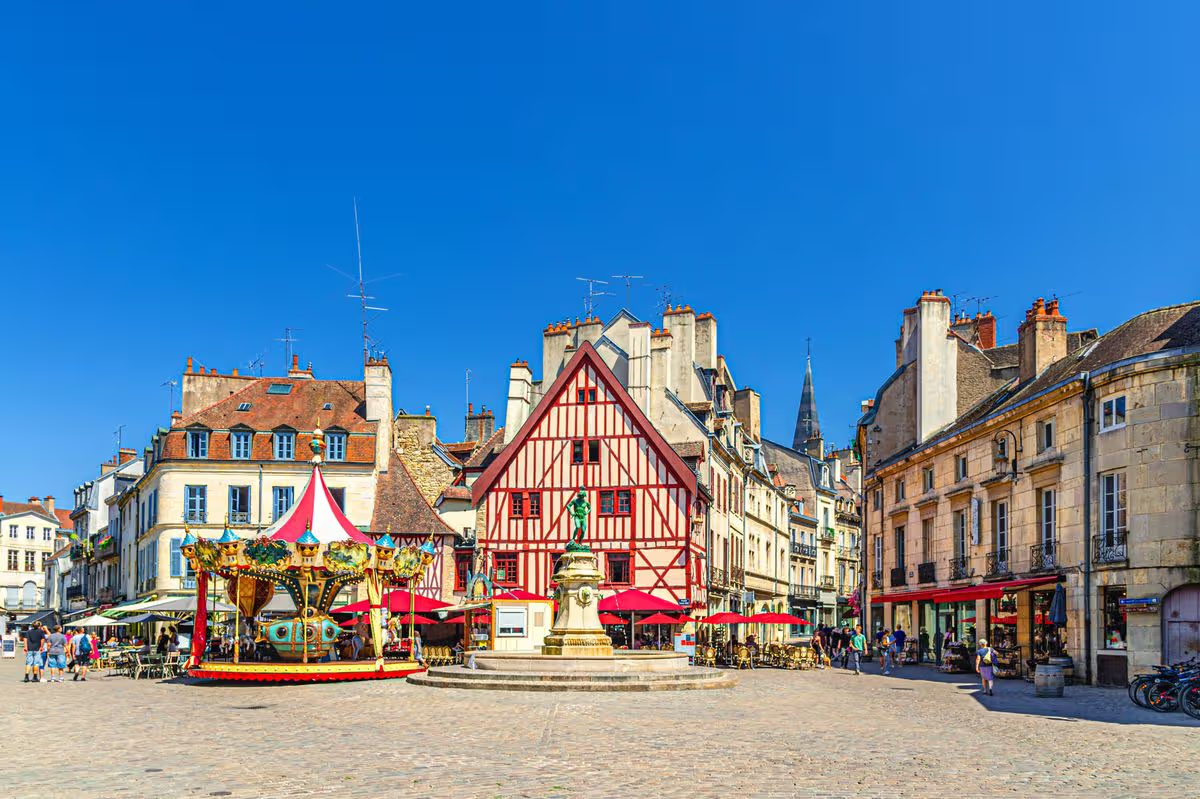
The service trundles through charming towns including Dijon(Image: Aliaksandr Antanovich via Getty Images)
A rail journey linking three capital cities boasts some of Europe’s most breathtaking scenery—and could set you back half the price of a flight.
The Eurostar and France’s TGV whisk passengers from London to Geneva, making the very most of a trip that spans three nations. The train departs from St Pancras with a change in Paris before heading onwards to the Swiss capital.
It’s a nearly six-hour journey in total, passing through Montbard, Dijon and Bourg-en-Bresse, offering stunning vistas of national parks and rolling countryside. Passengers can hop off in Paris to discover the city—with landmarks including the Eiffel Tower, Notre-Dame, the Champs-Élysées, Sacré-Cœur and the Louvre.
Once the train pulls into Geneva, visitors can take in Lake Geneva, Cathédrale de Saint-Pierre, the Palais des Nations, the botanical gardens and the Brunswick Monument.
From there, it’s also a brief trip to the nearby Alps, with day excursions available from the city to ski or snowboard on the slopes and savour the local restaurants. The train can be half the price of a plane ticket. According to Skyscanner, return flights this month cost up to £394.
During the same period, return train tickets cost around £135, half the price of a flight, according to Trainline.
Families can also cut costs by purchasing Interrail passes—£482 for a family of four to travel on four days within one month, plus seat reservation charges. And expense isn’t the sole advantage.
According to the Times, four passengers journeying from London to Geneva and back by rail produce approximately 44kg of carbon emissions, compared with 108kg by car and 1,608kg by plane. The Intergovernmental Panel on Climate Change states that, to maintain climate change within sustainable limits, each person has a carbon “budget” of 1,500kg of carbon emissions per year.
Although there are a number of factors that determine how polluting different forms of travel are, such as the type of electricity production used to power trains, riding the rails is typically greener than flying.
Back in 2023, carbon calculations made by the Rail Delivery Group found that travelling by rail from London to Edinburgh creates 10 times fewer carbon emissions than by car and 13 times fewer than by plane.
One of the tricky considerations for passengers is generally cost, with budget airlines such as Ryanair, easyJet and Wizz Air typically offering cheaper plane tickets than the equivalent train tickets.
The route from London to Geneva shows that it is not always the case. The price gap between the two forms of transport may also be getting smaller.
Travellers are facing rising airfare costs and reductions in flight schedules as the conflict in the Middle East causes oil prices to soar, with concerns that ticket prices could remain elevated for months even if the war de-escalates. Cathay Pacific, AirAsia and Thai Airways are among a growing number of airlines increasing fares to offset the hikes.
While train services are also impacted by rising oil prices, fuel tends to be a much smaller proportion of their operating margins than with airlines.
A woman was left laughing at herself after visiting a Spanish castle for just €3 (£2.61) – only to discover the surprising reason behind the tourist attraction’s low entrance fee
Content creator Alisatata, known as @iam_alisatata on social media, revealed how she paid just €3 (approximately £2.69) to visit Castillo de Colomares following her move to Spain. She was instantly struck by the elaborate design of the structure, located in the coastal town of Benalmádena – but her wonder soon turned to astonishment when she uncovered the reality behind it.
Despite its impressive, historic look, the building was in fact constructed between 1987 and 1994, meaning it’s nowhere near as ancient as she’d believed.
Posting the moment on TikTok, she said: “Admiring this ancient castle and wondering how the ticket was so cheap… then realising it was actually built in 1994.”
The striking structure isn’t a castle in the conventional sense, but rather a monument dedicated to Christopher Columbus and his expeditions.
Covering roughly 1,500 square metres, it’s thought to be the world’s largest monument honouring the explorer – and it even houses what is claimed to be the smallest church on Earth.
Content cannot be displayed without consent
Her video rapidly grabbed viewers’ attention, with many highlighting the mix-up.
One person said: “Most ancient castles have no decorations or details; they were built for defence in times of war, not to be beautiful.”
Another added: “That’s still pretty cool,” while a third wrote: “It’s not actually a medieval castle – it’s a monument dedicated to Christopher Columbus.”
Despite the confusion, visitors reckon the attraction is still well worth checking out.
Reviewing Castillo de Colomares online, one person described it as an “absolutely beautiful monument” with “amazing carving work,” adding the views alone justify the modest entrance fee.
Another visitor said it provided a “lovely break from the beach,” noting that while the site is fairly compact, there’s loads to absorb as you wander around.
A third reviewer called it an “architectural curiosity” overlooking the Costa del Sol, praising its blend of styles – from Gothic to Mudejar – and its scenic location.
While it might not be the ancient fortress she originally envisaged, it appears the distinctive landmark still made a memorable impact.
Long before he became an NBA Hall of Famer, Paul Pierce was a senior at Inglewood High School thrilled to be chosen to play in the 1995 McDonald’s All-American Game, a nationally televised showcase that has brought together 24 of the best prep players in the country every year since 1978.
The McDonald’s all-time scoring record of 30 points had been set in 1981 by (who else?) Michael Jordan a month after his 18th birthday. Fourteen years later Pierce scored at a blistering pace, yet because someone had stolen his jersey, he played a portion of the game with the name “McCoy” on the back.
Broadcasters credited “McCoy” with several baskets and apparently the scorekeeper couldn’t keep track either. In the box score, Pierce was credited with 28 points. In his mind, he was certain he had more than 30.
He painstakingly watched the game tape and, sure enough, he had scored 31 points. Yet the official McDonald’s record book didn’t recognize it, and Jordan continued to hold the record until Jonathan Bender put up 31 in 1999.
That is just one of the delightful, insightful stories included in the feature-length documentary “Meal Ticket,” an exhaustively researched labor of love by co-directors Corey Colvin and Carlton Gerard Sabbs of production company Stony & Yates. The film will premiere Thursday on Prime Video.
Meanwhile, Jordan had his own beef with McDonald’s — or at least his mother did. He was not given the John R. Wooden Award as Most Valuable Player in that 1981 game even though he set the scoring record and made shots during the East team’s last five possessions, including the winning basket in a 96-95 victory.
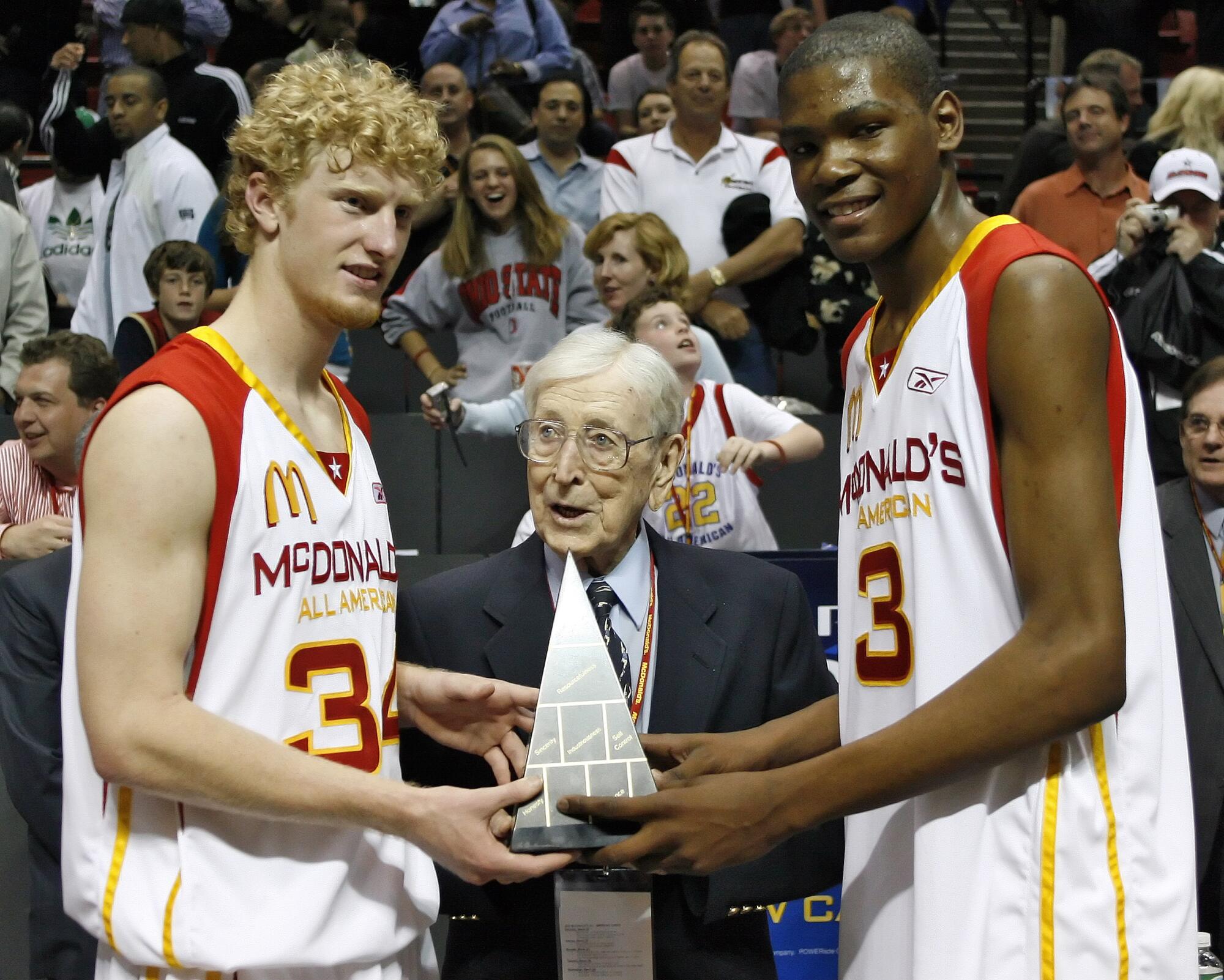
Chase Budinger, left, and Kevin Durant, co-MVPs of the 2006 McDonald’s All-American High School basketball game, hold the MVP trophy in front of legendary coach John Wooden, center.
(Denis Poroy / Associated Press)
Deloris Jordan was not happy. On the elevator leaving the arena, she told broadcaster Billy Packer, “Poor Michael. My poor son Michael. He never gets any recognition. He never gets any respect.”
Soon, of course, her son would get his due, first for leading North Carolina to the NCAA title as a freshman — again sinking the winning shot — then for leading the Chicago Bulls to a record six NBA titles in eight years while winning 10 scoring titles. Michael Jordan is widely considered the greatest basketball player of all time.
Produced by Roc Nation, Known Originals and Creative Control, “Meal Ticket” chronicles the 49-year history of the McDonald’s All-American Games. Nearly 50 Naismith Hall of Famers were participants, and many reminisce for the documentary.
For most, the showcase was their first time on national television. At 17 or 18 years old, they were fresh-faced, eager and ultra-competitive. Colvin, 41, and Sabbs, 39, dug deep into archives of games and surrounding activities provided by McDonald’s and ESPN, and the result is a balanced blend of action footage and fond memories.
“We tried to illustrate the parallel between the McDonald’s game and the growth of the sport,” Colvin said. “I honestly feel it’s a power hidden within the McDonald’s game that people haven’t paid attention to. If you want to know where basketball is going, watch the McDonald’s game.”
Among the key developments was founder Bob Geoghan expanding the event to include girls’ basketball, launching a doubleheader format with the boys beginning in 2002 that proved immensely popular.
Two years later Candace Parker won the annual Slam Dunk Contest, defeating among others JR Smith and Josh Smith, both of whom would be NBA first-round picks within months. Parker’s achievement was so unlikely that her own brother hung up on her when she called to tell the family, according to the documentary. Just another nugget unearthed by Colvin and Sabbs.
The creative careers of the Chicago South Side products began with directing branded content, and their mentors, directors Coodie Simmons and Chike Ozah, helped them make a pitch to McDonald’s in 2022 for an independent documentary.
Early fears that the fast-food colossus would be overly brand conscious and dictate content were allayed. Mickey D’s not only gave the directors the rights to tell the story, but also provided game footage while steering clear of editorial meddling.
Bronny James of the West team talks to his dad, LeBron James of the Lakers, at the 2003 McDonald’s All-American Game in Houston, Texas.
(Alex Bierens de Haan / Getty Images)
“You’d think with McDonald’s, they’d be very hands-on to position and push the brand,” Sabbs said. “But they were good partners. We were even concerned about the name, ‘Meal Ticket,’ because it’s kind of edgy, a quadruple entendre. Would McDonald’s approve it? They stood by us. Nobody micromanaged us. And when they were around, we knew we’d be getting some french fries.”
The closest Sabbs and Colvin came to deviating from McDonald’s sanitized version of events came when the directors recognized the role Geoghan played in launching the Games. Amateur basketball luminaries Wooden — the legendary former UCLA coach with 10 national championships — Sonny Vaccaro and Sonny Hill were drawn into promoting the Games largely because Geoghan earmarked profits for the Ronald McDonald House Charities.
The documentary team immersed itself in the 2022 McDonald’s All-American Games, shadowing two boys and two girls throughout the weekend. Part of that story was the outpouring of emotion for Geoghan, who died at 87 in February 2022 and was honored at the Games a month later.
“When we were filming in 2022 we saw how deeply everyone respected Bob,” Sabbs said. “They did a tribute on the Jumbotron before the game and put a Bob Geoghan jersey and a dozen roses on the seat where he watched games.
“Bob never wanted to get rich off the McDonald’s Games. He was a humble guy who some said died penniless. I hope this film helps him and his family get some recognition for what he contributed to basketball. He really ought to be in the Naismith Hall of Fame and I hope that happens.”
All indications point to Geoghan redirecting attention to the court and the sheer number of precocious youngsters who went on from the showcase to legendary professional careers. California has produced the most McDonald’s players on both the boys and the girls teams. And simply considering those who eventually made their marks with the Lakers is staggering.
Magic Johnson starred in the first McDonald’s game in 1978. James Worthy played alongside Isiah Thomas, Dominique Wilkins and Ralph Sampson the next year. Shaquille O’Neal was MVP in 1989. Kobe Bryant made highlight reel plays in 1996. JJ Redick was 2002 MVP and won the three-point shootout. LeBron James was MVP in 2003.
Bryant and James, of course, were among the elite players to jump straight from the showcase to the NBA, skipping college. Another player who did so, Amar’e Stoudemire, was physically dominant even when sharing the court with other future greats.
“I was a different kind of beast, man,” Stoudemire says in the documentary. “I’m not doing a finger roll off the glass move. I’m attacking the basket and I’m shaking the whole backboard. I think from that point on, everyone knew, ‘Stoud, he’s going to the NBA. He ain’t going to college.’ By the time we left, I’m sure there were a few screws and hinges that had left the rim.”
JR Smith also realized he was going to skip college for the NBA after dominating the McDonald’s Game in 2004, scoring 25 points on an assortment of dunks and long-range jumpers. He was committed to North Carolina but had made no secret that he didn’t want to go there.
Upon returning to the hotel after the game, Smith began running through the halls, yelling, “I’m going to the league!”
This year’s Games will take place March 31 at Desert Diamond Arena in Glendale, Ariz. The West boys roster will include Southern California products Brandon McCoy Jr. and Maximo Adams from Sierra Canyon, Christian Collins from St. John Bosco and James Crowe Jr. from Inglewood. Jerzy Robinson from Sierra Canyon and Cyndee Bryant from Corona Centennial will play in the girls game.
Even with NIL money seeping into players’ bank accounts, Sabbs and Colvin haven’t noticed a change in how the best of the best approach the McDonald’s All-American Games.
“All you hear are these stories from all-star games that the players don’t care anymore because there’s too much easy money,” Colvin said. “But these guys are competing, playing defense, diving on the floor. The McDonald’s Games are still a precursor for where the game is going, from elevating the girls to NIL, and we hope that comes across in the film.”