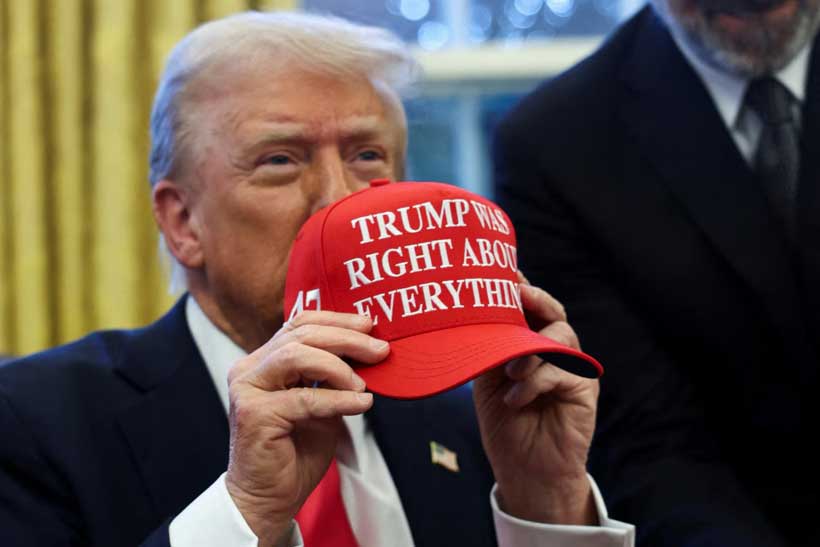
President Donald Trump, right, on Saturday said he will place 100% tariffs on all Canadian goods if Canadian Prime Minister Mark Carney, left, makes a trade deal to import Chinese-made electric vehicles. File Photo by Shawn Thew/UPI | License Photo
Jan. 24 (UPI) — Canadian officials might ink a trade deal with China, and U.S. President Donald Trump said that would trigger a 100% tariff on all Canadian goods sent to the United States.
Trump announced the new tariffs would take effect immediately if Canadian Prime Minister Mark Carney turns Canada into a conduit for Chinese-made goods intended for the United States.
“If [Prime Minister] Carney thinks he is going to make Canada a ‘drop off port’ for China to send goods and products into the United States, he is sorely mistaken,” the president said on Saturday in a social media post.
“China will eat Canada alive, completely devour it, including the destruction of their businesses, social fabric and general way of life,” Trump said.
“If Canada makes a deal with China, it will immediately be hit with a 100% tariff against all Canadian goods and products coming into the U.S.A.”
In a subsequent post, the president said the world does not need China to “take over Canada,” and the proposed trade deal will not “even come close to happening.”
Carney met with Chinese President Xi Jinping in Beijing last week and made a deal to lower some of the tariffs imposed by one another on some of their trade goods.
China will lower its tariffs on Canadian agricultural products, while Canada will lower its tariff on up to 49,000 electric vehicles that are made in China.
The Canadian government in 2024 placed tariffs on Chinese vehicles in 2024 in a coordinated effort with the United States.
During the World Economic Forum in Davos, Switzerland, Carney earlier this week told an audience that the international order led by the United States is done.
He criticized the use of tariffs by leading economic powers, which he said exploits the vulnerabilities of smaller nations and their respective economies.
Many viewed it as a thinly veiled criticism of Trump and his tariff policies.
Trade tensions arose between the United States and Canada over the past year as the president has sought to counteract tariffs on U.S. goods sent to its neighbor to the north.
Trump also has suggested making Canada the United States’ 51st state, which rankled many to the north.
WASHINGTON — President Trump on Saturday threatened to impose a 100% tariff on goods imported from Canada if America’s northern neighbor went ahead with its China trade deal.
Trump said in a social media post that if Canadian Prime Minister Mark Carney “thinks he is going to make Canada a ‘Drop Off Port’ for China to send goods and products into the United States, he is sorely mistaken.”
While Trump has waged a trade war over the last year, Canada this month negotiated a deal to lower tariffs on Chinese electric vehicles in return for lower import taxes on Canadian farm products.
Trump initially had said that agreement was what Carney “should be doing and it’s a good thing for him to sign a trade deal.”
Carney’s office did not immediately respond to a request for comment.
Trump’s threat came amid an escalating war of words with Carney as the Republican president’s push to acquire Greenland strained the NATO alliance. Trump had commented while in Davos, Switzerland, this week that “Canada lives because of the United States.” Carney shot back that his nation can be an example that the world does not have to bend toward autocratic tendencies.
Trump later revoked his invitation to Carney to join the president’s “Board of Peace” that he is forming to try to resolve conflicts in the Gaza Strip and elsewhere.
Trump’s threat to take over Greenland — a semiautonomous territory of NATO ally Denmark — has come after he has repeatedly needled Canada over its sovereignty and suggested it also be absorbed the United States as a “51st state.”
He resumed that this week, posting an altered image on social media showing a map of the United States that included Canada, Venezuela, Greenland and Cuba as part of its territory.
In his message Saturday, Trump continued his provocations by calling Canada’s leader “Governor Carney.” Trump had used the same nickname for Carney’s predecessor, Justin Trudeau, and his use of it toward Carney was the latest mark of their soured relationship.
Carney has emerged as a leader of a movement for countries to find ways to link up and counter U.S. foreign policy under Trump. Speaking in Davos before Trump, Carney said, “Middle powers must act together because if you are not at the table, you are on the menu.”
Trump, in his Truth Social post Saturday, also said that “China will eat Canada alive, completely devour it, including the destruction of their businesses, social fabric, and general way of life.”
Carney has not yet reached a deal with Trump to reduce some of the tariffs that he has imposed on key sectors of the Canadian economy. But Canada has been protected by the heaviest impact of Trump’s tariffs by the Canada-U.S.-Mexico Agreement. That trade agreement, which Trump signed in his first term, is up for a review this year.
In the fall, the Canadian province of Ontario aired an anti-tariff ad in the U.S. that prompted Trump to end trade talks with Canada. The television ad used the words of former President Reagan to criticize U.S. tariffs. Trump pledged to increase tariffs on imports of Canadian goods by an extra 10%. He did not follow through.
As for China, Canada had initially mirrored the United States by putting a 100% tariff on electric vehicles from Beijing and a 25% tariff on steel and aluminum. China had responded by imposing 100% import taxes on Canadian canola oil and meal and 25% on pork and seafood.
But as Trump has pursued pressure tactics, Canada’s foreign policy has been less aligned with the U.S., creating an opening for an improved relationship with China. Carney made the tariff announcement this month during a visit to Beijing.
Carney has said that Canada’s relationship with the U.S. is complex and deeper and that Ottawa and Beijing disagree on issues such as human rights.
Canada is the top export destination for 36 U.S. states. Nearly $2.7 billion worth of goods and services cross the border each day. About 60% of U.S. crude oil imports are from Canada, as are 85% of U.S. electricity imports.
Canada is also the largest foreign supplier of steel, aluminum and uranium to the U.S. and has 34 critical minerals and metals that the Pentagon is eager for and investing in for national security.
Price writes for the Associated Press. AP writer Rob Gillies in Toronto contributed to this report.
The United States has issued a warning to Haiti’s Transitional Presidential Council, writing that it would consider action should the temporary governing body compromise the Caribbean nation’s security.
In a sternly worded social media post on Thursday, the US embassy in Haiti maintained that its goal was the “establishment of baseline security and stability”.
Recommended Stories
list of 3 itemsend of list
“The US would regard any effort to change the composition of the government by the non-elected Transitional Presidential Council at this late stage in its tenure (set to expire on February 7) to be an effort to undermine that objective,” Deputy Secretary of State Christopher Landau wrote.
He added that the US would respond if such changes to the council were to occur. His statement, however, failed to identify the precise circumstances that prompted the warning.
“The US would consider anyone supporting such a disruptive step favoring the gangs to be acting contrary to the interests of the United States, the region, and the Haitian people and will act accordingly,” Landau said.
Haiti continues to struggle with the ravages of widespread gang violence, instability and corruption in its government.
But the US threat is likely to send shudders throughout the region, particularly in the aftermath of the January 3 attack on Venezuela.
The administration of President Donald Trump has repeatedly advanced the notion that the entire Western Hemisphere falls under its sphere of influence, as part of a policy it dubbed the “Donroe Doctrine”, a riff on the 19th-century Monroe Doctrine.
Trump has referenced that premise to justify the use of US military force to abduct Venezuelan President Nicolas Maduro, as well as to claim the US needs to control Greenland.
A political crisis
Located some 11,000 kilometres (800 miles) southeast of the US, Haiti has long struggled with instability. It is considered the poorest country in the Western Hemisphere, as it continues to suffer from the legacy of foreign intervention, dictatorship and natural disasters.
But in 2021, the country faced a new crisis when President Jovenel Moise was assassinated in his home in the capital, Port-au-Prince.
Federal elections have not been held since, leading to a crisis of confidence in the government. The last federally elected officials saw their terms expire in 2023.
Experts say the lack of leadership has allowed Haiti’s gangs to flourish, and since the Moise assassination, they have taken control of vast stretches of the territory, including up to 90 percent of the capital.
The resulting violence has forced more than 1.4 million Haitians from their homes. Millions more suffer from food insecurity, as thoroughfares are often restricted by gang-led roadblocks.
This week, a United Nations report found that, between January and November of last year, an estimated 8,100 people were killed in the violence. That marks an escalation from 2024, when the yearly total was 5,600.
But efforts have been made to restore the country’s stability. The Transitional Presidential Council was designed as a temporary governing structure to set the framework for new federal elections. Established in 2024, it has nine members who rotate to serve as chair.
Very quickly, however, the council faced criticism for its membership – largely selected from the country’s business and political elite – and allegations of corruption swirled. Infighting has also broken out among the members.
The US too has added to the tensions on the council. In November, it announced visa restrictions against an unnamed government official, later identified in the media as one of the council’s members, economist Fritz Alphonse Jean.
While the council had been slated to hold tiered elections starting last November, it failed to meet that benchmark, and the first vote has been postponed to August.
In the meantime, the council’s mandate is set to dissolve on February 7, and the panel’s future remains unclear.
UN calls for action
In this week’s report on Haiti, UN Secretary-General Antonio Guterres linked Haiti’s ongoing humanitarian crisis to the vacuum in its government.
“Violence has intensified and expanded geographically, exacerbating food insecurity and instability, as transitional governance arrangements near expiry and overdue elections remain urgent,” Guterres said.
Another UN representative – Carlos Ruiz-Massieu, who leads the UN Integrated Office in Haiti (BINUH) – was also emphatic about the immediate need for transparent democratic processes and unified governance.
“Let us be clear: the country no longer has time to waste on prolonged internal struggles,” he said.
Still, in a speech on Wednesday to the UN Security Council, Ruiz-Massieu added that there have been “encouraging” signs ahead of this year’s scheduled elections. He applauded efforts to increase voter registration, including in Haiti’s diaspora, and encourage political participation among women.
But Ruiz-Massieu underscored that security concerns, including gang violence, could impede the democratic process, and that there was more work to be done before elections could be held.
“Achieving this goal will require sustained coordination among relevant institutions, predictable financing of the electoral process and security conditions that allow all voters and candidates to participate without fear,” he said.
The UN also signalled it would bolster its multinational security support mission in Haiti with more troops later this year.
President Donald Trump walks to speak to members of the media before boarding Marine One en route to Palm Beach, Fla., on the South Lawn of the White House in Washington, D.C. on Friday, January 16, 2026. Early Tuesday, Trump told reporters that he would slap a 200% tariff on French wine and champagne in his push for the European nation to join his Board of Peace. Photo by Yuri Gripas/UPI | License Photo
Jan. 20 (UPI) — President Donald Trump early Tuesday threatened to impose a 200% tariff on French wine and champagne in an effort to pressure France to join his intergovernmental Board of Peace organization.
Trump made the comments early Tuesday to reporters at Palm Beach International Airport before boarding Air Force One to take him to Washington, D.C.
“I’ll put a 200% tariff on his wines and champagnes, and he’ll join,” Trump said, referring to President Emmanuel Macron of France, who is reportedly not planning to accept his offer to join the U.S.-led Board of Peace.
The Board of Peace is a U.S.-led intergovernmental organization proposed by Trump in connection with his Gaza cease-fire plan, which was endorsed by the United Nations Security Council in a resolution related to its Gaza peace mandate.
Though initially conceived as a mechanism to establish peace in Gaza, the charter now makes no mention of the Palestinian enclave, suggesting it may have larger ambitions to address global conflicts, The New York Times reported. The Times also reported that the United States is asking participating countries to pay more than $1 billion to join the board.
Several countries have already accepted Trump’s invitation, including Hungary, Vietnam and Morocco.
Trump told reporters early Tuesday that he has invited Russia, led by authoritarian President Vladimir Putin.
When asked about Macron reportedly turning aside his invite, Trump responded with an insult: “Well, nobody wants him because he’s going to be out of office very soon.”
France is to hold presidential elections next spring, with Macron ineligible to run again due to the country’s constitutional two-term limit.
Trump frequently uses tariffs as a bargaining tool, employing the economic measures as a negotiation tactic. However, those he has imposed during his second term have been challenged in court, as Congress constitutionally controls the nation’s taxing authority.
He recently announced a 10% tariff on goods from several European nations, including France, over their opposition to his plan to seize Greenland from Denmark.
Trump later Tuesday posted online what he said was the text of a message Macron had sent him seeking to arrange a dinner in Paris on Thursday while he is in Europe for the World Economic Forum, running Monday through Friday.
“I do not understand what you are doing on Greenland,” Macron wrote, according to Trump.
Jan. 17 (UPI) — Eight NATO member nations will be subjected to tariffs if they don’t remove recently deployed troops from Greenland, President Donald Trump said.
Denmark, Finland, France, Germany, the Netherlands, Norway, Sweden and the United Kingdom will be assessed 10% tariffs as of Feb. 1, which would more than double to 25% on June 1, if they do not remove their troops from Greenland, Trump said Saturday.
Greenland is a territory owned by Denmark, which Trump wants to make part of the United States for military purposes and says will be occupied by China or Russia if it does not become a U.S. territory.
“World Peace is at stake!” Trump said in a post on Truth Social. “China and Russia want Greenland, and there is not a thing that Denmark can do about it.”
He said Greenland has “two dogsleds as protection, one added recently,” and could not defend itself against an incursion by Russia or China.
“Only the United States of America … can play in this game, and very successfully, at that!” the president said. “Nobody will touch this sacred piece of land, especially since the national security of the United States, and the world at large, is at stake.”
He said the eight NATO nations targeted with tariffs “have journeyed to Greenland for purposes unknown” and called it a “very dangerous situation for the safety, security and survival of our planet.”
The president said Greenland is needed to deploy the proposed “golden dome” aerial defense system and other modern weapons systems that can support offensive and defensive military operations to protect North America against military attacks.
“This very brilliant, but highly complex system can only work at its maximum potential and efficiency, because of angles, metes and bounds, if this land is included in it,” Trump said.
“The United States of America is immediately open to negotiation with Denmark and/or any of these countries that have put so much at risk, despite all that we have done for them, including maximum protection, over so many decades.”
The president wants to buy the whole of Greenland, which has been rejected by leaders in Denmark and Greenland.
The United States has a military base on Greenland, which has become more strategically important due to new shipping lanes emerging near it and more natural resources becoming accessible in the region as the world continues to warm.
U.S. officials have tried to buy Greenland for more than 150 years, but Denmark consistently has opposed such offers.
Left, to right, Greenland Minister of Foreign Affairs Vivian Motzfeldt, Denmark Minister for Foreign Affairs Lars Lokke Rasmussen, Sen. Ruben Gallego, D-Ariz., and Sen. Lisa Murkowski, R-Alaska, meet in the office of Sen. Angus King, I-Maine, for a meeting with members of the Senate Arctic Caucus in the Hart Senate Office Building on Capitol Hill in Washington on Wednesday. President Donald Trump maintains that he wants the United States to control Greenland. Photo by Bonnie Cash/UPI | License Photo
President Donald Trump speaks during a roundtable discussion on rural healthcare in the East Room of the White House in Washington, D.C., on Friday. At the meeting, he proposed raising tariffs on countries that oppose his plan to annex Greenland. Photo by Yuri Gripas/UPI | License Photo
Jan. 16 (UPI) — President Donald Trump said Friday that he may add tariffs to countries that oppose his plan to take over Greenland, which is under the control of Denmark, a NATO member.
He made the remarks during a White House roundtable on rural healthcare. He was talking about threatening European countries with tariffs if they didn’t pay more for prescription drugs.
“I went through country after country,” Trump said. “I just went one after another.”
“I may do that for Greenland on countries if they don’t go along with Greenland because we need Greenland for national security,” he said.
On Thursday, Danish Minister for Foreign Affairs Lars Lokke Rasmussen and Greenland Minister of Foreign Affairs Vivian Motzfeldt met with Vice President JD Vance and Secretary of State Marco Rubio in Washington, but the meeting didn’t end in a diplomatic solution to the ongoing tension.
“Today, I’m leading a bipartisan delegation to Denmark to meet with Danish and Greenlandic leaders. Congress is unified in wanting to thank our NATO allies and stand firm against unnecessary threats to trusted partners,” Sen. Chris Coons, D-Vt. posted on X Friday morning.
The overall U.S. tariff average since Trump took office is about 17%, CNBC reported.
The president has used the International Emergency Economic Powers Act for many of the tariffs, though the use of that law has been heavily challenged in the courts, and several courts have found it unlawful.
The U.S. Supreme Court will soon rule on the use of the IEEPA for tariffs.
“I hope we win the Supreme Court case, because if we don’t, [it’d] be a shame for our country,” he said Friday.
Left, to right, Greenland Minister of Foreign Affairs Vivian Motzfeldt, Denmark Minister for Foreign Affairs Lars Lokke Rasmussen, Sen. Ruben Gallego, D-Ariz., and Sen. Lisa Murkowski, R-Alaska, meet in the office of Sen. Angus King, I-Maine, for a meeting with members of the Senate Arctic Caucus in the Hart Senate Office Building on Capitol Hill in Washington on Wednesday. President Donald Trump maintains that he wants the United States to control Greenland. Photo by Bonnie Cash/UPI | License Photo
Greenland’s location and resources make it vital to US security, Trump argues in his ongoing push for acquisition.
Published On 16 Jan 202616 Jan 2026
Share
US President Donald Trump says he may impose tariffs on countries that do not support his plan to have the United States control Greenland.
“I may put a tariff on countries if they don’t go along with Greenland, because we need Greenland for national security,” Trump said at a health roundtable at the White House.
Recommended Stories
list of 3 itemsend of list
Since Trump returned to the White House in January, he has repeatedly expressed his desire to take over Greenland, a demand Denmark and many other European nations have rejected.
Trump has said Greenland is vital to US security because of its strategic location and large supply of minerals, and has not ruled out the use of force to take it.
A bipartisan delegation of US lawmakers met the leaders of Denmark and Greenland in Copenhagen on Friday, seeking to “lower the temperature” with assurances of congressional support after President Donald Trump’s threats to seize the Arctic island.
European nations this week sent small numbers of military personnel to the island at Denmark’s request.
The 11-member US delegation, led by Democratic Senator Chris Coons, met Danish Prime Minister Mette Frederiksen and her Greenlandic counterpart Jens-Frederik Nielsen, as well as Danish and Greenlandic parliamentarians.
“There’s a lot of rhetoric, but there’s not a lot of reality in the current discussion in Washington,” Coons told reporters following the meetings, saying the lawmakers would seek to “lower the temperature” on returning home.
Looking for a deal
Trump’s special envoy to Greenland also said on Friday he plans to visit the Danish territory in March and believes a deal can be made.
“I do believe that there’s a deal that should and will be made once this plays out,” Jeff Landry told Fox News in an interview on Friday as a bipartisan delegation of US lawmakers was set to meet leaders of Greenland and Denmark.
“The president is serious. I think he’s laid the markers down. He’s told Denmark what he’s looking for, and now it’s a matter of having Secretary [of State Marco] Rubio and Vice President JD Vance make a deal.”
MINNEAPOLIS — President Trump on Thursday threatened to invoke the Insurrection Act and deploy troops to quell persistent protests against the federal officers sent to Minneapolis to enforce his administration’s massive immigration crackdown.
The president’s threat comes a day after a federal immigration officer shot and wounded a Minneapolis man who had attacked the officer with a shovel and broom handle. That shooting further heightened the fear and anger radiating across the Minnesota city since an Immigration and Customs Enforcement agent fatally shot a Renee Good in the head.
Trump has repeatedly threatened to invoke the rarely used federal law to deploy the U.S. military or federalize the National Guard for domestic law enforcement, over the objections of state governors.
“If the corrupt politicians of Minnesota don’t obey the law and stop the professional agitators and insurrectionists from attacking the Patriots of I.C.E., who are only trying to do their job, I will institute the INSURRECTION ACT, which many Presidents have done before me, and quickly put an end to the travesty that is taking place in that once great State,” Trump said in social media post.
The Associated Press has reached out to the offices of Gov. Tim Walz and Minneapolis Mayor Jacob Frey for comment.
The Department of Homeland Security says it has made more than 2,000 arrests in the state since early December and is vowing to not back down. ICE is a DHS agency.
Protests, tear gas and another shooting
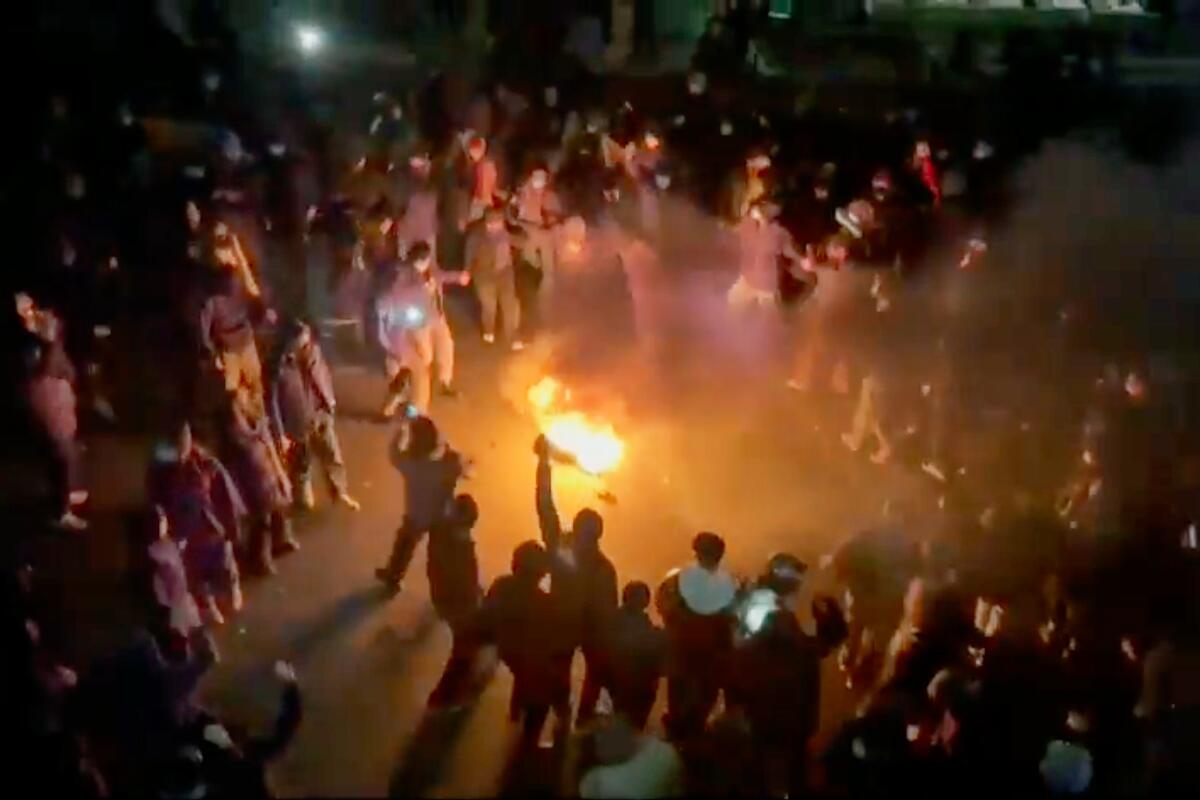
In Minneapolis, smoke filled the streets Wednesday night near the site of the latest shooting as federal officers wearing gas masks and helmets fired tear gas into a small crowd. Protesters responded by throwing rocks and shooting fireworks.
Police Chief Brian O’Hara said during a news conference that the gathering was an unlawful assembly and “people need to leave.”
Things later quietened down and by early Thursday only a few demonstrators and law enforcement officers remained at the scene.
Demonstrations have become common on the streets of Minneapolis since the ICE agent fatally shot 37-year-old Good on Jan. 7. Agents have yanked people from their cars and homes, and have been confronted by angry bystanders demanding that the officers pack up and leave.
“This is an impossible situation that our city is presently being put in and at the same time we are trying to find a way forward to keep people safe, to protect our neighbors, to maintain order,” Frey, the mayor, said.
Frey said the federal force — five times the size of the city’s 600-officer police force — has “invaded” Minneapolis, scaring and angering residents.
Shooting followed a chase
In a statement describing the events that led to Wednesday’s shooting, Homeland Security said federal law enforcement officers stopped a driver from Venezuela who is in the U.S. illegally. The person drove away and crashed into a parked car before taking off on foot, DHS said.
After officers reached the person, two other people arrived from a nearby apartment and all three started attacking the officer, according to DHS.
“Fearing for his life and safety as he was being ambushed by three individuals, the officer fired a defensive shot to defend his life,” DHS said.
The two people who came out of the apartment are in custody, it said.
O’Hara said the man shot was in the hospital with a non-life-threatening injury.
The shooting took place about 4.5 miles ( north of where Good was killed. O’Hara’s account of what happened largely echoed that of Homeland Security.
During a speech before the latest shooting, Walz described Minnesota as being in chaos, saying what’s happening in the state “defies belief.”
“Let’s be very, very clear, this long ago stopped being a matter of immigration enforcement,” he said. “Instead, it’s a campaign of organized brutality against the people of Minnesota by our own federal government.”
An official says the agent who killed Good was injured
Jonathan Ross, the Immigration and Customs Enforcement officer who killed Good, suffered internal bleeding to his torso during the encounter, a Homeland Security official told The Associated Press.
The official spoke to AP on condition of anonymity in order to discuss Ross’ medical condition. The official did not provide details about the severity of the injuries, and the agency did not respond to questions about the extent of the bleeding, exactly how he suffered the injury, when it was diagnosed or his medical treatment.
Good was killed after three ICE officers surrounded her SUV on a snowy street a few blocks from her home.
Bystander video shows one officer ordering Good to open the door and grabbing the handle. As the vehicle begins to move forward, Ross, standing in front, raises his weapon and fires at least three shots at close range. He steps back as the SUV advances and turns.
Homeland Security Secretary Kristi Noem has said Ross was struck by the vehicle and that Good was using her SUV as a weapon — a self-defense claim that has been criticized by Minnesota officials.
Chris Madel, an attorney for Ross, declined to comment.
Good’s family has hired the same law firm that represented George Floyd’s family in a $27 million settlement with Minneapolis. Floyd, who was Black, died after a white police officer pinned his neck to the ground in the street in May 2020.
Karnowski, Richer, Golden and Madhani write for the Associated Press. Madhani reported from Washington. AP reporters Bill Barrow in Atlanta; Julie Watson in San Diego; Rebecca Santana in Washington; Ed White in Detroit and Giovanna Dell’Orto in Minneapolis contributed to this report.

Jan. 15 (UPI) — President Donald Trump threatened to invoke the Insurrection Act to stop protests in Minnesota on Thursday after an ICE agent shot another civilian.
Trump made the threat on social media hours after an Immigrations and Customs Enforcement officer shot a man in Minneapolis, increasing tension between agents and demonstrators.
“If the corrupt politicians of Minnesota don’t obey the law and stop the professional agitators and insurrectionists from attacking the patriots of I.C.E., who are only trying to do their job, I will institute the Insurrection Act, which many presidents have done before me, and quickly put an end to the travesty that is taking place in that once great state,” Trump wrote.
A statement from the U.S. Department of Homeland Security said the victim of Wednesday’s shooting was a Venezuelan immigrant who was in the United States illegally.
A U.S. president has not invoked the Insurrection Act in more than 30 years. It allows the president to send military troops to areas of civil unrest. George H. Bush used it in 1992 in response to the Los Angeles riots after four officers who were caught on camera beating Rodney King, a Black man, during a traffic stop, were acquitted.
The Insurrection Act gives military troops the authority to take actions they are normally prohibited from taking on U.S. soil, such as making arrests and performing searches
Protestors continued to film and shout down ICE agents after Wednesday’s shooting, calling for them to leave the city. Last week, ICE agent Jonathan Ross fatally shot 37-year-old Renee Good while she was driving away in her vehicle in Minneapolis.
State and local officials have joined the calls from protesters to remove ICE from Minneapolis. Minneapolis Mayor Jacob Frey filed a lawsuit against the Trump administration on Monday, seeking to have the influx of federal agents removed.
Gov. Tim Walz addressed the ongoing unrest on Wednesday, saying “news reports simply don’t do justice to the level of chaos and disruption and trauma the federal government is raining down on our communities.”
Walz said 2,000 to 3,000 federal agents have been dispatched to Minnesota and are pulling people over indiscriminately.
WASHINGTON — Federal Reserve Chair Jerome Powell said Sunday the Department of Justice has served the central bank with subpoenas and threatened it with a criminal indictment over his testimony about the Fed’s building renovations.
The move represents a major escalation in President Trump’s battle with the Fed, an independent agency he has repeatedly attacked for not cutting its key interest rate as quickly as he prefers.
The subpoena relates to Powell’s testimony before the Senate Banking Committee in June, he said, regarding the Fed’s $2.5-billion renovation of two office buildings, a project that Trump criticized as excessive.
Until now Powell had maintained a restrained approach to Trump’s criticisms and personal insults, which he has mostly ignored. But after Sunday’s actions, Powell issued a video statement in which he bluntly characterized the threats of criminal charges as “pretexts” to undermine the Fed’s independence when it comes to setting interest rates.
“This is about whether the Fed will be able to continue to set interest rates based on evidence and economic conditions — or whether instead monetary policy will be directed by political pressure or intimidation,” Powell said.
The central bank had attempted to placate the administration by dialing back some policies, such as efforts to consider the effect of climate change on the banking system, that Trump and his economic advisors clearly opposed.
In his testimony in June, Powell disputed some of the criticisms that had been levied against the Fed’s renovation of two historic office buildings, which have ballooned in cost.
The White House did not immediately respond to a message seeking comment Sunday.
The Justice Department said in a statement Sunday that it can’t comment on any particular case, but added that Atty. Gen. Pam Bondi “has instructed her US Attorneys to prioritize investigating any abuse of tax payer dollars.”
A spokesperson for U.S. Atty. Jeanine Pirro’s office didn’t immediately respond Sunday to a text message and phone call seeking comment.
With the subpoenas, Powell becomes the latest perceived adversary of the president to face a criminal investigation by the Trump administration’s Justice Department. Trump has urged prosecutions of his political opponents, obliterating institutional guardrails for a Justice Department that for generations has taken care to make investigative and prosecutorial decisions independent of the White House.
The potential indictment has already drawn concern from one Republican senator, who said he’ll oppose any future nominee to the central bank, including any replacement for Powell, until “this legal matter is fully resolved.”
“If there were any remaining doubt whether advisors within the Trump administration are actively pushing to end the independence of the Federal Reserve, there should now be none,” said Sen. Thom Tillis of North Carolina, who sits on the Banking Committee that oversees Fed nominations. “It is now the independence and credibility of the Department of Justice that are in question.”
Rugaber writes for the Associated Press.AP writers Seung Min Kim, Eric Tucker, Michael Kunzelman and Alanna Durkin Richer contributed to this report.
Weekly insights and analysis on the latest developments in military technology, strategy, and foreign policy.
On the 13th day of increasingly tense protests against Iran’s leadership, Crown Prince Reza Pahlavi urged U.S. President Donald Trump to intervene on behalf of the anti-government demonstrators. His comments came a short while after Supreme Leader Ayatollah Ali Khamenei finally addressed the unrest with a defiant tone, blaming Trump for sparking the protests and suggesting that crackdowns will become more severe. Meanwhile, an Iranian prosecutor is threatening protestors with death. More on that later in this story.
Amid all the rhetoric, the ferocity of the unrest has reportedly compelled the U.S. intelligence community to rethink its initial assessment of the situation, recognizing that it is more serious than initially thought. Meanwhile, observers say the death toll has increased as millions of Iranians again took to the streets across the nation. Protestors are blaming a regime crackdown, while Iranian security forces say they have been the subject of attacks by unruly mobs.
Video emerging on social media shows large crowds continuing demonstrations throughout the country, with some showing damaged buildings in the aftermath of previous protests. However, getting a full picture of what is unfolding remains a challenge given the ongoing shutdown of internet and phone service in Iran.
Despite the violence committed by the Iranian regime and the internet outage across the country the people in Iran are unfazed and continue to fight. Tehran tonight. pic.twitter.com/QyfFvGhclU
Pahlavi, whosefatally ill father, Mohammad Reza Pahlavi, fled Iran ahead of the 1979 Islamic revolution, is now living in exile in the U.S. He called upon Trump to back up tough words with actions. As we have pointed out before, the American leader has said the Khamenei regime is “going to have to pay hell” if it starts killing protestors in large numbers.
“Mr. President, this is an urgent and immediate call for your attention, support, and action,” Pahlavi extolled on X. “Last night you saw the millions of brave Iranians in the streets facing down live bullets. Today, they are facing not just bullets but a total communications blackout. No Internet. No landlines. Ali Khamenei, fearing the end of his criminal regime at the hands of the people and with the help of your powerful promise to support the protesters, has threatened the people on the streets with a brutal crackdown.”
“I have called the people to the streets to fight for their freedom and to overwhelm the security forces with sheer numbers. Last night they did that,” Pahlavi continued. “Your threat to this criminal regime has also kept the regime’s thugs at bay. But time is of the essence. The people will be on the streets again in an hour. I am asking you to help. You have proven and I know you are a man of peace and a man of your word. Please be prepared to intervene to help the people of Iran.”
Mr. President, this is an urgent and immediate call for your attention, support, and action. Last night you saw the millions of brave Iranians in the streets facing down live bullets. Today, they are facing not just bullets but a total communications blackout. No Internet. No…
Asked for a response from the Trump administration, the White House referred us to the president’s remarks yesterday, which can be seen in the following video.
#Trump says: “I have let [#Iran‘s leaders] know that if they start killing people … we’re going to hit them very hard. … [T]hey know and they’ve been told very strongly … that if they do that, they’re going to have to pay hell”. pic.twitter.com/Uppnejnuvt
In his speech before supporters in Qom province, Khamenei took aim at Trump and other outside “hirelings” for fanning the flames.
Trump “made an irrelevant and provocative statement declaring that, should the government of Iran take certain actions, he would move against it,” Khamenei complained. “Such remarks have emboldened rioters and elements hostile to the nation. Were he truly capable of governing his own country, he would attend to its numerous internal crises.”
The Iranian leader then intimated that those continuing to protest will be met with a harsh response.
“Certain people accept and act according to his wishes, engaging in acts of sabotage and arson merely to please” Trump, Khamenei continued. “It must be clearly understood that the Islamic Republic was established through the sacrifice of hundreds of thousands of honorable individuals, and those who opposed it have failed. The Islamic Republic will not be overthrown. Do not serve foreign powers, whoever you may be, if you become an agent of foreigners and act on their behalf, the Iranian nation will disown you, and the Islamic establishment will likewise reject you as for that arrogant man who sits in judgment over the entire world.”
Full Speech: Khamenei’s 1st Reaction Amid Iran Protests, Trump Regime Change Threat, Israel War Plan
Tehran’s prosecutor took an even harsher stance, threatening protestors with death.
“We will show no leniency toward instigators of unrest,” said Ali Salehi. “They will be charged with Fasad fil ard (‘spreading mischief on earth’), which carries the death penalty.”
BREAKING:
Tehran’s chief prosecutor said the Islamic regime will execute anti-regime protesters
“We will show no leniency toward instigators of unrest. They will be charged with Fasad fil ard (‘spreading mischief on earth’), which carries the death penalty,” said Ali Salehi. pic.twitter.com/mSjUAeLlFC
So far, “at least 51 protesters, including nine children under the age of 18, have been killed and hundreds more injured in the first 13 days of the new round of nationwide protests in Iran,” the Norway-based Iran Human Rights NGO (IHRNGO) reported on Friday. “IHRNGO has also received reports of dozens more protesters being killed in Tehran, Mashhad, Karaj (Fardis) and Hamedan. These reports are currently being verified and not included in the present figures.”
A video shows multiple bodies on hospital floor in Tehran as the Islamic Republic continues its campaign of repression during an internet and telephone blackout. pic.twitter.com/HLTyhrFFzq
There are claims that Iran’s Basij security forces opened fire on protestors in Tehran.
Eyewitness report from Tehran:
“ Last night in central Tehran, around 8–9 p.m., riot police were dispersing people with tear gas and pellet guns. But when we moved past Enghelab, toward Sharif University and Behboudi, there were no officers there; the riot units had all pulled… https://t.co/i2hi9ApA4e
— ثنا ابراهیمی | Sana Ebrahimi (@__Injaneb96) January 9, 2026
Meanwhile, Iran’s state media has released a video it claims shows protestors shooting security forces in Kermanshah. Iranian officials said security personnel were killed in Tehran as well.
“After unrest in various cities and locations, the capital was also affected by the brutal attacks of armed terrorism,” the official Iranian Tasnim news agency claimed. “Last night, armed terrorists martyred several personnel of the Greater Tehran Police Intelligence with direct Kalashnikov gunfire.”
Meanwhile, Iranian intelligence is urging residents to turn in those engaging in demonstrations.
As the protests rage on, the idea that they pose a serious challenge to the Khamenei regime is gaining increasing traction in U.S. intelligence circles, Axios reported on Friday.
“Early this week, U.S. intelligence assessed that the protests lacked sufficient energy to challenge the stability of the regime,” U.S. officials told Axios. “But that view is being reassessed in light of recent events.”
Mike Waltz, the U.S. Ambassador to the U.N., said, “America stands with the Iranian people in their quest for basic dignity and freedom.”
The Iranian regime is once again BRUTALIZING its own people instead of listening to them.
Though Khamenei has vowed not to back down to protestors, a British Member of Parliament suggested some Iranian leaders may be preparing to leave the country.
“We’re also seeing Russian cargo aircraft coming and landing in Tehran, presumably carrying weapons and ammunition, and we’re hearing reports of large amounts of gold leaving Iran,” Tom Tugendhat told parliament. He then asked whether the government could update lawmakers on reports that “suggest that the regime itself is preparing for life after the fall.”
The War Zone cannot independently verify Tugendhat’s claim.
In the UK House of Commons, Tom Tugendhat, the Conservative MP and Chair of the Foreign Affairs Committee, asked Hamish Falconer, the Labour MP for and Minister for the Middle East and North Africa, to respond to reports that Russian cargo aircraft have recently landed in Iran… pic.twitter.com/XkKjRUiAI9
Yesterday, we noted that the protests are raging as Israeli Prime Minister Benjamin Netanyahu ordered new plans to attack Iran over concerns about its nuclear weapons ambitions and the rebuilding of the country’s military capabilities. The Israeli leader’s statement came days before Trump’s latest threat to take action against Iran.
Though no military movements by either Jerusalem or Washington appear imminent, these threats, as we reported yesterday, raise the question of whether either would risk an attack that could potentially galvanize the population behind the Ayatollah. A senior Israeli Defense Forces (IDF) official told us that these concerns are baked into any attack plans.
“If Israel were to strike Iran as an exploitation of an opportunity, namely a moment of Iranian weakness, such a move would, in my view, take place only with full coordination, cooperation, and backing from President Trump,” said the official, offering an unclassified assessment of the situation. “Israel, as I understand it, would not act independently in such a scenario.”
US President Donald Trump (R) and Israeli Prime Minister Benjamin Netanyahu (L) would likely act in concert for any attack on Iran, a senior IDF official tells us. (Photo by Jim WATSON / AFP) JIM WATSON
“Should Trump decide that the time is right and that it aligns with his own interests to confront Iran, he would likely give a green light for an Israeli strike,” the official added, speaking on condition of anonymity to discuss operational details. “There is a relatively high likelihood that Trump could pursue such a course, particularly in light of Khamenei’s repeated public disparagement of him, Trump’s explicit warnings to the Iranian leadership against harming protesting civilians, and the fact that the Iranian regime has now begun violently suppressing and killing protesters.”
Regardless of what actions will be taken in the future, the official concurred with Khamenei that outside influences have already been at work during these protests.
“It is reasonable to assume that covert operatives, alongside recruited and motivated Iranian citizens, are helping to organize, lead, and sustain the protests and the broader struggle against this totalitarian system,” he posited.
Update: 4:30 PM Eastern –
During a meeting with oil industry officials Friday afternoon, Trump repeated his stance that he could attack Iran if the crackdowns on protesters get out of hand.
“Iran is in big trouble,” Trump said. “It looks to me that the people are taking over certain cities that nobody thought were really possible just a few weeks ago. We’re watching the situation very carefully. I’ve made the statement very strongly that if they start killing people like they have in the past, we will get involved. We’ll be hitting them very hard where it hurts. And that doesn’t mean boots on the ground, but it means hitting them very, very hard where it hurts. So we don’t want that to happen.”
Trump – “Iran’s in big trouble. It looks to me that the people are taking over certain cities that nobody thought were really possible… We’re watching… I made the statement very strongly that if they start killing people like they have in the past, we will get involved.” pic.twitter.com/GoA5zWEAkN
One site of the ongoing protests has been geolocated to Tehran.
Meanwhile, it appears that Iranian anti-regime demonstrators have practically taken over Mashhad, Iran’s second-largest city. The regime’s security forces have retreated to just a few government buildings and don’t move from there.
BREAKING:
The Iranian anti-regime protesters have practically taken over Iran’s 2nd-largest city Mashhad.
The regime’s security forces have retreated to just a few government buildings and don’t move from there. pic.twitter.com/DEiEvr0kYc
United States President Donald Trump has issued a stern warning to defence contractors that supply the US military, accusing them of profiteering.
In a Truth Social post on Wednesday, he threatened to take action if the companies failed to take specific actions, including capping executive pay, investing in the construction of factories and producing more military equipment at a faster clip.
Recommended Stories
list of 3 itemsend of list
“MILITARY EQUIPMENT IS NOT BEING MADE FAST ENOUGH,” Trump wrote at one point in his lengthy, 322-word post.
“It must be built now with the Dividends, Stock Buybacks, and Over Compensation of Executives, rather than borrowing from Financial Institutions, or getting the money from your Government.”
Trump singled out the technology company Raytheon as the worst offender, in his eyes.
“I have been informed by the Department of War that Defense Contractor, Raytheon, has been the least responsive to the needs of the Department of War, the slowest in increasing their volume, and the most aggressive spending on their Shareholders rather than the needs and demands of the United States Military,” Trump wrote in a follow-up post.
The president threatened to sever government ties with Raytheon, now known as RTX, which earns billions from its defence contract work.
Just last August, the Department of Defence awarded the firm $50bn – the maximum possible – for a 20-year contract to supply the military with equipment, services and repairs.
“Our Country comes FIRST, and they’re going to have to learn that, the hard way,” Trump warned.
Defence spending fuels a significant portion of the US economy: As of 2024, Defence Department spending represented approximately 2.7 percent of the US gross domestic product (GDP).
Normally, the total defence budget hovers around $1 trillion. But in a Wednesday evening post on Truth Social, Trump announced that he would petition congressional Republicans to boost that amount to a record $1.5 trillion for fiscal year 2027.
“This will allow us to build the ‘Dream Military’ that we have long been entitled to and, more importantly, that will keep us SAFE and SECURE, regardless of foe,” Trump wrote.
Still, Trump’s threats sent stocks for defence contractors plummeting, amid uncertainty over the future of the high-stakes industry.
Since taking office for a second term, Trump has taken an aggressive, hands-on approach to private companies that have ties to national security concerns.
In June, for instance, the Trump administration was awarded a “golden share” in the metal company US Steel, in exchange for giving a green light to its merger with Japan’s Nippon Steel. That share allows the Trump administration to essentially have a veto over any major action US Steel may take to reorganise or dissolve.
The Trump administration has continued to snap up stakes in other private firms, most notably mining companies involved in the production of rare earth minerals and other raw materials used in technology.
It is not yet clear how Trump plans to enforce his demands for the defence contractors he blasted in Wednesday’s social media messages. Nor is it certain that Trump could legally enforce his orders.
But Trump aired a list of grievances against the companies, including that their executives’ pay was simply too large.
“Executive Pay Packages in the Defense Industry are exorbitant and unjustifiable given how slowly these Companies are delivering vital Equipment to our Military, and our Allies,” he wrote at one point.
At another, he called on the private firms to invest in new construction projects, a request he has made across industries, from the pharmaceutical sector to automakers.
“From this moment forward, these Executives must build NEW and MODERN Production Plants, both for delivering and maintaining this important Equipment, and for building the latest Models of future Military Equipment,” Trump said.
“Until they do so, no Executive should be allowed to make in excess of $5 Million Dollars which, as high as it sounds, is a mere fraction of what they are making now.”
He also complained that the defence companies were “far too slow” in offering repairs for their equipment.
Defence contractors are responsible for a range of services and products, from software to training to missiles and tanks. RTX, for example, designed the Patriot Missile, the US’s flagship surface-to-air missile system, and it keeps the US military supplied with spare parts and other updates.
Based in Virginia, the company boasted sales exceeding $80bn in 2024. Just this week, the US Federal Aviation Administration (FAA) awarded RTX a $438m contract to update its radar system.
Still, Trump maintained that too much of that income was going to shareholders, executive pay and stock buybacks, wherein a company purchases its own shares in order to limit their supply and increase their value.
“Defense Contractors are currently issuing massive Dividends to their Shareholders and massive Stock Buybacks, at the expense and detriment of investing in Plants and Equipment,” Trump wrote.
“This situation will no longer be allowed or tolerated!”
US president says a military operation focused on Colombia’s government ‘sounds good’ to him.
Published On 5 Jan 20265 Jan 2026
Share
United States President Donald Trump has threatened his Colombian counterpart, Gustavo Petro, in the wake of Washington’s abduction of Venezuela’s leader, and said he believed the government in Cuba, too, was likely to fall soon.
Trump made the comments late on Sunday while speaking to reporters on board Air Force One.
Recommended Stories
list of 4 itemsend of list
“Venezuela is very sick. Colombia is very sick too, run by a sick man who likes making cocaine and selling it to the United States. And he’s not going to be doing it very long. Let me tell you,” the US president said.
When asked if he meant an operation by the US on Colombia, Trump said: “Sounds good to me.”
He added that a US military intervention in Cuba is unlikely because the country appears to be ready to fall on its own.
“Cuba is ready to fall. Cuba, looks like it’s ready to fall. I don’t know how they , if they can hold that, but Cuba now has no income. They got all of their income from Venezuela, from the Venezuelan oil,” Trump said.
“They’re not getting any of it. Cuba literally is ready to fall. And you have a lot of great Cuban Americans that are going to be very happy about this.”
Trump’s comments come a day after US forces captured and detained Maduro and his wife in a surprise attack on Caracas. The Venezuelan leader and his wife, Cilia Flores, are due to appear in court on drug-related charges in New York later on Monday.
Speaking to reporters on Air Force One, Trump also insisted the US was ‘in charge’ of Venezuela, even though the country’s Supreme Court has appointed the country’s Vice President Delcy Rodriguez as interim leader.
He also reiterated a threat to send the US military back to Venezuela if it “doesn’t behave”.
Trump has made no secret of his ambitions to expand US presence in the Western hemisphere and revive the 19th century Monroe Doctrine that states Latin America falls under the US sphere of influence. Trump has called his 21st century version the “Don-roe Doctrine”.
The US president has also previously threatened both Colombia and Cuba. Over the weekend he said that Petro has to “watch his ass” and that the political situation in Cuba was “something we’ll end up talking about because Cuba is a failing nation”.
Embattled Wisconsin Judge Hannah Dugan, who was convicted of obstruction last month for helping an immigrant evade federal officers, has sent her resignation letter to the governor.
The letter was sent Saturday. Republicans had been making plans to impeach her since her Dec. 19 conviction. A spokesperson for Gov. Tony Evers said his office received Dugan’s letter, and he would work to fill the vacancy without delay.
Dugan wrote that over the last decade she handled thousands of cases with “a commitment to treat all persons with dignity and respect, to act justly, deliberately and consistently, and to maintain a courtroom with the decorum and safety the public deserves.”
But she said the case against her is too big of a distraction.
“As you know, I am the subject of unprecedented federal legal proceedings, which are far from concluded but which present immense and complex challenges that threaten the independence of our judiciary. I am pursuing this fight for myself and for our independent judiciary,” Dugan said in her letter.
Last April, federal prosecutors accused Dugan of distracting federal officers trying to arrest a Mexican immigrant outside her courtroom and leading the man out through a private door. A federal jury convicted her of felony obstruction.
The case against Dugan was highlighted by President Trump as he pressed ahead with his sweeping immigration crackdown. Democrats insisted the administration was trying to make an example of Dugan to blunt judicial opposition to the operation.
Republican Wisconsin Assembly Speaker Robin Vos praised Dugan’s decision.
“I’m glad Dugan did the right thing by resigning and followed the clear direction from the Wisconsin Constitution,” Vos said.
Democrat Ann Jacobs, who is chair of the Wisconsin Elections Commission board, said she agreed with Dugan that Milwaukee should have a permanent judge in place while this fight plays out.
“Despite her situation, she is ever the champion of justice, wanting to remove the judiciary from a political battle over her fate. I’m sure this is terribly hard for her but she is true to her faith and her principles,” Jacobs said in a post on X.
On April 18, immigration officers went to the Milwaukee County courthouse after learning 31-year-old Eduardo Flores-Ruiz had reentered the country illegally and was scheduled to appear before Dugan for a hearing in a state battery case.
Dugan confronted agents outside her courtroom and directed them to the office of her boss, Milwaukee County Chief Judge Carl Ashley, because she told them their administrative warrant wasn’t sufficient grounds to arrest Flores-Ruiz.
After the agents left, she led Flores-Ruiz and his attorney out a private jury door. Agents spotted Flores-Ruiz in the corridor, followed him outside and arrested him after a foot chase. The U.S. Department of Homeland Security announced in November he had been deported.