threatened

Arab News | United Kingdom’s unity threatened by pact between Wales, Scotland and Northern Ireland

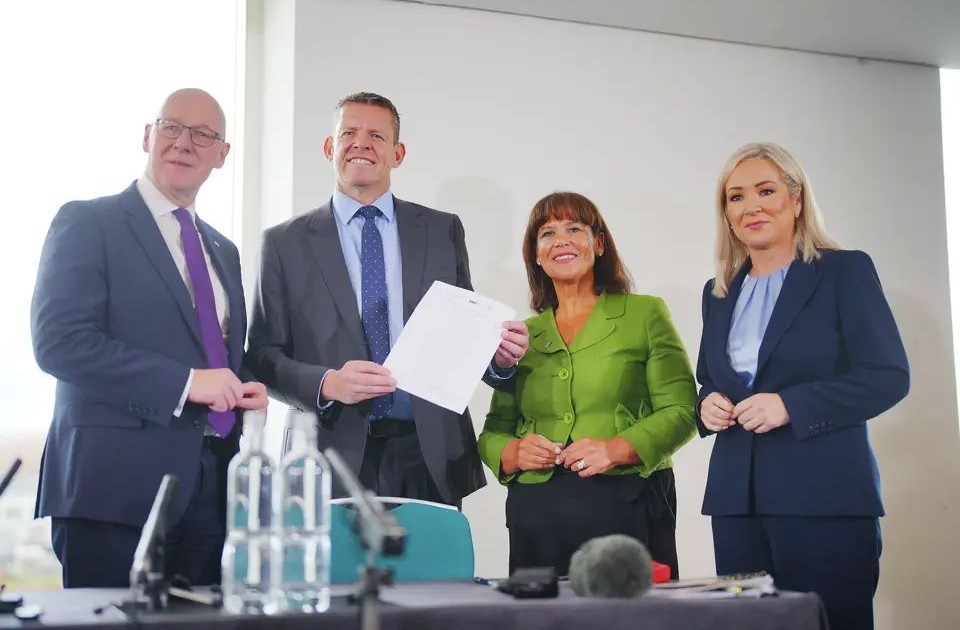
LONDON: The leaders of Wales, Scotland and Northern Ireland signed a pact Monday that threatens to lead to the breakup of the United Kingdom.

The first ministers of the three semiautonomous regions of the U.K. told Prime Minister Andy Burnham and his government to prepare for constitutional change and that their future lies with the European Union.

“For people watching across these islands — for people watching around the world — there could be no clearer sign that Westminster’s time is coming to an end,” they said in a memorandum of understanding, referring to Parliament.

The announcement came about 48 hours after U.S. President Donald Trump waded into the waters of the politically contentious issue when he said he would “ love to see ” a reunified Ireland during a trip to visit his golf course hosting the Irish Open.

It’s the first time the leaders of all three countries are either from pro-independence parties, or pro-unification in the case of Northern Ireland, which was partitioned and remained part of the U.K. when Ireland won independence from Britain over a century ago.

Tensions remain despite devolution of power

Burnham’s spokesperson brushed aside the threat and said the prime minister strongly believes in the union and was more focused on lowering the cost of living than dealing with constitutional debates.

“The United Kingdom is at its best when people come together around our shared values and problem-solving, rather than division,” Tom Wells said.

Nicola McEwen, director of the University of Glasgow Center for Public Policy, said the summit was symbolically important but has no legal significance.

“I don’t see the threat to the union being bigger today than it was yesterday,” McEwen said.

In the late 1990s, the U.K. passed legislative acts that decentralized government through the process of devolution, giving each country except England some level of policy independence and self-governance through their own parliaments. But tensions have remained with the U.K.-wide government in London, which retained control over national issues and those concerning England.

Scotland’s John Swinney and Northern Ireland’s Michelle O’Neill called for independence referendums in their countries, while Rhun ap Iorwerth did not provide a timetable for one in Wales.

The three leaders appeared in their political capacity, rather than their official one, possibly because O’Neill is in a power-sharing government with the Democratic Unionist Party.

Northern Ireland’s Deputy First Minister Emma Little-Pengelly, of the DUP, accused O’Neill, of the Sinn Fein party, of “weaponizing” the role of first minister by signing the agreement.

“I am first minister in the north of Ireland,” O’Neill replied. “This is about historic change happening all around us.”

Scottish nationalists believe support for independence is rising

Scotland tried unsuccessfully to break away in 2014, with voters rejecting a referendum 55% to 45%. But McEwen said support for Scottish independence has grown since Brexit, in which the U.K. formally left the European Union in January 2020, following a referendum in June 2016.

Swinney, leader of the Scottish National Party, said he believed voters would now vote for independence if the U.K. government approved a referendum.

Burnham told Parliament last week he would allow such a vote to be held if there was a “clear consensus” in Scotland, but later sent Swinney a letter saying a vote was “off limits.”

The 1998 Good Friday peace accord that ended three decades of sectarian violence in Northern Ireland known as “The Troubles,” requires a vote on unification if polls there indicate it would likely pass, a threshold the U.K. government says has not been met. Ireland would also have to approve the change in a referendum.

Burnham has made devolution a major theme since taking office less than two months ago, but his focus has been on regional governments across England, a reflection of his years as mayor of Greater Manchester.

Swinney tried to turn Burnham’s ideology to his advantage, saying his frequent talk of devolution “leads you to the logic of recognizing the right of the people of Scotland, in my case, to decide their own future.”

Beyond any threat of departing the union, McEwen said the greatest impact of the three joining forces could be that they agreed to cooperate with each other routinely and that could help to exert more influence on the U.K. government.

“It does keep on the agenda that question about, well, if the United Kingdom is a union based on consent, what is the pathway where it looks like that consent may no longer be there?” McEwen said. “Any U.K. government has been very reluctant to engage in that discussion.”


Source link

Why has Trump threatened to bomb Oman – for a second time? | US-Israel war on Iran News

United States President Donald Trump has threatened to bomb Oman if it “gets in the way” of a peace deal between the US and Iran.

Oman is currently negotiating with Iran over the reopening of the critical Strait of Hormuz, while Iran has repeatedly stated that it will not speak directly to the US.

On Monday, as Iranian officials said they were close to announcing an agreement with Oman, a 60-day Memorandum of Understanding (MoU) between Washington and Tehran – which had provided for a period of peace talks but largely fell apart early on – expired with little hope for renewal.

This is not the first time Trump has threatened Oman, a US ally which has never entered into any direct conflict with the US. Oman, through whose territorial waters the contested Strait of Hormuz also flows, has positioned itself as a neutral party in the US-Iran war. Despite that, it has suffered a number of strikes by Iran, which has targeted US military assets and infrastructure around the region in retaliation for US-Israeli attacks.

Now, Trump is threatening to strike it as well.

Here is more about what Trump has threatened, and why.

What did Trump threaten Oman with?

Trump told US broadcaster Fox News on Monday that Iran should surrender, and claimed that his administration had opened a direct backchannel for talks with Iran’s Islamic Revolutionary Guard Corps (IRGC).

During the interview, he threatened to bomb US ally Oman if it “gets in the way” of US talks with Iran.

“If Oman gets in the way, we’ll bomb the s*** out of them,” he said.

An IRGC spokesman denied Trump’s claim of direct talks, telling Iran’s semi-official Tasnim News: “There are no talks taking place between IRGC officials and the Americans, and this lie by Trump is merely fantasies caused by the delusions and nightmares he has suffered as a result of defeat and desperation in the war.”

Has he threatened Oman before?

Monday was not the first time Trump threatened Oman over the course of the five-month war between the US and Iran. In May, he made a similar threat.

At a cabinet meeting on May 27, a reporter asked Trump what he thought about the idea of Oman and Iran jointly overseeing shipping through the Strait of Hormuz.

“ Would you accept a short-term deal that allows Iran and Oman to control the strait?” the reporter asked.

Trump replied with a seemingly offhand threat. “Nobody is going to control it. It’s international waters, and Oman will behave just like everybody else, or we will have to blow them up.”

While there was initial speculation that Trump might have misspoken and said “Oman” instead of “Iran”, the US State Department later shared the comment on social media, with a transcript of the quote that referred to the Arab country.

INTERACTIVE - Strait of Hormuz - March 2, 2026-1772714221

What is the context for all this?

For the past few weeks, Iran and Oman have been engaged in direct talks, facilitated by mediators in Qatar, to reach an agreement over how to manage maritime traffic through the Strait of Hormuz in the future.

While Iran had agreed to keep the strait open to shipping without charge for 60 days following the signing of the MoU with the US on June 17, this quickly fell apart as the two sides disagreed over who had ultimate control over the strait – in particular which routes ships should take. Towards the end of June, Iran launched strikes on a number of ships which had followed an Oman-issued route, approved by the US, rather than its own route, and the US restarted strikes on Iran for nearly two weeks.

Following that, Iran refused to talk directly to the US, saying it had violated the terms of the MoU which included a cessation of hostilities on all fronts, and began talks with Oman over the future of the strait instead. Iran also issued a list of new demands relating to the lifting of sanctions and a permanent end to US strikes before it would resume talks, it said.

On Monday, Tehran said the two countries have reached an agreement on a new shipping route in the strait and are now preparing a joint declaration.

Foreign Ministry spokesperson Esmaeil Baghaei said the proposed mechanism for control of the strait seeks to protect the interests of both Iran and Oman while allowing commercial shipping to pass through.

“This is the first time that a mechanism is being developed to simultaneously safeguard the sovereign rights of the two littoral states and ensure the safe passage of commercial vessels,” said Baghaei.

The Strait of Hormuz is a critical waterway through which one-fifth of the world’s oil and liquefied natural gas (LNG) supplies were shipped before the US-Israel war on Iran began on February 28. Roughly 130 ships sailed through the strait each day.

Iran closed the strait in early March, allowing only a few ships it deemed “friendly” to pass through the strait until it signed the MoU with the US on June 17. Since then, it has become the key issue holding up talks for a lasting peace plan to end the war on Iran.

The US, meanwhile, has established its own blockade on Iranian ports in and around the strait. Last week, it fired on a Panama-flagged cargo vessel it accused of attempting to reach Iranian ports and which, it said, had failed to follow orders to change course.

The crisis has triggered global energy shortages and the price of oil has soared. The price of Brent crude, the global benchmark, was about $66 a barrel just before the Middle East conflict began. Over the course of the war, the price has surged past $100 on several occasions, most recently on July 23. In March, the price rose as high as $119.

Global benchmark Brent crude futures rose to $91.22 a barrel on Tuesday, inching close to a three-week high.

What is Oman’s position on the Iran war?

Oman, which is known for its neutrality, has not publicly stated that it intends to join Iran in controlling the Strait of Hormuz. The US and Oman are close partners with a relationship stretching back nearly 200 years.

The two countries have multiple cooperation treaties, including security partnerships, a free trade agreement and a science and technology deal.

During the war, Iran launched multiple strikes on US military assets and energy infrastructure in neighbouring countries, including Oman.

Oman previously acted as a key mediator between Washington and Tehran as they sought a resolution to the war that began on February 28, when the US and Israel attacked Iran.

So, why is Trump threatening Oman now?

A potential Iran-Oman understanding covering the Strait of Hormuz could cut against one of Washington’s core demands: that Iran relinquish control of the strait as a condition of ending the war. Rather than curbing that control, such a deal would lend it greater legitimacy by formalising Iran’s position.

But experts say Trump is also likely angry that the US has seemingly been cut out of the deal relating to the strait.

“In part, a solution mediated without US intervention and which in fact allows Oman and Iran to manage passage through Hormuz, which lies entirely within the two countries’ territorial waters, would show how impotent the United States is and has been,” Laleh Khalili, a professor of Gulf studies at the University of Exeter, told Al Jazeera.

The US and Iran have also strongly disagreed about whether Iran should be allowed to charge fees to shipping companies using the strait. Under international law, tolls for passing through natural waterways such as Hormuz are forbidden, even when they are not technically in international waters. However, fees for services such as insurance, environmental protection and docking can be charged. It has yet to be seen whether this issue will be addressed in an Iran-Oman agreement.

In late July, US Secretary of State Marco Rubio warned that Iran should not be allowed to charge tolls on vessels traversing Hormuz. Days earlier, Trump himself pledged there would be no tolls for passage through the strait, unless they are collected by his own country.

On August 14, Trump went a step further, telling his supporters in New York that he had plans to declare the Strait of Hormuz a “territory” of the US. “After we finish defeating Iran, which is being very badly defeated, pretty soon I’ll be declaring the Hormuz Strait a territory of the United States,” Trump said.

Kazem Gharibabadi, Iran’s deputy foreign minister for legal and international affairs, responded to that threat on social media with defiance.

“Trump said that, after Iran’s defeat, he will soon declare the Strait of Hormuz as American territory,” Gharibabadi wrote.

“The Strait of Hormuz cannot be taken over by a tweet, nor by an aircraft carrier, nor by issuing a decree, nor by an election speech. Iran is neither afraid of threats nor intimidated by a show of force.”

Source link