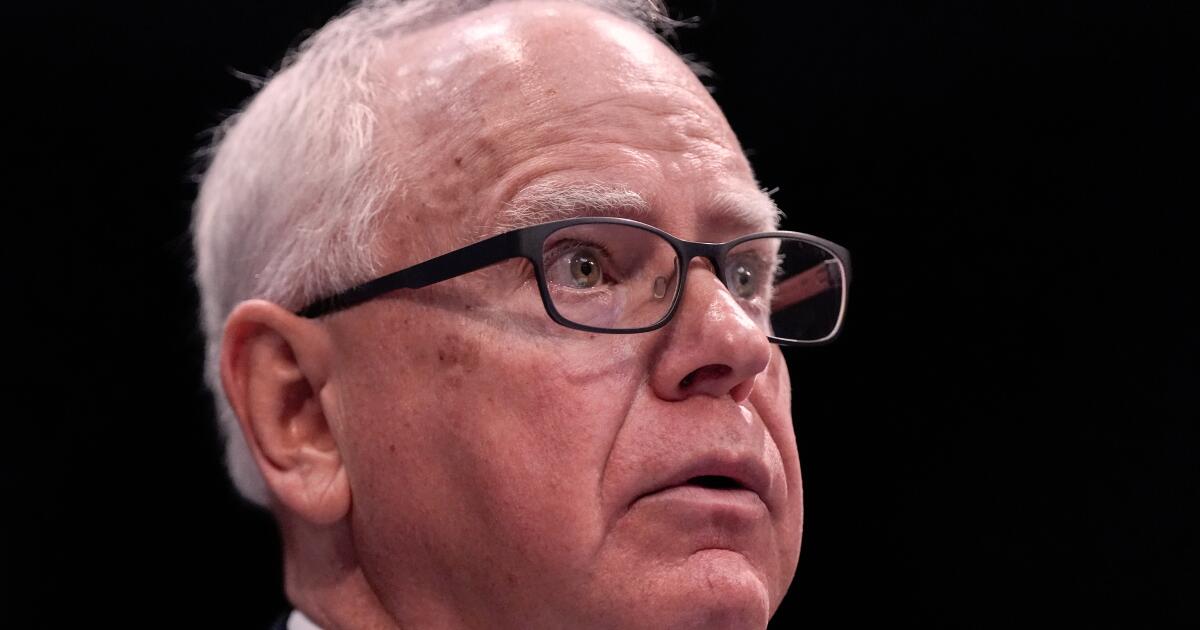
Tim Walz, Democrats’ 2024 VP pick, drops bid for third term as Minnesota governor
ST. PAUL, Minn. — Minnesota Gov. Tim Walz, Democrats’ 2024 candidate for vice president, is ending his bid for a third term as governor amid President Trump’s relentless focus on a fraud investigation into child care programs in the state.
Less than four months after announcing his reelection campaign, Walz said Monday that negative attention and Republican attacks have contributed to an “extraordinarily difficult year for our state,” making it impossible for him to serve full time as governor while also being a candidate to keep his job.
“Every minute that I spend defending my own political interest would be a minute I can’t spend defending the people of Minnesota against the criminals who prey on our generosity and the cynics who want to prey on our differences,” Walz said at the state capitol. “So I’ve decided to step out of this race, and I’ll let others worry about the election while I focus on the work that’s in front of me for the next year.”
Walz did not take questions from reporters after speaking for about seven minutes, much of which involved repeating his earlier written statement announcing his decision.
“Donald Trump and his allies — in Washington, in St. Paul, and online — want to make our state a colder, meaner place,” Walz said, referring to the Trump administration withholding funds for the programs and the president’s attacks on Somali immigrants in Minnesota. “They want to poison our people against each other by attacking our neighbors. And, ultimately, they want to take away much of what makes Minnesota the best place in America to raise a family.”
Despite the opaque references, Walz did not explicitly acknowledge the effect of a viral video from a right-wing influencer who claimed he’d found rampant fraud at day care centers operated by Somali residents in Minneapolis. But the Trump administration has cited the video in its decision to cut off certain federal funding streams, and the video’s creator, Nick Shirley, was happy to take credit for the governor’s decision.
“I ENDED TIM WALZ,” Shirley posted Monday on social media.
Walz’s exit scrambles the contest in a Democratic-leaning state that Republicans have insisted they can win. Democrats currently hold 24 out of 50 governor’s seats nationwide, with 36 seats, including Minnesota’s, on the ballot in 2026.
The candidates to replace Walz
Democratic Sen. Amy Klobuchar is considering entering the Minnesota race, according to a person close to her. The person, who wasn’t authorized to speak publicly and spoke on the condition of anonymity, said the senator, who ran for president in 2020, has not made a final decision.
Around a dozen Republicans are already running. They include MyPillow founder and Chief Executive Mike Lindell, an election denier who is close to Trump. They also include Minnesota House Speaker Lisa Demuth; Dr. Scott Jensen, a former state senator who was the party’s 2022 candidate; state Rep. Kristin Robbins; defense lawyer and former federal prosecutor Chris Madel; former executive Kendall Qualls; and former Minnesota GOP Chair David Hann.
A military veteran, union supporter and former high school educator and coach, Walz helped enact an ambitious Democratic agenda for his state, including sweeping protections for abortion rights and generous aid to families.
Kamala Harris picked Walz as her running mate in the 2024 presidential election after his attack line against Trump and his running mate, then-Ohio Sen. JD Vance — “These guys are just weird” — spread widely.
Walz continued building his national profile since his and Harris’ defeat in November. He was a sharp critic of Trump as he toured early caucus and primary states. In May, he called on Democrats in South Carolina to stand up to the Republican president, saying, “Maybe it’s time for us to be a little meaner.”
There were partisan reactions to Walz’s announcement
Reactions to Walz’s decision reflected the intense partisanship certain to spill into the campaign to pick his successor.
Democratic National Committee Chairman Ken Martin, who led Minnesota Democrats when Walz was first elected governor in 2018, said Walz “entered public life for the right reasons and never lost sight of them.” Walz’s guiding principle, Martin added, “has always been showing up and doing the work that actually makes their lives better.”
Klobuchar, posting on X, praised Walz as “a true public servant” who made a “difficult decision” but said nothing about her own pending choice.
Another Minnesotan of national prominence, Republican House Majority Whip Tom Emmer was more succinct, issuing a statement that said in its entirety: “Good riddance.”
Democratic Governors Assn. Chair Andy Beshear, the second-term Kentucky governor, praised Walz as a “a national leader in fighting for the middle class” and said his organization “remains very confident Minnesotans will elect another strong Democratic governor this November.”
At the Republican Governors Assn., spokeswoman Courtney Alexander blasted Walz for “failed leadership” and argued that the eventual Democratic nominee “will need to defend years of mismanagement and misplaced priorities.”
Walz, for his part, stood by his administration’s stewardship.
“We should be concerned about fraud in our state government,” he said, adding that “a single taxpayer dollar wasted on fraud should be intolerable.” But Walz said his administration has worked diligently to address fraud and manage the state’s operations.
A look at Walz’s time as governor
Through nearly two terms as governor, Walz navigated a closely divided legislature. In his first term, he served alongside a Democratic-led House and Republican-controlled Senate that resisted his proposals to use higher taxes to boost money for schools, healthcare and roads. But he helped broker compromises.
He used the office’s emergency power during the COVID-19 pandemic to shutter businesses and close schools, prompting Republican pushback.
Republicans also were critical of Walz over what they saw as his slow response to sometimes violent unrest that followed the killing of George Floyd, an unarmed Black man, by a white Minneapolis police officer in 2020. Walz pleaded for calm after Floyd’s death but also stood out as a white political leader who expressed empathy toward Black Americans and their experiences with police violence.
In his second term, Walz worked with Democratic majorities in both legislative chambers to chart a more liberal course in state government, aided by a huge budget surplus. Minnesota eliminated nearly all of the state abortion restrictions enacted in the past by Republicans, protected gender-affirming care for transgender youth and legalized the recreational use of marijuana. Walz and his fellow Democrats also enacted free school meals for all students and a paid family and medical leave program that went live on Jan. 1.
That record, combined with Walz’s rural background and experience representing southern Minnesota in Congress, landed him on Harris’ radar as she considered potential running mates in 2024 after replacing Joe Biden at the top of the Democratic ticket. After a whirlwind search, she opted for Walz over other candidates including North Carolina’s Roy Cooper, Kentucky’s Andy Beshear, Pennsylvania’s Josh Shapiro and former Transportation Secretary Pete Buttigieg.
Walz received a warm welcome from Democratic voters but drew mixed reviews for his lone debate against Vance.
More recently, Walz has been frustrated in his efforts to enact new gun control measures following a mass shooting in August at Annunciation School in Minneapolis, which left two children dead and injured dozens. He had hoped to call a special session to consider a list of gun safety proposals.
Karnowski and Barrow write for the Associated Press. Barrow reported from Atlanta.
