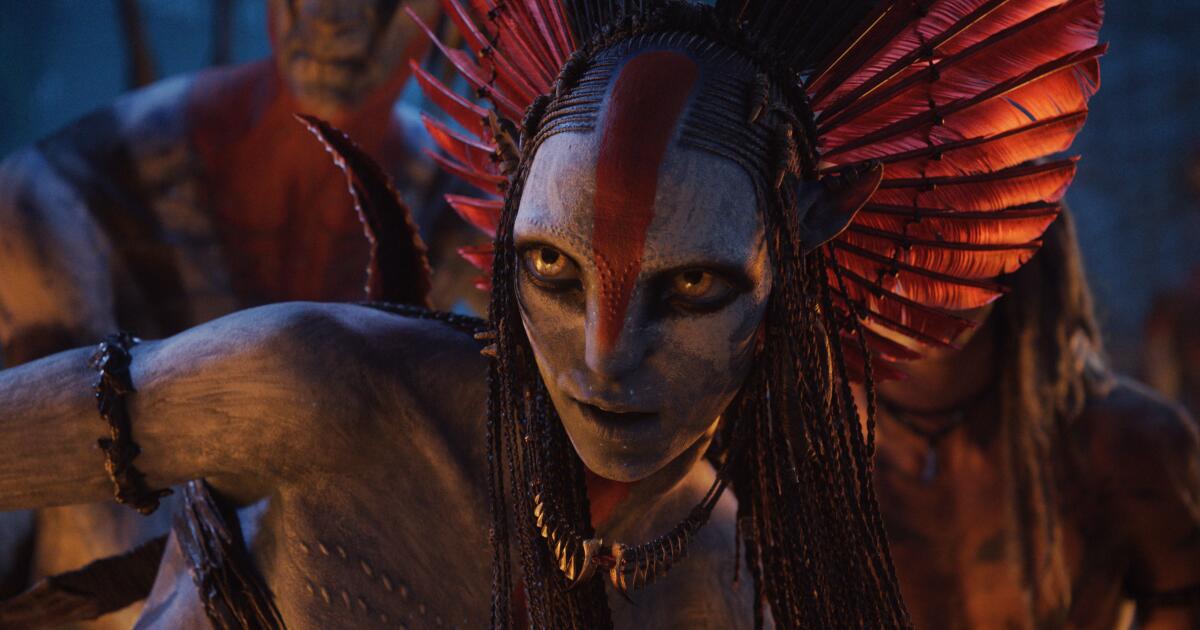
Even ‘Avatar: Fire and Ash’ can’t lift 2025 box office out of pandemic-crisis doldrums
As “Avatar: Fire and Ash” headed to the big screen this month, theater owners held their breath.
In an uneven year that saw two billion-dollar hits and a viral “chicken jockey” craze, but also a disastrous first quarter and a nearly 30-year-low at the October box office, the end of December was the last chance for theaters to make up ground.
But even James Cameron and the Na’vi — the latest “Avatar” film has already grossed more than $472 million globally — couldn’t save 2025 from a disappointing conclusion.
Box-office revenue in the U.S. and Canada is expected to total $8.87 billion for the year, up just 1.5% from last year’s disappointing $8.74 billion tally, according to movie data firm Comscore. More troubling is that 2025’s domestic box-office haul is projected to be down more than 20% compared with 2019, before the pandemic changed audiences’ movie-going habits and turbocharged streaming in ways that the exhibition industry is still grappling with.
The problem: Fewer people are buying movie tickets. Theatrical attendance is running below last year’s levels, with an estimated 760 million tickets sold as of Dec. 25, according to media and entertainment data firm EntTelligence. Last year, total ticket sales for 2024 exceeded 800 million.
Part of the explanation for the falloff in cinema revenue and admissions lies in the movies themselves.
Industry experts and theater owners say the quality and frequency of releases led to dips in the calendar that put extra pressure on the other movies to perform. Once-reliable genres such as comedies and dramas are facing a much tougher time in theaters, and female moviegoers — who came out in droves in 2023 for “Barbie” — were underserved in a year that largely skewed toward male-leaning blockbusters.
“It’s fair to say that 2025 didn’t quite reach the levels many of us expected at the start of the year,” Eduardo Acuna, chief executive of Regal Cineworld, said in a statement. “A big part of that comes down to a lack of depth in the release schedule, and the struggle of many smaller titles to break through.”
Even big-name stars such as Margot Robbie, Colin Farrell, Dwayne Johnson and Sydney Sweeney couldn’t prop up attendance for films such as Sony Pictures’ “A Big Bold Beautiful Journey,” A24’s “The Smashing Machine” and Black Bear Pictures’ “Christy,” all of which flopped.
And despite the critical acclaim and stacked cast list for Paul Thomas Anderson’s “One Battle After Another,” the film has stalled domestically at $71 million, with a global total of $205 million.
“One Battle After Another” had a budget of about $130 million, while “The Smashing Machine” reportedly cost $50 million and has grossed just $21 million worldwide.
“The challenge facing Hollywood is how to reconcile the budgets of these films with how much they can earn in theaters and down the road, eventually, in streaming,” said Paul Dergarabedian, head of marketplace trends at Comscore.
Universal Pictures’ “Wicked: For Good” hauled in more than $324 million, but it was one of few big blockbusters targeted to women. (Taylor Swift’s “The Official Release Party of a Showgirl,” which brought in $50 million globally, was another.)
Though the summer was marked by a number of big films, including Warner Bros.-owned DC Studios’ “Superman,” Universal’s “Jurassic World Rebirth” and Apple’s “F1 The Movie,” most were geared toward male audiences.
Female-focused films are “are few and far between,” said Jeff Bock, senior box-office analyst at Exhibitor Relations, an entertainment data and research firm. “There should be something for everyone playing most of the time, and that isn’t the case.”
To be sure, there were some bright spots for the industry, including success from young audiences.
Warner Bros. Pictures’ “A Minecraft Movie” was the highest-grossing domestic film this year, with $423.9 million. Close behind was Walt Disney Co.’s live-action adaptation “Lilo & Stitch,” which collected $423.8 million in the U.S. and Canada and a total of $1 billion worldwide.
Counting those two, five of the year’s top 10 domestic-grossing films had PG ratings, including “Wicked: For Good,” Disney’s animated “Zootopia 2” and Universal’s live-action “How to Train Your Dragon.”
“In general, the good news about the year is that most of the big hits involved young audiences,” said Tom Rothman, chair and CEO chief executive of Sony Pictures’ motion picture group. “There is a bit of a youth-quake.”
Disney capitalized on the big year for family-friendly fare.
The Burbank entertainment giant recently crossed $6 billion at the global box office for the year, powered by billion-dollar hits such as “Lilo & Stitch” and “Zootopia 2,” and marking the company’s biggest year since 2019. (Though it wasn’t all sunny for Disney this year, as Pixar’s original animated film “Elio” misfired, as did the live-action film, “Snow White,” which was mired in controversy.)
Another notable youth driver was “Demon Slayer: Kimetsu no Yaiba Infinity Castle” from Sony Pictures in partnership with its anime banner, Crunchyroll. The film had a massive opening weekend haul of $70 million in July on its way to a domestic gross of $134 million and a global total of $715 million, highlighting the increasing popularity of anime.
“The mainstreaming of anime at the theatrical box office is a really significant part of what happened this year and a really good sign,” Rothman said. “You’re bringing in young audiences.”
Not surprisingly, established intellectual property — whether video games, known franchises, novels or comic books — still topped the charts this year, with nine of the top 10 domestic films tied to an existing title.
That familiarity at the box office counts when moviegoers, particularly families, are looking for movies to watch. Viewers can be choosy about how they spend their cash and time, and may not always want to gamble on a movie they’ve never heard of.
“Meaningful IP still has an advantage in getting people to come to the theater, though it’s not the only way to do it,” said Adam Fogelson, chair of Lionsgate’s motion picture group, which saw success this year with an adaptation of Stephen King’s novel “The Long Walk,” as well as franchise film “Now You See Me: Now You Don’t.”
Horror flicks also scared up plenty of business in 2025. Warner Bros., in particular, had a string of wins in fearful films, including Ryan Coogler’s “Sinners,” “The Conjuring: Last Rites,” Zach Cregger’s “Weapons” and “Final Destination Bloodlines.”
In one notable exception, Blumhouse had a rare miss with “M3GAN 2.0,” the follow-up to the 2022 cult favorite. In an interview on “The Town” podcast, Blumhouse Productions Chief Executive Jason Blum blamed the sequel’s shortcomings on a change in genre from the original.
As 2025 draws to a close, industry insiders and theater owners are more optimistic about next year’s box office prospects.
Several big films are set to release in 2026, including Christopher Nolan’s much anticipated “The Odyssey,” Disney and Marvel Studios’ “Avengers: Doomsday,” Denis Villeneuve’s “Dune: Part Three,” as well as Disney and Pixar’s “Toy Story 5” and “The Super Mario Galaxy Movie” from Universal, Nintendo and Illumination Entertainment.
That anticipation is also clouded by the uncertainty of the impending Warner Bros. deal and what that will mean for movie releases.
Many cinema owners fear that a takeover by Netflix will limit or eliminate the theatrical exclusivity of Warner Bros. films, though Netflix executives have said they will honor the company’s current and future commitments to the big screen. And if Paramount were to buy the company, theatrical exhibitors fear that the number of films would decrease, leaving them with less content to show. (Paramount CEO David Ellison has said the company did not plan to release fewer movies.)
Any deal is expected to take at least a year to complete.
In the meantime, Hollywood will wait to see how strong the 2026 slate truly is.
“There are a lot of great titles out there, and that’s why people have been calling 2026 a return to form,” said Bock of Exhibitor Relations. “Even though 2026 is very promising, can Hollywood keep delivering year-in and year-out?”