It turns out Raven Johnson’s “revenge tour” wasn’t completely over.
The South Carolina guard was selected as the 10th overall pick by the Indiana Fever at the 2026 WNBA draft Monday, setting her up to be reunited with a former college teammate as well as a notable rival.
Described as “one of the most WNBA-ready players” in the mock draft by The Times, the two-time national champion was famously waved off by then-Iowa phenom Caitlin Clark during their Final Four matchup in the 2023 NCAA women’s basketball tournament.
During the first quarter, Clark declined to guard Johnson, who had the ball outside of the three-point line, with wave of her arm while turned away from her. Not only did Clark’s team go on to win, the taunt — much like a number of other moments involving the sharpshooting former Hawkeye — went viral.
Johnson has been open about how that moment and the online response took a toll on her mental health.
“I was all over the internet,” Johnson said while discussing some of the adversity she’s faced in her basketball career on a recent episode of the “I Am Next” podcast. “I got bashed, I got bullied, I got called all these things that I wasn’t … like a monkey [and] just things like that. I wanted to quit basketball at that time and I wanted to just go in this little bubble of isolation and just be by myself.”
She credited her faith and the support of her teammates and loved ones for being able to turn it around and use the moment to fuel her “revenge tour” the next year. South Carolina beat Clark’s Hawkeyes in the 2024 national championship to cap off an undefeated season.
Caitlin Clark and Raven Johnson at the 2024 NCAA women’s basketball tournament.
(Carolyn Kaster / Associated Press)
At least in part because of this history, the online response to Johnson being drafted by the Fever has been divided among the team’s fans as well as the supporters of each of the individual players. But the Fever staff were clearly elated to be able to nab Johnson off the board.
“Let’s go,” Fever coach Stephanie White said in a video call with Johnson posted on social media on Monday. “We are so excited.”
Johnson isn’t the only one who is set to join forces with a rival in the next chapter of their career. Following her trade from the Sparks, Rickea Jackson will be teammates with Chicago Sky center Kamilla Cardoso, whose game-winning buzzer beater for the Gamecocks took down the former’s Tennessee team at the 2024 Southeastern Conference tournament.
And that’s not to mention the Washington Mystics following their selection of UCLA center Lauren Betts as the fourth overall pick Monday by later drafting Texas standout Rori Harmon in the third round. Betts’ viral block is what sealed UCLA’s win over Texas at the Final Four en route to the Bruins’ championship win earlier this month. (The Mystics also selected UCLA forward Angela Dugalic in the first round.)
Despite the naysayers, Johnson appears excited to be joining a championship contender with the Fever. During a Monday news conference, Johnson mentioned Clark, Aliyah Boston and Kelsey Mitchell among the team’s vets she’s looking forward to learning from.
“She has taught me so much through my college experience,” Johnson said of Boston, her former college teammate. “She taught me what pro habits were. She taught me you have to bring those habits every day to practice. … She is a phenomenal person. She instills so much in young people and there’s no way you don’t want to play with somebody like that [and] look up to somebody like that.”
It was not just a nation of sports fans and media that became entranced when former Chargers great Philip Rivers, like a soldier, answered the call to duty and joined another one of his former teams, the Indianapolis Colts, at age 44, five years after his last game. (Five years after! No misprint). Former players, like me, were curious and envious.
This was a selfless, noble act by Phil. A player is not eligible for the Hall of Fame until five years after his last season. Thus, Phil has delayed his consideration as a candidate by another five years.
The winter is not merely a matter of age; it is long after the time when the pro football player lived a life at full throttle, doing what years of unromantic labor crafted his mind and body to do.
Jim Porter, the president and chief executive officer of the Pro Football Hall of Fame, reported that about 35 million males, from youth leagues to high schools to colleges, have played organized football. Of that total, only about 22,000 have played in a professional game. Shameful pride compels me to say there are only about 300 players in the Hall of Fame.
Colts quarterback Philip Rivers throws the ball during a game against the San Francisco 49ers on Dec. 22 in Indianapolis.
(Zach Bolinger / Associated Press)
Now, at 88 years old, I am in that winter of life; a time long after leaving that locker room, a place that was alive with bravado and bonds with teammates, each knowing the devastating work it took to, not only get there, but to stay there, because each year the team would bring in a fresh group of draftees and players acquired by trade who wanted your spot. As teammates, we had an unspoken contract to do the drills to the extent that the movements become instinct, to do the work, to play injured, to show up.
The memories of teammates stay fresh. I will share a few stories that stick with me about players early Charger fans will recall:
Power of Alworth
San Diego Chargers wide receiver Lance Alworth poses for a photo in 1970.
(Associated Press)
Lance Alworth is in the Pro Football Hall of Fame. Our team in the ‘60s had many players that deserve to be called great; however, we all held Lance in special regard because he encompassed high levels of skill and character. He had speed, elusiveness, and he blocked (something of a dirty word to many wide receivers). The best way to describe how I felt about Lance is to relate an incident that took place when our plane was returning from an East Coast game. The plane hit a long stretch of weather so bad that it caused the plane to rise and drop and shake to such an extent that I knew it was going to crash and kill us all. I truly felt it was all over. Then I remembered that Lance was on board and I relaxed, thinking we are safe because God would not kill Lance. I am still amused that I actually thought that.
A formidable man
Ernie Ladd, seen here in action for the San Diego Chargers, on Oct. 29, 1963.
(Associated Press)
Ernie Ladd was a 6-foot-9, 325-pound defensive tackle who played the position with skill and fury and, for four seasons, before severe knee injuries reduced him from great to good, was as skilled as anyone who ever played the position. And strong. Ernie joined the Chargers in 1961. In 1963, coach Sid Gilman made the Chargers the first team in professional football to employ a strength coach and direct that all players begin a weight-training program. At that time, I was one of only a few players in professional football that lifted year-round because coaches, at all levels of football, discouraged weightlifting, believing it tied up an athlete’s muscles. Ernie had never lifted weights. During our first training session with our strength coach, Alvin Roy, Ernie lifted 300 pounds over his head. I had trained for years and my best lift at that time was a military press of 325 pounds.
He demonstrated strength and restraint when a dispute arose between him and a teammate, who I will refer to as X, a defensive lineman whose play fell far below expectations when he was a high draft choice. Ernie was given to fun-loving razzing of others in the locker room. X took offense and swung his fist at Ernie. Ernie caught the fist in his big right hand, then grabbed X’s forearm and bent the wrist up, forcing X to the ground. Ernie then said, “X, if I let you up, are we done?” X, red with embarrassment, said it was over and Ernie released him.
The reason this stuck with me was because it reminded of an incident in the John Steinbeck novel, “Of Mice and Men,” in which Lennie, a slow-witted worker on a ranch, was being repeatedly struck by the ranch foreman until Lennie caught the foreman’s fist in the air and crushed his hand. The reference is a bit strained because Ernie was extremely bright.
Ernie was the most joyful game participant I had ever seen, bright and quick-witted, laughing before a game, getting energy from the thrill of what was about to take place. Before one of our games, he said to me in a mockingly serious voice, “Ronnie Jack, I hope I don’t kill anyone out there today. If I do, I want you to represent me and plead self-defense.” At the time, I was going to law school at night.
Surprising Wright
Ernie Wright left college early and joined the team at age of 20, the same year I signed up for the Chargers — 1960. He played offensive left tackle, making All-Pro several times. He was extremely bright, great work ethic, and proved it by having a very successful post-football business career.
Different players have different game-day, pre-event routines. I tried to stay calm and collected no matter how big the moment. I believed that if I allowed myself to get charged up by adrenaline rushes before the game started, I would use up energy I needed for the entire game.
My pregame ritual became a curious thing for Ernie. After one of our games, Ernie approached me, and the following conversation took place:
Ernie: I have been watching you before games and seeing your lips moving and I thought you were praying. I finally decided today to get closer so that I could hear what you were praying for. Was it for a team to win, was it to kick butt. You were singing to yourself! You were singing “Fly Me to the Moon.” Is that what you have been doing before all these games?
Me: That’s it. It is my way of staying calm.
Ernie (laughing): And here I thought you were deeply religious, and I have been careful not to swear around you.
A mind for politics
Republican vice presidential candidate Jack Kemp accepts a jersey from football players at Fairfax High in 1996.
(John Hayes / Associated Press)
Jack Kemp was the Chargers’ first quarterback. After an injury in his third year, he played for the Buffalo Bills. After football, he became a congressman in the Buffalo area and, later, presidential candidate Bob Dole’s choice to join his Republican ticket as his vice presidential running mate. Jack and I were training camp roommates during our first year with the Chargers. We became close friends. Jack was constantly thinking about politics and the relationship between government and the public and how power and policy shape everyday life and collective freedom.
Jack’s early political beliefs embraced the John Birch Society, a movement that felt expansive federal power is a threat to individual liberty. Among the Birch beliefs that Jack embraced was that there should not be Social Security, that if it was absent, people would then accept the responsibility of regularly putting away funds for their retirement.
During the week before a game in San Diego, I told Jack that Social Security is earned insurance, not welfare, that it spreads the risks across society, and keeps seniors out of poverty. I gave as an example my mother, who was a first-generation American with only a fifth-grade education who, prior to my retiring her when I signed with the Chargers, held minimum wage jobs that barely covered monthly expenses of her raising my brother and me by herself. I told Jack that her, and likely millions like her, given the choice of setting aside a dollar a month for retirement or spending it to care for her family, would place family first.
The depth of Jack’s constant thinking of politics became clear to me the Sunday of that week. I have forgotten the name of our opponent, but I do remember that it was a brutally contested game on a very hot day and we were ahead by only three points. At halftime, our team was walking toward the locker room when I heard Jack call out to me: “Ron, Ron, wait up.” I thought he was going to ask my opinion on what run plays would be best to call. Nope. Jack said: “I’ve been thinking about what you said about Social Security and people like your mother. I agree with you. Social Security must stay.” Then he was back to football: “OK, then, let’s get ‘em.”
I was surprised. It was a, “Wait … did that just happen?” moment. We were in the middle of a football game!
Being a part of something special
Athletes, as a group, have always been ahead of the country in improving racial and religious relations among the population. I am reminded of my senior year at the University of Southern California in 1959 when Willie Wood and I were elected co-captains of the football team. That was done at a time when 99% of the fraternities at the school barred us from membership because Willie was Black and I was Jewish. That sentiment in America meant nothing to our predominately white Christian teammates who, true to the nature of sports, judged teammates only on their character, work ethic and production.
Missing the demands of the game
And then there were the opponents. How deeply they are missed, those men across the line who made excellence necessary. While it is true that some opponents were less skilled than others, the collisions with all of them were just as real.
Playing against greatness was a measurement of who you were. I had the, yes, the pleasure of playing directly against fellow Hall members such as Deacon Jones, Buck Buchanon, Bobby Bell and Claude Humphrey, and a slew of other notable defensive linemen. They, and others, were equally committed to stopping me from doing my job.
It has now been 54 years since I left the game and I still miss it.
Mix was inducted into the Pro Football Hall of Fame in 1979.
Lakers guard Bronny James blocks a shot by Spurs forward Kelly Olynyk at Crypto.com Arena on Feb. 10.
(Gina Ferazzi / Los Angeles Times)
For the second consecutive game Friday, Lakers coach JJ Redick called the second-year guard’s number for important minutes.
Not to complete garbage time chores. Not as a gimmick to please the King. But because he needed a ball-handler he could trust after the regular rotation got wonky in the second quarter of the Lakers’ 116-99 victory over the Brooklyn Nets at Crypto.com Arena.
For the second consecutive game, Bronny helped buoy the Lakers. In four minutes, he had a deflection and drained a three-pointer that not only keyed a much-needed 9-0 Lakers run but also was the first father-to-son assisted basket in NBA history, coming on a pass from LeBron.
His former teammate sees in Bronny what his current teammates do: A hard worker who needs only to nurture his confidence to be able to contribute in the NBA.
“He’ll be great,” Williams said. “Especially starting off on the defensive end. He can guard one through four, pick up full [court,] have good ball pressure. On the offensive end, he’s a gamer. He can make shots, he can drive the ball. He can get his teammates open. The biggest thing with him is just keeping that confidence.
“When he’s confident and he’s in flow state, in rhythm, he’s a great, great player. … He’s just gotta keep working.”
Bronny’s been working in the G League the last two seasons, bouncing between the big leagues and the developmental circuit, where last season his averages were solid — including 21.9 points, per game — but nowhere near as efficient as they’ve been this season. In 13 games, he’s averaging 14.8 points on 54.7% shooting, including 41.7% from three-point range.
Lakers forward LeBron James greets his son, guard Bronny James, on the court during a game against the Clippers at Crypto.com Arena on Nov. 25.
“He’s always been able to shoot the ball. He shot the ball at a high level pretty much throughout his years of playing ball. So I just think there’s the confidence in the rhythm and just getting the strength back and his wind and everything. Everything is just coming back.”
That’s carried over to the big club; Bronny is shooting 41.9% from three-point range in those instances when Redick has called on him — as he also did in a 137-130 victory over the Indiana Pacers on Wednesday.
In that victory, Bronny had four points, two steals and a block in 13 minutes. Redick credited the 21-year-old with settling the team with a pull-up jumper with 3:55 to go in the game, which was the second this season LeBron and Bronny played together.
The first time it happened, in the season opener in 2024, the prevailing thought was that it wouldn’t happen again for a long time — and if it did, something had probably gone very wrong for the Lakers that game.
But that’s not the case. No, because Bronny has made a convincing case as an NBA player.
“I’ve been wanting to play basketball my whole life,” Bronny said. “It’s a dream come true. I’m so privileged to be able to play basketball for a job and I love every single second of it. My teammates embrace it. I’m best friends with all my teammates and my coaches. I’m just happy to be here.”
He’s become an effective plug-and-play piece — and not on a tanking Nets team that regularly runs out G League-caliber players, but on a playoff-bound Lakers team that has won 14 of its last 16 games.
The No. 55 draft pick in 2024, Bronny has surpassed Dalton Knecht, the 17th pick in that same draft, in the Lakers’ pecking order.
He’s become a player who can be counted on, and he’s especially valuable to a team that happens to badly need youth and athleticism, as the Lakers do.
You want to talk twists? How about whatever happens with LeBron — when, or if, he retires — the Lakers should seriously consider keeping Bronny in the fold. Seriously.
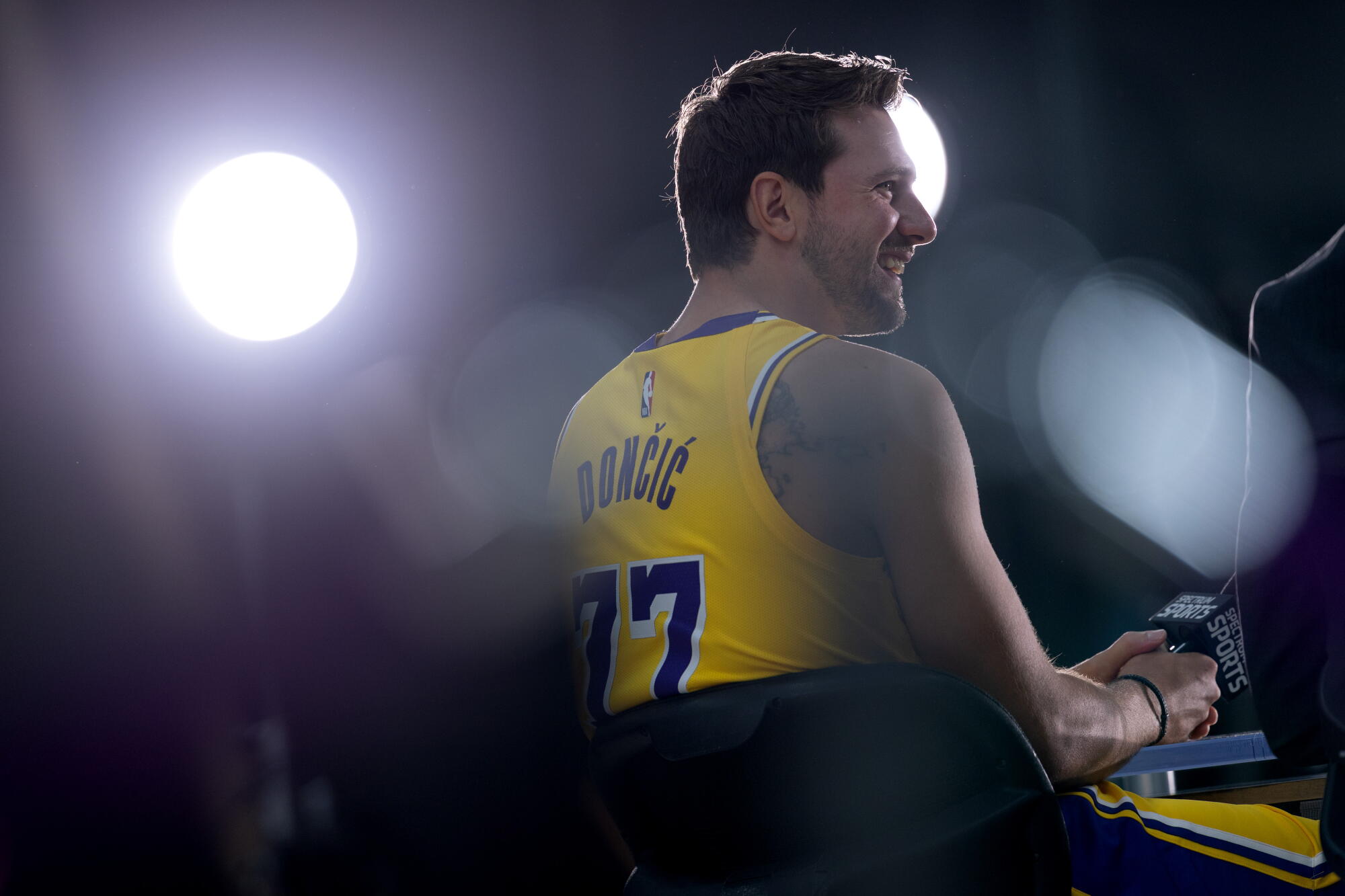
MIAMI — The chants started in a purple-and-gold-clad cluster in the upper deck at Kaseya Center. As Luka Doncic’s scoring total crept up with each step-back three, free throw or fadeaway shot, the cheers grew louder, coming from every corner by fans dressed in every color.
“M-V-P! M-V-P!”
“That’s what I think every player wants to hear,” Doncic said.
Doncic’s season-high 60 points — the first 60-point game for a Lakers player since Kobe Bryant’s swan song in 2016 — led the Lakers to a 134-126 win over the Miami Heat on Thursday. It was another exceptional feat in Doncic’s late-season campaign for the NBA’s most valuable player.
The NBA’s leading scorer poured in 100 points in less than 24 hours, helping the Lakers extend their winning streak to eight games. Doncic is averaging 40.9 points per game over the streak, shooting 42.2% from three-point range. He became just the seventh Laker to record a 60-point game, joining franchise legends Bryant, Elgin Baylor, Wilt Chamberlain, George Mikan, Jerry West and Shaquille O’Neal.
Doncic’s dominance has rescued the Lakers, propelling them to a season-best winning streak. The team’s previous best winning streak was built by taking down bottom-feeding teams including New Orleans, Utah and Dallas. This streak is against some of the league’s best: Six wins are against teams with a .500 record or better and five were against .600 teams. The Lakers have climbed from sixth to third in the Western Conference in two weeks, netting critical tiebreakers against rivals Minnesota, Denver and Houston.
Lakers star Luka Doncic, left, controls the ball in front of Miami’s Bam Adebayo during the first quarter Thursday.
(Rich Storry / Getty Images)
Doncic, in his first full season with the Lakers, began the season as one of the betting favorites to win MVP. But the Lakers went through December doldrums, losing four out of five. He missed two games while traveling to Slovenia to be present for the birth of his second daughter, Olivia. When he returned, Doncic shot 24.5% from three over the next five games.
Doncic’s defense was criticized, along with his consistent complaining to referees. Reigning MVP Shai Gilgeous-Alexander, who leads the Western Conference-leading Oklahoma City Thunder with 31.5 points, 4.5 rebounds and 6.6 assists, figures to still be the favorite in the MVP race, especially with the Thunder on a conference-best 10-game winning streak.
Doncic’s production never dipped — he has maintained the league’s top scoring average for most of the season — but his play still lacked the same zip that made him a must-watch star in Dallas.
Lakers star Luka Doncic reacts after making a three-pointer in the third quarter Thursday against the Miami Heat.
(Rich Storry / Getty Images)
The Lakers embodied some of their star’s struggles. The team was sorting through injuries while trying to integrate new pieces. The chemistry “wasn’t there,” guard Marcus Smart said.
Finally, it all clicked, starting with Doncic.
“Just trusting my game,” Doncic said of how he’s reached this level at this stage of the season. “I know some games I won’t have it. … I’ve been there, so you just got to trust in yourself. I got all the support from my teammates, which helps me a lot.”
Teammates cheered, jumped and raised their fists from the Lakers bench when Doncic made his final free throw to finish off his 60-point night. On a night when LeBron James tied the NBA’s regular-season games played record, appearing in his 1,611th game and notching a 19-point, 15-rebound, 10-assist night, it was Doncic’s final points that seemed to make James smile the widest.
Doncic, who said the crowd’s chants gave him goosebumps, added it “makes my heart happy” seeing the reaction from all of his teammates.
Lakers star LeBron James reacts to a free throw by teammate Luka Doncic in the fourth quarter against the Miami Heat on Thursday.
(Rich Storry / Getty Images)
“We all know the talent that Luka is,” Smart said. “And when he gets in those modes, man, it’s definitely a sight to see, and you don’t want to miss it.”
Before the game, Redick sarcastically wouldn’t even utter the name of the award Doncic has positioned himself for, only saying he believed Doncic should be in the “M-word conversation.”
If it’s not the cheers from the crowd, Doncic doesn’t care about the chatter either.
“It’s you guys, the media,” Doncic said. “I ain’t got nothing to do with it.”
MIAMI — Venezuela won the World Baseball Classic for the first time, rebounding from a blown eighth-inning lead to beat the United States 3-2 Tuesday night on Eugenio Suárez’s tiebreaking double in the ninth.
Maikel Garcia’s third-inning sacrifice fly and Wilyer Abreu’s fifth-inning homer off rookie Nolan McLean built a 2-0 lead before a roaring pro-Latin America crowd. Meanwhile, left-hander Eduardo Rodríguez and lights-out relievers limited the Americans to two hits through the seventh.
Bobby Witt Jr. walked with two outs in the eighth and Bryce Harper drove the second straight changeup from Andrés Machado over the center-field fence for a two-run homer that tied it. Harper slowly trotted around the bases and took time at third to salute coach Dino Ebel.
Luis Arraez walked against Garrett Whitlock starting the ninth. Pinch-runner Javier Sanoja stole second just ahead of catcher Will Smith’s throw and came home when Suárez doubled to the left-center gap. Suárez spread his arms wide and pointed to the sky at second base while teammates streamed from the dugout to greet Sanoja at the plate.
Daniel Palencia struck out two in a perfect bottom half to finish a three-hitter and get his third save of the WBC, striking out Roman Anthony to end the game. Venezuelans ran onto the infield to celebrate as the Americans stared while leaning on their dugout railing.
“Nobody believed in Venezuela but now we win the championship,” Suárez said. “This is a celebration for all the Venezuelan country.”
Despite a heralded roster of stars led by Aaron Judge, Harper and Paul Skenes, the U.S. lost its second straight final of baseball’s premier international event and remained without a title since 2017.
Venezuela celebrates its victory.
(Lynne Sladky / Associated Press)
Judge was 0 for 4 with three strikeouts in the championship game and hit .222 with five RBIs in the tournament, while Harper batted .214 with three RBIs and Alex Bregman .143 with four RBIs. The U.S. scored nine runs in the three knockout-round games while batting .188.
Ahead of a matchup with political overtones, players and coaches avoided discussing the government turmoil between the nations, heightened when the U.S. military captured Venezuela President Nicolás Maduro in January. The sellout crowd of 36,190 at LoanDepot Park was heavily pro-Venezuela, with some booing American players during the introductions.
Venezuela became the second Latin American nation to win the WBC, after the Dominican Republic in 2013. The U.S. took the title in 2017 and lost the 2023 final to three-time champion Japan on this same field.
While the U.S., Japan and the Dominican Republic got much of the attention ahead of the sixth edition of the 20-nation event, Venezuela’s success was not that surprising. Sixty-three players born in Venezuela appeared on Major League Baseball opening-day rosters last year, second-most from outside the U.S. behind the Dominican Republic’s 100.
Venezuela went ahead in the third inning against McLean, getting the start because Tarik Skubal and the Detroit Tigers decided the two-time Cy Young Award winner would make only a first-round appearance.
Salvador Perez sliced a first-pitch single and Ronald Acuña Jr. walked with one out. The runners advanced when McLean bounced a curveball, and Garcia followed with a sac fly to center.
Abreu doubled the lead when he drove a fastball 414 feet to center. His helmet fell off when he rounded second and he hopped in excitement as he neared the plate, where he was greeted by a line of teammates.
Rodriguez gave up one hit in 4 1/3 innings before Venezuela turned to its bullpen.
U.S. players had arrived at LoanDepot Park in game-worn U.S. Olympic hockey jerseys coordinated by outfielder Pete Crow-Armstrong and Jack Hughes, who scored the gold medal-winning goal against Canada last month.
In a darkened ballpark filled by fans wearing wristbands with festive blinking lights, Judge and Arraez led the teams down the foul lines for the introductions while carrying their nation’s flags.