team melli

Iran is right. FIFA, U.S. government must be better World Cup hosts

How it started: A dream. A French machine-gun officer in the trenches during the First World War. A man named Jules Rimet, who believed an international soccer tournament would bring the nations together with the goal of peace.

How it’s going: The world’s biggest party. A 48-nation celebration of the world’s most beloved sport. Expected to generate about $8.9 billion, it’s become such a big deal that it’s being hosted by three countries — one of which, yes, launched a war on a competing nation in the months before the tournament.

The United States’ war with Iran, costly in all the profound ways that war is, also laid the groundwork for an uneven — and possibly precedent-setting — playing field.

At this World Cup, Team Melli has been subjected to shifting travel restrictions and uncertainty unlike the other 47 teams, spending the tournament commuting between Southern California and its base in Tijuana.

And still, after Sunday’s 0-0 draw against Belgium, the world’s No. 10-ranked team, Team Melli is in position to not only get out of its group at the World Cup for the first time, but to win Group G.

Iran’s treatment only makes its performance more impressive — while bringing into question the future of a tournament that purports to be apolitical. And conjuring up concerns about how the Olympics will operate when L.A. is supposed to open its arms to the world two years from now.

Will we be laying down blanket bans again? Will it be easier to ditch diplomacy than to deal hospitably with a global audience for a global event?

Russia and Qatar were capable of implementing systems that relaxed visa requirements to accommodate every team and its fans in the previous two World Cups. Why couldn’t the United States?

Instead, the U.S. State Department suspended visa issuance for nationals from not only Iran, but also from participating countries Haiti, Senegal and Ivory Coast. Iraq’s striker, Aymen Hussein, was held and questioned for nearly seven hours at Chicago’s O’Hare airport.

And the U.S. has allowed members of Iran’s team — discounting the 15 administration officials who reportedly were denied entry — to enter the country only within 24 hours of a match and leave the same day.

And those arbitrary restrictions — they’re OK 24 hours before a match, but not 48? — have put Team Melli at a competitive disadvantage.

“I think that united us even more,” said winger Alireza Jahanbakhsh, who spoke eloquently in English postmatch, a gracious statesman in Adidas sneakers. “That’s one of the things that I think we showed today — we showed a great team character. And part of it comes from the situation we are in.”

Through an interpreter, coach Amir Ghalenoei broadened the scope of what Iran has been facing in its runup to the World Cup.

“We were in a state of war for six months, we didn’t have a league and I remember once during a FIFA qualifying day, we traveled 40 hours by land to another country to play,” Ghalenoei said. “Everybody knows about the visa issues. Everyone knows about our coming to America. A part of the team was in competition conditions and part of them had their domestic league suspended because of the war … and many of the teams that were supposed to play us, canceled.

“I think we entered the World Cup in the worst possible conditions. This is the part I wanted the whole world to know … but the players who entered the World Cup under these conditions are truly commendable.”

It’s been a spirited rebuttal to what’s felt like a counterattack on the inherent values of the World Cup. A reminder that governments and governing bodies can get it wrong, but the beautiful game stays undefeated.

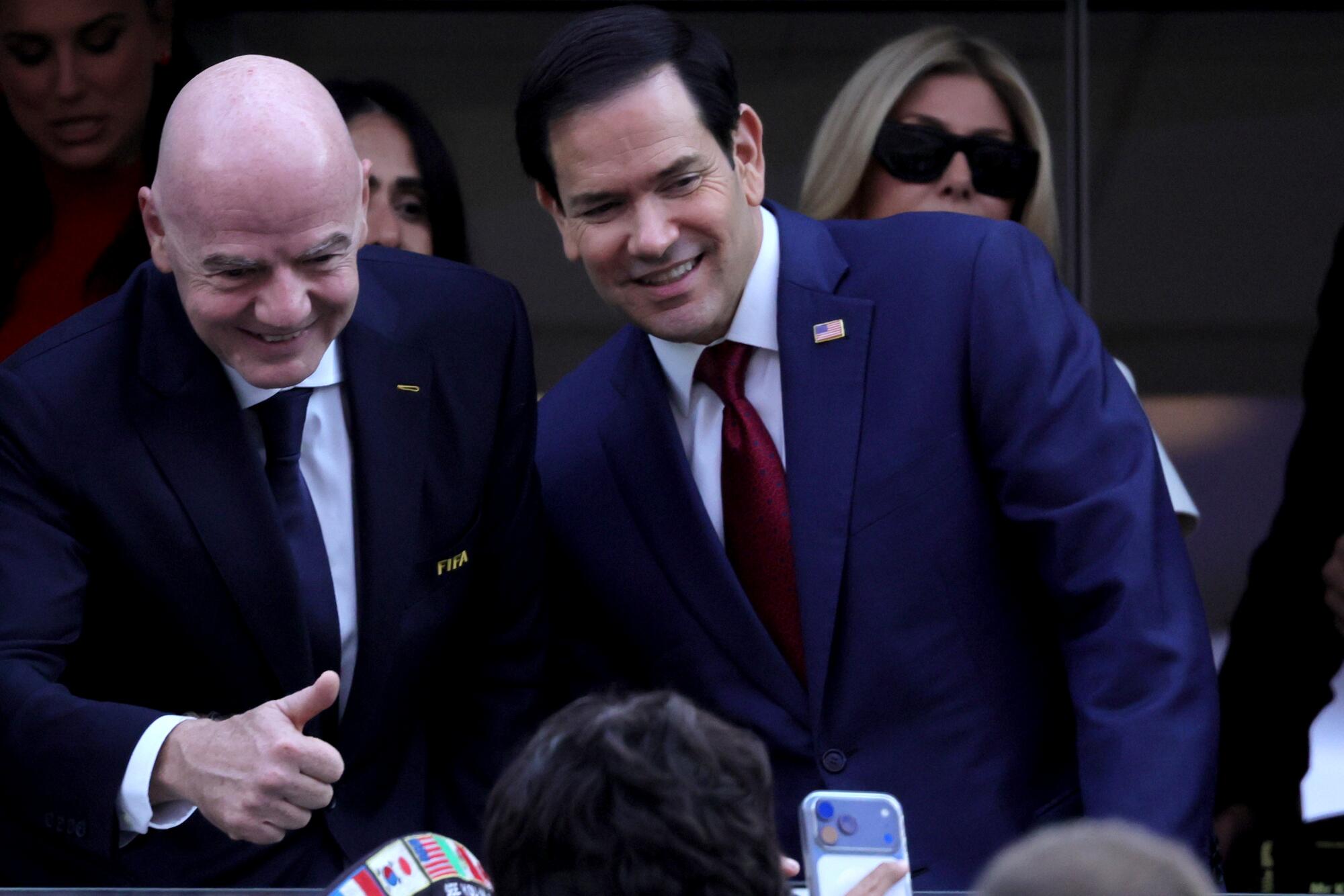
FIFA president Gianni Infantino, left, and U.S. Secretary of State Marco Rubio pose for a photo.

FIFA president Gianni Infantino, left, and U.S. Secretary of State Marco Rubio pose for a photo before a World Cup game between the U.S. and Paraguay at SoFi Stadium on June 12.

(Robert Gauthier / Los Angeles Times)

But what about FIFA?

What about the all-powerful governing body that runs the sport, whose motto is “Football Unites the World”?

The world’s foremost party planning committee, with the cachet to override branded venue names with generic, location-based names — Los Angeles Stadium instead of SoFi Stadium — on Google and Apple maps?

What has FIFA done to flex its muscle to maintain the integrity of the world’s beautiful game?

Not much.

There have been niceties and brownnosing, but no sanctions or threats thereof. Not even a hint of repercussions for diminishing the integrity of the event.

No fines, like what FIFA imposed on six national football associations in response to racist incidents involving supporters during the qualifiers for the World Cup.

No bans, like what FIFA leveled in 1988, when it ousted Mexico from all FIFA competitions for using four overage players in the Under-20 World Cup, or in 2006, when Myanmar was banned from qualifying after refusing to play Iran in an Asian qualifying match for the 2002 World Cup.

Peace talks are ongoing between the United States and Iran, but Iran’s footballing ambassadors haven’t been free to move or to prepare as they wish ahead of its matches against Belgium, and before that, their 2-2 draw against New Zealand.

Apparently, though, Iran will get greater control over travel arrangements before its now hugely consequential final group-stage match is in Seattle against Egypt on June 26, or so Ghalenoei believed when he addressed reporters Saturday.

“What my problem is, why didn’t they let ‌us come ⁠earlier for the first two games as well?” Ghalenoei asked. “If they’ve managed to do this now, why didn’t they do that for our first game and for this game?”

Good questions.

Questions no one should be asking at the World Cup.
Source link

He lost his father to Iran’s regime. At World Cup, he cheered for Team Melli

Unprecedented sports feats and historical firsts are usually joyous affairs. Something to celebrate, fun trivia to tuck away for later.

On Monday in Inglewood, the history was much more fraught, and not at all trivial.

Iran’s national soccer team played on American soil — this time on SoFi Stadium’s natural turf — for the first time in 26 years. And for the first time, a country hosted a World Cup participant with which it is mired in an on-again, off-again war.

There was, in the days and hours leading up to the match, protest and pushback from portions of the large, local Iranian diaspora who didn’t think it was possible to support the country’s football team without supporting the oppressive regime.

But inside SoFi Stadium, thousands of L.A.’s Iranian supporters gave the team its full-throated support. So did many new Mexican fans who’ve adopted Team Melli, which has been staying and training in Tijuana between matches as it was barred from the United States except for game days.

Most of the near-sellout crowd of 70,108 were there cheering Iran, helping propel this team under so much pressure to an entertaining 2-2 tie with New Zealand.

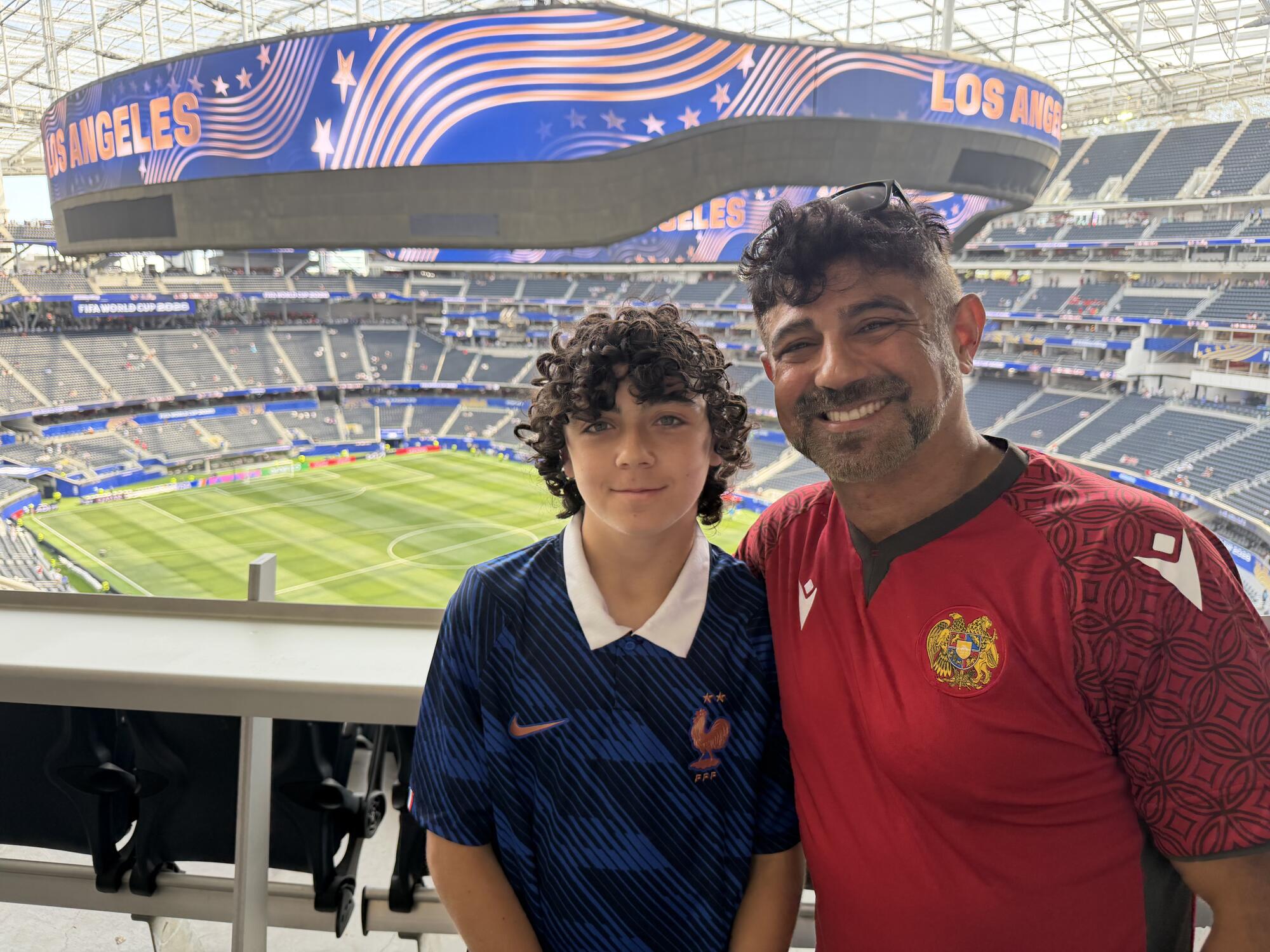
And there, among the thousands of enthusiastic Iran supporters swept up in the match, was my son’s favorite soccer coach, Narbé Mansourian, with his son, 13-year-old Daniel.

Narbé’s brother got his hands on a pair of nosebleed tickets and immediately handed them over to his soccer-loving relatives.

And Narbé — a fifth- and sixth-grade social studies teacher in Hollywood — had no qualms about backing these Iranian men. There were no second thoughts about separating the players from the politics in the country with the complicated geopolitical — and personal — history.

Now, know this: Mansourian is no fan of Iran’s Islamic regime. He was 7 in 1983 when his father, a political dissident, was executed in Evin Prison, nine months after he’d been apprehended.

Narbé remembers visiting his dad, Vazgen, at the notorious prison. He remembers the long drive to get there, the long wait to see him and the game he and his mom used to play: “Today you are 4 years old.”

Narbé Mansourian, right, and his son Daniel before Monday's World Cup match between Iran and New Zealand at SoFi Stadium.

Narbé Mansourian, right, and his son Daniel before Monday’s World Cup match between Iran and New Zealand at SoFi Stadium.

(Mirjam Swanson / Los Angeles Times)

What started as a way to avoid paying bus fares for 6-year-old Narbé became the way to fool guards at prison, where only the small children were allowed to physically touch their imprisoned loved ones.

He remembers being allowed behind the glass, where he’d wait for his dad to emerge, blind-folded.

When his dad was killed at 37, Narbé said his mother didn’t immediately find out. And when she did, she initially told Narbé that he’d been sick. There was no funeral and when they went to visit his father’s grave, they found a dirt field. There were no markers, Narbé recalls.

He has kept Vazgen’s Coke-bottle glasses, his watch and the still-intact little LEGO house they built together before his dad was taken to prison.

Narbé has held onto so many difficult memories, including the nighttime terrors associated with bombings during the Iran-Iraq war. But there are also happier recollections. Like the stories he would make up about good guys going against the greedy. And, yes, memories of going to soccer games with his dad.

So, “absolutely, I’m going to root for the Iranian national team,” Narbé said before Monday’s match, saying that, to him, equating the Iranian national team with the country’s regime is like rooting against the Knicks because you don’t like President Donald Trump, a native New Yorker.

“It’s not like a cartoon good guy, bad guy,” Narbé said. “There’s so much gray. Because they live there. My heart goes out to them. It can’t be easy, to kind of teeter-totter like that.”

A pre-revolutionary Iranian flag is displayed before the World Cup group stage match between Iran and New Zealand at SoFi.

A pre-revolutionary Iranian flag is displayed before the World Cup group stage match between Iran and New Zealand at SoFi Stadium.

(Allen J. Schaben / Los Angeles Times)

I should’ve expected this outstanding youth soccer coach would be most concerned with the players on the pitch.

Some fans got into SoFi on Monday with the Iranian Lion and Sun flag, a historic Iranian national and opposition flag that was banned from the stadium because FIFA desires to steer free of politics (unless it’s steering straight into them). It was a strange sight in Los Angeles, seeing stadium workers asking attendees to discard flags in an effort to censor the expression of people here.

Some of those fans turned their backs during the national anthem, which many in the stands jeered at its start. But then, once the game took hold, so did the support.

“There were many Iranians here,” Iran coach Amir Ghalenoei said through an interpreter. “They believe in different political affiliations, different beliefs, but they all wholeheartedly encouraged us, and I think that’s a victory for all of us.”

Source link

After turbulent World Cup road, Iran plays to draw with New Zealand

The Iranian national team finally got to just play soccer.

Their journey to the World Cup has been uniquely fraught, with a war erupting between the host of their matches and their home country.

They had to relocate their base camp from Arizona to Tijuana, struggled to get all of their traveling party into the United States amid visa scrutiny and absorbed President Trump’s suggestion they may not be safe if they chose to play in the World Cup.

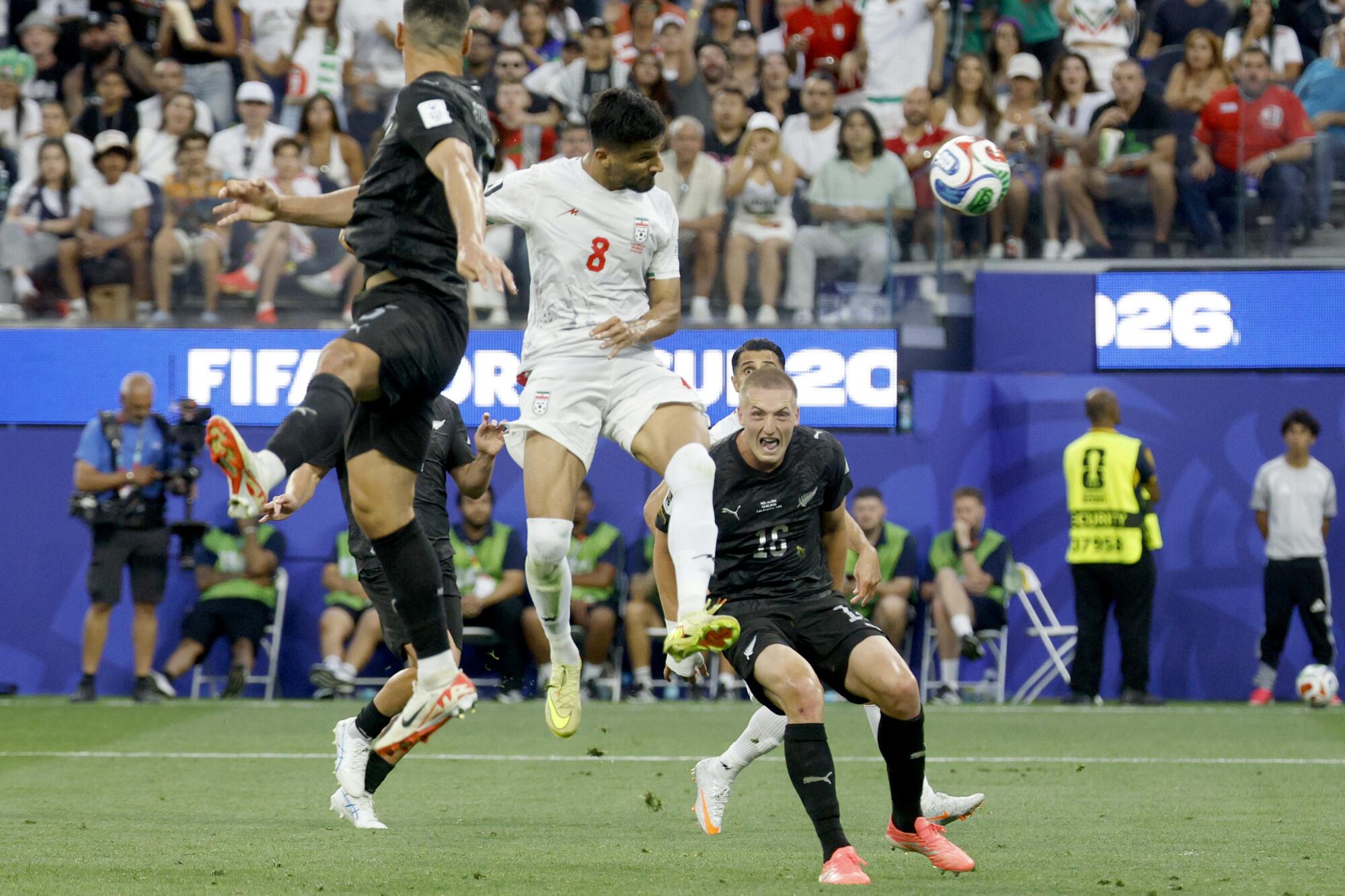
Iran forward Mohammad Mohebi (8) heads the ball for a goal during the second half.

Iran forward Mohammad Mohebi (8) heads the ball for a goal during the second half against New Zealand in group play at the World Cup on Monday.

(Ronaldo Bolanos / Los Angeles Times)

With the focus shifted solely to soccer, Iran’s 2-2 draw with New Zealand in front of an announced crowd of 70,108 Monday night at SoFi Stadium may have felt like a victory because of the sheer fight it took for Team Melli to play in Inglewood.

After Belgium and Egypt tied 1-1 earlier Monday, all the teams in Group G are tied at one point apiece.

The All Whites showed no signs they were rattled by the pro-Iran crowd or their standing 65 slots behind Iran in FIFA world rankings.

Iran fell behind twice, but the team rallied to avoid plummeting to the bottom of its group.

A flurry of chances generated by both teams during stoppage time never translated into a winning goal.

New Zealand struck first.

New Zealand forward Elijah Just, right, celebrates after scoring his second goal against Iran on Monday.

New Zealand forward Elijah Just, right, celebrates after scoring his second goal against Iran on Monday.

(Robert Gauthier / Los Angeles Times)

Elijah Just rumbled toward the box and seemed to pinball around the Iranian defense. He passed to Sarpreet Singh, who chipped the ball to Chris Wood in the box. Wood then chested the ball back to Just, who took one touch before kicking the ball in for New Zealand’s first goal in the seventh minute.

A small but hearty contingent of New Zealand cheered.

After the hydration break, Iran’s Ramin Rezaeian pushed the ball into the box and tapped it to Saman Ghoddos. Shahriyar Moghanlou’s shot was blocked, but Rezaeian was in position to tap the deflection into the far lower left corner of the net in the 32nd minute.

The stadium roared as Mexico fans joined Iran fans cheering and waving flags.

1

Iran goalkeeper Alireza Beiranvand watches the ball go into the net after a goal by New Zealand forward Elijah Just.

2

Iran defender Milad Mohammadi leaps over a New Zealand defender during the second half.

3

New Zealand defender Finn Surman, top, goes after the ball in front of Iran forward Ali Alipour.

4

Iranian soccer team fans show their support during the team's 2-2 draw with New Zealand.

1. Iran goalkeeper Alireza Beiranvand watches the ball go into the net after a goal by New Zealand forward Elijah Just in the first half. (Allen J. Schaben/Los Angeles Times) 2. Iran defender Milad Mohammadi leaps over a New Zealand defender during the second half. (Kelvin Kuo / Los Angeles Times) 3. New Zealand defender Finn Surman, top, goes after the ball in front of Iran forward Ali Alipour during the second half. (Allen J. Schaben / Los Angeles Times) 4. Iranian soccer team fans show their support during the team’s 2-2 draw with New Zealand. (Kelvin Kuo / Los Angeles Times)

Both teams has chances to break the tie late in the first half.

New Zealand earned a free kick in the 45th minute just outside the box. Wood took a direct shot at the goal, but Iran goalkeeper Alireza Beiranvand gathered it with ease.

During first-half stoppage time, Rezaeian’s free kick was headed home by Ali Nemati, but Nemati was clearly offsides and the goal was waived off by the referees.

In the 54th minute, Iran turned the ball over and Just connected with Just for his second goal of the match.

Iran responded in the 64th minute with Rezaeian’s cross headed home by Mohammad Mohebi, tying the game and delighting fans.

Iran forward Mohammad Mohebi reacts after scoring against New Zealand in the second half Monday.

Iran forward Mohammad Mohebi reacts after scoring against New Zealand in the second half Monday.

(Kelvin Kuo / Los Angeles Times)

Before the game, protesters outside SoFi Stadium argued Iran’s oppression regime should be sanctioned for human rights violations and banned from competition. Other Iranian Americans countered they gathered at the venue to cheer on players rather than Iran’s totalitarian leaders.

Iran captain and star striker Mehdi Taremi said before the game he hoped the team that has unified in the face of massive distractions could provide solace during a difficult time.

“We, the players of the national team, we play for every Iranian, be it the Iranian diaspora or be it Iranians in the country,” Taremi said through a FIFA interpreter. “Look, in every country, people have different opinions, but we are here as footballers to unite people, and we will try to bring joy to all Iranians, irrespective of where they live.

“Everyone is entitled to their own opinion, and we respect them, but we are here to bring joy to the Iranian people. We do not get involved in politics. We are here to play football.”

Source link