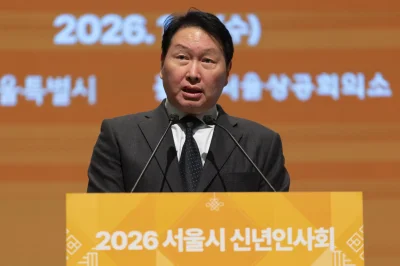
Choi Tae-won calls for regulatory reform, national AI strategy

Choi Tae-won, chairman of the Korea Chamber of Commerce and Industry, delivers a New Year’s address at a Seoul business community event at the Korea Chamber of Commerce and Industry building in Seoul on Jan. 7, 2026. File. Photo by Yonhap News Agency
Jan. 18 (Asia Today) — Choi Tae-won, chairman of the Korea Chamber of Commerce and Industry, said South Korea needs sweeping regulatory reform and a national artificial intelligence strategy to counter what he described as structural low growth hovering around 1%.
In a broadcast interview Sunday, Choi compared the economy to “a bike with the brakes on,” warning that without a shift toward growth-centered policies, South Korea could see accelerated outflows of capital and talent.
Choi said South Korea’s potential growth rate has fallen to about 1.9% and actual growth is lower, near 1%. He argued that if growth stalls, young people leave and resources for redistribution shrink, fueling social conflict and putting pressure on democratic stability.
He pointed to what he called a “step-like” regulatory system as a core cause, saying obligations and restrictions rise sharply as companies grow, reducing incentives to expand. He urged a shift from a framework he said protects small and medium-sized businesses while restraining large firms to one that provides incentives for companies that are scaling up.
Choi also criticized what he called excessive economic penalties that can deter investment, arguing that the risk of criminal punishment can outweigh expected returns in corporate decision-making.
On AI, he described the technology as a civilizational shift and urged the government to treat it as a national strategic priority. He called for world-class AI infrastructure, a dedicated startup market centered on what he termed “AI Generation” and a proof-of-concept support system to speed commercialization.
Choi also proposed closer economic cooperation with Japan, suggesting that adopting a shared visa system similar to Europe’s Schengen zone could generate about 3 trillion won (about $2.2 billion) in added value, along with tourism and other synergies.
— Reported by Asia Today; translated by UPI
© Asia Today. Unauthorized reproduction or redistribution prohibited.