London, United Kingdom – For several weeks, until her daughter is paid, Donna O’Hara is unable to buy food. On those days, she goes to a food bank instead, or borrows money to get by.
The 54-year-old, who has four children, started relying on food banks, nonprofit initiatives that collect and provide free emergency food to those in need, after her son and his girlfriend moved out following the birth of their baby in February. They had been contributing to the household bills, and losing that income tipped things over the edge.
Recommended Stories
list of 4 itemsend of list
“Mentally, it’s just stressful and it’s embarrassing having to go to the food bank, utterly embarrassing,” she says. “I hate asking people for help. I hate borrowing money.”
The stress compounds an already precarious situation.
O’Hara has multiple myeloma, a blood cancer, and has been hospitalised three times since October on life-saving antibiotics after infections forced her to pause chemotherapy. Her cancer is in remission, but doctors have told her it is likely to return before she can resume treatment. Her husband died of lung cancer last year.
Two of her children are on Universal Credit, the UK’s main working-age welfare monthly payment, including support for housing, children and low income or unemployment.
After paying child maintenance, her son is left with 340 pounds ($460) a month to live on after the payment. He cannot work because he is waiting for gallbladder surgery.
“Who can live on 340 pounds a month?” O’Hara said. “And because I’m always helping him out, that cuts into my money.”
Her own housing benefit payment is 1,800 pounds ($2,440) a month, against rent of 2,500 pounds ($3,390) for a private property with the downstairs toilet she and her late husband both needed because of their cancer treatment. She has fallen behind, and expects to be evicted.
“The day the bailiffs come round, I must be packed and ready to go into the housing they put me in,” she said. “Who knows where I’m going to end up?”
‘Damaging structural factors’
The UK has been in an acute cost of living crisis since inflation surged from late 2021, driven initially by pandemic disruption and then by the spike in energy prices following Russia’s invasion of Ukraine.
But for households like O’Hara’s, the strain runs deeper, with its roots in more than a decade of austerity, weak wage growth and stagnant productivity, compounded by the economic impact of Brexit.
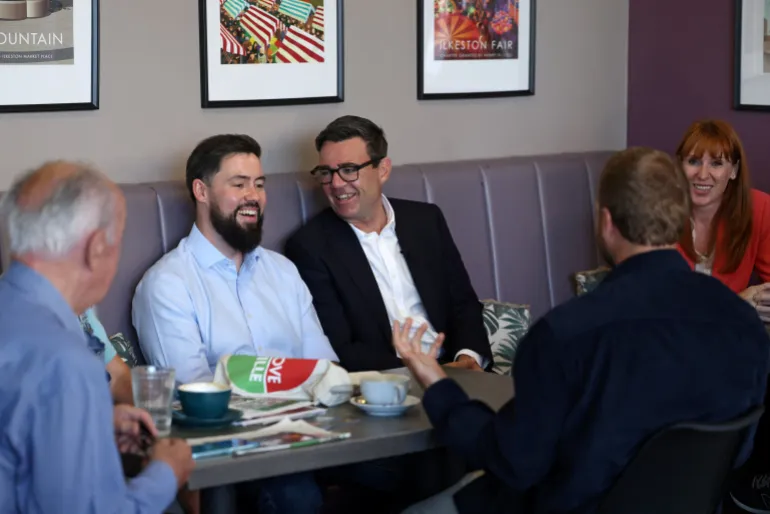
That longer history is central to Prime Minister Andy Burnham’s political pitch. To tackle the UK’s cost of living crisis, the new premier has set out a 10-year plan built around expanding social and affordable housing, reforming Universal Credit and investing in local economies.
He is currently touring the nation to engage with people’s financial concerns.
Universal Credit is meant to act as a safety net, but for many, including O’Hara, it no longer stretches far enough to cover it.
Prime Minister Andy Burnham, Labour MP Adam Thompson and Housing Secretary Angela Rayner meet with local business owners in Ilkeston, on August 11, 2026 [Toby Shepheard/Pool via Reuters]
Research from the Joseph Rowntree Foundation puts scale behind stories like O’Hara’s.
“We estimate 7.4 million low-income families were unable to afford at least one essential item in the last six months,” said Sam Tims, the charity’s lead analyst, pointing to cutbacks on heating, toiletries and food. “This is at a record high.”
Tims traced the roots directly to policy choices.
“The combination of all these damaging structural factors has left our economy weaker, our wages lower, our rents higher and our income safety net in need of repair,” he said, noting that the basic rate of Universal Credit support is lower now than a decade ago.
He welcomes the removal of the two-child benefit limit in April, estimated to have lifted about half a million children out of poverty, but argues it needs to be paired with a “protected minimum floor” in Universal Credit and higher local housing allowance rates to make private rents affordable again.
Adam Lang, director of policy at Carnegie UK, says the think tank’s polling shows just more than a quarter of households could not afford an unexpected 850-pound ($1,150) expense, and one in 20 cannot afford to feed everyone at home.
“What is striking is that we’ve conducted the same survey for the last three years and we see no real improvement on most of these measures,” he said.
Lang cautiously supports Burnham’s approach, but warned against expecting a single set of measures to fix things.
“It is heartening to hear the UK government talk of a 10-year plan,” he said. “On the other hand, it is clear that life is too hard for too many and change is required.”
He argued that governments need to track wellbeing alongside growth and employment, so policymakers can see “not just how the economy is performing, but how people are doing”.
Evelyn Henderson-Child, senior researcher at the Centre for Local Economies (CLES), said that even when growth does happen, it does not reliably reach those navigating the crisis.
“GDP [Gross domestic product] can kind of swish on upwards while the foundational conditions of life, community resilience and people’s financial stability are eroded,” she said, pointing out that growth-focused policy tends to prioritise high-productivity sectors while overlooking the ones that actually sustain society and offer significant amounts of employment, such as food, retail, transport, housing and care.
The answer lies less in growth itself and more in who benefits from it, she believes.
“Traditional policy tends to rely on patching up inequality, if it does at all, after wealth is generated and concentrated at the top,” she said. “It’s about pre-distribution, rewiring the economic system from the get-go so that economic and social benefits are spread more evenly.”
But the debate over growth statistics and structural reform is of little consequence for O’Hara.
“Some people say ‘work on a budget’. Try working on a budget when you have to count your pennies just to get a loaf of bread,” she said. “It’s not my fault I got cancer and can’t go to work. Life shouldn’t be like that.”
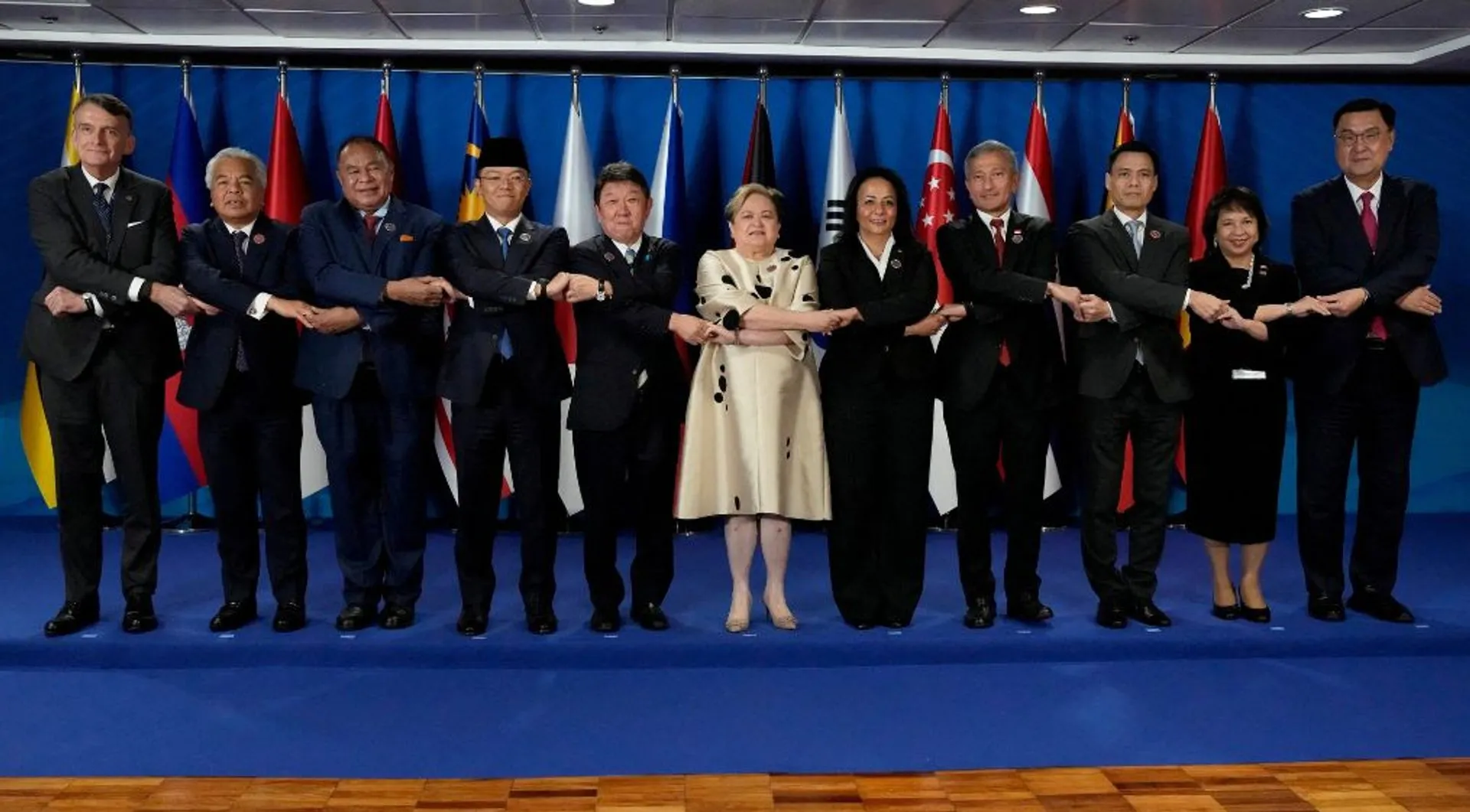
Renewed fighting between the US and Iran has overshadowed the ASEAN gathering in Manila.
The Philippines is hosting a meeting of foreign ministers from Southeast Asia.
They are expected to address regional security issues, including the civil war in Myanmar and the territorial disputes in the South China Sea.
Recommended Stories
list of 3 itemsend of list
But renewed fighting between the US and Iran has overshadowed the gathering.
Ministers have called for hostilities to end.
The conflict has hit Asia hard – disrupting its energy and food supplies, international commerce and raising fears of a global economic slowdown.
Will it also affect ASEAN’s efforts to tackle issues within the region?
Presenter: James Bays
Guests:
Richard Heydarian – Political Scientist and Author of Indo-Pacific: Trump, China and the New Struggle for Global Mastery
Phar Kim Ben – Professor in ASEAN studies at International Islamic Univeristy of Malaysia and former Director of Political & Security Community at ASEAN Secretariat
Don McLain Gill – Lecturer at De La Salle University and Indo-Pacific Research fellow with Asia Pacific Foundation of Canada
• American playwrights, recognizing that identity is more complicated and slippery than ideology, have been shedding fresh light on what it means to be an American. • Writers such as Young Jean Lee, Tarell Alvin McCraney, Quiara Alegría Hudes, Branden Jacobs-Jenkins, Jeremy O. Harris, Ayad Akhtar, and Bess Wohl have been creating drama from the multidimensional, intersectional realities of characters whose backgrounds refuse to be compartmentalized into a single category.
The American democratic experiment stands on shaky ground. Not since the Civil War have these proverbially United States been so disunited. As the nation throws itself a grand old 250th birthday bash in Washington, the mood in much of the country is more funereal than festive.
All-out partisan warfare has sown chaos. Republican legislators, taking their lead from a president who sees half the nation as his personal enemy, have put their own party’s interests over the republic’s. Staying in office has become the only thing that matters. The values imparted to me throughout my public school education — equal opportunity, impartial justice, respect for expertise, basic honesty — have been abandoned by a new breed of politician that has turned governance itself into a blood sport.
Where can one turn for reassurance that America’s best years are still ahead? Would you believe me if I said the theater? I’m not toeing the line for my field. I’m merely calling attention to a development that’s been gaining strength since I first reported on it in 2015. A cohort of playwrights, breathtakingly diverse demographically as well as aesthetically, has been rejuvenating American theater.
These writers aren’t on a sociological mission. They’re not trafficking in grievance or appealing to a particular political base. They let their plays do the talking. And they’ve been trying to have a conversation that isn’t hijacked by the most doctrinaire voices in the room.
From an institutional perspective, the American theater is in bad shape. The triple whammy of the COVID-19 closures, inflation and technological disruption has left everyone hurting. The Mark Taper Forum had to suspend programming for more than a year, smaller companies still in operation are producing fewer shows, and producers everywhere are gravitating toward the bankably familiar.
But despite this difficult terrain, it has been a boom time for American playwriting. For more than a decade, I’ve been teaching a course at the California Institute of the Arts called American Drama Now, and each year the selection of plays has become harder to whittle down. I designed the seminar partly around theater offerings in Los Angeles to connect students to recent developments in the field and to consolidate awareness that something special is happening in the American theater.
The current generation of playwrights has revealed itself to be remarkably resilient and independent. It has had no other choice. By the time many of these rising talents were accruing debt in graduate writing programs, the dream of a sustainable career in the nonprofit theater had already gasped its last breath.
When Wendy Wasserstein, Tony Kushner,Craig Lucas and Jon Robin Baitz emerged in the late 1970s and ’80s, it was still imaginable that a chosen few playwrights could make a living via the regional theater circuit, that constellation of companies founded as an alternative to the Broadway model.
That prospect was growing dimmer a few years later when playwrights such as Suzan-Lori Parks and Lynn Nottage came into prominence. But hope was still alive in the late 1990s and early 2000s. Regional theaters such as Seattle Rep, the Guthrie, the Goodman and Baltimore Center Stage remained committed to their missions while New York nonprofit companies continued to hold the line off-Broadway.
When did the picture change? In 2009, “Outrageous Fortune: The Life and Times of the New American Play” was published by the Theatre Development Fund, and one of the key findings in this study written by Todd London with Ben Pesner and Zannie Giraud Voss is that “there is no way to view playwriting as anything but a profession without an economic base.” A chasm had opened between the network of increasingly corporate-minded nonprofit theaters and the artists this system was built to serve.
The situation has grown bleaker in the last decade and a half as commercial pressures have ramped up and media consolidation and digital shortsightedness have obliterated arts coverage. Yet there’s been an unexpected upside. Theater artists who have come of age in this period have been released from the burden of having to conform to notions of regional theater respectability.
Instead of worrying about the timid taste of subscription audiences, these dramatists have been writing for themselves and their communities, dreaming up plays that don’t have to fit into institutional slots or stay within the staid bounds of traditional proscenium house decorum. The irony is that in not trying to pass muster with more conservative theatergoers (and their fastidious institutional guardians), playwrights have been winning over not just critics but also formerly squeamish artistic directors and perennially nervous Broadway producers.
The politics of identity for them is a lived experience. And as dramatists, they’re uniquely positioned to appreciate the conflicted loyalties and communal tensions of American life in dramatic rather than dogmatic terms. Whatever agendas they may personally espouse, these writers are too alert to the messiness of history and human nature to be rigidly ideological in their work.
The ongoing war between woke and anti-woke factions is a fatuous melodrama best left to the satirists. The goal of playwrights grappling seriously with what it means to be an American today isn’t to score social media points but to shed light on the fractured reality of our collective experience.
Characters in plays by Young Jean Lee, such as “Straight White Men,” are often “trying on masks to see what might prove effective in a given situation.”
(Lawrence K. Ho / Los Angeles Times)
Identity is not a fixed fact but a raucous collision of parts. No single category can contain the Whitmanesque multitudes jockeying for position inside us. Race, religion, ethnicity, gender, age, sexuality, class, disability and geography don’t line up in perfect political harmony, and each social marker tells only a fraction of the whole story. (Money, the great unequalizer, may be the most taboo subject of all.) “We are not only but also,” the sociologist and cultural historian Todd Gitlin wrote in his 1995 book “The Twilight of Common Dreams: Why America Is Wracked by Culture Wars.” We also overlap and often even clash with ourselves.
Discussion around identity can be dangerous. How can anyone be expected to navigate the minefield? Tribalists and traditionalists have controlled the terms of the battle, one by simplifying, the other by denying, the way privilege has shaped our compound selves.
Playwrights know better. They understand the way oppression, which falls disproportionately on the marginalized, has warped all of us. History, whether acknowledged or not, is etched in our souls.
It is a long-held tenet of the theater that the most interesting characters, like the most interesting people, are defined by their schisms and paradoxes. (How else could Hamlet have maintained his centuries-long hold?) Dramatists are more cognizant than ever of the sociopolitical import of these contradictions and they’ve been chronicling the way this historically freighted baggage emerges in the drama of everyday life.
All the world is indeed a stage and all its inhabitants merely stock players, as Jaques lays out in “As You Like It.” Hegel described Shakespeare’s characters as “free artists of their own selves.” The truth where we and our contemporary stage surrogates are concerned is somewhat more constrained. Culture and representation largely determine the range of our performance possibilities.
Plays such as Branden Jacobs-Jenkins’ “Appropriate” reexamine “the canon of great American family dramas … to uncover the stories that have been suppressed.”
(Craig Schwartz)
Jacobs-Jenkins has recognized perhaps more acutely than any of his peers the way dramatic forms have locked us into set scripts about our lives. He tackles genres — adapting a Dion Boucicault melodrama in “An Octoroon,” reexamining the canon of great American family dramas in “Appropriate” — to uncover the stories that have been suppressed in the dominant white middle-class narratives that would prefer not to think of themselves as political.
Lee’s standout identity plays — “Straight White Men,” “The Shipment” and “Songs of the Dragons Flying to Heaven” — reject the illusion of stable, coherent characters propagated by psychological realism. The figures in her uncategorizable works are in experimental flux, trying on masks to see what might prove effective in a given situation. Even “Straight White Men,” which uses the old home-for-the-holidays genre as a springboard, can’t help spinning away from the drama’s droll hyper-naturalism toward something resembling performance art. (Not even straight, white men want to be confined to a box, even a relatively plush one.)
“Fairview,” by Jackie Sibblies Drury, “theatricalizes the experience of the white gaze.”
(Jeff Lorch)
In “Fairview,” Jackie Sibblies Drury theatricalizes the experience of the white gaze, ultimately reversing the comfortable position white theater audiences have traditionally held. Bess Wohl’s “Liberation,” this year’s most decorated play, reanimates the history of the 1970s feminist movement by questioning what it could be leaving out of the picture. “The Balusters,” by David Lindsay-Abaire, brings the current culture wars to the stage with unique sensitivity through the squabbles of a neighborhood association torn between protecting its town’s heritage status and coming to terms with the more pluralistic demands of the 21st century.
“Fairview,” “Liberation,” and “The Balusters” are extremely funny plays that also happen to be deadly serious. If philosophy begins in wonder, trenchant social drama seems to start in laughter.
What do theatergoers want? They don’t just want to look; they also want to be seen. Isn’t that what any of us wants when gazing into the mirror held up to nature, as Hamlet describes the theater? To be granted a more expansive view of ourselves and others?
E pluribus unum, the motto of the United States, is so fundamental that it’s printed on our currency. There’s perhaps no place where the truth of this phrase — out of many, one — is more regularly realized than at the theater, where strangers transform over the course of a show into that mysterious organism we call an audience.
Gitlin ends “The Twilight of Common Dreams” with a plea: “For too long, Americans have busied themselves digging trenches to fortify their cultural borders, lining their trenches with insulation. Enough bunkers! Enough of the perfection of differences! We ought to be building bridges.”
A coalition mindset doesn’t mean denying history or pretending that America has been a level playing field. It’s been anything but in this “melting pot where nothing melted,” to quote the rabbi whose eulogy sets Kushner’s “Angels in America” in motion. But history happens to all of us, not just a select few. And to be an American is to be embroiled in the great democratic experiment that has been defined by division from the beginning. Empathy, the nuclear fusion of playwriting, is expanded when we’re allowed to take in more of our patchwork selves. Today’s dramatists have been extending a generous invitation to their compatriots: We’ll show you our complexity, if you’ll show us yours.
England fans were left frustrated as their side were held to a goalless draw against Ghana, but were Thomas Tuchel’s side fortunate not to have a penalty given against them?
The incident in question happened late in Tuesday’s game as Prince Adu charged into the box before Ezri Konsa came across and appeared to bring down the midfielder.
No spot-kick was given – to the relief of England supporters, with replays showing Konsa had caught Adu on the knee and made no contact with the ball.
The BBC pundits watching the game were largely in agreement that Konsa and England were fortunate not to have been punished.
“I think that’s a penalty,” former Three Lions and Manchester United striker Wayne Rooney said on BBC One.
“Konsa takes a huge risk. His feet are off the floor when he comes flying in and he gets the man, not the ball.
“That could easily have been given in my view.”
Fellow former England international and ex-Manchester City defender Micah Richards added: “England were chasing the game, they were trying to score the goal but you still need that protection behind you.