Analysis: Syria-Lebanon ties tested by alleged Assad loyalists’ plots

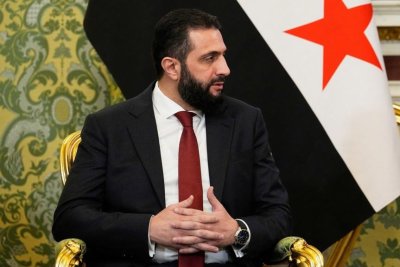
Reports that former Syrian regime officers are hiding in Lebanon and plotting against new Syrian President Ahmad Sharaa and his government have raised concerns in the two countries. File Photo by Alexander Zemlianchenko/EPA
BEIRUT, Lebanon, Jan. 16 (UPI) — Lebanon and Syria have been working to turn the page on decades of mistrust and tense ties since the ouster of Syrian President Bashar Assad in December 2024.
But the uneasy process has been complicated by reports that former regime officers hiding in Lebanon were involved in plots against Damascus’ new leadership.
The alleged use of Lebanese territory to destabilize Syria and undermine the rule of its new president, Ahmad Sharaa, has emerged as a highly sensitive security issue, raising concerns in the two neighboring countries.
The reports were based on leaked audio recordings obtained by Al Jazeera of former Assad loyalists, including high‑ranking military officers, discussing plans to regroup, secure funding and weapons, and explore possible coordination with Israel to undermine Syria’s stability after the collapse of the Assad regime.
They were specifically considering military action involving remnants of the former regime’s forces in Syria’s coastal regions to regain influence, particularly in Alawite-majority areas.
The most alarming part was the alleged establishment of an operations command cell in Lebanon by Suhail al‑Hassan, Syria’s former special forces commander, widely feared for violently suppressing protests and ordering air strikes against civilians during the civil war.
Al‑Hassan, who has been sanctioned by the United States, European Union and United Kingdom over his role in serious human rights abuses, was among the first senior regime officials evacuated to Moscow after the collapse of Assad’s rule.
Concerns about the alleged plot prompted the Lebanese Army, military Intelligence and other security services to conduct raids in northern Lebanon, including searches in areas with Alawite villages and camps hosting Syrian refugees, as well as in a camp recently established by Hezbollah in the town of Hermel that houses displaced Syrian Alawite families.
A Lebanese Army source said all camps near the border with Syria were searched to determine whether former Syrian officers were present.
Several arrests were made, though the source did not disclose the number. Published reports indicated that those detained faced charges ranging from illegal entry to possession of weapons or drugs.
“The [Syrian] officers were not [found] in these camps,” the Army source told UPI. “We found nothing [that supports] such a plot or planning. There is nothing of that sort in the camps.”
The source said officers usually do not stay in the camps and have the money to rent apartments, but “they are not active.”
While the case is being quietly investigated by Army Intelligence, Lebanese President Joseph Aoun downplayed the reported plot, saying raids carried out in several areas across northern and eastern Lebanon uncovered no evidence of officers linked to the Assad regime and stressing that Lebanon remains in coordination with Syria on the issue.
A Syrian national identified as Ahmad Dunya was reportedly arrested in Lebanon earlier this week on suspicion of transferring funds from Assad’s cousin, Rami Makhlouf, to finance fighters involved in the alleged plot.
The arrest followed a request by Syrian authorities for Lebanon to locate and hand over more than 200 former officers who fled their country after Assad’s ouster.
Hisham Jaber, a Lebanese military expert and former Army general, said the number of Syrian officers who crossed into Lebanon following the takeover by Sharaa’s forces in Syria was “unknown.”
“There are large groups [of Syrian officers in Lebanon], along with funds that could be used to attract Syrian refugees who supported the Assad regime and recruit them to carry out sabotage missions inside Syria,” Jaber told UPI, dismissing any possibility of action in Lebanon.
Those officers, however, are under close watch and surveillance by the Lebanese Army and intelligence, according to the Lebanese Army source, who said that such efforts would be “reassuring” to the Syrian authorities. “There is no such conspiracy,” he added.
What may have fueled Syria’s fears is Hezbollah’s role in providing protection to fleeing Syrian officers.
According to Jaber, Hezbollah, an ally of the Assad regime that fought in Syria to prevent its collapse, is undoubtedly “in solidarity” with them, but the question is whether the Iran‑backed party would be able to protect them.
“Hezbollah could do that in its own ghettos in the Bekaa (eastern Lebanon) and Beirut’s southern suburbs, securing their stay or providing logistics, but they can’t remain there and would have to leave if they decide to take political or military action,” he said.
Lebanon, keen to maintain the best possible relations with Damascus, would therefore need to convince Syria that it would foil any conspiracy to destabilize the country, but cannot extradite Syrian officers because of legal hurdles and a lack of evidence.
“In a way, if Lebanon hands over anyone to the new authorities in Syria without evidence, it could also be accused of committing a miscarriage of justice,” David Wood, a senior Lebanon analyst at the International Crisis Group, told UPI. “This is a very politically and legally sensitive issue.”
Wood suggested that Lebanon’s best interest is to keep these former officials under surveillance, arrest them if there is evidence that they are breaking the law, but not immediately comply with extradition requests coming from Damascus.
Lebanon, long a refuge for freedom seekers, has upheld a doctrine since its independence in 1943 of preventing the country from becoming a corridor or launchpad for conspiracies against its Arab neighbors, and of rejecting requests to hand such individuals over to their home countries.
However, the Syrian officers in question cannot be considered freedom seekers, especially if they choose to engage in military plots at a time when the Lebanese remain divided over the new leadership in Damascus, much as they did during the Assad regime.
Sharaa is seen as a strong Sunni leader by most of Lebanon’s Sunnis, while Christians appear cautious because of his jihadist past, and Hezbollah remains distrustful, according to Wood.
Sharaa’s positive rhetoric toward Lebanon since assuming power in Syria — calling for the two countries to move past their troubled history, pledging non-interference in Lebanese affairs and putting Hezbollah’s fighting alongside Assad’s forces during the civil war behind them — is encouraging, but both countries need to translate words into concrete actions.
While Lebanon and Syria have consolidated political, diplomatic and security coordination, as well as successfully curbing drug and arms trafficking, they have so far been unable to resolve urgent issues that could stabilize their relations.
These include the most volatile issue of Syrian prisoners held in Lebanon, the Syrian refugee crisis — with only half a million of 1.5 million refugees having returned home — and the demarcation of their shared border.
“Lots of things need to be worked on — all of them still at a very preliminary stage,” Wood said, noting “domestic uncertainties on both sides, with each facing challenges that are not necessarily linked to the relationship.”
However, the fate of Hezbollah and its patron, Iran, is a major factor in Lebanon’s future, and by extension in Lebanese-Syrian relations — “something fundamental that could reshape the country,” he added.