symphony

Taxidermy sound bath? It just works at the Natural History Museum

I lay on my back and stared at a bright blue painted sky, dappled with puffy clouds. As my mind drifted, the sound of a breeze, created by handheld fans, filled the room. Then came a symphony of chimes, crystal bowls, wave drums and rain sticks. To my right, a black bear cub eyed me curiously.

Soon a thunderous crescendo of gongs arose. I looked to my left, where two endangered polar bears stood on a sheet of ice, ocean looming behind them.

The noises softened and went still. With a resounding clap from participants around the room, I came back to reality.

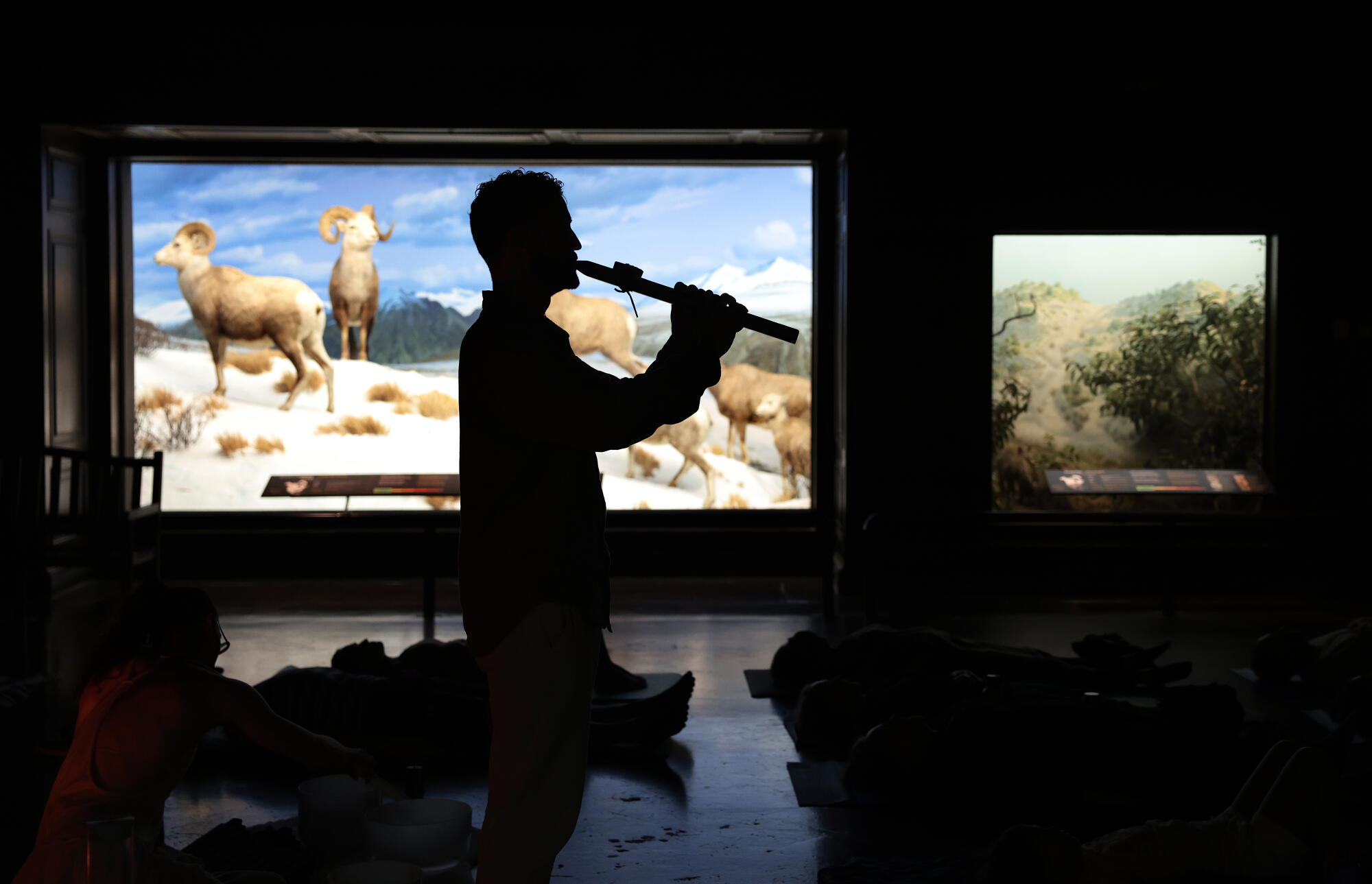
I wasn’t in a forest, nor the Arctic. And no, I had not recently taken any psychedelic substances. I was at a sound bath in the North American Mammal Hall at L.A.’s Natural History Museum, surrounded by dioramas of taxidermy, meditative instruments and sound healers from the Oso Sound Healing Studio.

Avery Whitmore leads participants in a sound bath.

Avery Whitmore leads participants in a sound bath.

Hosted earlier this month, the sound bath was the first of two events in the museum’s new Mindfulness Mornings at the Museum series, where guests can experience a meditative practice in the iconic gallery before opening hours. A nearly sold-out yoga session led by SoulPlay Yoga will take place on Sept. 13, and museum organizers hope to host more events after that, said Joel Quizon, the manager of public programs.

The Natural History Museum always looks for ways to “activate the museum space,” Quizon said. Ahead of the sound bath, Oso Sound Healing Studio founder Avery Whitmore said the unconventional space would invite a childlike energy, a deeper connection to animals and introspection.

“Just seeing these older animals, it takes you into another place,” Whitmore said. “It could invite you into a deeper meditation about where we are, where we come from. In that mind state, you might be a little bit more receptive to exploring the same questions about yourself.”

The museum introduced Mindfulness Mornings following the success of its past wellness events — including sound baths that were part of its First Fridays after-hours series. With those events, the lines went “down to the basement,” Quizon said.

People laying down on the floor during a sound bath.

The Natural History Museum is an apt venue for mindfulness events as people already see it as an “oasis [in] the city,” said Joel Quizon, the museum’s manager of public programs.

Two women lay on yoga mats

Participants Kenny Mayo of Culver City, left, and Verseilla McCloskey of Long Beach are immersed in sound.

Whitmore, who previously collaborated with the museum during First Fridays in 2025, founded Oso Sound Healing Studio in 2023. He played piano and percussion as a child and later guitar as an adult, but “put all of that away for many years,” he said.

About a decade ago, personal struggle led him to seek out spiritual practices, and that healing guided him toward being of service to others. That led him to attend massage school — not to start a career as a massage therapist, he said, but to learn how to give back to others.

The experience inspired him to learn other healing modalities, including breath work and sound meditation: the latter of which reignited his musical appreciation. “ It helped to revisit that, or reawaken it from another perspective,” Whitmore said.

When I attended the sound bath, about 100 people filled the hall and Whitmore opened the meditation by asking how many new sound bathers were here. More than half of the attendees, including me, raised their hands.

During the practice, participants can peek and see the varied habitats of North America beside them.

During the practice, participants can peek and see the varied habitats of North America beside them.

Avery Whitmore created a sound bath experience inspired by the unique museum space.

Avery Whitmore created a sound bath experience inspired by the unique museum space.

With the overhead lights dimmed and soft light spilling from the dioramas, the displays looked like windows to other worlds. I took a mat next to the American black bears and American badgers, only slightly jealous that the mats next to the large-scale walrus diorama were taken.

The meditation lasted about an hour. In addition to the variety of instruments evoking the sounds of nature, it incorporated breathwork, vocal exercises and a small amount of physical sensation: a refreshing spritz of rose water. Sets of instruments were stationed along every wall of the room, fully encompassing us in sound. Peeking at the animals around me, I couldn’t help but think of them as characters whenever new instruments joined the symphony.

“Definitely the coolest sound healing experience I’ve been to,” said Kenny Mayo, 35, after the sound bath.

“The different stations felt like an orchestra. It was put together in such a beautiful, methodical way, and all of the instruments were harmonizing perfectly.  It felt like no matter where you were, there was something close to you,” Mayo said.

Toward the end of the meditation, Whitmore asked participants to envision an animal and invited them to receive its message. Mayo said she thought of a hawk, and found meaning in connecting with the spirits of animals that “don’t exist anymore.”

“It’s a magical thing, to be able to see the history of all the animals, our ancestors,” she said. “We can still connect to the essence.”

I looked at the taxidermy black bear cub, standing energetically on its hind legs, and imagined the future ahead of it; then across the room to the adult polar bears, traversing an icy surface that, beyond the diorama, continues to melt away.

As part of the meditation, participants were invited to think about where they were, and where they've come from.

As part of the meditation, participants were invited to think about where they were, and where they’ve come from.
Source link

The homeless National Symphony finds shelter at the Hollywood Bowl

A wonderful Oval Office perk is what Thomas Jefferson dubbed “The President’s Own.” At the president’s beck and call is the United States Marine Band, created by an act of Congress in 1798.

But for an acquisitive current occupant of the White House, the oldest continuously active musical organization hasn’t seemed enough. In his appropriating the John F. Kennedy Center for the Performing Arts, also created and officially named by Congress, the president obtained the National Symphony Orchestra. Unlike its “President’s Own” sibling, which is supported by the Defense Department annual allotment of some $400 million for military bands, the NSO is administered, funded (between a third and half of its $35-million budget) and lately threatened by what are now the whims of the Kennedy Center.

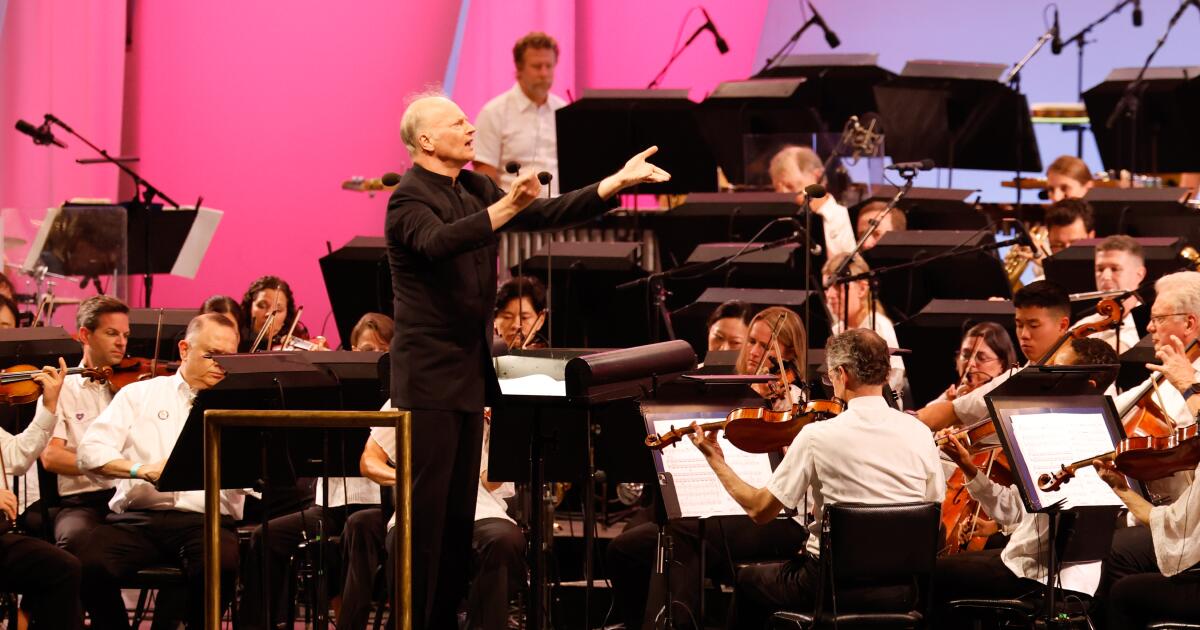
The NSO appeared at the Hollywood Bowl on Tuesday night, however, with a collective sigh of relief. A week earlier the Kennedy Center Board, without congressional input or legal approval, approved an imminent, two-year closure of the venue for repairs and remodeling, with little word about the homeless or economic future of its artist affiliate. By early August, no new NSO season, which would begin in September, had been announced.

But Tuesday morning, the NSO, in fact, did lay out a full and musically substantial season, the 10th for its music director, Gianandrea Noseda. Not taking a chance on the courts preventing a Kennedy Center closure, the NSO will become next season a peripatetic ensemble performing in various venues in and around D.C., as well undertake a national tour in the spring. Uncertainty remains, but for now all is as well as can be expected.

The NSO, however, offered little of what to expect. I can only find one program next season as unimaginative as Tuesday’s at the Bowl. The orchestra looks forward to several premieres of new works by lively composers and a variety of significant guest conductors, including the venturesome Teddy Abrams (who will lead the Los Angeles Philharmonic’s season-opening gala) and eclectic former NSO music director Leonard Slatkin (who is also the former L.A. Phil principal guest conductor for the Hollywood Bowl). Noseda’s only other bland program will be the one he brings on tour to The Soraya in April.

Hearing the NSO at the Bowl, moreover, is an act of guess work. With the new immersive sound system, orchestra impact becomes a matter of technology, giving individual instruments paranormal prominence and turning full orchestra glory into a sensual sound bath. Still, with its smooth strings, creamy brass, pungent winds and friendly percussion, Noseda’s NSO came across as a gracious orchestra meant to please, and, consequently, a seemingly marvelous anomaly in an otherwise divisive present-day D.C.

But that offered few favors for Leonard Bernstein’s Symphonic Dances from “West Side Story” or Gershwin’s “An American in Paris,” where the Bowl has regularly hosted far more idiomatic, swinging performances. Dvorak’s “New World Symphony” in the second half was, on the other hand, satisfyingly full-bodied. While Noseda sometimes practices likability to a fault, his sense of drama is ever sure, and it is hard to get enough of the lyrical sweetness he conveys. As an encore, Noseda led the overture to Bernstein’s “Candide” with real flair.

But why commonplace “Candide” and “West Side Story,” when Bernstein wrote “Slava! A Political Overture,” for the NSO as tribute in 1977 to its Russian music director, Mstislav Rostropovich? Might not the NSO make a point with “Three Mediations” from “MASS,” Bernstein’s multimedia masterpiece that controversially opened Kennedy Center in 1974. Bernstein also wrote a major late work for the NSO, “Songfest.” Bernstein, himself, conducted the Los Angeles Philharmonic in the West Coast premiere at the Bowl in 1983, which had special significance because his collaborator on “Songfest,” Tom Cothran, who happened to have grown up in Pasadena.

For his part, Noseda has done an exceptional job in championing major Black composers at home and on record. Carlos Simon has been the NSO’s composer in residence for the last five years, and Noseda has revived and recorded an essential album of works by George Walker. In October, Noseda and the NSO will release a recording of two symphonies by William Grant Still, who lived in L.A. Deeply evocative of a post-Dvorak new world, they are beautifully played on the new recording and would have been ideal for the Bowl.

The NSO has given up on the Kennedy Center, but must we? There are many questions that have not been considered. The current plan for infrastructure improvements and slapdash redecorating at the cost of $250 million. In fact, the facility’s playhouse, opera theater and concert hall are due for major renovations. But that requires significant planning, the hiring of a major architecture firm with concert hall experience, a first-rate acoustician and, ideally, four times the allotted budget.

This is clearly a long-term job for Congress and consultants who would do well to study the approach of the Salzburg Festival. It has been planning for several years to rehabilitate its large concert hall (which is of similar vintage to the Kennedy Center), which will require five years and a cost of around $600 million. It is also carefully examining alternate performance sites to be used during construction.

The Kennedy Center is a memorial, and before another new idea is allowed out, let the Kennedy Center board visit Lincoln Memorial Reflecting Pool for a moment of reflection on how and why to bring the NSO, America’s Own, back home. In the background, the U.S. Marine Band could offer its kin moral support by playing in the background Ives’ mysteriously transcendental “Unanswered Question.”

Source link