Supreme

Philippine Supreme Court rules same-sex partners can co-own property

Parade participants ride on a float during the LoveLaban Pride March in Quezon City, Metro Manila, Philippines, on June 28, 2025. Manila’s Supreme Court on Tuesday ruled that same-sex partners can co-own property. File Photo by Rolex Dela Pena/EPA

Feb. 10 (UPI) — Same-sex partners can legally co-own property in the Philippines, the nation’s Supreme Court announced Tuesday, a landmark decision for LGBTQ rights in the overwhelmingly Christian nation.

The ruling, which was dated Thursday but released Tuesday, states for the first time that same-sex partners can jointly own property under Article 148 of the Family Code, the country’s primary law governing marriage, family and property relations.

“Our laws should be read from more contemporary lenses. We must bear in mind how the lived realities of many couples in the Philippines are now far from heteronormative standards,” Senior Associate Justice Marvic Leonen said in a concurring opinion.

“To be different is not to be abnormal. A same-sex relationship is a normal relationship and therefore should be covered by Article 148 of the Family Code. Otherwise, we render legally invisible some forms of legitimate intimate relationships.”

The ruling comes in litigation over ownership of a Quezon City house once inhabited by same-sex couple Jennifer Josef and Evalyn Ursua.

They purchased the property in 2006, agreeing to register it under Ursua’s name for ease of bank transactions. According to court documents, when they separated, they agreed to sell the house and divide the proceeds equally.

However, Josef filed a complaint for partition of the property and damages after Ursua refused to sell it, recognize Josef as a co-owner or give her half of the property.

Same-sex unions are illegal in the conservative Christian nation where public support of such relations was only about 22%, according to a 2018 survey by the nonprofit social research institute Social Weather Stations.

Shared property is governed under two provisions of the Philippine Family Code: Article 147, which applies to legally married couples; and Article 148, which concerns couples who cannot legally marry, such as so-called adulterous heterosexual relationships, incestuous or otherwise prohibited relationships and bigamous or polygamous marriages.

This effectively left same-sex couples without a clear legal basis to assert shared property claims.

The case made its way to the Supreme Court after a lower court and then an appeals court ruled against Josef.

In its ruling, the Supreme Court reversed the previous orders, citing a 2007 document signed by Ursua that recognized Josef as co-owner of the property into which she paid 50% of the expenses for its acquisition and renovation.

With its ruling, the high court clarified the provisions of the Family Code to state that same-sex couples fall under Article 148 since marriage is only permitted between a man and a woman.

The justices also stated that without a law recognizing same-sex marriage, Congress and local governments must work to address issues affecting the rights of same-sex couples.

“This Court does not have the monopoly to assure the freedom and rights of homosexual couples,” the Second Division of the Supreme Court said.

“With the political, moral and cultural questions that surround the issue concerning the rights of same-sex couples, political departments, especially the Congress, must be involved to quest for solutions, which balance interests while maintaining fealty to fundamental freedoms. The process of legislation exposes the experiences of homosexuals who have been oppressed, ensuring that they are understood by those stand with the majority.”

Source link

US Supreme Court rejects challenge to California redistricting effort | Elections News

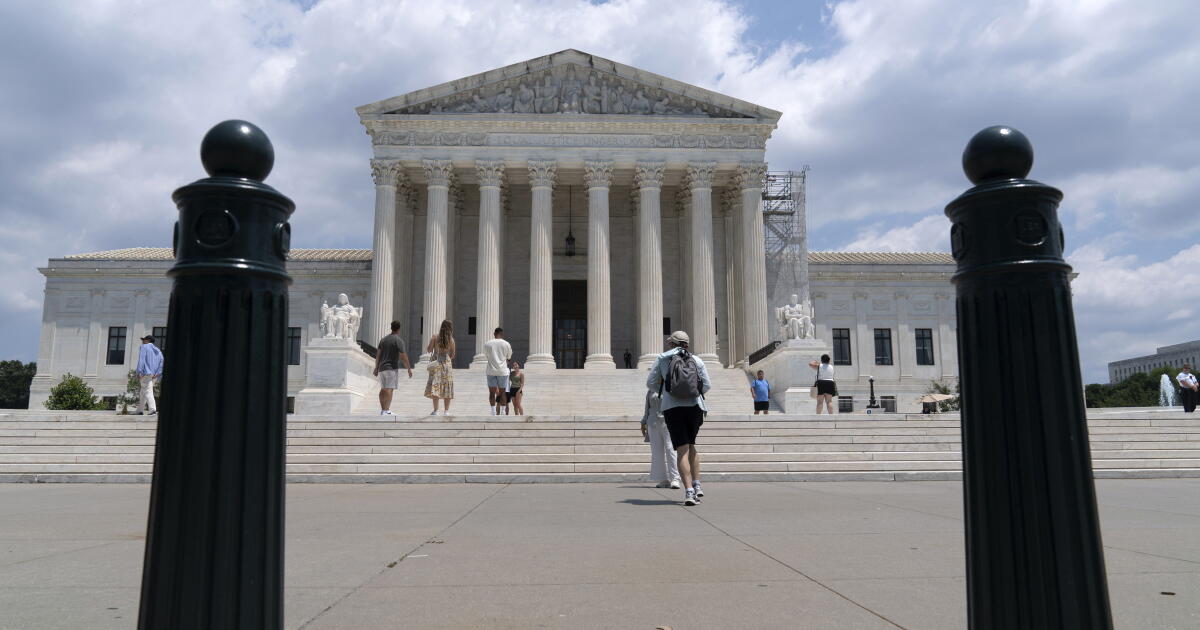
The United States Supreme Court has ruled in favour of a California redistricting measure meant to net the Democratic Party more congressional seats, rejecting a challenge from the state Republican Party.

There was no dissent in Wednesday’s decision, and the conservative-majority court did not offer any explanation for its decision.

Recommended Stories

list of 3 itemsend of list

Instead, its order was comprised of a single sentence, stating that the Republican application “is denied”.

Previously, in December, the Supreme Court had allowed a similar redistricting measure, designed to benefit Republicans in Texas, to move forward.

Democratic officials in California have applauded Wednesday’s decision as fair, given that Republican President Donald Trump has led a nationwide push to redraw congressional districts in his party’s favour.

“Donald Trump said he was ‘entitled’ to five more Congressional seats in Texas,” California Governor Gavin Newsom said in a written statement.

“He started this redistricting war. He lost, and he’ll lose again in November.”

California’s Attorney General Rob Bonta echoed Newsom’s remarks, blaming Trump for launching a kind of redistricting arms race that threatened to disenfranchise Democratic voters.

“The US Supreme Court’s decision is good news not only for Californians, but for our democracy,” Bonta said in the statement.

The Supreme Court’s decision marks a win for Democratic efforts to counter the Trump-led redistricting efforts, which began last year in Texas.

In June last year, reports emerged that Trump had personally called Texas state politicians to redraw their congressional districts to give Republicans a greater advantage in Democrat-held areas.

Each congressional district elects one person to the US House of Representatives, which has a narrow Republican majority. Out of 435 seats, 218 are held by Republicans, and 214 by Democrats.

Texas, a Republican stronghold, proceeded to approve a newly revamped congressional map in August, overcoming a walkout by Democratic legislators.

That, in turn, prompted Newsom to launch a ballot initiative in California to counteract the Texas effort.

Just as the new Texas congressional map was designed to increase Republican seats by five, the California ballot initiative, known as Proposition 50, was also positioned to increase Democratic representation by five.

Voters in California passed the initiative overwhelmingly in a November special election, temporarily suspending the work of an independent redistricting commission that had previously drawn the state’s congressional maps.

Newsom, a possible 2028 presidential contender, framed Proposition 50 as a means of fighting “fire with fire”.

The new map approved under Proposition 50, however, will only be in place through the 2030 election, and Newsom has pledged to repeal it, should Republicans in Texas do the same with their new map.

The push to redistrict for partisan gain — a process known as gerrymandering — has long faced bipartisan pushback as an attack on democratic values.

Normally, redistricting happens every 10 years, after a new census is taken, to reflect population changes.

But this mid-decade redistricting battle comes before the pivotal 2026 midterm elections, which are slated to be a referendum on Trump’s second term as president. Trump has already expressed fear that he might be impeached, should Congress switch to Democratic control.

Partisan gerrymandering is not necessarily illegal, unless it purposefully disenfranchises voters on the basis of their race. That, in turn, is seen as a violation of the Constitution and the Voting Rights Act, an important piece of civil rights legislation from 1965.

In response to the passage of Proposition 50, Republicans in California sued Newsom and other state officials in an effort to overturn the new congressional map.

They argued the new map was created “specifically to favor Hispanic voters” and would dilute the representation of Republican voters in the state.

The Trump administration joined the lawsuit on November 13, backing the state Republicans.

But Bonta, the California attorney general, argued the redistricting process was legal. In court filings, he also maintained that Trump’s backing of the lawsuit was driven by self-interest.

“The obvious reason that the Republican Party is a plaintiff here, and the reason that the current federal administration intervened to challenge California’s new map while supporting Texas’s defense of its new map, is that Republicans want to retain their House majority for the remainder of President Trump’s term,” his court filing said.

Bonto also called on the Supreme Court not to “step into the political fray, granting one political party a sizeable advantage” by overturning Proposition 50.

The victory for California Democrats on Wednesday comes as redistricting fights continue across the country.

Already, states like North Carolina, Ohio and Missouri have adopted new congressional maps to favour Republicans. There has been pushback, though.

In December, Indiana’s Republican-led legislature voted down a partisan redistricting measure, despite pressure from Trump to pass it.

Source link

Supreme Court rejects GOP challenge to California’s new election map

The Supreme Court ruled Wednesday that California this fall may use its new election map, which is expected to send five more Democrats to Congress.

With no dissents, the justices rejected emergency appeals from California Republicans and President Trump’s lawyers, who claimed the map was a racial gerrymander to benefit Latinos, not a partisan effort to bolster Democrats.

Trump’s lawyers supported the California Republicans and filed a Supreme Court brief asserting that “California’s recent redistricting is tainted by an unconstitutional racial gerrymander.

They pointed to statements from Paul Mitchell, who led the effort to redraw the districts, that he hoped to “bolster” Latino representatives in the Central Valley.

In response, the state’s attorneys told the court the GOP claims defied the public’s understanding of the mid-decade redistricting and contradicted the facts regarding the racial and ethnic makeup of the districts.

Gov. Gavin Newsom proposed re-drawing the state’s 52 congressional districts to “fight back against Trump’s power grab in Texas.”

He said that if Texas was going to redraw its districts to benefit Republicans so as to keep control of the House of Representatives, California should do the same to benefit Democrats.

The voters approved the change in November.

While the new map has five more Democratic-leaning districts, the state’s attorneys said it did not increase the number with a Latino majority.

“Before Proposition 50, there were 16 Latino-majority districts. After Proposition 50, there is the same number. The average Latino share of the voting-age population also declined in those 16 districts,” they wrote.

It would be “strange for California to undertake a mid-decade restricting effort with the predominant purpose of benefiting Latino voters and then enact a new map that contains an identical number of Latino-majority districts,” they said.

Trump’s lawyers pointed to the 13th Congressional District in Merced County and said its lines were drawn to benefit Latinos.

The state’s attorneys said that too was incorrect. “The Latino voting-age population [in District 13] decreased after Proposition 50’s enactment,” they said.

Three judges in Los Angeles heard evidence from both sides and upheld the new map in a 2-1 decision.

“We find that the evidence of any racial motivation driving redistricting is exceptionally weak, while the evidence of partisan motivations is overwhelming,” said U.S. District Judges Josephine Staton and Wesley Hsu.

In the past, the Supreme Court has said the Constitution does not bar state lawmakers from drawing election districts for political or partisan reasons, but it does forbid doing so based on the race of the voters.

In December, the court ruled for Texas Republicans and overturned a 2-1 decision that had blocked the use of its new election map.
The court’s conservatives agreed with Texas lawmakers who said they acted out of partisan motives, not with the aim of denying representation to Latino and Black voters.

“The impetus for the adoption of the Texas map (like the map subsequently adopted in California) was partisan advantage pure and simple,” Justice Samuel A. Alito Jr. wrote in a concurring opinion.

California’s lawyers quoted Alito in supporting their map.

Source link

On This Day, Feb. 1: U.S. Supreme Court meets for 1st time no quorum

Feb. 1 (UPI) — On this date in history:

In 1790, the U.S. Supreme Court convened in New York City for its first session. Only three of the six justices were present so there was no quorum.

In 1861, Texas seceded from the United States.

In 1865, U.S. President Abraham Lincoln signed the 13th Amendment, which abolished slavery.

In 1896, Giacomo Puccini’s opera La Boheme premiered in Turin, Italy.

In 1946, Norwegian Trygve Lie was selected to be the first U.N. secretary-general.

In 1947, members of the Jewish underground launched pamphlet bombs throughout Tel Aviv, warning British military authorities to expect further retaliation against its drive to suppress violence in the Holy Land.

In 1951, the Defense Department, responding to needs to effectively execute its Korean War strategy, ordered drafting of 80,000 men during April for assignment to the U.S. Army.

File Photo by Kevin Dietsch/UPI

In 1960, four Black students, later known as the Greensboro Four, staged the first of a series of non-violent protests at a Woolworth lunch counter in Greensboro, NC.

In 1968, the communist Viet Cong began a major offensive in the Vietnam War with a fierce attack on the South Vietnamese city of Hue.

In 1978, famed director Roman Polanski escaped to France after pleading guilty to charges of having sex with an underage girl.

In 1991, South African President F.W. De Klerk announced he would seek repeal of key laws on which the apartheid system was based.

File Photo by Brian Kersey/UPI

In 2003, the space shuttle Columbia broke apart during its descent over the southwestern United States. All seven astronauts aboard were killed.

In 2004, Janet Jackson had a “wardrobe malfunction” in her appearance with Justin Timberlake during the halftime of Super Bowl XXXVIII.

In 2009, Iceland swore in its first female prime minister, Johanna Sigurdardottir.

In 2011, Egyptian President Hosni Mubarak, with hundreds of thousands of protesters demanding his departure after a reign of nearly 30 years, announced he wouldn’t seek re-election.

In 2012, at least 73 people were killed and 200 hurt in a fight between fans and players at a soccer match in Port Said, Egypt.

In 2021, the Myanmar military took control of the government and announced a nationwide state of emergency hours after detaining leader Aung San Suu Kyi and other high-ranking elected government officials in a coup.

In 2023, seven-time Super Bowl champion Tom Brady announced his re-retirement from the NFL after 23 seasons in the league.

File Photo by Jim Ruymen/UPI

Source link

Panama Supreme Court axes port contract with Hong Kong

A cargo ship leaves a lock on the Panama Canal in Panama City, Panama, on Jan. 19. The Supreme Court of Panama invalidated the contract of a Hong Kong subsidiary to operate ports on the Panama Canal, ruling it is unconstitutional. Photo by Carlos Lemos/EPA

Jan. 30 (UPI) — The Supreme Court of Panama invalidated the contract of a Hong Kong subsidiary to operate ports on the Panama Canal, ruling it is unconstitutional.

In a Thursday ruling the high court said the terms of Panama Ports Company’s contract that allowed it to operate the ports of Balboa and Cristobal violated the country’s constitution. Panama Ports Company is a subsidiary of CK Hutchinson Holding, a company based in Hong Kong.

The court said the ruling was made after “extensive deliberation.”

Panama Ports Company has been operating two of Panama’s five ports since 1997. It was founded in Hong Kong and is not owned by the Chinese government.

The company argues that the court’s ruling lacks a legal basis and “jeopardises not only PPC and its contract but also the well-being and stability of thousands of Panamanian families who depend directly and indirectly on port activity.” It said that it has invested more than $1.8 billion in the ports’ infrastructure in the nearly 30 years it has operated there.

Panama’s President Jose Raul Mulino said ports will continue to operate without interruption following Thursday’s ruling. APM Terminals Panama will operate the Balboa and Cristobal ports in the interim.

President Donald Trump has long sought control over the Panama Canal and voiced his desire to block China from operating there. Last year he threatened to seize control of the canal.

After the ruling, shares in CK Hutchinson fell by 4.6%.

China’s Ministry of Foreign Affairs said Chinese companies will pursue legal action to maintain their rights to operate on the Panama Canal, calling the decision “contrary to the laws governing Panama’s approval of the relevant franchises.”

CK Hutchinson has pursued a sale of its interest in the Balboa and Cristobal ports to a group of U.S. investment firms, including BlackRock. The proposed deal is estimated to be worth more than $22 billion.

Thursday’s decision may impact those plans.

Picketers hold signs outside at the entrance to Mount Sinai Hospital on Monday in New York City. Nearly 15,000 nurses across New York City are now on strike after no agreement was reached ahead of the deadline for contract negotiations. It is the largest nurses’ strike in NYC’s history. The hospital locations impacted by the strike include Mount Sinai Hospital, Mount Sinai Morningside, Mount Sinai West, Montefiore Hospital and New York Presbyterian Hospital. Photo by John Angelillo/UPI | License Photo

Source link