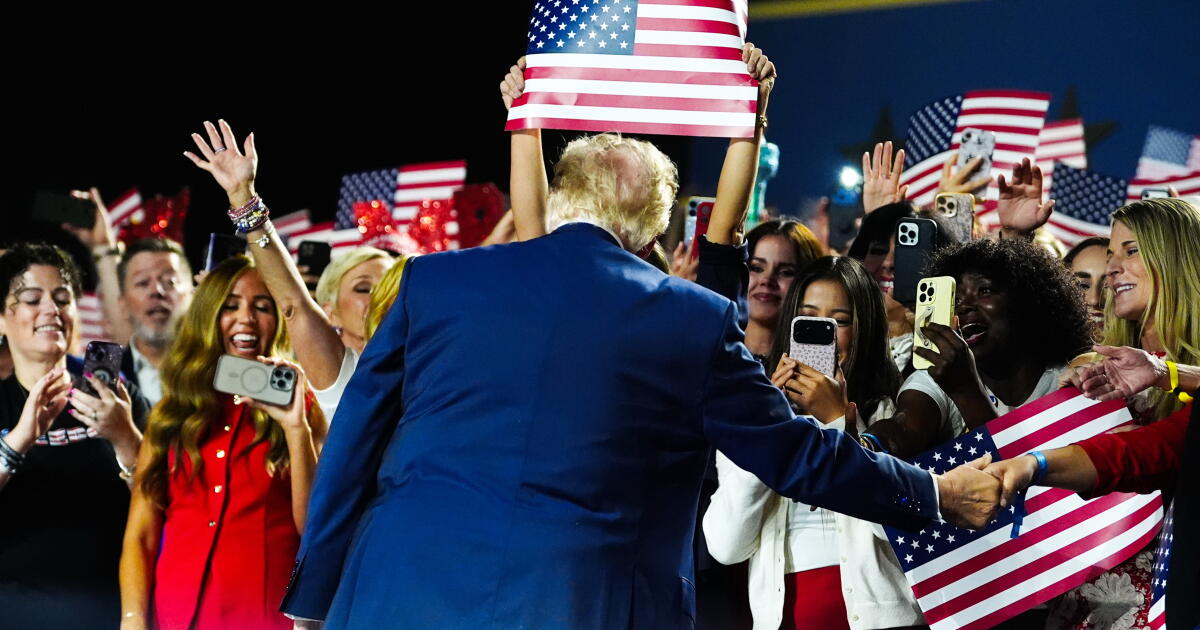
supporters

Venezuela passes law enacting harsh penalties for supporters of US blockade | US-Venezuela Tensions News

Venezuela’s National Assembly has passed a law enacting harsh penalties for those who support or help finance blockades and acts of piracy, including up to 20 years in prison.

The legislation was passed on Tuesday after the United States seized oil tankers linked to Venezuela, acts that the government of President Nicolas Maduro has denounced as lawless acts of piracy.

Recommended Stories

list of 3 itemsend of list

“This law seeks to protect the national economy and avoid the erosion of living standards for the population,” lawmaker Giuseppe Alessandrello said, while presenting the law before the National Assembly, controlled by Maduro’s governing party.

The US has carried out a series of increasingly aggressive measures over the past several months, deploying sizeable military forces to Latin America, seizing oil tankers, killing dozens of people in military strikes on what it says are drug-trafficking boats, and threatening land strikes on Venezuela itself.

The legality of some of those acts, such as the seizure of oil tankers in international waters, is contested. Others, such as the strikes against alleged drug traffickers, are widely considered illegal.

“We are in the presence of a power that acts outside of international law, demanding that Venezuelans vacate our country and hand it over,” Samuel Moncada, Venezuela’s representative at the United Nations, told the Security Council (UNSC) during a meeting on Tuesday.

“The threat is not Venezuela,” he added. “The threat is the US government.”

China and Russia also criticised US actions. Russia’s ambassador, Vassily Nebenzia, said that the Trump administration was creating a “template” for the use of force that could be used against other Latin American countries in the future.

“We saw clear support for Venezuela from Russia and China, but also from Colombia, and even from some other member states, talking about how the US needs to abide by international law and calling for de-escalation,” Al Jazeera correspondent Gabriel Elizondo said from the UN.

He added that several Latin American countries with right-wing governments, such as Argentina, Panama and Chile, appeared to side with the US.

“The bottom line here is that we have not gotten any better sense from the United States on what their endgame is here, where they plan to take this,” he added.

The Wall Street Journal reported on Tuesday that the US military had moved special operations aircraft and cargo planes with troops into the Caribbean this week.

“We have a massive armada formed, the biggest we’ve ever had, and by far the biggest we’ve ever had in South America,” Trump told reporters on Monday.

Maduro has said the US is seeking to topple his government and seize control of Venezuela’s large oil reserves, which members of the Trump administration have falsely claimed rightfully belong to the US. Trump said on Monday that the US would retain the oil seized from the tankers as well as the tankers themselves.

Addressing the UNSC, the US ambassador, Mike Waltz, said that oil sales were a “primary economic lifeline for Maduro and his illegitimate regime”, repeating an unsubstantiated claim that Maduro oversees a vast criminal enterprise that traffics drugs to the US.

“The single most serious threat to this hemisphere, our very own neighbourhood and the United States, is from transnational terrorist and criminal groups,” Waltz said.

The US pressure campaign has become a useful pretext for the Venezuelan government’s efforts to crack down on internal dissent.

Rights groups have said that Maduro’s government has become more repressive since the presidential election in July 2024, in which Maduro claimed victory despite the widespread doubts about the credibility of the results. The opposition has maintained it was the true winner, and few countries have recognised Maduro’s victory.

Source link

As gerrymandering battles sweep country, supporters say partisan dominance is ‘fair’

When Indiana adopted new U.S. House districts four years ago, Republican legislative leaders lauded them as “fair maps” that reflected the state’s communities.

But when Gov. Mike Braun recently tried to redraw the lines to help his fellow Republicans gain more power, he implored lawmakers to “vote for fair maps.”

What changed? The definition of “fair.”

As states undertake mid-decade redistricting instigated by President Trump, Republicans and Democrats are using a tit-for-tat definition of fairness to justify districts that split communities in an attempt to send politically lopsided delegations to Congress. It is fair, they argue, because other states have done the same. And it is necessary, they say, to maintain a partisan balance in the House of Representatives that resembles the national political divide.

This new vision for drawing congressional maps is creating a winner-take-all scenario that treats the House, traditionally a more diverse patchwork of politicians, like the Senate, where members reflect a state’s majority party. The result could be reduced power for minority communities, less attention to certain issues and fewer distinct voices heard in Washington.

Republican Sen. Rand Paul of Kentucky fears that unconstrained gerrymandering would put the United States on a perilous path, if Democrats in states such as Texas and Republicans in states like California feel shut out of electoral politics. “I think that it’s going to lead to more civil tension and possibly more violence in our country,” he said Sunday on NBC’s “Meet the Press.”

Although Indiana state senators rejected a new map backed by Trump and Braun that could have helped Republicans win all nine of the state’s congressional seats, districts have already been redrawn in Texas, California, Missouri, North Carolina and Ohio. Other states could consider changes before the 2026 midterms that will determine control of Congress.

“It’s a fundamental undermining of a key democratic condition,” said Wayne Fields, a retired English professor from Washington University in St. Louis who is an expert on political rhetoric.

“The House is supposed to represent the people,” Fields added. “We gain an awful lot by having particular parts of the population heard.”

Under the Constitution, the Senate has two members from each state. The House has 435 seats divided among states based on population, with each state guaranteed at least one representative. In the current Congress, California has the most at 52, followed by Texas with 38. The District of Columbia and U.S. territories such as Puerto Rico have no voting representation in either chamber of Congress.

Because senators are elected statewide, they are almost always political pairs of one party or another. Pennsylvania and Wisconsin are the only states with a Democrat and Republican in the Senate. Maine and Vermont each have one independent — who caucuses with Democrats — and one senator affiliated with a political party.

By contrast, most states elect a mixture of Democrats and Republicans to the House. That is because House districts, with an average of 761,000 residents, based on the 2020 census, are more likely to reflect the varying partisan preferences of urban or rural voters, as well as different racial, ethnic and economic groups.

This year’s redistricting is diminishing those locally unique districts.

In California, voters in several rural counties that backed Trump were separated from similar rural areas and attached to a reshaped congressional district containing liberal coastal communities. In Missouri, Democratic-leaning voters in Kansas City were split from one main congressional district into three, with each revised district stretching deep into rural Republican areas.

Some residents complained their voices are getting drowned out.

Democratic Gov. Gavin Newsom has defended California’s gerrymandering effort — approved by voters last month — as necessary to fight what he calls a power grab launched by Trump. Republican Gov. Mike Kehoe of Missouri has defended his state’s redistricting — approved by GOP lawmakers and signed into law by him — as a means of countering Democratic states and amplifying the voices of those aligned with the state’s majority.

All’s ‘fair’ in redistricting?

Indiana’s delegation in the U.S. House consists of seven Republicans and two Democrats — one representing Indianapolis and the other a suburban Chicago district in the state’s northwestern corner.

Dueling definitions of fairness were on display at the Indiana Capitol as lawmakers considered a Trump-backed redistricting plan that would have split Indianapolis among four Republican-leaning districts and merged the Chicago suburbs with rural Republican areas. Opponents walked the halls in protest, carrying signs such as “I stand for fair maps!”

Ethan Hatcher, a talk radio host who said he votes for Republicans and libertarians, denounced the redistricting plan as “a blatant power grab” that “compromises the principles of our Founding Fathers” by fracturing Democratic strongholds to dilute the voices of urban voters.

“It’s a calculated assault on fair representation,” Hatcher told a state Senate committee.

But others asserted it would be fair for Indiana Republicans to hold all of those House seats, because Trump won the “solidly Republican state” by nearly three-fifths of the vote.

“Our current 7-2 congressional delegation doesn’t fully capture that strength,” resident Tracy Kissel said at a committee hearing. “We can create fairer, more competitive districts that align with how Hoosiers vote.”

When senators defeated a map designed to deliver a 9-0 congressional delegation for Republicans, Braun bemoaned that they had missed an “opportunity to protect Hoosiers with fair maps.”

Disrupting an equilibrium

By some national measurements, the U.S. House already is politically fair. The 220-215 majority that Republicans won over Democrats in the 2024 elections almost perfectly aligns with the share of the vote the two parties received in districts across the country, according to an Associated Press analysis. It was made possible, however, in part by a gerrymander of North Carolina districts in the GOP’s favor prior to the 2024 election.

But that overall balance belies an imbalance that exists in many states. Even before this year’s redistricting, the number of states with congressional districts tilted toward one party or another was higher than at any point in at least a decade, the AP analysis found.

The partisan divisions have contributed to a “cutthroat political environment” that “drives the parties to extreme measures,” said Kent Syler, a political science professor at Middle Tennessee State University. He noted that Republicans hold 88% of congressional seats in Tennessee, and Democrats have an equivalent in Maryland.

“Fairer redistricting would give people more of a feeling that they have a voice,” Syler said.

Rebekah Caruthers, who leads the Fair Elections Center, a nonprofit voting rights group, said there should be compact districts that allow communities of interest to elect the representatives of their choice, regardless of how that affects the national political balance. Gerrymandering districts to be dominated by a single party results in “an unfair disenfranchisement” of some voters, she said.

“Ultimately, this isn’t going to be good for democracy,” Caruthers said. “We need some type of détente.”

Lieb writes for the Associated Press.

Source link

Jimmy Lai supporters queue outside Hong Kong court ahead of verdict | Freedom of the Press News

Media mogul Lai was arrested in 2020 under a national security law imposed by China.

Supporters of Hong Kong democracy activist and media mogul Jimmy Lai have begun queuing overnight outside a Hong Kong court ahead of a verdict in his lengthy trial.

The verdict will be delivered by a three-judge panel in a hearing that begins at 10am local time (02:00 GMT) on Monday and comes amid international calls to release Lai, who has already spent five years in jail.

Recommended Stories

list of 3 itemsend of list

On Sunday night, Lai’s supporters formed a queue more than a block long outside the courthouse. Some even had camping gear as they tried to secure a spot among the 507 tickets to the courthouse — 58 tickets are for Lai’s courtroom and the rest are for viewing in a separate overflow room by video link.

Dozens of police officers have been deployed around the area in preparation for Monday’s verdict.

Various of groups of pro-democracy activists including Jimmy Lai , center, arrives at a court in Hong Kong, Tuesday, Sept. 15, 2020. Prominent activists Jimmy Lai and Joshua Wong were among more than two dozen activists appearing in court after being charged of participating in unlawful assembly. They were charged for joining a vigil last June 4 to commemorate the anniversary of the 1989 Tiananmen crackdown. While the event has been held every year, authorities did not grant permission for the gathering this year citing concerns over the spread of coronavirus. [AP Photo/Kin Cheung]
Pro-democracy activists, including Jimmy Lai , centre, arrive at a court in Hong Kong [File: Kin Cheung/AP]

Lai, 78, the multi-millionaire founder of the now-shuttered Apple Daily newspaper, was arrested in 2020 under a national security law imposed by Chinese authorities to quell anti-government protests that rocked Hong Kong in 2019.

Lai’s family says his health has worsened after more than 1,800 days in solitary confinement, and that he suffers from diabetes, high blood pressure and heart palpitations.

Earlier this month, his daughter Claire Lai told the AFP news agency in Washington, DC that her father has lost “a very significant amount of weight” and noted that he has become “a lot weaker than he was before.”

“His nails turn almost purple, grey and greenish before they fall off, and his teeth are getting rotten,” she added.

Countries including the United States and the United Kingdom, as well as rights groups, have said Lai’s 156-day trial is politically motivated and have called for his immediate release.

US President Donald Trump also raised Lai’s case with Chinese President Xi Jinping in a meeting in South Korea in October and has said he would do his utmost to “save” Lai.

But Beijing has called Lai “an agent and pawn of anti-China foreign forces”, describing him as the main planner behind disruptive activities in the city.

The Chinese and Hong Kong governments have also said the tycoon is receiving a fair trial and that the national security law treats all equally. They say no freedoms are absolute when it comes to safeguarding national security.

“Jimmy Lai has endured five years in prison under appalling conditions simply for doing his job as a founder of one of the most renowned and independent media outlets in Hong Kong,” the media advocacy group Reporters Without Borders said in a statement.

“The trial can only be described as a sham and has nothing to do with the rule of law.”

After Monday’s verdict, if Lai is convicted, he could be sentenced in the near future. He can, however, appeal the outcome.

Source link