European natural gas prices may need to jump above €100/MWh ($117) by December for the continent to rebuild enough inventory to last the winter if the Strait of Hormuz crisis persists and keeps spot liquefied natural gas prices in Asia elevated, Goldman
The amount of Iranian oil offered to Chinese buyers has declined sharply and is rapidly running out, while prices have jumped, Reuters reported Friday, showing the effectiveness of the U.S. blockade of Iran’s ports in preventing new supply from leaving the Persian Gulf.
nLIGHT (LASR) shares fell about 21% on Friday after the laser technology company warned that China-linked supply chain disruptions would weigh on current-quarter results, overshadowing better-than-expected second-quarter earnings and revenue.
If we take it as read that the better the view, the worse the cooking, then by rights south Wales’s Gower peninsula should be a culinary desert. The first time I visited almost 15 years ago, I was unprepared for its loveliness – back in 1956, Gower (never the Gower, as locals were quick to correct me) was the first place in the UK to be designated an area of outstanding natural beauty, and though the peninsula abuts the country’s second city, Swansea, it still feels profoundly rural. Crisscrossed by narrow lanes flanked by towering hedges and ancient churches, it’s a great place to cycle, to drive, and above all to walk up an appetite.
Indeed, it’s been a long-held ambition of mine to hike the 43 miles of the Welsh Coast Path from Mumbles to Loughor. Sadly, it remains just that because on this latest trip I spent considerably more time chomping than yomping … though in fairness I was on a research mission for a walking trip with a friend here later in the summer, because as a food writer and semi-professional glutton, I never like to head anywhere unprepared.
With this in mind, and another friend on hand as a chauffeur, Wilf the dog and I began our investigations in Mumbles, where Swansea thins into a pretty seaside village of colourful Victorian villas culminating in a magnificent, privately owned pier. (A few years ago, a visiting Prince William observed to owner Bert Bollom, the third generation of his family to run it, that this was an unusual career choice. Bert shrugged that he’d inherited the job from his dad. “Tell me about it,” he recalls the prince sighing.)
Though the pier is undergoing restoration work, there’s a good view of the “crown of the Bristol Channel” from another Bollom enterprise, On the Rocks, a steak restaurant with a terrace jutting over the foreshore that’s no doubt a terrific place for a sundowner. But, I tell myself sternly, when you’re starting a walk you need to put one foot in front of the other, not sit around drinking, especially as the friend I plan to come back with later in the summer is happily, if rather inconveniently, pregnant.
Crab sandwich at the Gower Seafood Hut in Mumbles.
There’s thus not much point in returning to the Gower Brewery Taproom, despite the warm welcome and dog biscuits we receive on this occasion – I’ll probably suggest we stop instead at Joe’s, the local cult masquerading as an ice-cream parlour. (Vanilla, freshly churned in-house daily, is the only move here. Unless you’re under the age of 10, do not waste your time on other flavours.) Thankfully, the expectant one is past the nauseous stage, so I can also steer her in the direction of the crab sandwiches (local sourdough and deliciously salty Shirgar butter) at the Gower Seafood Hut with a clear conscience – depending on the time of day, it might also feel appropriate to fortify ourselves with a helping of fried whitebait or cockle popcorn before joining the coast path, particularly as Chris Price, who mans the stoves, has, according to co-owner Sarah Kift, already walked much of it himself.
That said, I reckon I’ve got the fuelling part of the route covered; for a start, there’s another ice-cream parlour, Fortes, just round the headland in Limeslade Bay. From the neat beach huts of Langland to the golden sands of Three Cliffs Bay, however, the sites are more prehistoric than edible (tasty as the Bacon Hole cave sounds, the nearest it gets to cured meat is its hoard of ancient narrow-nosed rhinoceros and straight-tusked elephant bones, now 200 miles away in the British Museum). Take a brief detour into the village of Southgate though, and you’ll happen upon a brilliant Greek cafe – I didn’t anticipate tucking into a sugar-dusted bougatsa custard pie and a punchy little coffee in The Gower Deli, but this place is full of surprises.
Sometimes they come too thick and fast even for my boundless appetite: just 20 minutes inland from Three Cliffs, if you follow the lazy meandering waters of the Pennard Pill past the ruins of a Norman castle, sits the Gower Heritage Centre. Clustered around a 12th-century water mill, it boasts a cider press, organic community agriculture project, sauerkraut producer, jewellery designer and bike shop plus – and the jewel in its crown as far as I’m concerned – the superb Little Valley bakery, whose traditional Gower loaf is produced using the mill’s barley flour. They also make ridiculously flaky pasties, focaccia sandwiches, huge cookies and excellent viennoiserie – in short, a rambler’s dream.
The Beach House restaurant in Oxwich on the Gower.
From Three Cliffs, it’s about another five miles along the coast to Oxwich. If you make one reservation for your Gower trip, make it at the Beach House there. Admittedly, given its Michelin star, one might not want to wander in directly from the path in quick-dry hiking sandals, but our welcome couldn’t be warmer, despite Wilf’s rather over-effusive manner (the terrace is dog-friendly, as is one table inside, which you can bet your boots I will be booking well in advance).
A Michelin-star dish at the Beach House restaurant in Oxwich.
From our seats, we can see the two boats that supply the restaurant with lobster. “They belong to Paul and Jim,” says chef Hywel Griffith. “Every morning, I text them what we need that day.” The lamb is from the North Gower salt marsh; the seaweed in the laverbread rolls (a clever play on the traditional puree) from Selwyn’s in Pen-clawdd; and the dessert, a malted mousse with wood sorrel and fermented pine syrup, is the single most delicious thing I’ve eaten since Sarah Kift’s crab sandwich.
Five more miles brings us to Port Eynon, whose chief attraction on this visit is the tiny, genuinely artisan Gower Gin Company – having enjoyed one solo guided tasting with my designated driver and the teetotal terrier, I’ll pass on another with a reluctant abstainer. It’s six more miles to Rhossili, once, somewhat absurdly, declared the “ninth best beach in the world” by TripAdvisor. What’s not up for debate is that it’s 3 miles long and stunning.
Sunrise over Mumbles lighthouse and privately owned pier. Photograph: leighcol/Getty Images
Thanks to the National Trust, it’s also untouched by the grubby hand of commercialism, so should you be peckish, pause at the aptly named View cafe before you descend the cliff. Offering colourful vegan “power bowls” (popular with the surfing crowd apparently) and homemade falafel alongside the rarebit and bara brith, the only packaged food in sight is a bag of locally produced dog treats I’m bullied into buying for my elderly companion who, despite a brisk trot down to the Worms Head Coastwatch station beforehand, is in no mood to obey the house rule that “shouting is not permitted”.
Turn the corner on to the north coast, and you’re faced with Whiteford Sands, yet another broad expanse of golden gorgeousness with great cooking attached in the form of the Britannia Inn in Llanmadoc, where the salt marsh lamb croquettes at the bar drive the tiny diner under the table to distraction.
Fortunately, I don’t have to test Wilf’s restraint on the living, bleating thing on this occasion, as the remaining seven miles of the route – through the marshes to Pen-clawdd, – will have to wait till next month. When we finally get there, however, I will insist on stopping at the Gower Brewery to toast our achievement. I’ve even road-tested their Zero beer in preparation. As I said, I like to plan ahead.
“The Yemeni armed forces have carried out a significant military operation targeting two Saudi oil tankers that violated the ban imposed by the armed forces in the Red Sea,” the Houthis claimed on Telegram. “The operation involved a number of ballistic and cruise missiles, as well as drones. Thanks to God’s help, the strikes were accurate and caused a large fire on both vessels.”
بيان القوات المسلحة اليمنية بشأن استهداف سفينتين نفطيتين سعوديتين خالفتا قرار الحظر في البحر الأحمر ما أدى إلى نشوب حريق كبير فيهما، واجبار 10 سفن على التراجع والعودة – 22 يوليو 2026م pic.twitter.com/S5ijNZYaV7
TWZ cannot independently verify the Houthi claim. However, in a post on X, UKMTO stated that a master of an oil tanker “reports being struck by an unknown projectile which has caused a fire onboard that the crew are currently fighting.”
The incident took place 70NM southwest of Al Shuqaiq, Saudi Arabia, the organization added. “There are no reported casualties and no environmental impact. Authorities are investigating. Vessels are advised to transit with caution and report any suspicious activity to UKMTO.”
The increasing tensions on the BAM come as U.S. President Donald Trump threatened to destroy Iranian bridges and power plants each time Iran hits a ship transiting the Strait of Hormuz, which has been a major flashpoint of tit-for-tat exchanges of fire. Trump also threatened that he will retaliate for the deaths of three U.S. Army soldiers during a July 17 attack on Muwaffaq Salti Air Base (MSAB) in Jordan. He made those statements at a dignified transfer ceremony for the soldiers, plus one killed in Iraq, at Dover Air Force Base in Delaware today.
The incident in the Red Sea took place a day after the U.S. Navy warned that the Houthis had moved weapons near the BAM.
“Recent Houthi statements indicated a readiness to target shipping (specifically Saudi-affiliated) if directed,” the Navy’s Joint Maritime Information Center (JMIC) warned on Tuesday. “According to regional reporting, Iran has instructed the Houthis to stand ready to close the Red Sea oil route should the United States strike Iranian power infrastructure.”
“Sources close to the group stated that the Houthis have completed preparations to attack shipping, including the deployment of missiles and drones positioned near Bab al-Mandeb.”
The Houthis have also “told shipping companies not to load or discharge cargo at Saudi Arabian ports or they may be targeted, according to an email the group sent to companies,” Reuters reported.
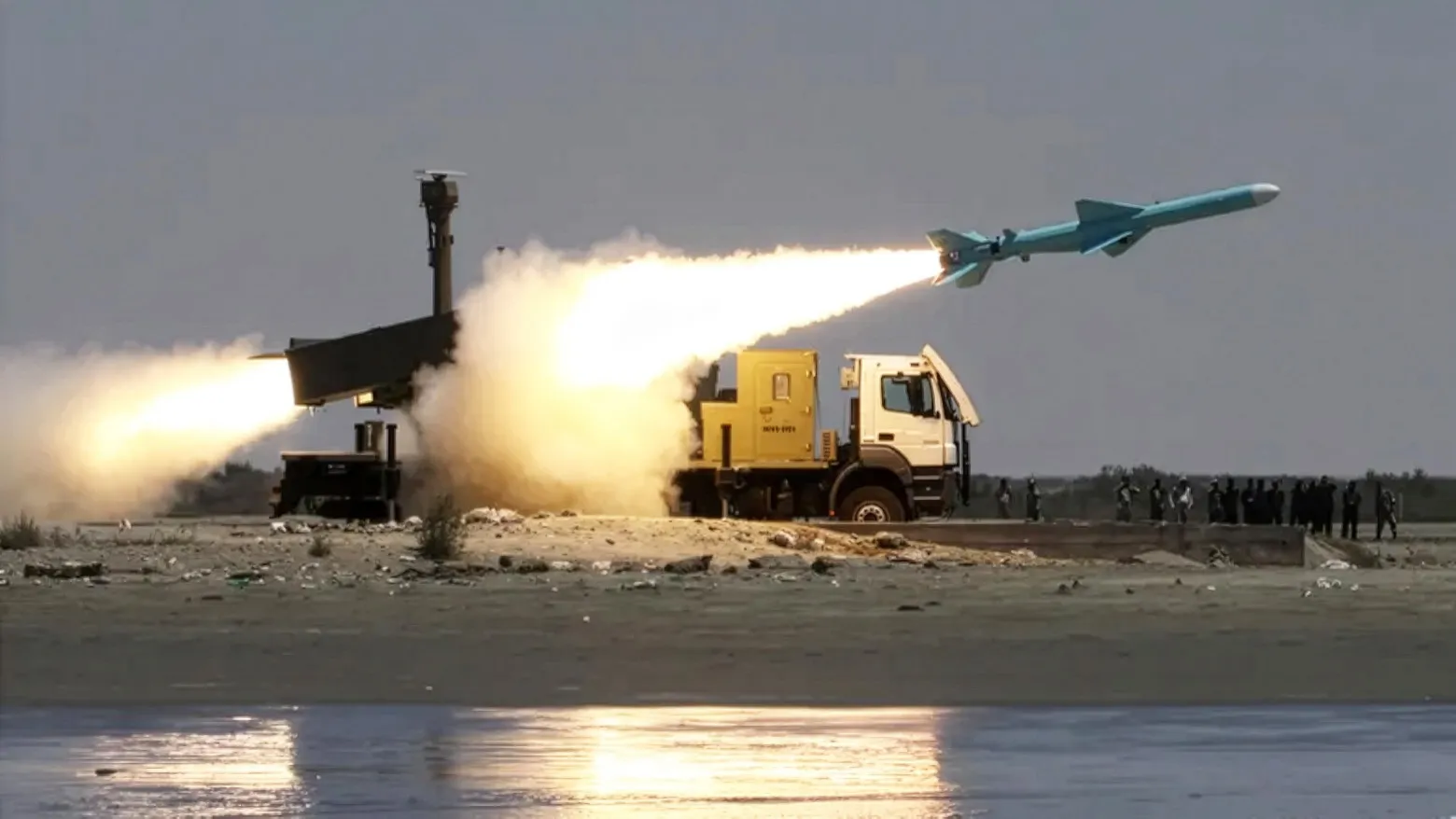
The Houthis are gearing up for potential anti ship missile launches, releasing footage that appears to show their Asef anti-ship ballistic missile (ASBM) as they continue to threaten commercial shipping linked to Saudi Arabia.
As we have frequently detailed, a Houthi blockade of the BAM threatens to add further pressure on oil exports from the Middle East, already drastically affected by the Iranian closure of the Strait of Hormuz and the resumption of the U.S. blockade on Iranian ports. Saudi Arabia has diverted millions of barrels of oil per day through pipelines to its Yanbu port on the Red Sea in an effort to minimize the energy shortages due to the hostilities in the Persian Gulf. This also raised the specter of the U.S. having to get as involved as it did during the previous Houthi campaign against shipping that ended last September, which could pull resources away from Iranian-focused operations.
Before the attack claim, global trade intelligence firm Kpler pointed out on X that while traffic continues through both straits, “operational confidence remains under pressure.”
“Traffic declined sharply across both chokepoints on 21 July, with Strait of Hormuz crossings down 31% day-on-day to nine vessels and Bab al-Mandeb down 34% to 29 amid a worsening security backdrop,” Kpler added. “Four confirmed vessel U-turns near the Gulf of Aden suggest operators are becoming more cautious following Houthi threats against Saudi-linked shipping. At the same time, confirmed maritime attacks continue around the Strait of Hormuz, reinforcing concerns that uncertainty across both regional chokepoints could reshape routing decisions, increase freight costs and sustain higher geopolitical risk premiums for energy markets.”
Dual chokepoint risks deepen
Shipping continues through both the Strait of Hormuz and Bab el Mandeb, but operational confidence remains under pressure. Traffic declined sharply across both chokepoints on 21 July, with Strait of Hormuz crossings down 31% day-on-day to nine… pic.twitter.com/D7dmCRffcv
As noted earlier in this piece, Trump visited Dover Air Force Base to take part in the dignified transfer ceremony honoring Lt. Tyler James Feehan, 25, of Hawaii, Pvt. Isabella Gonzales, 19, of Texas, Sgt. Angel Rampersad, 28, of New York and Sgt. Michael Emmanuel Swinton, 30, of North Carolina.
Today, we honor four American heroes who made the ultimate sacrifice in service to our nation.
May God hold them in His eternal embrace and comfort their grieving families, and may God forever… pic.twitter.com/P5NA59ltAU
— Rapid Response 47 (@RapidResponse47) July 22, 2026
Feehan, Gonzales and Rampersad were killed during the July 17 Iranian barrage of MSAB. U.S. Central Command (CENTCOM) previously announced Rampersad as missing, but her status was updated to a Duty Status–Whereabouts Unknown and she is believed to be deceased.
Swinton was killed during a controlled detonation of a downed One-Way Unmanned Aerial System on July 19, 2026, at Erbil Air Base, Iraq.
— Rapid Response 47 (@RapidResponse47) July 22, 2026
Speaking to reporters, Trump said his administration would share the results of the investigation into the MSAB attack and vowed that Iran would “pay a big price.”
Those comments followed an earlier statement the president posted on Truth Social vowing to target key infrastructure sites each time Iran strikes a ship transiting the Strait of Hormuz.
“From this point forward, any time the Islamic Republic of Iran shoots at a ship in the Strait of Hormuz, whether it be by Missile, Rocket, Drone, or any other device or weapon, the United States will bomb and destroy ONE BRIDGE OR POWER PLANT, including those located next to, or in, the Capital City of Tehran,” Trump proclaimed.
Not surprisingly, Iranian officials reacted to Trump’s comments by issuing their own threats in response.
“Iran will retaliate against regional infrastructure and energy facilities with American interests if the United States strikes any Iranian bridge or power plant, responding directly to a new threat from US President Donald Trump,” the Islamic Revolutionary Guard Corps (IRGC)-connected Tasnim news agency stated on X.
A military source said Iran will retaliate against regional infrastructure and energy facilities with American interests if the United States struck any Iranian bridge or power plant, responding directly to a new threat from US President Donald Trump. pic.twitter.com/a8MIFqxktx
Earlier on Wednesday, Jordanian officials said the country was once again targeted by Iran.
“An official military source at the General Command of the Jordanian Armed Forces—Arab Army stated that air defense systems detected six missiles coming from Iranian territory targeting the Kingdom’s territory today, and engaged them immediately upon their entry into Jordanian airspace,” the Jordanian military stated on X. “Air defenses intercepted and shot down four missiles, while the other two fell in two remote, uninhabited areas, without causing any casualties or material damage.”
“The Kingdom’s airspace is under continuous operational monitoring, and the Armed Forces will deal with any aerial threat targeting Jordanian territory according to the applicable rules of engagement, in a manner that ensures the protection of the Kingdom’s sovereignty and the safety of its citizens,” officials added.
The situation in Jordan is so intense that the U.S. Embassy in Amman issued a security alert.
“President Trump, Secretary of State Rubio, and the Department of State have no higher priority than the safety and security of American citizens,” the embassy cautioned on X. “We remind U.S. citizens that Iran has attacked civilian and critical infrastructure across the Middle East, including hotels, airports, diplomatic facilities, and other civilian locations.”
Security Alert: U.S. Embassy Jordan July 22
President Trump, Secretary of State Rubio, and the Department of State have no higher priority than the safety and security of American citizens. We remind U.S. citizens that Iran has attacked civilian and critical infrastructure… pic.twitter.com/UOihlptEwp
— U.S. Embassy Amman (@USEmbassyJordan) July 22, 2026
Over the course of the past 12 days, Iran has lobbed missiles and drones at several Arab nations, taking particular aim at U.S. military installations.
Satellite imagery continues to emerge on social media purporting to show damage at these bases. The images below claim to show a 117-FPS radar at Al-Jaber Air Base in Kuwait destroyed by an Iranian barrage. While the image clearly shows what appears to be a radome destroyed, TWZ cannot independently verify the date, location or provenance of the imagery. CENTCOM, which does not talk about battle damage, declined comment.
Imagery has also emerged purporting to show that U.S. Air Force aerial refueling tankers and other aircraft have evacuated Al Udeid Air Base in Qatar, the largest American base in the region. Again, we cannot confirm the details and CENTCOM, which also does not typically talk about the movements of assets, declined comment.
However, Axios reported last week that the Trump administration “notified Israel it is sending dozens more refueling planes to the country ahead of a potential expansion of military operations against Iran.”
“Israeli officials say the U.S. wants to send several dozen more refueling planes in the coming days, bringing the number of planes to the same level it had at the beginning of the war,” Axios added. “Israeli officials say the U.S. military prefers operating the refueling planes from Ben Gurion Airport, because other air bases in the region are more exposed to Iranian attacks and less safe for U.S. planes. At the moment, the Iranians are still deterred from launching attacks on Israel, because it will likely trigger a massive retaliation.”
The U.S. still sits ready to conduct long-range bomber strikes from bases in the U.S. and the U.K.
There were recent unconfirmed claims by open-source trackers that B-1B Lancer bombers out of RAF Fairford in England took part in yesterday’s attacks on Iran. Again, we cannot verify that and CENTCOM declined comment.
Overnight, B-1B “Lancer” bombers flying from RAF Fairford (EGVA) conducted strikes in Iran as the US ramps up operations again. Although 2 bombers launched, it appears it was pre-planned that only 1 of them would… pic.twitter.com/Q7Ic3Ahqk3
However, Israel’s KAN news outlet claimed that “Israel has been informed by the United States that it intends to escalate attacks on Iran in the coming days and to carry out attacks using heavy bombers for the first time in the current escalation.”
In addition, other U.S. Air Force assets – including EA-37B Compass Call electronic warfare jets – appear headed to the region, according to online flight trackers. While we don’t know for sure these jets will actually head to the Middle East, it could be another sign of the U.S. bolstering assets ahead of an increase in intensity of attacks, which have been largely focused over the past 12 days on Iranian coastal targets.
Amid these rising tensions with Iran, the Houthis have now apparently raised the stakes and it will be absolutely critical to keep the BAM open as the world already sits on the razor’s edge of a full-on energy crisis.
UPDATE: 7:17 PM EDT –
CENTCOM announced a new round of attacks on Iran.
“At 5:30 p.m. ET today, U.S. forces began launching more strikes against Iranian military targets at the Commander in Chief’s direction,” the command stated on X. “The mission will continue to further degrade Iran’s ability to threaten civilian mariners and commercial vessels transiting regional waters.”
At 5:30 p.m. ET today, U.S. forces began launching more strikes against Iranian military targets at the Commander in Chief’s direction. The mission will continue to further degrade Iran’s ability to threaten civilian mariners and commercial vessels transiting regional waters.
With $1.7 trillion tied up in inefficient supply chains, CFOs are making liquidity a core strategy.
Gustavo Muller, Monkey
There’s $1.7 trillion of working capital sitting on the balance sheets of the largest U.S. companies: not locked in failed investments or delayed acquisitions, but trapped in slow receivables, excess inventory, and payment structures designed for a different economic environment.
That money hasn’t disappeared. It remains tied up in processes that no longer reflect how companies manage risk, liquidity, or supply chains.
For many CFOs, the largest untapped source of liquidity is the cash already embedded in operations. Yet organizations often struggle to unlock it because treasury, procurement, operations, and suppliers continue to pursue different objectives using disconnected systems and metrics.
The culprits include receivables that take too long to convert to cash, inventory accumulated as protection against uncertainty, supplier payment structures that fail to balance liquidity across the value chain, and cash reserves that remain underutilized because companies lack the visibility to deploy them effectively.
For years, these inefficiencies were manageable. Low interest rates, predictable supply chains, and abundant liquidity reduced the urgency to rethink working capital. Treasury managed liquidity, procurement negotiated payment terms, sales focused on collections, and financial institutions provided financing within established relationships.
Today’s environment demands a different approach.
Higher interest rates, geopolitical uncertainty, higher tariffs, supply chain disruptions, and persistent margin pressure have elevated working capital from a finance function to a strategic business priority. Yet many organizations continue to manage liquidity using operating models designed for a different era.
According to Deloitte’s Q1 2026 CFO Signals survey, siloed organizations and outdated technology remain among the largest internal barriers to cost management. Boston Consulting Group has noted that extending payment terms alone often merely shifts financing costs along the supply chain rather than improving overall efficiency.
The challenge is therefore broader than financing. It is about coordination.
Working capital decisions increasingly require treasury, procurement, operations, finance, and suppliers to operate from the same information and align around shared objectives. Without that alignment, companies often optimize individual functions while reducing efficiency across the broader organization.
Reflecting these realities, investors have changed their expectations. Following several years of tighter capital markets, boards increasingly emphasize cash-flow resilience, capital discipline, and operational efficiency alongside growth. Liquidity has become a competitive advantage rather than simply a financial metric.
Rethinking Working Capital
Companies are responding in different ways. Many are investing in better forecasting and real-time cash visibility. Others are modernizing treasury infrastructure, digitizing receivables and payables, expanding supply chain finance programs, or adopting data-driven tools that improve coordination across functions. Financial institutions are evolving their offerings through broader funding networks, automation, and digital onboarding capabilities.
No single approach will solve the challenge for every organization. What appears increasingly clear, however, is that fragmented processes and limited transparency are becoming more expensive. As supply chains grow more complex and financing conditions remain uncertain, organizations require greater visibility into where liquidity resides, how quickly it can move, and how financing decisions affect every participant across the value chain.
The International Finance Corporation and the World Bank have consistently highlighted digital infrastructure as a key enabler for expanding access to supply chain finance, particularly among smaller suppliers that have historically remained outside traditional financing programs. The objective is not technology for its own sake, but the creation of more efficient, scalable financial ecosystems.
The U.S. has one of the world’s deepest capital markets. Yet many companies continue to face unnecessary constraints in moving liquidity through their supply chains.
The next phase of working capital management, then, will likely depend less on access to capital — which remains abundant — and more on the ability to connect information, participants, and decision-making across increasingly complex commercial networks.
Organizations that succeed will be those that treat working capital not as a quarterly reporting metric but as an enterprise-wide capability that strengthens resilience, improves capital allocation, and creates flexibility in periods of uncertainty.
***
Gustavo Muller is CEO and co-founder of Monkey, a financial solutions marketplace. He has more than two decades of experience in financial markets, having held senior positions at Citibank, XP Investimentos, and as co-founder of Fisher Venture Builder.
Weekly insights and analysis on the latest developments in military technology, strategy, and foreign policy.
As renewed hostilities between Iran and the U.S. and its allies enter a 10th day, the Houthi rebels of Yemen say they are imposing an embargo on Saudi oil shipments passing through the Bab el-Mandeb (BAM) Strait. The move threatens to add further pressure on oil exports from the Middle East, already drastically affected by the Iranian closure of the Strait of Hormuz and the resumption of the U.S. blockade on Iranian ports. Saudi Arabia has diverted millions of barrels of oil per day through pipelines to its Yanbu port on the Red Sea in an effort to minimize the energy shortages due to the hostilities in the Persian Gulf. This also raises the specter of the U.S. having to get as involved as it did during the previous Houthi campaign against shipping that ended last September, which could pull resources away from Iranian-focused operations.
BREAKING: Houthis of Yemen announce a a “maritime embargo” against Saudi Arabia, “effective immediately.”
Saudi Arabia has until now exported ~4.5m b/d from Yanbu in the Red Sea, most of it heading South throughout the Bab al-Mandab Strait between Yemen and Djibouti-Eritrea pic.twitter.com/c96Apzh9As
On Monday, Kuwait said it came under Iranian fire again.
“Kuwaiti air defenses are currently engaging hostile missile and drone attacks following the heinous Iranian aggression,” the Kuwaiti Defense Ministry stated on X. “The General Staff of the Army notes that any sounds of explosions heard are a result of air defense systems intercepting hostile attacks. Everyone is urged to adhere to the security and safety instructions issued by the relevant authorities.”
Hours earlier, Bahrain said it too had come under a new wave of Iranian attacks.
“The General Command of the Bahrain Defense Force (BDF) announces that Iran is continuing its systematic hostility approach through its sinister attacks targeting civilians in the Kingdom of Bahrain,” BDF posted on X. “The General Command clarifies that, with strong will and high combat readiness, the air defense systems attacked, intercepted and destroyed a number of treacherous Iranian air strikes today, Monday, July 20, 2026.”
The extent of the damage in either Kuwait or Bahrain is unclear at the moment. These most recent attacks came after U.S. Central Command on Sunday night said it wrapped up a ninth straight day of strikes on Iranian assets, targeting “military command centers, air defense and coastal surveillance sites, maritime capabilities, missile and drone launch sites, and communications networks to further diminish Iran’s ability to attack commercial vessels and civilian mariners transiting the Strait of Hormuz,” the command stated on X.
Amid this kinetic activity, as we noted earlier in this story, the Iranian-backed Houthis say they will no longer permit Saudi Arabian ships passage through from the Red Sea into the Bab el-Mandeb Strait.
“The Yemeni Armed Forces declare a maritime embargo against the criminal Saudi enemy, based on the equation of an ‘eye for an eye,’ effective immediately upon the issuance of this statement,” the Houthis stated on Monday, according to the official Houthi SABA media outlet. The move follows increased tensions between the Houthis and Saudi Arabia as well as a request by Iran “to stand ready to close the Red Sea oil route if the United States strikes Iranian power infrastructure,” Reuters reported last week. “The idea has been discussed within the Islamic Republic’s leadership, and the message has been conveyed to Iran’s Houthi allies.”
⚡️BREAKING: Yemen’s Houthis have announced a Naval Blockade on Saudi Arabia from the Red Sea
This move essentially Cuts OFF Saudi oil exports through the Bab al-Mandeb Strait pic.twitter.com/gqV8E5hfq1
Houthi forces on Monday reportedly began issuing warnings on open maritime frequencies near Yemen that the BAM is closed to Saudi shipping and its vessels are subject to attack.
Houthi forces are reportedly issuing warnings on open maritime frequencies near Yemen that the Bab al-Mandab Strait is closed to Saudi shipping. pic.twitter.com/MD0KhmTmJ5
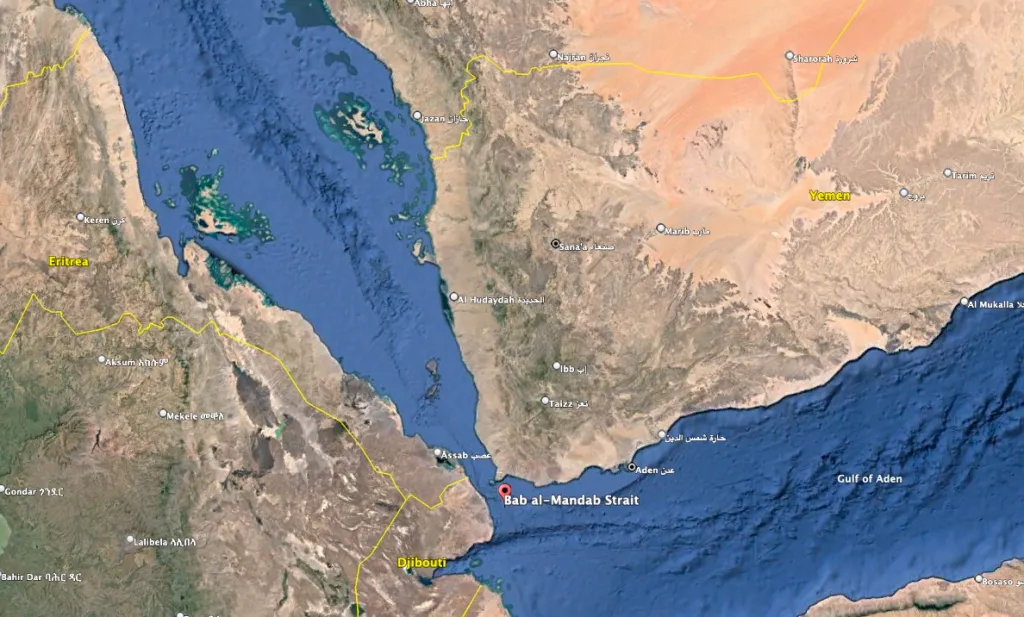
A Houthi shut down of the Bab el-Mandeb (BAM) Strait, a narrow stretch of water between Yemen and Djibouti, would choke off the flow of oil exports from Saudi Arabia, exacerbating the above-mentioned impingement on the flow of oil from the closed Strait of Hormuz.
Having both straits closed at once is something of a ‘sum of all fears’ scenario for the global energy marketplace.
“The full closure of the BAM would cut global oil supply by 7% as it would leave most Saudi oil exports unable to leave the region,” Reuters noted on Monday. “The disruption would add to the massive cut to global oil flows from the war in the Gulf, which has already reduced shipments by 10% of global supply.”
You can read more about the effects of both straits being closed at once in our story about that here.
The Bab el-Mandeb Strait is a strategic chokepoint where the Houthis declared they have imposed an embargo on Saudi shipping. (Google Earth) The Bab al-Mandab Strait between Yemen and Djibouti has become a dangerous chokepoint of Houthi attacks. (Google Earth image)
Beyond affecting the flow of oil, a Houthi blockade on the BAM threatens to open a new front in this conflict.
The Houthis carried out a campaign against shipping in November 2023 in solidarity with Palestinians over the latest war between Israel and Gaza. However, while it was ostensibly aimed at only Israeli connected ships, numerous commercial vessels with no clear Israeli ties were attacked as were several U.S. and allied warships. The campaign stretched into the summer of 2025, forcing some vessels to avoid the Suez Canal for a far longer route around Africa, boosting shipping costs by nearly $200 billion at the time.
The Houthi attacks also forced the U.S. and allies to deploy many warships, including the Eisenhower and Truman Carrier Strike Groups (CSG) to both defend against Houthi attacks and strike targets in Yemen. These operations resulted in a large expenditure of air defense and strike munitions.
You can see video of some of those encounters below.
WATCH: CENTCOM releases footage as US HAMMERS Iran
The possibility exists that a new wave of Houthi attacks — especially if non-Saudi ships are targeted — could drag in U.S. forces already in heavy use in the Persian Gulf region battling the Iranians. This sets up a major showdown as Saudi oil is a lifeline to Asian supplies hobbled by conflict in the Persian Gulf. We reached out to CENTCOM for comment and will update this story with any pertinent details shared.
Earlier on Monday, the head of the European-led task force providing maritime security in the Red Sea region told us the Houthis remain a threat to navigation despite not having attacked any merchant vessels since September 2025.
“The security situation in the Bab el-Mandeb remains fragile and is highly sensitive to regional escalation,” Rear Admiral Vasileios Gryparis, Commander of EUNAVFOR ASPIDES, told TWZ. “On the rhetorical level, the Houthis’ leadership reiterated several times their alignment with the broader Axis of Resistance.”
Gryparis’s comments, in response to a query from last week about Iran’s outreach to the Houthis, came before the Yemeni group’s embargo declaration.
“From an operational standpoint, we assess that the Houthis pose a threat and are capable of rapidly escalating,” the ASPIDES commander told us. “We maintain a frequent presence at sea, monitor the situation, and adjust our actions when needed. In the event of a resumption of Houthi attacks on merchant vessels, which remains a possibility, we are present and ready to implement our mandate, within our means and capabilities. ASPIDES remains ready, within its defensive mandate, to adapt to evolving operational requirements.”
A French destroyer operating under EUNAVFOR ASPIDES provided support to a commercial vessel transiting the Red Sea region. (ASPIDES)
Being drawn into defending against a new Houthi campaign on shipping in the Red Sea region would exacerbate the strain on U.S. forces already under tremendous pressure from Iran. In addition to defending against ongoing barrages, the U.S. has committed about 20 U.S. warships, along with hundreds of aircraft dispersed across various bases, vessels, and forward arming and refueling points in the Middle East, to maintaining the newly reimposed blockade on Iranian ports. Moving these assets to another prologned shooting match in the Red Sea would degrade those capabilities and the ability to support a war effort should it fully erupt. It’s a capacity issue.
Expanding the fight against Iran is already in discussion by the Trump administration.
“The U.S. is planning for a wider war,” a U.S. official familiar with internal administration discussions told The Washington Post.
But the official cautioned that “the expansion of U.S. operations will be limited by dwindling stockpiles of air defense and long-range munitions and constraints on the ability to surge more troops and aircraft into the area because of battle damage,” the newspaper continued.
“We do not have enough to safely sustain operations, and I don’t think the White House is aware of that,” the Post said the official added.
One notable detail from The Washington Post’s reporting: even as the Pentagon prepares for the possibility of a broader conflict with Iran, one U.S. official warned that the campaign could be constrained by dwindling stocks of air defense interceptors and long-range munitions,… https://t.co/Xo9A6yNFnppic.twitter.com/dKEN3IGNUr
All this comes as there are increasing signs of damage at U.S. facilities in the Middle East from Iranian barrages. Though largely spared in the initial phases of Epic Fury due to robust air defenses, the airfield at Muwaffaq Salti Air Base in Jordan has taken the brunt of recent attacks, while several other installations have been hit as well.
The air base has long been a major regional hub for U.S. operations, and is being very actively utilized in the current conflict. It hosts the greatest concentration of U.S. tactical aircraft in the region, and thus is an extremely important target, where, as we pointed out, even one ballistic missile landing on an apron could destroy multiple prized aircraft and take the lives of U.S. service members or cause injuries.
Satellite imagery has emerged on social media purporting to show the extent of the damage at MSAB. The following shows what is claimed to be before and after views of strikes on aircraft hangars and containerized housing units. The imagery is provided by Iran and, because U.S. satellite firms do not collect over American facilities, we cannot independently confirm what is being depicted.
Before-and-after imagery shows at least two dozen containerized living units housing U.S. troops completely destroyed by Iranian strikes at 31°49′57″N, 36°47′47″E.
Two U.S. service members were killed at this site, while a third remains missing. pic.twitter.com/sqPOxhGTLr
Beyond damage, the number of troops killed and injured in Iranian attacks is rising. On Monday, the Pentagon identified two soldiers killed in action.
“1st Lt. Tyler James Feehan, 25, of Ewa Beach, Hawaii, was killed in action on July 18, 2026, and Pvt. Isabella Gonzales, 19, of Carrollton, Texas, was killed in action on July 17, 2026, during an enemy attack on July 17, 2026, at Muwaffaq Salti Air Base, Jordan,” the Pentagon said in a statement. “The incident is under investigation.”
Both soldiers worked for air defense units. Feehan was assigned to 2nd Battalion, 55th Air Defense Artillery Regiment, 32nd Army Air Missile Defense Command, Fort Bragg, North Carolina. Gonzales was assigned to 1st Battalion, 57th Air Defense Artillery Regiment, 52nd Air Defense Artillery Brigade, 10th Army Air Missile Defense Command, Ansbach, Germany.
BREAKING: The Pentagon has identified the soldiers killed in action from Iranian attacks in Jordan as 19-year-old Pvt. Isabella Gonzales and 25-year-old 1st Lt. Tyler James Feehan.
1st Lt. Feehan was assigned to 2nd Battalion, 55th Air Defense Artillery Regiment, 32nd Army Air… pic.twitter.com/3PFpnMcOVZ
Today’s identifications came after CENTCOM on Saturday reported that two U.S. service members in Jordan were killed in action on July 17. Additionally, the command said one service member was currently missing, but later said unidentified remains were found.
CENTCOM also reported on Sunday that “a U.S. service member in northern Iraq was killed in action July 18 during a controlled detonation of unexploded ordnance from a downed Iranian one-way attack drone. A second service member was wounded and continues to receive medical treatment for a minor injury.”
We have asked CENTCOM and the Army to confirm that Feehan was the soldier killed in Iraq during the controlled detonation or if he was killed in another incident.
It should be noted that in announcing the identities of Feehan and Gonzales, the Pentagon said they died in support of Operation Inherent Resolve (OIR), which is the fight against ISIS in Iraq and Syria. We asked the Pentagon for clarity and they deferred us to CENTCOM, which has yet to respond.
“In the week leading up to the Iranian attack on Friday that killed two U.S. soldiers and left one service member missing in Jordan, Iran carried out three other strikes against U.S. forces in the country,” the paper explained. “Those attacks injured dozens of U.S. service members and damaged several helicopters, according to several U.S. officials, who spoke on the condition of anonymity to discuss operational matters. But the Pentagon did not disclose the earlier strikes, nor the casualties and damage they inflicted.”
The episode “is the latest example during the Iran conflict of the tension between what the Pentagon says is the need for operational security and the government’s obligation to inform the public about the conduct of the war,” the Times proffered.
The Pentagon pushed back on that claim, rejecting it as “baseless and malicious.”
The Department of War rejects these baseless and malicious accusations of hiding injury numbers as outright lies from partisan hacks at the New York Times who are desperate to smear America’s military and its leadership.
Still, despite the increasing violence, both the U.S. and Iran have suggested that further diplomacy to end the fighting is possible. This is even as both sides declared the ceasefire over and Iranians last week said they would no longer negotiate a Memorandum of Understanding on a possible peace deal.
“You can’t have an MOU that’s alive if they’re violating the terms,” U.S. Secretary of State Marco Rubio told reporters. “The U.S. always remains open to a diplomatic solution. We’ve tried multiple times with Iran and we’ll continue to try… but their behavior is what we’re responding to — and their behavior is they’re launching missiles and drones against ships.”
.@SecRubio: “You can’t have an MOU that’s alive if they’re violating the terms… The U.S. always remains open to a diplomatic solution. We’ve tried multiple times with Iran and we’ll continue to try… but their behavior is what we’re responding to — and their behavior is… https://t.co/SIYaJOeAHKpic.twitter.com/qv4THvFqRg
— Rapid Response 47 (@RapidResponse47) July 20, 2026
“Proposals were put forward by the mediators, we were informed of them, and we received them,” Iran’s Foreign Ministry spokesman Esmail Baghaei said during a press conference. “However, let me not go into details right now. The gist of the matter is that the diplomatic mission has been actively working these days, and some ideas from a number of mediators have reached us—yes, this is confirmed.”
FM Spox: Peace is not a luxury item stored away in the vault of int’l relations, waiting to be handed over. Rather, it is something that must be fought for. Peace comes at an exceptionally high price particularly in our region, where war is being normalized and forced upon us. pic.twitter.com/Ulpt2hPfl4
Still, Trump threatened to continue striking Iran should more U.S. forces be killed.
“Every time Iran kills an American Soldier they will pay for that killing many times over!” the president proclaimed on Truth Social. “This directive has been passed on to Secretary of War, Pete Hegseth, Chairman of the Joint Chiefs of Staff, Daniel Caine, and every Leader in the Military.”
There are no new peace talks scheduled and it remains unclear if they will be. Meanwhile, the new Houthi blockade could deeply complicate an already highly-precarious situation in the Middle East.
UPDATE: 4:50 PM EDT –
CENTCOM announced the start of the 10th consecutive day of strikes on Iranian targets.
“Today at 4 p.m. ET, U.S. forces began a new round of strikes against Iran at the Commander in Chief’s direction,” the command stated on X. “The strikes are designed to further degrade Iranian military capabilities used to attack commercial shipping in the Strait of Hormuz.”
Today at 4 p.m. ET, U.S. forces began a new round of strikes against Iran at the Commander in Chief’s direction. The strikes are designed to further degrade Iranian military capabilities used to attack commercial shipping in the Strait of Hormuz.
“U.S. forces struck Iranian military command centers, maritime capabilities, missile and drone launch sites, and air defense systems to degrade Iran’s ability to continue attacking commercial vessels flowing through the Strait of Hormuz,” the command stated on X. “Commercial vessel transits through the vital international maritime corridor continue. Since early May, CENTCOM forces have helped facilitate the transit of approximately 900 commercial vessels and 450 million barrels of crude oil.”
U.S. Central Command (CENTCOM) announced it concluded another round of strikes against Iran at 9:00 p.m. ET on July 20, targeting military command centers, maritime capabilities, missile and drone launch sites, and air defense systems for the tenth consecutive night intending to… https://t.co/e6VYmo3vt6pic.twitter.com/A6b0lMqn4B
Weekly insights and analysis on the latest developments in military technology, strategy, and foreign policy.
A very large and interesting-looking vessel is taking shape at a shipyard in southeastern China. What can be seen of it so far points strongly to it being the largest naval resupply ship anywhere in the world. A vessel like this would be valuable for supporting the Chinese People’s Liberation Army Navy’s (PLAN) growing blue water ambitions. It would be particularly important for enabling the PLAN’s conventionally-powered aircraft carriers, their air wings, and their escorts, to operate for sustained periods of time far from Chinese shores and friendly ports.
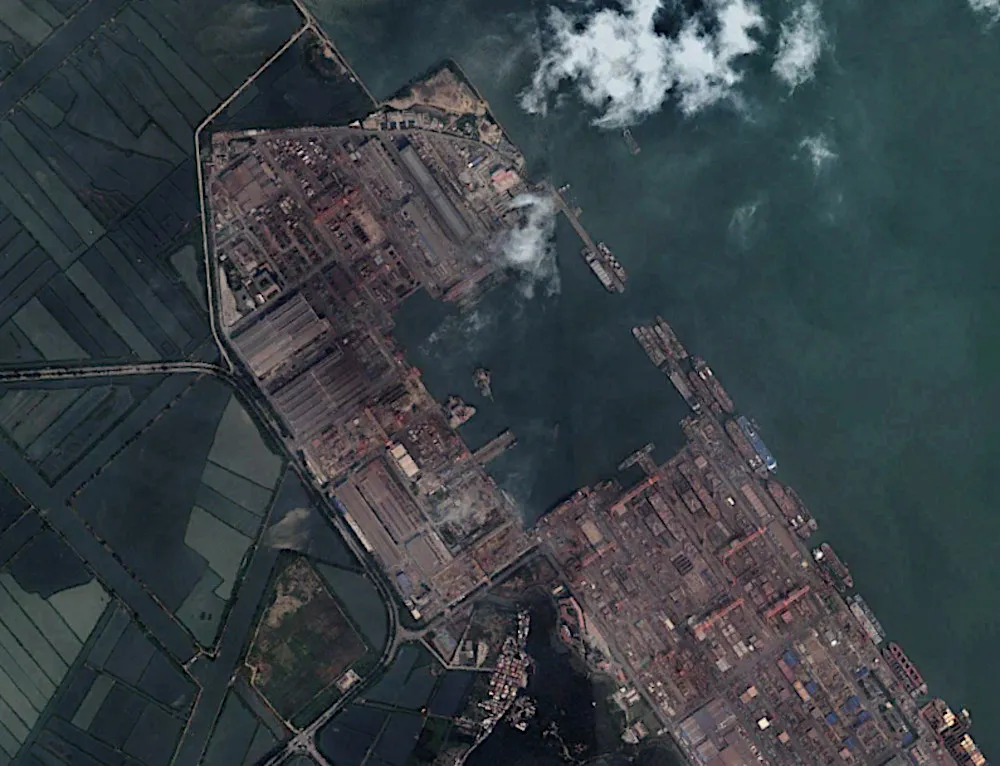
The ship is being built at a yard on Longxue Island, which is situated just southeast of the city of Guangzhou. A review of satellite imagery from Planet Labs indicates that it has been under construction since at least Febraury. A subsidiary of the China State Shipbuilding Corporation (CSSC) operates this facility. That firm is currently known as the CSSC Offshore and Marine Engineering Company (COMEC). It was previously called Guangzhou Shipyard International (GSI).
A satellite image offering a general overview of the COMEC/GSI yard. Google Earth
COMEC/GSI’s public portfolio is focused on large commercial vessels, including oil and liquid natural gas (LNG) tankers and cargo ships. It also builds specialized civilian designs, such as semi-submersible heavy lift ships and platforms designed to support offshore wind turbine construction.
🔎🇨🇳PLAN Amphibious Ambition: China’s Dual Paths to Cross-Strait Dominance Visible
▶️PLAN Power Check: Imagery (Sept 29) from Longxue Island’s COMEC Shipyard shows two strategic tracks for amphibious lift: continued production of logistics assets and high-tech combat… pic.twitter.com/VUUH96OTkO
The ship being built on Longxue Island that is now drawing attention is approximately 885 feet (270 meters) long and is 121 feet (37 meters) across its widest (also known as the beam), based on available satellite imagery. There is a superstructure at the bow end with clear wings for a large bridge and a mast on top. There is also a separate superstructure at the stern end with exhaust stacks situated in front of it.
In May, CSSC also released a picture of the COMEC/GSI yard showing the ship from the stern as viewed from near ground level. The image, which was reportedly included in a social media post marking the change in solar terms in the traditional Chinese calendar, shows a large hangar with two at the rear of the stern superstructure. A large flight deck and hangar are also taking shape at the stern.
A close-up look at the ship in question as seen in the picture CSSC released in May. CSSC
A Planet Labs satellite image taken on July 2, seen at the top of this story and in parts throughout, also shows two large openings on the right side of the superstructure at the stern. These might be for launching and/or recovering small boats, including lifeboats. These could also just be apertures for crew walkways or other workspaces.
However, it is what is seen in between the two superstructures that may be the most notable aspect of the ship. There are several pillar-like vertical structures positioned relatively close to both sides of the hull. This is in line with what is typically seen on naval vessels configured to conduct at-sea refueling and replenishment of other stores. The flight deck and hangar at the stern would also allow for vertical replenishment via helicopters.
“The hull form is broad and slab-sided, with a full midsection optimised for volume rather than speed alone. This is a characteristic associated with large fleet auxiliaries designed to carry fuel, dry stores, and ammunition for carrier strike groups,” according to a report on this ship from Jane’s back in April.
The ship’s design language also follows modern PLAN standards. Its layout, in broad strokes, is very similar to that of the Type 901 replenishment ship in PLAN service now. The PLAN also operates smaller Type 903 replenishment ships that have a roughly similar configuration, as well.
A Type 901 replenishment ship. Japanese Ministry of DefenseOne of China’s smaller Type 903 replenishment ships. Chinese state media
Overall, the new ship under construction at the COMEC/GSI yard looks very much like a Type 901, but substantially scaled up. The Type 901 is quite large already, with a length of around 787 feet (240 meters) and a beam measuring just under 102 feet (31 meters). It also said to displace some 45,000 tons with a full load. As another point of comparison, the U.S. Navy’s newest John Lewis class replenishment oilers are just under 746 feet (227.3 meters) long and have roughly a 105-foot (32.2-meter) wide beam, according to the official fact sheet.
The new AOE design under construction at COMEC, Guangzhou. As already indicated by satellite imagery, this seems a very substantial hull, fa larger than the ca 45k ton Type 901 AOE (second image). Note the dual hangar doors for comparison.
This is how of a monster is the new Replenishment ship building in Guangzhou
Compared from Left To Right 1. Type 903 2. Type 901 (Current Biggest) 3. Monster 4. Type 076 (50,000 tons) 5. Type 075 (40,000 tons) 6. Type 071 (25,000 tons)
— PLA Military Updates🇨🇳 (@PLA_MilitaryUpd) April 10, 2026
What other, more specific features and capabilities the new ship might have remains to be seen. What kind of armament it might have, even just for localized self-defense, is unknown. The Type 901 has four 30mm H/PJ-13 Gatling-type guns in turrets to provide close-in defense.
At-sea replenishment, in general, is a critical capability for any major navy that desires to conduct sustained blue water operations without having to rely on friendly ports. Even during peacetime in the broad expanses of the Pacific, port facilities of any kind, let alone ones capable of supporting large warships, can be few and far between and under direct threat.
For the PLAN, there is the added demand for at-sea replenishment support that comes from operating a growing fleet of so-far conventionally-powered aircraft carriers. Those carriers require steady streams of gas for their air wings on top of the fuel and other support needed to keep them sailing at all.
The Chinese aircraft carriers Liaoning and Shandong sail together, along with their escorts, as aircraft from their air wings fly overhead. Chinese government
The PLAN is also conducting more regular operations involving full carrier strike groups with conventionally-powered escorts that also need refueling and other support to keep up. During combat operations, replenishment ships also bring vital additional supplies of munitions to forward-deployed vessels.
A Type 901 replenishment ship, center, together with the aircraft carrier Liaoning, at top, and escorting surface combatants. Chinese government
It really cannot be overstressed how important at-sea replenishment is to modern blue water naval operations. This was underscored just earlier this year by challenges the U.S. Navy faced in keeping its conventionally-powered warships in the Middle East fueled amid Iranian attacks on friendly ports.
“So traditionally, for 25 years, we’ve been at war in the Middle East and that war was effectively fought in the parking lot of a giant gas station,” Robert Hein, Director of Maritime Operations for the U.S. Navy’s Military Sealift Command (MSC), said during the Navy League’s annual Sea-Air-Space exposition in April. “Iran has effectively shut down that gas station. So we’ve had to come up with really creative ways of, ‘how do we replenish the fleet?’”
You can read more about the “tanker treadmills” the Navy instituted in response, as well as other steps the service is taking now to bolster its at-sea replenishment capabilities and capacity, here.
Replenishments At Sea
It is worth noting here that America’s aircraft carriers are now all nuclear-powered, which eliminates their need to be refueled at sea. However, they still need gas for their air wings and other support to conduct sustained forward operations. Their escorts are all conventionally-powered, as well. As an aside, China may now be in the process of building its first nuclear-powered aircraft carrier.
There may be a possibility that the ship under construction at the COMEC/GSI yard could be something other than a huge new at-sea replenishment ship, but this seems extremely unlikely. As noted, the ship has an array of distinct features that are exactly what one would expect to see on a replenishment vessel, and an overall configuration in line with that of the Type 901.
The new ship’s large size, both in terms of length and width, will offer far more internal volume for fuel, munitions, spare parts, food, and everything else needed to keep a carrier strike group operating far out to sea. China has a growing number of other ships that will require blue water support, too. This includes its massive Type 076 amphibious assault ship, which is expected to carry a substantial air wing, as well as a growing number of smaller Type 075 types.
Chinese PLA Navy’s First Type 076 Amphibious Assault Ship “Sichuan” Conducts First Sea Trial
The appearance of this ship at the COMEC/GSI also comes as the PLAN continues to modernize and expand its fleets across the board, in scale and scope, with a clear eye toward more regular and sustained blue water operations. China has been investing heavily in establishing a network of naval port facilities around the Pacific and elsewhere globally to help support these activities, as well. As noted, having to rely on friendly ports is not always desirable or even possible, especially during a conflict when the countries in question may be neutral parties.
An unclassified Office of Naval Intelligence briefing slide from circa 2023 underscoring the disparity between U.S. and Chinese naval shipbuilding capacity. ONI
Satellite imagery shows significant progress on the new ship of interest at the COMEC/GSI yard since the start of this year. More insights into the design and capabilities of what is likely to be the world’s largest dedicated naval replenishment vessel should emerge as that work wraps up.
The price of Brent crude, the international benchmark, gained 3.9% to $78.96 per barrel, while the US benchmark crude oil price rose 4% to $74.26 per barrel.
ADVERTISEMENT
ADVERTISEMENT
Prices for both types of crude oil had recently slipped back to the levels seen before the war with Iran began, after the two sides reached an interim agreement to end the conflict and ships resumed transporting oil through the Strait of Hormuz.
However, the United States launched several waves of strikes on Iran early on Monday morning following an Iranian attack on a container ship in the Strait of Hormuz that set the vessel ablaze and left one crew member missing over the weekend. Iran retaliated by targeting countries across the Middle East.
US stock futures fell, with the contract for the S&P 500 down 0.4% and that for the Dow Jones Industrial Average 0.3% lower. Nasdaq Composite futures lost 1%.
In Asian trading, Tokyo’s Nikkei 225 index lost 1.1% to 67,786.86, while in Seoul, the Kospi declined 5.6% to 7,060.69.
Shares in South Korean memory chipmaker SK Hynix, which soared 13% on their Wall Street debut on Friday, slumped 10.6% in Seoul. Its bigger rival, Samsung Electronics, fell 6.7%.
Elsewhere in Asia, Hong Kong’s Hang Seng edged 0.1% higher to 24,202.41, and the Shanghai Composite index shed 1.2% to 3,947.34.
In Australia, the S&P/ASX 200 declined 0.3% to 8,777.00.
US stocks ticked higher on Friday after investors showed sustained appetite for winners of the artificial intelligence (AI) boom. The S&P 500 rose 0.4% and the Dow Jones Industrial Average added 0.3%. The Nasdaq Composite climbed 0.3%.
SK Hynix’s shares jumped after trading began at midday after it raised roughly $26.5 billion by selling American depositary shares at a price of $149 each.
SK Hynix’s stock in Seoul had already surged more than 600% over the past year thanks to enthusiasm for AI. The boom has translated into real profits, driven by soaring demand for computer memory. But it has also raised concerns that AI stock prices have climbed too high and that the world’s spending on chips and data centres will not generate enough productivity and profit growth to justify the investment.
That has led to sharp swings in AI stocks, which have become some of Wall Street’s most influential because of their enormous market values.
Nvidia was the single biggest force lifting the S&P 500 on Friday, rising 4%.
Beyond the uncertainty surrounding AI, investors are turning their attention to the upcoming corporate earnings season.
Companies across industries will need to deliver strong profit growth to justify their elevated share prices, which remain close to record highs. This week will bring earnings reports from many of the biggest US banks, including Bank of America, Citigroup, JPMorgan Chase, Goldman Sachs and Wells Fargo, with several reporting on Tuesday alone.
Concerns about how the continued fighting with Iran will affect the global flow of crude oil are clouding the outlook for both energy costs and overall inflation.
High bond yields have been weighing on financial markets worldwide because more expensive oil and persistently high inflation could prompt the Federal Reserve and other central banks to raise interest rates.
Higher interest rates can help keep inflation under control, but they also slow economic growth and weigh on the prices of all kinds of investments.
Ukraine appeared to have begun large-scale strikes against Russian shadow tankers attempting to supply occupied Crimea with fuel, as an energy crisis on the peninsula worsens.
At the same time, Ukraine has continued to cause fuel shortages in Russia itself, striking refineries deep inside the country, including, for the first time, the Omsk refinery in Siberia, Russia’s largest, 2,500km (1,553 miles) from the Ukrainian border.
Recommended Stories
list of 4 itemsend of list
Ukraine’s Unmanned Systems Forces commander Robert Brovdi said his forces had struck 19 Russian tankers, a cargo ship and a ferry between July 6 and 8, including nine tankers on the night of July 7.
Residents stand near an apartment building hit by a Russian drone strike in Kyiv, Ukraine, July 8, 2026 [ [Reuters]
Ukrainian Navy spokesman Dmytro Pletenchuk told newspaper Suspilne that Russia had rerouted fuel supplies to Crimea after Ukraine deprived it of overland routes.
“They had few options left. It’s either a land corridor or a sea connection,” Pletenchuk said. “As far as we know, they don’t use the Kerch Bridge for such transportation in the necessary volumes,” he said, referring to the bridge connecting Crimea to Russia.
Ukraine detonated a truck on the bridge in 2022, setting alight a fuel train that had been travelling alongside it and demonstrating the risk of using the bridge for large volumes of fuel.
Ukraine pivoted to attacking Crimea in the past few weeks after disabling the oil offloading terminal at Novorossiysk, on the opposite Russian coast, Ukrainian President Volodymyr Zelenskyy told the Financial Times.
“We were slowing down the militarisation of our peninsula occupied by Russia,” he said. “We cut off the logistics and took control of the fuel and energy complex. We showed what it means to operationally control the sky at a specific point, at a specific time.”
The Ukrainian Presidential Office in Crimea said these strikes had caused “a management crisis on the peninsula”.
In Sevastopol, fuel has stopped being sold to civilians, and more than a dozen Crimean regions are suffering from electricity blackouts.
Ukraine continued strikes on the peninsula in the past week, destroying seven Sukhoi aircraft and two sheds containing Shahed aerial drones at the Saky airfield on July 3, the Kerch oil transhipment terminal on July 6 and three hangars at the Guardsman airfield on the same day.
Ukraine also kept up pressure on Russia, launching what mayor Sergei Sobyanin said was its largest strike on Moscow in two years.
More than 400 Ukrainian drones were downed while heading for the city on July 7, which was the first day of a NATO summit in Ankara.
“When our drones weren’t flying to Moscow and St Petersburg, [Russian president Vladimir] Putin didn’t think much about it. He understood that the war was far from the Kremlin,” Zelenskyy told the Financial Times.
“When not a hundred drones, but a thousand would start flying to Moscow, and when he would feel and see this, he would be advised to move somewhere beyond the Urals. This would be a moment like a new page on the path to ending the war.
A rescuer hands a cat named Boniya, found under the rubble of an apartment building damaged by a Russian missile strike a day earlier, to Anastasia Sorokina, a friend of the cat owner in Kyiv, Ukraine, July 7, 2026 [Sergiy Karazy/Reuters]
Ukraine struck several energy targets during the week, furthering its twin goals of starving Russia of petrol and export revenue from oil.
The SBU said it struck and set alight the St Petersburg oil terminal on July 4, which it described as “one of the largest oil product transshipment terminals in the Baltic region”. Zelenskyy posted video purporting to show the terminal in flames.
On Sunday, Ukraine’s General Staff said its forces had struck the Slavneft Yanos refinery in Yaroslavl, 700km (430 miles) from Ukraine, the Ust-Luga refinery on the Baltic Sea, and the Omsk Refinery. Russia’s defence ministry said it had shot down 613 of 625 Ukrainian drones detected in the airspace overnight.
Ukraine’s Air Force said that Russia had lost 42.7 percent of its refining capacity over the past year, and suffered $13.5bn of damage to oil infrastructure.
These strikes have cumulatively caused petrol and diesel shortages in the Russian market, with consumers in urban hubs lining up to fill their cars.
During the week, Ukraine also struck the Kremny EL Group in Bryansk, which it said manufactured microchips, semiconductors and other electronics for the armed forces.
Rescuers working at a site of a Russian missile and drone strike on the previous day, during which a residential building was heavily damaged, amid Russia’s attack on Ukraine, are seen through broken glass, in Kyiv, Ukraine, July 7, 2026 [Alina Smutko/Reuters]
Zelenskyy said the air war would prove “decisive”, because in 2026 Ukraine’s ground troops had effectively stopped Russia’s slow advance of the last two years.
Independent assessments have suggested that Russia gained a total of 97 square kilometres (37 square miles) in the first six months of the year.
“The war is ongoing, but the front line is no longer moving. When the front line is almost not moving, and the enemy cannot invade by sea, the sky remains,” Zelenskyy said.
US President Donald Trump handed Zelenskyy a major victory at the NATO summit in Ankara on Wednesday, saying he would license Ukraine to produce interceptor missiles for anti-air systems.
Zelenskyy has been campaigning for a licence to build Patriot interceptors, which he believes Ukraine can do faster and more cheaply than the US or European manufacturers.
But Zelenskyy said Patriots ultimately are not the answer for European air defence, announcing his intention to develop FREYA, a Ukrainian-designed anti-ballistic system like Patriot “but with a higher production capacity and at a lower cost”.
Is Russia losing?
Zelenskyy’s commander-in-chief warned against dismissing Russia too easily.
“It’s still too early to talk about a qualitative turning point in the war,” Oleksandr Syrskii wrote on his Telegram messaging channel. “The aggressor is showing signs of exhaustion, but retains significant offensive potential,” adding that Russia “plans to extend the front line, which already exceeds 1,250 kilometres (777 miles).”
Putin relaunched the narrative that Moscow will overrun the eastern Ukrainian region of Donetsk, four-fifths of which Russia already controls.
In a televised meeting with his top generals on July 3, Putin was told that Russia has seized 3,000sq km (1,160sq miles) of Ukraine so far this year, and “liberated” 133 settlements. His commander in chief, Valery Gerasimov, also claimed to control the cities of Kupiansk in Kharkiv, and Kostiantynivka in Donetsk.
The Institute for the Study of War, which uses geolocated footage to assess advances, estimated that Russian forces have a presence in 2.4 percent of Kupiansk and 37 percent of Kostiantynivka – and most of that in the form of infiltrations, not firm control.
The Ukrainian military has estimated the number of Russian servicemen in Kostiantynivka at between 100 and 250.
Putin was told that Russian forces seized 636sq km (245sq miles) of Ukraine in June alone. The ISW estimates the real number at 30sq km (11sq miles).
Kostiantynivka is politically important to the Kremlin because it is the first of four heavily fortified cities, including Kramatorsk and Sloviansk, which Moscow must seize to take control of Donetsk – which Putin considers a puppet state and has repeatedly prioritised.
“The capture of Kostyantynovka by the troops of the South battlegroup opens a direct road for further advance to Kramatorsk and Sloviansk, other fortified areas in the Donbas, and is, of course, the key to liberating the entire territory of the Donetsk People’s Republic,” Putin said.
The Donbas includes Donetsk and Luhansk, which Putin mistakenly claimed to have taken in its entirety.
“I understand that we should no longer speak of the Slovyansk-Kramatorsk-Kostyantynovka line, but simply of the Slovyansk-Kramatorsk line,” Putin told the gathering.
The price of Brent crude has reached its lowest since February 27, before the war started.
Published On 25 Jun 202625 Jun 2026
Oil prices have extended their decline to levels last seen before the start of the Iran war, as expectations of rising supply from the Middle East outweighed demand concerns.
Prompt-month Brent crude futures for August delivery fell $1.06 (1.44 percent) to $72.68 a barrel by 06:39 GMT, while US West Texas Intermediate (WTI) lost 76 cents (1.08 percent) to $69.58 a barrel.
Recommended Stories
list of 4 itemsend of list
Both contracts hit their lowest since February 27.
August Brent was trading lower than September, which was priced at $73.59, signalling ample short-term supply.
Brent had fallen by more than $3 on Wednesday as supply concerns eased, while WTI settled down nearly $3.
US Energy Secretary Chris Wright told a forum that flows through the Strait of Hormuz were close to those before the start of the Iran war, with at least 20 million barrels having exited the strait in the past 24 hours.
A return to complete normality would take a few weeks, however, because the strait needs to be cleared of mines, he added.
Rising Middle East supply, together with Iran set to boost sales after a temporary reprieve from US sanctions, drove down prices of physical crude oil cargoes around the world.
New routes
An initial accord last week to end the US-Israeli war with Iran, which began on February 28, has allowed the resumption of traffic through the strait.
The accord set up a 60-day period of negotiations to tackle tougher issues, such as Iran’s nuclear programme.
Wright said oil would continue to flow through the strait even if the deal did not hold, and that Iran would not be able to close it again.
Tehran has said it plans to impose what it calls maritime service fees, as opposed to tolls, while the United States argues it is an international waterway and therefore should not be charged.
Oman opened temporary routes on Wednesday to ease tanker departures from the strait, with the International Maritime Organization and Omani authorities coordinating movements.
On Thursday, Iran’s Revolutionary Guards warned against any crossings of the Strait of Hormuz without authorisation, saying vessels not complying “will be dealt with” and condemning the new routes.
At the time of writing, Brent crude was down 0.91% at $79.12 a barrel, while US West Texas Intermediate (WTI) crude had fallen 0.70% to $75.32 a barrel.
ADVERTISEMENT
ADVERTISEMENT
Lower crude prices reflected broader investor sentiment in early trading after Qatari and Pakistani mediators said the first round of negotiations between the US and Iran aimed at securing a final agreement to end the conflict had concluded with “encouraging progress”.
A memorandum of understanding signed last week includes a commitment to reach a final agreement within 60 days, an end to fighting on “all fronts” – including in Lebanon – and the reopening of the Strait of Hormuz.
Markets mixed as analysts monitor US-Iran negotiations
Meanwhile, Asian stocks were mixed on Monday, with markets in Japan and South Korea trading higher, while US futures traded lower.
Tokyo’s Nikkei 225 jumped 1.6% to 72,364.82 after reaching a new all-time high of 72,831.73 during intraday trading, helped by technology stocks fuelled by enthusiasm over the global artificial intelligence boom.
Japan’s SoftBank Group, the multinational investment holding company with a strong AI focus, rose 2.4%, while chip equipment maker Tokyo Electron gained 2.3%.
South Korea’s Kospi added 0.4% to 9,084.37 and was trading near record highs, led by AI-related shares. Memory chip maker SK Hynix surged 4.7%.
“We’re seeing another strong market today,” Neil Newman, managing director and head of strategy at Astris Advisory Japan, said. He cautioned that the Japanese market was “probably getting a little stretched” from an investor’s point of view, “especially with what’s going on in the Middle East”.
Hong Kong’s Hang Seng fell 1% to 23,690.86, while the Shanghai Composite Index edged 0.2% higher to 4,098.01.
“The number is classified. At the end of June last year, there were as few as 16 in Ukraine’s arsenal,” the publication stated. Given the low supplies and constant Russian bombardment, Ukrainian President Volodymyr Zelensky has frequently requested additional interceptors from the U.S. and allies.
We were receiving PAC-3 missiles from our partners in certain quantities, but later that monthly volume was cut several times over. It wasn’t due to a lack of funding, but because of the war in the Middle East. This affected different types of weapons. Whatever we could, we… pic.twitter.com/qwPFydwAzC
— Volodymyr Zelenskyy / Володимир Зеленський (@ZelenskyyUa) June 3, 2026
SASC said it “recognizes the importance of Patriot air defense systems and Patriot Advanced Capability-3 (PAC-3) interceptors in supporting Ukraine’s self-defense and notes continued concerns regarding interceptor availability, production capacity, and the impact of transfers on United States military readiness.”
“Accordingly, the committee directs the Secretary of Defense, in coordination with the Under Secretary of Defense for Acquisition and Sustainment, to submit a report to the congressional defense committees, not later than October 1, 2026, assessing the feasibility of increasing deliveries of PAC-3 interceptors to Ukraine,” its directive states.
We have reached out to the committee to find out which variant of the PAC-3 they are referring to. Lockheed Martin is boosting production of the more advanced current-generation Patriot PAC-3 Missile Segment Enhancement (MSE) interceptors and it is unclear how many of the other variants are still being made or are in U.S. stockpiles.
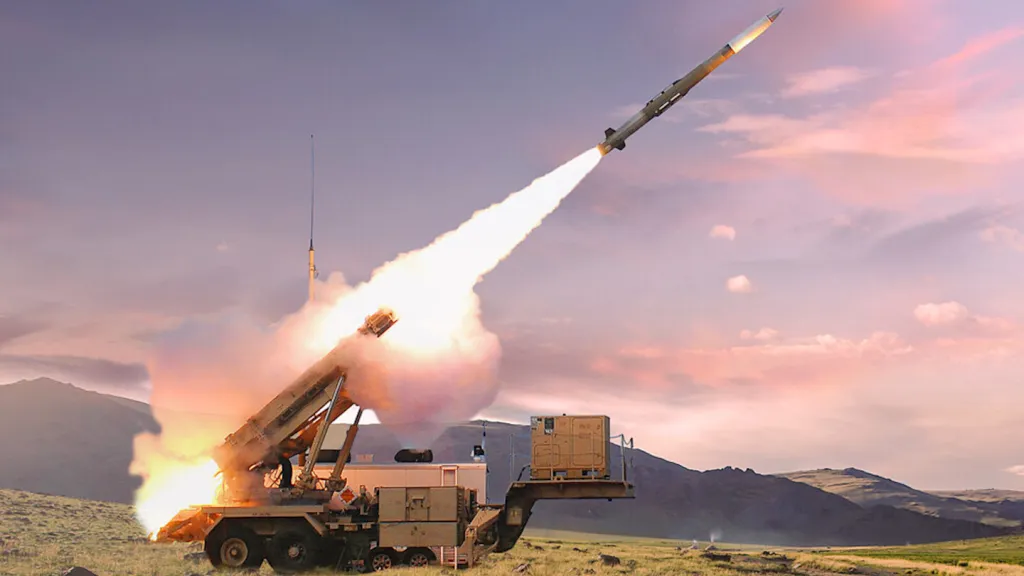
A Patriot Advanced Capability-3 (PAC-3) Cost Reduction Initiative (CRI) missile is launched during an Integrated Battle Command System (IBCS) flight test at White Sands Missile Range in 2021. (Darrell Ames) Darrell Ames
SASC wants the following information from the Pentagon:
“An assessment of current and projected Ukrainian requirements for PAC-3 interceptors over the next 12 months;”
“An assessment of the availability of PAC-3 interceptors from existing Department of Defense inventories for transfer to Ukraine and the impact of such transfers on United States military readiness and operational plans;”
“An evaluation of options to accelerate production of PAC-3 interceptors, including through multiyear procurement authorities, advance procurement, expanded supplier capacity, and other industrial-base investments;”
“An assessment of the feasibility of increasing annual PAC-3 interceptor production and the anticipated timeline for achieving such increases;”
“An identification of any statutory, regulatory, contractual, or supply-chain barriers to increasing interceptor deliveries to Ukraine;”
“An assessment of opportunities for allied and partner nations operating Patriot systems to contribute additional PAC-3 interceptors to Ukraine, including options for United States backfill arrangements;” and
“Recommendations for legislative or administrative actions that would enable increased interceptor deliveries to Ukraine while maintaining acceptable levels of U.S. military readiness.”
In addition, the committee said the secretary should “brief the congressional defense committees on the findings of the report, not later than 15 days after its submission.”
The Pentagon on Wednesday declined comment on the committee’s report, how many interceptors it has provided to Ukraine or whether it has the ability to increase that supply. We have reached out to Lockheed Martin as well and are awaiting a response.
Soldiers from the 11th Air Defense Artillery Brigade conduct a Patriot missile live-fire exercise at MacGregor Range near Fort Bliss, Texas, Aug. 23, 2025. (U.S. Army photo by Sgt. JaDarius Duncan) Sgt. JaDarius Duncan
TWZ recently addressed the supply of these munitions in a story about a new report from the Center for Strategic and International Studies (CSIS).
The report, on the severity of the depletion of U.S. advanced weapons stockpiles, found that current production PAC-3 MSE “is around the baseline rate of 650 interceptors per year, with half the deliveries going to the United States and the rest to allies and partners.”
Lockheed Martin announced Tuesday that it would be increasing its annual production rate of PAC-3 MSE (Missile Segment Enhancement) Interceptors for the MIM-104 “Patriot” Surface-to-Air Missile System from roughly 600, to 2,000 a year, under a new contract with the Department of… pic.twitter.com/aCkVK8xkqx
“Because U.S. procurement in the last decade has averaged 225 missiles per year, deliveries from prior years will not be enough to fully replace expenditures,” CSIS cautioned. “For that, the United States will need to wait for the 3,203 Patriot missiles requested in the Army’s FY 2027 budget. These are projected to start delivery in May 2029.”
As we noted earlier in this story, in addition to the Patriot interceptors already provided to Ukraine, the U.S. used a large amount during the conflict with Iran defending its assets, as well as those of allies.
The CSIS report found that at the start of the war with Iran, “there were about 2,500 Patriot interceptors in the U.S. inventory,” though its accompanying chart does not specify which variant. “During the course of the conflict, between 1,060 and 1,430 Patriots were fired.” We don’t know what that tally includes, but we do know that PAC-2 and PAC-3 series interceptors have been employed in the latest conflict with Iran.
CSIS
Adding to questions about the ability to supply Ukraine with more Patriots, a top official from Lockheed Martin recently warned that the company cannot give U.S. allies any certainty over when they will receive interceptors despite plans to triple capacity, according to Financial Times.
Brian Dunn, vice president for strategy and business development of missiles and fire control, recently said that the company was working hard to scale up production of critical PAC-3 interceptor missiles amid a supply crunch exacerbated by the war in Iran.
But in remarks to journalists at the ILA Berlin Air Show, “he sent a sobering message to American allies including Germany, Japan, Poland, the UAE and Saudi Arabia that operate the Patriot air defense system,” the publication reported.
Dunn said the extra capacity “is obviously going to be able to satisfy multiple user requirements in a faster timeline.” However, he added that Lockheed Martin does not “control what the allocation of those missiles is going to be. We can’t tell anybody where you’re going to be on that [priority list].
“Obviously there’s a lot of rhetoric coming right now from the Department of War . . . about how they’re going to reorder, reorganize, who’s going to get missiles first,” he continued. “We don’t control any of that.”
🇺🇸 American company Lockheed Martin cannot guarantee US allies the delivery of Patriot interceptors, which Ukraine desperately needs, despite plans to triple its production capacity.
This was stated by the company’s vice president, Brian Dunn, according to the Financial Times. pic.twitter.com/fq8QYdtAXR
Meanwhile, for Ukraine, the influx of new Patriot interceptors cannot come soon enough. Two nights ago, for instance, Russian forces launched 70 missiles and over 600 drones in a mass assault, according to the Kyiv Independent.
“Of the 34 ballistic missiles fired, 19 were aimed at the capital,” the publication noted.
You can see a video of one of those strikes below.
The number of Ukrainian cultural sites hit in Russia’s overnight attack on Kyiv continues to rise, with the Mystetskyi Arsenal on fire this morning.
“Kyiv’s beleaguered Patriot batteries did a valiant job, intercepting 15 of them, along with five of the six 3M22 Zircon hypersonic cruise missiles launched in the attack,” the news outlet added. “Still, even layered defenses were stretched beyond the limit.”
Rodríguez thanked US Chargé d’Affaires John Barrett for helping establish ties with US corporations. (Prensa Presidencial)
Mérida, June 16, 2026 (venezuelanalysis.com) – The Venezuelan government has signed two agreements with foreign companies as part of efforts to bolster the country’s National Electric System (SEN).
On Monday, Acting President Delcy Rodríguez penned a memorandum of understanding with GE Vernova, a company formed from the 2024 breakup of US conglomerate General Electric, at Miraflores Palace in Caracas.
“This memorandum is historic for Venezuela, so we can recover such an essential service for the Venezuelan people,” she stated during a televised broadcast. “I have asked the teams to convert this memorandum into a contract as soon as possible and start the works.”
According to Rodríguez, the agreement will incorporate 1,000 Megawatts (MW) into Venezuela’s electricity grid in the next 24 months, and 5,000 MW over four years. The acting president added that GE technicians have spent “six weeks” in the country assessing conditions of electric equipment.
Rodríguez did not disclose what the deal entails, nor what components of the electric grid will be turned over to GE Vernova, but stated that the plan concerns generation, transmission, and electricity substations.
The Venezuelan acting leader went on to thank US Chargé d’Affaires John Barrett, who was present at the ceremony, for promoting engagement with major US corporations like GE. Company executives Roger Martella and Eric Gray were likewise in attendance. Martella stated that GE’s objective was to quickly reactivate electricity generation.
“We want to move quickly so the system can work as best as possible in a few months. We already have an agreement on technical details,” he said.
Two days earlier, Venezuelan authorities announced a separate accord with Argentina-based firm Industrias Metalúrgicas Pescarmona (IMPSA) to rehabilitate the Manuel Piar and Antonio José de Sucre hydroelectric projects, known as the Tocoma and Macagua dams. Both are located in the Caroní river, in Bolívar state, which also supplies the Simón Bolívar Hydroelectric Plant, known as the Guri Dam.
The official release indicated that the agreement aims to inject 2,640 MW into the grid. IMPSA President Jorge Salcedo clarified on social media that the company’s initial target is to restore 672 MW of capacity from Tocoma within 19 months.
“This agreement launches a broader effort to strengthen Venezuela’s power system through a comprehensive plan that could deliver up to 2,160 MW at Tocoma and 480 MW at Macagua over the next five years,” he wrote.
The Tocoma project dates back to the 2000s. In 2008, Venezuela’s state electricity company CORPOELEC hired a construction consortium headed by Brazilian firm Odebrecht to build the dam, with IMPSA tasked with supplying machinery.
However, despite costs running over US $9.3 billion, more than triple the original $3 billion budget, the project was not culminated. Venezuelan authorities reported that construction was at 90 percent completion in 2016. A $1.2 billion debt owed by CORPOELEC saw IMPSA suspend activities with only two of the ten projected turbines partially installed.
According to Reuters, IMPSA is holding most of the contracted equipment in storage and will replace the missing or obsolete ones with new technology.
IMPSA was temporarily owned by the Argentine state before being privatized by the Milei administration in February 2025. The company was acquired by the US-based consortium Industrial Acquisition Fund (IAF). IAF’s main partner is ARC Energy, headed by close Trump ally and donor Jason Arceneaux.
Venezuela’s electrical system has suffered under years of US sanctions as well as underinvestment, lack of maintenance, and corruption. Around 40 percent of its installed 30,000 MW capacity is currently operational, with generation deficit around 3,000 MW meaning regular blackouts in most of the country.
Strengthening the electrical supply is a precondition for the country’s economic recovery, with growing oil production placing an additional burden on the grid.
The Rodríguez acting government has sought to address the issue by opening the electricity system to the private sector, with GE and IMPSA the first corporations formally engaged.
On June 4, the National Assembly preliminarily approved a reform of the Organic Law of the National Electricity System. The new legal framework breaks with the 2007 legislation under Hugo Chávez that centralized the grid under CORPOELEC and defined all stages of electricity generation and distribution as “strategic for the nation.”
The reform allows for private sector participation in generation, transmission, distribution, and commercialization ativities through concessions lasting up to 25 years. It also envisions new tariff structures based on “real costs and reasonable returns” for investors.
Kazakhstan’s Energy Minister Yerlan Akkenzhenov said international partners are urging the country to increase oil exports as concerns grow over disruptions to energy supplies linked to tensions around the Strait of Hormuz.
According to Akkenzhenov, buyers are seeking the maximum possible increase in Kazakh oil shipments due to uncertainty surrounding one of the world’s most important energy transit routes. However, he noted that Kazakhstan faces infrastructure and production constraints that limit how quickly exports can be expanded.
To support higher output, Kazakhstan has postponed planned maintenance work at the Kashagan Oil Field until 2027. The country is also considering increasing crude shipments through the Baku Tbilisi Ceyhan Pipeline, potentially raising volumes from 1.5 million tons to 2.2 million tons annually and beyond.
The development comes as global energy markets remain sensitive to geopolitical tensions involving Iran and the Strait of Hormuz, a key route for international oil and gas exports.
Why It Matters
Kazakhstan’s growing importance highlights how global energy markets are seeking alternative supply sources amid rising geopolitical risks in the Middle East.
Any disruption in the Strait of Hormuz could affect a significant share of global oil shipments, prompting importers to diversify supply chains and reduce dependence on vulnerable routes. Kazakhstan, one of the world’s major oil producers, is increasingly viewed as a reliable alternative supplier.
The decision to delay maintenance at Kashagan signals that Kazakhstan is prioritizing production stability and export capacity at a time when energy security has become a major concern for consuming nations.
The move could also strengthen Kazakhstan’s strategic position in global energy markets, giving it greater influence as countries seek dependable suppliers outside conflict affected regions.
Key Stakeholders
Kazakhstan – Seeking to expand exports while balancing OPEC+ commitments.
Yerlan Akkenzhenov – Overseeing the country’s energy strategy.
Kashagan Oil Field – One of the world’s largest oil fields and a key source of future production growth.
OPEC+ members monitoring compliance with production agreements.
Energy importing countries seeking alternative crude supplies.
Oil traders and global energy markets responding to supply risks.
Countries along the Baku Tbilisi Ceyhan Pipeline route that facilitate exports to international markets.
Future Outlook
Kazakhstan is likely to face increasing pressure from international buyers if instability around the Strait of Hormuz persists. While production constraints may limit immediate gains, the postponement of Kashagan maintenance suggests authorities are positioning the country to maximize output over the coming years.
The expansion of exports through the Baku Tbilisi Ceyhan pipeline could become increasingly important as energy consumers seek routes that bypass geopolitical hotspots. This would further enhance Kazakhstan’s role in global energy diversification efforts.
However, Kazakhstan must also balance market demand with its commitments under the OPEC+ framework. Any significant increase in production could attract scrutiny from fellow producers seeking to maintain supply discipline and price stability.
If Middle East tensions remain elevated, Kazakhstan is likely to emerge as one of the key beneficiaries of the global search for secure and reliable oil supplies.
Edinburgh Airport has said operations have no returned to normal (Image: undefined via Getty Images)
Flights were delayed at two major UK airport because of jet fuel supply issues on Sunday evening. Passengers on ten flights flying out of Glasgow and Edinburgh airport faced delays.
The two Scottish airports have now said their operations are returning to normal after issues with the supply of jet fuel on Sunday evening.
The situation around the Strait of Hormuz, where shipping has been severely constrained since the outbreak of the Iran war, has led to a reduction in the global supply of jet fuel. However the issues at the two Scottish airports are understood to be linked to a shortage in drivers for fuel lorries rather than the global market.
A spokesperson for Edinburgh Airport said 10 flights were delayed on Sunday, but deliveries had resumed on Monday.
A spokesperson for Glasgow Airport said: “A short‑term staffing issue has affected one of the fuel suppliers used by airlines at the airport, with work underway to return stock levels to normal. There have been no related flight cancellations, and the airport remains fully operational.”
The spokesperson said fuel stocks are now returning to normal and there was no widespread disruption despite delays to some flights. Jet fuel is purchased by airlines, while the airports provide storage and infrastructure.
The Middle East has been a difficult region to deal with in oil markets. When it comes to energy geographies, the region has proven to be a disproportionately significant part of the world’s energy resources, with export facilities traversing a handful of maritime routes and political situations that have been tense, if not outright volatile, at times. The change in 2025 and into 2026 isn’t the nature of the forces but rather the confluence of overlapping pressures: ongoing sanctions enforcement, multiple theaters of conflict, OPEC+ tensions that are more public than ever in previous years, and disruptions to shipping in the Red Sea, which now seem to have become a semi-permanent part of the shipping route landscape.
There is no background information for commodity traders, market analysts, and energy investors. It’s a real-time, constantly evolving dynamic that can make all the difference in the day-to-day performance of prices, and it’s particularly important when prices are sliding around rapidly, and the stories behind them are changing just as fast.
The Behavior of Prices and the Risk of Middle East Supplies
The area is responsible for about one-third of the world’s crude production. That should make it significant in and of itself. What makes matters worse is that export infrastructure is concentrated in a handful of terminals, pipelines, and maritime corridors where a disproportionately large share of oil is exported. The disruption of any of them (even for a moment) reduces a large supply signal to an extremely short time frame.
Traders who follow crude oil price live data are the first ones to witness this. Real-time feeds are a reflection of more than just the fundamental supply-demand elements, but the market’s real-time assessment of the value of geopolitical risk and how much it “should” be worth at any given moment. A news event, which is a minor detail in a more stable environment, can cause future prices to move $5 or more in less than an hour. The consistent and tough question – and it is a tough one – is, which events actually have physical supply implications and which ones are sentiment-driven moves that die in a session or two?
The Strait of Hormuz
About 20-21 million barrels per day of crude oil and petroleum products go through the Strait of Hormuz, which is about 20% of the world’s oil consumption. No readily available bypasses can be found that can absorb that flow at a similar cost. There are partial alternatives, including the IPSA pipeline and Saudi Arabia’s East-West pipeline, but they would not even come close to filling the deficit should the Hormuz be closed en masse.
It is a strait between Oman and Iran. Geography makes it so that any serious disruption in U.S.-Iran relations or of security conditions in the Gulf in general puts Hormuz back on the market’s agenda. Traders are all familiar with this: when there is a lot of Iranian tension, the futures positioning will always reflect the chokepoint risk, even if there is no incident per se.
Production Outages That Don’t Make the Front Page
The issue of the supply is something that generally doesn’t get the same kind of attention it should get, but the clearest example of this recurring issue is Libya. In recent years, internal political squabbles about how to divide up oil revenues have led to several production shutdowns that have temporarily increased the tightness of the light sweet crude grades refined by European and Asian plants. The disruptions are likely to persist when there is no political agreement, and the pattern is robust. In recent years, Iraq’s export pipeline to the North through Turkey has also been down for extended periods of time. These relatively inconspicuous disruptions can add up and impact medium-term supply dynamics, though not necessarily have the same impact as a more conspicuous incident.
Key Risk Factors Shaping Market Sentiment in 2026
The Middle East is a geopolitical risk that has many variables. It’s a combination of interwoven pressures that work in various ways and to varying effects on the length of the price impact. The issues that currently have the greatest attention of serious analysts are generally of three types:
Export infrastructure and production infrastructure are currently under physical threat to production.
Sanctions regimes and the dynamics of their enforcement.
Disruption of shipping routes and attendant disruption of the trade economics.
Everything is unique, and sometimes they are not in the same direction at the same time. That’s part of what makes the current situation more complicated than any one risk headline implies.
Active Conflict Zones and Exposure to Infrastructure
The latest example of large-scale infrastructure targeting is the 2019 attack on Saudi Aramco’s Abqaiq and Khurais facilities in the country, which was carried out using drones and missiles. The loss in output occurred temporarily, amounting to about 5.7 million bpd, the largest sudden supply shock in modern oil market history. The recovery was quicker than many expected, partly because of the operational robustness of Aramco and partly because the situation was swiftly contained diplomatically. But the event has permanently changed the way markets view the vulnerability of infrastructure in the Gulf, and that repricing has not been complete.
The Persistent Iranian Supply Question
Iran’s petroleum sales have also been sustained in the face of sanctions, largely via Asian markets out of reach to Western sanctions. A full-fledged deal between Tehran and Western governments has yet to be hammered out, as of early 2026. That has left volumes of Iranian supply in a limbo of sorts: they could be rapidly reduced by stepped-up enforcement, and they could be dramatically increased by a change in diplomatic circumstances. Both of these results can have significant price consequences, and even the uncertainty can be a factor in the market without a clear decision.
Infrastructure Concentration Risk
The concentration levels in Saudi Arabia’s export system warrant a more significant focus than is generally found outside of export specialist circles. Abqaiq processes and stabilizes a huge percentage of Saudi crude before it is shipped to export terminals, removing the sulfur from it. That kind of ‘single point of failure’ is not typical in most industrial supply chains. In the case of oil, it’s a structural aspect of the market and one that has been proven, not just thought.
OPEC+ Internal Dynamics
However, OPEC+ compliance has been quite lackluster at times, notably from Iraq and Kazakhstan, which have had a history of overproduction. This gives rise to an everlasting discrepancy between OPEC+ declarations and the actual supply data. For analysts, the bottom line is that it is important not to take production decisions at face value but to also consider the track record of implementation once a deal has been agreed on to see what the real supply impact was.
Non-State Actor Activity and Shipping Friction
Since late 2023, the Houthis have started to attack commercial shipping vessels in the Red Sea more frequently, and these attacks have persisted through 2025. What those disruptions drove home is that it’s not necessary to blow a wellhead to impact oil market economics. A round-the-Cape voyage will increase the time in transit by about ten to fourteen days, as well as the fuel costs. During periods of increased Houthi activity, insurance costs for tankers traveling in the Gulf area skyrocketed. Both impacts are not a direct factor in the crude benchmarks, but both impact the effective landed cost of Middle East barrels in destination markets.
How the Market Prices Geopolitical Risk
Knowing the difference is important, as geopolitical events do not affect oil prices in a single manner. Some effects are immediate and visible: a surge in the price of Brent futures within minutes of an incident report. Others come more slowly, via changes in freight rates, changes in the repricing of insurance, and changes in buyer behavior, which may take days or weeks to be reflected in trade flow data. The rate of these impacts varies, and so do their effects.
Then there is the issue of what the market “already” had in place whether there was an event or not. When there is a constant regional tension, there is usually some risk premium in prices. The incremental market move may therefore be less than anticipated when an event then reinforces concerns, the surprise element of the event, which is typically the one that produces the biggest market moves, is already discounted.
Risk Premium in Practice
Geopolitical risk premiums in times of heightened Middle East tension have varied from around $4 to $10 per barrel, depending on the market participants’ views on the probability of actual physical supply disruptions in the case of Brent crude, according to S&P Global Commodity Insights. That’s a fairly broad window for economic trading, and it has a tendency to close up very fast when the tension subsides and without a supply event, which is the more common scenario.
The geopolitical risk premium factors analysts may consider are:
The nearness to active conflict, producing fields, or the working export terminals.
Production capacity that would be available to make up for the loss of production elsewhere.
The availability and magnitude of the IEA’s strategic stockpiles to be tapped.
Current tanker market conditions and the viability of an alternative route.
Diplomatic messages sent by governments in the area, including the United States and other great powers
Past examples of similar events, which have had identifiable supply impacts.
It is not easy to give exact weights to these inputs. Part of the reason for the price action to seemingly be different with comparable geopolitical events can be due to different analysts forming different conclusions from the same events.
Historical Supply Disruptions and Price Responses
The following table shows some of the more significant supply events that took place in the Middle East and the approximate market impact. The trend of most entries was that the first price movement has been greater than the actual physical supply effect, at times much greater, and then it has partially retraced to a more stable situation.
Event
Year
Estimated Supply Impact
Approximate Brent Price Reaction
Abqaiq/Khurais Attacks (Saudi Arabia)
2019
~5.7 mb/d temporary loss
~15% intraday spike
Libyan Civil War Output Collapse
2011
~1.4 mb/d reduction
~$20/bbl over several weeks
U.S. Re-imposition of Iran Sanctions
2018
~1-1.5 mb/d reduction
~15% sustained over several months
Iraq-Northern Field Disruptions
2014
Partial northern output loss
~$10/bbl elevated premium
Houthi Red Sea Disruptions
2023-24
Rerouting; limited direct supply loss
Moderate – primarily freight cost impact
Iran Sanctions + Red Sea Friction
2025-26
~0.8-1.2 mb/d constrained Iranian output
Persistent $4-8/bbl risk premium in Brent
The 2025-2026 entry is a more diffuse form of market pressure than those acute events listed above. It is not one particular incident, but rather sanctions enforcement and Iranian volumes kept low and shipping activity in the Red Sea continuing to cause friction in the transport system, which has kept transport costs elevated. The World Economic Outlook from the IMF pointed out that this type of persistent supply constraint is likely to have a longer-lasting impact on medium-term price expectations than acute supply shocks, which markets have historically been able to absorb and turn around in relatively short periods of time. Thus, a slow-burning risk premium can be more ‘sticky’ than a dramatic risk premium.
Broader Market Implications
Crude oil benchmarks are not the only place where supply risk from the Middle East exists. It extends out to related markets in ways that are not always apparent when the world’s focus is on the Brent or WTI headline price.
The second-order victim is likely to be refined product markets. In times of crude supply shortages or increased uncertainty, refinery margins and regional product availability may be affected to a greater extent, and the effects on end consumers may be magnified, especially in regions where there is little local refining or a high concentration of import logistics. The energy crisis of 2022 in Europe was a prime example of how the upstream pressure to supply energy flows through the downstream more quickly than most market players would have thought.
Other segments of the market that are impacted by increased supply risks in the Middle East are:
Tanker freight rates, which can also rise sharply without reference to crude prices during times of major-scale rerouting.
In oil-dependent economies, currency markets can be affected by changes in the prices of the oil that the state supplies, which change expectations of fiscal revenue and sovereign credit risk.
LNG markets with some short-term fuel switching demand in the exposed economies as a result of regional geopolitical pressure.
In agricultural commodity markets, where there is known overlap between energy input costs and food production, processing, and transport economics
Strategic Reserve Releases (SRRs) as a Counterweight
During the IEA’s coordinated strategic reserve release in 2022, it was seen that policy tools are in place to mitigate short-term supply shocks and that they can be implemented on a material scale when political conditions are right. However, there are drawbacks to those processes. During that time, reservoir levels were lowered significantly, and a rebuild takes time. There are also doubts about the effectiveness as a deterrent because, over time, markets will factor in the possibility of a release during the next big disruption event, effectively canceling the effect of a release in advance.
Geopolitical Risk Analysis: What It Does and Doesn’t Accomplish
It’s easy to fall into the temptation, because of the amounts of money potentially involved, of viewing geopolitical risk analysis as a predictive tool. It generally lacks it there. It’s actually helpful for comprehending markets and its actions, as well as for charting structural weaknesses that are price-relevant. What it doesn’t do well is tell you when an event will happen, or how big the market’s reaction will be when it does.
Instead of getting lost in qualifications, the specific limitations should be called out:
Escalation and de-escalation are non-linear and unpredictable to a great extent. Conflict situations that appear to be intractable can be solved in a flash, and stable times can fall apart in an instant. Both directions remain silent and don’t herald themselves.
When demand for a commodity is the same, the market price may be quite different in the two market conditions. There are interactions between the geopolitical trigger and positioning, sentiment and open interest that are not modelable in advance.
Secondary effects (such as freight repricing, product supply shifts and insurance cost changes) happen at varying rates to the initial crude price move, and thus the total impact of the market is more difficult to gauge in real time.
Analytical path dependency can occur when geopolitical narratives set up a framework that later information gets filtered through, without being recognized as such.
All this does not negate the analysis. It’s about calibration and about honesty when the power of explanation runs out, and speculation sets in.
Conclusion
Middle East supply risk is not a succession of shocks that will come and go and be completely addressed but rather a structural state in global oil markets. The combination of production weight, geographic concentration of export infrastructure, and political complexity of the region always comes with a certain level of supply uncertainty as a base case. The level of that uncertainty and the extent to which that uncertainty is priced into securities on a given day are what change.
The hard part for traders, analysts, and energy investors is not recognizing that there is risk – that’s obvious. It’s gaining a good enough sense of what matters most at a given moment, what the big picture supply-demand dynamics are, and at what point a careful study of the facts begins to look like well-informed guesswork. The clear understanding of that boundary is, in fact, probably more valuable than any single analytical framework that can be applied to the boundary.
Disclaimer
This article is provided for informational and educational purposes only. It does not constitute financial advice, investment advice, or a recommendation to buy, sell, or hold any financial instrument, commodity, or derivative product. Trading in energy markets, including crude oil futures, CFDs, and related instruments, involves substantial risk of loss, including the possible loss of capital invested. Past market behavior and historical price patterns referenced in this article are not reliable indicators of future performance. Geopolitical developments described may not materialize as anticipated or may evolve in ways that differ materially from historical precedent. Readers should conduct their own independent research and consult a qualified financial professional before making any investment or trading decisions. Nothing in this article should be interpreted as a trading signal, directional market recommendation, or endorsement of any specific trading approach.