Peru’s interim president continues on trial one day after taking office

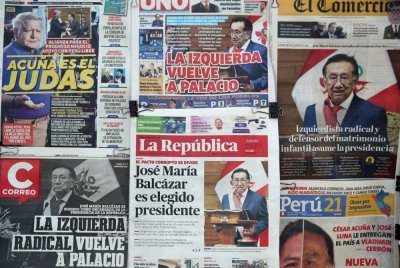
Newspaper front pages feature Peru’s new interim president Jose Maria Balcazar in Lima on Thursday. Congress elected Balcazar as the new interim president during an extraordinary session. But he is also on trial for financial irregularities. Photo by Paolo Aguilar/EPA
Feb. 20 (UPI) — Peru’s interim President Jose Maria Balcazar was summoned to continue his trial over alleged misappropriation of funds from the Lambayeque Bar Association just one day after assuming the presidency.
The case adds legal pressure to a temporary administration already shaped by political uncertainty.
Peru’s Public Ministry alleges that during his tenure as dean of the Lambayeque Bar Association from 2019 to 2022, Balcazar committed irregularities in managing the institution’s financial income and expenditures.
Prosecutors also allege he ordered profits to be deposited into his personal bank accounts, El Comercio newspaper reported.
Balcazar, a lawmaker from the leftist Peru Libre party, assumed the interim presidency Wednesday following the removal of his predecessor Jose Jeri. News of the court summons emerged only hours after his inauguration.
The first hearing is scheduled June 16, with additional sessions set for June 23 and June 30, either virtually or at the Lambayeque Superior Court in Chiclayo, according to judicial authorities.
A judge ordered the president’s mandatory attendance and warned that failure to appear could result in him being declared in contempt and subject to a nationwide arrest warrant.
On the day lawmakers elected Balcazar, the Lambayeque Bar Association issued a statement opposing his candidacy and warning of multiple allegations against him, RPP Noticias reported.
The association expelled Balcazar permanently Aug. 13, 2022, citing violations of its statutes and code of ethics. It said his conduct caused “serious harm to his own professional association and, consequently, to the dignity and distinguished image all Peruvian lawyers must preserve.”
Balcazar has consistently denied the accusations, saying they lack legal basis.
He also has faced other investigations and complaints over several years. During his time as a judge and later as a congressman, he was the target of allegations including suspected judicial misconduct, fraud, identity impersonation and bribery, along with other questions raised about his professional conduct.
In his first remarks as president, Balcazar sought to downplay the impact of his legal cases, saying “it is not difficult to govern a country” and adding his administration will focus on ensuring “unquestionable” elections scheduled for April.
Separately, former President Pedro Castillo, who is serving an 11-year, five-month sentence for rebellion after his failed 2022 attempt to dissolve Congress, has requested a presidential pardon from Balcazar.
Castillo’s former defense minister and attorney Walter Ayala formally delivered it to the presidential office.
During Castillo’s administration, Balcazar emerged as one of his most visible defenders. He supported Castillo’s government and questioned investigations that involved officials close to the executive branch, local outlet Peru21 reported.