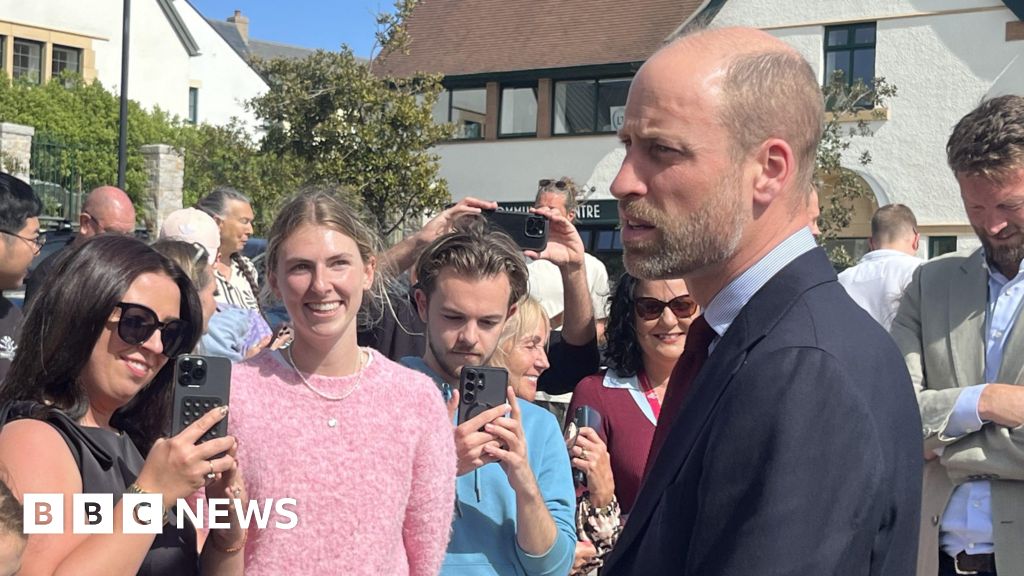
Prince William visits newly built Cornish suburb
The Prince of Wales visits Nansledan, a “sustainable urban extension” of a Cornwall coastal town.
Source link
The Prince of Wales visits Nansledan, a “sustainable urban extension” of a Cornwall coastal town.
Source link

As Eileen Wang and her supporters tell it, the former Arcadia mayor was led astray by a man she trusted and loved.
After chasing her political ambitions in the San Gabriel Valley suburb, Wang, 58, won a City Council seat in 2022 with the help of a campaign advisor who was also her romantic partner. Two years later, he was charged by federal authorities with secretly working on behalf of the Chinese government.
Wang, a naturalized U.S. citizen, distanced herself from her ex and remained in office, becoming mayor earlier this year. The scandal had mostly quieted — until Monday, on the eve of President Trump’s planned trip to Beijing, when a plea deal was unsealed revealing Wang’s own murky role as an agent for China.

A man walks past an empty space where a photograph of former Mayor Eileen Wang was removed in the lobby of Arcadia City Hall.
(Genaro Molina/Los Angeles Times)
Now, Wang has become a national political talking point, with critics painting her as a calculating foreign agent who sought to infiltrate the American government and undermine democracy.
Katie Miller, wife of top Trump advisor Stephen Miller, blasted Wang on social media site X as a “spy.”
“This is pure China trying to influence U.S. politics and U.S. elections,” Katie Miller said on Fox News.
Back home, some of Wang’s former colleagues in local government say they repeatedly tried to raise alarms about her.
“There were red flags everywhere,” said Sharon Kwan, an Arcadia city council member and former mayor.
Wang admitted in her plea agreement to posting and editing web content at the request of the Chinese government — without disclosing her ties to U.S. authorities, as the law requires. She ran afoul of the Foreign Agents Registration Act, or FARA, a federal statute that experts said has seen ramped up enforcement over the last decade, particularly in cases involving China.
But those familiar with the law — and international espionage — said it does not appear that Wang was engaged in spycraft as it is commonly understood.
Dennis Wilder, a former senior U.S. intelligence official and professor at Georgetown University, said that, in the CIA, Wang would be referred to as “an agent of influence.”
“She’s not a spy in the Jason Bourne sense,” Wilder said, referring to the fictional American agent. “She’s not out there recruiting sources and that sort of thing. That’s not the role that they want for her. But they see this other role as extremely important.”

A man exits Arcadia City Hall on Tuesday.
(Christina House/Los Angeles Times)
Wang moved to the U.S. around 30 years ago, in part, she told The Times in 2024, because she wanted “freedom for speech, freedom [for] thinking.”
Her mother was a Chinese medicine and acupuncture doctor and her father was a physician in Sichuan province before working at USC, she said. Authorities have not detailed how she immigrated or her path to citizenship. She landed in Arcadia, she said, lured by what the school district in the affluent city of 54,000 could offer her two young boys.
She ran an after-school program and was involved in some community organizations, but said she did not move in political circles until shortly before her 2022 run for city council. She switched her party affiliation from Republican to Democrat, which, she said, spoke more to the needs of voters in her district, where many share her Chinese roots.
“I walk about 140 days,” she said of her campaign, adding that she hit every door in her district five times. “I never stop.”
Yaoning “Mike” Sun, Wang’s former fiance, managed her campaign.

Arcadia City Councilmember Sharon Kwan stands outside the front entrance of the San Gabriel Valley suburb’s City Hall. “This is not something where we can just dismiss and pretend nothing happened,” said Kwan regarding the case against ex-mayor Eileen Wang.
(Genaro Molina/Los Angeles Times)
Kwan, who was elected to the city council at the same time, recalled Sun as a constant presence at city meetings and events, “always with the camera.”
“Always recording, always promoting her,” Kwan said. “She was like a celebrity to him.”
Two years after Wang took office, in December 2024, federal authorities arrested Sun on suspicion of acting as an illegal agent of China.
Prosecutors accused Sun in a criminal complaint of working with another man to cultivate Wang as a political asset for the People’s Republic of China or PRC. Federal prosecutors in Los Angeles identified the other man as John Chen, describing him in a sentencing memorandum as “a high-level member of the PRC intelligence apparatus,” who had “met personally” with Chinese President Xi Jinping.
Chen instructed Sun to submit reports on Wang, referred to throughout the complaint as “Individual 1,” to Chinese officials, including one the federal complaint said they referred to as the “Big Boss.” A draft of the report allegedly included a request for $80,000 to “support pro-PRC activities in the United States.” Sun was also told to tout Wang’s relationship with an unnamed U.S. congressperson, the complaint said.
Both men eventually pleaded guilty to working as unregistered agents of China, with Sun sentenced this year to four years in prison. Chen was sentenced to 20 months.
Wang spoke with Chen on the day she was elected and three more times over the next few months, according to the complaint in Sun’s case.
“You are doing a good job, I hope you can continue the good work, make Chinese people proud,” Chen told Wang, in a conversation on Jan. 23, 2023, according to the complaint in Sun’s case.
Chen and Sun also coordinated a trip to China in 2023 for Wang to meet with “leadership,” which would include stops in six different places, according to the complaint. It’s unclear whom Wang met with on the trip.
After Sun’s arrest, Wang denied to several people that they had been engaged to marry. She said during a council meeting that their relationship ended in spring 2024.
Jolene Cadenbach, a pastor in Arcadia, said Wang confided in her that “she had been lied to” by Sun.
“I think he did a con job on her,” Cadenbach said.
The recent plea agreement gave the wrong impression about Wang, the pastor said.
“It made her sound like she was some kind of spy and it wasn’t like that at all,” she said. Wang was only following Sun’s orders, she added: “He told her to put up this site, she did it. She didn’t really investigate it.”
In a statement, Wang’s lawyers said she “apologizes and is sorry for the mistakes she has made in her personal life.” They said “she genuinely loves this city and is devoted to the people and the community within it,” but “her trust and love for apparently the wrong person… ultimately led her astray.”

Arcadia resident Sonia Martin sits on the porch of her home. Martin said she had long expressed concerns about the city’s former mayor, Eileen Wang.
(Genaro Molina/Los Angeles Times)
After Sun was charged in 2024, Sonia Martin and other Arcadia residents showed up at council meetings carrying protest signs. Martin said she expected Wang to be pushed out. Instead, she said, most council members appeared to unite behind Wang.
“They wanted to have this feeling of, like, everything’s great here. We’re all warm. Look at us, it’s kumbaya,” Martin said.
Kwan said she repeatedly tried to bring up the concerns of constituents to her fellow council members but was brushed off.
“Everybody was just so silent,” Kwan said. “This is not something where we can just dismiss and pretend nothing happened.”
The job of mayor rotates among Arcadia City Council members, and when it was Kwan’s turn last April, she warned during her swearing-in speech that constituents “must remain vigilant against influence of foreign governments, including efforts by the Chinese Communist Party, that may seek to shape local policy for the interests that do not align with our residents.”
Since Wang’s plea agreement became public, some have scoffed at the notion that Chinese spies would establish an outpost in Arcadia, or that the web posts she made before becoming mayor amounted to any sort of meaningful propaganda campaign.
But according to Sun’s plea agreement, local office was just the start. Prosecutors said Sun’s 2023 report for Chinese officials boasted that “during the 2022 U.S. midterm elections, I orchestrated and organized my team to win the election for city council.” He called Wang a “new political star.”
Wilder, the former U.S. intelligence official, said that sounded like a familiar strategy.
“Maybe she would end up in Congress some day or at the state government level. They invest in these folks hoping they move up the political food chain,” the Georgetown professor said. “That is part of the Chinese long game.”
In her plea agreement, Wang admitted that from late 2020 through at least 2022, she worked with Sun to run a website called U.S. News Center that branded itself as a news source for Chinese Americans.
Wang and Sun “executed directives” from Chinese government officials, posting requested articles and reporting back with screenshots showing how many people viewed the stories, the agreement says.
Prosecutors also say Wang edited articles at the request of officials and shared information showing the reach of the posts.
“Thank you leader,” she wrote on Aug. 20, 2021, after being complimented for a post that was viewed more than 15,000 times, according to the plea agreement.
Wang never disclosed that the Chinese government had directed her to post the content, according to court documents.
That sort of low-level violation of the law is not supposed to trigger federal charges unless, according to a February 2025 memo by then-Atty. Gen. Pam Bondi to Justice Department prosecutors, the case involved “conduct similar to more traditional espionage.” The Trump administration has pursued other high-profile foreign agent cases recently, with prosecutors winning a conviction Wednesday of a man charged with running a covert police station in Manhattan and keeping tabs on political dissidents.
When news broke of the charges and plea deal involving Wang, current and former city officials said they were not surprised.

A wall of photographs of former Arcadia mayors hang inside Arcadia City Hall. Eileen Wang is shown second from left on the bottom row. Wang admitted in court filings this week to working as an unregistered agent for China.
(Genaro Molina/Los Angeles Times)
“The warning signs around Eileen Wang were public for more than a year before this plea, agreement, and too many people in positions of influence defended and supported her,” April Verlato, a former mayor of Arcadia, said in a statement. “Our electeds should have represented what was best for the community and held her accountable. The San Gabriel Valley deserves better.”
Paul Cheng, mayor pro tem of Arcadia, said the council didn’t move earlier to oust Wang because a majority of its members wanted to let the federal investigation run its course.
“The public always says, ‘Why didn’t you investigate her when her boyfriend was arrested? Why didn’t you do something?’” he said.

Pedestrians walk along a sidewalk next to Huntington Drive in downtown Arcadia on Wednesday.
(Genaro Molina/Los Angeles Times)
But, he emphasized, “council members are not federal investigators.”
“We are not supposed to get involved,” said Cheng, an attorney. “It would make the situation 10 times worse.”
Cheng spoke highly of Wang, painting her as a committed civil servant with a passion for veterans, first responders and diversifying the businesses on Baldwin Avenue, the city’s main corridor.
“She probably attended the most events compared to all of us,” he said. “People have tried getting me to say she’s a horrible person, but I can only say what I saw, which was I thought she did a good job on council.”

May 5 (UPI) — One of 23 people injured in a weekend shooting at a lake party in an Oklahoma City suburb has died, authorities said Tuesday as they continue to search for a suspect.
The shooting occurred at around 9 p.m. CDT Sunday at Lake Arcadia where a group of young people were having an unauthorized party near a campground that had been advertised across social media.
Police initially said 10 people were taken to area hospitals but warned the number would rise as individuals were transported by private vehicles.
The deceased victim was identified by the Edmond Police Department as “an 18-year-old young woman.”
“Our thoughts are with her loved ones, as well as all those affected by this tragic incident,” the Edmond Police Department said in a statement.
“We thank our community and media partners for their patience and understanding as we work to confirm details and release appropriate information. This investigation is being handled with the utmost care and seriousness.”
The announcement came a day after local police announced the casualty toll had increased to 23, with injuries ranging in severity. Some suffered gunshot wounds, authorities said.
Police said they were not releasing suspect information at this time but asked members of the public with information about the shooting to contact authorities.
Edmond Mayor Mark Nash issued a statement Monday explaining that shootings such as the one on Sunday are rare for the city and “will not define us.”
“We are a strong, engaged community. We support one another, we face challenges directly and we move forward together,” he said.
“That is what makes Edmond special, and that is exactly what we will continue to protect.”