strikers

Belfast rallies for Palestine hunger strikers as memories of 1981 return | Israel-Palestine conflict

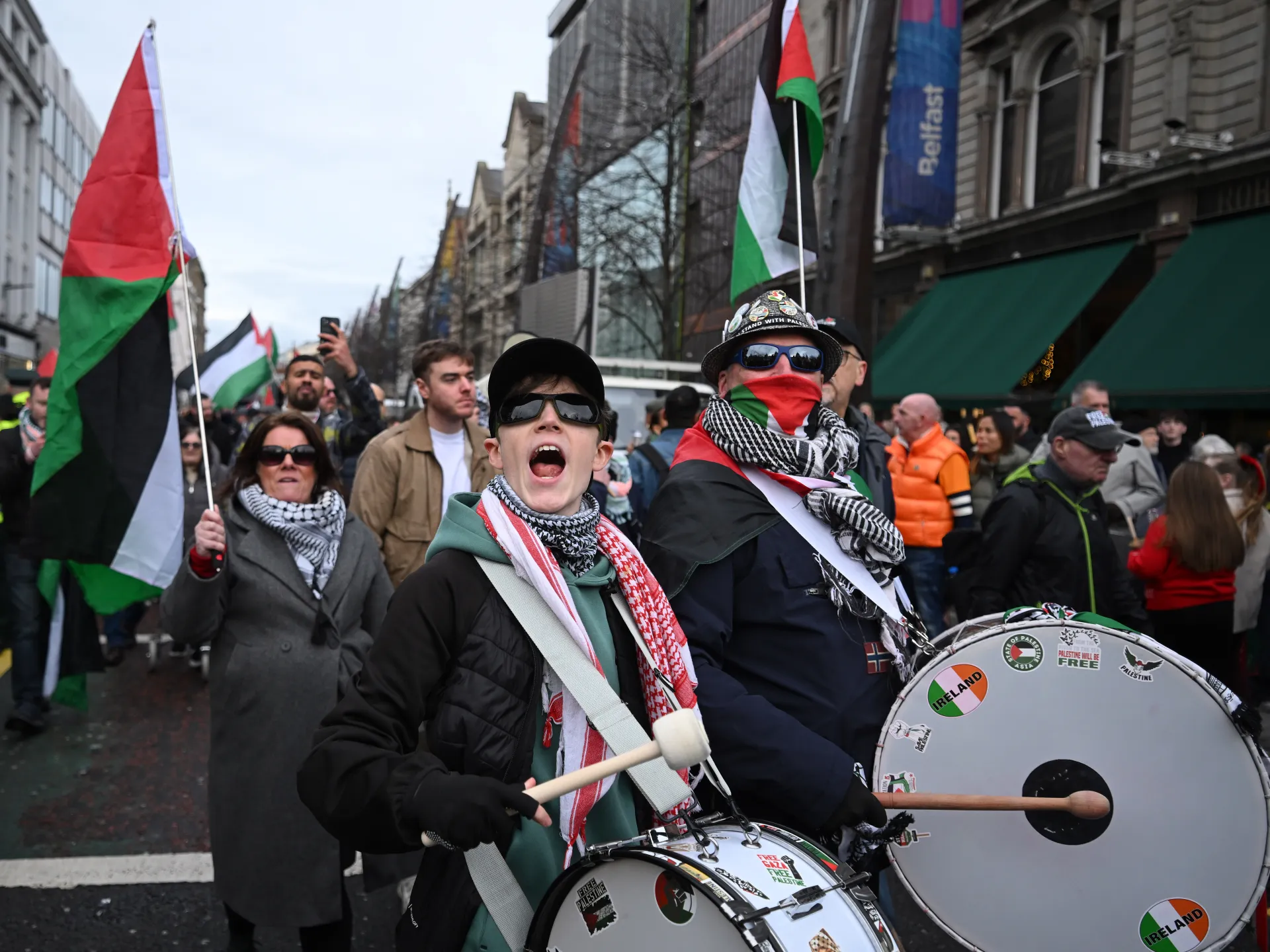
Belfast, Northern Ireland — On New Year’s Eve, as fireworks lit the Belfast sky, the city’s streets were abuzz — and not only in celebration.

Hundreds gathered in solidarity with activists from the Palestine Action group who are on hunger strikes in prison. Their chants echoed past murals that do not merely decorate the city, but testify to its troubled past.

Along the Falls Road, Irish republican murals sit beside Palestinian ones. The International Wall, once a rolling canvas of global struggles, has become known as the Palestinian wall. Poems by the late Palestinian writer Refaat Alareer, killed in an Israeli air strike in December 2023, run across its length. Images sent by Palestinian artists have been painted by local hands.

More recently, new words have appeared on Belfast’s famed walls. “Blessed are those who hunger for justice.” Painted alongside long-familiar images of Irish republican prisoners like Bobby Sands are new names now written into the city’s political conscience: the four pro-Palestinian activists currently on hunger strike in British prisons, their bodies weakening as the days stretch on.

“This is not a city that will ever accept any attempt to silence our voice or our right to protest or our right to stand up for human rights,” said Patricia McKeown, a trade union activist who spoke at the protest.

“These young people are being held unjustly and in ridiculous conditions – and they have taken the ultimate decision to express their views … and most particularly on what’s happening to people in Palestine – why would we not support that?” she asked.

A hunger strike reaches Belfast

The protest in Belfast is part of a growing international campaign urging the British government to intervene as the health of four detainees deteriorates behind prison walls. All are affiliated with Palestine Action and are being held on remand while awaiting trial, a process campaigners say could keep them imprisoned for more than a year before their cases are heard. With legal avenues exhausted, supporters say the hunger strike has become a last resort.

The Palestine Action members are being held over their alleged involvement in break-ins at the United Kingdom subsidiary of Elbit Systems in Filton near Bristol, where equipment was reportedly damaged, and at a Royal Air Force base in Oxfordshire, where two military aircraft were sprayed with red paint. The prisoners deny the charges against them, which include burglary and violent disorder.

The prisoners are demanding release on bail, an end to what they describe as interference with their mail and reading materials, access to a fair trial and the de-proscription of Palestine Action. In July, the British government of Prime Minister Keir Starmer banned Palestine Action under a controversial anti-terrorism law.

Heba Muraisi is on day 61 without food. Teuta Hoxha is on day 55. Kamran Ahmed on day 54. Lewie Chiaramello on day 41. Hoxha and Ahmed have already been hospitalised. Campaigners describe it as the largest hunger strike in Britain since 1981, one they say is explicitly inspired by the Irish hunger strikes.

In 1981, Irish Republican Army and other republican prisoners went on hunger strike in Northern Ireland, demanding the restoration of their political status. Ten men died, including their leader, Bobby Sands, who was elected to the British parliament during the strike. Margaret Thatcher took a hardline public stance, but behind the scenes, the government ultimately sought a way out as public opinion shifted.

One prisoner, 29-year-old Martin Hurson, died on the 46th day. Others, including Raymond McCreesh, Francis Hughes, Michael Devine and Joe McDonnell, died between days 59 and 61. Sands died after 66 days on a hunger strike.

Sue Pentel, a member of Jews for Palestine Ireland, remembers that period vividly.

“I was here during the hunger strike,” she said. “I went through the hunger strikes, marched, demonstrated, held meetings, protested, so I remember the callous brutality of the British government letting 10 hungers die.”

“The words of Bobby Sands, which are ‘Our revenge will be the laughter of our children’. And we raised our families here, and they’re the same people, this new generation who are standing in solidarity with Palestine.”

‘If this continues, some will die’

Standing beneath a mural of Bobby Sands, Pat Sheehan fears history is edging dangerously close to repeating itself. He spent 55 days on a hunger strike before it was called off on October 3, 1981.

“I was the longest on that hunger strike when it came to an end in 1981, so in theory I would have been the next person to die,” he said.

By that stage, he said, his liver was failing. His eyesight had gone. He vomited bile constantly.

“Once you pass 40 days, you’re entering the danger zone,” Sheehan said. “Physically, the hunger strikers must be very weak now for those who have been on hunger strike for over 50 days.”

“Mentally, if they have prepared properly to go on hunger strike, their psychological strength will increase the longer the hunger strike goes on.”

“I think if it continues, inevitably some of the hunger strikers are going to die.”

Sheehan, who now represents West Belfast as an MLA for Sinn Fein, believes that Palestine Action-linked hunger strikers are political prisoners, adding that people in Ireland understand Palestine in a way few Western countries do.

“Ireland is probably the one country in Western Europe where there’s almost absolute support for the Palestinian cause,” he said. “Because we have a similar history of colonisation; of genocide and detention.”

“So when Irish people see on their TV screens what’s happening in Gaza, there’s massive empathy.”

Ireland’s stance

That empathy has increasingly translated into political action. Ireland formally recognised the state of Palestine in 2024 and has joined South Africa’s case at the International Court of Justice, alleging genocide in Gaza, a charge Israel denies.

The Irish government has also taken steps to restrict the sale of Israeli bonds, while Ireland has boycotted the Eurovision Song Contest over Israel’s participation and called for its national football team to be suspended from international competition.

But many campaigners say the government’s actions have not gone far enough. They argue that the Occupied Territories Bill, which seeks to ban trade with illegal Israeli settlements, has been stalled since 2018, and express anger that United States military aircraft transporting weapons to Israel are still permitted to pass through Ireland’s Shannon Airport.

Meanwhile, in the northern part of Ireland that remains part of Britain, the war in Gaza has dominated domestic politics.

The Stormont Assembly was thrown into crisis after Democratic Unionist Party education minister Paul Givan travelled to Jerusalem on a trip paid for by the Israeli government, prompting a no-confidence vote amid fierce criticism from Irish republican, nationalist, left-wing and unaligned political groups.

Belfast City Hall’s decision last month to fly a Palestinian flag was also fervently opposed by unionist councillors before it was eventually approved.

For some loyalist and unionist groups, support for Israel has become entwined with loyalty to Britain, with Israeli flags also flying in traditionally loyalist parts of Belfast.

With a legacy of identity rooted along sectarian lines, the genocide in Gaza has at times been recast along the old fault lines of division.

‘Solidarity reaches Palestine’

Yet on the streets of Belfast, protesters insist their solidarity is not rooted in national identity, but in humanity.

Damien Quinn, 33, a member of the Boycott, Divestment, Sanctions (BDS) movement, said hunger strikes had always carried a particular weight in Ireland.

“We are here today to support the hunger strikers in Britain. But we are also here for the Palestinian people for those being slaughtered every single day,” he said.

Palestine Action, he said, “made it very clear they have tried signing petitions, they have tried lobbying, they’ve tried everything”.

“So when I see the way they are being treated in prison, for standing up against genocide, that’s heartbreaking.”

For Rita Aburahma, 25, a Palestinian who has found a home in Belfast, the hunger strike carries a painful familiarity.

“My people don’t have the luxury of speaking out, being in Palestine – solidarity matters,” she said.

“I find the hunger strikers are really brave – it’s always been a form of resistance. It does concern me, and many other people, how long it has taken the government to pay attention to them, or take action in any form.

“Nothing will save those people if the government doesn’t do something about them. So it is shocking in a way, but not that surprising because the same government has been watching the genocide unfold and escalate without doing anything.

“Every form of solidarity reaches the people in Palestine.”

Source link

Who are the Palestine Action hunger strikers? | Human Rights News

Four members of the Palestine Action group, which has been proscribed as a terrorist organisation in the United Kingdom, are continuing with their hunger strikes in different prisons around the country.

Four other Palestine Action members have ended their hunger strikes – some after being hospitalised.

Recommended Stories

list of 4 itemsend of list

Here is what we know about the four remaining hunger strikers.

Why are the Palestine Action protesters on hunger strike?

Imprisoned Palestine Action members have been on hunger strikes in prisons around the UK for more than 50 days.

The Palestine Action members are being held on remand in prisons over their alleged involvement in break-ins at the UK subsidiary of Elbit Systems in Filton near Bristol, where equipment was reportedly damaged, and at a Royal Air Force base in Oxfordshire, where two military aircraft were sprayed with red paint.

The prisoners deny the charges against them, which include burglary and violent disorder.

Of the four still on hunger strikes, three were imprisoned in November 2024 for their alleged involvement in break-ins at the UK subsidiary of Israeli weapons group Elbit Systems in Filton near Bristol, where equipment was reportedly damaged. One has been in prison since July 2025 for alleged involvement in damage at a Royal Air Force base in Oxfordshire, where two military aircraft were sprayed with red paint.

Palestine Action, a protest group launched in July 2020, describes itself as a movement “committed to ending global participation in Israel’s genocidal and apartheid regime”.

The UK parliament voted in favour of proscribing the group on July 2, 2025, classifying it as a “terrorist” organisation and bringing it into the same category as armed groups like al-Qaeda and ISIL (ISIS). Critics decried the move, arguing that while members of the group have caused damage to property, they have not committed acts of violence that amount to terrorism.

More than 1,600 arrests linked to support for Palestine Action were made in the three months following the ban’s introduction. The ban has been challenged in court.

The hunger strikers have five key demands: immediate bail, the right to a fair trial – which they say includes the release of documents related to “the ongoing witch-hunt of activists and campaigners” – ending censorship of their communications, “de-proscribing” Palestine Action and shutting down Elbit Systems, which operates several UK factories.

“The UK government has forced their bodies to a breaking point,” pro-Palestine activist Audrey Corno told Al Jazeera Mubasher.

“A promise to the government is that the prisoners’ resistance and the people’s resistance against the genocide [in Gaza], Israel’s occupation and apartheid of genocide will not stop until it ends.”

Who are the remaining hunger strikers?

Heba Muraisi, Kamran Ahmed, Teuta Hoxha and Lewie Chiaramello are the four people, aged between 20 and 31, who are continuing their hunger strikes.

Heba Muraisi

Muraisi, 31, was on day 60 of her hunger strike on Thursday. She is being held in HMP [His Majesty’s Prison] New Hall in Wakefield, a prison in West Yorkshire about 180 miles (290km) north of London.

Muraisi was arrested in November 2024 for her alleged role in an August 2024 raid on the Israel-based Elbit Systems in Bristol, which is believed to have cost the Israeli weapons manufacturer more than $1.34m.

According to social media posts, Muraisi is of Yemeni origin. However, Al Jazeera could not independently verify this.

She was transferred to the West Yorkshire prison in October 2025 from HMP Bronzefield in Surrey, about 18 miles from the UK capital.

“Heba is demanding to be transferred back to HMP Bronzefield. She was transferred very suddenly, very far away from her entire support network and family, which is based in London. She’s been experiencing consistent medical negligence. Her body is, as you’d imagine, increasingly weak,” Corno said.

In a statement shared with Al Jazeera on December 29, Muraisi said: “I’ve been force-fed repression and I’m stuffed with rage and that’s why I’m doing what I’m doing now. I am bringing acute awareness to the unjust application of UK laws by our Government and I’m glad that people can now see this after a year of imprisonment and human rights violations. Keep going, keep fighting.”

Muraisi’s trial is set for June 2026, according to the protest group Prisoners For Palestine.

Heba Muraisi
Heba Muraisi [Courtesy of Prisoners for Palestine]

Kamran Ahmed

Ahmed, 28, was also arrested in November 2024 and is being held in HMP Pentonville in north London. He was also arrested for his alleged involvement in the raid on Elbit Systems in Bristol. Ahmed has been on a hunger strike for more than 50 days.

According to a report by Middle East Eye, Ahmed is a mechanic.

Ahmed was hospitalised for a third time on December 20 after he refused food, his sister, Shahmina Alam, told Al Jazeera.

“We know that he’s rapidly been losing weight in the last few days, losing up to half a kilogramme [1.1lbs] a day,” Alam told Al Jazeera in late December.

Ahmed, who is 180cm (5′11′), entered prison at a healthy 74kg (163lbs), but his last recorded weight was 60kg (132lbs).

“Kamran has been hospitalised for the fourth time recently,” Corno said.

Kamran Ahmed
Kamran Ahmed [Courtesy of Prisoners for Palestine]

Teuta Hoxha

Hoxha, 29, was on day 54 of her hunger strike on Thursday. She is being held at HMP Peterborough. She was also arrested in November 2024 on allegations of involvement in the Elbit Systems raid.

According to Prisoners for Palestine, Hoxha was moved from HMP Bronzefield on the day UK parliamentarians voted to proscribe Palestine Action – July 2, 2025.

Corno told Al Jazeera that she is in regular contact with Hoxha and that she has been having heart palpitations. “She’s not been able to sleep through the night for weeks on end. I can see her memory start to deteriorate.”

In a statement published on the Prisoners for Palestine website, Hoxha said: “This is a witch hunt, not a fair fight, and that behind the arrests of dissenting voices under counterterrorism powers, holding us on remand without trial for nearly two years and targeting protesters who condemn Palestinian suffering, is the palpably desperate attempt to force us all under the imperial boot of submission.”

Teuta Hoxha
Teuta Hoxha [Courtesy of Prisoners for Palestine]

Lewie Chiaramello

Chiaramello, 22, has type 1 diabetes and hence, he has been fasting every other day. He is on day 28 of his hunger strike.

He has been held in HMP Bristol since July 2025 in connection with an incident at RAF Brize Norton, according to Prisoners for Palestine, and faces charges of conspiring to enter a restricted area for purposes harmful to the UK’s safety and interests, as well as conspiracy to commit criminal damage. His trial is set for January 18, 2027.

On June 20, a group of Palestine Action activists broke into RAF Brize Norton, the largest Royal Air Force base in Oxfordshire, and sprayed two military planes with red paint, causing an estimated $9.4m worth of damage.

“He’s been having to manage his insulin intake on his own with no medical supervision,” Corno said.

Lewie Chiaramello
Lewie Chiaramello [Courtesy of Prisoners for Palestine]

Who else has been on a hunger strike?

Four other imprisoned Palestine Action activists have ended their hunger strikes, mostly after being hospitalised.

This includes Qesser Zuhrah, 20 and Amu Gib, 30, who are being held at Bronzefield prison in Surrey. The pair began their hunger strikes on November 2 to coincide with the Balfour declaration of 1917, when Britain pledged to establish a national home for the Jewish people in Palestine.

Umar Khalid, 22, who has muscular dystrophy, ended his hunger strike after 13 days. Jon Cink ended his hunger strike after 41 days when he was hospitalised. Qesser Zuhrah ended her hunger strike after 48 days and was hospitalised. Amy Gib was also hospitalised.

Source link

Palestine Action hunger strikers launch legal action against UK government | Israel-Palestine conflict News

London, United Kingdom – Lawyers of imprisoned hunger-striking activists linked to the protest group Palestine Action have put the British government on notice as the justice secretary refuses to meet them.

Imran Khan & Partners, which represents the collective, wrote a pre-claim letter to the government on Monday, warning that they would seek a High Court case should officials fail to respond by Tuesday afternoon.

Recommended Stories

list of 4 itemsend of list

Eight activists, aged between 20 and 31, have participated in a rolling strike that began on November 2. There are rising fears that one or more of them could soon die in jail.

In recent days, their relatives and loved ones have told Al Jazeera of their deteriorating health and repeated hospital admissions.

Their lawyers have long called for a meeting with Justice Secretary David Lammy to discuss welfare and prison conditions, believing such an intervention could be life-saving.

But the government has so far refused, saying hunger strikes are not an unusual phenomenon in prisons and that policies to provide adequate medical care to anyone refusing food are being followed.

“Our clients’ food refusal constitutes the largest co-ordinated hunger strike in British history since 1981,” the lawyers wrote, referring to the Irish Republican inmates led by Bobby Sands. Sands and nine others died of starvation, one on day 46 of the protest.

“As of today’s date, [the current] strike has lasted up to 51 days, nearly two months, and poses a significant risk to their life with each passing day,” the lawyers wrote.

The detainees are being held in five prisons over their alleged involvement in break-ins at the United Kingdom’s subsidiary of the Israeli defence firm Elbit Systems in Bristol and a Royal Air Force base in Oxfordshire. They deny the charges against them, such as burglary and violent disorder.

Amu Gib, Heba Muraisi, Teuta Hoxha and Kamran Ahmed are on day 52, 51, 45 and 44 of their protests, respectively. Lewie Chiaramello, who is diabetic and refuses food every other day, began his protest 30 days ago.

Qesser Zuhrah, Jon Cink and Umer Khalid have ended their strike.

All eight will have spent more than a year in prison before their trials take place, well beyond the UK’s usual six-month pre-trial detention limit.

The hunger strikers’ five demands include immediate bail, the right to a fair trial and the de-proscription of Palestine Action, which accuses the UK government of complicity in Israel’s war crimes in Gaza. The UK government banned Palestine Action in July, branding it a “terror” group, a label that applies to groups such as ISIL (ISIS). The protesters have called for an end to alleged censorship in prison, accusing authorities of withholding mail, calls and books. They are also urging that all Elbit sites be closed.

‘Engage with each one’

Leading human rights barrister Michael Mansfield has backed calls for the government to intervene.

“It’s a simple proposition, engage with each one,” he told Al Jazeera. “That’s your job [as government], that’s what you’re there for. You are safeguarding people’s health, welfare and life.”

In a letter addressed to Lammy, he wrote, “Fundamental human rights in the United Kingdom are being destroyed in this quagmire of disinterest and populist politics, the most important being the presumption of innocence and the right to a fair trial by means of preparation and due process.

“There has to be an equality of arms which can hardly be achieved when a defendant is held in oppressive and lengthy periods of remand.”

Families of the prisoners have alleged mistreatment in prison, saying some detainees have been verbally abused and left without care in dangerous health conditions. The Ministry of Justice has denied these accusations and says it cannot comment on individual cases.

“Government takes action when it chooses to,” Mansfield wrote. “There could be no more appropriate time than now with the life-endangering protest by the hunger strikers. The delay is grotesque in some cases, up to two years with trial dates being set in 2027.”

Nida Jafri, a friend of hunger striker Amu Gib, plans to deliver Mansfield’s letter – and one of her own – in hand to the Ministry of Justice on Tuesday.

“These people are on remand – not convicted, still awaiting full legal process,” reads Jafri’s letter. “They are weak, in pain, and visibly wasting away. The absence of adequate medical observation or humane treatment under prison or hospital care is not only unacceptable; it breaches fundamental rights to health, dignity, and life.”

Source link

Two Palestine Action hunger strikers in UK prisons admitted to hospital | Israel-Palestine conflict News

London, United Kingdom – Two Palestine Action-affiliated remand prisoners on hunger strike have been taken to hospital, according to a family member and a friend, adding to fears that the young Britons refusing food in protest could die at any moment.

Twenty-eight-year-old Kamran Ahmed, who is being held at Pentonville prison in London, was hospitalised on Saturday, his sister, Shahmina Alam, told Al Jazeera.

Recommended Stories

list of 4 itemsend of list

Amu Gib, 30, who has not eaten food for 50 days at HMP Bronzefield in Surrey, was taken to hospital on Friday, said the Prisoners for Palestine group and friend Nida Jafri, who is in regular contact with them. Gib uses the pronoun they.

Ahmed and Gib are among six detainees protesting across five prisons over their alleged involvement in break-ins at the United Kingdom’s subsidiary of the Israeli defence firm Elbit Systems in Bristol and a Royal Air Force base in Oxfordshire.

They deny the charges against them, such as burglary and violent disorder.

“It’s day 42 [of Ahmed’s hunger strike], and at this point, there’s significant risk of organ damage,” said his sister, Alam. “We know that he’s rapidly been losing weight in the last few days, losing up to half a kilogram [1.1lbs] a day.”

Ahmed’s last recorded weight was 60kg (132lbs).

When Al Jazeera first interviewed Alam on December 12, Ahmed, who is 180cm (5′ 11”), weighed 64kg (141lbs), having entered prison at a healthy 74kg (163lbs). On Thursday, Alam told journalists at a news conference in London that he weighed 61.5kg (136lbs).

Ahmed’s speech was slurred in a call with the family on Friday, said Alam. He is said to be suffering from high ketone levels and chest pains.

“Honestly, I don’t know how he’s going to come out of this one,” said Alam.

It is the third time Ahmed has been hospitalised since he joined the hunger strike.

Shahmina Alam with Kamran Ahmed - Palestine Action linked hunger striker [Courtesy of Alam family]
Shahmina Alam with her younger brother, Kamran Ahmed, a Palestine Action-linked hunger striker [Courtesy of the Alam family]

‘Critical stage’

The hunger strikers’ demands include immediate bail, the right to a fair trial and the de-proscription of Palestine Action, which accuses the UK government of complicity in Israel’s war crimes in Gaza. The UK government banned Palestine Action in July, branding it a “terror” group, a label that applies to groups such as ISIL (ISIS).

The protesters have called for an end to their alleged censorship in prison, accusing authorities of withholding mail, calls and books. They are also urging that all Elbit sites be closed.

The six are expected to be held for more than a year until their trial dates, well beyond the UK’s six-month pre-trial detention limit.

Qesser Zuhrah, a 20-year-old who has refused food for 50 days, is also in hospital, having lost 13 percent of her body weight, according to her lawyers. The other protesters are Heba Muraisi, Teuta Hoxha and Lewie Chiaramello, who is diabetic and refuses food every other day.

There was no immediate comment from either Pentonville or HMP Bronzefield.

‘I’m scared’

Gib called their friend, Jafri, on Thursday from prison, telling her they needed a wheelchair to attend a doctor’s appointment where their vital signs would be checked.

Prison staff at first “refused” to provide a wheelchair, and later, after offering one, “refused to push” it, Jafri said. “So they laid there with … no check of their vitals on day 47 of their hunger strike,” Jafri said.

When they are hospitalised, the prisoners are unable to call their loved ones, as they can from jail.

Jafri told Al Jazeera, “I’m scared they’re there alone with no phones and no calls allowed.”

Gib, who has lost more than 10kg (22lbs), is below the normal range for most health indicators, which is “highly concerning” for their immune system, their lawyers have said.

Prison officials have “failed to provide [Gib] with thiamine [a vitamin] consistently, and Amu is feeling the effects on their cognitive function”, the lawyers said.

Gib’s eyes are also “sore with the bright [prison] lights”, Jafri said.

Nida
Amu Gib (left) with their friend, Nida Jafri [Courtesy: Nida Jafri]

The lawyers have demanded a meeting with Secretary of State for Justice David Lammy, hoping his intervention could be life-saving. Thousands of everyday Britons, hundreds of doctors and dozens of MPs have urged Lammy to heed their call. But so far, he has refused, leading critics to accuse the UK government of wilfully ignoring the issue.

The UK media have also been accused of downplaying the protest and its dangers.

The protest is said to be the largest coordinated hunger strike in UK prisons since 1981, when Irish Republican inmates led by Bobby Sands refused food.

“In contrast to the robust media coverage of the Irish hunger strikes in the 1980s, the Palestine Action hunger strikes have been largely met with media silence,” wrote Bart Cammaerts, a professor of politics and communication at the London School of Economics.

“What will it take for the British media to pay attention to the plight of jailed pro-Palestinian activists? The death of an activist? Or the awakening of a moral conscience?”

Source link