
straight

Bridgerton boss sets record straight on ‘recasting’ major characters

Bridgerton returned for its long-awaited fourth outing on Netflix, bringing Benedict Bridgerton’s love story to life at last.

Bridgerton: Five bombshells from season four

Bridgerton’s showrunner has finally addressed rumours that there are plans to recast some of its key characters going forward.

Two years after Penelope Featherington (played by Nicola Coughlan ) and Colin Bridgerton ( Luke Newton ) became official, the Netflix period drama returned to delve into Benedict Bridgerton’s (Luke Thompson) journey.

As expected with the free spirited second eldest son, his story wasn’t going to be a simple one as Benedict fell for maid Sophie Baek (Yerin Ha) but luckily, they managed to get their happy ever after.

Something that has troubled some fans though is the fact that season one’s Daphne Bridgerton (Phoebe Dynevor) has failed to return to the show since the second series.

Much to some fans’ disappointment, Daphne didn’t even show up at the funeral of sister Francesca Bridgerton’s (Hannah Dodd) husband John Stirling (Victor Alli).

The same can be said for her husband Simon, Duke of Hastings (Rege Jean-Page) who hasn’t been in Bridgerton since it first launched in 2020.

Their lack of absence has led viewers to question if Daphne and Simon could be recast for future series so their characters can feature in the show.

However, showrunner Jess Brownell has shut down this speculation, explaining why she wouldn’t want to axe Dynevor and Jean-Page from the Bridgerton universe.

“We are not interested in recasting the characters,” she told Variety.

“I think it would [be] a disservice to everything Regé and Phoebe set up in season one, and all the beautiful work they put into those characters.

“We would love to potentially have them back at some point, but I think, logistically, we want to make sure we bring them back when we have something really meaty for them.

“To have them come back to say a line at a funeral and just prove that they were there, it wouldn’t feel right for many reasons.”

Brownell went on to add that she would love to “bring everyone back at some point in the future” but given the cast’s increasingly busy schedules, this may become a challenge.

Since leaving Bridgerton behind, Dynevor has starred in films including erotic thriller Fair Play, political drama Anniversary and conspiracy thriller Inheritance, to name a few.

Meanwhile, Jean-Page has been in spy thriller Black Bag, fantasy film Dungeons and Dragons: Honor Among Thieves and The Gray Man.

They aren’t the only ones who have been busy away from the Netflix hit as Anthony Bridgerton’s Jonathan Bailey has since gone on to star in Jurassic World Rebirth and the Wicked franchise.

But if Bridgerton ever did come to an end, could the final series bring the entire original cast back together again?

Bridgerton is available to watch on Netflix.

Source link

Jordan Chiles powers UCLA gymnastics to second straight Big Ten title

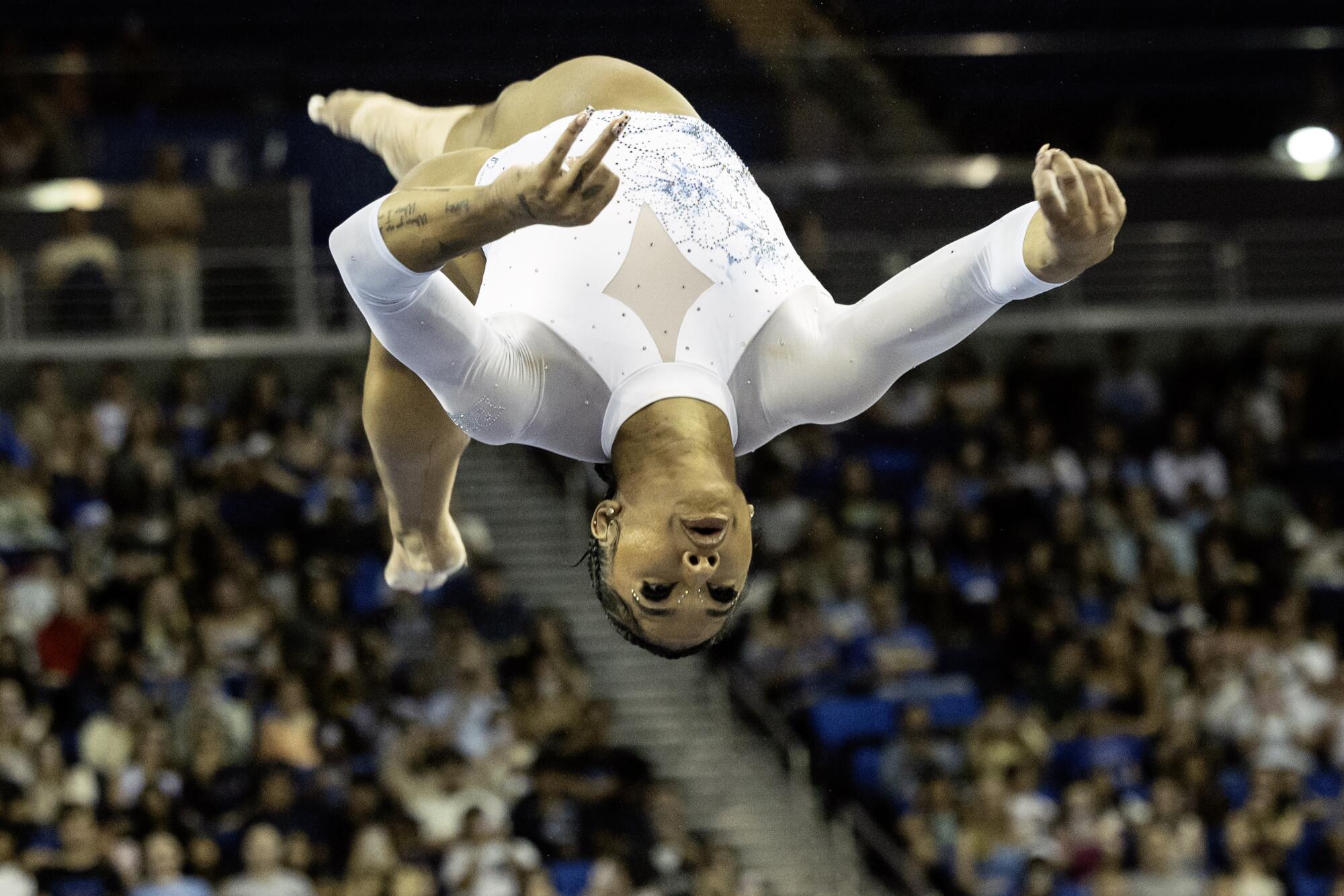
Led by another standout performance from Jordan Chiles, the No. 5 UCLA women’s gymnastics team clinched the Big Ten regular-season championship for the second consecutive year Friday night by winning its Big Four meet at Pauley Pavilion.

Chiles, who had the top all-around score of 39.625, helped UCLA defeat No. 18 Iowa, No. 19 Ohio State and No. 25 Maryland with an overall score of 196.950. Her 9.950 on the vault in the final rotation sealed the win.

“The thing I’m taking away from today is that they really are fighters,” UCLA coach Janelle McDonald said. “They really didn’t give up [at] any moment, and they really were just resilient through it all.”

Ciena Alipio opened with a 9.850 on the uneven bars. Tiana Sumanasekera followed it with a 9.750 before Nola Matthews, Sydney Barros and Chiles each scored a 9.900.

Alipio was impressed by how well Matthews performed on short notice.

“She is one to always kind of just put her head down and work, and I’m really proud of her to see her step up today,” Alipio said.

On the balance beam, Katelyn Rosen started with a 9.750 and Barros posted a 9.850. Flexing UCLA’s depth, Mika Webster-Longin received a 9.825 in her top routine. Chiles had a 9.825. In an almost-perfect routine, Alipio posted a 9.950. The mark helped UCLA extend its lead.

It wasn’t all good news for the Bruins on the first rotation — Rosen sustained a foot injury and was held out for the remainder of the meet.

“I’m hoping it’s not no big deal, but we’ll get her checked out and just want to take the precaution and pull her out of those lineups,” McDonald said.

UCLA's Jordan Chiles competes on the balance beam Friday during a Big Ten quad meet at Pauley Pavilion.

UCLA’s Jordan Chiles competes on the balance beam Friday during a Big Ten quad meet at Pauley Pavilion.

(Etienne Laurent / For The Times)

Matthews started the floor exercise in Rosen’s place, opening with a 9.675. Alipio followed with a 9.825, and Sumanasekera and Ashlee Sullivan posted scores of 9.875 and 9.900, respectively. Needing a big performance to keep their lead, Chiles did not disappoint, scoring a 9.950.

Matthews demonstrated the level of depth UCLA has leaned on throughout the season.

“I definitely can say that is a huge leadership role as a freshman,” Chiles said. “Being able to step in at a time like that … we trusted the fact that she was gonna go out there and do her job.”

UCLA's Katelyn Rosen competes on balance beam during the Bruins' quad meet win at Pauley Pavilion on Friday.

UCLA’s Katelyn Rosen competes on balance beam during the Bruins’ quad meet win at Pauley Pavilion on Friday.

(Etienne Laurent / For The Times)

Going into the last rotation, UCLA led Ohio State by just .150. The Bruins needed a strong performance on vault to claim the conference title.

Sumanasekera set the tone with a 9.850. Madisyn Anyimi followed with a 9.775. After replacing Rosen, Webster-Longin earned a 9.800 in her season debut on vault, and Sullivan posted a 9.850 before Chiles clinched the win.

But the Bruins want more.

“This is a regular season, we still have Big Ten championship, we have regionals and we have NCAA,” Chiles said.

The quad-meet experience was a learning curve, Alipio said. UCLA had to perform at a high level through the final routine to secure victory.

UCLA gymnast Ashlee Sullivan performs her floor routine during the Bruins' quad meet win Friday at Pauley Pavilion.

UCLA gymnast Ashlee Sullivan performs her floor routine during the Bruins’ quad meet win Friday at Pauley Pavilion.

(Etienne Laurent / For The Times)

McDonald said adjusting to tough competition levels up UCLA. The Bruins hope the experience will pay dividends for the young team in the postseason.

“We just kept reminding them to just take a breath, stay present and just really trust their training and their preparation that they’ve had leading into today,” McDonald said.

After donning hats and shirts that commemorated their championship, the Bruins celebrated on the floor with cheers and pictures. But come next week, the work begins again.

“We fought, for sure, until the end,” Alipio said. “But we also know we’re going into the gym on Monday, and we’re putting our heads down and working because this wasn’t our best, but we have more to show everybody.”

Source link

Luka Doncic and Lakers lose third straight on Royce O’Neale’s three

Two nights after losing to the Orlando Magic in a heartbreaker, the Lakers focused on trying to beat a Phoenix Suns team missing key players.

In the end, the result was the same — disappointment.

The Lakers lost 113-110 after Austin Reaves missed a three-pointer as time expired, the Suns coming up with the clutch shot on Royce O’Neale‘s three with nine-tenths of a second left to send the Lakers to their third consecutive loss Thursday night.

On the final play, Marcus Smart inbounded the ball and LeBron James and Maxi Kleber set a double-screen to get Reaves open. Reaves floated to the corner and took a cross-court pass but his shot bounced off the rim, sending the Lakers to another loss despite Luka Doncic‘s 41 points, eight rebounds and eight assists.

The fourth quarter was a back-and-forth affair before the Suns built a 12-point lead with 6:28 left. The Lakers quickly recovered and tied the score on a Reaves three-pointer with one minute left. O’Neale scored on an offensive rebound to give the Suns a 110-108 lead before James scored on a put-back to tie the score.

The Suns then called a timeout to set up O’Neale’s winning shot.

Phoenix, which had lost six of eight, played without All-Star guard Devin Booker (right hip strain), Dillon Brooks (left hand fracture) and Jordan Goodwin (left calf strain).

Still, the Lakers (34-24) knew the Suns (34-26) would play hard and throw up a lot of three-pointers — Phoenix shot 22 for 50 from three-point range.

When the Lakers went up by three early in the fourth, things looked good. But then the Suns went on a 13-3 run.

Lakers coach JJ Redick was forced to call a timeout after Oso Ighodaro rolled in for an uncontested dunk, putting the Lakers down 96-86 with 7:43 left.

The Lakers went down by 10 points in the second quarter, but took a two-point lead late in the quarter on a Reaves three-pointer. But Grayson Allen scored on a layup to tie the score 49-49 at halftime.

The Lakers opened a 13-point lead in the third quarter, but ended up tied 80-80 entering the fourth.

Allen carried the Suns in the third, scoring 16 points. He missed just one of his shots and just one of his five three-pointers in the third.

James finished with 15 points, six rebounds and five assists. Reaves scored 14 points and Smart had 13 points.

The Lakers lost to Orlando on Tuesday by one point on a botched play when Doncic didn’t shoot a three-pointer and instead passed the ball to James, who missed a last-second three-point attempt.

It was a tough way for the Lakers to end their eight-game homestand, going 4-4 over that stretch.

Redick was asked if it is easy to move on after a tough loss.

“Well, I think that’s not in general,” Redick said. “I think there are specific times throughout the season where you talk about what just happened, more than just your normal review. You’re not going to do that after every game. So, we had a great practice and meeting on Monday after the Boston game and you don’t need to belabor every single loss.”

ETC.

Lakers forward Rui Hachimura didn’t play against the Suns because of an illness, the team said. But backup center Jaxson Hayes, who missed the last game with right ankle soreness, played 21 minutes against the Suns, finishing with eight points and three rebounds.

Source link

Lloyd Kelly: Why Juventus player’s second yellow card became ‘awful’ straight red

Former Premier League defender Curtis Davies said the decision was an “absolute disgrace”.

“Kelly goes up for a header, he’s gone for the header cleanly. His feet have to land on the ground somewhere,” he added on BBC Radio 5 Live.

“Unfortunately, he lands on the player. There needs to be a level of understanding – where is he meant to put his feet? I understand Kelly’s frustration.”

Davies’ sentiments were echoed by football journalist Rory Smith, who called the decision “awful” and a “disgrace”.

Meanwhile, former Tottenham midfielder Andy Reid felt football was “moving closer and closer to being a non-contact sport”.

“There needs to be contact in football and sometimes people do get painful ones. It happens. There’s nothing you can do about that. It’s part of the game,” he said.

According to Uefa rules, any player sent off by the referee – whether that is via two yellows or a straight red – is automatically suspended for the next match in European club competition.

However, in light of Juventus’ exit from the Champions League, Kelly’s suspension will carry over to next season.

Former Manchester City defender Nedum Onuoha added: “If I was Kelly I’d be really disappointed, but with how football works, it’s always going to be a red.”

But former Liverpool full-back Stephen Warnock disagreed.

“I don’t agree with it because it is purely accidental. I understand the yellow card, but not the red,” he said.

Source link

Straight Talk On State Of U.S. Airlift Capabilities From General Who Ran Air Mobility Command

The U.S. buildup of forces in the Middle East ahead of a possible attack on Iran relies very heavily on the performance of the U.S. Air Force Air Mobility Command (AMC). Hundreds of its cargo jets and aerial refueling tankers have moved materiel into theater and helped tactical jets, radar planes and other aircraft deploy across oceans to places like Muwaffaq Salti Air Base in Jordan, among many other locations. At the same time, the current crisis in the Middle East pales in comparison to the massive spike in demand for airborne logistics that would occur during a Pacific fight against China. Regardless, ever greater demand is being placed on an increasingly aging AMC fleet.

Few people know the nuts and bolts of AMC and its mission better than Michael “Mini” Minihan, a retired Air Force general who led the command from October 2021 to November 2024. In a 45-minute interview, Minihan offered his insights on that and a whole host of other topics. They include the current crisis and its airlift demands, challenges from China, future airframes, arming airlifters and refuelers, the connectivity issues he championed, AI and the leaked memo that put a cap on his career.

Michael Minihan led U.S. Air Force Air Mobility Command (AMC) from October 2021 until his retirement in November 2024. (USAF) AMC commander Gen. Mike Minihan. USAF

Since retiring, Minihan serves as a strategic advisor and board member to defense and technology companies, non-profits, and think tanks while continuing to write and speak on leadership, national security, and the future of air mobility and global power projection.

Some of the questions and answers have been edited for clarity.

Q: The C-17 Globemaster III heavy lifters have been supporting one crisis after another it seems. Have the hours accumulated faster on those airframes? What do you think should replace them and when? 

A: All the things I was concerned about while I was in uniform, I remain concerned about right now. The options on the table are service life extension programs [SLEP] that the C-17 is already a candidate for. There was talk late last year about the KC-135 Stratotanker receiving another [SLEP]. You know, those types of things are concerning to me. At the end of the day, I think this nation needs to pay for the Air Force it needs, and the Air Force that it needs has a modern, capable mobility fleet. It’s not just old stuff that keeps getting patched up to get older. That’s the reality. So I’m concerned.

C-17 Globemaster. (USAF)

Q: Right now, a massive buildup is underway in the Middle East. AMC is doing the heavy lifting there as always. But in a crisis in the Pacific, would we have enough airlift aircraft to support moving quick enough across that vast theater, especially to respond to an invasion of Taiwan? 

A: What you’re talking about is always a concern, regardless of the scenario. The reality is that America relies on the mobility fleet to project its power… So there’s not any scenario, even in the day-to-day competition, where you’re happy with the supply-demand intersection. So I think that we’ve got to work on capacity, certainly out of the entire mobility fleet, when it comes to the airlift and the air refueling. And then if you overlay that in contested environments, the concern gets bigger.

This KC-46 Pegasus aerial refueling tanker remains at Moron Air Base in Spain after suffering a mishap earlier this momth. (Pepe Jimenez)

Q: Considering how long it has taken to build up forces in the Middle East, where tankers and cargo jets are flying over uncontested airspace, how concerned are you about being able to project enough power over long distances to protect Taiwan from an attack by China?

A: The alarm that I had when I was active duty exists today… So the reason I’m a civilian right now is because I was ringing the bell on the exact questions that you’re asking right now and that concern still remains. The reality is against a China or against a Russia, they’re going to challenge you in all domains, from great distances. They absolutely understand that the mobility fleet is America’s capability to project power quickly. So there’s going to be a focus on it. But once again, you’re describing concerns that I had and expressed when I was active duty, and I still have those same concerns.

Inside Taiwan’s Strategy to Counter a Chinese Invasion | WSJ


Q: What response did you receive when you expressed those concerns in a memo that was leaked to the public in 2023?

A: Well, I’m a civilian right now.

Q: Is that the reason why?

A: The leak created antibodies that would want me in another job. That memo was getting after all the things that you’re asking about right now. It was getting after capability and capacity. It was getting after readiness. It was getting after explode into theater. It was getting after the mobility fleet being able to do what it’s asked to do, despite being extremely vulnerable, despite it being extremely antiquated – all those things. 

A portion of the memo AMC Commander Gen. Michael Minihan wrote that was leaked to the public. (USAF via X) USAF via Twitter

I believe that the Chief of Staff of the Air Force [Gen. Kenneth S. Wilsbach] now is focused on modernization and readiness. Those were 100% things that I was championing very early. And I think those things exist now, and I think we need to continue to put pressure on [those things] to get the resourcing, to get not just the Air Force, but America’s mobility fleet, to the capability and capacity that it needs to be at, so that we can not have concerns about China and not have concern about [deploying] to Europe when needed.

Q: Were you fired over the memo?

A: I was not fired. I thought for two weeks that I was going to be fired, but I was thankfully allowed to serve out the rest of my command tour. But I was asked to retire.

Gen. Mike Minihan, U.S. Air Force retired, delivers a speech at the Herk Nation Legacy Monument Award at Little Rock Air Force Base, Arkansas, May 5, 2025. The event honored Minihan as the second recipient of the Herk Nation Legacy Award, recognizing his outstanding contributions to Herk Nation and the Air Force. (U.S. Air Force photo by Airman Rachel Bates-Jones)

Q: What were the biggest lessons learned by Mobility Guardian and our readiness to meet the challenge China poses in the Pacific? 

A: We’ve got to explode into theater very quickly. We’ve got to be able to explode into theater in numbers and volumes and challenges that we’ve not experienced in any of the modern…operations. We’ve got to put the entire joint force in place. We’ve got to do it quick enough that it gives an enormous deterrent value and also be able to provide that decisive victory, should it get to that.

We’ve got to transition from a deploy to an employ phase very quickly. So that’s establishing hubs and spokes. And then the last thing I’ll say – this is about maneuver. We have got to maneuver at a tempo required to win. So we got to put America’s unique and amazing capabilities in a position of advantage, and then once they’re in that position of advantage, we’ve got to be lethal, and that requires logistics, sustainment, supply maneuver, all the things that have to come together in the joint force to be lethal have to be there, and we need to work extremely hard to do that. 

So Mobility Guardian was really a rehearsal, and we demonstrated that we couldn’t explode into theater. We demonstrated that we could go from deploy to employ. But we also learned some hard lessons, and to get it to the scale and the volume of the tempo that we needed to be, we’ve got work to do.

Mobility Guardian 2023


Q: What were some of these lessons?

A: The lessons are connectivity. You probably heard me say that a bunch both in uniform and out of uniform, but connectivity became my number one thing. I testified before the House Readiness Committee on that. I came up with a concept called 25% of the fleet by 2025, but the reality is that the car I rented right now driving from the airport to my hotel room has more connectivity in it than the overwhelming majority of the mobility fleet. So connectivity matters. 

We’ve got to operate at a tempo required to win, which means we need to do extremely long missions. We need to have exquisite situational awareness. We need to understand the changing dynamic of the operational environment. When it comes to red forces, blue forces, threats, priority receivers, priority users. We’ve got diffuse information and logistic priorities across services, so there’s almost an unlimited amount of lessons learned. And then command relationships matter as well as command and control. All those things matter too. So plenty of lessons learned. I don’t think any of those are surprising. I think they’re accounted for in the Air Force’s readiness and modernization. But we also need to get resources so that we can be the Air Force this country needs.

An F-15 Eagle from the 159th Fighter Wing receives mid-flight refueling from a KC-135 Stratotanker assigned to the 128th Air Refueling Wing of Milwaukee during Sentry Aloha off the coast of Honolulu, Hawaii on January 15, 2026. Sentry Aloha provides cost-effective and realistic, large-scale training scenarios to prepare warfighters and support the Air National Guard’s position as a crucial component of the nation’s operational force.
An F-15 Eagle from the 159th Fighter Wing receives mid-flight refueling from a KC-135 Stratotanker assigned to the 128th Air Refueling Wing of Milwaukee during Sentry Aloha off the coast of Honolulu, Hawaii on January 15, 2026.
(Master Sgt. Lauren Kmiec photo) Master Sgt. Lauren Kmiec

Q: How would you peg our overall readiness, realistically, to confront China in the Pacific militarily? 

A: We’re ready. I like the way that [IndoPacific Command leader] Adm. [Sam] Paparo uses it. He says we’re ready, but he’ll never admit to being ready enough. This is kind of like the coaches that you love to play for – they are never satisfied. I would broaden it beyond readiness. I would say readiness, integration and agility of the joint force is what matters. And as ready, integrated and agile as we are, we need to be more. And those things have a deterrent value in themselves, and they’re also the essentials to decisive victory. So China enjoys positional advantage, but America enjoys extreme warfighting capabilities that can always get better, and it starts with readiness, integration and agility. We want to get to the point where we’re so ready that they don’t want to take us on.

Q; What were the three biggest problems you faced in your job and how did you go about solving them? Were you successful?

A: The three biggest problems I faced during my command tour at Air Mobility Command was resourcing, resourcing and resourcing – articulating the state of the mobility platforms and securing the resources necessary to get them on step to where they need to be. And so I said resourcing three times, and I mean it.

Pentagon
The Pentagon. (Department of War) (Photo By Bill Clark/CQ-Roll Call, Inc via Getty Images)

This is all about money. You can say everything you want. You can say all the things are important. You can say ‘you’re right, General Minihan, we agree with you,’ but if it’s not followed up with resourcing, then it’s meaningless, you know? So at the end of the day, this is all about resourcing. Can we decide to be the Air Force, the joint military that puts the resourcing behind what it means to decisively defeat a near peer adversary? Or do we wait until another December 7, or another September 11 event to finally get all the things pulled together that we need to pull together. So I get it. This is expensive. 

We’ve got a chance of a century right now, I believe, with this administration. When you line up the executive orders, when you line up the acquisition reform, when you look up the possibility of a $1.5 trillion defense budget, you know those things come together means that we can move faster and move differently than we’ve ever done but we’ve got to be ready to do it.

We can’t apply all the opportunities over the same template of how we acquire, how we take risk, how we get our warfighters the things that they need and expect a different outcome at the end of the day. The overall statement for this, and this is big into problem statements. If I were to describe the problem statement we’re trying to solve is, can we get critical war-winning capabilities to our warfighters faster than China? At the end of the day, if we can answer yes to that question, then we’re going to be okay. If it’s a maybe or a no, then we’re going to have some significant concerns moving forward.

Trump Calls For Massive Increase To Defense Spending: $1.5 Trillion For 2027


Q: Were you successful in your efforts to solve those problems?

A: Was I successful? I would say I was successful at ringing the bell. I needed three more years to get it across the line. And I’m not comparing myself to a Gen. [Curtis E.] LeMay or a Gen. [Wilbur L.] Creech, but those two [Major Command] MAJCOM commanders – who are the fathers of the modern strategic bomber force and the father of the modern fighter force –  were both MAJCOM commanders for over six years. So if I had to give myself a grade, I would say me and my teams were A-plus for effort and articulation and at the end of the day, getting the system to react quickly within three years proved extremely challenging.

Q: What was your grade for that?

A: It’s to be determined. You know, the money process takes a little time. I think there’s money for connectivity coming up in the current and the next few years, which is a great sign and a big change. If I were to grade it for what I wanted, I would have given myself a C, but I think it’s a higher grade than that, due to the circumstances, due to the realities of the budgeting and the resourcing process.

Q: What are the three biggest problems facing current interim AMC Commander Lt. Gen. Rebecca Sonkiss (formerly deputy AMC commander until Gen. John D. Lamontagne was named Air Force Vice Chief of Staff earlier this month). 

A: The problems are getting resourcing across the line. Can you deliver them? Money. You know, at the end of the day, MAJCOMs don’t have the money to get the things that they need and under the current process. So how do you affect the organizations and entities above you, so that you can align the resourcing to do the things that it needs to do, and the timelines that you need to do it when that’s always a challenge for everybody. 

Air Mobility Command (AMC) Change of Command Ceremony – Scott AFB


But if you’re asking what [Lamontagne] needs to worry about…if you look at the first Iran operation, if you look at the Venezuela operation, whatever is going to happen over the next short-term future for the Middle East, you can walk away saying, ‘we’re just fine.’ You can walk away saying, ‘Hey, we can project power over long distances. We can impose America’s will. We can do the things that our president and our nation asked us to do.’ And that’s right, you can do it under those circumstances. 

The courage of the joint team is phenomenal. The capability of the joint team is phenomenal, but it does not compare to what will happen in a near-peer fight in the Pacific or in Europe. We are going to be contested from long distances in all domains, and the fleet that we have now is not going to be successful in that environment unless we take quick action and fix things.

The U.S. Air Force has awarded a contract for the development and production of a new Next Generation Penetrator (NGP) bunker buster bomb.
A B-2 bomber drops a GBU-57/B Massive Ordnance Penetrator (MOP) bunker buster bomb during a test. (USAF) USAF

Q: There is a lot of hype around Rapid Dragon and giving the airlift community a ‘shooter’ role. But in a major conflict, won’t the fleet be tasked to the max just with its core logistics mission? Do we need more airframes to really do the Rapid Dragon concept justice?

A: I hear this one a lot. So here’s the reality. I’ve got to carry the missile, the bomb anyway. Okay, I’m not trying to be Global Strike. I’m not trying to be a fighter. I’m not trying to compete with capabilities that are legit and high-end when it comes to delivering kinetic effects. But if I have to carry it anyway, and there’s an ability for C-130s, C-17s  and other airlift platforms, why would you not want that capability? 

So I’m not saying it can go into the high-threat areas or the medium-threat areas. I’m not saying that it needs to be a primary mission. But let’s really look at the thing – at the entire process here. I’ve got to carry that stuff anyways, so I am either gonna stop and drop it off for someone else to shoot, or I could have the ability to do it. If a combatant commander needs a demand signal, there’s a ton of C-130s. Our foreign partners and allies operate them. These aren’t complex systems. The munitions already exist. It’s essentially air-dropping it out of the airplane. And I think it has enormous viability in the Pacific. It can service medium- to low-[threat] targets all day long that need servicing and free up the other sets to get after the high-end threat environments where they need to be focused. So I think it’s something we need to consider.

Rapid Dragon


Q: That segues nicely to my next question. What are the biggest threats China poses to our tankers and airlifters during a time of war?

A: The ability to get out of town by dropping electrical grids and navigation signals. This is true for all the platforms. This is why I say we’ll be contested at great distances in all domains. Critical infrastructure matters and getting out of town – we already talked about what it means to explode into theater. So it’d be silly to think that they’re going to not take a very inexpensive way to disrupt our ability to do that. And then, the farther you get to the threat, regardless of which way you’re heading around the ocean, you know is going to increase their ability to reach out with long-range effects and stop mobility. 

If you stop one tanker, you stop six fighters. That sounds like a good return on investment if you’re an adversary trying to prevent us from projecting power. I don’t think I’m saying anything I haven’t said before, and I don’t think I’m saying anything that’s inconsistent with others [are saying] about what the real environment is going to look like. 

They’re students of us. They have unimpeded access to our critical infrastructure for a decade or more, and we’re going to expect them to call in on their investment and impose a cost on us a great distance.

Q: Is there any particular Chinese system or munition that worries you the most?

A: What worries me the most? I’m worried, just like I was in uniform, about the multi-domain aspect for which they’re going to go after us. I’m worrying about how those all come together. Certainly, without connectivity in the mobility fleet, it’s hard for mobility aircraft to understand where the threats are, especially the kinetic threats. So our ability to understand if you’re in a threat ring or a dynamic threat environment is extremely handicapped. And certainly the kinetic ones are of the biggest concern. Like they are in any war. 

1/2 During the 3rd Sept 🇨🇳CCP Military parade in Beijing, some Air Defense Missile systems were shown in CCTV 4K: HQ-9C, HQ-11, HQ-19, HQ-22A & HQ-29… pic.twitter.com/cIxoX5Tc7Z

— Jesus Roman (@jesusfroman) September 3, 2025

Q: We have seen interest from the DoW in multiple fronts on how to give our existing tankers better defenses, from better situational awareness to giving them mini interceptors to pairing them with [collaborative combat aircraft] CCA-like companions. What do you think the best cocktail of solutions is here?

A: The single biggest contributor to survivability in a big airplane is connectivity. The biggest contributor is not having a 12-hour-old Intel brief that you’re relying on to get you through the mission. So real-world updates, real-time updates, just like our fighters and our bombers enjoy. Battle management that gets after maneuver and not just kill chain. Those things matter. 

If you were to ask me what I would want most when it comes to survivability, it would be connectivity that gives me the situational awareness to let our young crews – our captains, our lieutenants, our NCO – go out there and make great decisions as they’re operating under delegated authorities. Connectivity matters most. No doubt. Connectivity is why I put the priority on it when I was in uniform, because it’s the single biggest contributor to survivability. I just don’t think because of the size of these airplanes, in the maturity of the threat, that we’re going to be able to rely on traditional means of survivability.

U.S. Air Force Capt. Jarod Suhr, left, 100th Operations Support Squadron pilot and wing tactics officer, clarifies points of the Real-time Information in the Cockpit system to Capt. Anthony Vecchio, 100th OSS pilot and wing tactics officer, on a KC-135 Stratotanker at Royal Air Force Mildenhall, England, Oct. 18, 2023. The newly installed communications system gives aircrew the ability to access vital information including threats, target data and locations of friendly forces, providing much more accurate and instant information. (U.S. Air Force photo by Karen Abeyasekere)
U.S. Air Force Capt. Jarod Suhr, left, 100th Operations Support Squadron pilot and wing tactics officer, clarifies points of the Real-time Information in the Cockpit system to Capt. Anthony Vecchio, 100th OSS pilot and wing tactics officer, on a KC-135 Stratotanker at Royal Air Force Mildenhall, England, Oct. 18, 2023. The newly installed communications system gives aircrew the ability to access vital information including threats, target data and locations of friendly forces, providing much more accurate and instant information. (U.S. Air Force photo by Karen Abeyasekere) Karen Abeyasekere

Q: What about mini interceptors, or pairing these aircraft with CCA-like companions? Would that work?

A: I mean, I love it. The whole concept we came up with, the next-generation air lift [NGAL] and next-generation air refueling systems [NGAS]. I definitely see a role for CCA beyond just loyal wingman to fighter. So we can do this with everything from a CCA version of a tanker. We can do it with a stealth version of a tanker. I don’t think we need huge numbers of those. We can do stealth-like characteristics, like blended wing

We can certainly have aircraft that are multirole, both cargo and air refueling. And so then you can have a lot of tankers that look like the tankers that we have now, the ability for small CCA and drones and other things to do electronic warfare and spoof and jam and other things like that are all on the table in my book and things that we should be exploring.

A rendering of the blended wing body demonstrator aircraft now in development for the Air Force. (USAF) A rendering of the blended wing body demonstrator aircraft now in development for the Air Force. USAF

Q: What about a stealth tanker? Would we be able to afford it? Has adapting the B-21 Raider stealth bomber been looked at? What are your thoughts on that?

A:  I think that we’ve got to have a family approach to air refueling, and that’s where the NGAS concept came up. It’s hard for me to believe, to think that you’re going to be able, in a highly contested environment, to get our highest capabilities into the high-threat environments without having some sort of stealth-like CCA air refueling capability. I don’t think we need big numbers of them. I understand completely that they’re expensive, but we’ve got to work through that process, and we’re doing it with NGAS. So everything I’m telling you, I’ve said for years, and I’ve got a lot on the record out there that’s getting after the questions you’re asking, and I’ve not changed since I got out of uniform. 

The U.S. Air Force's selection of Boeing's F-47 as the winner of its Next Generation Air Dominance (NGAD) combat jet competition raises new questions about plans for new stealthy aerial refueling tankers.
A rendering of a notional stealth tanker refueling an F-35 Joint Strike Fighter. (Lockheed Martin Skunk Works) Lockheed Martin Skunk Works

The announcement by Northrop Grumman, the partnership with Embraer gets after this. If you go tackle that announcement, it gets after creating a family-of-systems approach to the problem, as opposed to we’re just going to field one piece of the problem at a time. We’re not going to work the integration in advance. We’re not going to work the readiness in advance. We’re not going to work the agility in advance, and I was happy to see in that announcement that they’re approaching the problem differently, because that’s the kind of approach I think we need to be successful.

Q: Have you looked at adapting the B-21 for this kind of stealth tanker role?

A: I don’t know what they’re looking at adapting, but I think there’s eloquence in the solutions that exist and that they’re working on, and then broadening their missions to beyond just the original intent for which they were designed. So I think that there’s great value in looking at those opportunities.

A B-21 Raider conducts flight testing, which includes ground testing, taxiing, and flying operations, at Edwards Air Force Base, California. The B-21 will interoperate with our allies and partners to deliver on our enduring commitment to provide flexible strike options for coalition operations that defend us against common threats. (Courtesy photo)
A B-21 Raider conducts flight testing, which includes ground testing, taxiing, and flying operations, at Edwards Air Force Base, California. (Courtesy photo) 412th Test Wing

Q: What about an Agile Combat Employment (ACE) tanker capable of supporting small numbers of fighters from forward airfields? The KC-390 is being pitched for such a role. Do we need smaller tankers capable of operating from shorter fields?

A: We need a family of tankers that can address all the warfighter needs in all the warfighter environments. So we need tankers that look a lot like the ones we have now, that can handle the low-threat environments. We need tankers that can push into the medium-threat environments and service the big volume offloads in the abundant amount of receivers that will be out there. We need tankers that can operate in a medium- to high-threat with blended wing and stealth characteristics. And then we need stealth like tankers that can go into a higher-threat environment, as well as unmanned and CCA. 

Northrop Grumman and Embraer are working together to evolve the multi-mission KC-390 Millennium aircraft, to provide advanced tanking capabilities for the United States Air Force and allied nations. (Photo Credit: Northrop Grumman)

I believe there’s room in the Air Force for all in that capability. Let’s be clear, it’s what the kinetic force needs, you know. So the strike force and the bomber force are [fifth-generation] fifth-gen and [sixth-generation] sixth-gen, and yet we still operate a mobility force that’s on its best day, 2.5 Gen and in some cases, second generation. So we’ve got to catch up, not because of ego, but because of capability. At the end of the day, this is about equilibrium of the enabling force to actually do what it needs to do, so that the strike force can carry out its missions in all environments. That’s what needs to happen.

Q: Is there money to do that? Is there a will from higher headquarters and then the administration to make that happen?

A: Well, there needs to be. Like I said, I think the opportunity is here with this administration. Its executive orders, its acquisition reform, and the possibility of a significant increase in the budget. But this gets back to, are we going to pay for the Air Force that this country needs? It’s been under-invested in, especially in mobility, and we need to ensure that this president and every future president, when they call on the Air Force to support the joint force, to project America’s power to serve the national interests and impose our will when needed, that we need to develop these kind of things. We have to do this if we want to be the Air Force that this country needs.

The last KC-135 Stratotanker aerial refueling jet was delivered to the Air Force in 1965. (USAF)

Q: Have you talked to anybody in the current administration or the current Department of War about this, and what’s your sense of the interest there?

A: I think the conversation is turning where it needs to go. I have not talked to the current administration about this specifically, but I think there’s an appreciation, when you line up the talking points that align the priorities of where the department is going, I think that there is 100% alignment with what my priorities were when I was in uniform, what my priorities are now that I’m out of uniform, with the priorities of where this administration is going.

I realize it’s still hard. I realize there are still challenges. I realize there are no easy answers to any of this, and I realize that there’s more to modernization and readiness than just the mobility fleet. And I also realize that these are the things that we need to do.

Q: Low-end drones are a big problem, especially for big airplanes sitting idle on the ground. What do you think should be done to defend our airlift assets against lower-end drones?

A: Just like everyone else, I watched the [Operation Spider Web] attack that Ukraine carried out on Russia’s strategic forces. And the only thing that surprised me about that is that people were surprised and that it took so long for them to do it. This is a real threat. It gets down to air base defense. It’s something that we championed in Air Mobility Command during my time there, because of the drone incursions that were happening over multiple Air Mobility Command bases and multiple Air Mobility Command missions. So this isn’t a surprise to me. 

Over 4-minutes of drone footage from Operation Spiderweb has just been released by the Security Service of Ukraine (SBU), showing the targeting of roughly two dozen Tu-95MS and Tu-22M3 Long-Range Strategic Bombers as well as two of the Russian Air Force’s extremely limited A-50… pic.twitter.com/ZpW85oPb7M

— OSINTdefender (@sentdefender) June 4, 2025

This is going to have to be a joint solution, and I know the Army is working very hard on this, but there’s also going to have to be a capability of the Air Force and wings that are deploying to be able to do this on their own as well. So no easy answers here. 

I feel like we’re behind, but catching up. I think it nests nicely into the Golden Dome opportunity as well. But you know, you gotta be able to handle everything from the low-cost drones all the way up to the highest capability missiles that could attack the homeland. This all fits in a spectrum of threats that we need to be concerned about. 

A graphic of how the Golden Dome missile defense system will be designed to work. (DIA)

Q: You brought up drone incursions. When and where did they happen and was the source ever found?

A: The incursions took place in late 2021 and early 2022 for Joint Base Andrews in Maryland and constantly at Joint Base McGuire-Dix-Lakehurst in New Jersey throughout my command. I’m not tracking that the source of those incursions was identified. It doesn’t mean that they weren’t. To my knowledge they weren’t. But, you know, at the end of the day, if you can’t control the airspace, including the airspace that drones are using, that’s a problem. It doesn’t matter if you’re in garrison or deployed. We’ve got to have the ability to defend at a greater capability than we have. 

Q: How are the C-5M Galaxy cargo jets doing? Are readiness rates improving? Will we need a direct replacement of something its size when their time finally comes to head to the boneyard? Was the M upgrade program successful?

A: I’m a year and a half out of the conversation. The last data point I got was from U.S. Transportation Command (TRANSCOM) commander Gen. [Randall] Reed‘s congressional testimony, where he said that the mission reliability rate, I believe, had fallen to 46%. So, if that’s true, then it’s still an enormous concern. I don’t know any part of your life where you tolerate a critical capability operating less than half the time when you need it. So C-5s are an enormous concern for me. 

I think there are options out there when it comes to large-volume aircraft that exist, that are being worked now, that can help us get capability quickly. And then I think there are concepts out there, like the commercialization of the C-5 fleet, that need to be taken seriously as well and apply commercial standards, commercial supply chain to increase the readiness of it. And between a combination of those two, I think that you can sustain what America needs to project large volume lift, but also get much higher than a 46% mission reliability rate.

A C-5 Galaxy transport jet. (USAF)

Q: Do you see the need for a similar sized cargo aircraft to replace the C-5 when it’s finally time for them to retire?

A: I do. I think building large, colossal aircraft is one of the hardest things to do on the planet, when you think about it. I need someone to help fact check me on this, but I don’t think more than 250 large aircraft have ever been built. You know, when you include the Hughes aircraft, include the C-5, include the Russian Antonovs, the fleet has been small because it’s hard. At the same time, it does things that nothing else can do. You don’t have to condemn your cargo to sea lift only. You can move things very quickly – large volume things, critical capabilities. And so we need to have this capability. 

But I don’t see the Air Force buying C-5 replacements. I see them transitioning C-5s to a different model, like commercialization. And I see the manufacturer of a large aircraft that can handle the volume being in the CRAF [Civil Reserve Air Fleet], and being a service concept that can get America the stuff we need when we need it. As opposed to developing another C-5 replacement, in addition to what’s going to have to eventually replace the C-5…

Q: Was the M upgrade on the C-5 successful?

A: I wasn’t there for when it was done, but … I would love to see what the original predictions were. When you spend all that money on that airplane and then still have a 46% mission reliability rate, it sounds like it is still challenged, like it used to be.

NAVAL STATION ROTA, Spain (Feb. 22, 2023) Seabees assigned to Naval Mobile Construction Battalion (NMCB) 1, NMCB 11, and Air Force Personnel from the 436th Maintenance Squadron (MXS), install a new tail rudder on a C5 Super Galaxy. This maintenance evolution is the first time it had been completed outside of Dover Air Force Base. NMCB 1 operates as a part of Navy Expeditionary Combat Command and is assigned to Commander, Task Force 68 for deployment across the U.S. Naval Forces Europe-Africa area of operations to defend U.S., allied, and partner interests. (U.S. Navy photo by Mass Communication Specialist 1st Class Sean P. Rinner)
Seabees assigned to Naval Mobile Construction Battalion (NMCB) 1, NMCB 11, and Air Force Personnel from the 436th Maintenance Squadron (MXS), install a new tail rudder on a C5 Super Galaxy. (U.S. Navy photo by Mass Communication Specialist 1st Class Sean P. Rinner) Petty Officer 1st Class Sean P Rinner

Q: Why hasn’t the Air Force gone big into uncrewed smaller logistics aircraft like China has? Especially considering dispersed ops in the Pacific?

A: Aviation right now is at a point of affordability and simplicity that we have got to distribute capability down to more tactical levels and have less centralization. Drones, automated aircraft 3,000 pounds or less, need to be a part of that equation. They need to be a part of the equation. 

I am a big fan of drones…The problem we’re trying to solve is getting winning capabilities to our warfighters faster than China. That’s what we need to be focused on. We have got to be infatuated with automation and connectivity. We have to be infatuated with drones and automated aircraft from small to medium to large capabilities. 

China’s unmanned transport aircraft completes maiden test flight


The biggest question I hear about why people don’t want small- and medium-capability is because they’re concerned about who commands and controls it and in my mind, that’s the point. You don’t have to command and control it. This is like a distributed maneuver pool, like a Jeep used to be in the Army. It’s inexpensive, it’s easy to operate, and we give it to maneuvering commanders in the field. We get TRANSCOM and Air Mobility Command out of the command and control of it. We let commanders determine their own priorities and service them, and then all we have to do is integrate them into the critical capabilities that Air Mobility, Command and TRANSCOM provide. You know those and we actually free up more of their assets to do that strategic and operational lift, as opposed to always having to get down into the capabilities that can be served by something much smaller. Does that make sense?

Q: Yes. Single pilot tanker operations, what’s your final thought on that?

A: Final thought on that is, we need to do more of it. I’m not saying we need to do more testing, but when it comes to automation, when it comes to concepts, when it comes to the tempo, the things we’re going to be required to do, we have to set ourselves up to be successful in an extremely deadly and demanding operational environment. 

And to think that we’re going to apply the old dogma over this new operational environment, it’s just going to put us in a really challenging place to be successful in. So single tanker pilot ops made a comment on autonomy. It made a comment on what we need to do to win in the Pacific. It made a comment on risk taking, and it made a comment on, I think, a command team that understood how to apply real concepts over real problems and come out with an informed way forward. So there was a larger message than just single pilots in tankers.

A picture the Air Force released of the KC-46A that was used for the single-pilot sorties on October 25, 2022. (USAF) A picture the Air Force released of the KC-46A that was used for the single-pilot sorties on October 25, 2022. USAF

Q: Finally, how did you see the rise of AI influencing AMC and how do you see it being used by the command in the future?

A: I’m a big fan of AI as long as commanders maintain the risk and the priority settings. You know I tried hard to get AI incorporated in Air Mobility Command, but the entire ecosystem wasn’t ready to have that conversation yet. I think AI and data are its own domain. 

Like other domains we’re going to need supremacy and superiority in it. We’re going to need to fight for it and fight from it. It’s going to benefit from the other domains, but I think disproportionately it’s going to benefit the other domains. More so our ability to sense and seize opportunity, our ability to simplify, our ability to reduce variables, our ability to gain decision advantage, our ability to make better decisions, quicker, at a higher tempo than the adversary. I think all those things are AI- and data-oriented, and I’m still not certain that we see it that way. We have got to get first mover advantage in the AI domain, and that’s going to take some work. I think that we’re starting to get there, but I think we have a long way to go on it.

Boeing KC-46A Tanker Refuels Military Aircraft Using 3D


Q: Why do you think that there’s been such resistance to AI?

A: I’m not certain most people actually use it. It’s new. Certainly there’s a newness to it. But at the end of the day, this is about data. Can you trust the data? It really flips the script, if you think about it as its own domain, because then you understand the magnitude of its importance, and you understand that this is about decision making and trust, and that you’re actually not off-shooting that to the machine to do. That you’re asking the machine and the AI to reduce variables and increase simplicity.

Then you really think about, how does a commander be able to set priorities, set risk tolerances, adjust those as required, and then, at the end of the day, this is about better decision making. I think that there’s a complexity to this that just needs to play out a bit, but I know one thing, I don’t think our adversaries are downplaying AI and data as a domain. I think that they’re 100% embracing it, and I think we need to do the same. And of course, it’s American ingenuity. We’ll get better at it and dominate.

Q: Any final thoughts you want to share? Any questions I didn’t ask?

A: No, I appreciate the opportunity here. I think that the Air Force has it right when it comes to modernization and readiness. I think that the Air Force has it right, and we need to have the resourcing to be their Air Force that this country needs. I think mobility has a longer way to go than most within the Air Force. So I continue to champion that. Those things I cared about in uniform, I care about out of uniform, and I didn’t wait to retire to have an opinion on these things. So I want to be the generation of Americans that gets this straight before we get slapped like we did on December 7th and September 11th. Let’s not wait till we get slapped to get the act together. Let’s go now hard, because our sons and daughters deserve it.

Contact the author: howard@thewarzone.com

Howard is a Senior Staff Writer for The War Zone, and a former Senior Managing Editor for Military Times. Prior to this, he covered military affairs for the Tampa Bay Times as a Senior Writer. Howard’s work has appeared in various publications including Yahoo News, RealClearDefense, and Air Force Times.


Tyler’s passion is the study of military technology, strategy, and foreign policy and he has fostered a dominant voice on those topics in the defense media space. He was the creator of the hugely popular defense site Foxtrot Alpha before developing The War Zone.


Source link

No. 2 UCLA wins its 19th straight game with thrashing of Indiana

The No. 2 UCLA women’s basketball team beat Indiana 92-48 at Pauley Pavilion on Sunday afternoon. Lauren Betts picked up a first-half double-double with 12 points and 10 rebounds. She finished with 16 points and was one of seven players to reach double figures.

“It speaks to how talented this team is,” Betts said. “We have threats at every single position, and it makes it so much easier for me to do my job, because I know that if they’re going to double, triple, I’m going to find somebody who’s able to score.”

UCLA extended its win streak to 19 games. With another lopsided victory under their belt, the Bruins said they have focused on consistency, no matter the opponent.

“I actually did bring that up in the locker room, and I should have, because that’s really been the challenge is to enjoy, relish, lean into, that we’re playing for our standard,” said coach Cori Close. “I’ve been really honest that we haven’t been doing that consistently against opponents that maybe don’t give the scoreboard, won’t give us that exact read.”

UCLA guard Kiki Rice drives to the basket under pressure from Indiana's Nevaeh Caffey.

UCLA guard Kiki Rice drives to the basket under pressure from Indiana guard Nevaeh Caffey as Hoosiers forward Maya Makalusky watches at Pauley Pavilion on Sunday.

(Jessie Alcheh / Associated Press)

UCLA’s Charlisse Leger-Walker scored 10 points in the second quarter alone and Kiki Rice, who recorded a 15-point second half after only scoring two in the first, led all Bruins in points.

“I wasn’t happy with the way I competed in the first half,” Rice said. “Regardless of the outcome offensively, I can control how hard I play. I’m proud of my defense, and in the second half I focused in on that and started to find a better rhythm.”

UCLA (25-1, 15-0 Big Ten) separated itself from Indiana (14-13, 3-12) in the second quarter with 30 points, taking a 47-20 halftime lead. In the third quarter, the Bruins outscored the Hoosiers 29-14.

Maya Makalusky scored 13 points for Indiana and Lenée Beaumont added 11. They were the only Hoosiers in double figures.

Close said Angela Dugalic led the way for the Bruins in the first half, playing at the level of aggression that the coaching staff was looking for. Close added that Dugalic’s intense effort was in response to a couple of games during which Dugalic wasn’t playing to her usual standard.

“[Yesterday] we’re talking about what was leading to that,” Close said of a conversation with Dugalic. “She was like, ‘I just start second guessing when I get that first foul.’ And I was actually thankful that she had that scenario. And I just said, ‘Hey, this is what we talked about yesterday, you got to play the same way.’”

Indiana guard Lenée Beaumont tries to the basket under pressure from UCLA guards Charlisse Leger-Walker and Kiki Rice.

Indiana guard Lenée Beaumont drives to the basket under pressure from UCLA guards Charlisse Leger-Walker and Kiki Rice Sunday at Pauley Pavilion.

(Jessie Alcheh / Associated Press)

Dugalic picked up a foul in the first quarter, providing a chance to respond to adversity in a different way.

The Bruins’ four turnovers were their lowest total in a game this season after giving up the second most during a close win last week against No. 13 Michigan State. Close put the players through a special workout in between the games to reduce the giveaways.

“Not only did they have to do a bike sprint for every single turnover and every one under our passion play goal that they didn’t get, but they had to watch their lack of productivity while they did it,” Close said.

The Bruins held Indiana to 31.3% shooting from the field, below the Hoosiers’ 47.9% average on the season, fifth best in the Big Ten.

UCLA has three more games before the Big Ten tournament, with Washington up next at 7 p.m. PST on Thursday. A Bruins win or a Michigan loss would clinch the No. 1 tournament seed for UCLA.

Source link