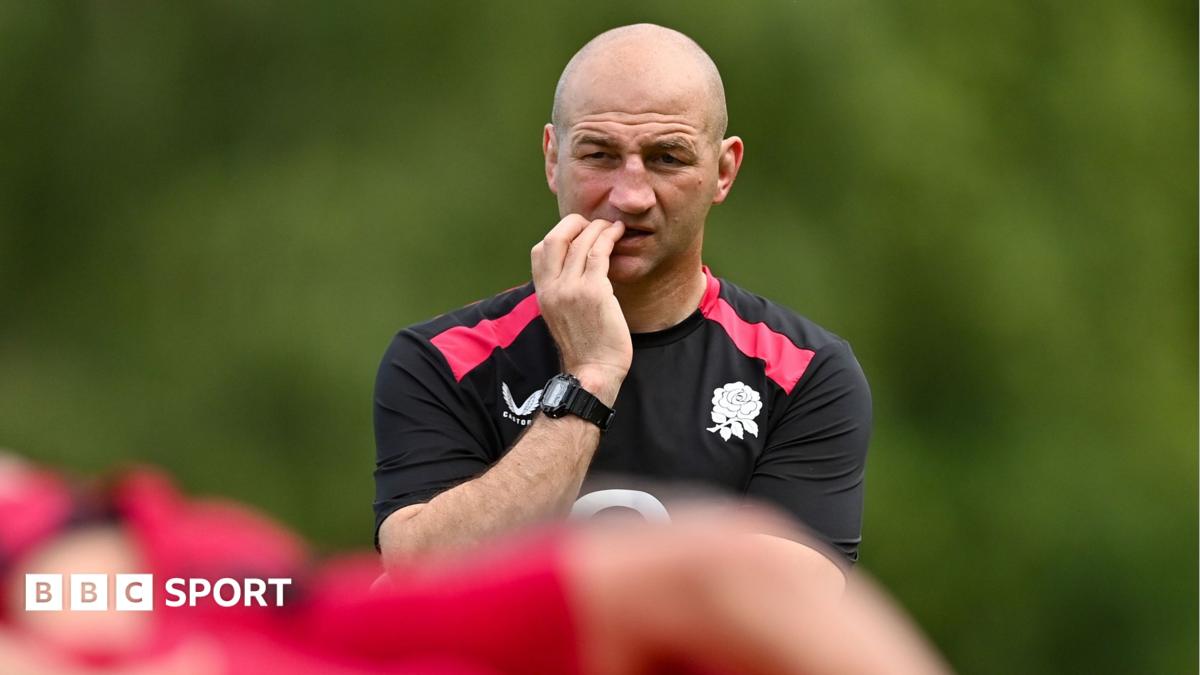
England’s preparations have also been affected by the Prem schedule, with players involved in Sunday’s fixtures having less time for full squad training.
“We had a session today really that was affected obviously by the fact that we had a Sunday game in Prem Rugby,” Borthwick explained.
“Fortunately, we don’t have any Sunday games this coming week in Prem Rugby, which I’m pleased about.
“So that should allow players to be recovered in a proper run into the Test match.”
Borthwick acknowledged the challenge of balancing club and international commitments, but said playing at the weekend could benefit England.
“They’ll go back and play the rugby and in so many ways that will be a positive for us for next weekend,” he said.
“The players are match fit at club level, playing regularly at club level, and as long as they don’t get injured, then they’re all available for selection next week, then that will be positive.
“I’d say on one side, I think it’s a real strength of English rugby that the players have such great loyalty and passion for their clubs as we saw very evidently in this last round with the derbies that went on.
“They are team-mates and best of mates the next day for a couple of days [with England] and then they go back to being rivals again until they come back into camp next week.”
Borthwick also identified the breakdown as an area where England need to adapt to the demands of international rugby.
He pointed to the recent European fixtures, in which English clubs collectively lost more of their own breakdown ball and won less opposition breakdown ball than teams from other competing nations.
“Part of my job is identify those bits of where I need to bridge from where the players are in Prem rugby to where they are in Test rugby,” he said.
“The level of competition [at the breakdown] is at a different level in Test rugby.”
In rural Modoc County, in California’s remote northeast corner, Republican gubernatorial candidate Steve Hilton donned a beige cowboy hat and climbed atop a horse.
Riding through a grassy field, with his dress shoes in the stirrups, Hilton lamented to a camera that California was “completely being ruined by killjoy bureaucrats” who put too many rules on fun stuff like beach fire pits and bars that stay open extra late.
In coastal San Luis Obispo County, Hilton boarded a bright yellow dune buggy at the Oceano Dunes State Vehicular Recreation Area and called the California Coastal Commission “idiots” for trying to end off-road beach driving.
And in the Central Valley, he waved the ceremonial green flag at a stock car race at the Madera Speedway, where he was named grand marshal of the annual Harvest Classic. (The designation caused a minor uproar, prompting the operator of the racetrack to make a fake online concession menu that offered a hot dog and soda for $6 for Republicans and $17.50 for Democrats.)
If it seems like Hilton — the British immigrant and former Fox News talk show host — is just about everywhere, taking just about every media interview that comes his way, well, that’s the point, he says.
He has logged thousands of miles on the proverbial campaign trail, visiting all 58 counties in his quest to lead the nation’s most populous state, where no Republican has been elected to statewide office in 20 years.
Meanwhile, his heavily favored — and far more staid — opponent, Democrat Xavier Becerra, has kept a comparatively low profile, agreeing to just one debate with Hilton and holding few public events, mostly in urban areas.
In a phone interview while driving through Los Angeles, Hilton said: “Whether I’m in Humboldt or Del Norte or Siskiyou County, my joke is, when people say, ‘Where do you live?’ I say I live in the Hampton Inn somewhere in California because we’re basically in a different place every night.”
The odds are against him.
Sure, California produced GOP presidents Richard Nixon and Ronald Reagan. But today, Democrats outnumber Republicans nearly 2 to 1 in the state, and the current White House occupant shares a mutual disdain with the vast majority of Golden State voters.
Hilton was endorsed during the primary by President Trump, who suggested at a campaign rally this month that Iran could “take out” Los Angeles and San Diego, drawing swift outrage from both Democrats and Republicans.
Hilton has tried to walk a fine line, appealing to the 6 million Californians who voted for the president in 2024 while simultaneously downplaying Trump’s support.
This summer, Hilton took out full-page ads in The Times and the San Francisco Chronicle asking: “Can you be anti-Trump and still vote for me?”
“Yes, I’m the Republican,” it said. “The ‘Fox News guy.’ Endorsed by Trump. But this election is not about who you hate in Washington. It’s about what you love here.”
Corrin Rankin, chairwoman of the California Republican Party, said that 16 years after the state’s last Republican governor, Arnold Schwarzenegger, left office, “it’s safe to say Democrats own all the problems in California.”
“You can’t blame Trump for what’s going on here in California,” she said. “We feel really good about Steve Hilton’s campaign. He is working so hard, up and down the state.”
Hilton has blasted California Democrats as entitled, saying they assume Becerra will cruise to victory in the race to replace termed-out Gov. Gavin Newsom simply because he has a “D” beside his name on the Nov. 3 ballot.
Hilton frequently quotes a September podcast interview by Los Angeles’ Democratic mayor, Karen Bass, who mocked his British accent and said: “The governor’s race right now is over. Our governor’s name is Xavier Becerra. You don’t need an election on Nov. 3. A Republican cannot win in this state.”
Hilton told The Times that Democrats “feel they don’t have to earn your vote. … They can deliver results that are bad as ever, and they don’t need to work hard to deliver results for people or earn their support. And I think it’s that attitude that is going to be their downfall.”
Steve Hilton has the support of 33% of likely California voters, according to a recent poll, while rival Xavier Becerra has 58%.
(Jason Armond / Los Angeles Times)
Becerra is a former member of Congress who represented Los Angeles, and he was the California attorney general and U.S. Health and Human Services secretary under President Biden. He has the backing of 58% of likely California voters, compared with 33% who support Hilton, according to a poll released late last month by the UC Berkeley Institute of Governmental Studies and co-sponsored by The Times.
The poll showed that voters’ top concern was reducing the state’s high cost of living — followed by fighting Trump administration policies.
“Hilton is trying to win an election, so he tries to frame himself as someone who can appeal to the broader electorate,” Underland said. “But at the end of the day, he has the albatross around his neck, which is Trump, who is openly hostile to California.”
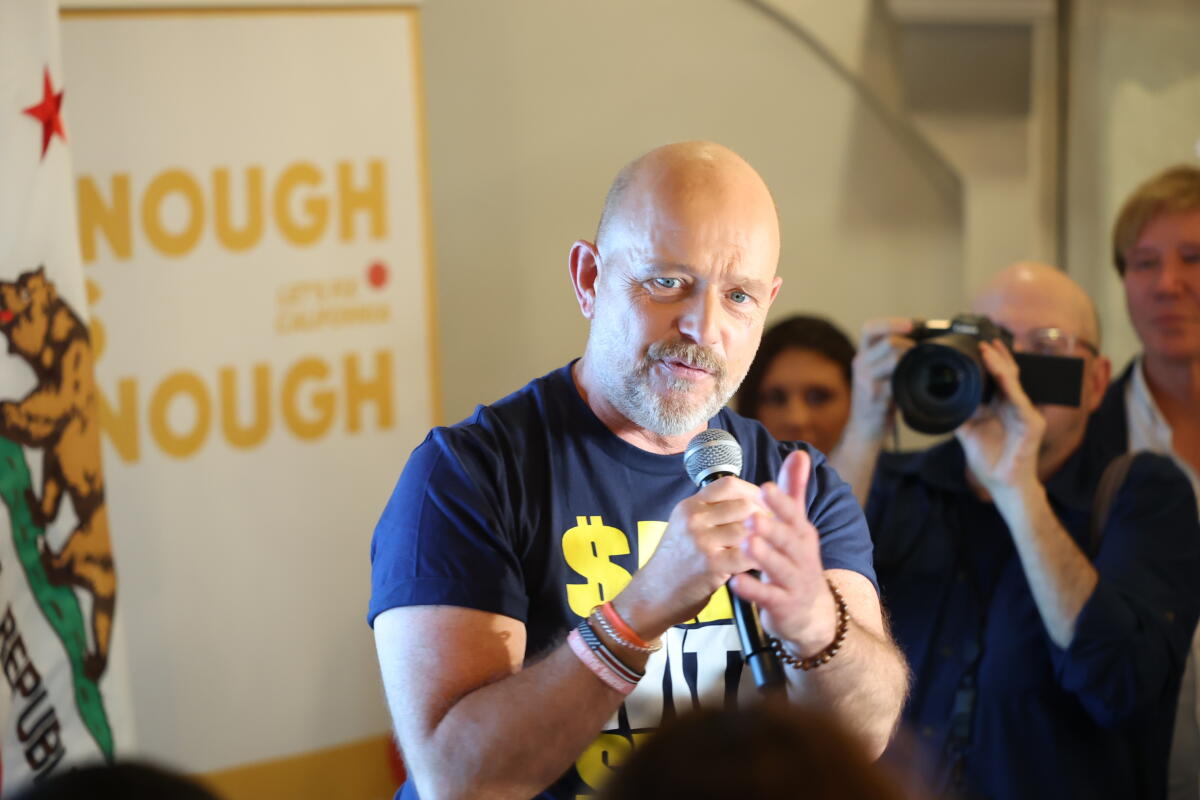
Hilton cuts a colorful and pugnacious figure on the campaign trail. He eschews ties and jackets, favoring T-shirts with punchy phrases like, “$ave With Steve” and “WAKE UP” superimposed on a California license plate — a reference to his proposal to eliminate the state’s Department of Motor Vehicles and slash vehicle registration fees, which would cut billions in state revenue.
He wears one bracelet with the name of slain right-wing activist Charlie Kirk, whom he called an “incredibly close friend.” Another reads, “Save Girls’ Sports,” calling back to this spring, when he traveled to the state high school track and field championship in Clovis to protest the participation of a transgender athlete.
Republican nominee Steve Hilton protests transgender athletes’ participation in girls’ sports during a May 29 news conference in Clovis, Calif.
(Tomas Ovalle / For The Times)
Hilton, 57, was born in London to parents who fled conflict in their native Hungary during the 1956 uprising against the Soviet-controlled communist government and later anglicized their surname, Hircsák, to Hilton.
He was a senior advisor to British Prime Minister David Cameron, a member of the Conservative Party, though the men’s once-close friendship never recovered from Brexit, Britain’s withdrawal from the European Union. Hilton supported it; Cameron did not.
Hilton earned a reputation as eccentric but savvy, pushing the Conservative Party to embrace same-sex marriage and more climate-friendly policies. Dubbed “the barefoot revolutionary” for his refusal to wear shoes, Hilton was satirized on the BBC political sitcom “The Thick of It” as Stewart Pearson, the Tories’ “eco-friendly, media-savvy, blue-sky-thinking” communications director.
He and his family moved to California in 2012 after his wife, Rachel Whetstone, was promoted to lead global communications at Google. For six years, he hosted “The Next Revolution,” a weekly Fox News show from which Trump regularly tweeted clips.
In 2015, the couple purchased their home in the Silicon Valley city of Atherton, one of the wealthiest ZIP Codes in the U.S., for $12.5 million, property records show.
Whetstone now leads communications for Sierra, an AI startup founded by OpenAI board Chairman Bret Taylor and Clay Bavor, who met while working at Google. Hilton and Whetstone’s 2024 tax returns show they had a combined household income of $7.5 million, which included his reported earnings of $250,000 from Fox News and her $6.7 million from her then-employer, Netflix.
Hilton became a U.S. citizen in 2021 and last year renounced his British citizenship.
He finished second in the June 2 primary behind Becerra. Under California’s top-two primary system, the first- and second-place finishers, regardless of party, advance to the general election.
The pack of Democratic candidates was so large that party leaders initially urged struggling candidates — including Becerra — to drop out to avoid splitting the vote. Becerra shot to the top of the polls when then-Rep. Eric Swalwell, a front-runner at the time, dropped out of the race after he was accused of sexual assault and misconduct.
Republicans coalesced around Hilton after the president endorsed him over his GOP rival, Riverside County Sheriff Chad Bianco, a staunch Trump supporter who later said the endorsement made Hilton unelectable.
Kim Nalder, director of the Project for an Informed Electorate at Sacramento State, said it is exceedingly difficult for Hilton to distance himself from Trump and the Fox News brand.
“If you had a different brand of Republican they might have a shot,” given the discontent in the state over myriad issues, she said. “But Trump is so politically radioactive in California right now that it is an effective technique to tie this particular candidate to him.”
California’s population growth is stagnant after years of pandemic-era losses, with immigration lagging amid the Trump administration’s crackdown and many residents leaving the state for more affordable parts of the country.
Greg Perrone, past president of the conservative Greater Bakersfield Republican Assembly, said he was impressed with Hilton’s policy knowledge and the amount of detail in his economic plans.
Steve Hilton, right, chats with Sir Richard Branson before a White House dinner with then-British Prime Minister Cameron and President Obama in 2012. Hilton was an advisor to Cameron.
(Susan Walsh / Associated Press)
“There’s a real concern that the current state of the economy is worse than people expected,” Perrone said. “A lot of people hung their hat on Donald Trump saying he was going to bring down prices, and that just has not happened. There’s a lot of angst.”
Perrone said he remains a Trump supporter, though he has been frustrated by the frenetic roll-out of tariffs that, he said, hurt many businesses. While he has been annoyed that Becerra, in his view, has focused more on the president than laying out his own detailed economic plans, he acknowledged that the strategy plays well in blue California.
Christopher Cole, former chairman of the Lassen County Republican Party, said that in his rural corner of the state, he has seen Trump banners that have hung since 2016 start to come down because people are angry about the Iran war, the high cost of fuel and the economy.
“When Trump stupidly endorsed Hilton, it was the kiss of death for any down-ticket Republican,” said Cole, whose county voted for Trump on 76% of the ballots in 2024, the highest percentage in the state, and was the only one to support Bianco in this year’s primary.
“Hilton is a carnival barker and a very wealthy man,” said Cole, who supported Bianco. “You can’t run a multimillionaire when people are struggling to put food on the table.”
Hilton has made a slew of campaign promises to lower the cost of living, including having no taxes on income below $150,000, lowering energy bills by slashing climate-friendly regulations imposed by Democrats, and having $3 gasoline (though governors cannot directly set the price at the pump, which is driven largely by global crude oil supply and demand).
He has tried to channel the state’s discontent into persuading voters to “try something different” by voting Republican.
During the gubernatorial race debate on CNN last month, Hilton quoted a former Biden domestic policy advisor who reportedly called Becerra a “bitch-ass,” and his campaign promptly launched a website, bitchassbecerra.com, outlining alleged failures of the politician known for his calm demeanor and decades of government experience.
“I think Hilton got dealt a bad card with Becerra making the runoff,” said Rob Stutzman, a Republican strategist who was Schwarzenegger’s spokesman. “It’s difficult to get anyone outraged about Becerra because he is perfectly boring. He worked for Joe Biden — maybe that upsets some people? — but you can’t associate him with any bizarre, woke policies like you could Kamala Harris or Gavin Newsom.”
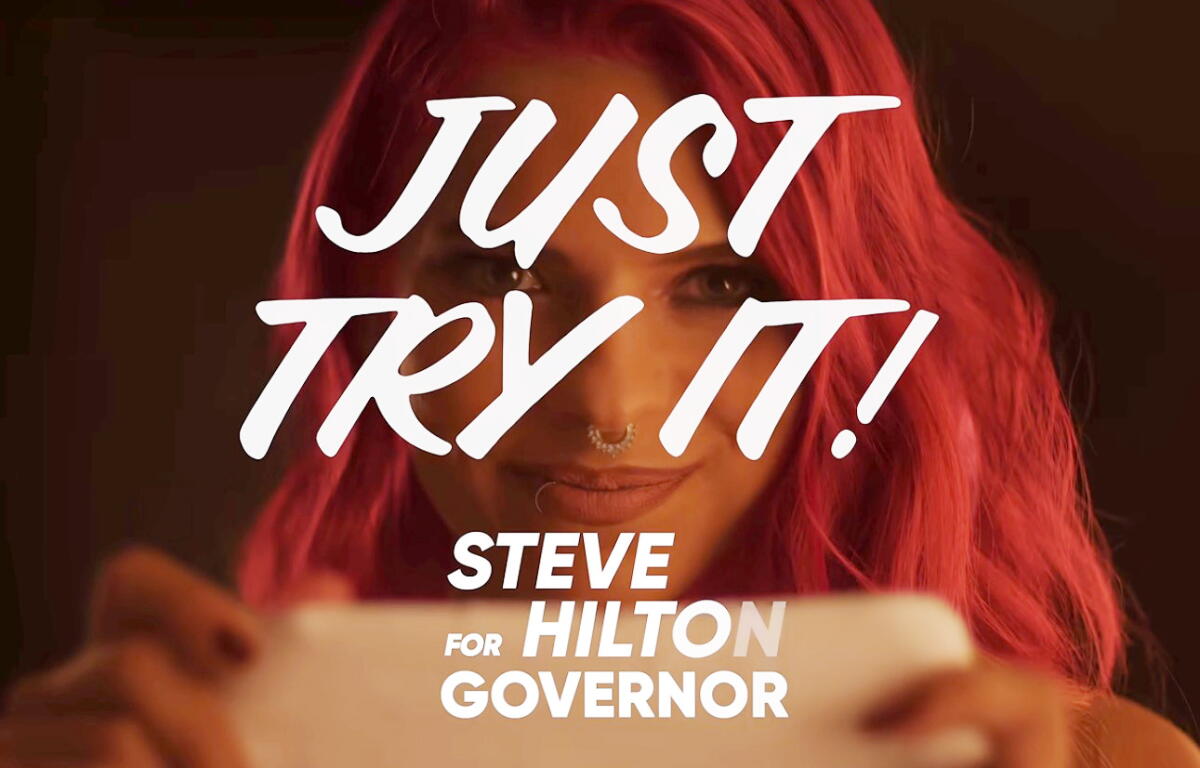
Hilton’s campaign this month released a provocative, sexually suggestive ad titled “Just Try It!” in which two young women sit on a bed in a candlelit room. An LGBTQ+ pride flag hangs on the wall, and they’re seemingly talking through one’s first romantic encounter with another female.
In a recent poll, voters rated California’s high cost of living as their top concern, followed by fighting Trump administration policies. Above, people gather in North Hollywood to watch the Sept. 30 gubernatorial debate.
(Jason Armond / Los Angeles Times)
Wearing a T-shirt that says, “RESIST,” the anti-MAGA mantra, the first-timer nervously says: “I’ve just never done anything like this before. Like, what if my dad finds out?”
The other woman holds her hand as she fills out a ballot for Hilton then says, “Now lick it,” referring to the mail ballot envelope.
Some conservatives condemned the ad, saying it promoted lesbianism. Liberals criticized it, too, saying it was insensitive to the LGBTQ+ community.
The day the ad launched, he told The Times: “I think there’s a very strong sense that things aren’t working in California, and my argument is: ‘OK, let’s try something different.’”
Later, he said he never meant to offend anyone with the risqué ad, which did, after all, do its job in racking up millions of views online — coveted and invaluable publicity for a long-shot California Republican.
Smith moves to 223 career catches, a record for fielders, as Australia bowl out South Africa for 284 in reply to 390.
Published On 12 Oct 202612 Oct 2026
Steve Smith has broken the Test record for the most career catches by a fielder as Australia have played themselves into a strong position on the third day of the first Test against hosts South Africa.
Smith held four catches on Sunday, taking his total to 223, as South Africa were bowled out for 284 in reply to Australia’s first innings of 390 at Kingsmead Stadium in Durban.
Nic Maddinson (17 not out) and Travis Head (10 not out) added 33 runs off just 5.4 overs to stretch Australia’s overall lead to 139 before bad light ended play for the third day in a row.
Maddinson, who laboured to a 33-ball duck in the first innings, hit two fours off Marco Jansen in the first over of the second innings and added a six off Wiaan Mulder before play was called off.
Australia’s bowlers applied relentless pressure on an easy-paced pitch and a succession of South African batsmen contributed to their own dismissals by playing poor shots.
Six Protea batters reached 30, but David Bedingham’s 49 was the top score.
Australian captain Pat Cummins took three for 54, and Mitchell Starc, Josh Hazlewood and Nathan Lyon claimed two wickets each as Australia’s long-serving bowling quartet combined with customary efficiency.
Smith special in the slips
Smith started the day on 219 catches, one behind Joe Root of England.
He equalled the record when he caught Temba Bavuma. Smith, playing in his 126th Test, broke the record when he lunged to his left from second slip to hold a sharp edge from Bedingham off Cummins.
Smith was in the action again with a spectacular catch to dismiss Verreynne, again anticipating well at slip as the South African wicketkeeper made good contact with a reverse sweep that Smith held in an outstretched right hand.
His fourth catch was from an edge to slip by last man Anrich Nortje off the bowling of Beau Webster.
Smith’s career haul of 223 catches exceeds the total of all but 11 specialist wicketkeepers.
Australia’s modern Test side remain a fascinating one to unpick.
Viewed by many in England as there for the taking in last winter’s Ashes despite a 4-1 win, they are also labelled too old by many observers at home.
The victims of recent shock defeats by West Indies and Bangladesh, they are still unbeaten in their past nine Test series.
But while their struggling batting line-up was bailed out by Matt Renshaw across the first two days of the first Test in Durban, they took control over South Africa on day three in an all-too familiar way.
Nine years after they first appeared together as Australia’s bowling quartet, Mitchell Starc, Josh Hazlewood, Pat Cummins and Nathan Lyon produced their latest relentless performance to dismiss South Africa for 284. There was even some magic from Steve Smith thrown in too.
Cummins took three wickets, Starc, Hazlewood and Lyon two apiece, in doing so brushing off any doubts about their effectiveness at the start of a run of Tests against the world Test champions, in-form New Zealand, India and England.
She was part of a generation whose parents were from the rancho of El Cargadero, Zacatecas, and started families in el Norte while waiting out the Mexican Revolution in the 1910s and the Cristero Revolt in the 1920s. Many returned to their home village when things calmed down.
After growing up in Mexico, my grandmother moved to California with my grandfather and their children in the 1960s. Only the American government considered her a native-born U.S. citizen, while society dismissed her as a Mexican. We grandchildren always considered our Mama Chela a doña — a grand Mexican dame who never wore pants and frequently covered her hair with a veil out of modesty. All she remembered from her early childhood in Arizona were snippets of the nursery rhymes “Did You Ever See a Lassie?” and “The Bear Went Over the Mountain.”
The El Cargadero diaspora, which mostly settled in Anaheim, saw our forebears’ American birth as a stroke of provenance allowing them to legally enter the U.S. and give their progeny a head start that other Mexicans could only dream of. It’s a story I’ve repeatedly told over my decades-long journalism career, and no one has yet challenged my description of my grandmother as an immigrant.
If they did, I’d think they had too much time on their hands, or maybe that they were a wackjob contrarian.
Cue Steve Hilton.
The Republican candidate for California governor is trying to make a scandal out of his Democratic opponent, Xavier Becerra, portraying himself as the son of Mexican immigrants. Twice last week during their CNN debate, Becerra said his parents came to California “with $12.” In previous interviews during his decades in the political spotlight, Becerra has shared that his father, Manuel, was born in Sacramento in 1928 and moved to Mexico as a child during the Great Depression, eventually returning to the land of his birth.
Hilton, who has been endorsed by President Trump, has as much a chance of becoming the Golden State’s next governor as Stephen Miller. But he and his supporters have latched on to Becerra’s statement like it was the borderlands version of stolen valor. Critics combed through Becerra’s family genealogy like Indiana Jones searching for the Holy Grail, then posted their findings online — Becerra’s dad grew up in Tijuana before coming back to California, then married in Guadalajara before returning in the 1950s to Sacramento, where Xavier was born — to claim that Becerra is one giant, pandering fraudster.
“Unlike Xavier Becerra, I am an immigrant,” the British-born son of Hungarian refugees harrumphed on social media. He followed up by declaring that Becerra is “LYING” about his family’s American experience “in order to score identity points.”
What more proof do California voters need that Hilton is laughably out of touch with how we live? Many Mexican Americans, including my cousins and me, consider family members raised in Mexico to be immigrants, even if they were born in the U.S. Growing up down south forever shapes your language, work ethic, appreciation for how hard life can be and so much more. When they return to the U.S., such people often find themselves ostracized as paisa — country — and must learn the mores of American life, just like those born abroad.
To argue that calling them immigrants is technically wrong is like getting angry at people who don’t pronounce Los Feliz the Spanish way. For Becerra’s critics to claim he’s stretching his immigrant roots to appeal to Latino voters is an insult to Latinos. We know a cultural faker when we see one, and the Becerra family story isn’t an anomaly; it’s our lives.
Gubernatorial candidate Steve Hilton addresses patrons at Victorio’s Ristorante in North Hollywood in September.
(Jason Armond / Los Angeles Times)
“It’s a weird gotcha,” said Cal State Fullerton Chicano studies professor Alexandro José Gradilla, whose wife’s grandmother was born in California and raised in Mexico, then bounced between the two countries for the rest of her life. “What’s the dis? Where’s the dunk? It’s so normative, especially of that generation. We cannot have the 2026 definition of immigration, the border and policy apply to a completely different landscape.”
Becerra’s critics subscribe to “this very American bias that an immigrant only moves once to the U.S., the land of opportunity, of hope — all that mythology,” Gradilla continued. During the Ellis Island era, he noted, European immigrants returned to their home countries with their U.S.-born children, and then those children faced many of the same hardships as first-time arrivals when they came back to the U.S. as adults.
“‘We don’t call those people expats or returnees — ‘immigrant’ is the only intelligible label we understand,” the profe concluded. “Until we come up with a better label, Becerra’s dad is an immigrant.”
There are many legitimate reasons to bash Becerra, from his refusal to participate in more debates to his paltry number of public rallies to a platform that sounds like more of what created California’s current woes. His family history isn’t it.
Hilton’s fixation on Becerra’s immigrant bona fides shows how desperate he is to gain some traction, any traction, with Latino voters. He at least has picked up on Latinos’ regard for immigrant success stories. But after bragging about being the candidate of legal immigrants, for Hilton to hold being born here against someone who went back and forth between the U.S. and Mexico is a weak salsa pendejada.
Hilton would have been better off with his conservative base if he had labeled Becerra the son of an anchor baby.
At a press conference with elected officials to oppose Proposition 39, which would mandate voter identification, my colleague Nicole Nixon asked Becerra about Hilton’s attacks on his dad. Becerra finally unlocked the inner cholo so many of us have been waiting to see, instead of the Chicano Ned Flanders he’s been projecting for decades.
“So this is what happens when people who don’t understand immigration start to pontificate,” he responded, summarizing his family story once again and pointing out the discrimination his father faced as someone of Mexican heritage, birthright citizenship be damned.
“Steve Hilton may not know that [Mexican American history] because he’s not from the U.S.,” Becerra said. “Steve Hilton may not know that because even though he’s an immigrant, he hasn’t taken the time to research.”
Wow, the brown Democratic candidate calling the white Republican candidate a dumb immigrant — California politics sure have changed!
But Becerra’s smackdown had a point. Conservatives deeply misunderstand what it is to be Mexican American. We’ve never fit into the American assimilation story and so have created our own narrative, one that people like Hilton refuse to accept at their own peril.
Hilton needs to take a Chicano studies class, where discussions about the fluidity of Mexican identity inevitably come up.
And, wouldn’t you know it, Gradilla planned to bring up that very subject with his students this week — he didn’t even know about Hilton’s attacks against Becerra until I told him.
“For Hilton, anyone of Mexican heritage in this country needs to be grateful, you need to be loyal, and you need to be here,” Gradilla said. “Who would ever want to leave the U.S.? Well, some people have to.”
Your prospect of winning is small. So small, you could peer through a microscope, blink and miss it. How, then do you draw voters to your candidacy and boost your chances?
Actually, let’s not pretend. A very real flesh-and-blood Republican, Steve Hilton, is running for California governor and if your idea for grabbing attention doesn’t involve a make-believe lesbian couple, double entendre and a soft-core porn vibe, you’re very clearly lacking in imagination.
Hilton ran an ad featuring just such elements, garnering coast-to-coast notice, millions of views and ensuring the tagline — “Now lick it” — while not as resonant as, say, “The only thing we have to fear is fear itself,” will forever live in political infamy.
What the spot tries to do, convince folks in this left-leaning redoubt to be venturesome and vote for Hilton, is not the least offensive, though your friendly political columnist, hardly a prude, found the execution a bit, well, icky.
You’re reading the L.A. Times Politics newsletter
Expert columnists cover the insights, legislation, players and politics you need to know.
By continuing, you agree to our Terms of Service, which include arbitration and a class action waiver. You agree that we and our third-party vendors may collect and use your information, including through cookies, pixels and similar technologies, for the purposes set forth in our Privacy Policy such as personalizing your experience and ads.
Being a cis white male of a certain age, however, means perhaps we shouldn’t be the one to judge. We’re certainly not the target audience. So we turned to two of the youngish, hippest people we know, Daughters No. 1 & 2, who are both well-accomplished 30-somethings and truly upstanding citizens.
What follows is their spontaneous reaction.
Daughter No. 1: “Stupid, infantilizing.”
Daughter No. 2: “Wtf is this fake woke AI ad? Ew.”
(For the record, Hilton said the ad was not AI generated. He apologized, sort of, to those who took offense.)
We also asked the Fabulous Mrs Z. — who has impeccable judgment, notwithstanding all the years she’s stayed married to your friendly political columnist — for her response. “It’s just so strange and stupid,” she said. “Why would he approve this ad? It makes me question his judgment.”
What do the pros say?
Of course, that’s just four people — one of whom doesn’t even live in California — so it’s not much of a sample.
For more insight, we turned to some political professionals.
And who better to weigh in than Fred Davis, the madcap genius behind another infamous California campaign spot, the so-called Demon Sheep ad he concocted for Carly Fiorina’s 2010 U.S. Senate campaign. The Felliniesque production included lightning bolts, a Roman column and a man covered in sheepskin crawling on all fours and leering with a glowing red eye — the point being that Fiorina’s rival, Tom Campbell, was supposedly a profligate wolf in fiscal-conservative sheep clothing.
Strange, yes, but definitely more memorable than an accountant in green eyeshade laboring over the books.
Anyway, Davis — who’s featured Paris Hilton, bad hair and a giant rat in a crown as part of his out-there oeuvre — loved the new Hilton campaign spot, calling it “super attention-getting, super interesting.” (Which is not the least surprising from a man whose chosen epitaph is, “If you don’t notice it, why bother?”)
“I think it’s a brilliantly done ad,” Davis said, “wonderfully written.” And, he added, “I can’t imagine it gaining him one vote.”
Which was sort of the point, no?
Kevin Spillane also appreciates Hilton’s effort, given his own Sisyphean struggles as a Republican strategist in California.
A screen grab from Steve Hilton’s “Just Try It” ad. Columnist Mark Z. Barabak found execution of the spot a bit, well, icky.
(Steve Hilton for Governor)
“They’re doing something out there and on the edge. I don’t fault them for that,” said Spillane, who supports Hilton and has contributed to his campaign. “It’s a clever concept of trying to get people to do something that they’re not used to doing.”
Which is to say vote for a Republican for statewide office in California.
But Spillane, too, questioned the execution. “I actually was fine with the ad until they got to the ‘lick it’ line,” he said, insisting he is also no prude. “That’s just a little too explicitly sexual.”
Running, not advancing
To his credit, Hilton has been running hard for governor. Much harder than his Democratic rival and the prohibitive front-runner, Xavier Becerra. Hilton has issued an abundance of policy proposals and spoken before pretty much any group or microphone-wielding reporter or podcaster who’ll have him.
None of which has garnered Hilton anywhere near the publicity captured by his racy “Just Try It, California” ad.
Hilton’s edgy attitude and pugnacious put-downs would place him right at home among the network’s collection of trolls, provocateurs and Democrat-bashing gargoyles.
But Hilton should leave the advertising to someone else.