stepped

We stepped back in time as the stunning Settle to Carlisle line marks 150th year

As the world famous Settle to Carlisle line celebrates 150 years of service, the Mirror joined the 1 m passengers expected this year.

150th anniversary of Settle to Carlisle line

It is widely lauded as one of the best train journeys in the world, and is just about to celebrate its 150th anniversary.

A huge public outcry and an appeal that raised £3m saved it from closure in the 1980s.

The Settle to Carlisle line survived and remains one of the most scenic in the country, crossing the Pennine Hills, the Yorkshire Dales and Cumbria’s Eden Valley.

It celebrates 150 years since its first rail passenger journey with a series of events including a steam train service.

The Mirror joined some of the 1 million passengers expected to travel on the route this year.

READ MORE: Jeremy Clarkson shows off birthday cake given to him by David BeckhamREAD MORE: Omeprazole patients with acid reflux told ‘red flag issue’ by NHS GP and BBC star

It was wet, wild and stormy as we ventured south from Carlisle to the Ribblehead Viaduct.

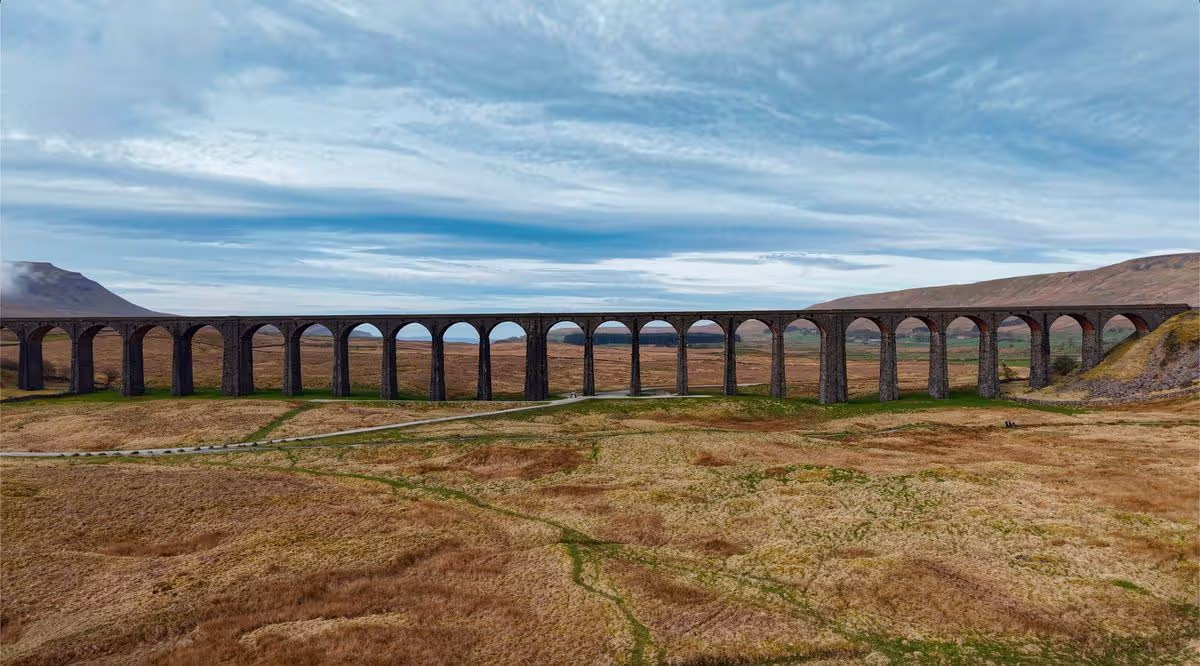
Its magnificent 400m arches are 400 meters (1,300 ft) long. A huge workforce of 6,000 men – 2,300 specifically on the Viaduct – built it between 1870 and 1875.

You can imagine the conditions they faced during winter on the wide open moorland surrounding the giant structure.

The navvies who died are buried in the cemetery at Chapel-le-Dale. Even in the pouring rain, the path passing under its 24 arches remains busy with hikers and cyclists.

You must take a short break during your train journey to see the viaduct in all its glory.

From your train seat, you have a breathtaking backdrop of rolling countryside.

Wind bent the trees on the distant hills. The stations are straight out of a 1930s black-and-white film.

“I say that is my office window,” said Yvonne Harland, 52, a Carlisle-based conductor on the route.

“It is absolutely stunning. Many passengers are hikers and dog lovers heading outdoors.

“It does not matter if you are in the valleys around Dent or the Ribblehead Viaduct.

“It is a tonic. You have to get off the train to see the viaduct; otherwise, you only catch a glimpse.

“The Three Peaks are just beautiful too. No disrespect to people who work in an office, but it takes some beating.

“I was in education for 20 years, and I fancied a change.”

Regular passenger Robin Gilder, 83, a retired ITV newsman, remembers the campaign to save the line in the 1980s.

Now he enjoys bringing along his grandson Finley Doran, 12, for days out. “I use it regularly now,” he said. “Especially since I retired.

“They had a dog sign the petition to save the railway and there is a statue to him at Garsdale station.

“There was huge public outcry when they announced they were closing this line.

“They raised millions of pounds to keep it open. So I think we should use it as much as we can.”

Finley, tucking into some sweets and pop, added: “I have been on about twenty times now. We use it all the time.”

For Scottish pharmacist Amy Robertson, it is her maiden journey. The 28-year-old is heading to Leeds to see a former friend with the misty hills rolling by her window.

“It does remind me of Scotland,” she said. “This is really lovely and you get some really nice views when you go up to the north of Scotland around Fort William.

“The weather may not be very good, but the countryside is beautiful.”

Northern recorded 995,000 passenger journeys on the line in 2025, the highest number since the Covid-19 pandemic.

But demand is expected to rise this year. Commercial and customer director Alex Hornby said he was confident passenger numbers would hit 1m.

“Customers can enjoy miles of breathtaking scenery, which changes throughout the year, and there are plenty of opportunities to get off and explore,” he said.

The Settle to Carlisle section of the line was completed in 1875; freight trains ran for a year before passenger trains were introduced on May 1, 1876.

The Settle Carlisle Railway Development Company will run a chartered steam train between Carlisle and York on May 23.

Karen Morley-Chesworth, their community rail officer, told the Mirror: “The Lonely Planet said it was in the Top 10 most scenic railway journeys in Europe.

“So it brings in many tourists and serves local people all year round. It runs down the backbone of Britain through Cumbria, Yorkshire and the Pennines.

“But it is the beauty of it that stays with you; every station takes you back in time, and the history of the line still fascinates people. It remains important to communities all along the route.”

Northern is set to offer £1.50 tickets to customers travelling on the route to mark the milestone.

Thousands of workers contributed to its complex construction, which includes 14 tunnels and more than 20 viaducts along its 72 miles (116km) of track.

In 1983, British Rail announced plans to close the line to passengers amid concerns about the cost of repairing the Ribblehead Viaduct. But £3m was spent between 1988 and 1991 to bring it back into use.

The Settle Carlisle Railway Development Company’s chairman, Pete Myers, said the company was working with communities along the line to mark the “special anniversary year.”

He said: “The Settle to Carlisle line is unique, connecting communities from Yorkshire through to Cumbria, and also providing a sustainable and beautiful way for visitors to explore the Yorkshire Dales, Westmorland Dales and Lake District.”

Source link

DHS advised immigrant children to self-deport until a judge stepped in

Last September, the Department of Homeland Security started advising unaccompanied immigrant children that they could either self-deport or expect to face long-term detention.

But a federal judge in Los Angeles on Mondayordered the government to stop using such “blatantly coercive” language, ruling that the new advisals, as they are known, violated a 40-year-old court order that bans immigration agents from pressuring unaccompanied children to give up asylum claims and leave the U.S.

According to court documents, the legal advisal was given to recently detained immigrant children. Unaccompanied children are those in the country without a parent or legal guardian.

The minors were told they had the option to return to their country, that doing so would result in no administrative consequences and that they still could apply for a visa in the future.

But the children also were told that if they chose to seek a hearing with an immigration judge or indicated that they were afraid to leave the U.S., they could expect to be held at a detention facility “for a prolonged period of time.”

Those who turned 18 while in custody would be turned over to Immigration and Customs Enforcement for deportation, they were told. The advisal, though generally passed on verbally, was written out in court documents by lawyers representing the immigrant children, which the government did not dispute.

“If your sponsor in the United States does not have legal immigration status, they will be subject to arrest and removal,” the advisals continued. “The sponsor may be subject to criminal prosecution for aiding your illegal entry.”

U.S. District Judge Michael W. Fitzgerald said that “such a threat disturbingly mirrors” the testimony of Jose Antonio Perez-Funez, a plaintiff in a 1980s class-action lawsuit challenging the tactics of immigration officers.

Perez-Funez, who was 16 when he was arrested near the Mexican border, testified in 1985 in Los Angeles federal court that he agreed to self-deport because federal officers said he would face lengthy detention if he didn’t return to El Salvador.

Perez-Funez’s case originally led the court to establish due process safeguards for immigrant children, giving them the right to speak with a relative or attorney before signing forms that waive their pursuit of legal protection.

“The Government was thus already on notice that such a statement delivered in this environment is precisely the kind of inappropriate persuasion the Injunction sought to prevent,” Fitzgerald wrote.

Fitzgerald, a judge in the Central District of California, also denied a request by the federal government to end the permanent court-mandated safeguards for immigrant children.

In response to a request for comment, U.S. Customs and Border Protection provided a statement, attributed to a spokesperson who wasn’t named, that the agency is following the law and protecting children. The agency said the advisal document explains to unaccompanied children their options available under federal law.

“Many unaccompanied minors are brought to the border by smugglers and face real risks of exploitation, which is why providing a clear, lawful advisal is essential,” the statement said. “It ensures they understand their rights and options — and for many who were trafficked or coerced, returning home to their family is the safest path.”

Unaccompanied children are first held by Homeland Security before being turned over to the Office of Refugee Resettlement, which is within the Department of Health and Human Services, for long-term housing. Federal law requires ORR to provide them with a legal consultation within 10 days.

“It is difficult to imagine a scenario more coercive than the one faced by [unaccompanied immigrant children] in the 72 hours before they are transferred into ORR custody, particularly for noncitizen children who likely do not know whether they possess any rights at all,” Fitzgerald wrote in his order.

In declarations to the court, children wrote that they felt threatened by the government’s advisals. One minor, identified as D.A.T.M., said the threats to prosecute their parents and of long-term detention caused them to sign voluntary departure papers.

Mark Rosenbaum, an attorney at the pro bono law firm Public Counsel, helped secure the 1986 court order. He said his legal team discovered Homeland Security had changed the advisals only after a government attorney notified him in November that the agency was going to seek to end the court-mandated safeguards.

“I consider this a war on children — the most vulnerable population,” he said.

The government has until Thursday to decide whether it will appeal the judge’s ruling. Regardless, Rosenbaum said, his goal is to establish more aggressive monitoring of unaccompanied children’s cases to ensure their rights aren’t violated again.

Source link

I stepped into ancient Egypt surrounded by £100million worth of artefacts

THERE aren’t many moments in your life where you are surrounded by heaps of gold and mummified cats – but in a new experience, Egypt has been brought to the UK.

Ancient Egypt is probably something we all learnt about in school focusing on the Pyramids and Tutankhamun.

The Ramses & the Pharaohs’ Gold exhibition in London is home to over 180 Ancient Egyptian artifactsCredit: Supplied
And it feels like stepping back in time to an ancient tombCredit: Supplied

Follow The Sun’s award-winning travel team on Instagram and Tiktok for top holiday tips and inspiration.

But The Ramses & the Pharaohs’ Gold exhibition at NEON at Battersea Power Station in London allows visitors to explore the life and death of the Pharaoh Ramses II (also known as Ramses the Great).

While you might not know who he is, he was the third pharaoh of the 19th Dynasty but is often thought to be one of the most powerful rulers of the Egyptian Empire.

Upon entering the experience, a short film presentation sprawled across giant screens revealing details of Ramses the Great and how he reigned for 67 years.

Read more on travel inspo

CHEAP BREAKS

UK’s best 100 cheap stays – our pick of the top hotels, holiday parks and pubs


TAKING OFF

I’ve visited 50 countries & this much-loathed budget airline is the world’s best

He built more monuments and statues than any other pharaoh including Abu Simbel, a 20-metre-tall statue of himself carved into a sandstone cliff.

He lived to about 90 years old, which was pretty impressive for someone of the Bronze Age.

But perhaps even more surprising is that he had over 200 wives and more than 100 children…

As the video ended, a set of doors swung open to reveal a statue at the entrance of the exhibition – I was about to step into ancient Egypt myself.

The room was dark with statues and objects subtly lit, allowing them to glimmer.

For the first half of the exhibition, I wove through stone statues, monoliths and intricate ornaments.

In fact, across the whole experience there are more than 180 Egyptian artifacts estimated to be worth over £100million and for many of them, it is their first time out of Egypt.

Though, one issue I found was that it is rather like seeing the Crown Jewels at points, where long lines of people steadily move past exhibits to get a glimpse of the artifacts.

At the mid-point, there is a clever 3D projection that recreates the Battle of Kadesh – where Ramses II used propaganda to achieve victory.

The second part of the experience turns to the Gold of the Pharaohs where it really does feel like you are entering the depths of a tomb, with the walls becoming sandy stone and the lighting lowering to feel like a dimly lit cave.

It includes the coffin of Ramses IICredit: Supplied

Throughout this part, I explored more artifacts from the era and since Ramses’ own tomb was looted, many of the gold items on display come from the Royal Tombs of Tanis.

My favourite part was definitely seeing the delicately mummified animals including several cats, a lion cub and even crocodiles.

Intricate jewellery glimmers and silver coffins stand tall, all before you reach the showstopper of the experience – Ramses II’s coffin.

Even though his gold was stolen, his wooden sarcophagus which protected his mummy for thousands of years, is considered to be one of the most significant artifacts in Egyptian history.

While Ramses II himself is not at the exhibition (to see his body you’ll have to head to the National Museum of Egyptian Civilization (NMEC) in Cairo) a large screen recreates what he would have looked like at different stages of his life and shows his body as it was discovered.

Fun fact – in 1976, Ramses II’s mummy was actually issued a modern Egyptian passport to travel to Paris, France, for fungal treatment and this meant his passport photo was of course, his deceased self with his occupation listed as ‘King (deceased)’.

There are even mummified animals including several cats, a lion cub and even crocodilesCredit: Supplied

Leaving the experience, you’ll enter a large shop where you can pick up souvenirs, such as your own Egyptian papyrus with your name written on it in hieroglyphs by a robot, for £10.

If you have worked up an appetite, there is also a cafe, as well as a VR Experience you’ll also find that at the end of the experience.

Popping on a headset, I flew through the temples of Abu Simbel and the tomb of Queen Nefertari.

In total, it lasts about 10 minutes and you sit on a golden-egg motion chain.

Though, it is definitely not one for those who easily get motion sick…

The exhibition is running until the end of August and tickets cost from around £24.55 per adult and £19.55 per child.

The VR experience costs an additional £14 per person.

The exhibition is recommended for children aged five and older, though I would say children under the age of 10 may get bored as there is a lot of reading involved in the exhibit and little interaction.

At the end you can pay extra to do a VR experience that allows you to travel through Ancient EgyptCredit: Supplied

Also, as someone who knows a bit about Ancient Egypt already, at times the historical descriptions are complicated as they have a lot of information to take in.

The VR experience is great for children though and recommended for those aged eight-years-old and above.

If going as just adults, I would definitely recommend the audio guide which is narrated by celebrity historian Dan Snow.

It costs £5 per person.

In other attraction news, London’s ‘best family attraction’ is about to get even better – with huge new outdoor play area and cafe next month.

Plus, one of the UK’s most popular free attractions reveals £350million expansion – its biggest in 200 years.

The exhibition and experience is running until the end of AugustCredit: Supplied


Source link

‘I went on UK city break and felt like I’d stepped into the world of Bridgerton’

Surrounded by countryside and quaint shops, spending the night in this historic crescent building felt like living out a life in a period drama manor

I stayed in the ultimate spa hotel with a rooftop pool and underground relaxation cave’

Pulling up to the hotel felt like I was stepping into the world of Bridgerton. It was impossible not to be immediately blown away by the sheer size of its Georgian masterpiece, which is the exact greeting I’d expect from a five-star hotel.

The Buxton Crescent Hotel sits at the very heart of the Derbyshire town. Really, it is the centrepiece of the place, and so it would be hard to imagine staying anywhere else when visiting for a weekend.

Buxton, as a spa town, rivals Bath and is famous for its natural and ancient spring waters that have been filtered through the Peak District’s limestone for 5,000 years. It’s these clean, drinkable, and consistently warm waters that provide mineral-rich and calming waters to the spa within the hotel.

These small but significant details are what make the Buxton Crescent hotel feel so swanky. To know I was staying within the walls of such a historic building certainly helped me live out my period drama dreams.

Room

After a very warm welcome and helpful valet service from the team, we were directed to our humble abode for the night, which was one of the Crescent Rooms with rear-facing views. The décor had a timeless feel to it that felt aged, but with class, generally the kind I’d expect for a hotel of this sort – but it was nothing mind-blowing.

Best Derbyshire holiday cottage deals

This article contains affiliate links, we will receive a commission on any sales we generate from it. Learn more
Sykes Cottages

From £32 per night

Sykes Cottages

See the deals

Derbyshire is known for its dramatic Peak District landscapes, historic market towns and stately country houses. Sykes Cottages has hundreds of places to stay, with prices from £32 per night.

It was clean, the bed was incredibly comfortable, and it had everything we needed for a simple night’s stay. Normally, the package we enjoyed – which included a night’s stay, spa access, dinner, and breakfast – would cost around £510 for this time of year.

A particularly noteworthy feature of the room was the shower, which, to be honest, was potentially the best I’ve ever had, with a huge overhead waterfall and amazing water pressure. I guess you’d expect nothing less from a town quite literally famous for its water and cleansing methods, and it certainly beats the half-hearted drip of a flimsy budget hotel bathroom.

Spa facilities

Buxton Crescent is part of the Champneys Spa empire, but it definitely didn’t feel like a chain. Instead, it offered an authentic spa experience, and one of luxury at that.

I was impressed by just how big the place was and kept stumbling upon different rooms, areas, underground, and on the roof – like the rest of the hotel, it is a bit of a maze.

There are a number of unique features that make this spa a standout in my eyes, the first blindingly obvious one – the epic rooftop pool. It’s rare to find an outdoor pool anywhere in Derbyshire, let alone one on the roof of an 18th-century building, and yet it certainly adds a wow factor to the place.

Even amid the thick fog and cold of June, its thermal waters and bubbling pools create a cool environment for a relaxing swim. It’s a shame the views aren’t much to write home about, considering Buxton is surrounded by beauty.

Adding to this sense of magic is the colour-illuminated relaxation pool in a dimly lit room. The thermal pool sits peacefully beneath an impressive stained-glass canopy that reflects onto the water and the original 1920s tiles lining the pool. I think it’s these standout elements combined that lend the hotel its five-star status.

I was lucky enough to experience one of the unique water-based treatments, which the hotel claims is not available anywhere else in the UK. Opting for the Signature Wave Balance on the Water Couch, I was going into this rather blindly.

The masseuse was friendly and made me feel incredibly comfortable as she used the waterbed’s rhythms to create movement beneath me and gently helped relax my muscles. Personally, I don’t think this treatment was for me, and I would have enjoyed a more intense massage over a relaxation one, not to mention the atmosphere outside of the room was a slight mood killer.

With it being a Saturday, a bit of busyness at the spa is expected. However, outside of the room, I could hear doors shutting, floorboards creaking, and people chatting, and it was hard to stay in my ‘waterbed cocoon’ with all that going on – there’s only so much tranquil music can drown out.

Restaurant

I am everyone’s least favourite type of person to dine with (vegetarian), so if a menu isn’t stacked with options, which they rarely are, I can be a bit of an awkward one. However, the veggie options at the hotel were drool-worthy and felt just as fancy as any other meat-based dish. Not to mention, the setting and service were arguably the most five-star aspects of this place.

As we entered the restaurant for our reservation, we immediately felt underdressed, as guests were quite literally suited and booted for their evening meal. The dimly lit restaurant, wine stands, and well-dressed waiters made the experience feel very fancy, adding to my sense of a regal stay.

I couldn’t help but find the way the space transformed in the morning quite humorous. While the furniture remains the same, the lights are up, people are helping themselves to food, and all of the same guests’ blazers are swapped for hoodies.

In my opinion, there’s only so fancy a breakfast can get in a hotel, when really, everyone just wants a full English. I was pleased to see both vegetarian and vegan options of this, but more importantly, alongside a menu of dishes, you could tuck into smoothies, fruits, yoghurts, pastries, the lot.

Whilst it did sort of feel like the shine had worn off by morning with coffee-stained menus and mugs, as far as hotel breakfasts go, I thought it was still up there with the best.

In the area

There’s no questioning how perfectly placed the Buxton Crescent Hotel is in respect of all that the town has to offer; it is in the centre of it all. So much so that I thought it felt as though the town was built around this very building.

Attached to the building is the Cavendish Arcade, which offers a range of independent shops perfect to mooch around. In fact, this building is actually where the town’s original hot baths were first housed.

Just a stone’s throw away from the hotel entrance is the high street, bursting with cafes, restaurants and shops, as well as other little roads leading you to more hidden independent spots. I’d certainly suggest a wander, as some of the best-looking foodie spots are slightly more tucked away from the Greggs and Café Nero of it all – shock.

For deeper exploration, Buxton acts as the ideal hub for hikers and cyclists keen to explore the Peak District National Park. Lud’s Church is one of the closest and most popular routes, full of dramatic views and a sense of mystery with its moss-covered gorges.

Meanwhile, a more challenging hike would take you to Dragon’s Back, a ridge walk near Buxton that showcases the jagged, rugged limestone cliffs of the peaks. Previously, I parked up in the village of Hollinsclough and walked from there, but there are other alternative starting points.

The Buxton Crescent Hotel is the ultimate romantic spa getaway in the Peak District, and that was evident by the number of couples surrounding us at dinner, in the spa, and on our hike. Clearly, we missed the memo all this time that Buxton is, in fact, the place to be for an idyllic romantic getaway.

Book it

Rooms at Champneys Buxton Crescent Hotel & Wellness Spa start from £185 including bed and breakfast. For general hotel bookings, please visit: buxtoncrescent.com and contact Email: info@buxtoncrescent.com Tel: +44 1298 808 999

Source link