stc

Yemen’s Saudi-backed government retakes southern areas from STC: What next? | Houthis News

The internationally recognised government of Yemen says its forces have taken full control of the south from the separatist Southern Transitional Council (STC), which was aligned with the Saudi-backed government until recently.

“As the president of the country and the high commander of the armed forces, I want to assure you of the recapture of Hadramout and al-Mahra,” Rashad al-Alimi, the head of the Presidential Leadership Council (PLC), said on Saturday.

Recommended Stories

list of 4 itemsend of list

Last month, Saudi Arabia intervened militarily in support of the PLC after the STC captured the two border provinces, which Riyadh said was a threat to its national security. The STC along with the PLC fought against the Houthis, who control northwest of Yemen, including the capital Sanaa.

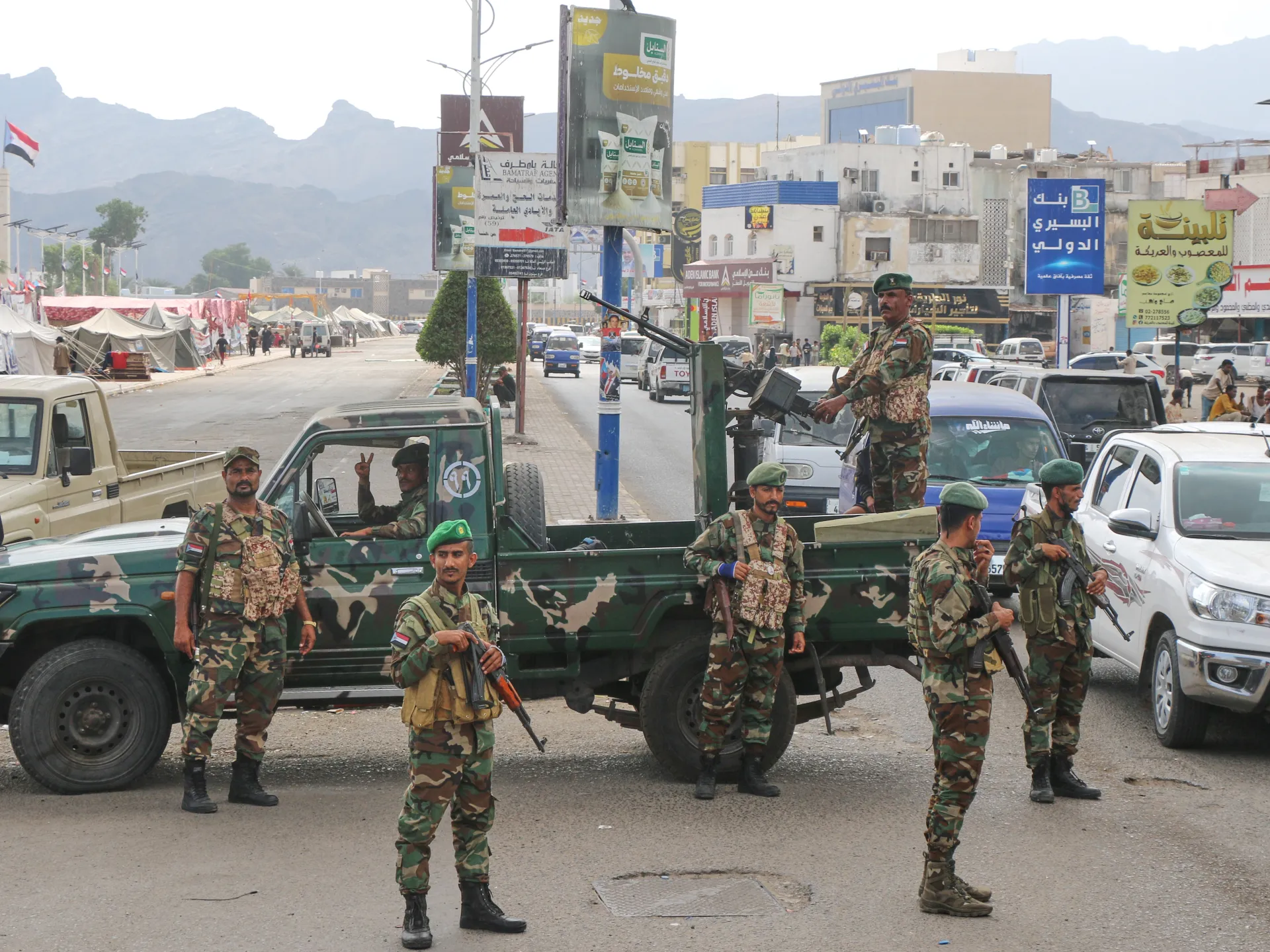
On Friday, the STC was dissolved, and its leader, Aidarous al-Zubaidi, fled the country after forces loyal to the PLC took control of most of the south and eastern Yemen.

The future of the STC, which is backed by the United Arab Emirates, remains uncertain amid internal divisions and the exile of its leader.

Saudi Arabia is now planning to host a conference of the main political factions from the south to shape the future of Yemen.

So what’s the latest political and security situation in Yemen, and what are the challenges in uniting Yemen?

What did the PLC chief al-Alimi say?

In his televised address on Saturday, al-Alimi called on all parties to unite ranks to restore state institutions.

He announced the formation of a Supreme Military Committee, which has been tasked with preparing military forces for the next phase of the conflict and readying them if the Houthis reject peaceful solutions.

The Yemeni leader warned armed groups to surrender their weapons and rejoin the ranks of the state, underlining “the importance of strengthening security, protecting social peace and working closely with the [governing] coalition and the international community to combat terrorism”.

He accused the Houthis of refusing to engage in dialogue and blamed the Iran-linked group for prolonging Yemen’s suffering because of their “coup against constitutional legitimacy”.

“South Yemen has for the first time in 10 years one political and military authority. No more military factions, no more divisions over ethnic and sectarian lines for the time being. There is going to be one Supreme Military Committee under the control of President Al-Alimi,” Al Jazeera’s Hashem Ahelbarra said, reporting from Riyadh, Saudi Arabia.

“Rashad al-Alimi has told the Houthis that they have two options: negotiate a settlement or face repercussions, including the potential for a military offensive,” he said.

Al-Alimi is a successor of Abd Rabbu Mansour Hadi, the leader of a United Nations-backed government who was evicted by the Houthis in 2014. The Houthis insist they are the legitimate authority across Yemen and do not recognise the PLC, which was formed in 2022.

“Now the PLC, backed by Saudi Arabia, is reforming institutions, disbanding STC institutions, and they are saying that their focus in the near future would be confrontation with the Houthis,” Ahelbarra said.

The president said the issue of self-determination in southern Yemen would remain a top priority, backing a southern dialogue conference under Saudi Arabia’s sponsorship.

What’s the status of the STC?

As the Saudi-backed military campaign against STC forces intensified in Hadramout and al-Mahra provinces, the southern separatist movement announced plans to hold a referendum on independence from the north on January 2.

But days later, the southern separatist force suffered major territorial losses at the hands of the PLC forces, who expanded their control over most of southern Yemen, where the STC had sway for more than a decade. The group’s now-exiled leader remains defiant, but some of its other leaders have switched loyalties.

On Friday, STC Secretary-General Abdulrahman Jalal al-Subaihi said in a broadcast on Yemeni television that the dissolution of the group was taken to preserve peace and security in the south and in neighbouring countries.

He praised “the measures taken by the Kingdom of Saudi Arabia and the solutions it has provided that meet the needs of the people of the South”.

However, STC spokesman Anwar al-Tamimi, who is in Abu Dhabi, rejected the announcement coming out of Saudi Arabia, calling it “ridiculous news”.

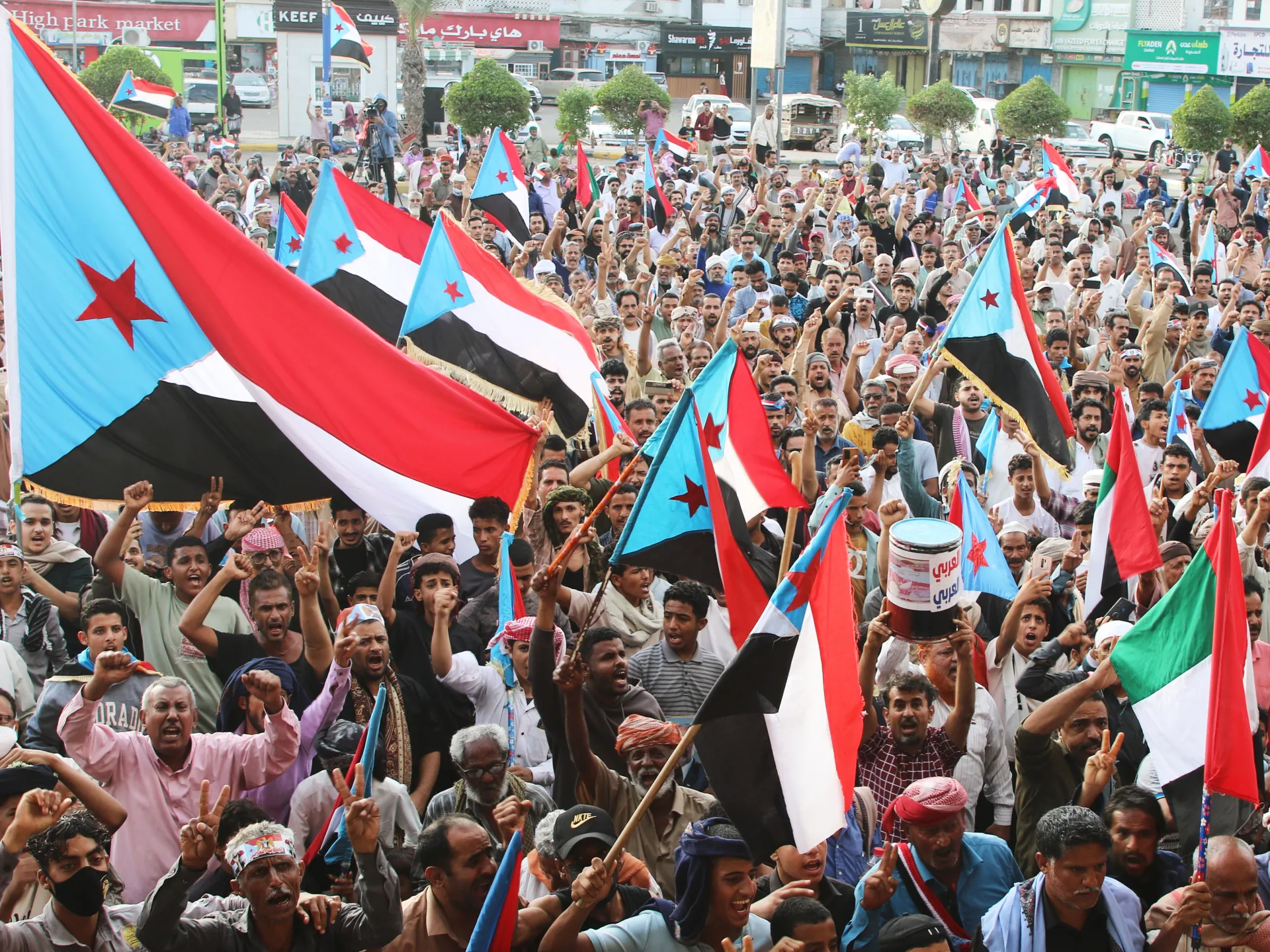
On Saturday, thousands of STC supporters poured onto the streets of Aden, the capital of anti-Houthi forces in southern Yemen.

“The STC members who joined Riyadh say they are waiting to see what happens next when it comes to details of the Riyadh conference,” Ahelbarra said, referring to talks between the PLC and STC in the Saudi capital.

“I think the consensus is that everybody is willing to talk about federal system, some sort of autonomy. But the very notion of separatism is over.

“Will people in the south willing to accept the notion of autonomy or federalism, that remains to be seen,” he said.

The disenfranchisement of southern Yemen after the region was merged with the north to form a united Yemen in 1990 has also been one of the grievances.

“Al-Alimi said these are genuine concerns which are going to be taken into account at the conference. Whether he will be able to address some of those concerns remains to be seen,” the Al Jazeera correspondent said. The date of the conference is yet to be announced.

Since its formation in 2017, the STC’s goal has been separation from the rest of Yemen. Two years later, it took control of Aden and other areas in the south from the Yemeni government.

Al-Zubaidi later joined the PLC as vice president, but he continued to nurse the ambition for a “two-state solution” as STC fighters continued to expand their control in the south, weakening the fight against the Houthis.

The current conflict was triggered after the STC forces captured Hadramout and al-Mahra, drawing the Saudi intervention.

Al-Zubaidi has since been removed from his post as a PLC member, stripped of his immunity, and charged with “high treason” and “inciting internal strife”.

The Saudi military said in a statement on Thursday that al-Zubaidi fled by boat to Somalia and then flew to Abu Dhabi.

What happened in recent weeks?

In November, a Saudi-backed umbrella group of tribes from the Hadramout region seized the PetroMasila oil facility, seeking a bigger share of oil revenues and an improvement of services for Hadramout residents.

The STC used the seizure as a pretext for advancing in Hadramout and al-Mahra. These two regions hold nearly all of Yemen’s oil reserves.

Tensions soared after Saudi-backed forces attacked the Yemeni port city of Mukalla in the south, alleging incoming shipments of arms from the UAE for the STC.

The UAE said it had been surprised by the Saudi air strikes and the shipments in question did not contain weapons and were destined for Emirati forces, not the STC.

Less than two weeks later, Yemen’s Saudi-backed government had taken control of the south and east of the country from STC forces.

Hesham Alghannam, a Saudi scholar with the Malcolm H Kerr Carnegie Middle East Center, said the kingdom’s move “made it very clear” that it views Yemen’s eastern provinces, especially Hadramout, as a “core national security matter”.

Riyadh views the region as critical, Alghannam said, because of its geography and strategic oil and port assets. “From Riyadh’s view, losing influence there would be more than a local setback,” he told Al Jazeera. “It would create a major security gap. It would weaken energy resilience and open space for hostile or competing powers to position themselves directly south of the kingdom.”

The Saudi-backed governing coalition then asked the UAE to withdraw its forces from Yemen within 24 hours.

The UAE withdrew all its “counterterrorism” units from Yemen. The UAE’s Ministry of Defence said it carried out a “comprehensive assessment” of its role in Yemen and decided to end its mission there.

The episode has strained ties between Saudi Arabia and the UAE.

Yemen
The Giants Forces, which were part of the STC, have switched sides throwing their weight behind the PLC [Fawaz Salman/Reuters]

What next?

The STC will find it hard to bounce back without military support from the UAE while many of its leaders have shown a willingness to participate in the Saudi-led dialogue.

However, it is believed to still hold influence in the region.

Abdulaziz Alghashian, an adjunct professor at Naif Arab University, said the dissolution of the STC was inevitable.

“I think the legacy of the STC has now become just too poisonous. I think the recent developments have just illustrated the fact that there is probably no goodwill for the STC to be part of a genuine political process,” Alghashian told Al Jazeera.

“The dissolution of the STC suggests clearly there is a clear restructuring of the political process within Yemen. And the political framework that Saudi Arabia is trying to work with is also being redeveloped and restructured in a manner that creates a lot of confidence for Saudi to get involved in,” he said.

But some experts said the Saudi goal of a united Yemen would be difficult to achieve due to southern divisions and the Houthis’ control of northwest Yemen.

Yousef Mawry, a journalist based in Sanaa, said Yemen’s conflict will shift from the south to the north and a showdown is expected between PLC forces and the Houthis.

He added that both sides believe in a unified Yemeni state but each side believes they are the ones who should be ruling over the affairs of both the north and the south.

“The big question: Is there a common ground that al-Alimi’s government and the Houthis can agree on?” he said.

“The Houthis believe that al-Alimi’s government is nothing but a Saudi proxy that is working on behalf of the US and Saudi interests over Yemeni land. Al-Alimi has pointed fingers at the Houthis, accusing them of being an Iranian proxy,” he told Al Jazeera.

The Saudi-led military coalition, which included the UAE, intervened in support of Hadi’s UN-recognised government in 2015 but failed to defeat the Houthis. The war ended in a deadlock with the Houthis still in control of Sanaa and the regions around it.

Saudi Arabia and the Houthis agreed to release prisoners and pledged not to attack each other’s territory. But the larger political questions remain to be resolved.

“What we are seeing is that al-Alimi is taking over full control of the south. Once they have full control, whatever political framework that works in, the Houthis are not going to accept it,” Mawry said.

There is mistrust between the two sides with the Houthis accusing the PLC of catering to the interests of foreign powers while the PLC accuses the Houthis of running Iranian propaganda. Saudi Arabia has historically maintained influence in its southern neighbour – Arab region’s poorest country. Houthis challenged Riyadh’s traditional role in the country.

Mawry fears the conflict will likely grow as both sides have drawn red lines. “They want full control of Yemen,” he said.

Source link

Thousands of supporters of Yemen’s separatist STC rally in Aden | Conflict News

Southern Transitional Council faces uncertain future amid internal divisions over plans to disband with its leader in exile.

Thousands of Yemenis have taken to the streets in Aden to show support for the Southern Transitional Council (STC) amid conflicting reports about the separatist group’s purported plans to disband following deadly confrontations with Saudi Arabia-backed forces.

STC supporters chanted slogans against Saudi Arabia and Yemen’s internationally backed government in demonstrations on Saturday in Aden’s Khor Maksar district, one of the group’s strongholds.

Recommended Stories

list of 3 itemsend of list

The crowd waved the flag of the former South Yemen, which was an independent state between 1967 and 1990.

“Today, the people of the south gathered from all provinces in the capital, Aden, to reiterate what they have been saying consistently for years and throughout the last month: we want an independent state,” protester Yacoub al-Safyani told the AFP news agency.

The public show of solidarity came after a successful Saudi-backed offensive to drive the STC out of parts of southern and eastern Yemen that it had seized towards the end of last year.

The confrontations exposed heightened tensions between Saudi Arabia and the United Arab Emirates, a top ally that the Saudi authorities have accused of backing the STC.

The group had taken over the provinces of Hadramout, on the border with Saudi Arabia, and al-Mahra, a land mass representing about half the country.

After weeks of Saudi-led efforts to de-escalate, Yemeni government forces, backed by the Gulf country, launched an attack on the STC, forcing the separatists out of Hadramout, the presidential palace in Aden and military camps in al-Mahra.

On Friday, an STC delegation that travelled to Riyadh for talks had announced the dissolution of the group in an apparent admission of defeat.

Secretary-General Abdulrahman Jalal al-Sebaihi said the group would shut down all of its bodies and offices inside and outside of Yemen, citing internal disagreements and mounting regional pressure.

However, Anwar al-Tamimi, an STC spokesman, contested the decision, writing on X that only the full council could take such steps under its president – highlighting internal divisions within the separatist movement.

During Saturday’s protest in Aden, STC supporters held up posters of the group’s leader Aidarous al-Zubaidi, who was smuggled from Aden to the UAE this week after failing to turn up to the talks in the Saudi capital.

Saudi-backed forces have accused the UAE of helping him escape on a flight that was tracked to a military airport in Abu Dhabi.

Authorities in Aden that are aligned with Yemen’s Saudi-backed government on Friday had ordered a ban on demonstrations in the southern city, citing security concerns, according to an official directive seen by Reuters.

Source link

Yemeni STC leader says group dissolved; others dispute announcement

Some officials for Yemen’s separatist Southern Transitional Council on Friday said the council has been dissolved, but others deny the claim and say the STC is still active in southern Yemen. Photo by Najeeb Mohamed/EPA

Jan. 9 (UPI) — Some leaders of the Southern Transitional Council in Yemen announced the dissolution of the group that controlled southern Yemen territory, but others in the separatist group say it is still active amid peace talks Friday.

STC Secretary-General Abdulrahman Jalal al-Sebaihi announced the STC’s pending dissolution on Yemeni TV while attending peace talks in Riyadh, Saudi Arabia. His counterparts in Yemen said his declaration was made under duress and was not true.

“The decisions relating to the Southern Transitional Council cannot be taken except by the Council in its entirety, with all its institutions, and under the chairmanship of the president,” STC spokesman Anwar al-Tamimi said in a social media post.

“This will happen as soon as the STC delegation present in Riyadh is released,” he said.

“The STC will continue positive and constructive engagement with all political initiatives, which give the southern people the opportunity to determine their future.”

A coalition backed by Saudi Arabia has taken control of the territory in southern Yemen that formerly was held by the STC, which is supported by the United Arab Emirates.

The conflicting statements regarding the STC were made after STC leader Aidarous al-Zubaidi secretly left Yemen on Tuesday night with the help of the UAE instead of traveling to Riyadh to negotiate matters in Yemen.

Instead, he was taken to Abu Dhabi on Wednesday, which raised tensions between Saudi and UAE officials.

In addition to leading the STC, al-Zubaidi was a member of Yemen’s Presidential Leadership Council, which expelled him on Wednesday when he did not show up in Riyadh to discuss matters in Yemen.

The UAE and Saudi Arabia recently worked together to oppose Iran-backed Houthis in Yemen, and the STC wants to have an independent state recognized in South Yemen.

The STC’s dissolution could imperil efforts to re-establish a former north-south divide in Yemen, which existed prior to the nation’s unification in 1990.

Saudi Arabia supports the PLC, which is the internationally recognized government in Yemen, while the UAE backs the STC.

Source link

Yemen’s main southern separatists to disband, senior STC official says | News

DEVELOPING STORY,

The STC, which Saudi Arabia says is backed by the UAE, launched an offensive against Yemeni gov’t troops in December.

Yemen’s main southern separatists ‍have decided to disband following talks in Saudi Arabia, the secretary-general of the organisation has announced.

The Southern Transitional Council (STC) Secretary-General Abdulrahman Al-Subaihi said in a broadcast on Yemeni television on Friday that the dissolution of the group was taken to preserve peace and security in the south and in neighbouring countries.

He praised “the measures taken by the Kingdom of Saudi Arabia and the solutions it has provided that meet the needs of the people of the South”.

However, there was no immediate ‍comment from those members of the separatist group who are not taking part in the ‍talks in Riyadh.

The STC had said it had lost contact with all members ‍of the delegation in Riyadh, indicating a split was emerging within the group.

A feud between Saudi Arabia and the UAE that came to light after the STC, which Riyadh says is backed by Abu Dhabi, launched an offensive against Saudi-backed Yemeni government troops in December.

On Thursday, the Saudi Arabia-led coalition in Yemen said the STC leader Aidarous ‌al-Zubaidi had fled to the UAE via Somaliland after skipping the talks in Riyadh, accusing the UAE of smuggling him out of the country.

More to come…

Source link

After STC hubris, dream of South Yemen looks further away | Conflict News

Landing at Aden International Airport on a trip in late 2017, the plane had two flags visible as it moved along the tarmac. One was the flag of the former South Yemen, resurrected as a symbol of Yemen’s secessionist southern movement. The other was of the United Arab Emirates (UAE), the movement’s primary backer.

Passing one checkpoint after another on the road out of Aden, the flag of the actual Republic of Yemen wasn’t visible, and only made an appearance towards the city of Taiz, to the north.

Recommended Stories

list of 3 itemsend of list

The UAE-backed secessionist Southern Transitional Council (STC) had been formed a few months earlier, in May 2017. Headed by Aidarous al-Zubaidi, it made clear that its ultimate goal was separation from the rest of Yemen, even if it found itself on the same side as the Yemeni government in the fight against the Houthi rebels occupying the Yemeni capital Sanaa.

By 2019, the STC and the Yemeni government fought in Aden and other areas of the south. The STC emerged on top, forcing the government out of Aden – the former capital of South Yemen and the city the government had designated as a temporary capital during the conflict against the Houthis.

Momentum continued to be on the STC’s side for the next few years, as it seized more territory. Even after al-Zubaidi joined the Saudi-backed Presidential Leadership Council (PLC) as a vice-president, officially making him a member of the Yemeni government, it was clear that on the ground, the STC had de facto control over much of the former South Yemen.

Al-Zubaidi must have felt close to achieving his goals when he found himself at the United Nations General Assembly in September. Speaking to the international media, he said that the “best solution for Yemen” was a “two-state solution”.

But then he went too far. His move last month to push STC forces into the eastern governorates of Hadhramout and al-Mahra, effectively securing control over all of the former South Yemen, was a red line for Saudi Arabia.

The STC leader is on the run, forces now loyal to the Yemeni government are in control of the majority of southern Yemen, and many of his allies have changed sides.

The UAE, meanwhile, appears to have accepted that Saudi Arabia is the primary foreign actor in Yemen, and has taken a step back – for now.

What now for South Yemen?

In a matter of weeks, secession has gone from a de facto reality to seemingly further away than it has been since the early days of Yemen’s war in the mid-2010s.

It was only last Friday that al-Zubaidi announced a two-year transitional period before a referendum on the independence of southern Yemen and the declaration of the state of “South Arabia”.

A week later, the STC looked divided – with Abdul Rahman al-Mahrami, a PLC member also known as Abu Zaraa, now in Riyadh, appearing to position himself in the Saudi camp.

The Yemeni government, with Saudi support, is attempting to reorganise the anti-Houthi military forces, with the aim of moving them away from being a divided band of groups under different commands to a force unified under the umbrella of the government.

Nods to the “southern issue” – the disenfranchisement of southern Yemen since the country’s brief 1994 north-south civil war – continues, with plans for a conference on the issue in Riyadh.

But the ultimate goal of hardline southerners – secession – is off the table under current circumstances, with consensus instead forming around the idea of a federal republic allowing for strong regional representation.

The Yemeni government also sees an opportunity to now use the momentum gained in the recent successes against the STC to advance against the Houthis, who control Yemen’s populous northwest – even if that remains an ambitious goal.

Of course, this is Yemen, and the winds can always change once again.

Support for the secession of southern Yemen remains strong in governorates like Al-Dhale, where al-Zubaidi is from. Hardcore STC supporters, those who have not been coopted, will be unlikely to simply give up, sowing the seeds for a potential insurgency.

And President Rashad al-Alimi will have to show that his power does not simply rest on Saudi Arabia’s military strength. One of the major tests of his legitimacy is whether he will be able to return with his government to Aden, and finally be based in Yemen for the first time in years.

That will be the ultimate challenge for the Yemeni government. Is it truly capable of being in control once again? Or are current events just a temporary setback for the STC and the cause of southern secession, waiting for the opportunity to rise up again?

Source link

Yemen’s separatist STC accuses Saudi Arabia of bombing forces along border | News

Saudi-backed Hadramout governor says move under way to ‘peacefully’ take over military sites from STC.

Fighting broke out on Friday in Yemen’s Hadramout province that borders Saudi Arabia, between forces loyal to the region’s Saudi-backed governor and the separatist Southern Transitional Council (STC).

The STC accused Saudi Arabia of bombing its forces near the border on Friday.

Recommended Stories

list of 3 itemsend of list

Seven people were killed and than 20 people were also wounded as seven air strikes hit a camp in Al-Khasah, said Mohammed Abdulmalik, head of the STC in Wadi Hadramaut and Hadramaut Desert.

But Hadramout’s governor Salem al-Khanbashi said on Friday that the efforts to take back bases from the STC were meant to “peacefully and systematically” reclaim military sites in Yemen’s southern province.

“The operation is not a declaration of war or an escalation, but rather a precautionary measure to protect security and prevent chaos,” he said in a statement.

Al Jazeera’s Mohammed Al Attab, reporting from Sanaa, said fighting was reported to be taking place on Friday in positions where STC forces are located along the Saudi border.

But, he added, “we are still waiting for confirmation about what is going on there,” saying that the latest information available from the area suggested the STC had maintained control of its positions.

The outbreak in fighting comes after Yemen’s Saudi-backed government said it ‍had appointed al-Khanbashi to take overall command of the National Shield forces in the eastern province, granting him full military, security and administrative authority in what it said was a move to restore security and order.

Saudi Arabia and the internationally recognised Yemeni government that it backs have accused the United Arab Emirates of arming the STC and pushing it to seize parts of the Hadramout and al-Mahra provinces in southern Yemen last month. Riyadh has warned that it views the STC’s growing presence in these provinces — which border Saudi Arabia — as a threat to its national security. The UAE has rejected these allegations and said that it is committed to Saudi Arabia’s security.

Last week, the UAE said it was pulling its remaining forces out of Yemen after Saudi Arabia backed a call for its forces to leave within 24 hours.

Saudi Arabia, the UAE and the STC are all part of a military coalition that Riyadh pulled together a decade ago to confront the Houthis. But the STC’s increasingly aggressive secessionist acts, and allegations that the UAE is assisting the group, have fostered tensions within the coalition.

The head of the Saudi-backed Presidential Leadership Council, Rashad al-Alimi, warned against any attempt to oppose the government’s decisions to prevent the country from sliding into a new cycle of violence.

“The decision to end the Emirati military presence came within the framework of correcting the course of the [coalition] and in coordination with its joint leadership, and in a way that ensures the cessation of any support for elements outside the state,” al-Alimi said in a statement.

Tensions escalate

The STC has insisted its fighters will remain in place in the southern provinces that Saudi Arabia and the official Yemeni government want them to withdraw from.

On Friday, Saudi Arabia’s ambassador to Yemen blamed STC leader Aidarus al-Zubaidi for refusing to grant landing permission the previous day for a plane carrying a Saudi delegation to Aden.

“For several weeks and until yesterday, ‌the Kingdom sought to make all efforts with the Southern Transitional ⁠Council to end the escalation … but it faced continuous rejection and stubbornness from Aidarus Al-Zubaidi,” the Saudi ambassador, Mohammed Al-Jaber, said on X.

A halt in flights at Aden International Airport ‌on Thursday continued into Friday as both sides traded blame for the air traffic shutdown.

In a statement on Thursday, the STC-controlled Transport Ministry accused Saudi Arabia of imposing an air blockade, saying Riyadh required ‍all flights to go via Saudi Arabia for extra checks. A Saudi Arabian source, however, denied the allegation, saying Yemen’s internationally recognised government, led by the Presidential Leadership Council, was behind the requirement for UAE-bound flights to land for inspection in Jeddah.

Yemeni presidential adviser Thabet al-Ahmadi confirmed to Al Jazeera that it had imposed a requirement that applied to one flight route departing from Aden airport. He said the move was meant to prevent STC money smuggling.

Source link