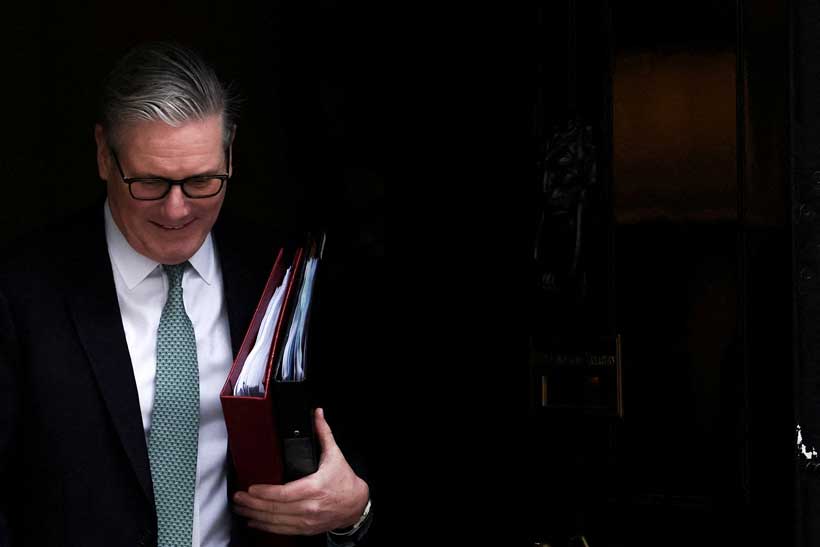
Following a beating in local elections, Prime Minister Keir Starmer (L) said Friday that he took responsbility for the losses suffered by Labour candidates across the country but vowed he would not quit. Photo by Neil Hall/EPA
May 8 (UPI) — Prime Minister Keir Starmer vowed Friday that he would not stand aside following a disastrous Labour performance in “mid-term” local elections in England, Wales and Scotland.
With early results from 46 of the 136 races in England showing Labour losing hundreds of seats in councils to Reform and the Greens, Starmer said while the situation was “really tough,” he had been handed a mandate to change Britain by the electorate in the general election in 2024 and that he intended to fulfil his promise.
He said he believed the message voters had sent in Thursday’s elections was about the “pace of change, how they want their lives improved.”
“Labour was elected to meet those challenges and I’m not going to walk away from those challenges and plunge the country into chaos. I led our party to that victory, that is a five-year mandate to change the country. It was a five-year term I was elected to do, I intend to see that through.”
Acknowledging his government hadn’t done enough to convince people that things could improve, their lives could be better and that there was hope, he said Labour would “in the coming days” set out steps it would take to win over the electorate.
Repeatedly pressed on whether he would lead Labour into the next election, Starmer would only say that he intended to serve the full five years of his term.
Large numbers of Labour MPs believe that the party will lose if Starmer leads it into the next election but do not want him to quit right now, favoring an orderly, consensual process of finding a successor, as opposed to an all-out leadership battle.
Sky News’ chief political correspondent said a member of Starmer’s “top team,” had messaged her saying that he was “the reason Labour risks handing the country to Reform.”
With counting still underway, or yet to begin, in the vast majority of contests for council and mayoral contests, as well parliamentary races in Scotland and Wales, the opposition Conservative Party were also close to 200 seats adrift.
The Green Party and the Liberal Democrats had each added dozens of seats.
Speaking in the London borough of Havering, which Labour lost overnight to Reform UK, leader Nigel Farage hailed what he said was a “truly historic shift in British politics.”
“The pattern that’s emerging across the country is that Labour are being wiped out by Reform in many of their most traditional areas. And what you’re going to see later on today is the Conservative Party being wiped out in their heartlands like Essex,” he said, noting that the county was the heartland of the leadership of the Conservative opposition.
“We’ve been so used to thinking about politics in terms of left and right, and yet what Reform are able to do is to win in areas that have always been Conservative. But equally, we’re proving in a big way we can win in areas that Labour have dominated, frankly, since the end of World War One.
“At the moment, we’re winning one in three of all the seats that are up. But I genuinely think the best is yet to come. I’m very excited about the north-east results, the Yorkshire results, some more to come in the West Midlands. So it’s a big day,” added Farage.
Forecasts put Reform’s eventual gains when the results are complete at as many as 1,000 seats of the 5,000 up for grabs.
In Scotland, where voters are electing all 129 seats in the Scottish Parliament, the ruling Scottish National Party is hanging by a knife edge amid a 17% swing to Reform.
However, the insurgent party’s rise could inadvertently help deliver First Minister John Swinney‘s 65-seat target, thanks to Reform UK candidates taking votes away from challenger parties, particularly those that oppose Scottish independence.
Swinney has said he would treat an SNP majority as a mandate to mount a second bid to secede from the United Kingdom, following a failed independence referendum in 2014.
Swinney told an election debate between the leaders of the five Scottish political parties plus Reform UK last month that holding a second independence referendum by 2028 was “perfectly conceivable.”
In Wales, where voters are electing a Senedd legislature that has been expanded to 96 seats, the ruling Labour administration was on track to lose power for the first time since devolution in 1999 and ending more than a century of Labour dominance in the country.
Plaid Cymru, the Welsh nationalists, and Reform UK, who were neck and neck in the polls, were expected to be the biggest beneficiaries, projected to emerge with 38 and 35 seats, respectively.
Deputy First Minister Huw Irranca-Davies told the BBC that he didn’t think Labour would be in a position to form the next government, saying the party’s campaign had failed to “cut through” to Welsh voters.
Wreathes are seen amongst the statues at the Korean War Veterans Memorial during Memorial Day weekend in Washington on May 27, 2023. Memorial Day, which honors U.S. military personnel who died while in service, is held on the last Monday of May. Photo by Bonnie Cash/UPI |
License Photo