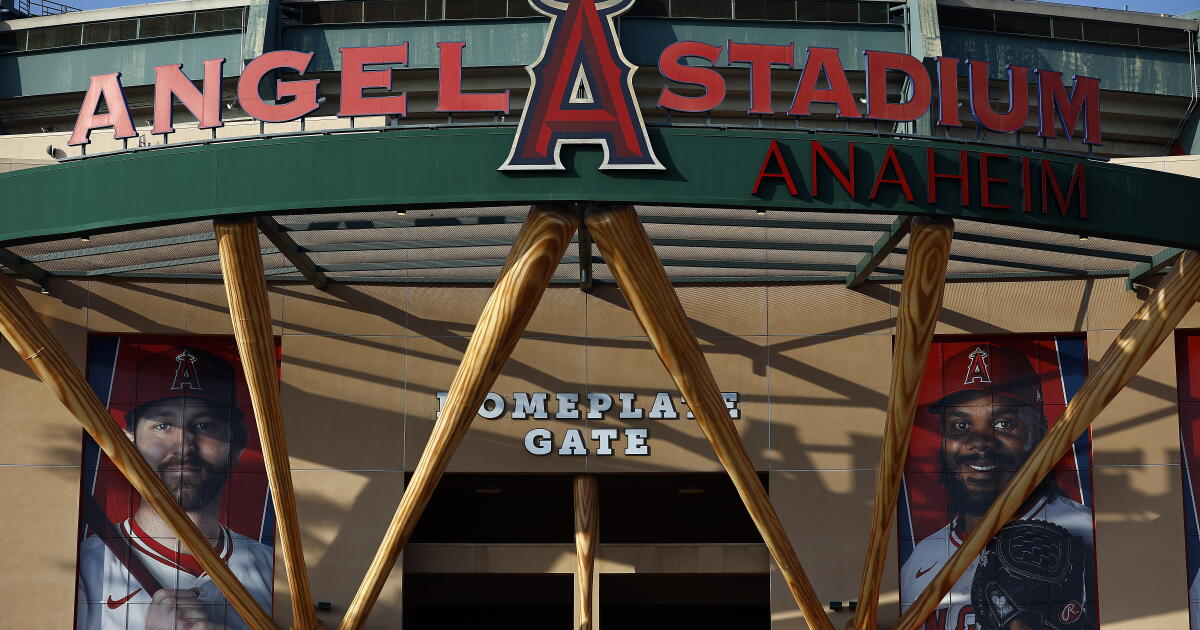
Why the Angels will get a fresh start with Stan Kroenke, and much more
When the Angels won their lone World Series, this was the headline in the Los Angeles Times: “Fantasyland!”
Can we run that headline again?
For your new owner, Angels fans, you get a proven winner and real estate developer — more on that in a second — whose very name drips with baseball history.
You know him as Stan Kroenke, the owner of the Rams. His full name is Enos Stanley Kroenke, so named in honor of two St. Louis Cardinals Hall of Famers: Enos Slaughter and Stan Musial.
As he assembled his sports empire, baseball was the one sport that eluded him. He has the Rams, the Denver Nuggets, the Colorado Avalanche and Arsenal. He badly wanted the Dodgers, a runner-up in the bidding when Mark Walter bought them in 2012.
Now he is acquiring the Angels — at a $4-billion valuation, a record for a baseball team — and getting the closest thing to a blank slate that any owner can get without buying an expansion team.
The general manager? He’s an interim, and his contract expires this year.
The manager? His contract expires this year too.
The roster? The only players currently under contract for next year are outfielder Mike Trout — the Angels’ answer to Musial — and pitcher Yusei Kikuchi.
The stadium? The lease expires in six years.
The Angels’ playoff drought? The longest in the majors, going on 12 seasons. Go, Super Bowl champ, go!
For Kroenke, the first order of business might well be a comprehensive search for what would be the Angels’ answer to Les Snead and Sean McVay, the GM and head coach duo that led Kroenke’s Rams to a Super Bowl championship. The players might not be the next order of business. The deal is not expected to be approved until early 2027, according to a sale announcement, and who knows whether owners still will be locking out players by then?
But Kroenke appears to be the perfect guy to resolve the longest-running and most critical order of business in Anaheim: resolving the Angels’ future there.
For 60 years, the Angels have played in a stadium surrounded by 130 acres of parking lots. For 60 years, fans have driven into the parking lots, watched the game, and driven home. For 60 years, the city has lost untold millions in tax revenue by failing to build anything atop those parking lots.
Kroenke just does it. He is doing it around SoFi Stadium, which he built. He is doing it around the Rams’ training facility in Woodland Hills, which he built. He plans to do it around the sports arena he is building in San Diego.
Now Kroenke could lobby for a new ballpark in Inglewood, in place of the Forum, and call it synergy. James Butts, the mayor of Inglewood, has said he would frown upon a ballpark there.
But here’s betting Kroenke won’t ask. The sale announcement highlighted Kroenke’s “presence in one of the largest sports and entertainment markets in the United States” and said the purchase of the Angels “extends this footprint south into a market of more than three million residents with its own distinct civic identity, corporate base and tourism economy.”
Kroenke wants what all sports owners want these days: money coming out of a stadium site 365 days a year, not just on game days. That means shops, restaurants, homes, hotels, offices, parks, music venues, and food halls. And good luck to Kroenke or any other developer trying to find a vacant 130 acres in any urban area in Southern California, much less one adjacent to a train station and within three freeways.
This is already happening across the 57 Freeway from Angel Stadium, where Ducks owners Henry and Susan Samueli are putting up what they call the OC Vibe. Kroenke’s history indicates he would do something just as fun, and likely grander given that he’ll have more land, and suddenly Anaheim could be the coolest place to be in Orange County (*unless Olivia Rodrigo is putting on another Daisy Chain Fields festival in Irvine).
And, if Kroenke is willing to rename the team the Anaheim Angels, the city and its local assemblyman just pushed through a new law that could provide him with a significant financial incentive for development, which in turn could reduce his cost to build the new ballpark the Angels so desperately need.
The city owns the stadium and parking lots, so they were not part of the team sale. City officials have not met with Kroenke.
“Fans and residents welcome the start of a new chapter for baseball in Anaheim,” Mayor Ashleigh Aitken said. “I am encouraged by Stan Kroenke’s track record with the Rams and his commitment to investing in and uplifting neighborhoods.
“I look forward to working with the team’s incoming ownership to advance our city’s priorities around housing, open space and youth sports at the right time.”
For decades, Anaheim has loftily labeled the land around the neighborhood around the “Platinum Triangle.” Now the city might well have struck gold.
The local assemblyman that introduced that law, Avelino Valencia, could hardly have been any happier Tuesday.
“This is a big day for Anaheim,” Valencia texted me. “For 60 years, our community has filled Angel Stadium, raised a World Series banner as the Anaheim Angels, and shown up through every season.
“Few cities can offer a new owner a foundation like that. New ownership means new possibilities, and Anaheim is ready for them.
“I congratulate Stan Kroenke and Kroenke Sports and Entertainment on their agreement to purchase the Angels, and I welcome them home. Let’s build a partnership rooted in pride of place, a team that reflects the city it calls home, and the return of the Anaheim Angels.
“Anaheim is ready to work together, and Anaheim is ready to win.”
In a statement, Sen. Tom Umberg (D-Santa Ana) called it “a great day for Angels fans and Anaheim.”
As the stalemate between the city and Angels owner Arte Moreno grew more entrenched, the condition of Angel Stadium deteriorated. So did Moreno’s investment in the team.
Three years ago, the city commissioned an assessment of what it would take to keep Angel Stadium up and running for decades to come. We’re still waiting.
Those words, in a nutshell, exemplified the relationship between the team and the city in recent years. When the news broke Tuesday, a city official reached out to me to ask if it were true. And, after years of city officials sniping that the Angels had for a decade clipped the “of Anaheim” from their “Los Angeles Angels of Anaheim” name, the Angels emailed a statement confirming the sale with this headline: “Kroenke Sports & Entertainment to Acquire the Los Angeles Angels of Anaheim.”
After a season of “Sell The Team” chants, Moreno did. And, after Gov. Gavin Newsom signed Valencia’s bill into law last week, the title of the law actually sounded more appropriate Tuesday: “The Home Run for Anaheim Act.”