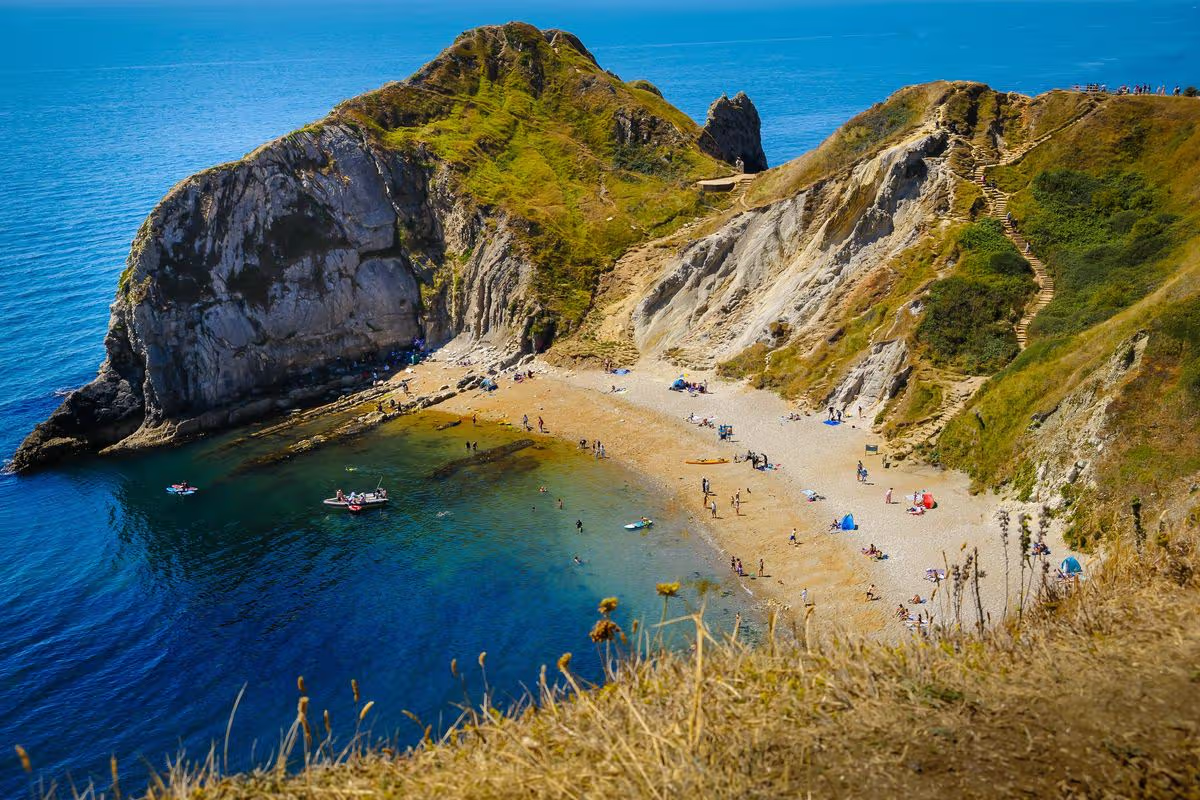
The iconic Dorset beach featured in one of the most emotional scenes in Ryan Gosling’s new film, and fans are now visiting the picturesque Jurassic Coast location for spring walks
Alice Sjoberg Social News Reporter
14:31, 05 Apr 2026
The beach was used to film an important scene in Project Hail Mary, starring Ryan Gosling (stock image)(Image: Getty Images)
There’s always a thrill when you recognise a familiar location in a film or TV programme, whether it’s a documentary or the backdrop for a fictional tale. While the UK serves as a popular setting for numerous blockbuster films and television series, one of this year’s biggest cinema releases actually filmed one of its most memorable scenes in the UK – and it’s accessible to visit right now as a stunning walking destination.
That’s precisely what one London-based couple decided to do, bringing their dog, Presto, along to the Jurassic Coast near Lulworth in Dorset to see the Project Hail Mary filming location after recently watching the film at the cinema.
“Cried at the cinema at this beach so we went in real life,” they captioned their video, before sharing footage from their day trip adventure.
Content cannot be displayed without consent
Without giving away any spoilers, the beach serves as a significant location for one of the film’s characters, with several of the more poignant scenes captured here, making it particularly meaningful for fans to experience. That said, the breathtaking views alone make the journey worthwhile.
Durdle Door stands as one of Dorset’s most photographed and iconic landmarks. Situated on the Lulworth Estate in south Dorset, it forms part of the stunning Jurassic Coast.
The coastline holds such exceptional geological significance on the world stage that UNESCO designated it as England’s first natural World Heritage Site in 2001, placing it alongside iconic natural treasures such as America’s Grand Canyon and Australia’s Great Barrier Reef.
The stunning natural limestone arch was created when powerful waves eroded the rock and carved a hole through its centre. The name Durdle comes from the old English word ‘thirl’, meaning to pierce, bore or drill.
The film also features the neighbouring Man O’ War Beach, which visitors can normally reach via a footpath. However, the pair revealed that during their late March visit, storm damage had swept away the steps leading down to this beach, rendering it currently inaccessible.
Still, they weren’t bothered, as they were able to take in the spectacular views from the clifftops overlooking the beach.
How do you get to the Jurassic Coast? If you’re travelling by car, you can park at the sizeable car park reached through Durdle Door Holiday Park. From there, it’s a 15-minute walk down a steep path to the steps above the beach.
For those without a car, the iconic landmark is also reachable by bus, with a brief journey from Wool in Dorset taking you straight to the beaches.
The London pair weren’t alone in their admiration for the landmark, as numerous others quickly flooded the comment section to share their own visits.
“Went back in 2022 and loved it, need to go back again now that I saw it in the film,” one person wrote. Someone else added: “I wish I hadn’t seen that this was in the movie before we saw it but it was special seeing it with my boys who I took there in 2022.”
The airline and tour operator has shared advice for passengers on social media
Jet2 shared a message about bookings on social media (stock photo)(Image: Getty)
Jet2 has issued an update for passengers worried about disruption to their spring travel plans. With the Easter holidays here at last, many families have booked European getaways over the next few weeks. However, some passengers are worried about possible cancellations.
Greece faced travel disruption this week after a deadly storm hit parts of the country, and Crete was enveloped in a Saharan dust storm. Passengers have also been warned of possible jet fuel shortages caused by the Iran war.
One passenger who shared their concerns with Jet2 has been told that all flights are currently planned to go ahead as normal. Taking to X, a customer named Liz Hughes asked Jet2 for guidance ahead of an upcoming trip to Corfu later this month.
Liz wrote: “We have return flights booked Man-Corfu 13-20 Apr. Should we be worried about cancellations?” A Jet2 employee named Lily responded to the question on Friday (April 2).
Replying from the @Jet2tweets account, Lily said: “Hi Liz, all flights are planned to go ahead as normal. If anything were to change regarding your booking, we would be sure to reach out to you directly to make you aware, and discuss the options available to you. Thanks, Lily.”
Content cannot be displayed without consent
The news comes as Ryanair boss Michael O’Leary has recently said passengers could face severe disruption in early May if the Middle East conflict continues. Speaking on Sky News Michael O’Leary said: “Fuel suppliers are constantly looking at the market.
“We don’t expect any disruption until early May, but if the war continues, we do run the risk of supply disruptions in Europe in May and June, and we hope the war will finish sooner than that and the risk to supply will be eliminated.”
Oil prices have surged since February due to Iran’s block on tankers passing through a key shipping passage, the Strait of Hormuz. The Business Secretary has said there are no supply chain issues for jet fuel “at this moment.”
Peter Kyle told Times Radio: “I was looking immediately after the conflict started, where we interact in order to get resilience into our society, into our economy, we’ve been working with all these key sectors, identifying sectors where there may well be challenges down the track. We have no (fuel) supply chain issues at this moment at all.”
UK airlines are not experiencing disruption to their supply of jet fuel, according to an industry association. An Airlines UK spokesperson said: “UK airlines are currently not seeing disruption to jet fuel supply and continue to engage with fuel suppliers and Government to monitor the situation.”
OUR Spotlight On column gives you the low-down on what to see and do in some of the most popular holiday destinations – as well as some unsung areas.
This week we are doing a deep dive on Piraeus, a small but certainly not insignificant port city within Athens, Greece.
Sign up for the Travel newsletter
Thank you!
Athens is much better to visit off seasonCredit: AlamyThe city has so much to do when there are fewer crowdsCredit: AlamyOf course The Parthenon is a mustCredit: Alamy
The Greek city is one to avoid in the summer – last year it hit 42C, a record high.
But Travel Writer Jonathon Samuels explains: “Athens is the perfect Greek city for an all-year-round mini-break, with lots to see and do.
“We began with an evening stroll around Athens’ oldest neighbourhood, Plaka.
“With narrow pedestrianised lanes, tourist shops and tavernas, it’s no surprise that the area is heaving in summer, but we had plenty of space to breathe and enjoy glimpses of The Acropolis in peace.
“For an even less crowded view, head to 360 Cocktail Bar where you can soak up not just the city’s sacred rock but views of the pastel-coloured buildings below, too.
“Look for the little funicular railway at the end of Plutarch Street which takes you through the hill to the summit.”
Here are some of our other top tips.
MUST SEE/DO
As a port city in one of the most history-rich cities in the world, Piraeus has some stories to tell.
And no place tells them better than the Hellenic Maritime Museum which delves into the maritime traditions of the region.
It only costs around £1.50 to enter and visitors can be wowed by ancient maps, flags and old school weaponry that was once used on the seas.
HIDDEN GEM
Margaro is a pokey restaurant loved by locals, but less-known by tourists.
The interior may be bland and simple (think plastic tables and basic wooden chairs), but the food is anything but.
You won’t need a menu as this third-generation family fish joint only serves a few basic dishes: fried shrimp, fresh fish such as mullet or bream and langoustines, all accompanied by a classic and hearty Greek salad.
There are no reservations, so just follow the queues of local down the back streets from the port.
You’ll be paying a fraction of the cost you would in main tourist spots, but for some of the best Greek food you’ve ever sampled.
BEST VIEW
Nest Rooftop Bar & Bistro at The Alex Hotel is the place to go, especially at sunset.
Set just a few metres back from the ocean, visitors can sip on cocktails while soaking up panoramic views of Saronic Gulf, with ferry boats and yachts on the water, and the sun-drenched terracotta roof tops of surrounding buildings.
RATED RESTAURANT
Pushing the boat out? Well this is the right place to do that – for a number of reasons.
The Michelin-starred Varoulko Seaside, in Mikrolimano marina, is a dream for seafood lovers.
Diners can tuck into traditional Greek flavours using modern culinary techniques – dishes like catch of the day come with fennel, orange and bearnaise sauce.
BEST BAR
Greek wine has soared in popularity in recent years and is now in the same league as some the finest wines in the world.
So if you’re keen to sample the best, a visit Paleo Wine Store is a must.
The cosy and sophisticated bar is housed in a former warehouse and serves excellent grape tipples.
If you’re unsure of what to order, staff are always happy to help. The setting is extremely cool, with industrial-style decor, long wooden tables and shelves stacked high with bottles.
HOTEL PICK
It’s not just its excellent rooftop (mentioned above) that makes the 4* Alex Hotel standout.
The bright and airy space has a modern Greek feel to it with stone-coloured furnishings and simplistic interiors. It’s well-located for exploring the region too, offering easy access to both the city and the sea.
The rooftop restaurant serves British favourites such as pizza, pasta and burgers, as well as more sophisticated dishes including sea drum ceviche and tuna tartare.
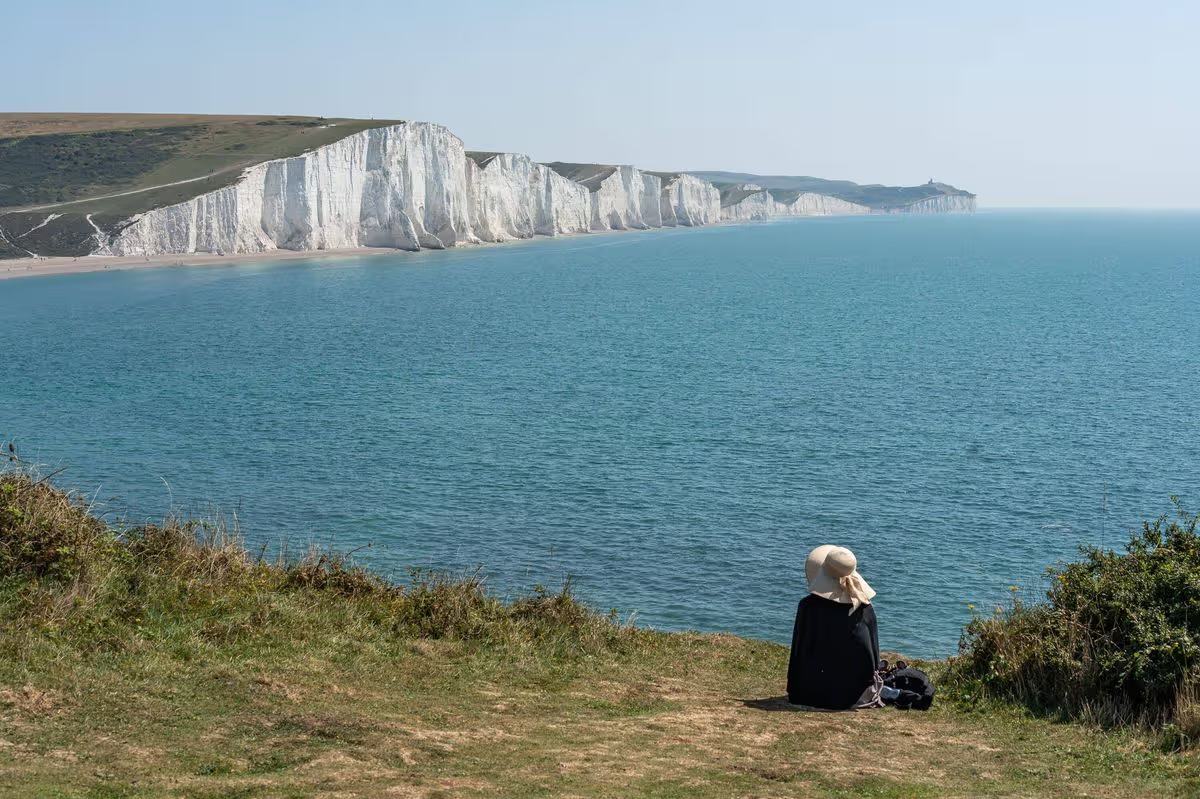
THERE are thousands of beaches in the UK but Cuckmere Haven has been named the best to visit in spring.
With beautiful views across the Seven Sisters chalk cliffs and some of the mildest temperatures in the country, it’s the perfect spot for your next trip to the seaside.
Sign up for the Travel newsletter
Thank you!
Cuckmere Haven has been named the best UK beach to visit in springCredit: AlamyThe Cuckmere River goes through the beach all the way to the seaCredit: Alamy
The experts at GO Outdoors analysed average spring temperatures, rainfall, sunshine hours and Google reviews to reveal the best spring beaches across England.
Cuckmere Haven in East Sussex came in top spot, scoring highly when it comes to mild temperatures as it’s an average of 9.5C during the spring months.
It averages 52mm of rainfall across the month, and 7.8 hours of sunshine each day.
The beach had a Google review score of 4.8 out of 5 and received an overall score of 9.60 out of 10 by Go Outdoors.
The shingle shoreline itself is unique as it’s the only spot in Sussex where a river flows through the beach to meet the sea.
It’s isolated too, but it’s worth the walk for the incredible views of the huge white cliffs.
One visitor said: “Absolutely stunning scenery. Long walks and perfect for the family I loved every second of walking his beautiful beautiful cliffs.”
Another added: “Wow – this iconic sight takes your breath away! The cliffs are blindingly white and the beach and surrounding countryside is so pretty. Everyone should see this once in their lifetime.”
While it has no shops or cafes around, there are four cottages up on the hilltop.
These are former homes of the coastguard and their families built in the 1820s, and are now used as residential homes.
Cuckmere Haven has also been called a ‘wild beach’ thanks to the amount of wildlife here, ranging from oystercatchers and skylarks to rabbits, seahorses and butterflies.
Daniel Start, author of Wild Guide London and South England, says: “This is a wild beach, where the river meets the sea, against a backdrop of the iconic Seven Sisters.
“You can explore the myriad caves carved within them or wander upstream to swim in the lakes made from the meanders of the ancient river.”
One Harry Potter scene was filmed at the top of Cuckmere HavenCredit: Refer to Source
Here’s another of our favourite beaches in the south of England – and a hotel to stay at too…
*If you click on a link in this box, we will earn affiliate revenue.
Sidmouth, Devon Take a trip to Sidmouth on the Jurassic Coast and wander down Jacob’s Ladder to its pretty shingle beach. Make sure to walk along the promenade and check out the independent shops and boutiques. Stay at the four-star Harbour Hotel for sea views and traditional afternoon tea from £135 per room.
Even if you haven’t been there, you might recognise the spot as Cuckmere Haven is frequently used in the backdrops of films.
Movie fans will recognise the spot at the top of Cuckmere Haven from Harry Potter and the Goblet of Fire when the characters use the Portkey to get to the Quidditch game.
The beach and surrounding area has also been used to film Robin Hood: Prince of Thieves, Atonement, Agatha Christie’s Poirot and Luther.
It was even used for Cheryl Cole’s music video, The Flood.
The closest train station to Cuckmere Haven beach is Seaford.
From there it’s a 15-minute drive, or there’s a popular walking route from the town across the coastline which takes just over an hour.
Another popular option is to head to Eastbourne and walk from there which is around a 12-mile trek.
Here are the best beaches to visit this spring…
This the full list of the best beaches to go to this spring according to Go Outdoors…
THE Easter holidays are finally here, and for many, it offers a welcome break for children and parents alike.
Whether you’re travelling abroad with the kids, planning a low-key escape, or squeezing in a quick day trip, it’s one of the best opportunities to reset.
Sign up for the Travel newsletter
Thank you!
The good news is that many destinations are still sitting just outside peak-season prices, so it’s possible to find great value for money if you plan smart (but you can still find some gems if you leave it to the last-minute).
In our checklist guide, we’ve outlined some of the top deals to consider for the Easter school holiday adventures.
If you’re looking for a fun activity that the entire family can get involved in, Woofstock is the perfect solution.
Visit the award-winning dog and family-friendly festival set in the stunning grounds of Powderham Castle near Exeter.
Back for 2026, the much-loved event promises a bumper turnout, easy access and plenty of free parking.
Visitors can expect live music, fun dog shows open to all breeds, and impressive displays, including agility and obedience stations to keep your pooch entertained.
There’ll also be plenty of dog-friendly stalls to browse, alongside reasonably priced food and drink.
Even better, one lucky winner can bag a VIP glamping package to enjoy the festival with their four-legged best friend. Enter the competition here.
Leeds Castle
Visit the Leeds Castle website to book your Spring getaway
Make this Easter extra special with a spring escape to the stunning Leeds Castle, which is nestled in the Kent countryside.
It offers the perfect mix of history, nature and family-friendly fun.
Choose from cosy B&B rooms in the Stable Courtyard or opt for the playful Knights’ Retreat lodges, ideal for families looking to add a little adventure to their stay.
Guests also enjoy access to the castle and its beautiful grounds, where there’s plenty to explore, from colourful spring gardens to three adventure playgrounds and impressive Birds of Prey displays.
From 3–19 April, families can take part in the Enchanted Easter Trail, a magical outdoor experience filled with interactive challenges, riddles and live entertainment.
After a day of exploring, guests can unwind in comfortable accommodations and soak up the unique atmosphere.
Slap Adventures
Visit the website
For those who believe driving should be more than just getting from A to B, Slap Adventures offers a next-level experience.
Designed exclusively for sports, performance and supercar owners, these curated driving tours transform every journey into something unforgettable.
Covering some of the most thrilling routes across the UK and Europe, each trip is carefully planned to combine exhilarating roads with stunning scenery, from winding mountain passes to scenic coastal stretches.
Every detail is taken care of, from premium accommodation to well-chosen stops along the way, allowing you to relax and fully enjoy the experience.
It’s a seamless, stress-free way to explore new destinations behind the wheel.
Cofton Holiday Park
Plan your stay
Set in a scenic valley near Dawlish Warren beach, Cofton Holidays is a five-star, family-run holiday park in South Devon offering a premium staycation experience for families, couples, and dog owners alike.
With a range of accommodation, including luxury lodges with hot tubs to touring and camping pitches, it caters to every kind of getaway.
Guests can enjoy standout facilities such as indoor and outdoor pools (open May to September), a leisure complex and on-site dining, making it easy to relax and unwind without leaving the park.
Cofton has earned multiple awards, including Holiday Park of the Year at the Dog-Friendly Awards for two consecutive years.
What sets it apart is its all-in-one approach.
From woodland walks to the beach and peaceful fishing lakes to a high ropes course, it offers something for everyone.
Port Aventura World
Book your visit
Located on Spain’s Costa Daurada, just an hour from Barcelona, PortAventura World is one of Europe’s most convenient and exciting short-haul family getaways, with direct flights from major UK airports.
With over 100 million visits in its 30-year history, the resort has become a go-to destination for families seeking sunshine, thrills and all-in-one entertainment.
It offers a wide choice of accommodation, including five themed four-star hotels and a five-star option within the resort, plus four additional hotels nearby (Ponient Hotels by PortAventura World).
At its heart are three standout parks: PortAventura Park, Ferrari Land, the only Ferrari-branded theme park in Europe, and Caribe Aquatic Park, one of southern Europe’s largest water parks.
For 2026, new attractions, including Coral Bay: The Lost Legend and Makamanu Jungle, promise even more family-friendly adventures, perfect for all ages. Enter the competition here.
Lenor
Shop the range
If you have a holiday planned, there’s nothing worse than arriving at your destination and finding your neatly packed clothes creased.
While many travellers rely on quick fixes like steam from the shower or flattening clothes under a mattress, there’s a far simpler solution: Lenor Crease Releaser.
This travel-friendly spray smooths wrinkles in seconds. Simply hang your clothes, spritz lightly, and smooth by hand for a fresh, ready-to-wear finish.
Now available in a handy 100ml size alongside the standard 500ml bottle, it’s ideal for holidays and weekends away.
Plus, Lenor’s Steamer and Ironing Waters make tackling laundry easier too, helping reduce creases while adding a long-lasting fragrance and preventing limescale build-up in your iron.
Crealy Theme Park & Resort
Explore short breaks at Crealy
Crealy Theme Park & Resort is one of Devon’s top family staycation spots, combining accommodation, entertainment and theme park thrills all in one place.
Families can choose from a wide range of stays, from luxury lodges with hot tubs and themed glamping to caravans and fully serviced camping pitches.
Voted Best Theme Park for Families at the 2025 UK Theme Park Awards, Crealy is home to over 60 rides and attractions, live shows, seasonal events and even animals, making it a hit with all ages.
Guests staying on short breaks can also enjoy evening entertainment during school holidays and selected weekends, with theme park entry included or discounted.
For 2026, the park is turning up the excitement with two major new rides, one of which is Pirates’ Plummet (the South West’s tallest), plus a packed events calendar that starts from Easter.
Visit Isle of Wight
Book now
If you’re craving a getaway that feels a world away without the long journey, the Isle of Wight delivers exactly that.
Just a short crossing over the Solent, you’re greeted by golden beaches, fresh sea air and an instant sense of escape – perfect for sunnier days.
From scenic coastal walks and dramatic cliff-top views to peaceful cycling routes through rolling countryside, there’s something for everyone to enjoy.
Whether you’re after adventure or a slower pace, it’s easy to switch off and soak it all in.
Food is another huge highlight too, with fresh seafood, artisan produce and locally crafted drinks adding to the experience.
Families will find plenty to keep everyone entertained, from unique attractions to unforgettable coastal views, which can be enjoyed from cosy cottages and boutique stays to laid-back campsites by the sea. Enter the competition here.
Bluebell Railway
Find out more
Climb aboard for a magical adventure at the Bluebell Railway, where every journey feels like stepping into a storybook.
Just a short trip from London or Brighton, this isn’t your average train ride.
Guests can hop onto a real vintage steam train and chug through the beautiful Sussex countryside, with smoke puffing and whistles blowing as they go.
With an all-day ticket, little explorers can jump on and off at different stations, each one like travelling through time, from the 1880s to the 1950s.
There’s plenty to discover along the way too.
Kids can get hands-on in the SteamWorks! exhibition, explore giant locomotives, or stop off for a bite to eat before the next adventure begins.
During Easter and school holidays, the fun goes even further, with children travelling for just £1 and surprise entertainment like dinosaurs, unicorns, a mobile zoo and favourite characters popping up along the route.
It’s a day full of imagination, adventure and unforgettable moments for the whole family.
Temblant Living
Find out more
Step into a real-life winter wonderland at Mont-Tremblant.
Here, snowy rooftops, twinkling lights and a cosy village feel like something straight out of a festive storybook that the whole family will love.
Days can be spent completely how you want them, whether that’s zooming down snowy slopes, building snowmen, or warming up with hot chocolate by the fire.
With Tremblant Living, the whole trip is made easy.
Their ski-in, ski-out stays mean you can step straight onto the slopes, while everything else, from lift passes to equipment and special experiences, is taken care of.
Mont-Tremblant is packed with everything you need for a fun snowy getaway with family and friends, creating cosy moments that kids (and grown-ups) will never forget.
Follow Checklist for more tips
If you want travel inspiration follow Checklist for more tips, tricks and deals.
You can follow @ChecklistSocial on Facebook, Twitter and Instagram or sign up to the newsletter and get inspiration for everything from home and DIY to wellbeing or food and drink.
Checklist is dedicated to providing the best free online competitions too – discover amazing new services and products when you visit the website today.
The riverside was heaving. Families spilled from cafes. A marching band trooped on to the bridge, their tasselled metal helmets dazzling in the sun. Priests with bushy beards delivered ageless chants from beneath their cylindrical kalimavkion hats. Men let off shotguns, terrifying the air. Easter Monday in Lefkimmi.
We hadn’t planned this. Simply right place, right time. The capital of southern Corfu, Lefkimmi is a working town, untroubled by tourism. There are Venetian-style houses – variously neat, tatty and decrepit – but no “attractions” to speak of. Just Corfiots doing Corfiot things: chewing the fat in their finest for this religious celebration – Greek Orthodox Easter, which falls on 12 April in 2026 – plus zipping about on scooters, drinking coffee, buying baklava and ice-creams.
“Right place, right time” was my hope for this trip to over-loved Corfu, an island of about 100,000 that, in 2025, was visited by approaching 4 million people. I was returning with fond memories. My first ever foreign holiday was here, in 1986. That was the first time I saw an olive tree, realised water could be that blue, and heard such a cacophony of cicadas it seemed the bushes were electrically charged.
Cape Asprokavos in the far south of the island – close to the starting point for Sarah Baxter’s walk. Photograph: Sarah Baxter
That was 40 years ago. Corfu – the green queen of the Ionian Sea, Gerald Durrell’s “garden of the gods” – was already popular. In the intervening decades, development has been rampant and infrastructure, from roads to water supply, struggles to cope with the summer influx. But how about visiting off-season and off-piste? Winter can be tricky, with many places shut, so my husband and I had chosen to come in spring, exploring largely on foot, via the Corfu trail.
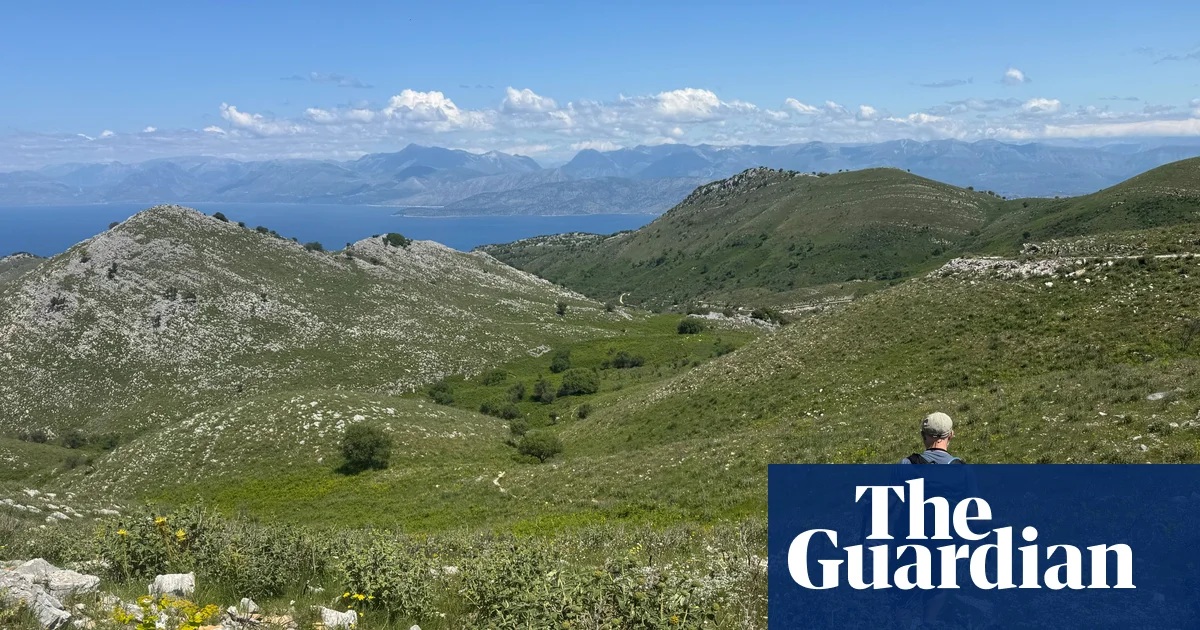
The sun was warm, the land now awake from hibernation as we set out on the 110-mile (180km) route that runs the length of the island, from Kavos to Agios Spyridon. Wriggling along the more rugged, less developed west coast, with deviations into the central hills and wide Ropa valley, it then traverses the mountainous north, always seeking the way less trodden. You could travel by (limited) buses or hire car, but doing some walking is the best way to happen upon Corfu’s offbeat bits.
We covered between 8 and 20 miles a day, though there’s no need to do all that – most walk it much more slowly. But, with our luggage being transported ahead each night to an array of simple pensions, family tavernas and beach hotels, our shoulders were light, so we were keen to roam as much as we could, following the yellow and black signs, arrows daubed on rocks and the GPS files on our phones – the route was largely well marked.
Every day, there were wonders to discover: wizened Mitéra, a 1,500-year-old olive tree near Prasoudi beach; a profusion of wildflowers, in all hues – rosy garlic, hot-purple rock roses, punchy yellow sage; a magical ancient footway between Makrata and Ano Garouna that had fallen out of use until the Corfu trail was blazed 25 years ago. The path traversed a cypress-pierced hillside before plunging into dark, forgotten olive groves that concealed what looked like the remains of a lost city, but was in fact natural rock cloaked in moss.
A few hours after these “ruins”, we arrived in Sinarades and found ourselves at the bottom of a flight of stone steps leading into the Folklore Museum. It couldn’t be open, could it? But yes, Makis beckoned us into this 19th-century farmhouse (entrance a modest €3), empty of visitors but full of the stuff of Corfiot village life: fine costumes, farming paraphernalia, fig cutters, cobblers’ tools.
Tools in the Folklore Museum, Sinarades. Photograph: Sarah Baxter
It was fascinating, getting these glimpses of old Corfu, invariably inland. In the northern mountain village of Sokraki, after the only downpour to spoil our sunny skies, we drank ginger beer at Emily’s cafe, still made the traditional way, using only water, lemon juice, sugar and ginger. Then we wove our way down the narrow streets to the Lithari Olive Oil Museum, where an old family press has been restored.
The following day, we visited Old Perithia, a 14th-century village tucked beneath Mount Pantokrator, the island’s highest point. Like many similar outposts, Perithia was abandoned in the 1960s; unlike many, it has been revived, and is now a lively, living cluster of homes, tavernas, honey shops and a characterful B&B. It was a hot day, so we flopped on to the shady terrace of O Foros cafe and lingered over fresh salad, homemade pie and tsigareli (garlicky wild greens), before descending to the coast via a long-lost path, only rediscovered during the Corfu trail’s creation.
Myrtiotissa beach is reached by a narrow path on the cliffs. Photograph: Constantinos Iliopoulos/Alamy
Despite being ravishingly clear and a respectable 16C (60F), there were very few swimmers in the sea. Such was the case at Myrtiotissa, halfway up the west coast – the spot where Odysseus allegedly washed ashore, and widely known as a nudist beach. A steep, skinny track leads to this cliff-backed sliver of sand, a real Instagrammer snarl-up in summer. But when we walked down, road and beach were deserted enough for us to throw off our inhibitions and clothes, and frisk Nereid-like in the waves.
If there’s one stretch of Corfu coast not to miss it’s Erimitis, the “hermit” peninsula at the island’s north-east. There used to be a naval observation post here, keeping an eye on Albania, about 2 miles away. As such, Erimitis escaped tourist development, leaving it the last stand of pristine Corfiot nature: no villas, no olives, just a scrub of oaks, myrtles and strawberry trees, brackish lagoons, butterflies and birds, herbs and wild orchids, plus rare monk seals and seagrass offshore.
But it’s under threat. In 2012, the government sold the rights to develop a portion of Erimitis to foreign investors. Organisations such as Save Erimitis and the Ionian Environment Foundation are fighting to conserve it.
Leaving the Corfu trail for the day, we picked up a footpath linking upmarket Agios Stefanos to the fishing harbour of Kassiopi, via Erimitis’s edges, a walk of about 5.5 miles. Immediately, there was a different feel here; it was a place without human touch, where the water seemed even clearer. We walked through fairytale tunnels of trees and detoured down a trail that ended at a bank, where a rope dangled down to a forest-backed beach. With no one about, it seemed silly to bother putting on swimmers, so we skinny-dipped again, now accustomed to the temperature, and warmed by the smugness of being here, now, alone. Right time, right place.
A fastball up and off the plate to Guardians left-handed hitter Steven Kwan was an inauspicious beginning to Dodgers right-hander Roki Sasaki’s season debut.
The arm-side miss fell in line with a persistent spring-training pattern for Sasaki, who struggled with command from his first Cactus League start through his Freeway Series appearance last week.
Over the course of a seven-pitch strikeout, however, Sasaki adjusted — something he failed to do during game action this spring.
“I actually didn’t have confidence at all before this game started,” Sasaki said through an interpreter Monday. “But I was just focusing on doing what I can control.”
In the Dodgers’ 4-2 loss Monday, Sasaki’s first start of the season was something of a best-case scenario. He held the Guardians to one run and four hits in four-plus innings. And the biggest difference from his spring training struggles was he issued just two walks.
The Dodgers squandered the effort with a lack of offense, in their first loss of the season.
Sasaki will have more to prove against stronger offenses than Cleveland’s. But his performance at least suggested that the Dodgers’ faith in him wasn’t misplaced.
“We know he can do it here, and especially now that his velocity is back to closer to where it used to be,” Dodgers general manager Brandon Gomes said last week. “I feel like he puts us in a great position to win.”
Dodgers manager Dave Roberts removes starting pitcher Roki Sasaki from the game in the fifth inning Monday against Cleveland.
(Ronaldo Bolanos / Los Angeles Times)
The Dodgers had seen Sasaki bounce back before. He had a middling start to last season and pitched through shoulder discomfort before landing on the injured list last May. His average fastball velocity plummeted from 98 mph in his MLB debut to 94.9 mph in his last start.
He returned from the IL in time for two relief appearances in September, his fastball sitting above 99 mph, and a dominant postseason run. He didn’t allow a run in eight of his nine playoff outings, and he posted a 0.84 ERA.
“He could have cashed in last year,” manager Dave Roberts said before the game. “Given his health early, the lack of performance towards the middle of the year, towards the end he could have just written it off and started fresh in the offseason.
“But he was willing to pitch out of the bullpen, ramp back up and give us whatever we needed. So for me, that was something where he put himself out there. That’s why I have a lot of confidence right now [that he can] turn the corner from spring training.”
Sasaki still threw some non-competitive pitches Monday. That inefficiency brought his pitch count up to 78 pitches twice through the Guardians’ batting order, and Roberts pulled him when the lineup turned over again.
Sasaki also reigned in his misses, used both sides of the plate, and effectively deployed his new cutter as a put-away pitch early.
“I couldn’t get through five innings, but the results overall felt pretty good,” Sasaki said. “I kind of have confidence about that.”
Through the first two innings, Sasaki held the Guardians scoreless, and to just one bloop single. But in the third, he threw a four-seam fastball down the middle to Austin Hedges and hung a cutter to Kwan for a pair of doubles and a run.
Dodgers outfielder Kyle Tucker rounds second base after a Mookie Betts double during the ninth inning against the Guardians at Dodger Stadium on Monday.
(Ronaldo Bolanos/Los Angeles Times)
Next, Sasaki walked Chase DeLauter, and the inning threatened to spiral. But Sasaki locked in to strike out José Ramírez and induce Kyle Manzardo to line out, escaping without further damage.
With no outs and one runner on in the fifth inning, Sasaki handed the ball over and left-hander Tanner Scott took over. Dodgers fans sent Sasaki, who’d been booed during his last spring start, off with a warm ovation.
“I think it should be a big boost to his confidence,” Roberts said after the game. “… When you don’t have success, it’s hard to have real confidence. That was certainly an honest admission. But when you perform, you start to have true confidence. So hopefully he can build on this one.”
After Scott, Dodgers left-hander Justin Wrobleski, who is in line to join the rotation when the schedule isn’t so packed with off days, provided four innings. He gave up three runs, all in the seventh.
The Dodgers didn’t score until the final inning, with the help of a little luck. Kyle Tucker reached base on a chopper that squeaked through the infield and then advanced all the way to third on a wild pitch. Mookie Betts then drove him in with a line-drive double. Two batters later, Betts scored as Freddie Freeman grounded out to first.
“The takeaway is, we’re 3-1 and the guys that we expect to swing the bats aren’t swinging the bats right now,” Roberts said. “So that’s a good thing; they’ll hit.”
Spring has arrived at Wicken Fen, one of Europe’s most important wetlands, and with it the first summer migrants. Chiffchaffs are usually the earliest, with their rhythmic song ringing out across the fens. Then, if the weather is mild, blackcaps and willow warblers might join them. Listen closely, especially early morning or at dusk, for the foghorn-like calls of the booming bittern across the reedbeds. There’s a pushchair- and wheelchair-friendly boardwalk around Sedge Fen, and wheelchair-accessible wildlife hides. Look out for the electric blue flash of a kingfisher, and male marsh harriers performing their dramatic sky-dancing flights as the breeding season gets under way, before the cuckoos arrive in late April. From £10 adults, £5 children (under-5s free), nationaltrust.org.uk
Artful planting in East Sussex
Spring evening at Petworth House. Photograph: Slawek Staszczuk/Alamy
When Dan Pearson created the landscape design at Goodwood Art Foundationsculpture park, which opened last May, he planned 24 seasonal moments to complement the art-dotted trails through woodland, glades and meadows. This is the first spring visitors will see his graphic plantings of daffodils and bluebells, cherry blossoms and the katsura grove coming into copper-coloured leaf. Over the Easter holidays, children can pick up a free Art in Nature pack to create rubbings and collages inspired by the shapes and textures.
There is artful nature of a different kind at nearby Petworth’s spring festival, with more than 100 pots of spring bulbs in flower, willow foraging and basket making workshops, and other garden-themed kids’ activities. Goodwood Art Foundation, £15 adults, under-18s free,goodwoodartfoundation.org. Spring festival at Petworth, from £21 adults, £10.50 children(under-5s free), 4-19 April,nationaltrust.org.uk
Feast by the sea in Kent
Morelli’s ice-cream parlour in Broadstairs. Photograph: Eye35/Alamy
From Italian small plates in Margate to Japanese ramen in Deal, the Kent coast has upped its foodie credentials. Dig in at the Broadstairs food festival, which pops up on the seafront over Easter (3-5 April). There’s a delicious lineup of chefs, street food stalls and local artisan producers, plus food-themed arts and crafts workshops, from chocolate lollipop making to screen printing napkins with fig, oyster, crab or seaweed designs. Broadstairs is a treat to eat your way around anytime, with seafood at Kebbells, tapas at Bar Ingo and, of course, a sundae at Morelli’s Formica-tastic ice-cream parlour. Free entry, 3-5 April, broadstairsfoodfestival.org.uk
Treetop thrills and stargazing in the Lake District
Go Ape high ropes course in Grizedale Forest. Photograph: Michael/Giant Peach
The deep dark woods at Grizedale Forest in the Lake District offer an action-packed day out for families, with Go Ape treetop thrills, adrenaline-pumping mountain biking and sculpture-filled walking trails (including a Gruffalo orienteering route and a Room on the Broom nature walk for Julia Donaldson fans). Now you can add stargazing to the list. The new Grizedale Observatory opened last May, the Lake District’s first public observatory and planetarium. There are family sessions every Saturday at 4pm, where budding astronomers can touch real meteorites and watch a show in the planetarium. Easter holiday events include Jupiter viewings, aurora nights and afternoon planetarium shows. Grizedale Forest, free (bar Go Ape), forestryengland.uk. Observatory events, from £13 adults, £8 children, grizedaleobservatory.com
See grand designs and baby lambs in North Yorkshire
Castle Howard. Photograph: Eye35/Alamy
Sir John Vanbrugh was a playwright with no architectural experience when he was commissioned in 1699 to build a massive new house for a fellow Kit-Cat Club member, the Earl of Carlisle. It would be fair to say that Castle Howard was a decent first stab. In celebration of the tercentenary of its creator, there are new tours giving unprecedented access to areas of the house, follies and monuments not usually open to the public. Plus you can meet baby lambs born on the estate at the magical Skelf Island adventure playground (4 and 5 April). Garden tickets, which include Skelf Island, from £17 adults, £8.50 children (under-3s free), castlehoward.co.uk
Woodland blooms in Cornwall
Magnolia at the Eden Project. Photograph: Douglas Lander/Alamy
Each year, six champion Magnolia campbellii are eagerly watched in six of the Great Gardens of Cornwall, including the Eden Project. The moment they come into full bloom (counted as 50 flowers), spring is declared to have officially arrived in England. This year it happened on 27 February. The Gulf Stream helps hurry the start of the season along here, and means you may see a few bluebells popping their heads up in the Easter holidays. Tehidy woods is famous for its carpets of bluebells – the first were spotted in early April last year. That will be just in time for fantastical theatre company Rogue Otherworld’s Wild Awake show, which weaves between the trees telling the story of the forest awakening, guided by the Wild Spring Hare. Wild Awake show, £10-£15 adults (pay what you can; under-3s free), 3-6 and 8-12 April, rogueotherworld.co.uk
Poohsticks in Ashdown Forest
AA Milne’s famous bridge in East Sussex. Photograph: Andrew Hasson/Alamy
It’s the 100th anniversary of AA Milne’s Winnie-the-Pooh this year, so good reason to follow the honey-loving bear and his friends down to the real-life Hundred Acre Wood in Ashdown Forest. Milne wrote the children’s classic at Cotchford Farm (now a holiday rental) on the edge of the forest, where he lived with his wife and his son, Christopher Robin. Follow the Pooh Walks (0.6 or 2 miles) from Gills Lap to trace out spots from the book, including The Enchanted Place, the Heffalump trap and Roo’s sandy pit. Don’t leave without playing a game of poohsticks on the Poohsticks Bridge. Pooh fans can plot a return trip for the summer holidays to catch The Big One Hundred celebration, which will include a giant puppet roaming through the woods, interactive performances and five new walking routes. Free, ashdownforest.org
A wild coastal walk in County Antrim
Gobbins cliff path, County Antrim. Photograph: Vincent Lowe/Alamy
The walkways, bridges and steps that make up the Gobbins cliff pathcling to sheer basalt rock, the waves crashing below. This elemental trail was built by the railway engineer Berkeley Deane Wise in 1902, and now can only be followed on 2.5hr guided tours, which have been paused since last year due to rockfall. They are due to restart on 20 March, and it’s a thrilling stop on the Causeway Coastal Route. Alternatively, the Blackhead Path is almost as dramatic and free, starting at nearby Whitehead. The route hugs the coast past smuggler’s caves and rocky coves, before taking the steep steps up to the clifftop Blackhead Lighthouse. A Mauds ice-cream at Coastal Coffee back in Whitehead is just reward for the climb. £22.75 adults, £16.50 under-16s(minimum 4ft tall, roughly seven years old), thegobbinscliffpath.com
Relive Springwatch in the Peak District
Padley Gorge. Photograph: Suxxes Photo/Alamy
Last year, BBC’s Springwatch was based at the Peak District’s Longshaw Estate. Over the weeks of live broadcasts, Chris Packham and Michaela Strachan spotted short-eared owls feeding voles to their chicks, kept an eye on pied flycatcher nests, and tracked hares, deer and a host of other wildlife across the estate’s habitats. The Padley Gorge and Burbage Brook walking route is particularly good in spring, winding past the pond to the ancient woodland of Padley Gorge, with its twisting oak trees and moss-covered boulders. Back out on the meadow, watch for birds of prey overhead – buzzards, red kites, peregrine and kestrels – and adders emerging from hibernation in the grass (so dogs need to stay on leads). Free,nationaltrust.org.uk
Go mudlarking on the Thames
Photograph: Julio Etchart/Alamy
For a hands-on dig into London’s history, try one of the Thames Explorer Trust’s In the Footsteps of Mudlarks tours. Normally anyone searching the river’s foreshore needs a permit from the Port of London authority, which has a waiting list running into the thousands. These two-hour guided tours give combers the chance to temporarily jump the queue, with archaeology experts on hand to help find and identify surface artefacts – maybe smoking pipes, pottery or even bones. Children over eight can join regular scheduled tours, while during the school holidays there are special family sessions (aimed at ages 5-12) meeting at the Brunel Museum in Rotherhithe. Children’s Footsteps of Mudlarks tour, £30 adults, £17 under-12s, on 4, 7, 9 April,thames-explorer.org.uk
Take a seabird safari in North Berwick
Gannets flying over Bass Rock. Photograph: Feldman1/Getty Images
Off the coast of North Berwick, the Bass Rock is home to the world’s largest colony of northern gannets. After spending the winter in warmer seas, the birds, with their distinctive black wingtips and yellow heads, return in February. Boat trips from the Scottish Seabird Centre restart in late March, and range from exhilarating RIB “seafaris” to gentler catamaran cruises, which loop around Craigleith (home to almost 10,000 breeding puffins) and Bass Rock, sometimes accompanied by dolphins and seals. Back on dry land, the centre has live wildlife cameras, as well as exhibits, games and films, or join a spring beach clean (10 April) along the sand. Boat trips, from £32 adults, £15 children (3 and under free); Scottish Seabird Centre Discovery Experience, £13.50 adults, £9 children (under-3s free), seabird.org
Join the Famous Five in Dorset
Swanage Railway and Corfe Castle, which inspired Enid Blyton. Photograph: Janet Carmichael/Alamy
“In the very middle … on a low hill, rose the ruined castle,” wrote Enid Blyton in the first Famous Five adventure, Five on a Treasure Island.Blyton holidayed for decades on Dorset’s Isle of Purbeck, and the imposing remains of Corfe Castle are believed to be the inspiration for Kirrin Castle. The most storybook way to arrive is in the vintage carriages of the Swanage Railway, which the author herself took, chugging through the countryside in a plume of smoke and steam. Try to catch the new Magic Faraway Tree film (out now) at a cinema to complete the Blyton jolly. Swanage Railway, from £14 adults, £7.50 children (under-5s free) one way, swanagerailway.co.uk
Iron age living at Loch Tay
Reconstructed roundhouses at the Scottish Crannog Centre. Photograph: PR
Back in the iron age, crannogs – roundhouse settlements built on artificial islands of stone and timber – would have been a common sight on lochs across Scotland. Their remnants have been remarkably preserved thanks to being buried beneath the cold, dark, peaty waters. The remains of 17 have been found in Loch Tay alone, and on its shores the Scottish Crannog Centre reconstructed these ancient structures in an immersive living museum, until it was destroyed by fire in 2021. It reopened nearby in 2024, and this spring will complete its first new crannog. To celebrate, join The Crannog is Hatching event on 4-5 April, exploring the traditions of birth and renewal, with springtime foods in the Feasting Hall. £15 adults, £10 children (under-5s free), crannog.co.uk
Dive into art near Edinburgh
Gateway pool was constructed with thousands of hand-painted tiles. Photograph: PA Images/Alamy
At the Scottish sculpture park Jupiter Artland, you can get a unique perspective on two of its works of art – by swimming in them. Joana Vasconcelos’s wiggling, vibrantly coloured Gateway pool and Charles Jencks’s Teletubbyland-like Cells of Life are open to bathers. Gateway is created from 11,366 hand-painted Portuguese tiles, and is bookable for half hour sessions from 2 April. Jencks’s lakes, surrounded by undulating grassy landforms, are open for swimmers every Sunday from 11am to 12pm (both over-3s only). There are pieces by Tracey Emin, Antony Gormley, Anish Kapoor and Andy Goldsworthy elsewhere in the 120-acre park, which is a half-hour drive from Edinburgh. Budding artists can also give it a go in the Make Studio, filled with materials – an invitation to get messy with paint, clay and more. From £11.80 adults, £7.50 children (3 and under free; swims included in ticket price but must be prebooked), jupiterartland.org
Find dragons in Caerphilly
The Great Hall at Caerphilly Castle. Photograph: Cadw Photographic Library/Crown
Wales’s largest castle, Caerphilly, reopened last July after a two-year, £8m renovation by Cadw, the Welsh government’s historic environment service. Built in the 13th century, the whole stronghold covers about 12 hectares (30 acres), with wide water defences, hulking great walls, stern-looking gatehouses and a leaning tower that’s even more leaning than Pisa’s (reputedly the result of gunpowder damage during the civil war). The most head-turning of the recent upgrades is the Great Hall dining room, now dressed for its medieval heyday. Elsewhere interactive exhibits bring the castle’s long history to life, and a family of giant, smoke-snorting (animatronic) dragons live in a lair beside the moat. £12.90 adults, £9 children (under-5s free), cadw.gov.wales
Ride a carousel in Flintshire
The Hawarden Estate. Photograph: Louise Roberts
On Saturday 4 April the grounds of the Hawarden Estate will be filled with vintage fairground rides for its Great Easter Show – the ferris wheel spinning, the carousel cranking out the waltz and squeals coming from the red-and-white-striped helter-skelter. Alongside there are circus skills workshops, a dog show, craft sessions and an egg-and-spoon race. If you miss out on the fete do not fear – the fun continues all season with a kids’ Explorer Club every Saturday and classes at the Walled Garden School (how to build a birdhouse on 7 April; a spring foraging walk on 11 April). There is also a self-guided explorer trail from the farm shop, with a 10-metre trumpet to blast and secret mirrors to spot among the trees. The Great Easter Show, £18.50 adults, £12.50 children (under-5s free; tickets include unlimited rides). The Walled Garden School events, from £30a person; Explorer Club, £10 a child (accompanying adults free), hawardenestate.co.uk
Highland tales in Inverness
An exhibition on Celtic music in the north tower at Inverness Castle. Photograph: John Paul
Sitting grandly on the banks of the River Ness, the red sandstone Inverness Castle isn’t really a castle at all: it was built in 1836 as a court and prison. There have been plenty of “real” castles on the strategic site since the 11th century, destroyed by everyone from Robert the Bruce to Bonnie Prince Charlie. This January, after a £47m redevelopment, it opened as the snazzy new Inverness Castle Experience, where visitors follow the voices of the seanchaidhean (Gaelic storytellers) to learn about Highland history and culture. Sure, there are clans and tartan, but also Celtic music, the sport of shinty and a tapestry created by more than 600 stitchers from across the Highlands and Islands. Finish on the rooftop platform looking out towards Ben Wyvis and the Highlands. £20 adults, £14 children (under-5s free),invernesscastle.scot
Cruise the world’s highest canal aqueduct in the Dee valley
Pontcysyllte aqueduct, north Wales. Photograph: Travelling Light/Getty Images
Standing 39 metres above the Dee valley in north Wales, the Pontcysyllte Aqueduct is the highest canal aqueduct in the world and, at 307 metres, the longest in Britain. It’s described in its Unesco World Heritage listing as “a masterpiece of creative genius”. See it up close on a 45-minute trip on board the Little Star, which departs from close to the Canal & River Trust’s Trevor Basin Visitor Centre five times a day from 1 April.Alternatively, walk across the towpath for free (you will need a good head for heights, although there are railings) and continue along the Llangollen canal to Llangollen. There, hike up to the ruins of Castell Dinas Brân overlooking the town, then pick up some homemade butter fudge at Cottage Cream’n’Candy. Trips on AngloWelsh’s Little Star, from £10.48 adults, £6.29 children, anglowelsh.co.uk
Hike the new Teifi Valley Trail
Poppit Sands, Pembrokeshire. Photograph: Robin Weaver/Alamy
West Wales has plenty of stunning walks, and these will be joined in April by a new waymarked route: the 83-mile (134km) source-to-sea Teifi Valley Trail. Designed as an eight-day hike, the route starts up at Strata Florida Abbey and follows the River Teifi downstream. For a lovely day walk, join it for the final leg at Cilgerran Castle, perched dramatically above the Teifi gorge. The path wiggles almost 8 miles through the Teifi Marshes Nature Reserve (kids can have a whiz around the willow maze), past Cardigan (lunch stop at Crwst), to the quaint village of St Dogmaels with its ruined Tironensian abbey. The finishing line is the dunes at Poppit Sands, where you can unlace boots and treat tired feet to a chilly dip. teifivalleytrail.wales
Car-free Cotswolds garden tour
Sezincote House in Gloucestershire. Photograph: Stuart Black/Alamy
The lively market town of Moreton-in-Marsh is the ideal jumping off point for a car-free Cotswolds jaunt – it’s only 1h 30min direct from London’s Paddington, or one change from Birmingham or Bristol. From there, strike out along the Monarch’s Way about 1.7 miles to Batsford Arboretum, home to the UK’s national collection of Japanese flowering cherry trees, with more than 120 covered in frothy blossom. Continue on to Bourton House Garden, which reopens for the season on 7 April, for perfectly clipped topiary and cakes in the tearoom. Finish the loop at Sezincote House and Garden, a little slice of India in the English countryside, with its water garden, elephant statues and stepping stones across a winding stream. Batsford Arboretum, from £10.90 adults, £3.15 children (under-4s free), batsarb.co.uk. Bourton House Garden, £10 adults (under-16s free), bourtonhouse.com. Sezincote House and Garden, from £9 adults (garden only), £3 children, sezincote.co.uk
IT MIGHT feel like we have been waiting forever for spring and now you can enjoy it by seeing lots of different sights in bloom.
National Trust sites and properties across the UK are home to an abundance of plants and trees.
Sign up for the Travel newsletter
Thank you!
There are tons of places to see blossom across the UK this spring, including National Trust propertiesCredit: Shutterstock EditorialAnglesey Abbey is less than six miles from Cambridge and features a country house that was built on the remains of a prioryCredit: AlamyThe house is surrounded by gardens, which is where you will find the blossomCredit: Alamy
And with that, there’s a lot of blossom to see.
Whether it be an apple or cherry tree, here are some of the top National Trust sites to see blossom this spring.
Acorn Bank, Cumbria
Acorn Bank is known for having an extensive herb collection as well as sprawling orchards and a working watermill.
And tucked behind its 17th-century walls, visitors will find the orchard with over 175 apple varieties.
From early May, many of the trees bloom with a soft pink-white blossom.
It costs £11 per adult and £5.50 per child to visit.
Anglesey Abbey, Cambridgeshire
Less than six miles outside of Cambridge, Anglesey Abbey features a country house that was built on the remains of a priory.
The house is surrounded by gardens, which is where you will find the blossom.
Back in 2021, Olympian Way was planted with cherry blossoms that bloom pink in March and April.
Visitors will also be able to find cherry blossom in the woodland and Rose Garden.
It costs from £19 per adult and £9.50 per child to visit.
Ardress House, County Armagh
Found in the ‘Orchard County’ of County Armagh, Ardress House features a 17th-century house with 18th-century interiors, as well as a traditional farmyard.
Each May, the property’s apple blossom appears and visitors can also head on a walk which encircles the farmhouse to see more blossom.
Attingham Park, Shropshire
Attingham Park is an 18th-century estate with a mansion and around 200 acres of parkland.
Blossom appears on the apricot trees each year in the Walled Garden from around mid-March, and then other trees follow, such as peach, pear and apple.
Admission to the house and gardens costs from £18 per adult and £9 per child.
Attingham Park in Shropshire has over 130 apple trees in totalCredit: PA:Empics SportBatemans used to be the home of Rudyard Kipling who wrote The Jungle BookCredit: Alamy
Bateman’s, Sussex
Bateman’s in Sussex is the family home of the writer of The Jungle Book, Rudyard Kipling, and was built in 1634.
Each year the orchard becomes alive with blossom from April to mid-May including apple trees and pear trees.
It costs £18 per adult and £9 per child to visit the estate.
Beningbrough, Yorkshire
At Beningbrough, visitors can explore a hall and gallery, eight-acre garden and even a wilderness play area.
And during the spring, the blossom emerges in the walled garden.
The blossom comes from many traditional and newly planted fruit trees.
It costs £16 per adult and £8 per child to visit Beningbrough.
At Beningbrough, visitors can explore a hall and gallery, eight-acre garden and even a wilderness play areaCredit: AlamyThe blossom at Beningbrough comes from many traditional and newly planted fruit treesCredit: Alamy
Blickling Estate, Norfolk
At Blickling Estate, visitors can see a Jacobean mansion which boasts a large collection of books as well as a 55-acre garden.
In the West Garden is where visitors will find magnolias blooming from March in shades of white and pink.
The orchard also features fruit trees which blossom.
It costs £18 per adult and £9 per child to visit.
Brockhampton, Herefordshire
Brockhampton estate features a medieval manor house and is home to the largest orchard in the National Trust, spanning more than 145 acres.
In the orchard, visitors will find prune damsons as well as apple varieties, all of which bloom between March and May.
There are also five interlocking ‘orchard rooms’ which have been designed to reflect the structure of an apple.
Admission to the entire estate costs £12 per adult and £6 per child.
Brockhampton estate features a medieval manor house and is home to the largest orchard in the National Trust, spanning more than 145 acresCredit: AlamyCalke Abbey has 50 varieties of rare and local apple treesCredit: Alamy
Calke Abbey, Derbyshire
At Calke Abbey, visitors can see a Baroque-style mansion that has peeling paintwork and abandoned rooms, as well as the physic garden and a sprawling estate.
In the garden, there are around 50 varieties of rare and local apple trees which means by May the garden is full of pink and white flowers.
At the beginning and end of the season, visitors can also enjoy Calke’s Festival of Blossom with a number of activities.
To visit the house, it costs £15 per adult and £7.50 per child and to visit the park and gardens it costs £8.50 and £4.25 per child.
Coleton Fishacre, Devon
Coleton Fishacre is a 1920s country retreat which also has a tropical garden.
In the garden, visitors can see apple and cherry blossom on a number of self-led trails.
As part of the Festival of Blossom, visitors can also write haiku or tanka poems using blossom poetry cards.
And there are guided mindful walks on March 31, April 13 and 29.
Coleton Fishacre costs £18 per adult and £9 per child to visit.
What’s it like to visit Coleton Fishacre?
TRAVEL Reporter Cyann Fielding has visited Coleton Fishacre and here’s what she thought:
Growing up I visited Coleton Fishacre several times and with each visit, I fell in love with it more.
The 1920s country house with a thatched roof sits on a hill overlooking the Devon coastline.
And inside the house, it is just as special with kitsch interiors that feel cosy.
Make sure to spend some time in the Library and the Saloon.
In the Library, you see tonnes of books with a huge painted map above the fireplace.
And then in the Saloon, there is a theatre-like atmosphere with lots of Art Deco features.
Coleton Fishacre features a subtropical garden with lots of blossomCredit: Alamy
Cotehele, Cornwall
Cotehele in Cornwall is a Tudor house with a mill, garden and estate.
On the estate, the orchard is the earliest to bloom with apple, cherry, plum and pear trees.
Across spring the estate also hosts a number of events including walks, music, creative workshops and community activities.
It costs £18 per adult and £9 per child to visit.
Just outside of Durham, you will find Crook Hall Gardens with a medieval hall and pretty gardensCredit: Alamy
Crook Hall Gardens, Durham
In the north of England, you can head to Crook Hall Gardens.
Here you will find a medieval hall with pretty gardens, just outside of Durham city.
In the orchard all the apple varieties bloom and as the season goes on, more species in the orchard flower.
It costs £10 per adult and £5 per child to visit the gardens.
Dunham Massey in Manchester is often noted as one of the best places to see blossom in Northern EnglandCredit: AlamyThere is also the Orangery, with small waterways and seasonal flowers to exploreCredit: Alamy
In the spring, cherry blossom blooms and is often noted as one of the best places in Northern England to see blossom.
There is also the Orangery, with small waterways and seasonal flowers to explore.
It costs £20 per adult to visit and £10 per child.
Dunster Castle and Watermill, Somerset
Dunster Castle doesn’t just feature a castle, but also a country home and subtropical gardens.
Throughout spring, blossom inspired decorations welcome visitors as well as there being a blossom themed display at the Stables Shop.
Families can also head on the ‘Bees and Blossoms Spotter Trail’ and toward the end of April, there will be a new willow sculpture by artist Woody Fox.
Outdoors, blossom will also appear in the subtropical and riverside gardens.
It costs £19 per adult and £9.50 per child to visit.
Dunster Castle doesn’t just feature a castle, but also a country home and subtropical gardensCredit: Alamy
Dyffryn Gardens, Vale of Glamorgan
At Dyffryn Gardens, visitors can see a number of small themed gardens that reflect different countries and styles, as well as a kitchen garden, arboretum, glasshouse and natural play areas.
During the spring, visitors can expect Dyffryn Gardens has a self-led Blossom Watch Walk through the estate and Edwardian garden rooms.
Visitors can grab a dedicated map which helps to show the highlights of the gardens.
It costs £14 per adult and £7 per child to visit.
Erddig Hall and Garden, Wrexham
Erddig Hall is a late 17th-century country house with an 18th-century Grade I listed walled garden.
Across the 1,200 acre estate there are meadows, lakes, ponds and rivers, to explore.
During the spring, Erddig has blossom across its walled garden, orchards and lime tree avenues.
Visitors can also see cherry, plum, pear and apple blossom appearing in stages across the garden’s fruit trees.
It costs £19 per adult and £9.50 per child to visit.
Felbrigg Estate is home to a 17th-century Hall with one of the largest collections in the National trustCredit: Alamy
Felbrigg Estate, Norfolk
Felbrigg Estate is home to a 17th-century Hall with one of the largest collections in the National Trust.
In the Walled Garden visitors can see blossom across fruit trees as well as historic varieties.
It costs £16 per adult and £8 per child to visit.
Gibside, Tyne and Wear
At Gibside – a Georgian landscape garden – visitors can explore pear, apple and apricot trees all blooming from March to May.
The Walled Garden is also colourful, with lots of pink blossom.
There are a number of events too including blossom bathing sessions, beekeeping demonstrations, pollinator counts, and creative workshops.
It costs £18 per adult and £9 per child to visit.
Greenway Mansion used to be the home of crime author Agatha ChristieCredit: Alamy
Greenway, Devon
Agatha Christie’s home in Devon is a great spot to explore the life of the crime writer as well as see blossom in spring.
Between March 21 and April 30, Greenway has its Festival of Blossom, with large magnolias blooming overhead, lots of fruit trees in bloom and wild hedgerow flowers appearing.
Admission to the whole property costs £18 per adult and £9 per child.
Gunby Estate, Hall and Gardens, Lincolnshire
Gunby Estate features an 18th-century country house with Victorian walled gardens near the Lincolnshire Wolds.
During the spring, visitors can expect to see the fruit trees in the walled gardens spring into bloom with different pastel pinks.
There is also a cherry walk which is great to visit in late April and pear blossom appears in the kitchen garden, alongside apple blossom in May.
Between March 29 and April 23, visitors can also catch some blossom indoors as the ‘Springtime Wonderland’ exhibition by Laura Andrew will be on.
And from April 13 to May 31, there is the Blossom Wellbeing Trail – a self-guided route to appreciate the sights, scents, and sounds of the season.
It costs £12 per adult and £6 per child to visit Gunby Estate.
At Hanbury Hall, there is an 18th-century house featuring original wall paintings by Sir James Thornhill as well as formal gardens.
The site is home to several species of blossom trees, including pear, apple, and cherry blossom, which all flower anytime from March to May.
Later in April and May, visitors can try out blossom bathing in the walled orchard, which has 56 varieties of heritage apple trees.
It costs £19 per adult and £9 per child to visit.
Ham House, London
Ham House is a Stuart house situated on the banks of the River Thames and boasts a unique collection of antiques and furniture.
The house even has its own cherry garden, with lavender and a 17th-century statue of Bacchus.
In the Outer Courtyard, lots of new blossom trees have been planted and even though they are young, more and more sprigs of colour are appearing each spring.
It costs £18 per adult and £9 per child to visit.
Hinton Ampner was rebuilt and today features a large house with a pretty gardenCredit: Alamy
Hinton Ampner, Hampshire
Following a fire in 1960, Hinton Ampner was rebuilt and today features a large house with a pretty garden.
During the spring blossom can be found across the orchard and wild garden.
And don’t miss the sweeping views of the Hampshire Downs.
It costs £18 per adult and £9 per child to visit.
At Killerton in Devon, visitors can head on a waymarked blossom trailCredit: Alamy
Killerton, Devon
Killerton is home to a Georgian house as well a chapel and historic garden and the gardens are one of the first to awaken in Devon according to the National Trust.
Visitors can head on a waymarked blossom route, which is around one-mile.
Along the way, they can read gardener’s notes that highlight the different blossoms.
It costs £18 per adult and £9 per child to visit.
Lyme, Manchester
Lyme in Manchester features a 600-year-old house with 1,400-acre grounds.
Visitors can explore ornamental cherry trees with soft pinks as well as creamy white blossoms.
In the Vicary Gibbs area of the garden, there’s a mindful walk where visitors can bathe beneath the Japanese Mt. Fuji cherry tree.
It costs £19 per adult to visit and £9.50 per child.
Visitors at Nostell in Yorkshire can explore a large Georgian house, landscaped gardens, parkland and stables courtyardCredit: Alamy
Nostell, Yorkshire
Nostell in Yorkshire boasts a large Georgian house, landscaped gardens, parkland and stables courtyard.
Visitors can see blossom across the Kitchen Garden, orchard and pleasure grounds with the season beginning in March.
There’s also a nice walk from the rose garden and orangery to the orchard’s heritage pear espalier.
In the pleasure grounds, make sure to look out for the magnolia with large flowers budding overhead.
It costs £14 per adult and £7 per child to visit.
Paycockes House and Garden, Essex
Paycockes House and Garden is a Tudor merchant’s house and in the gardens this spring, visitors can see blossom across the entire garden,
It costs £12 per adult and £6 per child to visit.
Sissinghurst in Kent has 1,100 fruit trees blooming each springCredit: Alamy
Sissinghurst, Kent
Sissinghurst is a castle with a world-renowned garden, where you will find 1,100 fruit trees blooming each spring.
The garden also has a particularly large blossom tree, known for its fluffy white flowers.
It costs from £20 per adult and £10 per child.
Waddesdon Manor, Buckinghamshire
Waddesdon Manor is a French Renaissance-style château, built by Baron Ferdinand de Rothschild, and it boasts Victorian-style gardens with statues and a wooded playground.
Between March 25 and April 12, visitors can head to Waddesdon’s Festival of Blossom which has fresh floral displays and a blossom trail inside the house.
In the gardens, visitors can see horse chestnut trees which have creamy-white or pink blossom in May.
It costs £27.50 per adult and £13 per child to visit.
Between March 25 and April 12, visitors can head to Waddesdon’s Festival of Blossom which has fresh floral displays and a blossom trail inside the houseCredit: Alamy
Wimpole Estate, Cambridgeshire
Wimpole Estate is home to a 17th-century mansion with Georgian interiors, a walled kitchen garden, and parkland.
Visitors heading to Wimpole’s orchard will see over 300 fruit trees which blossom between April and May.
Also in the Walled Garden are a number of cherry trees which have soft pink blossom.
It costs £21 per adult and £10.50 per child to visit.
What’s it like to visit Wimpole Estate?
TRAVEL ReporterAlice Penwill has visited Wimpole Estate and here’s what she thought:
One of my favourite National Trust spots that I visit throughout the year, in rain or shine is Wimpole Estate in Cambridgeshire.
It’s enormous, all spaced around its 17th-century hall and has a pretty garden which you can visit in the springtime.
But I love to explore the grounds (and it’s free of charge), you can walk for miles through cow fields, around the large ponds and up to the ruins in the folly – which if you’re a Slow Horses fan was used for filming in season one.
Afterwards you can duck into The Old Rectory to get a drink or something to eat, but what lots of visitors do, and myself included, is pack up a picnic and have it on the grass outside.
“What happened to my dreams? Simply put: they changed,” reads Phil Augusta Jackson aloud to a crowd in a furniture store. Tonight’s theme is change. From a podium, the television writer reflects on the long, thorny odyssey of his career. A pinball machine blinks in the background. Behind him, dreamy abstract prints hang on the wall, their shapes seeming to melt in the unseasonable spring heat.
Alongside mid-century furnishings and art in Echo Park, siblings Madeline Walter and Evan Walter host their wildly popular reading series, Essays. It’s a warm spring night. In a tender essay, Evan considers what he’s inherited from his idiosyncratic father. “I scream-sneeze like him now,” he reads. “It feels like a mess figuring out what parts of your parents you’re going to keep.”
In March 2024, the Walter siblings began the reading series in a friend’s backyard. “It was cold and wet, and we were so nervous nobody would come,” says Madeline. Since then, the show has moved through a series of venues before settling into a home at The Hunt Vintage. In just two years, it has grown into a local phenomenon, regularly drawing crowds of more than 150 people into the singular space.
The idea for Essays took shape during a conversation about creative constraints. Both writers and comedians, the siblings wanted to host a show that pushed beyond snappy punchlines and polished half-truths. “The objective is different from just being funny,” Madeline says. “It’s to tell me about yourself. Tell me something you’re thinking about.”
Siblings Madeline and Evan Walter host a popular monthly reading series called Essays at Echo Park’s Hunt Vintage.
(Ryan Wall )
Like many readings across Los Angeles, Essays taps into a growing appetite for sincerity. “People are really craving a space where you can be funny, be vulnerable, laugh at yourself — and where there’s an earnestness,” Evan says. That sensibility feels familiar to them. They grew up in what Madeline describes as a “very NPR-coded household that loved David Sedaris-style stuff.” She adds: “Doing something in the essay space feels like a surprising return to form.”
“One of my roommates describes it as a church-like experience, because everything is just so emotionally0driven and connective,” says Kaitlyn Kilmer, a longtime attendee.
The legacy of the series has begun to ripple outward. Their reading series has created a complementary Substack. Kilmer is now hosting a reading in her living room among friends.“We decided that we wanted to do our own, so I gathered a few friends who had been fans of the Essays show,” she says.
Essays exists in a larger network of reading series that make up Los Angeles’ diverse and ever-evolving literary scene. “There are so many readings now,” explains non-fiction writer Diana Ruzova, who frequently attends readings. “I’m not mad at it, though, mostly grateful that L.A. has a thriving literary community.”
In Los Feliz, Skylight Books continues to host intimate book launches for some of the most anticipated literary releases, drawing local favorites and celebrities.
“Our vibe is cozy,” says Mary Williams, general manager of Skylight Books. “We set up chairs under the big tree that grows in the middle of the store, and we hope this is a go-to place for our community to see their favorite authors while mingling with other book lovers.”
Elsewhere, at Heavy Manners Library, the tone of literary events leans more toward the experimental. “Experimental, unpolished writing can be shared and reflected on in an accessible, communal setting,” says program assistant Jane Shin.
This spring, literary events across the city run the gamut — from independent book fairs to poetry workshops, from the bizarre to the deeply vulnerable — welcoming everyone from curious newcomers to die-hard bookworms.
Winning tip: puffin-watching in the Inner Hebrides, Scotland
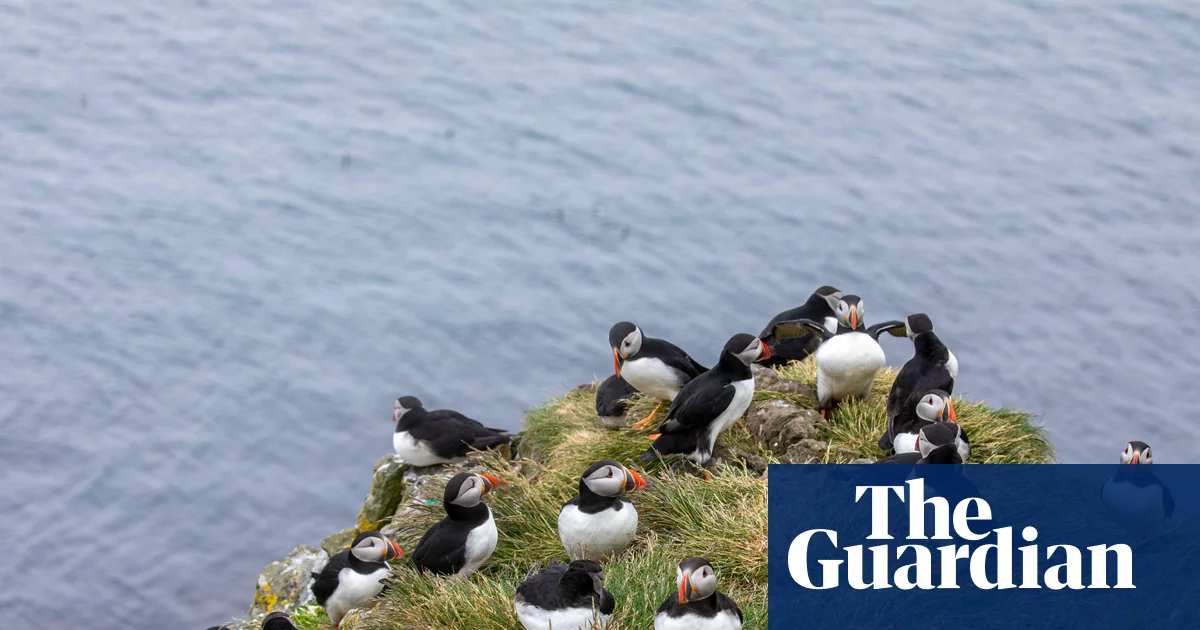
Last April, I based myself in Oban and took my teenagers puffin-watching at Lunga, off Mull, in the Treshnish Isles, with an organised tour (Staffa Tours) by ferry and foot. It was a real delight. The guides were brilliant and helpful, especially with my mobility issues, and we were surprised and amazed at how tame and friendly the puffins were – allowing us to get great views of their faces from as near as 5ft or so. Next spring, we are going again as this is the best time to see them arriving in their thousands. April
Profile
Readers’ tips: send a tip for a chance to win a £200 voucher for a Coolstays break
Show
Guardian Travel readers’ tips
Every week we ask our readers for recommendations from their travels. A selection of tips will be featured online and may appear in print. To enter the latest competition visit the readers’ tips homepage
–
Stunning architecture in the heart of Surrey
‘A National Trust gem’ … Homewood, architect Patrick Gwynne’s 1930s villa with a woodland garden, in Esher. Photograph: BritPics/Alamy
Grade I-listed Claremont Landscape Garden near Esher is great to visit in spring. But time your trip there right and you can also visit a National Trust gem just half a mile away: the Homewood, architect Patrick Gwynne’s 1930s modernist villa and accompanying woodland garden (for pre-booked guided tours only on specific Fridays and Saturdays, April-October). The house itself is stunning, with light pouring through the sitting room’s floor to ceiling windows, but on a sunny spring day the garden, complete with rhododendron tunnel, bamboo thicket, water gardens and stepping stones, proves a tranquil spot in which to linger and view the Le Corbusier-inspired abode. David M
Sheffield’s Tudor turret
The Turret House at Sheffield Manor Lodge. Photograph: Phil Wolstenholme/Alamy
One of our favourite days out as a family in spring is to explore the beautiful Sheffield Manor Lodge. There is a wealth of history to explore in the Turret – my young daughter loves telling everyone who’ll listen that Mary, Queen of Scots was detained here. There are also children’s trails, outdoor games and craft sessions – we’ve made stained glass kites, learned about a frog’s life cycle, had Easter egg hunts and completed outdoor yoga trails. On a warm spring afternoon, it is a stunning place – with a lavender maze, apothecary gardens, wildflower meadows and the amazing rhubarb shed cafe. Susan
Artistic treasure hunt on the North York Moors
Hanging Stones by Andy Goldsworthy in Rosedale. Photograph: Julian Broad/Ross Foundation
This magical mystery tour combines fresh air, beautiful, wild landscapes and art. The project is called Hanging Stones by Andy Goldsworthy, and it’s set in Rosedale. Several buildings that were in varying states of disrepair have been rebuilt as artworks and are connected by a six-mile walk encompassing Northdale, near Rosedale Abbey. You have to book a slot to find out where the key is, which you will pick up, together with a map, to get started. It’s the treasure hunt style that will get even the youngest in the group excited about the walk, allowing the adults to do something they wouldn’t otherwise dream of doing with children: admiring art and going for a decent walk. The cost is £10 per adult, while students and under-18s go free. Annelore
Dazzling azaleas in Gloucestershire
Springtime at Westonbirt Arboretum. Photograph: PA Images/Alamy
I always take my family to Westonbirt Arboretum near Tetbury in spring to celebrate the beautiful spectacle of nature exploding into a kaleidoscope of colour and life. The Arboretum is a breathtaking place, especially under a sunny sky. The well-marked paths mean you can easily wander through its 245 hectares (600 acres) and enjoy the fresh air filled with the delicate scent of blooming cherry blossoms. With more than 15,000 specimens and 2,500 species of trees and shrubs from across the globe, it serves as a stunningly beautiful living gallery. In spring, the arboretum dazzles with azaleas and rhododendrons bursting into brilliant shades of white, red and pink. My teenagers especially enjoy exploring the treetop walkway and quiet woodland trails – and a treat of tea and cake at the well-positioned cafe at the end of it all. Nicoletta
Wild garlic and lily ponds in Pembrokeshire
‘You might spot an otter or a heron’ … at Bosherston Lakes. Photograph: Edward Dyer/Alamy
For a springtime lift, head to Bosherston Lakes set in three limestone valleys with spectacular displays of lilies. Start in ancient woodlands, where there’s a shimmering, scented carpet of white wild garlic. It feels like a fairytale. Emerge at the serene lily ponds, where you might spot an otter or a heron, then follow the path to Broad Haven South. The moment you hit the dunes and see the beach open up is one of the finest coastal views in the UK. Finish with tea and cake at the nearby Stackpole Walled Gardens; it’s run by Mencap, so your pit stop supports a fantastic cause while you soak up the Pembrokeshire sunshine. Lucy Coast
Kites fluttering in the Chiltern skies
‘Really joyful’ … A kite festival at Dunstable Downs in Bedfordshire. Photograph: PA Images/Alamy
My favourite UK spring activity is flying kites with my family in the Dunstable Downs. The open hills and steady breeze make it the perfect spot to let our kites dance in the sky. There’s something really joyful about watching the colours flutter along with other kite-flyers. After some fun, we spread out a picnic blanket and enjoy homemade treats while soaking up the sunshine and taking in the beautiful views. It’s such a simple but special way to spend a bright spring day together outdoors. Victoria
A memorable walk in the Cotswolds
‘The perfect example of an idyllic Cotswolds village’ – Bourton-on-the-Water in Gloucestershire. Photograph: Ivan Okyere-Boakye Photography/Alamy
The circular walk from Bourton-on-the Water to the Upper and Lower Slaughters provides a buffet of springtime goodness, from trees in blossom and daffodils to wildflowers and nesting swans. Oh, and don’t worry, the Slaughters aren’t as morbid as they sound. They take their name from the Old English word slohtre, meaning “muddy place”, suggesting suitable footwear is needed. While Bourton-on-the-Water remains a tourist hotspot – the perfect example of an idyllic Cotswolds village – the walk towards the Slaughters via the Windrush Way and the Gloucestershire Way makes for a calming amble soundtracked by rivers and birdsong. Maxine Harris
Luscious blooms and afternoon tea in Devon
Killerton National Trust house and garden. Photograph: Peter/Alamy
Each spring, my family makes a pilgrimage to Killerton gardens in south Devon to see the glory of magnolia blossom on the south-facing slopes of Dolbury Hill, known locally as the Clump. The luscious blooms of pinks and ivory are the main attraction. It’s wonderful to see the children enjoy the release of running on the first-cut lawn and to watch their grandparents taking in the sight of the sea of daffodils. After a wet winter of grey skies, it’s also wonderful to have tea outside the house, basking in the sunshine. Simonetta Taylor
A Northumberland beach stroll
‘A great place for a leisurely wander’ … Beadnell beach. Photograph: Louise Heusinkveld/Alamy
Can anything beat standing on a beach getting a lungful of fresh sea air? I don’t care if I’m still having to wrap up in layers with a woolly hat, being on a beach feels like the start of summer. Beadnell beach in Northumberland is a great place for a leisurely wander, with cracking views and lots of dog-friendly places to refuel in the village. The breakfasts at the Courtyard Cafe have fuelled many a walk along the beach. Hannah S
Three weeks into spring practice, USC football coaches are making one thing clear: 95% of their best will not be accepted or tolerated. Wednesday’s practice started with some of the players doing up-downs after forgetting equipment.
“It was a good message from some of our staff and leaders in terms of the approach that we need to have every day that we come out here,” Trojans coach Lincoln Riley said.
A sentiment that was shared by junior defensive tackle Jide Abasiri: “We just have to be better prepared.”
After the hiccup, Riley said the team responded well and it was back to business.
USC defensive tackle Jide Abasiri (97) is pushing himself to be a more vocal leader as a the Trojans help young players get acclimated to the program.
(Gina Ferazzi/Los Angeles Times)
After a spirited day on the field on Tuesday following a one-week spring break, Wednesday’s practice was scripted with the intent to cause stress and create discomfort — stacking multiple two-minute drills after a 6 a.m. team meeting. The goal is to build a no-excuses program.
“It’s invaluable time, invaluable reps,” Riley said. “Coming out and working plays and the techniques, great. When you start putting those guys in real-life situations and you make it really difficult on them, you really start to see who rises up and they’re great teaching moments for these guys and for the team in terms of what we want to be and what we want them to be.”
Regardless of the mental challenges Riley applied, the Trojans’ morale remains positive as players compete for spots in the lineup. The energy of the team comes from within, Riley said.
“It allows us as a staff to really hone in on pushing these guys, and coaching and critiquing and correcting,” Riley said. “And they’re taking it well.”
Attention to detail has always been important at USC, but Abasiri said this year there is an extra emphasis being placed on play-specific details. The staff has implemented drills that focus on a player’s specific movement or job during various plays.
Entering his third season with the Trojans, Abasiri said he felt like he needed to be a team leader. USC landed the No. 1 class in the nation for the first time since 2006. With so many new young players joining spring practice and a limited number of Trojans with three years of experience, Abasiri felt it was his job to lead.
“Just being an older guy, I feel like it’s important for me to … help them just come along,” Abasiri said.
So far, his advice has been to “just have fun with it.”
“I mean, obviously, stay on top of everything and all your stuff, but I feel like people get so stressed and so caught up in what they’re doing that they forget that this is supposed to be enjoyable,” Abasiri said.
The coaching staff, meanwhile, is balancing teaching schemes and the playbook.
“You have to be able to do both at this level,” Riley said. “The new guys that came in did have a pretty good foundation. A lot of them came from really good programs. A lot of them had a pretty good working football knowledge to where when we got started with them, it wasn’t like you felt like you were starting from literal square one.”
Return game is still unsettled
USC is still working to identify its top kickoff and punt return options.
“We haven’t done a lot of live returns yet,” Riley said. “We’re just trying to figure out who really fields the ball well, who understands it, who makes decisions and honestly, the returners, they’re showing us a lot of what they can do just in the offensive and defensive periods.”
The coaching staff has a pretty good idea who some of the best players in that position are, but at the moment, they just want to develop the skills, from a return standpoint.
From Maddie Lee: Shohei Ohtani’s three straight strikeouts in the fourth inning of his final spring start Tuesday featured a different putaway pitch for each.
He got Angels slugger Jorge Soler to whiff on a sweeper. Jeimer Candelario went down on a curveball. And Jo Adell struck out on a fastball.
“Just shows the confidence he has and different ways he had to attack guys, to get ahead and also put guys away,” manager Dave Roberts said after the Dodgers’ 3-0 loss to the Angels in the Freeway Series finale. “And today the feel was really good, even better than the first outing.”
Pretty much everything was clicking for Ohtani heading into the regular season, even though it was only his second spring training start on the mound. Ohtani recorded 11 strikeouts in four-plus innings. He held the Angels to four hits, three of which were consecutive singles in the fifth, and was charged with three runs, all scored in the fifth.
For the first time in three years, Ohtani is set to begin the season as a fully healthy pitcher. And it will be the Dodgers’ first time managing his two-way schedule all year. Limited the last two seasons by his recovery and build-up from elbow surgery, Ohtani last made 20-plus starts in 2023 with the Angels.
“The desire is high,” Roberts said when asked about Ohtani’s aim to pitch wall to wall. “I think it’s realistic. Then the bigger question is, how are we going to manage that and navigate it?”
Get the latest on L.A.’s teams in the daily Sports Report newsletter.
By continuing, you agree to our Terms of Service, which include arbitration and a class action waiver. You agree that we and our third-party vendors may collect and use your information, including through cookies, pixels and similar technologies, for the purposes set forth in our Privacy Policy such as personalizing your experience and ads.
Can Kurt Suzuki lead Angels to success?
From Steve Galluzzo: Anxious may be the best word to describe the vibe in Anaheim before the Angels fly to Houston ahead of Thursday afternoon’s season opener versus the Astros.
New manager Kurt Suzuki has infused enthusiasm into a club that has not finished above .500 since 2015 and has missed the playoffs for an MLB-worst 11 straight seasons. The Angels went 72-90 and finished last in the American League West, though they were nine games better than 2024 — when they set a franchise record for losses with 99. Time will tell if the Halos have enough talent to contend in a division the Seattle Mariners are heavily favored to win.
A special assistant for the Angels the last three seasons, Suzuki signed a one-year contract last October and is the team’s fifth full-time manager since Mike Scioscia stepped down in 2018 after compiling a franchise-record 1,650 victories over 19 seasons. Suzuki spent 16 seasons as a major league catcher, retiring in 2022.
“It’s been fun,” Suzuki said prior to Sunday’s Freeway Series game, a 13-5 loss to the Dodgers at Angel Stadium. “Obviously I’ve never managed before but just being out of the game just as recently as a few years ago I understand the situations of the game, the speed of the game and those type of things. I’m not saying it’s going to be easy by any means. It’s a lot of work, but I’m having a great time, we’re surrounded by great people and the guys have been awesome so it’s been all good.”
As a former player, Suzuki will trust his instincts.
“For me, it’s attention to detail, it’s fundamentals, it’s just really being a baseball player,” he said. “Sometimes in this day and age of analytics and all that stuff you can kind of get lost in that sometimes. Not to say forget about it, but I think the more you can just play baseball how it’s supposed to be played, move guys over, situational hitting, things you grew up doing, if we can kind of keep that style and play hard and all that, I like our chances.”
From Bill Shaikin: Two decades after owner Arte Moreno decided the Angels should play under the Los Angeles name, elected officials representing Anaheim are pursuing two paths toward getting their hometown back into the team name.
Assemblyman Avelino Valencia, whose district includes Angel Stadium, has introduced state legislation that could require any sale or new lease of the stadium property be conditioned upon the team reverting to the Anaheim Angels name.
Meanwhile, Anaheim Mayor Ashleigh Aitken has asked the city attorney to explore whether the Angels have violated their current lease by dropping the Anaheim name from legal documents.
Not the best team in the country this year, but truly a testament to teamwork and hard work and talent retention.
Whether UCLA wins it all this season or not, the Bruins are the envy of teams everywhere, including Oklahoma State, whose season they ended with an 87-68 second-round victory Monday. Afterward, UCLA’s six seniors joined their teammates in one last victory lap around the court, waving to fans, soaking in the adoration, on their way to the Sweet 16 for the fourth consecutive season.
“Seeing a team who gets to host, a team who has stayed together, for the most part, they get to experience all the things that all of us want, and that is so incredibly rare and hard and special,” Oklahoma State coach Jacie Hoyt said.
But how much further those things will take these Bruins in the NCAA tournament after they fought off Oklahoma State?
Yegor Sharangovich scored in the fourth round of the shootout to lead the Calgary Flames to a 3-2 victory over the Kings on Tuesday night.
Olli Maatta and Zayne Parekh, each with their first goals of the season, scored in regulation time for the Flames, who have won four games in a row for the first time this season. Dustin Wolf stopped 23 shots.
Quinton Byfield scored both goals and Darcy Kuemper made 21 saves for the Kings, who have points in seven of their last nine but just three victories. They have dropped four straight.
Mikael Granlund scored twice, Alex Killorn had a goal and an assist, and the Ducks beat the Vancouver Canucks 5-3 on Tuesday night.
Mason McTavish and Troy Terry also scored for the Ducks, while John Carlson had three assists and Lukas Dostal stopped 27 shots.
The Ducks grabbed a 2-1 lead in the second period, only to see Vancouver rally and tie the score twice before McTavish scored the winner at the 5:45 mark of the third.
1934 — Horton Smith wins the first Masters golf tournament by one stroke over Craig Wood.
1947 — Holy Cross, led by George Kaftan, beats Oklahoma 58-47 in the NCAA basketball championship.
1958 — Sugar Ray Robinson regains the middleweight title for a record fifth time with a 15-round decision over Carmen Basilio.
1961 — Cincinnati ends Ohio State’s 32-game winning streak with a 70-65 win in the NCAA basketball championship. In the third-place game, St. Joseph’s beats Utah 127-120 in quadruple-overtime.
1967 — UCLA, led by sophomore Lew Alcindor’s 20 points, beats Dayton 79-64 for the NCAA basketball championship.
1972 — Bill Walton scores 24 points to lead UCLA to an 81-76 victory over Florida State and the NCAA basketball title.
1972 — Maryland beats Niagara 100-69 in the NIT championship, becoming the first team to score 100 points in the finals of the tournament.
1973 — The Philadelphia 76ers post the worst mark in NBA history at 9-73 under coaches Roy Rubin (4-47) and Kevin Loughery (5-26).
1982 — Wayne Gretzky becomes the first NHL player to score 200 points in a season.
1995 — Scotty Bowman gets his 900th regular-season coaching victory as the Detroit Red Wings beat the Canucks 2-1 in Vancouver.
2006 — Following the tradition of teenage American women pulling off big upsets, 16-year-old Kimmie Meissner uses the performance of her life to soar to the World Figure Skating Championships title.
2008 — Tennessee gives coach Pat Summitt her 100th NCAA tournament win, a 78-52 rout of host Purdue. The win sends the Lady Vols to the NCAA regional semifinals.
2011 — The Southwest regional is the first in NCAA men’s basketball history with three double-digit seeded teams in the semifinals. Virginia Commonwealth, an 11th seed beats 10th seed Florida State 72-71 in overtime and the top-seeded Kansas Jayhawks beat No. 12 seed Richmond 77-57 in the region’s other semifinal.
2012 — In the NBA’s first quadruple-overtime game since 1997, Joe Johnson scores 37 points and Josh Smith adds 22 as the Atlanta Hawks beat Utah 139-133. The four overtimes tie for the third-longest game in NBA history.
2016 — Klay Thompson scores 40 points and Stephen Curry adds 33 to help the Golden State Warriors become the second team to post back-to-back 65-win seasons with a 128-120 victory over the Dallas Mavericks. The Warriors improve their record to 65-7 following a 67-win season a year ago. The only other team to win at least 65 games in consecutive seasons was Chicago in 1995-96 and 1996-97.
2017 — Arrogate shows his class again in the $10 million Dubai World Cup as he comes from last place to win by an impressive 2 1/4 lengths.
Compiled by the Associated Press
Until next time…
That concludes today’s newsletter. If you have any feedback, ideas for improvement or things you’d like to see, email me at houston.mitchell@latimes.com. To get this newsletter in your inbox, click here.
Its historic cathedral, central attractions and pedestrian-friendly streets make it perfect for a UK staycation, especially now that it’s starting to warm up.
Nicola Roy Multimedia content creator and Esther Marshall
03:00, 22 Mar 2026
The city is very easy to walk around (Image: Teamjackson via Getty Images)
Spring has almost sprung, and now that the weather is getting slightly better here in the UK, there are more chances to get out and explore and enjoy the sun. You can’t beat a day or weekend trip somewhere new, and if you haven’t visited York before, consider this your sign to go this spring.
The stunning historic city earned the title of the UK’s most walkable city in 2023, according to LateRooms. Since then, it’s still considered one of the most pedestrian-friendly places in Britain, reports the Express.
There’s so much to do and see in York, from quaint cobbled streets lined with independent shops and eateries to a rich historical scene and plenty of green spaces too.
Among York’s highest-rated attractions is York Minster, which was previously crowned England’s most beautiful building.
One visitor wrote on Tripadvisor: “Tremendous place to visit and to marvel at what humans can achieve. You could spend a lifetime here and still find new pieces of craftsmanship.”
Visitors can also see one of the UK’s finest pieces of Royal history at the remarkable British landmark. York Minster houses one of the UK’s only statues of Queen Elizabeth II, which was installed to commemorate the Platinum Jubilee.
Also in York, you’ll find the Shambles – a medieval preserved street lined with timber-framed buildings and shops that feels like being frozen in time.
If you’re keen to spend some time in nature, Rowntree Park is a must-visit. With play parks for kids, tennis courts, skate parks and a gorgeous lake, it’s the perfect place to relax and soak up the sun this spring.
Taking to Tripadvisor, one fan wrote: “A beautiful well kept Victorian park with lots to do and see. Children’s areas, flower beds, arboretums, statues, and ponds. Lots of local wildlife. Excellent for a picnic.
“Cafe and toilets, all just a stone throw from York city centre and the racecourse. Well worth a visit.”
Brighton secured the second position on the list of walkable cities. Visitors can wander the seaside city’s Lanes before heading for an invigorating stroll along the promenade. Following a lengthy walk, there’s nothing better than a fish and chip supper on the beach with stunning sea views.
Bath claimed third spot on the list and is renowned for its remarkable Roman history and ancient baths. While tourists can’t bathe in the Roman baths, they will be able to unwind at the city’s spa instead.
Bristol was the greenest city on the list whilst London boasted some of the most city-centre attractions. Brighton, Inverness and Cambridge had the lowest levels of air pollution of any of the cities in the rankings.
Matt Fox, CEO and co-founder of LateRooms.com, said: “UK city breaks are as popular as ever and with spring around the corner, impromptu weekends away offer a great way to see and experience somewhere new.
“Getting to see all of the best sights somewhere has to offer in a short space of time can be hard work, but doing it on foot guarantees you’ll see so much more and stay active in the process too.
“All of Britain’s varied and historic cities offer something different and you can pack so much in without needing to set foot in a vehicle in almost all of them.”
Meanwhile Glasgow, Cardiff, Newcastle and Coventry were the least walkable cities in the top 20 rankings.
Spring is the season of creation, a time of renewal and new beginnings. In Los Angeles, alas, we were, last spring, a city of cinders. It was a time to mourn.
A hard year followed with floods, ICE, AI, etc., menacing our native optimism. Making matters worse, in December we lost L.A.’s grand visionary vizier, the architect who time and again built us out of civic funk and transformed L.A., inspiring the city he so loved to look good, feel good and do good.
But that is still the case. So many plans Frank Gehry imagined for L.A. still remain. Gehry bequeathed blueprints and models, sketches and concepts, for his large and devoted team of younger architects and next-generation visionaries equipped to fabricate our way out of angst.
Isn’t there supposed to be an Olympics on the way for which the city appears ill-prepared? Spring 2026 is the time to build.
A couple of springs ago, L.A. County dubbed the blocks around Gehry’s masterpiece, Walt Disney Concert Hall, the Grand Avenue Cultural District. This includes the rest of the Music Center, Museum of Contemporary Art, the Broad and Colburn School. The Grand, Gehry’s resplendent complex across the street from Disney, had recently opened and ground was about to be broken for the Colburn Center, a 1,000-seat concert hall equipped to also serve dance, opera and whatever yet-to-be-invented genres Gehry designed it to enable.
The Colburn Center is well on its way to completion next year. Bits of the building’s pink skin have started to peek out like spring blossoms on the construction site at 2nd and Olive. The Broad has begun an expansion. But after two years, nothing else has been done to make this the cultural district it must become, one unlike anything else in any city.
Four springs ago I toured Grand Avenue with Gehry to gather what he had in mind for an arts district. When Disney Hall opened in 2003, it instantly became an enduring symbol of L.A., overtaking the Hollywood sign in many cases. The Dodgers want to parade joy in winning their second World Series in row last October, where else but in front of Disney? But not in front of all Gehry had in mind.
We will soon have a pair of futuristic new museum buildings to show off this year: the David Geffen Galleries, the controversial Los Angeles County Museum of Art’s Peter Zumthor building (I predict it will prove a sensation), and the new Lucas Museum of Narrative Art (no predictions on that one) next door to the Coliseum. But the fact that each is a 15-minute ride away from the cultural district’s new Metro station only makes the district even more of a center.
A center, indeed. Gehry’s vision included completing the original plans cost-cut out of Disney a quarter-century ago, along with new modifications and much more throughout the area. Some are more costly than others. Enough could be done on Grand Avenue in time for the Olympics to make a difference if we begin this minute.
Since its opening, Disney has been — shamefully — the most poorly lit building of its stature in the world. Gehry had chosen the specific steel for its capacity to reflect light. His idea was to project on the building whatever concert was taking place that night. No sound, just imagery. Belt-tighteners didn’t want to commit the $2 or $3 million or whatever and go through the trouble.
It was spectacularly tested at the hall’s 10th anniversary, but with tacky prerecorded video and crummy amplification. Facilities are now included in the Grand for projectors. It would have been amazing in 2003 and will be amazing now. The Grand has been disappointingly slow to attract the restaurants, bars, cafes and shops it needs to create a scene. The projections could change all that and even create enough of a ruckus to get a reluctant, car-crazed city to make that Grand Avenue block pedestrian.
There is much more for Disney. Gehry wanted to turn BP Hall, where preconcert talks occur, into a small chamber music hall with a suspended balcony. He had plans for reconfiguring the seldom-used small outdoor Keck Amphitheater into an enclosed jazz club for Herbie Hancock and turning the little-used 1st Street entrance into a glass-enclosed bar that would be named the Ernest, in tribute to Ernest Fleischmann, the L.A. Phil executive director who was responsible for building Disney.
Disney was supposed to have a pit for the orchestra, allowing for staging opera and dance. The plans exist. That could be done in a summer for a couple million. Bottom-liners had also nixed Gehry’s original design for a more gracious lobby with a cafe out front, not the gloomy one installed against his will.
The Colburn Center has the potential for being another game changer for the area, a vibrant new hall where we are promised upward of 200 events a year from all walks of musical life, local and international. But Gehry had in mind even more.
He intended to lower the steep and pedestrian unfriendly 2nd Street hill, so that it would be an easy walk from the new Metro station two blocks away, and add two more pedestrian blocks by diverting traffic to the 2nd Street tunnel. This would connect the cultural district with Grand Central Market on one end and the Broad on the other. Then 2nd could itself become a lively street with the stores and restaurants a “district” needs.
A model of architect Frank Gehry’s design of an addition for Colburn School.
(Christina House/Los Angeles Times)
The extraordinary original plans for the Colburn Center included turning the parking lot across 2nd from the hall into a public plaza with a giant video wall and high-end outdoor sound system, for projecting nightly concerts in the hall. Gehry was a devoted outdoor-indoor architect, and he designed for the hall a balcony on which musicians can perform.
That initiative has thus far been blocked by City Hall officials, fearful of the tunnel’s aging infrastructure. Although if that’s the case, I’m not all that eager to be in the tunnel as it currently is when the Big One comes along. This is where L.A. shows its moxie. Upgrade the tunnel. Now! If this were Beijing, New Delhi or Hanoi, it would be a no-brainer.
Gehry next proposed building low-cost artist housing in Grand Park directly across from the Music Center, which would further create a true arts community. There has been talk of renovating the Dorothy Chandler Pavilion for three decades and that’s all it’s been. The corporate-esque recent Music Center plaza could use a little excitement, maybe a Phase II.
Arts make a city. The Edinburgh Festival in Scotland was created after World War II to help bring the city back to life. After its fire-bombing, Tokyo founded a bevy of symphony orchestras as a phenomenal experiment in mass antidepression. Beethoven’s Ninth Symphony played no small role in lifting the collective mood, preparing Tokyo to create what now feels like the world’s most arresting capital.
Unlike Scotland, unlike England, unlike Germany, unlike France, unlike Italy, unlike Poland, unlike Russia, unlike Finland, unlike the Czech Republic, unlike China, unlike any number of countries, America has no major international arts festival these days. We had one in L.A. in 1984 with the Olympic Arts Festival. The Cultural Olympiad in 2028 has shown no bones. But if we make the cultural district what it could be, there would be no better place anywhere for a major festival.
We have the goods. L.A. artists helped make the modern Salzburg Festival the meaningful model for all others. In 1992, the summer before Esa-Pekka Salonen became music director of the Los Angeles Philharmonic, he and the orchestra were invited to shake up clinging Austrian tradition. With the help of director Peter Sellars, they staged Messiaen’s epic opera “Saint François d’Assise,” with pyramids of televisions, resulting in music and monitors upending, in Mozart’s hometown, the role of the modern opera and, so to speak, the sound of music.
Over succeeding decades, both Sellars and Salonen have been Salzburg Festival lodestars. Last summer they were back staging two monodramas, Schoenberg’s “Erwartung” and “Abschied” (the last movement of Mahler’s symphonic song cycle “Das Lied von der Erde”). Conductor and director looked with shocking depth into the “Expectation” of death and gave a “Farewell” to the “Song of the Earth” we all await. I saw it twice and can’t imagine how anyone came away from it quite the same person, not more alive, not more fragile. Art on the stage doesn’t get deeper than “One Morning Turns Into an Eternity,” as Sellars named the production. Salonen, who conducted the production with Vienna Philharmonic, is now about to become the L.A. Phil creative director in the fall and will bring the production to Disney with the L.A. Phil next season. It is thus far the most important opera news of next season in America. All the more reason to build that pit in the hall and get started on much bigger plans.
Salzburg, which manages to come up with around $80 million from here and there, also helped with the question I’ve evaded: Who’s going to pay for all this? I’ve evaded it because it’s the wrong question. Money only started pouring into the building of Disney Hall when people got wind of what it was going to become. Five years ago, Crypto.com paid more than $700 million to change the name of Staples Center. That amount, which created nothing but an advertisement for a product of dubious value to society, is the price of two Walt Disney Concert Halls and probably all of Gehry’s projects put together. It is the amount that could fund nearly nine Salzburg-scale festivals.
If we let ourselves believe that L.A. wealth only cares for mega-crypto advertising, mega-mansions and mega-yachts, then L.A. is over. It isn’t. Do we want to show only that to the world? Downtown, and prominently Crypto.com Arena in L.A. Live, have been designated a center for LA28, as we’re calling the Olympics. That makes a graciously glorifying cultural district, which functions as creation being existential not commercial, just up the road from L.A. Live, L.A. live.
When one morning turns into an eternity, you don’t ask for the bill.
Phoenix — A sparse crowd braved the heat, which was approaching 100 degrees when Dodgers right-hander Shohei Ohtani walked off the mound at Camelback Ranch. But those who did were treated to a dominant pitching performance from the four-time MVP in his first start of spring training.
They repaid the favor with a standing ovation.
Ohtani limited the San Francisco Giants to one hit and overshot the innings goal manager Dave Roberts laid out Wednesday morning by pitching to one batter in the fifth inning. Ohtani didn’t give up a run in those 4 ⅓ innings, and the only other blemishes on the performance were a pair of walks and a hit batter.
“I was pretty happy with the pitch count today,” Ohtani said through interpreter Will Ireton. “In terms of the next outing, I do want to be better at executing in two-strike counts. I just didn’t finish off hitters as much as I wanted to.”
Ohtani is scheduled to make a start in the Freeway Series against the Angels before his first start of the season. If the rest of spring training goes smoothly, Roberts said he expects Ohtani to be ready to throw about five innings in his first regular-season start.
At that length, the Dodgers won’t need to designate long relievers to piggyback Ohtani’s starts. But Roberts stressed the importance of still carrying relievers who can throw multiple innings as the starters continue to build up early in the season.
“Once the season starts you’ve got to see how he’s feeling, how his stuff looks, how he’s throwing the baseball,” Roberts said after the Dodgers’ 5-1 win that was stopped after the eighth inning due to the heat.
Most of Ohtani’s build-up has taken place outside of competition, as he balanced playing in the World Baseball Classic for Team Japan as a position player, and addressing pitching on the side. By last week, he’d ramped up to a four-inning live batting practice session against his teammates on the national team in Miami.
“It actually didn’t feel like it was my first spring training outing,” Ohtani said. “I do see this as more of an extension of a live BP situation. So it didn’t feel too bad going into this game.”
Ohtani didn’t hit on Wednesday. With the heat and his unique spring, the team wanted to let him focus on pitching. He’s expected to be the designated hitter in Cactus League play Friday.
“In terms of the hitting, it did help that I played in an atmosphere that was pretty intense and competitive,” Ohtani said. “So the fact that I had to get things going earlier in the offseason maybe was the only thing that really affected my preparation. But I think it helped me more so than it hurt me, as I played through these meaningful games in the World Baseball Classic.”
Ohtani used a wide range of his arsenal Friday, landing an especially effective curveball for a called third strike against Heliot Ramos in the fourth inning.
“Never really surprised with him,” catcher Dalton Rushing said. “Everyone knows what he’s capable of. Everyone knows his main goal when he goes out there. He expects perfection every single time. And I think he was very, very close to it today.”
THE UK’s busiest and largest airport is launching a number of new routes over the coming months.
Last year, London Heathrow Airport saw around 84.5million passengers and is expecting to break the 85million mark this year.
Sign up for the Travel newsletter
Thank you!
London Heathrow Airport has a number of new routes launching over the next couple monthsCredit: AlamyThese include Tivat in Montenegro (pictured) and St Louis in AmericaCredit: Alamy
And this spring and summer, the world’s most connected airport is launching several new routes.
Dubbed America’s ‘gateway to the west’, the route will be launching as the famous Route 66 celebrates its 100th anniversary.
The stretch of Route 66 in St Louis, called ‘The Mother Road’ goes past landmarks including the Gateway Arch, the Old Chain of Rocks Bridge and Ted Drewes Frozen Custard.
Winding through the city, drivers on the route can stop off at neon-lit diners and a number of roadside attractions including the Route 66 Rocker – a massive 12.8metre-tall rocking chair.
The Guernsey route will then operate daily, also from Terminal 5, and cost from £101 return per person.
The new connection means that Guernsey residents will now more easily be able to travel across the globe by flying from Heathrow.
Guernsey is the largest of the Channel Islands and is known for having a mix of French and British culture.
One top spot to see is St Peter Port, a pretty harbour with charming houses.
As for the route to Tivat in Montenegro – this will launch on May 14, from Terminal 3 and cost from £172 return per person.
British Airways will be launching a route to Guernsey, creating a better connection for the island to international destinationsCredit: AlamyRecently named the most under-the-radar country, there will be new British Airways flights to MontenegroCredit: Alamy
Montenegro was recently named one of the most under-the-radar countries in the world, according to US News.
Tivat is found on the coast in the UNESCO-listed Bay of Kotor and features a large marina full of luxury yachts and pretty beaches such as Plaza Ponta.
Heathrow is also dubbing Tivat “one of Europe’s trendiest summer hotspots” thanks to its Adriatic scenery and offering travellers the perfect blend of sun, adventure and culture.
Low-cost Spanish airline Vueling will be launching a new daily service to Seville on March 29.
The route will operate from Terminal 4 and cost from £36 one-way, per person.
Spain is always popular with Brits and Seville is no exception.
The historic Andalusian city is great for both families and weekend city breaks with historic sites including the Cathedral – which is the largest Gothic temple in Europe – with La Giralda tower which has amazing views of the city.
Low-cost Spanish airline, Vueling, will be launching a route to SevilleCredit: AlamyThe city is home to the largest Gothic temple in EuropeCredit: Alamy
For a pretty souvenir, head to the Triana Neighborhood which is the historic district of the city and is known for its ceramics.
Another European route launching on the same day will be to Rome Fiumicino in Italy, with ITA Airways.
There will be two flights each day, operating from Terminal 2 costing from £138.24 return per person and the airport is about a half-an-hour drive from the city.
Rome, the capital of Italy, boasts several famous historical sites including the Trevi Fountain, the Colosseum, and the Pantheon.
And whilst you are in the city, you can even head to another country – Vatican City – where you can see St. Peter’s Basilica, the Vatican Museums and Michelangelo’s masterpiece in the Sistine Chapel.
ITA Airways will be launching a route to Rome Fiumicino – just 30 minutes from the capitalCredit: Alamy
A second US route launching soon will be to Seattle with Alaska Airlines.
Starting on May 22, the route will operate daily from Terminal 3 and cost from £523.04 return per person.
Seattle is one of America’s fastest-growing tech hubs and notable landmarks include the Space Needle observation tower and the Olympic Sculpture Park.
Foodies can also visit Chinatown, which is also home to the only pan-Asian art and history museum in America.
Pakistan International Airlines will also be launching two new routes by the end of March, marking the airline’s return to Heathrow after six years.
The first will be to Islamabad, the capital of Pakistan, on March 29, operating three times a week from Terminal 4, with return fares costing from £764.
The second route will be to Lahore, which is the second largest city in Pakistan.
The route will launch a weekly service on March 30, from Terminal 4.
And Alaska Airlines is launching a route to Seattle in AmericaCredit: Alamy
There are several travel warnings in place for Pakistan, so it is worth checking the Foreign, Commonwealth and Development Office travel advice before travelling.
Ross Baker, Heathrow’s Chief Customer Officer, said: “Every route launched from Heathrow gives passengers and businesses a new way to explore the world.
“Whether travelling for work or leisure, we are proud to collaborate with our airline partners to open up opportunities for passengers, exporters and importers.
“Greater connectivity is something passengers and businesses consistently say they want, which is why Heathrow expansion is so critical.
“It will add new routes and introduce more choice.
“Our plans will ensure the country gets the infrastructure it needs to stay competitive, connecting the whole of the UK to global growth.”
Breaks at the DWO Sirius -Adults Only start from £249 per person in MayCredit: UnknownThe hotel has an outdoor swimming pool with plenty of sun loungersCredit: loveholidays
The most affordable, but still with everything you need for a sunshine filled break, is at the DWO Sirius -Adults Only hotel on the Costa Brava in Spain.
The hotel has 161 rooms all decked out with modern amenities and air conditioning – which you might need in May as average temperatures can be as high as 24C.
Take a dip in the outdoor freshwater swimmingpool or relax on one of the sunloungers.
There’s a sun terrace too, restaurant, cafe, poolside snack bar, as well as an on-site gym – it’ll be quiet too as only guests age 16 and over are allowed.
The Spanish resort is a popular destination near PortAventura World, a theme park with over 40 attractions and huge rollercoasters.
It’s also close to sandy beaches likePlatja de Llevant, and the scenicCamí de Rondacoastal walk.
The hotel itself has rooms with air con, a TV, minibar and private bathroom.
It also has an outdoor swimming pool, restaurant, two bars along with evening entertainment and shows.
One visitor wrote: “Such lovely staff, food and hotel and we would go back again and didn’t want to leave.”
With loveholidays you can take a seven night break from May 2, 2026 from £269 per person.
This includes breakfast and return flights from London Stansted with Ryanair.
The four-star Hotel Best Punta Dorada is Salou on the Costa Dorada coastlineCredit: loveholidaysThe Gara Suites Golf & Spa has over 400 rooms and three outdoor poolsCredit: loveholidays
Or if you fancy jetting off to Tenerife, head to the Gara Suites Golf & Spa in Playa de las Americas.
In May, Tenerife temperatures can reach highs of 30C with around 10 hours of sunshine each day.
The Gara Suites Golf & Spa is a big resort with over 400 rooms as well as three outdoor pools and plenty of dining options.
It’s a top spot for families as it has a smaller pool especially for children, as well as a kids’ club and playground.
For golfing fans, there’s also a golf course short walk away – and the famous Siam Park waterpark is just a three-minutes drive away.
A seven night stay from May 14, 2026 starts from £339 per person – this includes breakfast and flights departing from London Stansted with Ryanair.
The Samos Hotel in Magaluf has a palm-tree shaped swimming poolCredit: Unknown
Another seven-night stay from £339 per person is available to book at the Samos Hotel in Magaluf.
The four-star Samos Hotel is right next to the beach and has a palm-tree-shaped lagoon pool.
It has 444 rooms spread across nine floors – some of which have sea views.
Inside there’s a spa with a small indoor pool, sauna, Jacuzzi and a range of spa treatments.
During the evening, there’s a full-on entertainment programme from shows to live music, bingo and karaoke.
The beach is an eight-minute walk away where there are lots of bars and restaurants.
You can eat at the hotel too as it has multiple bars, and restaurants that serve up classic Spanish food as well as international options too.
Majorca’s capital, Palma, is reachable within half an hour by car.
From ‘Brigadoon’ to ‘Riverdance’ to Bruce Springsteen to Lily Allen, here’s what we’re most looking froward to from April to June in the Los Angeles area arts scene.
If you’re on the hunt for the perfect spring getaway, this beach needs to be on your radar.
This article contains affiliate links, we will receive a commission on any sales we generate from it. Learn more
This spot has some of the best views in the country(Image: Getty)
As the UK welcomes warmer weather and springtime approaches, the allure of the beach becomes irresistible. With an abundance of stunning coastlines to choose from in the UK, deciding on the perfect spot can be a challenge.
Thankfully, the experts at Go Outdoors have done the hard work for you, compiling a list of the crème de la crème by analysing data from across the country. The research considered spring temperatures, rainfall records, sunshine hours and Google reviews of UK beaches, culminating in a definitive list of the nation’s top springtime beaches.
Taking the top spot is a breathtaking beach boasting 7.8 hours of daily sunshine during spring and minimal rainfall.
This idyllic location is none other than Cuckmere Haven in East Sussex, which achieved an impressive score of 9.60 out of ten in the Go Outdoors study. Visitors can enjoy picturesque river walks, a vast coastline and views of some of the country’s most renowned cliffs.
The beach itself is a sight to behold, but there’s also plenty to discover in the surrounding area. It offers one of the best vantage points of the Seven Sisters – England’s iconic white cliffs – and you can meander along the Cuckmere River towards the sea, reports the Express.
Praise for the beach abounds on TripAdvisor, with one gentleman enthusing: “Absolutely stunning scenery. Long walks and perfect for the family I loved every second of walking these beautiful cliffs. You can also see the Seven Sisters the whole time for those are into history.”
Another commented: “Wow – this iconic sight takes your breath away! The cliffs are blindingly white and the beach and surrounding countryside is so pretty. Everyone should see this once in their lifetime.”
Numerous visitors caution that some of the pathways around the beach can become muddy and slippery, so proper footwear is essential – though there are ample spots to pause and rest along your journey.
Calum Jones, author and outdoor enthusiast at GO Outdoors, advised: “When planning your spring beach trip, keep in mind that British weather can still be unpredictable. Bring a waterproof jacket to stay dry in case of sudden showers, choose supportive, waterproof footwear for any slippery sand or rocks, and layer your clothing so you can easily adjust to changing temperatures.
“Sun protection is also important, even in spring. Apply a generous layer of suncream before you head out, and don’t forget a cap and sunglasses to shield yourself from harmful UV rays.”
AS SPRING emerges, your Instagram feed will soon look like a sea of pink as people head off to find cherry trees blossoming – and the UK has some great free spots to see them.
Known as ‘hanami’, the tradition of seeing cherry blossoms is a centuries-old Japanese custom.
Sign up for the Travel newsletter
Thank you!
There are a number of places you can see blossom trees for free across the UKCredit: AFP
Taking place in the spring, the tradition celebrates the blossoms which symbolise new beginnings, mortality and the beauty of life.
While the UK doesn’t have anywhere near as many blossom trees as Japan does, there are several locations across the UK where you can catch them blooming for free – here’s some of the best.
Battersea Park, London
In South West London, head to Battersea Park and you will find a long run of cherry blossom trees on Cherry Tree Avenue.
If heading to the park, make sure to enjoy a wander next to the River Thames whilst seeing the 40 blossom trees.
The Meadows is a large public park south of Edinburgh‘s UNESCO World Heritage Old Town.
The park is even protected by an Act of Parliament, that was created in 1827.
During the spring, there are avenues of cherry trees.
They are known to bloom a little later than other places, usually starting to bloom in April.
In Edinburgh, The Meadows has an avenue of cherry treesCredit: Getty
Pittencrieff Park, Dunfermline
Up in Dunfermline, Scotland, head to Pittencrieff Park and walk along the path near the main entrance to enjoy a row of cherry trees that line the path.
The cherry trees usually blossom here in late April and whilst you are exploring the park, make sure to look out for its resident peacocks and the Andrew Carnegie statue.
Nearby, you can also visit Dunfermline Abbey and Palace.
Castle Park, Bristol
Castle Park in Bristol is an open space between the city’s Shopping Quarter and the Floating Harbour.
In addition to ruins in the park, visitors will be able to find different cherry trees.
One spot is the cherry avenue, with 21 trees.
And the other spot is a singular, white Japanese Cherry Tree that was planted in 2014 to mark the 70th anniversary of Hiroshima.
This type of cherry tree had actually died out completely in Japan, but was saved when a single specimen of the tree was found in England in 1923.
Paid-for spots to see cherry blossom in the UK
Kew Gardens, London – has a dedicated cherry walk and Sounds of Blossom festival
Alnwick Garden, Northumberland – home to the world’s largest orchard of Taihaku (Great White) cherry trees
Batsford Arboretum, Cotswolds – over 120 Japanese flowering cherry trees
RHS Wisley Garden, Surrey – an avenue of 140 Yoshino cherry trees
PHOENIX — Unable to ramp up through the first month of spring training because of lingering shoulder soreness, Dodgers left-hander Blake Snell took a step toward readiness Thursday, throwing his first bullpen session.
Two hours before Thursday night’s Cactus League game, Snell threw off the mound in front of a group of reporters and fans at Camelback Ranch. Snell threw 15 pitches — all fastballs — sitting between 87 to 89 mph.
“I feel good,” Snell said after his bullpen. “I was very excited to throw off the mound again and pitch. I’ve been looking forward to this for a while. This being like the first one where I actually could have the catcher down. I was still limited to what I could throw. I was throwing 87 to 89 [mph]. It felt effortless, easy, could command the ball, so [I’m] happy with that. [I’m] just happy to continue to grow and get better.”
The two-time Cy Young Award winner says he’s targeting an April return, and that he’s hoping to get back faster than initially expected.
“I want to pitch in April,” Snell said. “That’s my goal. So, I’ve kind of been the one pushing it, and they’re being more cautious. I think we’re just talking a little back and forth, but I think them seeing me throw a pen today, hopefully that just gives them more confidence to keep it going. I think we won’t really know until I throw a live [batting practice], I think that’s when we’ll really know. How do I recover from that? How do I feel? And then that will be like, ‘OK, let’s get him into games.’ That’s what I would envision. I’m not the front office or Dave, but that’s what I would think.”
Dodgers manager Dave Roberts, however, isn’t ready to give a timetable for Snell’s return.
“I think honestly, to think about when he’s going to come back, we’re just a ways away from even really having that conversation,” Roberts said, noting that six weeks is “the floor” when you also account for a potential rehab assignment.
Thanks to the depth of their pitching staff, the Dodgers can afford to be patient with building up Snell. Right-handers Emmet Sheehan and River Ryan, along with left-hander Justin Wrobleski, are all possibilities for starting assignments early in the season.
“We still need him to pitch, and I know he understands that,” Roberts said of Snell. “But we do have the luxury of trying to err on the side of caution. … We are certainly better when he’s pitching for us, when he’s active.”
Snell, for his part, is thankful to be throwing again without shoulder pain.
“The whole offseason, I mean, every throw kind of hurt,” Snell said. “It was just every throw, I could feel my shoulder. It was just cranky and I couldn’t get it going. And I thought I was doing everything I needed to, and I believe I was, and ultimately, I’m feeling better.”