The federal judge upheld a ruling that a Reconstruction-era federal ban on home distilling of alcoholic spirits because they could be difficult to tax is unconstitutional. File Photo by BIllie Jean Shaw/UPI
April 11 (UPI) — A federal judge upheld a previous ruling that that a Reconstruction-era federal ban on home distilling of alcoholic spirits is unconstitutional.
The 158-year-old law was aimed at preventing people from skirting tax collectors when it was enacted in an 1868 law that imposed excise taxes on distilled spirits and tobacco that was challenged by a man who wanted to distill bourbon whiskey at home.
The Fifth Circuit Court of Appeals on Friday overturned the law that has barred people from producing liquor in their homes because the federal government does not have the right to use its power of taxation to criminalize at-home distilling, FoxDC5 reported.
“The government contends that this prohibition was enacted to prevent tax evasion because ‘[a] distiller can more easily conceal a spirit’s strength (and thus avoid the proper tax rate) or conceal a distilling operation altogether if his still is in his house or connected with it,” the court said in its opinion.
“Congress’s taxing power ‘reaches only existing subjects,’ not activity that may generate subjects of taxation,” the court said. “Put otherwise, preventing activity that lest it give rise to tax evasion places no limit whatsoever on Congress’s power under the taxation clause.”
Although in-home production of beer and wine for personal or family use is legal, producing spirits at any location that is not an Alcohol and Tobacco Tax and Trade Bureau-qualified and licensed facility is not legal, the U.S. Department of Treasure, under which the Bureau exists, said on its website.
The lawsuit was brought primarily by Rick Morris who manufactures stills for legally approved distilling operations and wanted to distill bourbon whiskey at his home for his brother and friends.
Upon finding that he could not legally do this, Morris founded the Hobby Distillers’ Association, members of which joined him in the legal battle.
While the ruling does not mean in-home distilling is a free-for-all, it means that people can obtain permits from the bureau to set up a distillery, follow federal regulations and pay applicable taxes, the HDA said in a blog post.
“This is a major victory for the plaintiffs — including members of the Hobby Distillers’ Association — and a turning point for hobby distillers nationwide,” the organization said.
Secretary of Defense Pete Hegseth speaks during a press briefing at the Pentagon on Wednesday. Yesterday, the United States and Iran agreed to a two-week ceasefire, with the U.S. suspending bombing in Iran for two weeks if the country reopens the Straight of Hormuz. Photo by Bonnie Cash/UPI | License Photo
Weekly insights and analysis on the latest developments in military technology, strategy, and foreign policy.
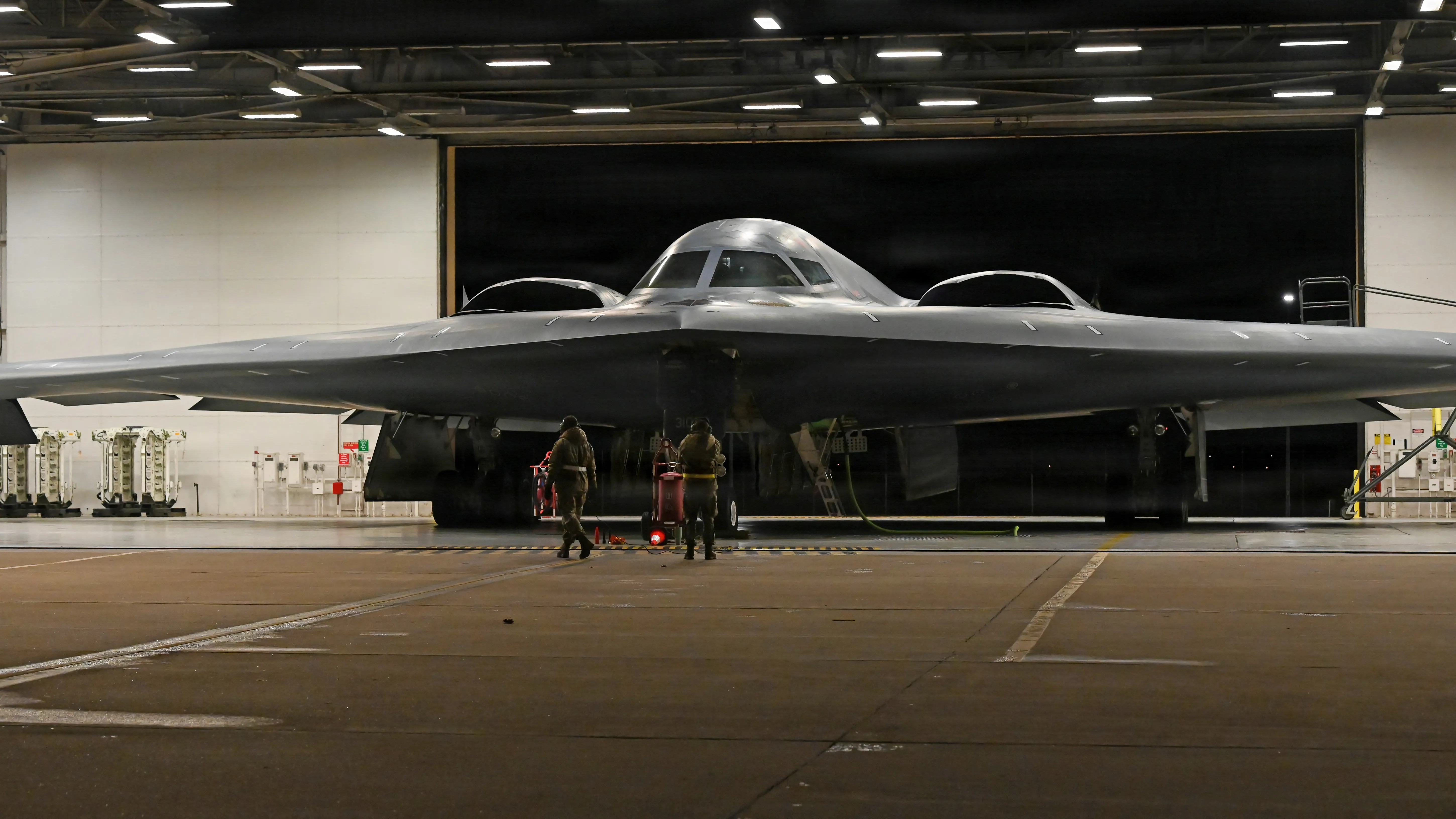
The B-2 Spirit has done what no other asset can do during the war with Iran — flying into dangerous airspace to release heavy weapons capable of penetrating even the most hardened targets. While B-1Bs and B-52Hs have forward deployed to the United Kingdom for their missions over and near Iran, the B-2s have flown smaller numbers of missions from their home at Whiteman Air Force Base in Missouri. At this time, there is no evidence that B-2s are operating out of Diego Garcia or anywhere else for the war effort. Still, they are delivering punishing blows, as represented in art on at least one of their gear doors. Beyond mission markings, some new features that just appeared along the aircraft’s huge leading edges are puzzling to say the least.
U.S. Air Force crew chiefs perform pre-flight checks on a B-2 Spirit stealth bomber during Operation Epic Fury, March 17, 2026. (U.S. Air Force photo) (U.S. Air Force photo)
We spotted these white rectangles with black borders that are sealed onto the B-2’s leading edges in images released today by U.S. Central Command (CENTCOM), showing a pair of the stealth bombers about to launch from Whiteman on another global airpower mission to Iran on March 17, 2026. The rectangles mirror themselves near the upper and lower leading edges and appear to use the typical tape method of sealing to keep the jet’s radar cross-section as low as possible.
The white squares are very loosely reminiscent of test marks the B-2 has worn at different times during its first decade of flying, when it was deep in trials. Why anything like that would be present on a combat mission, and on two separate aircraft, is puzzling. The possibility that they augment and mask the B-2’s radar signature is also worth bringing up, but the aircraft has other ways of doing that and why would B-2s fly missions without their stealth benefit, especially all the way from the United States, when other platforms are forward deployed for those applications? Delivering the Massive Ordnance Penetrator in permissive airspace is one potential reason, but again, why go through all the trouble when the aircraft can just hit its targets in standard configurations? The threat of losing signature data to threat systems is always a possibility, but whether it would drive such a modification is unclear.
(Public Domain) (Northrop Grumman)
It’s also possible that this is some kind of new sensor or electronic warfare installation, and that these are small apertures for whatever lies beneath. Enhancing the B-2’s ability to sense threats in its combat environment and react in real time to them, including by avoiding, attacking or jamming them, would be very important to its survivability over future battlefields. Also, making the Spirit more capable of communicating with assets even while keeping as stealthy as possible would be key. All these kinds of upgrades are important to making sure the B-2 remains relevant for the rest of its service life.
The byproducts of a new coatings upgrade for the Spirit are another possibility. The B-2’s radar-absorbent material (RAM) coatings are absolutely critical to its success, but are also one of the major drivers of its immense operating costs. Improvements to the coating’s materials and processes of applying them have been constant throughout its life as the USAF seeks to increase its availability rate and lower its cost per flight hour. This has changed the appearance of the B-2 over the decades. New technologies from the B-21 Raider program, for instance, are being applied to the B-2 in order to help address these issues.
So, we just don’t know what these new features are for, or if they will remain a staple on B-2s that receive them going forward.
How the B-2’s leading edge normally looks. (U.S. Air National Guard photo by 2nd Lt. Chris Bishop) 2nd Lt. Christopher Bishop
Also of interest is the aforementioned mission markings on one of the B-2’s nose gear doors. It shows 15 bombs. While we cannot say for certain what exactly this represents, it’s more likely that it denotes combat missions rather than individual weapons dropped. That still seems like way too many long-range strike flights from this operation for this aircraft, especially considering the image was taken a week ago, but it probably includes combat missions from last year, as well.
U.S. Air Force crew chiefs perform pre-flight checks on a B-2 Spirit stealth bomber during Operation Epic Fury, March 17, 2026. (U.S. Air Force photo)
Another possibility some may raise is that it could denote how many GBU-57/B Massive Ordnance Penetrators (MOP) this B-2 has dropped, but again, this number seems like far too many. In fact, it is not even clear if any MOPs have been employed in this campaign, and 15 would equal more than the total dropped by all the B-2s involved during Operation Midnight Hammer last June.
Like so many things Spirit, we just don’t know what we are looking at. The aircraft is an American icon and has now entered the backend of its operational career, with its successor and legacy, the B-21 Raider, waiting in the wings. At the same time, much about the B-2 remains a secret and likely will for years after it finally flies its last operational sortie.
This is also something of an abstract indicator of just how far ahead of their time Northrop’s engineers were when they gave birth to the world’s first stealth bomber, an aircraft that is more prized now as a national asset than anytime in its three-decades-long career.
A B-2 Spirit stealth bomber prepares to take off to conduct a mission during Operation Epic Fury, March 17, 2026. (U.S. Air Force photo)
Argentina’s spunkiest duo Ca7riel & Paco Amoroso have checked themselves into a wellness center for their latest album, “Free Spirits.”
Out Thursday, the LP pushes the limits of the duo’s experimentation, combining unpredictable blends of trap, rock and pop while still maintaining their raunchy sense of humor and musicianship. The 12-track project features collaborations with British musicians Sting and Fred Again, as well as California’s very own Anderson .Paak and Jack Black.
It’s been a busy year for the avant-garde pair, who won their first Grammy in February for their nine-track EP, “Papota.”
At the ceremony, they hinted at a rebrand for the upcoming album; both appearing on the red carpet wearing matching tan robes — a look far less flashy than the custom Versace outfits they wore at the Latin Grammys in November.
“We are trying to heal that velocity that we had in the past year. If you go so fast, you’re going to crash,” Paco Amoroso told Billboard in February. “We are healing ourselves now.”
Following their Tiny Desk performance in Oct. 2024 — which has reached over 27 million views to date — the Buenos Aires singers have etched an unpredictable, kooky path in the crazed music industry, often by criticizing it.
First, their 2025 EP “Papota” humorized their rapid ascent to stardom and poked fun at how artists must dilute their image to fit the mainstream.
Now through their LP “Free Spirits,” they continue to comment on the trope of the burned-out, exhausted artist who through a soul-stripping retreat can find renewal once again.
That purported healing is taking place at “Free Spirits Wellness Center,” a mock-up clinic led by Sting dedicated to advance physiological and cognitive expansion for people working under intense pressure.
In a music video released Wednesday, Ca7riel & Paco Amoroso checked themselves in after taking home five gramophone trophies at the 26th Latin Grammys.
Among the 12-step treatments are skin-changing artotherapy, where patients endure a painful micro-needling session combined with a non-goal-oriented painting session; cryo cerebral rebirth, where the brain regresses to its early developmental stages; and temperature contrast celibation, where they receive an ice bath combined with sexual arousal restrain.
None of these treatments make clear sense — mainly because they aren’t real — but that’s exactly Ca7riel & Paco Amoroso’s point: Fame is all make-believe pandemonium and there is no real recovery from it.