spent

L.A.’s police union spent big in the city runoff election, only to lose key races

L.A.’s police union went all out in this year’s city elections.

The Police Protective League poured well over $7 million into efforts to defeat mayoral candidate Nithya Raman over the last seven months, putting out attack ads, text messages and even a multi-page brochure highlighting her support from Democratic Socialists of America.

Raman beat Mayor Karen Bass anyway. And that wasn’t the only race where the PPL fell short.

The league, which represents about 8,500 officers, spent more than $1 million on its unsuccessful effort to torpedo Measure FD, the half-cent sales tax hike to fund the fire department. The union also waged campaigns this year against Marissa Roy for city attorney and in favor of Tim Gaspar, who lost his council race to Barri Worth Girvan in the San Fernando Valley.

Other big spenders faced similar losses.

You’re reading the L.A. on the Record newsletter

Sign up to make sense of the often unexplained world of L.A. politics.

The Central City Assn., a downtown-based business group, put $3.8 million into outside campaigns supporting Bass, with about two-thirds coming from Airbnb. The group spent nearly $2.2 million boosting city attorney candidate John McKinney, who lost to Roy by a huge margin.

To hear the police union tell it, the year wasn’t a total bust. The league spent more than $1 million helping City Councilmember Traci Park fend off a potent challenge from attorney Faizah Malik in her Westside district in the June 2 primary. Several other police union-backed incumbents — including Tim McOsker and Monica Rodriguez — also sailed to primary victories.

The league cheered City Atty. Hydee Feldstein Soto’s primary loss, said PPL spokesman Tom Saggau. The union publicly rescinded its endorsement of her last spring, saying she had not been forthcoming about a data breach of records involving police cases. Feldstein Soto disputed that framing.

Saggau said the union is exploring a campaign to repeal Measure FD, which he described as a regressive “forever tax.” And he portrayed the Bass reelection effort as a challenge from the beginning, with voters locally and across the nation furious over dysfunctional government and rising costs.

“Affordability was massively important,” he said. “But we don’t have a big megaphone on affordability.”

Saggau said the union focused its public safety message on politically moderate parts of the city, including San Pedro, Westchester, parts of the San Fernando Valley and Pacific Palisades, where thousands of homes were destroyed in a massive wildfire last year. Bass performed better in those areas than many others, he said.

Raman takes office on Dec. 14. A month later, the PPL is slated to begin negotiations with the city over its next contract.

Pulling back from McKinney

The candidate in the city’s runoff election who received the biggest drubbing was McKinney, who lost to Roy in the city attorney’s race by a 2-to-1 margin.

As it turns out, some of McKinney’s biggest financial supporters ramped down their spending once they got past the June 2 primary election, when he and Roy knocked Feldstein Soto out of the running.

The Central City Assn. spent more than $2 million during the primary on a campaign promoting McKinney, all of it from Airbnb, but only $100,000 in the runoff. The police union spent about $356,000 against Roy in the primary, but nothing during the runoff.

Saggau said the PPL got involved in the race out of dissatisfaction with Feldstein Soto, who made enemies with the Central City Assn. as well.

“While John McKinney’s platform was more closely aligned with our priorities, we are confident that City Attorney-elect Roy understands the issues facing our members and is prepared to address them,” Nella McOsker, the group’s president and chief executive, said in a statement.

Airbnb also didn’t put money into any pro-McKinney campaigns during Round 2. In a statement, Airbnb senior public policy manager Justin Wesson said both runoff candidates offered a “positive vision for the city.”

Feldstein Soto was unavailable for comment on Friday. Her office sued Airbnb last year over allegations of price gouging, which the company denied. During her reelection campaign, she assailed McKinney over the money spent by Airbnb on his behalf.

Powered by the Palisades?

It might seem counterintuitive, but Pacific Palisades, a hotbed of anti-Bass sentiment since the 2025 Palisades fire, broke hard for the departing mayor over her challenger, according to preliminary vote counts.

On election night, when more than 730,000 ballots were tallied, Bass was leading Raman in all three Pacific Palisades precincts. Bass had at least 64% of the vote in each of them.

Those results could change once the Los Angeles County Registrar-Recorder/County Clerk releases precinct results for the hundreds of thousands of ballots that have been counted since election night.

Four years ago, voters in the Palisades turned out in large numbers for real estate developer Rick Caruso, who lost to Bass citywide. This time around, Caruso told voters he was backing Bass.

Maryam Zar, who runs the Palisades Recovery Coalition, attributed the mayor’s strong showing in the neighborhood to the decision by Park, the local city councilmember, to publicly support her reelection. Park’s announcement, made during the campaign’s final weeks, swayed many Palisadians, she said.

“It was a vote for Traci Park,” Zar said.

State of play

— MENDING FENCES: They may have opposed her bid for mayor, but on Tuesday the City Council said mostly nice things about Raman during her first appearance on the council floor since the election. “They are making a calculated pivot to play nice,” said Sara Sadhwani, a politics professor at Pomona College. “Let’s see how long it lasts.”

— KNIFE’S EDGE: The race for the council’s 9th District still hasn’t been called, with former council aide Jose Ugarte leading community organizer Estuardo Mazariegos by just 41 votes, according to the latest tally released Friday evening.

— A CRASHING ‘WAVE’: Speaking at a press event for the first time since she lost the election, Bass said she believed she was swept out in a change election, which she described as a national wave. “This happens every five or six years, that voters get in a space where they just want everything new,” she said.

— MAKING HISTORY: Voters broke new ground this year, electing Asian Americans to all three of L.A.’s citywide elected offices. Raman came to the U.S. from India as a child, while Roy’s mother also emigrated from India. City Controller Kenneth Mejia, reelected in June, is Filipino.

— REPLACING RAMAN: Residents in Raman’s Hollywood Hills district have begun worrying that the council might skip a special election to fill her seat and simply appoint someone to fill her seat for the two years. Neighborhood leaders have already started urging the council to call a special election. “Any other way is essentially backroom anointment,” said Rob Glushon, president of the Encino Property Owners Assn.

— HIKING CITY FEES: The council moved ahead with a plan to boost the cost of filing challenges to the city’s real estate development decisions, hiking the fee from $229 to $1,145 for those who live near a project. The increase would be even larger for those who live farther away. YIMBYs applauded the move, while one critic said it is designed to “shut the people up.”

— SALES TAXES TOO: With the passage of Measure FD, the sales tax rate in L.A. will increase to 10.75%, up from 10.25%. The measure will pay for fire department operations.

— RAMAN’S DILEMMA: On the campaign trail, Raman was highly critical of Police Chief Jim McDonnell, promising she would replace him if elected mayor. Now, with a showdown brewing, she will have to decide when and how fast to change out department leadership.

— STEPPING IT UP: One week after the polls closed, election workers in Los Angeles County had processed about 99% of the 3.2 million ballots cast in the Nov. 3 election. That’s a faster pace than previous election cycles.

— HERE’S HORVATH: Speaking of L.A. County, Supervisor Lindsay Horvath threw her hat in the ring to run for countywide chief executive in 2028. She’s viewed as a top contender for the brand-new office, which was created as part of a ballot measure she co-authored in 2024.

— HOW RAMAN WON: Here’s the backstory on how Raman won her campaign for mayor, which started in an ADU behind her Silver Lake home.

— TURNING THE TABLES: Bass ran on her ability to work well with others. But in the end, she saw key relationships disintegrate during her tenure, with several onetime allies working to drive her out of office.

— IDOL GOSSIP: Rock legend Billy Idol made a visit to City Hall on Friday, serving as the main attraction for the event Councilmember Monica Rodriguez — an aficionado of ’80s bands — called “Billy effing Idol Day.” Idol offered his thoughts on cities, telling the council “as long as you give, they give something back.” He then went out to the building’s Spring Street steps, where he played several songs before a cheering crowd.

QUICK HITS

  • Where is Inside Safe? The mayor’s signature homeless program did not go to any new locations this week.
  • On the docket next week: The council’s transportation committee meets Wednesday to discuss a proposal to let volunteers repaint aging crosswalks at city intersections.

Stay in touch

That’s it for this week! Send your questions, comments and gossip to LAontheRecord@latimes.com. Did a friend forward you this email? Sign up here to get it in your inbox every Saturday morning.

Source link

I spent the night in one of the UK’s most haunted jails

“IS there anybody there?” I whisper into the darkness, silently praying I don’t hear a response.

It’s a Friday night and I’m sitting in the dark in Cornwall’s Bodmin Jail in a bid to make contact with the spirits that apparently roam this former prison.

Visit Cornwall’s Bodmin Jail Credit: Supplied
Built by prisoners of war in 1779, it became Cornwall’s county prison for more than 150 years and 55 public executions took place here

My husband Paul and I are sampling a thrilling experience, My Haunted Jail — Paranormal Investigation, which runs twice a week.

Upon arrival, visitors are split into pairs and taken to separate parts of the prison before being left to their own devices to see if they can conjure up any ghouls from the past.

Folklore is etched into the facility’s walls.

Built by prisoners of war in 1779, it became Cornwall’s county prison for more than 150 years and 55 public executions took place here.

WAIL OF A TIME

I drove Irish Route 66 with deserted golden beaches and pirate-like islands


TEMPTED?

Tiny ‘Bali of Europe’ town with stunning beaches, €3 cocktails and £20 flights

No wonder people think it’s haunted . . . 

One of the most infamous inmates, I learn, was Matthew Weeks, hanged in 1844 for the murder of Charlotte Dymond.

Both spirits have supposedly been spotted on different occasions, with Matthew wandering around pleading his innocence.

Another notable figure is Selina Wadge, who was hanged for the murder of her disabled son in 1878 and whose spirit preys on youngsters visiting the jail.

The Sun’s Natasha Harding in the stocks at Bodmin Credit: Supplied.
Natasha’s husband Paul is banged up behind bars Credit: Supplied.

The only prisoner ever to escape Bodmin was an inmate named Henry.

He allegedly vanished into thin air in 1897 and some believe his spirit still walks the corridors today, trying to find a way out.

We begin our paranormal experience in the naval wing, home to a museum that highlights the original cells and stories of those caged here.

There was a definite ghoulish atmosphere — no surprise when in a cold prison after dark.

While we didn’t experience any chills or things that go bump in the night, many people have reported feeling their clothes being tugged, or claimed to hear children screaming and keys rattling, as well as heavy footsteps.

Every part of the jail has been fitted out with cameras, so any paranormal activity can be caught on film and potentially used on the next My Haunted Project TV show.

Paul was the first to try the Bloody Mary challenge — a trend that’s been doing the rounds for a few years now.

It involves participants trying to summon the ghostly spirit of Bloody Mary by speaking her name three times into a mirror in a dark room.

Stay in one of Bodmin’s plush rooms Credit: Supplied
Bodmin Jail opened 70 lavish bedrooms — all of which are significantly more glamorous than the damp and dingy rooms we’d just been exploring

There have been reports of a shadow appearing or people being pushed and hearing whispers, but much to my relief, nothing materialised. May­be the ghouls sensed my apprehension?

After trying and failing to summon Bloody Mary, each pair of visitors were given 40 minutes in each section of the jail before being moved on by walkie-talkie in the dark.

Silently, we made our way through the jail, creeping into the administration block and then the courtroom.

It was very hard not to be moved by the stories of the people who were once housed in the prison as we wandered the eerie corridors.

It wasn’t just evil murderers who were locked up there, though — many people were jailed for petty crimes such as theft, as well as for being mentally ill.

In times gone by, there was no segregation, with men and women being caged together — and sometimes kids even accompanied their imprisoned mothers.

Our evening finished at 2.30am and although we didn’t experience any ghostly jumps, I was relieved to escape the damp cells and head to the comfort of a warm hotel room.

Following a £50million makeover in 2021, Bodmin Jail opened 70 lavish bedrooms — all of which are significantly more glamorous than the damp and dingy rooms we’d just been exploring.

Created from three former cells, each room retains original features but has modern-day upgrades and homely touches — thank goodness.

The next day, I learned that our now lovely looking room once housed 17-year-old apprentice, James Grenfell Trewhella.

He was jailed in 1848 for ­setting fire to a workshop and a carriage owned by his wealthy boss, Penzance coachbuilder John James.

At least he wasn’t convicted of murder, I suppose . . . 

GO: BODMIN JAIL, CORNWALL

THE My Haunted Jail – Paranormal Investigation experience runs every Friday and Saturday and costs £50pp.

STAYING THERE: One night’s B&B at the hotel is from £180.

See bodminjail.org.

Source link

More than $351 million spent on wealth tax on November ballot.

More than $351 million in political donations has been poured into a high-stakes contest about a proposed wealth tax on the November ballot, making it one of the most costly campaigns in California history.

About 90% of the money is being spent to defeat a statewide initiative to impose a new tax on the assets of billionaires, a multifaceted opposition effort bankrolled primarily by ultra-rich Californians being targeted by a measure that supporters call an economic reckoning.

The billionaire tax, Proposition 40, would levy a one-time, 5% tax on many assets of California billionaires who lived in the state as of Jan. 1.

Millions of dollars continue to flow into the campaigns of three intertwined ballot initiatives at the center of the debate: Proposition 40, and Propositions 41 and Proposition 42, which would neuter the Proposition 40 through strategic, esoteric tax law changes.

“The pro-40 campaign picked a fight and then came to that fight with a butter knife against a nuclear arsenal,” said GOP strategist Rob Stutzman, who is not involved in any of the wealth-tax-related ballot measures. “Because they’re so well funded, in today’s multifaceted media world, they are able to show up everywhere from network TV to inside video games. That is a very, very large advantage few campaigns ever get to have.”

But, Stutzman warned, money does not guarantee a win.

In the most expensive ballot measure fights in California history, $463 million was spent on two gambling proposals 2022. The initiatives pitted some of California’s most successful Native American tribes with gaming interests against gambling corporations, including online sports gaming companies DraftKings and FanDuel. Both side’s measure failed.

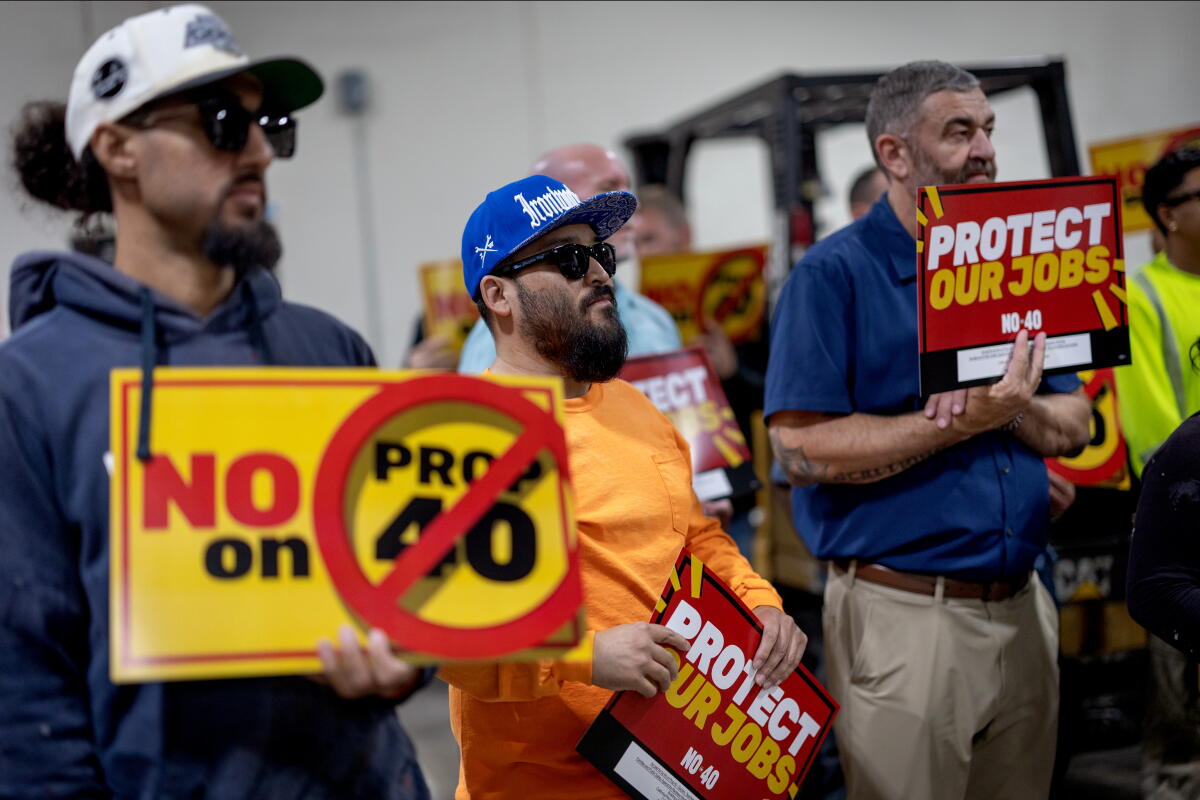
People attend a rally against Proposition 40 at the Iron Workers Apprenticeship Training Center

People attend a rally against Proposition 40 at the Iron Workers Apprenticeship Training Center on Oct. 5 in La Palma.

(Eric Thayer/Los Angeles Times)

The tax measure was crafted by Service Employees International Union-United Healthcare Workers West in response to federal healthcare funding cuts signed by President Trump last year that are expected to reduce California’s healthcare budget by $100 billion, burdening the state’s most vulnerable residents.

“Trump’s ‘Big Beautiful Bill’ slashes healthcare funding, with major coverage cuts scheduled to hit after the midterms,” said Suzanne Jimenez, the union’s chief of staff. “More than 3 million Californians could lose their health insurance. Hospitals and emergency rooms face closure. Patients will die unnecessarily when the care they need is no longer there. Proposition 40 is an emergency response to that looming disaster.”

The proposition’s supporters raised $34.3 million, nearly all of it from Jimenez’s union.

The two other measures, Propositions 41 and 42, would nullify the billionaire tax if either receives more votes.

Proposition 41 supporters say the measure aims to cut wasteful government spending by requiring audits for new state special taxes and would bar new state taxes that exempt their revenue from a state spending limit. Backers of Proposition 42 argue it would prohibit new taxes on retirement holdings, individually owned assets and other forms of personal savings.

Advocates for the billionaire tax say both are well-financed smokescreens to undercut Proposition 40.

Opposition campaigns to the wealth tax as well as the two countermeasures have received enormous donations from several of the state’s billionaires. But Building a Better California, the main funder of efforts to defeat the wealth tax, noted that its allies included Democratic and Republican politicians, prominent labor groups and business leaders.

“It’s rare for such a broad coalition to unite around any single cause in California, but it reflects the potentially devastating impact of this measure on healthcare, education, and our state’s economy,” the group said in a statement.

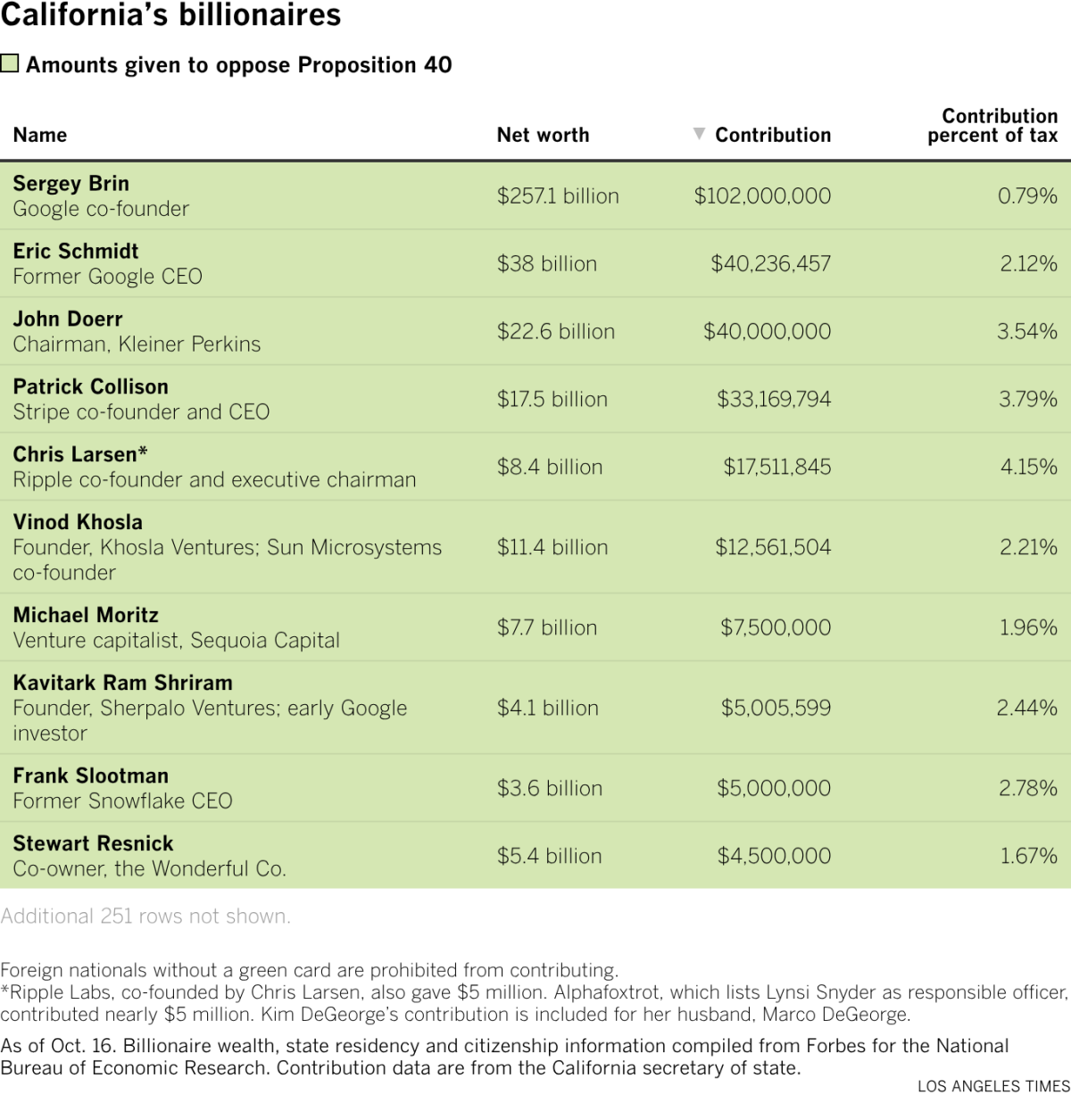
Among the largest donors opposing the wealth tax are billionaires Sergey Brin, a co-founder of Google who has donated more than $100 million to anti-wealth-tax efforts, and former Google leader Eric Schmidt and venture capitalist L. John Doerr, who each kicked in $40 million.

Brin, Schmidt and Doerr did not respond to requests for comment.

US tech entrepreneur Sergey Brin and Gerelyn Gilbert-Soto arrives for the 2026 Met Gala

US tech entrepreneur Sergey Brin and Gerelyn Gilbert-Soto arrive for the 2026 Met Gala celebrating “Costume Art” at the Metropolitan Museum of Art in New York in May.

(ANGELA WEISS/AFP via Getty Images)

The spending disparity also reflects a divide among Democrats and their allies, many of whom support wealth taxes, but argue that the way Proposition 40 was written is disastrous to California’s volatile budget, which is dependent on the state’s wealthiest residents.

Jodi Hicks, chief executive and president of Planned Parenthood Affiliates of California, said that while her organization would support a nationwide or a California wealth tax, their primary concerns are about 40’s impacts on the state budget and healthcare in the state.

“We are opposed to this particular proposal because we think it does more harm than good,” she said, adding that after what her organization “faced last year having to scramble for dollars because of [federal funding cuts] we are committed to work with the stakeholders facing cuts and not harming the budget and finding revenue in a smart way.”

The cash imbalance between supporters and opponents of the billionaire tax is vast. Those opposed to the measure raised $316.7 million, while proponents raised nearly $34.3 million.

protesters

The Fair Games Coalition, made up of community leaders, labor organizations and advocates, announce the launch of the Overpaid CEO Tax Initiative in front of the Tesla Diner in West Hollywood in January.

(Genaro Molina/Los Angeles Times)

The supporters of the wealth tax spent nearly all of their money gathering signatures to place the measure on the ballot. They had $1.6 million on hand as of Oct. 17.

Now, as voters cast ballots, their campaign appears reliant on public events and media coverage, such as of Sen. Bernie Sanders’ (I-Vt.) recent rally in support of Proposition 40 in downtown Los Angeles.

“What you are showing people from coast to coast and all over is that, yes, we can take on the greed of the oligarchs,” he said, calling it the most important ballot measure in the country. “Yes, we can create an economy and a government that works for all of us, not just the 1 percent.”

Facebook creator and Meta chief Mark Zuckerberg was among the California billionaires Sanders name-checked in his remarks. After Zuckerberg told company leaders that he planned to leave the state to avoid his control over the company substantially reduced by being forced to sell enough of his stock in the social media giant to pay the proposed levy, the company on Wednesday announced the creation of a new, non-voting type of stock that would allow Zuckerberg to sell enough shares to pay the proposed tax while retaining his voting power in exchange for him agreeing to remain in the state for eight years.

Meta CEO Mark Zuckerberg listens as President Donald Trump speaks to reporters

Meta CEO Mark Zuckerberg listens as President Trump speaks to reporters at the White House on Sept. 29.

(Jacquelyn Martin / Ap Photo/jacquelyn Martin)

The pro-wealth-tax campaign is sending voters emails and texts and has an online presence.

“Remember: it’s not enough to vote YES on 40. You also need to vote NO on 41 + 42,” read an email sent to voters on Tuesday. “Don’t be fooled: Props 41 and 42 are billionaire-funded initiatives designed specifically to undermine Prop 40, the California Billionaire Tax.”

Meanwhile, the anti-40 and pro-42 campaigns are inundating voters on television, streaming services, in mailboxes, through online influencers and even in digital video games such as Sim City.

Jimenez said voters will see through the blizzard of campaign messaging.

“The billionaires think voters are stupid. They think they can bury the facts under millions of dollars in advertising and disguise Prop. 42 … as protection for ordinary taxpayers,” she said. “Their spending also makes our case for us. When billionaires can afford to spend millions a day protecting their fortunes, voters can see that billionaires have plenty of money to spare.”

Sheri Sadler, a veteran Democratic media buyer, questioned how much voters were hearing about the rationale for the proposed billionaire tax.

“The yes side is severely lacking in getting their message through while the no side is dipping into different kinds of pockets,” she said.

Jessica Levinson, an election law professor at Loyola Law School, said that beyond voter confusion about the competing ballot measures, it is certain to face legal challenges, notably about the retroactive nature of the tax, which would apply to any billionaire who lived in California as of Jan. 1. She described that as “the biggest legal pressure point.”

“It’s kind of a mess,” she said.

Times staff writer Gabrielle LaMarr LeMee contributed to this report.

Source link

These Californians spent 0.07% of their billions to oppose Prop. 40

About 260 California billionaires would be subject to Proposition 40’s one-time 5% wealth tax according to the Forbes Real-Time billionaires list. Just 30 of those billionaires or their spouses, or 1 in 8, spent money opposing Proposition 40, the billionaire tax, according to a Times analysis of recent campaign filings.

Billionaires have individually contributed $293 million to oppose the tax measure and to support Proposition 41 and 42, which would nullify the billionaire tax if either receives more votes, according to a Times analysis. Sergey Brin, co-founder of Google, has given $102 million, more than a third of all billionaire money against the measure. But this is less than 1% of his estimated tax bill.

Several billionaires also contributed to the political action committee of the California Business Roundtable, which is spending to oppose Proposition 40 and support Proposition 43. Peter Thiel gave $3 million, Eric Schmidt gave nearly $2.6 million, Marco DeGeorge’s wife, Kim, gave $1.9 million, Chris Larsen gave $750,000 and Douglas Leone and his wife gave $500,000.

Proposition 40 would apply the tax to billionaires who were California residents on Jan. 1, 2026, and the taxable amount would be based on their net worth on Dec. 31. The tax is payable over five years.

Altogether, these individuals would owe at least $107 billion in taxes, according to an analysis by economists Jasper Boll, Emmanuel Saez and Gabriel Zucman. Their research was published in the National Bureau of Economic Research in August. Saez and Zucman are also architects of the tax proposal.

This amount is 5% of their combined estimated wealth by Forbes as of Oct. 16 and factors in a certain amount of tax avoidance and evasion. Spread across all 39 million Californians, the $107 billion would be roughly $2,700 per person. The Public Policy Institute of California estimates that the median household net worth in California was $303,000 in 2023.

The four richest Californians — Sergey Brin, Jensen Huang, Larry Page and Mark Zuckerberg — would owe 40% of the estimated taxes to be collected from the billionaire tax, according to a Times analysis. Their wealth largely comes from ownership of stock in extremely high-value technology companies.

Their net worth would increase 5% in about four months if their stock investments continues to grow as they have since December.

California billionaire wealth grew nearly threefold from 2022 to 2026, according to Times analysis of Forbes data collected by Boll and his colleagues, and much of that growth was not taxed. Billionaires’ taxable income is small compared with their wealth, because most of that wealth is invested in public stocks, and gains aren’t taxed until the stock is sold.

Page and Brin disclosed no taxable income in three of the years since 2019. Many others had similarly no publicly disclosed income. For that reason, Boll and his colleagues estimate that the Proposition 40 one-time tax would raise more than $100 billion, “with comparatively minor impacts on income tax revenue” from some billionaires leaving the state.

Based on Meta’s filings, the economists estimated that Zuckerberg’s taxable income was about $947 million in 2025, just 0.4% of his net worth.

Over the summer, Zuckerberg shared with Meta advisors his plans to relocate outside California to avoid the possibility of a significant reduction in his control over the company as a result of selling enough stock to fund a 5% tax. The advisors determined that Zuckerberg’s leadership presence at Meta headquarters was essential to the company’s success. On Wednesday, Meta announced the creation of new, nonvoting Class C common stock, which will allow Zuckerberg to sell the amount he needs to pay his potential tax bill while maintaining his voting power in exchange for his commitment to remain in the state for eight years.

Researchers at the Hoover Institution estimate the revenue to the state to be closer to $40 billion based on reports of billionaires’ residential purchases outside the state before and after Jan. 1 and their estimate of unannounced residency moves.

Chris Hoene, executive director at the California Budget and Policy Center, a nonpartisan group, said the residency question hinges on the amount of time spent living in the state. “Purchasing property in another location does not mean that they have changed their residency,” he said.

Ultimately, the state’s Franchise Tax Board, responsible for administering the tax, will have to assess residency. Hoene says this task is “easier for them to do than people realize.” The board will also calculate the amount of wealth subject to the tax using publicly available stock information and private assessments of personal property, such as artwork and jewelry. Real property, pensions and retirement accounts would be excluded.

Opponents of Proposition 40 are concerned that the threat of wealth taxes will lead to billionaires continuing to leave the state, resulting in a long-term decrease in state income tax revenue. Forbes recently reported that Brin registered to vote in Nevada last year. Peter Thiel disclosed Dec. 31 that he opened a new office in Miami; Florida has no wealth tax or income tax. But in July, he purchased a $130-million mansion in Bel-Air.

“The reality is the income tax loss can never get anywhere near the scale of what the wealth tax gain would be,” Hoene said.

Ninety percent of that gain would be spent on healthcare services to fill a gap in Medi-Cal from losses in federal funding that the measure’s authors estimate would total $190 billion over the next 10 years. Medi-Cal provides healthcare coverage for one-third of low-income Californians, according to the Legislative Analyst’s Office.

Gov. Gavin Newsom opposes a California-only tax and has instead called for a national wealth tax. Democrat Xavier Becerra and Republican Steve Hilton, who are running to replace Newsom, have spoken out against the tax. Other opponents include the California Teachers Assn., the California Medical Assn., and Planned Parenthood Affiliates of California. Supporters include Service Employees International Union, U.S. Sen. Bernie Sanders (I-Vt.), the California Democratic Party and the California Federation of Labor Unions AFL-CIO.

Times staff writer Queenie Wong contributed to this report.

Source link

I spent the night in a Wetherspoons hotel that feels more like a museum

WHEN you picture Wetherspoons, you probably think of cheap pints, even cheaper food, colourful carpets, and a lively Friday night.

But your night out at Spoons doesn’t have to end with an expensive taxi home – with dozens of hotels across the UK and Ireland, the budget pub chain is quietly offering some of the best value city breaks around.

Rooms at Keaven’s Port in Dublin start at £36pp based on two adults sharing Credit: Wetherspoons – Keaven’s Port
You can buy a pint of beer from €2.60 (£2.19) at Keaven’s Port Credit: Alamy

I headed to Dublin to see exactly what a night spent in a Spoons hotel really entails.

Spoiler alert: this particular Spoons hotel feels like staying overnight in a museum, and the rooms are nicer than you might think.

There are 56 Wetherspoons hotels across the UK and Ireland, so I decided to try out a stay at Keaven’s Port, a unique convent-turned-hotel in Dublin.

Keaven’s Port sits on Camden Street, which is where you’ll find crowds of locals out for drinks in Dublin – away from the expensive pints of Temple Bar.

Read more on cheap hotels

TOP MARKS

Dirt cheap hotels in 7 top holiday destinations that guests actually RAVE about


QUIDS IN

Crazy cheap holidays you can book right now with £16 hotels and £21 flights

This well-positioned pub hotel puts you on the same street as popular nightclub The Camden, which you’ll find buzzing on the weekends.

And as for daytime sightseeing, here you’re only a 20-minute walk from popular attractions like Dublin Castle and Trinity College.

Wetherspoons are known for repurposing unique historic buildings including former opera houses, corn exchanges and banks.

Not only does this guarantee some decent square footage for all those restaurant tables (as well as a prime spot in the town centre) but it makes for a pretty unique overnight stay.

This one I found to be particularly unique. Keaven’s Port hotel is made up of eight old Georgian townhouses as well as a chapel.

The collection of buildings used to belong to Ireland’s Little Sisters of the Assumption, a convent established in the 1890’s.

The collection of small lounge rooms in the hotel are packed with history Credit: Jenna Stevens
You can even dine inside the old chapel with confession booth seating Credit: Jenna Stevens

Now, the chapel has been restored and is part of the bar and restaurant area. I must admit, sitting in a confession booth under stained glass with a bowl of chips and a pint is a tad surreal.

Getting to the rooms takes weaving through a series of corridors and lounge areas, each of which are packed with historical artefacts that made this stay feel more like a trip to the museum.

Lining the walls were old dresses and textiles, painted portraits and more belonging to historic residents of Camden Street Upper, as well as information boards telling you all about the history of the building.

One lounge area sees a giant Guinness-style harp, cosy sofas and a chessboard, while another sees antique furniture, Renaissance paintings and a collection of battered books packed with fascinating old stories.

After making your way out of the maze, you’ll reach the main bar and restaurant area (which thankfully has its own entrance, too).

Everything about the restaurant screams Spoons – tiled floors, a very long bar, plenty of high tables with stools as well as booths and larger tables for groups.

I was pleasantly surprised by the rooms in Wetherspoons’ Keaven’s Port hotel Credit: Jenna Stevens
There are loads of cheap meal deals at Keaven’s Port like in UK Spoons pubs – a small fish and chips with an alcoholic drink costs €13.05 (£11.01) Credit: Alamy

Just when you think there’s more than enough space, a spiral staircase decorated with mirrors leads you down to an even larger restaurant, as well as courtyard for the summer beer garden months.

We all know Spoons pubs in the UK offer some great-value deals on food and drink, but can you get good value over in pricy Dublin?

It turns out you can. An Irish spice bag with a soft drink costs €10.50 (£8.86), and a small cooked breakfast is an unbelievable €2.95 (£2.49).

You can grab a pint of Abbott for €2.60 (£2.19), wine by the glass starts from €4.30 (£3.63), and cocktail pitchers from €9.95 (£8.39).

A hot drink will only set you back €1.70 (£1.43), and it’s free refills from then on all day.

But what are the rooms like? Once you make it out of the busy bar area through to the elevators, the noise of the bar soon disappears.

If I’m totally honest, I went in expecting a cramped room with stained furniture and some strange marks on the walls.

Thankfully, I was pleasantly surprised at what I saw when I stepped in.

First of all, these rooms are very spacious. The large double bed had crisp white sheets, and there was plenty of room surrounding it to open up your suitcase.

The spacious desk was laid with the usual tea and coffee facilities. Here you also get posh shortbread biscuits and water cartons decorated with pictures of Irish poet W.B. Yeats (I kept mine as a souvenir).

The bathrooms were pretty glam too with black marble, a large mirror and a surprisingly spacious tub and shower. All in all, not at all bad for the price point.

Inspired by the local history, I did a bit of my own research. Namely, I wanted to know, who actually was St Keaven?

The name supposedly comes from St. Kevin, a sixth-century Christian hermit and saint, with a church named after him in nearby Camden Row.

Little is known about the Irish saint, other than that he appears in Seamus Heaney’s poetry and that he is associated with the glacial valley of Glendalough in nearby County Wicklow.

If you fancy, you can actually take a day trip from Dublin city centre into Glendalough to walk beside its glacial lakes with Wild Rover Tours (from €43). If you want to see some of Ireland’s rolling green hills and sparkling lakes away from the city, I’d highly recommend giving it a try.

But if you’d rather stay in the centre and make the most of the cheap pints in the bar below your room, it’s a great place for pre-drinks before rocking up to The Camden.

Rooms start from €86 (£72) per night, or £36pp based on two sharing. Click here to book.

Prices correct at the time of publication.

Source link