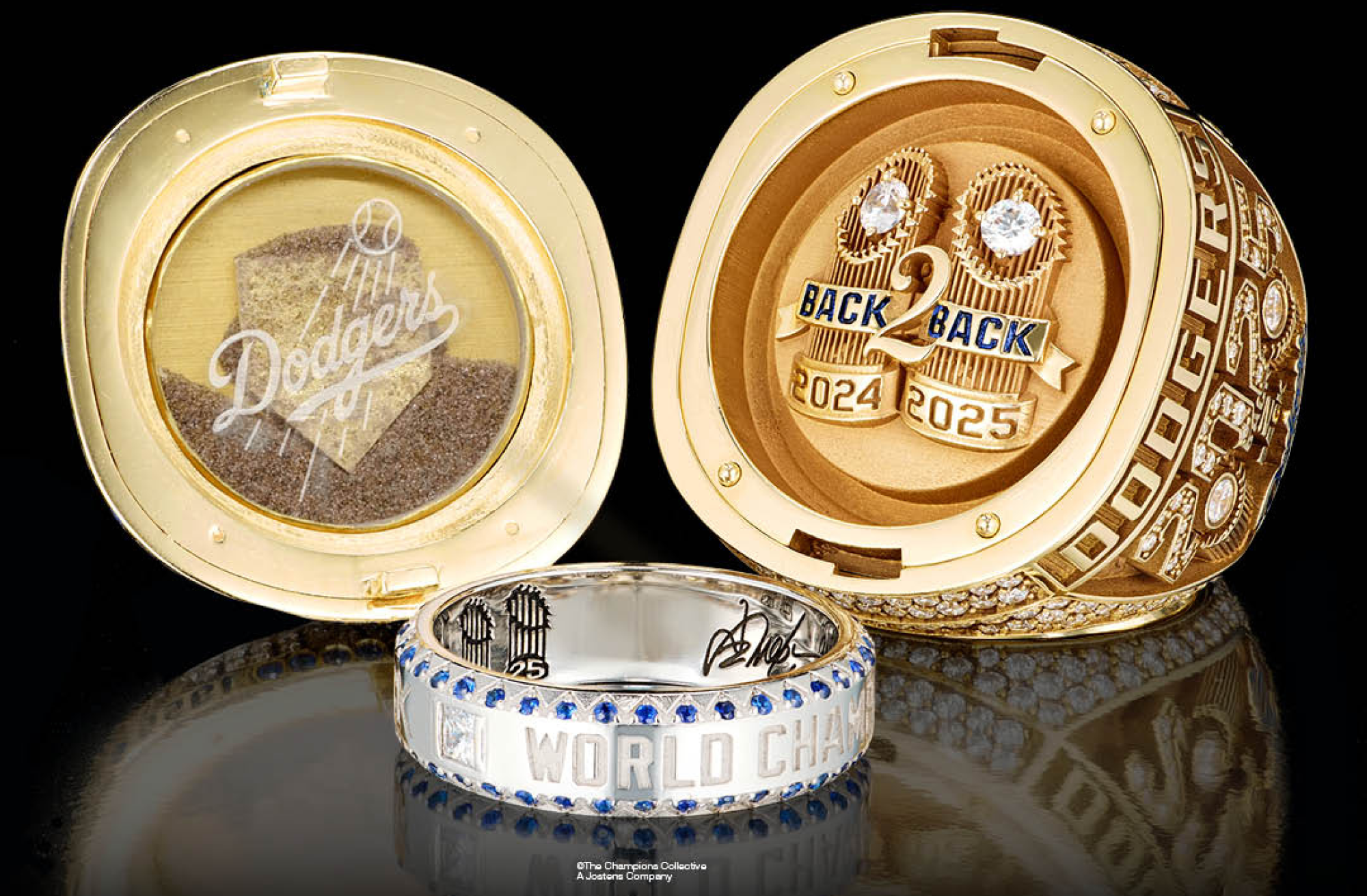
Dodgers received 2025 World Series rings. What do they look like?
Clayton Kershaw’s 2025 teammates had already received their World Series rings in a pregame ceremony Friday at Dodger Stadium when the future Hall of Famer jogged out of the dugout wearing his No. 22 Dodgers jersey.
He took the ball from manager Dave Roberts on the mound and delivered the ceremonial first pitch. Then the team re-emerged to present Kershaw with his ring.
“For me it’s just a great ending to my career,” Kershaw said when asked what the new ring meant to him. “I couldn’t have scripted it any better.”

A detailed look at the inside of the Dodgers’ 2025 World Series championship ring.
(The Champions Collective)
Though his playing days are over, Kershaw’s time with the Dodgers will continue. He’s joining the front office as a special assistant, according to a person with knowledge of the situation not authorized to speak publicly.
The Dodgers’ ring ceremony was the second part of a two-day celebration of the team’s 2025 World Series title. On opening day, the Dodgers brought out their trophies from back-to-back World Series titles and raised their new championship banner.
“I’m excited,” Kershaw said a couple hours earlier, after watching the Dodgers take batting practice before facing the Arizona Diamondbacks. “It’s why we play, is to win some of these rings. I heard the ring is pretty over the top; I haven’t seen it yet.”
Over the top, indeed.

A detailed look at the inside of the Dodgers’ 2025 World Series championship ring.
(The Champions Collective)
The diamond- and sapphire-encrusted rings highlight the back-to-back nature of last year’s World Series victory. They include engravings of the 2024 and 2025 trophies on both the outside and inside of the ring.
The L.A. logo is made up of 17 custom-cut blue sapphires, one for every postseason game the Dodgers played last year.
On the underside side of the ring, the four playoff series are listed, along with “11.01.25,” the date of Game 7 of the World Series.
The ring top holds dirt collected from home plate during Game 7, visible through a glass window when the ring is opened. Inside the ring sits a bespoke band that’s also set with sapphires and a diamond.

Dodgers players (from left) Shohei Ohtani, Freddie Freeman, Mookie Betts and Max Muncy show off their World Series rings before beating the Arizona Diamondbacks at Dodger Stadium on Friday.
(Gina Ferazzi / Los Angeles Times)
In a nod to the fan base, the total attendance figure for the 2025 season (4,012,470) gleams in blue on the bottom of the ring. Each players’ ring is also personalized with his signature, last name and number.
“Anytime you get to celebrate one more time with your teammates, it’s pretty special,” Kershaw said. “I know they’ve got to move on to this season, but I don’t have to. So I’m just going to keep relishing it. It’ll be great.”
Kershaw was already in town for work. He appeared on NBC’s broadcast of the Dodgers’ 8-2 win Thursday against the Diamondbacks.

A detailed look at the side of the Dodgers’ 2025 World Series championship ring.
(The Champions Collective)
“It’s just talking baseball,” Kershaw said. “So if people want to hear me talk about baseball, I can do that all day. I love baseball.”
His new role with the Dodgers, first reported by the Athletic, is another form of talking baseball.
“Probably not physically here in L.A.,” Kershaw said. “But definitely, I’m sure I’ll watch games. I still want to be a part of the Dodgers, so if I can help in some small piece, I will.”

A detailed look at the side of the Dodgers’ 2025 World Series championship ring.
(The Champions Collective)
Because Kershaw joined Team USA for the World Baseball Classic and then jumped into part-time broadcasting, he hasn’t fully experienced retirement yet. He said he doesn’t miss playing, but he misses the people.
“There’s a freedom with retirement,” Kershaw said. “If you don’t want to work out, you don’t have to. If your back hurts, it doesn’t matter. If your arm hurts, it doesn’t matter. You get to see a lot more stuff, be around for everything. So there’s a lot of great parts. It doesn’t take away from how special playing this game is, but there’s a lot of really awesome parts about being home.”