Who Speaks for Palestinian Women? Unmasking the Politics of ‘Saving’ in Gaza”
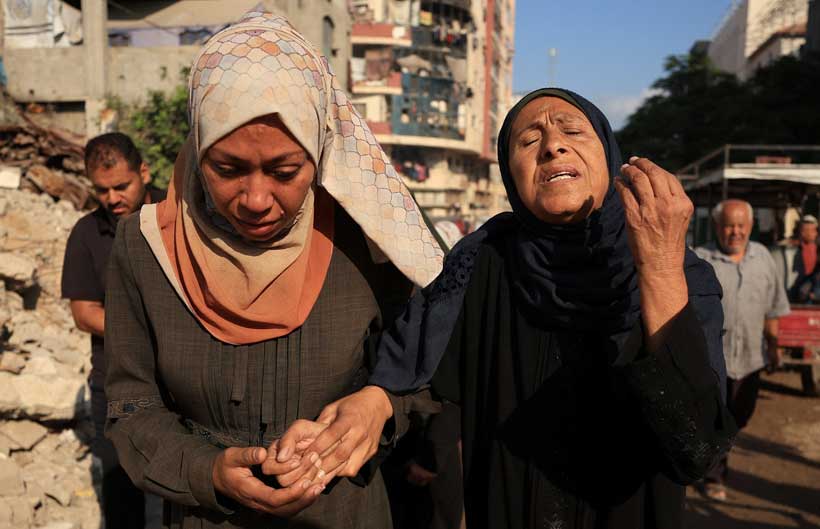
In the midst of the escalation of the Gaza conflict that has been going on since 2023, the world is once again witnessing the heartbreaking reality of women crying among the ruins of their homes and the burning of property, mothers who have lost children, and families separated by military attacks. Global media were quick to point to this event as a symbol of the suffering of civil society. But behind the empathy shown, there is also a question that is rarely asked: how exactly can Palestinian women be represented, and who can shape that narrative?
For decades, women in conflict zones, such as the Middle East, have often been portrayed in the same framework, as passive victims who need to be rescued and protected. In the context of Gaza, this pattern has resurfaced. Global media coverage often only highlights women’s plight without giving enough space for their voices, perspectives, and agency in conflict. This narrative does look humanistic, but it also contains an element of simplification that makes the world unaware of the more complex reality behind it.
This is where postcolonial feminism offers a sharper critique and helps us to look further at this issue as a form of epistemic violence. This perspective emphasizes that in understanding women’s experiences, it cannot be separated from considerations about the history of colonialism and global power relations. In the context of the Gaza conflict, this means that violence is experienced by women. Not only a patriarchal problem but also supported by aspects of colonialism, militarization, and inequality politics (Enloe, 2014).
This phenomenon cannot be separated from the thoughts of Lila Abu-Lughod, who mentioned “politics of saving” in her work entitled Do Muslim Women Need Saving? Abu-Lughod (2013) criticized how the Western world portrays Muslim women as an oppressed group in need of rescue. This narrative is not only a form of simplifying women’s representation but can also be used as a legitimacy for political, cultural, and even military intervention from external actors. Such as the concept of militarization of daily life raised by Enloe (2014), who explains that militarization does not only occur on the battlefield but also enters into the reality of daily life, including in how the media frames conflicts. Where in this context the representation of Palestinian women as passive victims is used to affirm certain narratives about war, security, and the legitimacy of power.
The term “security politics” in the Gaza conflict appears in a more subtle form. Palestinian women are positioned as a universal form of suffering but are rarely seen as political subjects with diverse experiences and aspirations. The suffering they experience in conflict becomes a global consumption, while structural contexts, such as colonialism and power inequality, are often ignored.
An important question then arises: who really has the right to speak on behalf of Palestinian women? This is where Spivak’s (2009) thoughts on the concept of the subaltern become relevant. Spivak himself argues that the subaltern group is a group that is in a marginalized position so that its voice is not heard in the dominant discourse. Even when they are “represented,” their voices are often mediated or even filtered by stronger actors.
In many news narratives about Gaza, Palestinian women rarely appear as the main narrator of their own experiences. Brand awareness is often told by foreign journalists and international organizations. Or humanitarian institutions as “representatives.” As a result, the narrative that is born is not a complete reflection of the reality they face, but rather a form of representation that has been framed according to the logic and direction of global media reporting.
This issue becomes more complex when we look at how the media tends to ignore the agency dimension. Palestinian women not only live in the shadow of conflict but also have active agency in various forms of resistance, both as activists, journalists, medical personnel, and community leaders. They have the capacity to build solidarity and even contribute to political struggles as well as peace. However, aspect II rarely gets the same spotlight as the narrative of suffering.
This disregard of agency can create an imbalance of representation. Palestinian women are only seen as passive victims, which makes them look like they also have no capacity as active actors. This inequality is not only a question of representation but also a question of power regarding who has the right to define reality for a particular purpose.
In the digital era, this is certainly starting to change. Social media provides a space for Palestinian women to be able to speak directly to a global audience. Through various social media platforms, they can share experiences and aspirations that are often not featured in the mainstream media. This ultimately opens up the possibility of a more authentic and diverse counternarrative.
However, the digital space is still full of limitations. Certain narratives can easily go viral, while others sink and disappear without a trace. In other words, while social media can offer opportunities, the space is not completely free from the influence of broader power structures.
Rereading the narrative of Palestinian women in the era of the Gaza conflict is a form of recognition that representation is not neutral. It is always related to interests, ideologies, and power relations. The narrative of “rescue” may seem like a form of concern from the surface, but if you look further, it can also be a form of control over the other party’s representation. Looking at the Gaza conflict through the lens of feminism is to question basic assumptions in global reporting. Do we really see them as individuals? Do we really hear their voices, or just voices about them?
Therefore, it is important to change our perspective. Instead of seeing Palestinian women as victims who need to be saved, we need to recognize them as subjects who have the capacity to speak, form agencies, and share their experiences in the form of real reality. This is not to ignore the real suffering but to place Palestinian women’s experiences in armed conflict in a broader, fairer, and closer context to reality. As Abu-Lughod (2013) reminds us, the more important question that arises is not how to save Muslim women, but how to understand the conditions and realities that shape their life experiences.
Ultimately, the lens of feminism, particularly postcolonial feminism, invites us to not only have empathy but also to be more critical. By looking further at how the narrative is formed, who can benefit, and which voices are ignored.
Perhaps the more relevant question is not whether Palestinian women need protection and rescue, but whether the world is ready to hear and see them as subjects who have the capacity to speak and move. Because what needs to change is not them, but the way we understand them.