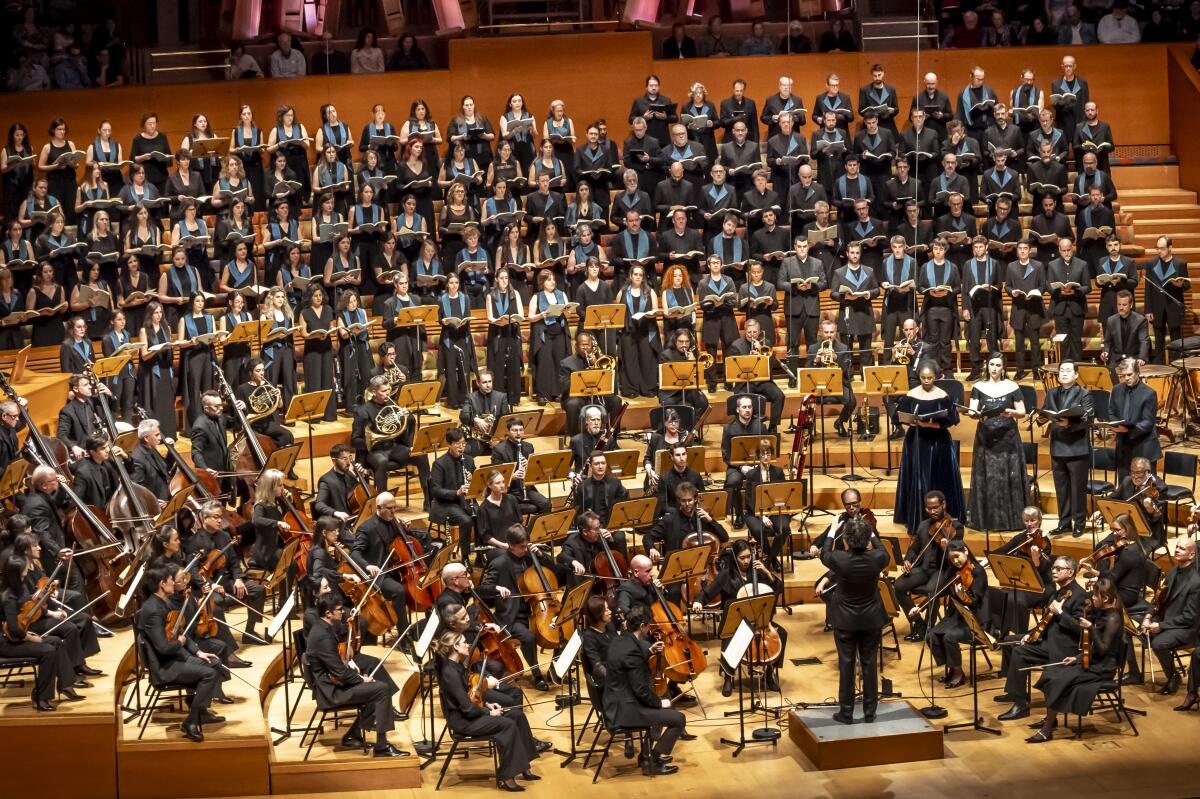
Gustavo Dudamel conducts Beethoven Missa Solemnis for the first time
Beethoven’s “Missa Solemnis” is a grand mass for large orchestra, chorus and four vocal soloists that lasts around 80 minutes. It was written near the end of Beethoven’s life and is his most ambitious work musically and spiritually. “Coming from the heart, may it go to the heart,” he wrote on the first page of the score.
The Beethoven biographer Jan Swafford put it this way: “ ‘Missa Solemnis’ is Beethoven talking to God, man to man. And what they talked about is peace. Creation was for Beethoven’s the magnificence in the world which we inhabit; ‘Missa Solemnis’ is meant to keep it thus.”
Yet among Beethoven’s major works, “Missa Solemnis” is, by far, the least performed, and not merely because of the need for large forces. Conductors struggle to get a handle on its mysteries and intricacies. Upon turning 70 last year, Simon Rattle contended “Missa Solemnis” remains beyond him. Upon his reaching 70, Michael Tilson Thomas made a momentous meal of “Missa Solemnis” 11 years ago with a staged performance with the Los Angeles Philharmonic at Walt Disney Concert Hall.
Gustavo Dudamel, who has been conducting Beethoven since he was a teen, waited until he passed his 45th birthday last month. His first “Missa Solemnis” performances over the weekend at Disney were the centerpiece of his month-long L.A. Phil focus on Beethoven.
That venture began a week earlier with a political statement. Beethoven’s incidental music to Goethe’s drama of liberation, “Egmont,” was updated with a new text that served as an urgent call for protest in our own era of authoritarianism and militarism. Here, Beethoven exerts a compulsion for triumphant glory.
The glory in “Missa Solemnis” is that of stupefaction. By this point in his life, Beethoven has had it with weapons, the drumbeat of soldiers, the addictive emotion of trumpet calls to action. His man-to-man with God is celestial diplomacy. There is no compromise. We either care, at all costs, for our magnificent world or nothing matters.
Dudamel clearly cares. He conducted the massive mass from memory. And costs be damned. He imported from Spain two spectacular choruses — Orfeó Català and Cor de Cambra del Palau de la Música Catalana — a total of some 130 singers who sounded like they had rehearsed for months under their impressive director, Xavier Puig. The four soloists — soprano Pretty Yende, mezzo-soprano Sarah Saturnino, tenor SeokJong Baek and bass Nicholas Brownlee — were needfully robust and powerful. They were placed mid-orchestra, behind the violas and bravely in front of the timpani.
“Missa Solemnis” follows the standard mass text but doesn’t necessarily follow the liturgical narrative. It is a work of theater, dramatizing feelings, as the earlier Disney staging attempted. Director Peter Sellars and conductor Teodor Currentzis have also been promising a major staged “Missa Solemnis” for many years.
The Kyrie opens with a strong D-major chord in the large orchestra that seems an obvious downbeat but turns out to be an upbeat. Down is up. Eighty or more minutes later at the end of the Agnus Dei, when the great plea for peace reaches its ultimate transcendence, up becomes, in one of the most profoundly unsettling moments in all music, down again. We never fully know where we stand in “Missa Solemnis.” Every expectation is thwarted. Beethovenian peace is a nearly superhuman endeavor.

Gustavo Dudamel conducts L.A. Phil, vocal soloists and Catalan choruses in Beethoven’s ‘Missa Solemnis’ at Walt Disney Concert Hall.
(David Butow / For The Times)
Dudamel‘s approach is to attempt the all-encompassing. He conducted without a baton but with his body. His arms were often open and wide as if embracing the musician masses on the stage, holding the whole world in his hands. Tidiness wasn’t necessarily the issue. Grandeur was. Molding sound was. And, of course, awe.
Throughout his career, Beethoven was the overwhelming master of awe. In “Missa Solemnis,” he out-glories the Gloria. His fugues are a draftsman’s rendering of heavenly splendor. Such awe asks for the superhuman from singers, especially in this ensemble from their ravishing high notes.
But Beethoven also questions every sentiment in the Mass. Grandeur can so suddenly turn solemn that it feels almost a ceremonial sleight of hand. In the Sanctus, a solo violin sails in from nowhere (“descending like a dove from heaven,” Hugh MacDonald nicely puts it in the program note), and suddenly we’re in a violin concerto with vocal soloists of transcendent allure.
The Agnus Dei begins in glum realization that there may be no compensation for humanity’s great sins when, again astonishingly without expectation, one of Beethoven’s uniquely wondrous melodies takes over. Saber-rattling trumpet and timpani intrude and are shushed away as worthless. Peace returns but just as it is about to climax it weakens. There is no grand Beethoven ending. “Missa Solemnis” just stops.
Dudamel’s approach was not, as his Beethoven has generally become, filled with fervent intensity in the moment. That may happen as he gains more experience with Beethoven’s most exigent score. The big moments were still huge, especially with the help of his fabulous chorus. The somber moments were well of the heart. There was eloquent solo playing in the orchestra, and extravagance from the solo singers.
Most unusual was the violin solo. The L.A. Phil is in a concertmaster search, and Alan Snow, the associate concertmaster of the Minnesota Symphony, sat in. He brought silken “descending dove” tone to his solo playing, but at low tone becoming more a voice from afar than soloist. Whether that is simply his sound or what Dudamel was after is, like so much in the “Missa Solemnis,” up to question. Still, its quiet exemplified the elusive essence of peace.
When Dudamel first walked on stage, he got, as he always does and especially in his last season as music director, a strong ovation. At the end of “Missa Solemnis,” the reaction was a respectful standing ovation, unlike the de rigueur rapturous reception he always earns with Beethoven.
Dudamel earned something far more rewarding. It wasn’t a moment for cheering but reflection. True peace in “Missa Solemnis” comes not from winning but from ending conflict, be it between nations, nature or among ourselves. We have as yet too little to celebrate.