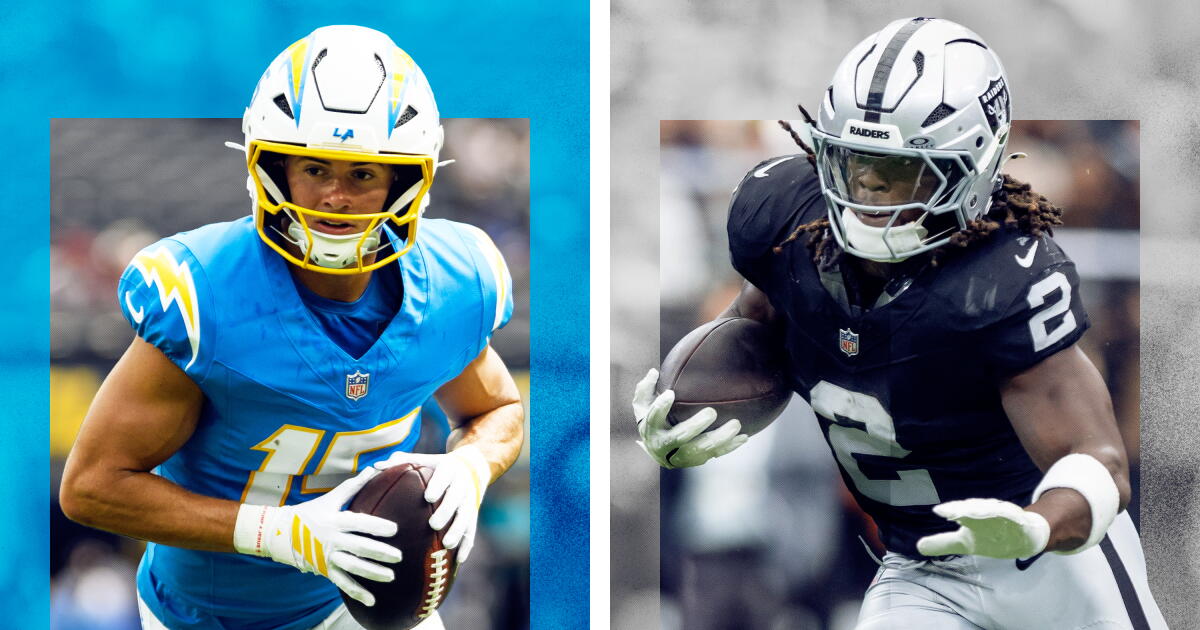
Jim Harbaugh had never lost an NFL opener as a head coach… until last Sunday.
Now, with the Las Vegas Raiders coming to town, Harbaugh is looking to keep another streak intact. With him as coach, his Chargers are 4-0 against the Silver & Black.
If Sunday’s game isn’t a must-win for the Chargers, it’s certainly a high-stakes contest on the heels of an opening flop against the Arizona Cardinals.
The Chargers did precious little right in that 26-14 defeat at SoFi Stadium, the first Week 1 loss for Harbaugh in seven openers.
The Chargers, who were favored by 9½ points, failed to generate anything close to a rhythm. The newly unveiled Mike McDaniel offense failed to get any real traction, and Justin Herbert was sacked three times.
One of the few bright spots for the Chargers was receiver Ladd McConkey, but his availability remains uncertain.
Meanwhile, the Raiders dominated the visiting Miami Dolphins, 27-13, handing Klint Kubiak a victory in his coaching debut. Granted, the Dolphins don’t show a lot of promise.
Harbaugh’s teams have swept the Raiders each of the past two seasons. In fact, the last time the Chargers lost to the Raiders was a 63-21 debacle Dec. 14, 2023, and Chargers coach Brandon Staley was fired the next day.
It will mark the ninth Super Bowl in the Los Angeles area across three venues: the Coliseum (two), Rose Bowl (five) and SoFi (two). But in some ways, all those previous games were a drumroll leading up to this one — Super Bowl LXI, in a futuristic $5-billion stadium, absent the lingering restrictions of a pandemic.
“Super Bowl LVI was an amazing experience, but it was still on that tail end of COVID, and it was not everything that this Super Bowl LXI could be,” said Peter O’Reilly, NFL executive vice president of club business, international and league events.
“We didn’t do a Super Bowl Opening Night — it was virtual — and there were a lot of things we were still adjusting. … It was absolutely spectacular during the weekend and on game day, but I do think this Super Bowl gives us all the chance to do it full-on, in the way an L.A. Super Bowl can and should be.”
In the weeks leading up to the first Super Bowl at SoFi, there were misguided rumblings that the game might be moved to Dallas, because the NFL had secured that city as a backup. But those type of contingency plans are in place for every Super Bowl, and the game was not in serious peril of being moved. Still, there was a cloud of public doubt lingering over the event.
“Those rumors created a lot of havoc and uncertainty in our market,” said Kathy Schloessman, chief executive of the Los Angeles Super Bowl Host Committee for both games. “It was hard to get the excitement going because people didn’t know if the city was open or closed. I almost hate to say it because I don’t want to jinx anything, but this is our first normal Super Bowl planning.”
Super Bowls can take over a city. Look at the games played in New Orleans, Indianapolis or Houston. Seemingly every resident was aware the game was happening. But in some of the bigger cities — New York, Los Angeles, Miami — there aren’t reminders everywhere you turn.
Something that might offset that this season is ESPN is broadcasting the game for the first time, and has been hyping it ever since the most recent Super Bowl ended.
“It’s a year of the Super Bowl for them that ends in Los Angeles,” O’Reilly said. “That feels natural and poetic. I can’t say enough good things about the way they’ve embraced it.”
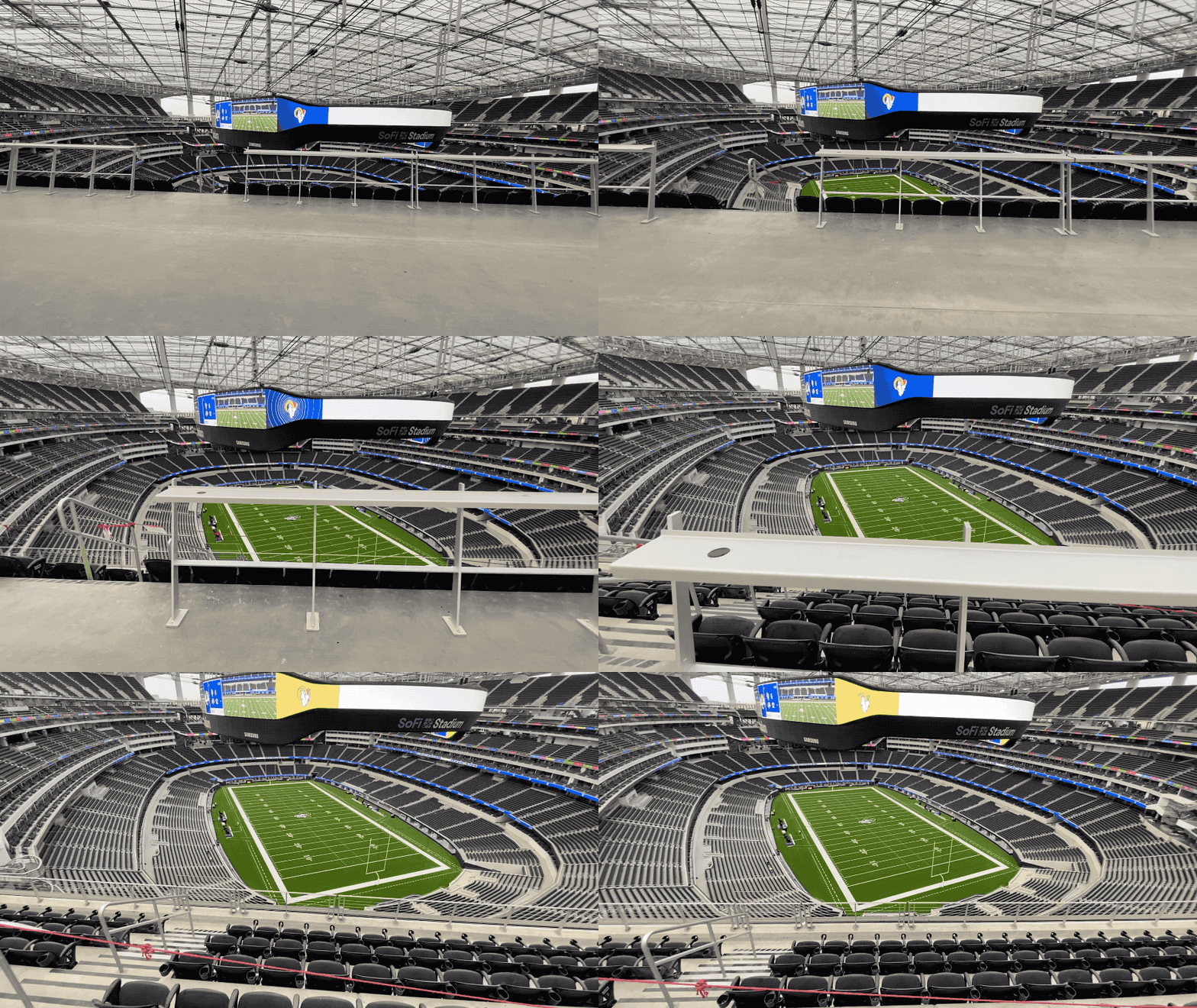
South side view of the field at SoFi Stadium.
(Sam Farmer / Los Angeles Times)
Disney is the parent company of ESPN, and likewise has embraced the game, which feels like a true confluence of the sports and entertainment industries.
“When I think about L.A. and brands coming together — Disney, SoFi Stadium, the Rams — I think it takes advantage of what the NFL had always hoped when bringing a Los Angeles team back,” Rams president Kevin Demoff said. “SoFi Stadium is that marriage of the NFL and entertainment.”
Whether they play in the game or not, the Rams are intimately connected to this Super Bowl, as they are the host team. That means they have a degree of financial responsibility to make good on the commitments made to the NFL when Los Angeles was awarded the game. They also are allotted more tickets to the game than the other franchises not hosting (or playing in) the event.
Although the Chargers were co-hosts for the first Super Bowl at SoFi, they opted not to host this one. According to a Chargers spokesman, they chose to cede the stage to Rams owner Stan Kroenke, whose vision they credit for the stadium and Hollywood Park development, but will make a “significant seven-figure financial commitment” to the host committee in the run-up to the game.
Part of Kroenke’s vision in moving the Rams and building the stadium and surrounding campus was to shift the center of gravity of the sporting world to Los Angeles. It’s worth noting that SoFi was a central location of the World Cup — the first U.S. goal was scored there — and will play host to swimming events in the 2028 Olympic Games.
“[SoFi] is now established as one of the world’s greatest sporting stages, which the Super Bowl helped put on the map the first time,” Demoff said. “But now it’s in the middle of this global run.”
It isn’t just the Super Bowl. SoFi will also play host to the NFL’s first-ever Thanksgiving Eve game — Rams versus Green Bay Packers — on Netflix.
“If you’re looking at the arc — not as a Super Bowl but how the NFL wanted to come back to Los Angeles — you have Disney, a longstanding, old-school entertainment partner,” Demoff said. “And then you have this element of streaming and new media and where the NFL is heading. It’s a really interesting juxtaposition.”
After a series of head-turning trades, signings and one legendary player’s return from retirement, the Rams and 10th-year coach Sean McVay are well beyond all-in.
On paper, the star-studded offense is seemingly invincible, the reconstructed defense inarguably impenetrable.
“It gets down to: how do we come together as a team,” McVay said. “But it’s hard to say top to bottom that the collection of individuals is not very special.”
The Rams are an overwhelming favorite to win Super Bowl LXI at SoFi Stadium.
It’s Super Bowl or bust. Again.
McVay said at the outset of training camp that the season would not be considered a success or a failure by whether the Rams win the Super Bowl.
Tell that to Rams fans.
Quarterback Matthew Stafford is the reigning NFL most valuable player — and shows no sign of slippage as he enters his 18th NFL season.
Receiver Puka Nacua led the league in receptions last season, and future Hall of Famer Davante Adams led the league in touchdown catches.
After their secondary was exposed in an NFC championship game defeat by the Seattle Seahawks, the Rams traded for All-Pro cornerback Trent McDuffie. They signed cornerback Jaylen Watson, McDuffie’s former Kansas City Chiefs teammate. And then general manager Les Snead pulled off another stunning deal for defensive end Myles Garrett, a two-time NFL defensive player of the year.
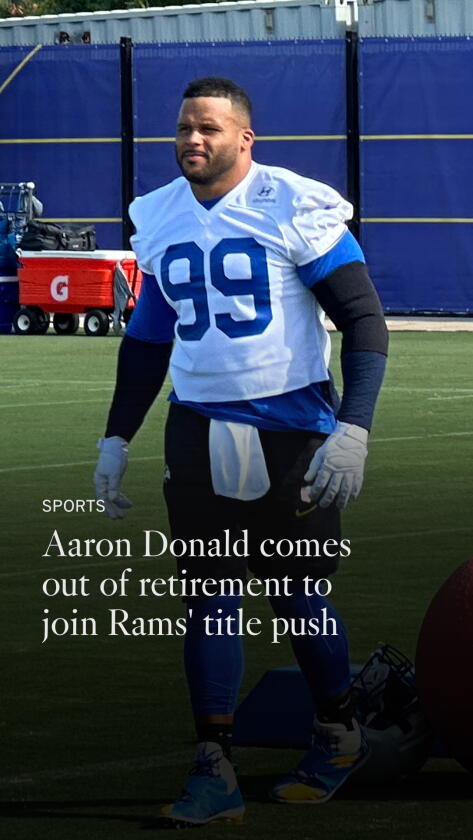
And that was before Aaron Donald, a three-time defensive player of the year, ended a two-year retirement to join a team about to embark on a boom-or-bust season.
Share via
Defensive lineman Aaron Donald has come out of retirement to join the Rams’ Super Bowl title push.
“You know all these other teams probably hate us,” Rams safety Quentin Lake said, chuckling. “They think we’re like the new Dodgers or something like that.”
Defensive line coach Giff Smith described the acquisition of Garrett, who amassed an NFL-season record 23 sacks last season, as “a grand slam.”
So what could possibly go wrong?
Nacua and left tackle Alaric Jackson are under investigation by the NFL regarding separate off-the-field incidents. If the league determines they violated the NFL’s personal conduct policy, they could be suspended.
The offensive line is experienced but short on quality depth at tackle. If Jackson is injured or suspended, Stafford is at more risk of injury.
Garrett sat out most of training camp and preseason practices because of a knee issue. Donald has not played a snap in two years.
Kicker Harrison Mevis came on last season and solidified a suspect field-goal unit, but it remains to be seen whether new coordinator Bubba Ventrone turns special teams from a liability into a strength.
Regardless, the Rams are built to win another title on their home turf.
“It’s special to be part of a team that can truly go all-in and bring in some new firepower to help us be able to reach the goals that we have in store for ourselves,” defensive lineman Kobie Turner said.
The Rams open the season this week against the San Francisco 49ers in Melbourne, Australia. The 49ers traveled there last week. The Rams are scheduled to depart Tuesday evening, arrive Thursday morning and play on Friday.
Unlike after other previous international trips, there will be no off week before the Rams play their home opener against the New York Giants. Then it’s consecutive road games against the Denver Broncos and the Philadelphia Eagles before a home game against the Buffalo Bills.
Rams defensive end Myles Garrett smiles during training camp in July.
(Robert Gauthier / Los Angeles Times)
The Rams then host the Arizona Cardinals before playing three of the next four games on the road at Las Vegas, Washington and Arizona.
It doesn’t get easier after a shortened bye week. The Rams play the Green Bay Packers the night before Thanksgiving. Then it’s a home game against the Chiefs, a trip to Santa Clara to play the 49ers, and a home game against the Dallas Cowboys.
The Rams play the defending Super Bowl champion Seahawks twice in the final three weeks, with a game at Tampa Bay sandwiched in between.
After all the buildup, the Rams are ready to embark on their quest.
They plan to finish it by hoisting the Lombardi Trophy at SoFi Stadium.
“It’s our time,” Turner said, “to go and make those dreams a reality.”