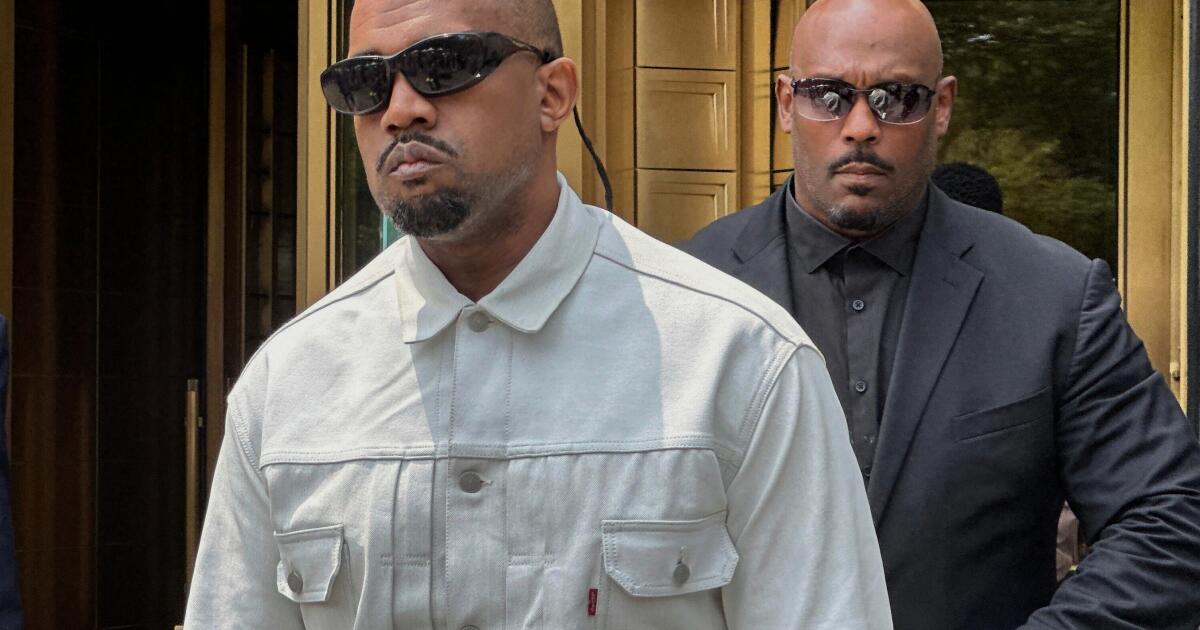
On the first night of Passover, Ye — the superstar rapper, the artist formerly known as Kanye West, the man who once threatened in a tweet to go “death con 3 On JEWISH PEOPLE” — performed for what looked like a full house at Inglewood’s SoFi Stadium.
The first of a pair of Ye concerts this week at the gigantic NFL palace, Wednesday’s show came two months after the 48-year-old musician apologized for his past antisemitic comments, attributing his behavior to injuries he sustained in a 2002 car crash.
More to the point, perhaps, the gig came on the heels of last week’s release of “Bully,” Ye’s first solo LP since 2022’s “Donda 2,” which the trade journal Hits predicts will enter the album chart at No. 2, right behind the latest from BTS.
In other words, Ye’s trying to get a comeback going — and, to judge by the very warm reception he got at SoFi, he might prove successful.
Wednesday’s concert — Ye’s first full live performance in Los Angeles since a 2021 gig at the L.A. Memorial Coliseum — lasted about two hours and featured guest appearances by Don Toliver and Ye’s 12-year-old daughter, North.
The rapper performed atop an enormous dome set up on the stadium’s floor; for much of the night, a spinning globe was projected onto the dome so that Ye looked to be — well, on top of the world is how he might’ve put it.
Early in the set, Ye asked his technical crew to “make the earth move slower,” which somebody made happen.
Accompanied by what sounded like prerecorded backing tracks, Ye opened with a handful of songs from “Bully,” which seeks a middle ground between the soulful, sample-heavy sound of his early work and the gloomier, synthed-up vibe of more recent records like “Donda” and his and Ty Dolla Sign’s “Vultures 1” and “Vultures 2.”
After an extended version of the new album’s “All the Love,” he reached back for an assortment of oldies, including all-timers like “Father, Stretch My Hands, Pt. 1,” “Mercy,” “Black Skinhead” and “Can’t Tell Me Nothing,” which he stopped and restarted after telling the crew to mute the music during the song’s line about getting his money right so that he could hear the crowd join in.
He also did his and Jay-Z’s collaborative 2011 hit — the one whose title contains the N-word — which made you think about how he and his old frenemy are both mounting comebacks at the same time, Jay-Z as a kind of retiree’s victory lap and Ye in hopes of moving past a mess of his own making.
Other classics Ye performed included “Bound 2” and “Heartless,” to name two of his most emotionally potent songs, though thick smoke in the stadium made it hard to feel a sense of connection with him as he moved back and forth atop the dome.
Ye brought out Don Toliver to perform “Moon” and Toliver’s “E85,” then cycled again through the “Bully” tracks he’d done earlier. North West came out to perform “Talking” and “Piercing on My Hand,” after which Ye did his and Ty Dolla Sign’s “Everybody,” which prominently samples the Backstreet Boys’ “Everybody (Backstreet’s Back).”
Then he finished with a sprint through some of his most beloved hits: “All Falls Down” into “Jesus Walks” into “Through the Wire” into “Good Life,” which he restarted several times because he said the lights were “corny.”
“Is this like an ‘SNL’ skit or something?” he asked when nobody made the changes he was looking for.
Ye ended the show with “All of the Lights,” which got a huge pryo display, and “Runaway,” his epic 2010 warning to anyone foolish enough to consider falling in love with him.
“Run away fast as you can,” he sang, and the crowd roared right along.
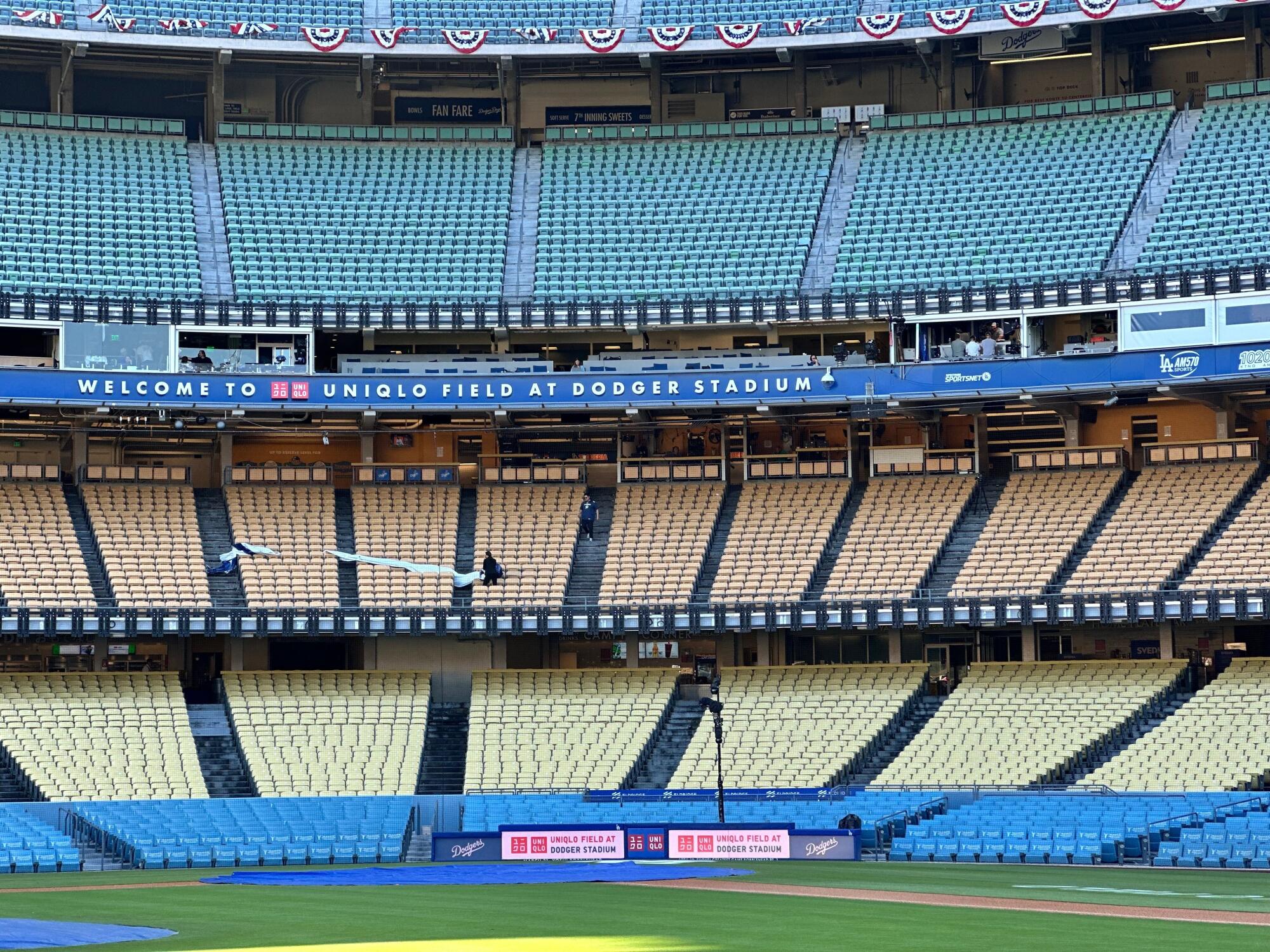
It was Dodger Stadium on Wednesday, when the grass outside the baseline and the bright red sign high above center field read “UNIQLO FIELD.” It will be Dodger Stadium on Thursday, when the defending World Series champions open their new season, and forevermore.
The official name of our summer home is now Uniqlo Field at Dodger Stadium. The team announcers will say that, and so will some of the signs. The fans won’t, and the founder of the company that just spent nine figures on the name you won’t use said he completely understands.
“That’s a very natural reaction,” Uniqlo founder Tadashi Yanai told me through an interpreter. “We respect that.”
Yanai said his company’s deal with the Dodgers covers five years. He would say only that the total value was “more” than $125 million. That provides the Dodgers with an annual naming rights payment in line with the ones at Crypto.com Arena, Intuit Dome and Sofi Stadium, without the Dodgers having to sell naming rights to the actual venue.
Are the Dodgers baseball’s version of a gold mine? Yes. Do they spend big and win big? Also yes. Do you mind if Uniqlo essentially covers Freddie Freeman’s salary this season?
“We need a lot of revenue to put out the product that we do,” Dodgers president Stan Kasten said. “That’s not a secret. And we’re proud of everyone who helps us do it: all of our fans, all of our media partners, and all of our sponsor partners. They are all important. It is how this all comes together.”
While Uniqlo would be delighted if you used its name, whatever local fans choose to call the stadium is not critical to the success of the partnership.
Ohtani made an estimated $125 million in endorsements and sponsorships last year, Sportico reported, a larger annual haul “than any other athlete in the history of sports.”
“The Dodgers are such a popular team,” Yanai said. “I usually ask my wife, after I come back from the office, whether Shohei hit a home run. I think all the Japanese people do that.”
Uniqlo Field signs were unveiled Wednesday at Dodger Stadium in the wake of the team’s naming rights deal.
(Beth Harris / Associated Press)
According to Forbes, Yanai is the richest man in Japan, where baseball teams carry corporate names. Why not buy a team and call it, say, the Uniqlo Bears?
“I always keep saying that could be very interesting,” he said, “but my wife turned it down. She keeps telling me, ‘Tadashi, you are not cut out to manage sports teams.’”
Instead, he is managing Uniqlo, an apparel company that pitches itself as blending comfort with quality. “We do not make disposable clothing,” Yanai said in the company’s last annual report.
Uniqlo has 794 stores in Japan but only 77 in the United States, including 14 in the Southland. Koji Yanai, a senior executive officer and Tadashi’s son, said the company aspires to grow annual U.S. revenues from $6 billion to $30 billion.
He shared what might be a more challenging aspiration.
“The Uniqlo Field at Dodger Stadium name may be very new for everyone,” he said, “but I hope in the near future the fans will like it and will love it.”
Jeff Marks, the chief executive of Los Angeles-based Innovative Partnerships Group, once brokered a naming rights deal in which the Cal football team would play on Kabam Field at California Memorial Stadium. He tried to find a receptive audience for the name.
“We educated a lot of freshmen, sophomores, and newcomers,” Marks said. “Are you going to go after alumni who have been calling it Memorial Stadium? No. So you didn’t focus on that. You focused on people that could be more impressionable, and it worked.”
With Dodger Stadium, we’ll see. For the 2026 season, it is now time for Dodgers baseball, but not before one reporter at a press conference Wednesday asked company officials whether Uniqlo would provide the Dodgers players with free clothing.
Kasten could not pass up the chance to interject.
“We pay them enough,” he said with a grin, “to shop at Uniqlo stores.”
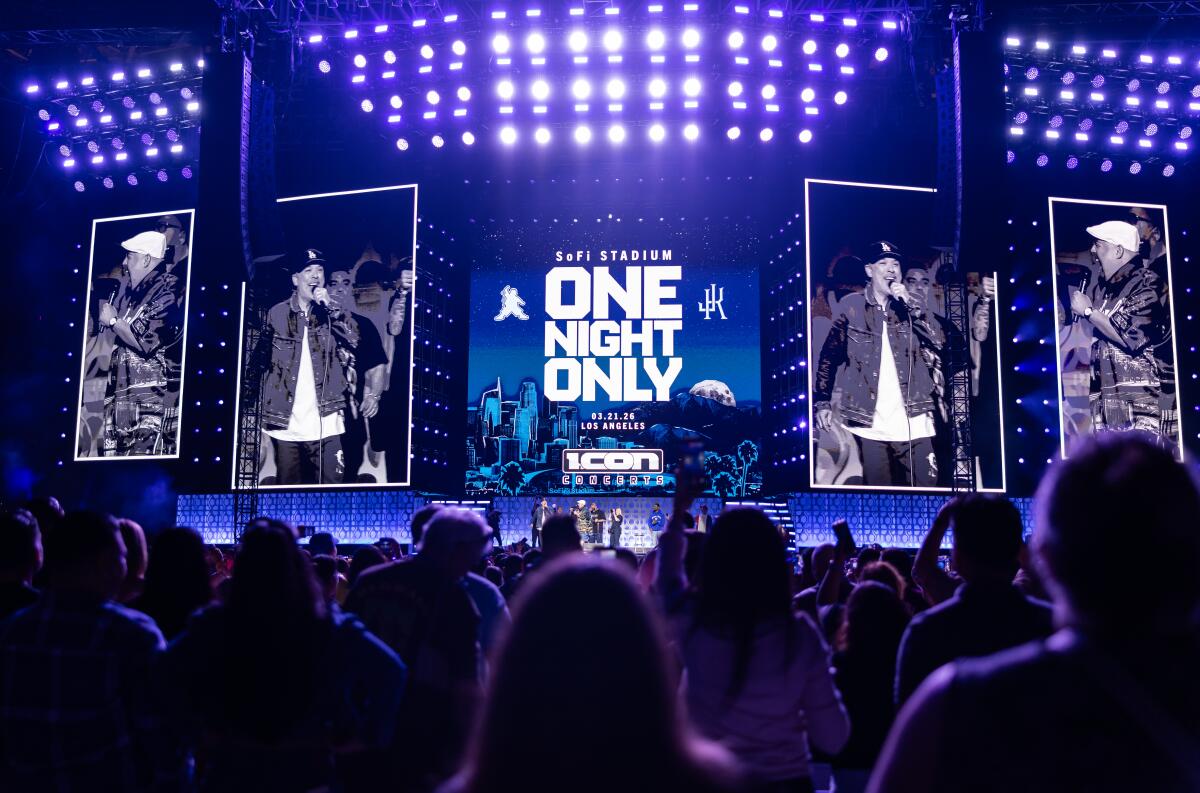
Comedians Jo Koy and Gabriel “Fluffy” Iglesias are used to delivering big laughs on large stages. But in the world of major L.A. venues, there’s big, there’s massive, and then there’s SoFi Stadium.
The show starring both comedians was billed as a record-breaking feat for stand-up when they sold out the 70,000-seater. Though the pressure to fill up the stadium was off, it still remained to be seen how the two comics would make their most dedicated fans laugh from more than a football field away. By that criteria, Saturday night was definitely a win.
Kicking off the early portion of the show at 7 p.m., fans were already filling the seats as opening acts from Iglesias’ camp, including Matt Golightly, Joey Guila, Alfred Robles, Martin Moreno (who celebrated his 58th birthday on stage) and ventriloquist funnyman Jeff Dunham got the crowd warmed up for about an hour before Iglesias took the stage first.
Comedians Jo Koy and Fluffy perform Saturday at SoFi Stadium.
(Christina House / Los Angeles Times)
It was almost 8 p.m. when Iglesias emerged following a video skit playing on the jumbo screens and the stadium’s massive halo scoreboard with his funny misadventures of a routine doughnut run at Randy’s Donuts that turned into the plot of “Sons of Anarchy” spinoff “Mayans M.C.” featuring lead actors Emilio Rivera, a.k.a. Miguel Golindo, and Clayton Cardenas, known for playing Angel Reyes. Reyes caused the first major eruption of noise in the crowd by pressing a detonation device that triggered columns of smoke that filled the stage as Fluffy made his entrance in a white flat cap and custom Los Angeles button-up to greet the sold-out stadium.
“Thank you for being here, all I have to say is we did it!” Iglesias proclaimed as the crowd cheered.
Pointing and waving to fans in the nosebleeds, he took time to embrace the moment that topped his previous triumph of performing at Dodger Stadium.
Fluffy takes the stage at SoFi Stadium in Inglewood.
(Christina House / Los Angeles Times)
Though the stage couldn’t have been bigger, both comedians used their ability to make a large event feel intimate by drawing the crowd in through storytelling and making them feel like they were part of a conversation. Iglesias set the tone of his set right away by telling us about the chisme (a.k.a. salacious gossip) surrounding his newly married stepson that weaved into stories about his travels all over the world including his controversial stop at the Riyadh Comedy Festival.
Iglesias also took a pause to relate one other historic fact about the two stadiums in L.A. he’s now been able to sell out.
Santino Villalovos of Tracy, Calif., shows his Fluffy tattoo during the Jo Koy and Fluffy show at SoFi Stadium.
(Christina House / Los Angeles Times)
“The two biggest shows in comedy were Dodger Stadium and SoFi Stadium. … And what did they both have in common? They both featured a Mexican,” he said.
Even though he thought about retiring as a comedian after filling up Dodger Stadium (twice) to film his special “Stadium Fluffy,” Iglesias said the SoFi show inspired him to keep pushing himself. And alongside Koy he knew they could do it.
Fans react to special guest Jamie Foxx during Jo Koy’s performance at SoFi Stadium in Inglewood on Saturday.
(Christina House / Los Angeles Times)
“Jo I know you’re in the back, thank you for trusting me man, we did it brother. And I’ll say it in front of an entire stadium, love you. Things like this for me is a huge deal because it inspired me and gave me another reason to keep doing what I love to do. And tomorrow I’m gonna be in the same situation I was after Dodger Stadium — what am I gonna do now? But until then I’m enjoy the hell outta tonight and I still have more stories to share with you.”
Fluffy’s most controversial (and true) bit of the night was breaking the news to his fans that his name is mentioned in the Epstein files, which sent collective shock through the stands.
“I’ve never been to the island, I’ve never been on the plane and I have never met Jeffrey Epstein,” he clarified.
Fans light up SoFi Stadium during Fluffy’s set on Saturday.
(Christina House / Los Angeles Times)
The comedian said that according to reports in the Epstein files, the late convicted pedophile apparently tried to buy tickets to his show at an Improv in West Palm Beach, Fla., in 2014 but was told by his assistant via email that both his shows were sold out.
“Jeffrey Epstein, one of the most diabolical human beings to ever walk the face of the earth. Had the ability to connect with politicians, with influencers, with celebrities. He put people in very compromising positions. He got people on planes. He put people on islands. He was involved in trafficking. He was able to accomplish all these evil, crazy things, but at the end of the day, he still couldn’t get tickets to see my show,” Iglesias said.
Jo Koy reveals himself with the Jabbawockeez at SoFi Stadium.
(Christina House / Los Angeles Times)
After a brief intermission, things transitioned to Jo Koy’s portion of the show featuring warm-up sets from TikTok skitmaster King Bach and longtime friend and stand-up star Tiffany Haddish, who came to the stage looking ready for the red carpet with a flowing silk dress, hair blowing in the man-made wind to deliver her brand of high-energy stories about becoming a real estate tycoon in South-Central.
When it was Koy’s turn to enter the stadium, he slipped in undercover, dressed as one of the Jabbawockeez — the legendary masked hip-hop dance troupe that danced onstage to a medley of West Coast hip-hop dressed in red with acrobatic swagger. At the end of a brief routine, Koy unmasked himself as one of the dancers, eliciting cheers from the crowd as his son helped him change onstage into his regular attire, Dodgers hat and a jean jacket.
Jo Koy performs at SoFi Stadium in Inglewood on Saturday.
(Christina House / Los Angeles Times)
Always a man of the people, his set also reminded us that he’s also a man of the pets, specifically dogs, launching into a long bit that felt worthy of a slightly more adult version of a Pixar movie. But beyond jokes and stories, Koy kept coming back to the idea that laughter, more than fame, marketing or money, is what helped the comedians’ big plans for SoFi come together.
“This place is full, all the way to the top, people laughing and having a good time. I know there’s a lotta s— going happening in the world right now but guess what, we don’t wanna hear it right now. We came to have a good f— time. I’m not here to debate s—, everybody’s in here, everything they said wasn’t supposed to happen happened. Look around, every f— color of the rainbow is in SoFi Stadium tonight.”
Jamie Foxx, left, sings with Jo Koy at SoFi Stadium.
(Christina House / Los Angeles Times)
The vibe of the set was all about escaping the problems of everyday life. For most of the night that was taken care of by comedy. And sometimes that escapism was aided by the power of R&B. Twice during the night Koy shocked the crowd with special guest sing-alongs, first with Babyface coming out to serenade the crowd with a brief yet un-relenting hit fest he wrote and/or sang including “Can We Talk,” the ‘90s hit he wrote for Tevin Campbell, and the Boyz II Men anthems “I’ll Make Love to You” and “End of the Road.”
The second surprise came courtesy of Jamie Foxx, who popped out in shades and 10-gallon hat to sing the Ray Charles homage-driven hook of Kanye West’s “Gold Digger.”
Aside from any historic accolades, Saturday night was the culmination of a show that was a year in the making and a victory lap for the careers of two comics who’ve been in the game for decades. It was also a moment where comedy’s past met its stadium-size future in the L.A. comedy world. Though it’s hard to say when the next big comedian will have enough fans to fill a stadium in L.A., Saturday didn’t feel like it was the last time comedy fans will show up to fill SoFi for a pair of comedians who put in the work to make themselves a team worth rooting for.