SOF Week 2026

Plan To Test OA-1K Skyraider II’s Rapid Deployability Outlined By Air Force Special Ops Command

With 18 examples of the OA-1K Skyraider II delivered to the U.S. Air Force’s Special Operations Command (AFSOC), the service is now looking forward to demonstrating the aircraft’s unique rapid-deployment capability later this year. AFSOC also says it plans to add laser-guided Advanced Precision Kill Weapon System (APKWS) rockets to the OA-1K’s armament options and is looking at boosting standoff capability in the form of Red Wolf mini cruise missiles. All of this comes at a time when the Pentagon is looking to cut back OA-1K numbers amid concerns surrounding its survivability and utility in a high-end fight, specifically with China, which stands today as the U.S. military’s pacing threat.

Lt. Col. Robert Wilson, chief of the AFSOC Armed Overwatch Requirements Branch, briefed journalists, including from TWZ, on the latest plans for the OA-1K ahead of the Special Operations Forces (SOF) Week, taking place from today in Tampa, Florida.

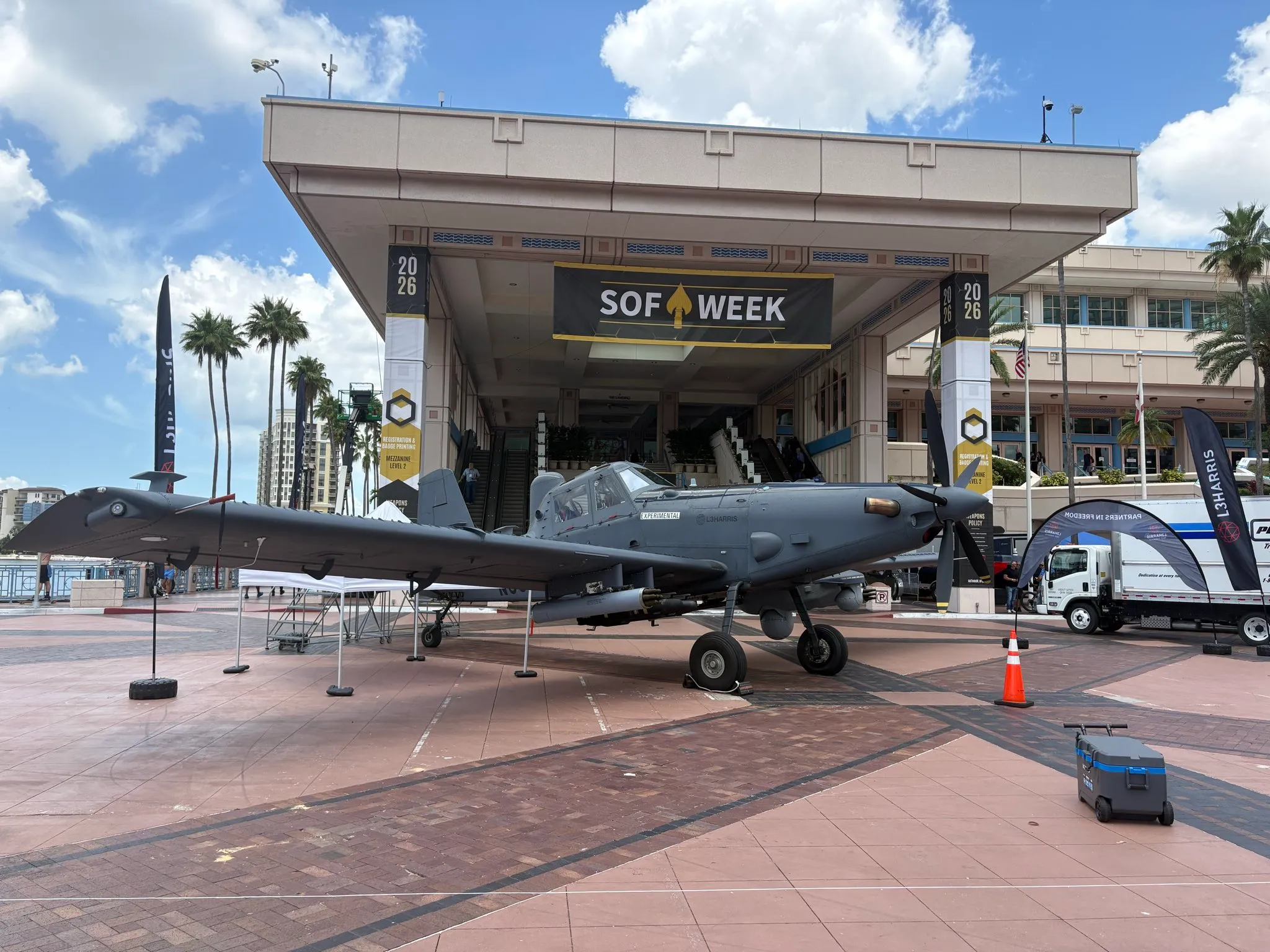
An OA-1K displayed outside of the Special Operations Forces (SOF) Week in Tampa, Florida. Air Tractor

Beginning with an overview of the program, Lt. Col. Wilson stressed that the OA-1K — a militarized derivative of the popular Air Tractor AT-802 crop duster — is not viewed as a replacement for legacy platforms like U-28 (which he previously flew) or the MC-12. Instead, it is “a new, purpose-built solution for today’s complex environments.”

An OA-1K Skyraider II and an MC-12W Liberty fly over the Gulf of America near Hurlburt Field, Florida, June 6, 2025. The MC-12W Liberty’s real-time intelligence and surveillance capabilities complement the OA-1K Skyraider II’s precision strike support, making their collaboration a powerful asset to Air Force Special Operations Command’s mission. (U.S. Air Force photo by Airman 1st Class Tori Haudenschild)
An OA-1K Skyraider II and an MC-12W Liberty fly over the Gulf of America near Hurlburt Field, Florida, June 6, 2025. U.S. Air Force photo by Airman 1st Class Tori Haudenschild

The thinking behind the Skyraider II reflects the transition from the Air Force’s focus on counter-terrorism operations in the post-9/11 period to a more complex threat picture. Now, the service has to be more prepared to fight against a much wider range of adversaries across the spectrum of conflict.

As Wilson explained, “the OA-1K represents a new era for AFSOC, with the flexibility to support not only counter-terrorism-like missions, but also crisis and contingency response, competition with more advanced adversaries, and even aspects of full-on conflict. To meet this wide range of mission sets, OA-1K is a multi-role capability platform that is essentially a Swiss Army knife of airborne capability.”

OA-1K Skyraider II Walk-Around Tour With Its Test Pilot thumbnail

OA-1K Skyraider II Walk-Around Tour With Its Test Pilot


The OA-1K multi-role mission remit therefore covers close air support (CAS), armed intelligence, surveillance, and reconnaissance (ISR), and precision strike.

At this point, Wilson explained, “we’re in the midst of production and delivery of aircraft, and we’re reaching a point where we are getting very close to demonstrating capabilities such as the weapons employment, the ability to provide ISR capability, so we’re kind of transitioning the program from what was previously developmental and conceptual to actually getting to the point where we’ll be looking to get into operational tests.”

To keep pace with changing threats, the Skyraider II has a modular design that provides flexibility for future upgrades, which could include expanded payloads, such as more advanced weapons, or more exquisite intelligence-collection capabilities.

An OA-1K Skyraider II sits ready for a mission June 25, 2025, at Eglin Air Force Base, Florida. The new Air Force Special Operations Command aircraft continues developmental testing with 96th Test Wing and U.S. Special Operations Command at Eglin. (U.S. Air Force photo by Samuel King Jr.)
An OA-1K Skyraider II sits ready for a mission at Eglin Air Force Base, Florida. U.S. Air Force photo by Samuel King Jr.

Reflecting on the potential for future enhancements in terms of external sensors and other payloads, Wilson continued: “We really think of this as levers that can be manipulated with a combination of fuel, weapons, and exquisite capabilities that can be increased or decreased based on the mission set to most effectively apply the capability to whatever mission it’s going out to accomplish that day.”

The OA-1K is also expected to enhance overall ground-force lethality and situational awareness through its provision of modern datalinks for joint integration.

All of this is expected to come with a much lower price tag than would be the case for traditional crewed aircraft.

According to Wilson, the cost-effectiveness of the OA-1K translates to a cost per flying hour of roughly $2,500. For comparison, an F-16C/D costs roughly ten times this amount per hour to operate.

“The OA-1K is one of the most affordable AFSOC platforms, which then frees up higher-end assets that are more costly, for other mission sets around the world, and that dollar amount makes it roughly 50 percent more cost-effective than even an MQ-1, which is an unmanned platform, and it’s more cost-effective than armed platforms like the U-28,” Wilson added.

NB: Wilson subsequently clarified that he had misspoken and that the cost comparison was between the OA-1K and other crewed platforms, like the U-28.

A U.S. Air Force U-28A Draco assigned to the 34th Special Operations Squadron prepares to take-off during exercise Tropical Dagger at Kingston, Jamaica, Feb. 22, 2024. The exercise was designed to bolster interoperability and demonstrate mutual defense of the region. (U. S. Air Force photo by Senior Airman Ty Pilgrim)
A U.S. Air Force U-28A Draco assigned to the 34th Special Operations Squadron prepares to take off during exercise Tropical Dagger at Kingston, Jamaica, February 22, 2024. U. S. Air Force photo by Senior Airman Ty Pilgrim

In terms of fielding, AFSOC has taken possession of its 18th OA-1K and is expecting a handful more throughout the end of the fiscal year. The initial cadre of crews is still training at Will Rogers Air National Guard Base in Oklahoma, with plans to station the aircraft in the future at both Cannon Air Force Base in New Mexico and Davis-Monthan Air Force Base in Arizona.

The next step in standing up this capability will involve demonstrating the rapid deployment abilities of the OA-1K. This is something that was part of the original requirement but which is also seen as increasingly vital for SOF missions, which already demand a high level of expeditionary agility. The ability to rapidly disassemble and reassemble the Skyraider II would become even more important in a potential confrontation with China in the Indo-Pacific theater.

“With rapid disassembly and reassembly, OA-1K can be loaded into a mobility aircraft like a C-5 or C-17 for rapid worldwide deployment, supporting missions around the world at a moment’s notice, and importantly, we’re talking a matter of hours instead of days or weeks that it would have otherwise required to fly around the world wherever it needs to go,” Wilson explained.

U.S. Air Force Senior Airman Daniel Rechner, a loadmaster assigned to the 701st Airlift Squadron, briefs U.S. Army Soldiers at McEntire Joint National Guard Base, South Carolina, Nov. 21, 2024. The South Carolina National Guard, in partnership with the 315th Airlift Wing, is conducting an aerial certification exercise to test a newly designed blade fold kit for the AH-64 Apache helicopter. The blade fold kit, developed to enhance operational efficiency, is 100 pounds lighter than its predecessor, marking a significant step forward in aviation technology and mobility. The exercise involves loading an Apache helicopter with the blade fold kit into a U.S. Air Force C-17 Globemaster III transport aircraft. The lighter blade fold kit simplifies preparing the helicopter for transport and frees up critical weight capacity for additional equipment or personnel. (U.S. Air National Guard photo by Master Sgt. Megan Floyd)
An AH-64 Apache is loaded into a U.S. Air Force C-17 Globemaster III transport aircraft at McEntire Joint National Guard Base, South Carolina, November 21, 2024. The Air Force expects the OA-1K to be deployed globally in a similar fashion. U.S. Air National Guard photo by Master Sgt. Megan Floyd

To start with, AFSOC is looking at testing this deployment capability using larger transport aircraft, primarily to maximize the number of OA-1Ks that can be moved at once, although Wilson said the exact number that will fit in a C-5 or C-17 will be determined as part of the operational test process later this calendar year.

Once deployed, the OA-1K is expected to operate “from nearly anywhere,” including short dirt surfaces, grass strips, and unimproved runways. As such, it will give the Air Force a combination of rapid deployment and austere environment capability that it otherwise doesn’t possess.

U.S. Air Force Col. Charles Redmond, 355th Wing deputy commander, and a pilot assigned to the 492nd Special Operations Wing prepare to take off in an OA-1K Skyraider II aircraft at Davis-Monthan Air Force Base, Arizona, Jan. 21, 2026. Redmond participated in a familiarization flight to better understand the Skyraider II’s mission set and capabilities, enhancing mission readiness. (U.S. Air Force photo by Senior Airman Jasmyne Bridgers-Matos)
U.S. Air Force Col. Charles Redmond, 355th Wing deputy commander, and a pilot assigned to the 492nd Special Operations Wing, prepare to take off in an OA-1K Skyraider II aircraft at Davis-Monthan Air Force Base, Arizona, January 21, 2026. U.S. Air Force photo by Senior Airman Jasmyne Bridgers-Matos

As noted earlier, there have been repeated questions about the survivability and general utility of the OA-1K in more contested environments, something that TWZ has looked at in depth in the past. But Wilson is confident that its mix of capabilities means it can still be relevant, even when facing a high-end opponent.

“First, it complicates things for the adversary because you may not have the aircraft in predictable locations,” Wilson contended. “It ensures that armed overwatch is provided for the joint force to increase their own survivability, and finally, it also ensures the persistent presence of the capability at a low cost compared to other platforms, freeing up higher-end assets for other locations.”

All of this can be achieved with a relatively tiny logistics footprint, with only a handful of contract maintainers required, and the disassembly/reassembly process can be done safely even in austere environments. Each two-person aircrew is being trained in this process, which includes conducting functional check flights in these locations before the aircraft conducts its mission. The actual process of disassembly and reassembly takes just a matter of hours.

A U.S. Air Force C-130 Hercules delivered U.S. Army Pacific Soldiers onto the newly renovated Angaur Airfield for training exercises in the Republic of Palau, Sept. 6. The successful arrival of the military cargo plane validates the airstrip’s use by military and commercial aircraft. “The completion of the Angaur Airfield Joint Improvement Project is a game changer,” said John Hennessy-Niland. “Palau now has a secondary airstrip. This had been a long-standing request from the government of Palau and the State of Angaur.”
A U.S. Air Force C-130 Hercules operates from a newly renovated austere airstrip during training exercises in the Republic of Palau, in the western Pacific Ocean. U.S. Army Pacific Public Affairs Office

With traditional Air Force platforms, deployments can take days or weeks, not just in terms of physically having to fly the aircraft to wherever it needs to go around the world, but all the planning that’s necessary for the crews, ground support services, etc.

“We have demonstrated this capability by doing a timed disassembly and reassembly in a controlled environment in a hangar,” Wilson added. “We’ll next look to conduct the activity in an actual mobility aircraft during our operational test later this calendar year.” After that, AFSOC will look to conduct the rapid disassembly and reassembly of the Skyraider II as part of exercises, likely next year.

“Just like anything else, the more reps and sets that we accomplish, the more ready we will be whenever we need to conduct it operationally,” Wilson said.

While Wilson did not mention it by name, this mode of operating ties directly into broader Air Force plans for the Agile Combat Employment, or ACE, concept, which is designed to ensure that combat airpower can still be brought to bear in a timely way, even when conventional airbases are put out of action or otherwise held under threat — the kinds of conditions likely in a conflict with a near-peer competitor, like China or Russia. In fact, the OA-1K has a particular role to play in this sort of scenario, since it’s even questionable if more advanced platforms will be able to execute as envisioned in a major conflict under ‘ACE rules.’

Wilson is also confident that, even without recourse to these kinds of expeditionary basing tactics, the OA-1K offers a suitable degree of survivability for many different scenarios.

A 137th Special Operations Wing Air Commando, Oklahoma Air National Guard, inspects Air Force Special Operations Command OA-1K Skyraider IIs on the Will Rogers Air National Guard Base flightline, Oklahoma City, March 31, 2026. The OA-1K Skyraider II is a dynamic aircraft with adaptive capabilities tailored for close air support, precision strike, surveillance and reconnaissance mission sets, providing the 137th SOW the leverage to support operations anytime, anywhere. (U.S. Air National Guard photo by Staff Sgt. Erika Chapa)
A 137th Special Operations Wing Air Commando, Oklahoma Air National Guard, inspects Air Force Special Operations Command OA-1K Skyraider IIs on the Will Rogers Air National Guard Base flightline, Oklahoma City, March 31, 2026. U.S. Air National Guard photo by Staff Sgt. Erika Chapa

“We have a certain built-in survivability capability for the platform,” Wilson explained. “The contractor has built in cockpit and engine armor, for example, to ensure that it’s survivable, and it does have defensive systems. So I would say it does have a baseline level of defensibility and survivability, and then we are certainly working on, with funding, ensuring that it is modernized and equipped, not only for survivability, but for really any other capability for the platform as well, to ensure that it remains relevant for the future.”

As for that first operational deployment, that could occur “in the coming years,” provided that the program continues to mature as anticipated.

There are potential pitfalls ahead, not least the question about how many OA-1Ks the Air Force will eventually receive.

Wilson reiterated that the program of record still calls for 75 aircraft, but admitted that this could be a challenge to achieve. As it stands, the U.S. Special Operations Command, as the procurement agency for the OA-1K, has cut its planned purchase down to 53 airframes, citing resource constraints.

Air Force Special Operations Command received two AT-802U trainer aircraft at Hurlburt Field, Florida on June 28, 2024. These aircraft will be used to train test pilots and initial cadre in a representative tail wheel aircraft in preparation for the missionized Armed Overwatch (OA-1K) variant. (U.S. Air Force photo by Senior Airman Ty Pilgrim)
Air Force Special Operations Command received two AT-802U trainer aircraft at Hurlburt Field, Florida, on June 28, 2024. These aircraft have been used to train test pilots and initial cadre in a representative tailwheel aircraft in preparation for the OA-1K variant. U.S. Air Force photo by Senior Airman Ty Pilgrim

“As the capability sponsor, I would say less than 75 is not desirable,” Wilson noted. “Any decrement below that is essentially a result of resource constraints and budget limitations. We will continue advocating to ensure that we get closer and ultimately achieve that program of record, but as you can imagine, budget constraints that impact various programs have decreased the final fleet size to less than that currently.”

The prospect of a potentially smaller OA-1K fleet means that having the aircraft working alongside other platforms, including drones, may become more important. Already, however, AFSOC sees the value of crewed/uncrewed missions for the Skyraider II.

“The integration of manned and unmanned assets is something that we’re certainly looking at in terms of capability,” said.

When it comes to weapons capabilities, Wilson confirmed that APKWS laser-guided rockets are compatible with the OA-1K and are something that AFSOC wants to have as part of the ordnance options for the platform.

An OA-1K pilot conducts a walkaround of an OA-1K armed with Hellfire missiles and an unguided rocket pod on the flightline at Hurlburt Field, Florida. U.S. Air Force photo by Staff Sgt. Natalie Fiorilli

APKWS is quickly becoming a weapon of choice for a wide range of platforms, offering a low-cost, high-volume, precision weapon that is equally effective for both ground attack and counter-drone missions. APKWS was proven incredibly effective on light attack aircraft experiments that tangentially led to the procurement of the Skyraider II, working as the primary weapon for those aircraft. So it should come as no surprise that it will be integrated onto the Skyraider II. It’s actually somewhat surprising it isn’t already.

As far as the Red Wolf cruise missiles, Wilson was a little more circumspect. “That is certainly an area that we are looking to explore to allow for inclusion of that weapon into the planned set,” he said.

As we have explained in the past, adding Red Wolf, or a similar standoff weapon, to the OA-1K armory is one way of ensuring the aircraft can be more relevant and survivable, providing it with a true long-range strike capability.

A Red Wolf miniature cruise missile is displayed in front of a U.S. Air Force OA-1K Skyraider II. L3Harris

Putting aside the Red Wolf, it is also somewhat surprising that so little weapons integration work appears to have been carried over from earlier iterations of the armed Air Tractor concept, since similar versions of this aircraft have been flying for years, including in combat.

The Air Force service sees the OA-1K as far more than a light attack aircraft and more as a modular platform that will be able to be configured for irregular warfare, armed overwatch, ISR, strike, and more. Clearly, by pushing its rapid-deployment capability, the service is seeking to underscore the relevance of the aircraft in the Pacific theater. Meanwhile, recent conflicts in the Middle East — where traditional airbases were pummelled by drone and missile attacks — have demonstrated that the Air Force still has a requirement to conduct combat operations in other, less-contested environments too.

Once the OA-1K starts demonstrating its rapid-deployment capability, AFSOC hopes that the aircraft will further demonstrate that it fills a niche that no other crewed Air Force platform currently can.

Contact the author: thomas@thewarzone.com
Thomas is a defense writer and editor with over 20 years of experience covering military aerospace topics and conflicts. He’s written a number of books, edited many more, and has contributed to many of the world’s leading aviation publications. Before joining The War Zone in 2020, he was the editor of AirForces Monthly.


Source link

Hunt For C-146 Wolfhound Special Ops Transport Plane Replacement Underway

U.S. Special Operations Command (SOCOM) is in the early stages of the search for a replacement for the C-146 Wolfhound cargo plane. The C-146s are unassuming twin-engine turboprop aircraft with civilian-style paint schemes that provide important logistical, medical evacuation, and other support, particularly to far-flung U.S. special operations forces. However, they are also based on a long-out-of-production design that was never in widespread use anywhere, and that makes them increasingly difficult and costly to sustain.

Col. Justin Bronder, head of SOCOM’s Program Executive Office for Fixed Wing (PEO-FW), spoke to TWZ and other outlets about the C-146 replacement plans at a roundtable on the sidelines of the annual SOF Week conference yesterday. The Wolfhounds are part of what SOCOM refers to as its Non-Standard Aviation (NSAv) fleets.

A C-146 seen flying from an austere airstrip in the Philippines during an exercise in January 2026. Courtesy photo via US Special Operations Command Pacific

There are some 20 Wolfhounds in service today, which are operated by Air Force Special Operations Command (AFSOC). The C-146, which AFSOC began flying in the early 2010s, is a militarized version of the Dornier Do-328, something we will come back to later on. The Air Force also has another Do-328, nicknamed Cougar, that has been used to conduct research and development and test and evaluation activities in support of SOCOM.

A briefing slide from the mid-2010s discussing the features of the Do-328 “Cougar” aircraft. SOCOM

“So we have had a highly successful Non-Standard Aviation program, again that really developed under the crucible of where those operations that the Command [SOCOM] was in many parts leading in the really peak days in the War on Terror,” Col. Bronder explained. “So those aircraft, again, battle-proven C-146 Wolfhound aircraft, [were] set up at various TSOCs [theater special operations commands], providing the direct support.”

A nighttime shot of a C-146 coming in to land on a highway in Arkansas during an exercise. USAF

However, “those aircraft were fairly constricted by their short range, [and] by being a unique aircraft. There wasn’t a large global backbone to sustain them,” he continued. “So it was a successful model, but maybe not a very cost-effective one.”

The Air Force’s official C-146 fact sheet says the aircraft can fly up to 1,500 nautical miles while carrying 2,000 pounds of cargo. The Wolfhound does offer the flexibility to operate from shorter runways and semi-prepared airstrips, as well as roads.

A C-146 operating from a roadway during an exercise. USAF/Master Sgt. Scott Thompson

“We’re looking for ways to recapitalize that fleet with something that’s more cost-effective, leverages a commercial kind of sustainment enterprise better, and then it again provides maybe a more capable aircraft to cover down on larger areas faster,” Col. Bronder added. “So those are the types of requirement spaces we’re working through as we plan out what the next phase of NSAv looks like.”

A simulated casualty is seen being attended to inside a C-146 during an exercise. USN/Chief Petty Officer Elizabeth Reisen

The Do-328 was first developed in the 1980s as a commuter airliner. A jet-engined 328JET derivative followed in the 1990s. Both variations only saw relatively limited sales. Just 217 examples were reportedly built, inclusive of both turboprop and jet-powered versions, during the production run in the 1990s. Only a fraction of those aircraft are still flying. Several attempts have been made to revive production of modernized versions of the design, but so far without success. Last year, Deutsche Aircraft unveiled the first prototype of its new D328eco, but, at the time of writing, it has yet to fly.

A picture of Deutsche Aircraft’s D328eco prototype, notably seen here without engines fitted. Deutsche Aircraft

With the exception of a lone example operated by the Botswana Defence Force, the U.S. Air Force is the only military user of the Do-328. All of the Air Force’s examples were acquired second-hand. The C-146s supplanted an even smaller fleet of Bombardier Q-200s, a version of the De Havilland Canada DHC-8, or Dash 8, which AFSOC had begun flying in the NSAv role in the late 2000s.

Since the early 2010s, the C-146s have been criss-crossing the globe, providing discreet support to U.S. operations forces, sometimes right at the tactical edge. As one known example, Wolfhounds were heavily involved in supporting the opening phase of the French intervention in the northwest African country of Mali in 2013. C-146s continue to be used to move special operations forces and cargo, as well as to help evacuate injured personnel and perform other light utility-type missions worldwide. They have even sometimes been employed as VIP transports in more far-flung locales.

Then-US Secretary of State John Kerry seen about to board a C-146 in Vietnam’s Ho Chi Minh City during a visit to the country in 2017. US Department of State

The C-146 fleet has also received various upgrades over the years. This includes unspecified modifications that have enabled the aircraft “to land at more austere, semi-prepared runways,” which “resulted in an approximately ten-fold increase in the number of available runways worldwide,” according to a declassified annual Air Force report published in 2015, which this author previously obtained via the Freedom of Information Act (FOIA).

The full entry on the C-146 from the declassified USAF annual report published in 2015. USAF via FOIA

As Bronder made clear yesterday, SOCOM and AFSOC are still very early in the process of laying out the requirements for a successor to the C-146. Any desire for boosts in range, performance, payload, and other capabilities will need to be balanced against the need for any future NSAv aircraft to be able to operate from the same kinds of remote and austere locations as the Wolfhound does today.

SOCOM is certainly looking to move quickly on securing a replacement for the C-146. It is asking for $55 million to buy the first three of these new NSAv aircraft in its Fiscal Year 2027 budget.

“The current C-146A fleet will be divested of on a schedule that maintains this critical TSOC capability, as transition to the new aircraft occurs,” the budget documents also note.

US Air Force personnel prepare to transfer simulated casualties to a waiting C-146 during an exercise in 2022. USAF/Staff Sgt. Christopher Stolze

In the meantime, the Wolfhound fleet will continue providing important, if not often overlooked, support to American special operations forces around the world.

Contact the author: joe@twz.com

Joseph has been a member of The War Zone team since early 2017. Prior to that, he was an Associate Editor at War Is Boring, and his byline has appeared in other publications, including Small Arms Review, Small Arms Defense Journal, Reuters, We Are the Mighty, and Task & Purpose.


Source link

New Engines Key To Night Stalker MH-60M Black Hawk Upgrade Plans

Plans for a new tranche of upgrades for U.S. Army special operations MH-60M Black Hawk helicopters are heavily tied to continued progress, or lack thereof, on an improved engine. Work on the Army’s Improved Turbine Engine Program (ITEP) is ongoing now, but there have also been threats to cancel it entirely in recent years, and its future remains murky.

Officials from U.S. Special Operations Command (SOCOM) talked about the intersection of future plans for the MH-60M fleet and ITEP during a roundtable at the annual SOF Week conference yesterday. TWZ was in attendance, along with other outlets. The Army’s elite 160th Special Operations Aviation Regiment, also known as the Night Stalkers, operates the MH-60Ms.

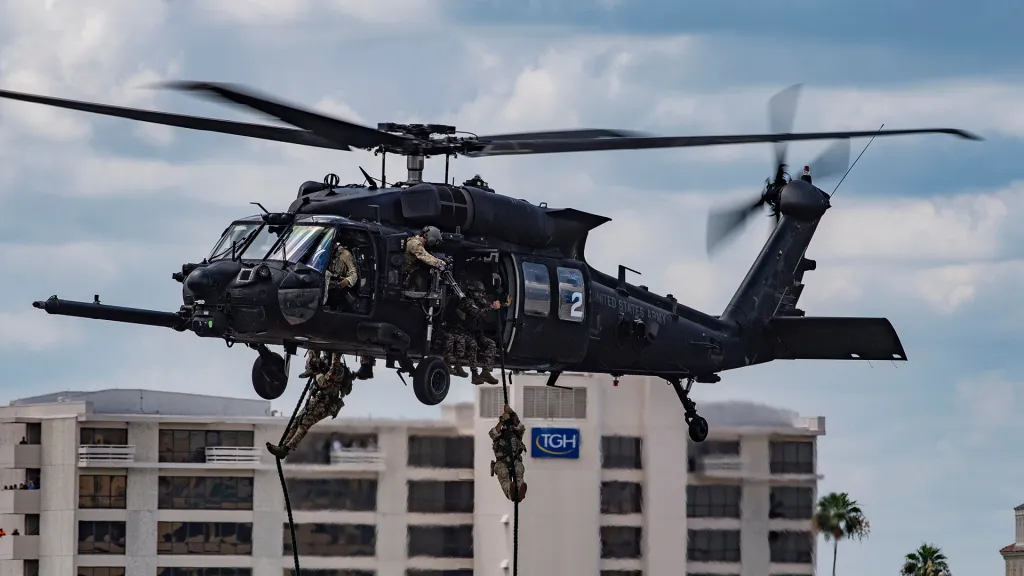
Special operators rappel from a Night Stalker MH-60M during a capability demonstration outside the 2026 SOF Week conference. Jamie Hunter

The Army selected General Electric’s (GE) T901 as the winner of the ITEP competition in 2019. The engine remains in development, with flight testing involving a modified Black Hawk beginning in May 2025.

“We are following very closely what the Army is doing with ITEP. We are hoping that we will get it,” Lt. Col. Aron Hauquitz, head of the Technology Applications Program Office (TAPO), said at the roundtable yesterday. “We’ll be able to put it in our aircraft, and we’ll create the Block 2 variant of the MH-60M.”

A T901 turbine engine. GE

In “FY30 [Fiscal Year 2030], we’re going to start either the Block 1.2 or the Block 2” upgrade program for the MH-60M fleet, Lt. Col. Cameron Keogh, the Program Manager for the MH-60 within SOCOM’s Program Executive Office for Rotary Wing (PEO-RW), also said at the roundtable. “It’s going to hinge on what’s going on with the Improved Turbine Engine, the T901 program that the Army’s running. We’re closely following that. If it continues to be successful, we will integrate that engine.”

To take a step back quickly, Night Stalker Black Hawks today already have an array of unique features compared to other H-60 variants in service elsewhere across the U.S. military and globally. This includes a terrain-following/terrain avoidance radar and other sensors, a variety of defensive systems, and an extensive communications suite, which you can read about in more detail here. A subset of the MH-60Ms are also configured as Direct Action Penetrators (DAP), which can be armed with a mix of guns, missiles, launched effects, and rockets to provide organic close air support during missions.

A pair of Night Stalker MH-60M configured as Direct Action Penetrators (DAP). USMC/Cpl. Matthew Williams

Cramming all of these capabilities on the MH-60Ms also requires significant changes to their core structure, and they are notably heavier than other typical H-60 variants. To account for this, the 160th’s Black Hawks already have YT706 turbine engines that are more powerful than the T701s found on standard Army models. GE makes both of these engines.

The YT706 has “higher fuel consumption, but it also has a higher output to help us keep that extra weight in the air,” Lt. Col. Keogh noted yesterday.

Integrating the T901 onto a typical Black Hawk will provide “50 percent more shaft‑power while delivering significantly higher fuel efficiency,” according to Lockheed Martin. Sikorsky, the prime contractor behind the H-60 family of helicopters, became a subsidiary of Lockheed Martin in 2015.

“The 50% power increase means a Black Hawk can transport additional fuel or payloads, such as launched effects, medical evacuation litters, forward area resupply loads or advanced sensor packages, without compromising aircraft performance,” Lockheed Martin highlighted in a press release earlier this month. “The engine’s performance at high altitude, high temperature conditions expands the Black Hawk’s envelope, giving commanders more options for insertion, extraction and reconnaissance missions in austere environments.”

Sikorsky Begins Black Hawk® Ground Runs with U.S. Army T901 Improved Turbine Engines thumbnail

Sikorsky Begins Black Hawk® Ground Runs with U.S. Army T901 Improved Turbine Engines


“Higher fuel efficiency and lower maintenance demands lessen the supply chain burden in contested environments, a core tenet of the Army’s continuous transformation strategy,” the press release noted. “Improved specific fuel consumption reduces the number of refuel stops, extending mission endurance and shrinking the fuel footprint in forward operating bases.”

The boost in capability that the T901 is set to bring is especially relevant for Night Stalker MH-60Ms, given their unique attributes and mission requirements. The maintenance and logistics benefits would also be particularly attractive for the 160th. The Regiment routinely flies extremely demanding missions, often conducted across long distances and under adverse conditions, and staged from far-flung locations with limited access to established support chains.

Plans otherwise for the Block 1.2/Block 2.0 MH-60M upgrades are still evolving.

Right now, the core “focus on that is payload restoration. We’re trying to take weight out of the airplane [sic], [and] we’re trying to move the CG, the center of gravity, forward,” Lt. Col. Keogh explained. “How we’re doing that without reducing capabilities is we’re just kind of moving the capabilities around.”

An MH-60M flies low over the water during the capabilities demonstration outside this year’s SOF Week conference. Jamie Hunter

“Somebody asked me earlier if we’re going to take the anti-ice system off the airplane to lose some weight. We’re not. We need the anti-ice, especially up in Washington State,” he continued. “We’re taking some of our heavier boxes, a lot of our avionics, we’re putting them up forward into the crew department, we’re putting them behind the pilots. That’s going to shorten cable runs – copper weighs a lot, you’d be surprised – and then it also helped with our CG shift, as well.”

“That’ll give the operators more butts in seats as they head out to the objective, and also give the air crews better fuel flexibility for mission planning,” he added.

To go back to ITEP, the new engine has long been expected to offer a major leap in performance to regular Army Black Hawks, as well as the service’s AH-64 Apache attack helicopters. However, as noted, the program has faced major uncertainty in recent years. The effort has suffered significant delays tied to manufacturing and supply chain issues. The T901 was also a central component of the Army’s Future Attack Recon Aircraft (FARA) program, which the service axed in 2024.

Last year, there were indications the Army was moving to cancel ITEP, too, with the service requesting no additional funding for the program in its 2026 Fiscal Year budget proposal. Congress subsequently interceded, appropriating another $238 million for continued work on the engine in the current fiscal cycle.

In its 2027 Fiscal Year budget request, the Army is again not asking for any new money for ITEP, which has raised new questions about the program’s future.

T901 First Engine to Test Mission Accomplished thumbnail

T901 First Engine to Test Mission Accomplished


At the Army Aviation Association of America’s (AAAA) 2026 Warfighting Summit last month, Army Maj. Gen. Clair Gill said he was “very excited about where they’re going there” with ITEP and that the engine was “almost nearing completion of certification.” Gill is the service’s Program Acquisition Executive for Maneuver Air.

ITEP is “performing as intended,” and “the resourcing that Congress added in 2025 and the resourcing that Congress added in 2026 is being used to deliberately continue that testing,” Army Brig. Gen. David Phillips also told TWZ and other outlets at a roundtable at the AAAA conference, but did not elaborate on future plans for the engine. Phillips is the Deputy Portfolio Acquisition Executive for Maneuver Air.

“We will need a little bit more money to get through the EMD [engineering, manufacturing and development] program, but it’s certainly not anywhere close to the money that we’ve already received for the program,” Mike Sousa, GE’s Executive Program Manager for the T901, had also told members of the media ahead of the AAAA conference, according to Breaking Defense. “So there is a little bit of money that is still required.”

Another factor now in all of this for the Army, as well as the Night Stalkers, is the expected arrival of the new MV-75 Cheyenne II tiltrotor in the next few years. The MV-75 offers massive boosts in range and speed compared to any Black Hawk variant. At the same time, that is also expected to come at a cost. As it stands now, the MV-75 is not expected to replace all of the Army’s H-60s, which will continue to play important roles for years to come. SOCOM and the 160th have a similar vision when it comes to the fielding of a special operations-specific version of the MV-75 and the future of the MH-60M.

A rendering of a special operations-specific version of the MV-75. Jamie Hunter

“There will not be a one-for-one swap for MH-60M and MV-75. Don’t ask me what that exact number will be,” Dr. Steven Smith, head of SOCOM’s PEO-RW, also said at the roundtable yesterday. “We’re still going to need analysis to determine what that will be, but it will not be a one-for-one swap. We recognize that the M-60s will be required for the crisis response mission.”

As an aside, the 160th’s MH-60Ms, including examples in the DAP configuration, were a key element of Operation Absolute Resolve to capture Nicolas Maduro, then Venezuela’s dictatorial president, in January. TWZ explored the contributions of the DAP helicopters in detail at the time.

Altogether, the MH-60M is still on track to be a central component of the Night Stalker’s fleets for years to come, whether the helicopters are re-engined in the end or not.

Contact the author: joe@twz.com

Joseph has been a member of The War Zone team since early 2017. Prior to that, he was an Associate Editor at War Is Boring, and his byline has appeared in other publications, including Small Arms Review, Small Arms Defense Journal, Reuters, We Are the Mighty, and Task & Purpose.


Source link

U.S. Military’s Shahed-136 Kamikaze Drone Clone Is Getting Hivemind Swarming Capability

The U.S. military’s Low-Cost Uncrewed Combat Attack System, or LUCAS, the recently combat-proven long-range one-way attack drone designed for massed operations, will be equipped with Hivemind autonomy software from Shield AI. The company was selected for the integration effort by the Office of the Under Secretary of War for Research and Engineering (OUSW R&E) as part of an effort to bring AI-enabled swarming and autonomous teaming to LUCAS. The aim of incorporating swarming capabilities onto LUCAS, which is built by SpektreWorks, is something that officials told us about soon after the program broke cover.

The LUCAS program, developed by the Office of the Deputy Assistant Secretary of War for Prototyping and Experimentation under OUSW R&E, is intended to field ‘affordable mass’ by producing large numbers of relatively low-cost drones that can be deployed in coordinated waves to saturate enemy defenses and expand strike capabilities at scale. Each LUCAS drone costs around $35,000, which is a fraction of the price of available missiles with similar range.

Based on the Iranian Shahed-136, LUCAS was used in combat for the first time when a large number of them were fired against Iranian targets in the opening salvos of Operation Epic Fury, the U.S. part of the joint U.S.-Israeli attack on Iran that began on February 28 of this year.

“LUCAS, indispensable,” U.S. Central Command boss Adm. Brad Cooper told TWZ when asked how effective the drones had been and how much they helped preserve magazine depth, given their comparatively low cost and faster and easier production.

Meanwhile, the original Shahed-136, as well as Russian Geran-series developments of it, have rapidly become a signature weapon of the war in Ukraine, acting as Moscow’s primary standoff strike munition. For years now, Shaheds have led Russia’s campaign of bombardment against Ukrainian infrastructure and cities. While the Shahed has a range in excess of 1,000 miles, LUCAS, in its current configuration, is a bit smaller, with a range of around half that distance. A version of the current airframe used for the LUCAS program also serves in a target surrogate role for training and testing.

Under the new effort, Hivemind will act as an AI “pilot” for LUCAS, allowing groups of drones to coordinate movements, maneuver collaboratively, and adapt to changing battlefield conditions in real time. The effort will culminate in an operational demonstration this fall in which a single operator will direct a swarm of LUCAS drones, but initial flight tests with the software installed will take place before then, Shield AI told TWZ.

Speaking to TWZ at the annual SOF Week conference yesterday, Shield AI’s Brandon Tseng explained that much of the work on inserting the Hivemind AI pilot into LUCAS has already been proven by the company’s experiences working with Ukraine.

“LUCAS is a reflection of about two years’ worth of work with OUSW R&E, and a reflection of a lot of the work that we’re doing in Ukraine with one-way attack drones,” Tseng explained. “For the past several months, we’ve been shipping hundreds of AI pilots for one-way attack drones into Ukraine. Those drones have increased the probability of a kill. They have reduced [the] kill chain timeline, they have reduced the cost per effect, instead of, one out of every 10 of these one-way attack drones hitting their target, now they’re 10 out of 10 in terms of what we’re seeing, and it’s really about taking a lot of that development that we’ve done over in Ukraine and bringing it to a program like LUCAS to again increase probability of kill, reduce cost per effect, and increase probabilities of success.”

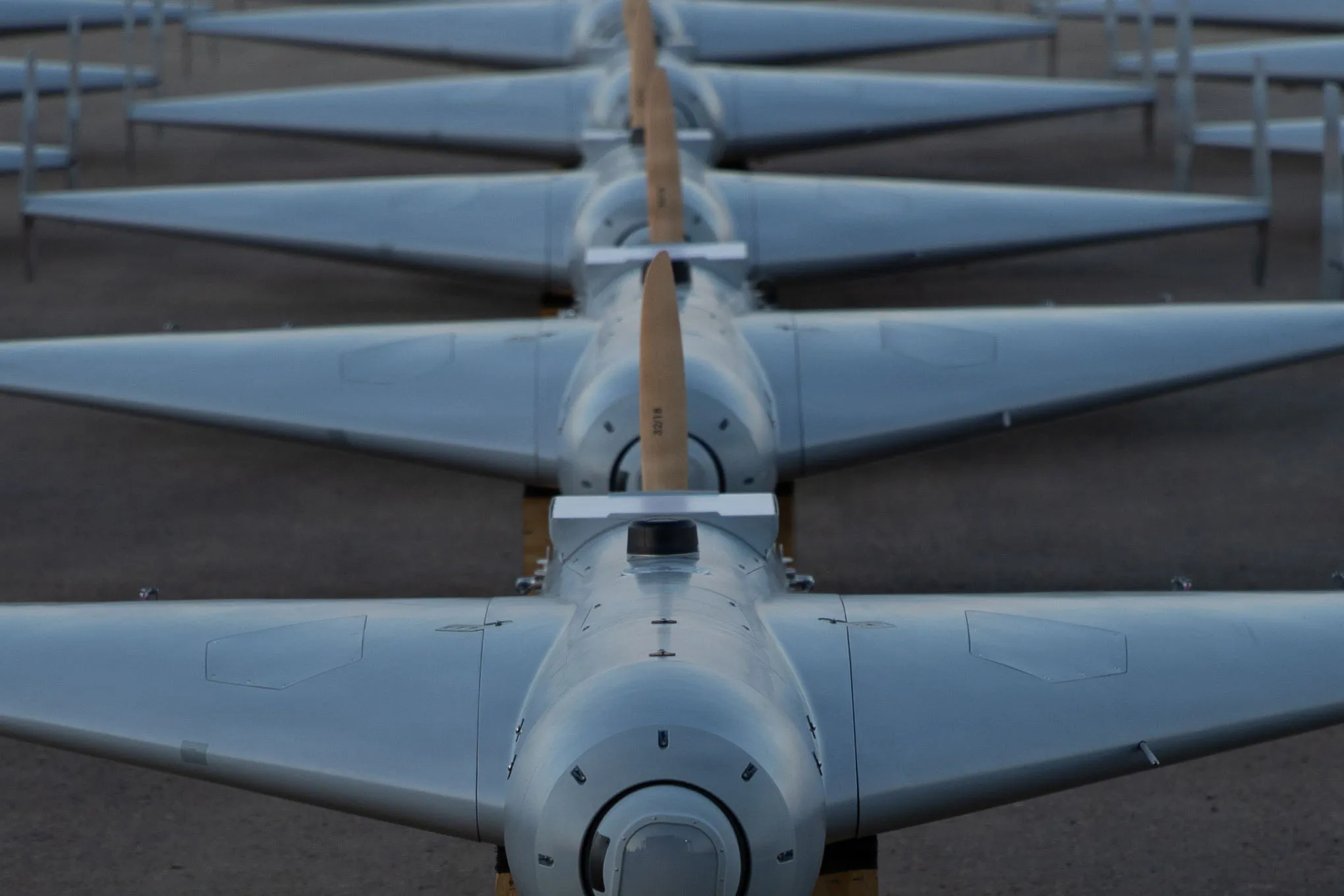
U.S. CENTRAL COMMAND AREA OF RESPONSIBILITY (Nov. 23, 2025) Low-cost Unmanned Combat Attack System (LUCAS) drones are positioned on the tarmac at a base in the U.S. Central Command (CENTCOM) operating area, Nov. 23. The LUCAS platforms are part of a one-way attack drone squadron CENTCOM recently deployed to the Middle East to strengthen regional security and deterrence. (Courtesy Photo)
Low-cost Unmanned Combat Attack System (LUCAS) drones are positioned on the tarmac at a base in the U.S. Central Command (CENTCOM) operating area, Nov. 23, 2025. The LUCAS platforms were part of a one-way attack drone squadron CENTCOM deployed to the Middle East to strengthen regional security and deterrence. Courtesy Photo/U.S. Department of War

In the Ukrainian context, Tseng confirmed that its AI agents are employed across a range of uncrewed platforms. At one end of the scale, these include one-way attack drones with a range of around 62 miles and an overall cost of $8,000, out of which the AI pilot costs around $1,000. At the other end of the scale are much larger and more expensive drones and missiles, including cruise missiles from the Switzerland-based Destinus company.

Returning to the U.S. military, the current effort began with Shield AI working on collaborative autonomy with OUSW R&E, something that began before the second Trump administration. That work was carried forward until the company was one of several down-selected to provide AI pilots for LUCAS.

The effort could represent a significant step toward fielding collaborative autonomy, a long-term goal of massed drone operations, with teams of autonomous systems operating together in dynamic and highly challenging combat environments. These could include ones where GPS is denied and communications are degraded, due to heavy employment of electronic warfare by the enemy.

“LUCAS is about delivering affordable mass, but mass without coordination is limited in value,” Tseng, who is the president and co-founder of Shield AI, said in a media release. “Hivemind is the AI pilot that makes that mass intelligent. It’s the autonomy layer that enables teams of drones to sense, decide, and act at scale. We’re proud to partner with OUSW R&E to put this capability in the hands of the warfighter at the speed of relevance.”

Hivemind is intended to streamline the operation of networked uncrewed systems by allowing a single operator to monitor and direct, as needed, multiple platforms simultaneously during complex, highly-coordinated missions. Using Hivemind, human operators retain authority over strike decisions, while the autonomy software handles navigation, coordination, and general mission execution. The operator can override and redirect the swarm’s operations and redefine its objectives at any time. Automating the swarm’s operations as much as a possible accelerates the timeline from target detection to engagement across a kill chain. The swarm should also be able to collectively act faster than an enemy can react, overwhelming and potentially breaking its decision cycle.

251216-N-NO146-1228 ARABIAN GULF (Dec. 16, 2025) A Low-cost Unmanned Combat Attack System (LUCAS) successfully launches from the flight deck of the Independence-class littoral combat ship USS Santa Barbara (LCS 32) while operating in the Arabian Gulf, Dec. 16. Task Force 59 operated the LUCAS drone, which is part of Task Force Scorpion Strike, a one-way attack drone squadron recently deployed to the Middle East to strengthen regional security and deterrence. (U.S. Army photo by Spc. Kayla Mc Guire)
A Low-cost Unmanned Combat Attack System (LUCAS) drone launches from the flight deck of the Independence class Littoral Combat Ship USS Santa Barbara (LCS 32) while operating in the Arabian Gulf, Dec. 16, 2025. U.S. Army photo by Spc. Kayla McGuire

“It’s our policy that the moral decision behind the use of lethal force is always made by a human, and so ‘human in the loop’ is certainly part of the game for that decision-making process,” Tseng highlighted. “Once you make that decision, in the same way, once you decide to launch a cruise missile, then the AI is actually helping ensure that that decision gets fulfilled.”

For the time being, the U.S. military demands a human operator is ‘in or on the loop’ for kinetic or otherwise potentially deadly actions, as opposed to letting autonomous weapons choose what targets to attack on their own without any extra authorization. While less controversial morally, this can also be a tactical hindrance, slowing the swarm’s potential and adding complexity and vulnerabilities to its operations. The debate around this choice will only get more heated as adversaries bypass this elected restriction in order to get an upper hand in future combat scenarios.

As we pointed out in our initial reporting on LUCAS’s emergence, the fact that some of the LUCAS drones already include miniature SATCOM terminals is very noteworthy. After all, ‘human in the loop’ swarming would not be possible without this form of communications at the beyond line-of-sight ranges these drones fly. At the same time, an entire swarm can be controlled in this manner, even if just a handful are equipped with SATCOM terminals. While a swarm can be mesh networked within line-of-sight, it has to relay all the important information back to an operator. By using some of the drones as SATCOM relay nodes, the entire swarm can be controlled remotely from most places on the planet.

A LUCAS drone equipped with a SATCOM antenna. (DoW)

Regardless, the Hivemind AI pilot will allow appropriately equipped LUCAS drones to perceive their environment, make decisions, and act autonomously without continuous human input. Unlike conventional autopilots tied to fixed flight paths, Hivemind is designed to dynamically adjust mission plans, react to unforeseen conditions, avoid obstacles, and carry out complex tasks with minimal operator oversight.

In terms of how an AI pilot can assist LUCAS drones, including providing autonomous mission execution and swarming in GPS-denied, communications-denied environments, Tseng likened the technology to that which is behind self-driving cars.

“We’re using a lot of the same technical approaches that Tesla or Waymo are using; we use sensors on board these drones and weapon systems to perceive our environment. We got a GPU [graphics processing unit, a specialized electronic circuit designed for digital image processing] that thinks about what to do and is programmed to think about the different missions that it’s executing in said environment, and then we take action, maneuvering the drone or the weapon system in the environment.”

Already, Hivemind has been inserted in a variety of other platforms, including aboard Anduril’s YFQ-44A under the U.S. Air Force’s Collaborative Combat Aircraft (CCA) program, the U.S. Navy BQM-177 test aircraft, the Airbus UH-72B Lakota helicopter, and the Destinus Hornet platform. The company says it has integrated AI pilots for 28 different platforms to date.

Teaming Autonomous Jets: Hivemind + MQM-178 Firejets thumbnail

Teaming Autonomous Jets: Hivemind + MQM-178 Firejets


Tseng said the company wants to start flight testing with Hivemind in July. “I hope they make it operational as quickly as possible,” he added.

The path to operational service should be made easier by previous experience from Ukraine, where it took only eight weeks to put an AI pilot into one of their one-way attack platforms.

However, the final decision on fielding AI-equipped LUCAS drones rests with the customer. “It’s up to the government, and I’m not going to disclose timelines on when the government thinks about fielding it,” Tseng said of the Hivemind-equipped LUCAS drone.

While LUCAS drones without AI pilots have already achieved impressive results in the recent conflict with Iran, according to the Pentagon, Shield AI is meanwhile confident that the capabilities of the platform will be significantly enhanced once they are flying with AI onboard. The results should include increasing the probability of kill, lowering the cost per effect, and increasing overall mission success.

“If you have cheap one-way attack drones, but it takes 10 or 20 of them to destroy a target, they’re no longer that cheap, right?” Tseng contended. “But if all of a sudden you have cheap one-way attack drones, and one out of one can kill it, and now you can kill 20 targets, that is a really low cost per effect, and that’s what the United States is after at the end of the day.”

ARABIAN GULF (Dec. 16, 2025) A Low-cost Unmanned Combat Attack System (LUCAS) launches from the flight deck of the Independence-class littoral combat ship USS Santa Barbara (LCS 32) while operating in the Arabian Gulf, Dec. 16, 2025. Prior to the launch, Naval Air Warfare Center Weapons Division’s Shipboard Weapons Integration Team validated that the ship could safely store, move, and handle the system at sea. Task Force 59 operated the LUCAS drone as part of Task Force Scorpion Strike operations. (U.S. Army photo by Spc. Kayla McGuire)
Another view of a Low-cost Unmanned Combat Attack System (LUCAS) drone launching from the USS Santa Barbara. U.S. Army photo by Spc. Kayla McGuire

Putting an AI pilot in the LUCAS drone is a big deal for the program. If it works as planned, it should help realize the long-held ambition of coordinated swarms of drones, not just drones being deployed en masse.

Using the software, multiple LUCAS drones will be able to share tasks and maneuver cooperatively, making saturation attacks even more effective. As well as the drones dynamically rerouting, avoiding air defenses, and otherwise adapting to changing battlefield conditions, an AI pilot makes it easier for missions to continue despite hostile jamming or loss of datalink connectivity. Indeed, using AI, drone swarms can maintain near-perfect combat efficiency even if it loses members. Drones can be configured with all different payloads, with the swarm’s makeup tailored to each mission, and the AI system can maximize their collective effectiveness at all times.

With flight testing of Hivemind-equipped LUCAS drones expected to start in only a couple of months, we should begin to get a better look at the transformation of these kamikaze drones from expendable individual weapons into groups of networked weapons that collectively equate to much more than the sum of their parts.

Contact the author: thomas@thewarzone.com

Thomas is a defense writer and editor with over 20 years of experience covering military aerospace topics and conflicts. He’s written a number of books, edited many more, and has contributed to many of the world’s leading aviation publications. Before joining The War Zone in 2020, he was the editor of AirForces Monthly.


Source link

Night Stalker MH-47 Chinooks May Get Aerial Refueling Tanker Role

Special operations MH-47 Chinooks offloading fuel to other aircraft in the air is one possible future scenario that U.S. Army Special Operations Command (SOCOM) is eyeing as it begins to work out what the future Block III iteration of the twin-rotor helicopter might look like. While hypothetical at this stage, a Chinook capable of operating as an aerial refueling tanker could help address the command’s lack of organic tanker capacity and support its future air assault strategies.

Speaking at the annual SOF Week conference, senior SOCOM officers provided updates on the current status of the highly modified MH-47Gs that provide the heavy-lift muscle for the 160th Special Operations Aviation Regiment, or 160th SOAR, the famous Night Stalkers. As we have reported in the past on multiple occasions, these highly capable aircraft are frequently noted with different modifications cropping up around their airframes.

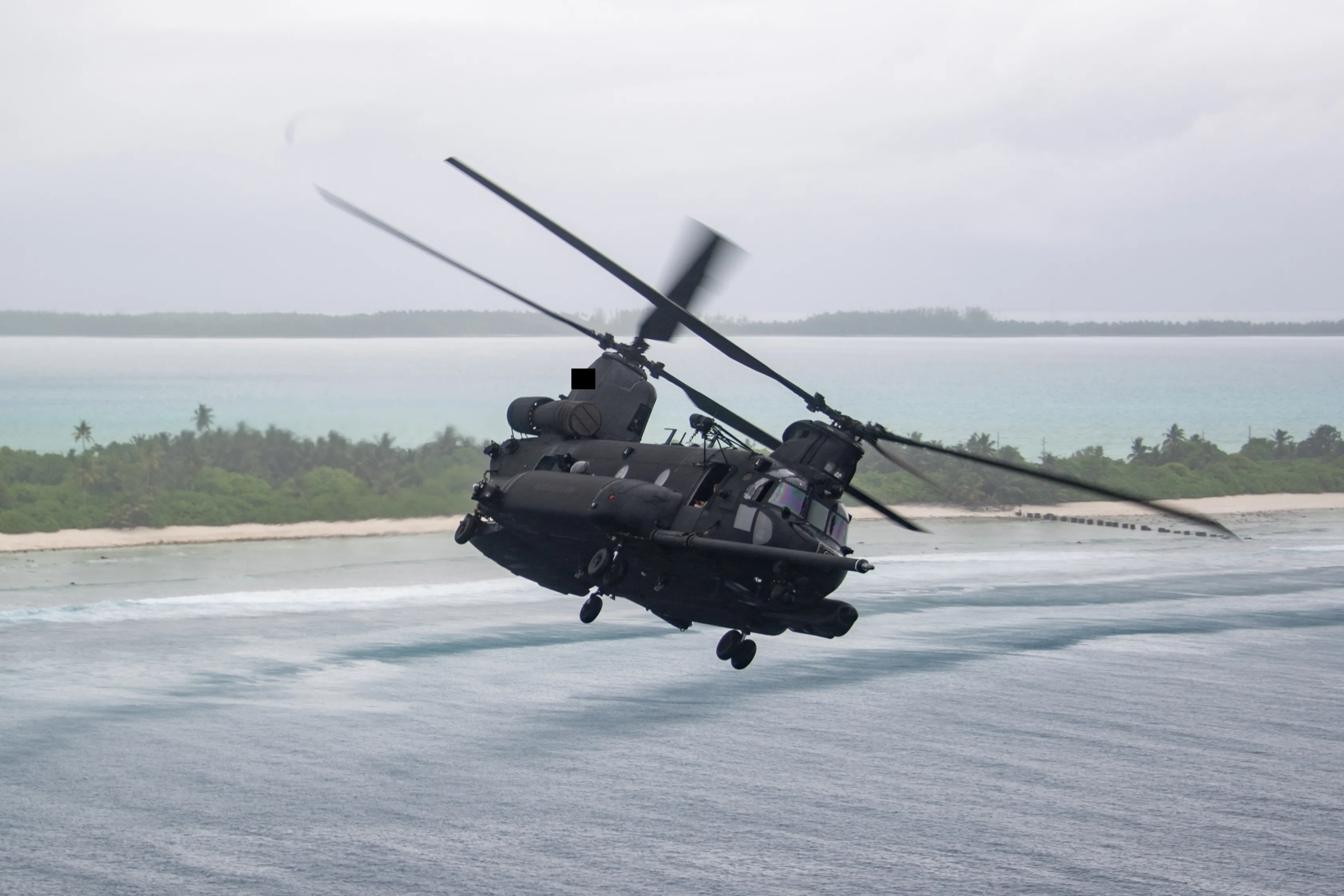
251014-N-ML137-1196 DIEGO GARCIA, British Indian Ocean Territory (Oct. 14, 2025) A MH-47G Chinook, attached to the “Night Stalkers” of U.S. Army 160th Special Operations Aviation Regiment, flies over Diego Garcia during a morale flight for service members stationed on the island, Oct. 14, 2025. U.S. Navy Support Facility Diego Garcia’s mission is to provide critical support to U.S. and allied forces forward deployed to the Indian Ocean, while supporting multi-theater forces operating in the CENTCOM, AFRICOM, EUCOM and PACOM areas of responsibilities in support of overseas contingency operations. (U.S. Navy photo illustration by Mass Communication Specialist 1st Class Samantha Jetzer)
A MH-47G Chinook, attached to the “Night Stalkers” of U.S. Army 160th Special Operations Aviation Regiment, flies over Diego Garcia, October 14, 2025. U.S. Navy photo illustration by Mass Communication Specialist 1st Class Samantha Jetzer

At this stage, however, SOCOM is beginning to draft possible requirements for the next iteration of special operations MH-47G — the Block III — expected to come online starting around 2032.

“Currently, we’re in Block II,” explained Sean Godfrey, product manager for the MH-47 at Army Special Operations Aviation Command. “We do not currently have what the Block III looks like, but that aircraft’s not going anywhere. It’s going to have to get upgraded over time.”

A slide from a SOCOM event at the annual SOF Week conference shows a pathway to the Block III MH-47G. Jamie Hunter

“Those next big things that we have to figure out would be how to get more out of the system,” Godfrey continued. “That would have to be enabling the aircraft to go further into more environments.” Another area of interest is increasing options for putting modular equipment on and off the aircraft, he added.

“That increased modularity to be able to rapidly take things on and off the aircraft to reconfigure it very quickly, to meet our mission requirements, is something that we’re always looking at,” added Dr. Steve Smith, SOCOM’s program executive officer for Rotary Wing.

“Anything that we do going forward, we’re going to try to make it as modular as possible. We want to go plug things in when we need them, unplug them, and take them off the aircraft when we don’t need them.”

Even with an aircraft offering the performance and capacity of the MH-47, preserving the allowable combat load is always at a premium. Increased modularity might include removing certain protection systems for operations in more-permissive environments, to give operators additional load. The same could be said for navigational systems, as well.

Two U.S. Army MH-47G Chinooks conduct helicopter air-to-air refueling operations with a U.S. Air Force HC-130J Combat King II, assigned to the 26th Expeditionary Rescue Squadron, over an undisclosed location in the U.S. Central Command area of responsibility, Dec. 27, 2022. U.S. Air Forces Central Command assets routinely conduct joint operations in support of CENTCOM’s regional stability priorities. (U.S. Air Force photo by Staff Sgt. Gerald R. Willis)
Two U.S. Army MH-47G Chinooks conduct helicopter air-to-air refueling operations with a U.S. Air Force HC-130J Combat King II, assigned to the 26th Expeditionary Rescue Squadron, over an undisclosed location in the U.S. Central Command area of responsibility, December 27, 2022. U.S. Air Force photo by Staff Sgt. Gerald R. Willis

Smith continued: “There might be cases where I want to fill that aircraft with as much fuel as possible, and maybe that MH-47 becomes a flying FARP, and I put it somewhere, and we refuel other aircraft off of them.”

A FARP, or Forward Arming and Refueling Point, is essential for operating from austere forward bases along (or beyond) the battle lines.

This is already a key mission for the MH-47, with the 160th using these aircraft in “Fat Cow” configuration. Filled with extra tanks, the Chinook then serves as a gas station on the ground for other rotary-wing aircraft. This was a tactic famously used in the Bin Laden raid.

A U.S. Army Soldier assigned to the 160th Special Operations Aviation Regiment loads rockets into a MH-60 Black Hawk during a forward arming and refueling point exercise at Marine Corps Outlying Field Atlantic, May 6, 2025. U.S. Army Soldiers and aircraft from the 160th SOAR utilized MCAS Cherry Point’s training area to conduct a FARP. This training is essential for enhancing the unit’s operational readiness and ensuring efficient support for rapid deployment, as Cherry Point provides the facilities and resources to simulate real world scenarios (U.S. Marine Corps photo by Cpl. Matthew Williams)
A U.S. Army Soldier assigned to the 160th Special Operations Aviation Regiment loads rockets into a MH-60 Black Hawk during a forward arming and refueling point exercise at Marine Corps Outlying Field Atlantic, May 6, 2025. U.S. Army Soldiers and aircraft from the 160th SOAR utilized MCAS Cherry Point’s training area to conduct a FARP. This training is essential for enhancing the unit’s operational readiness and ensuring efficient support for rapid deployment, as Cherry Point provides the facilities and resources to simulate real world scenarios (U.S. Marine Corps photo by Cpl. Matthew Williams) Cpl. Matthew Williams

At a FARP, aircraft can quickly receive fuel and weapons, even without shutting down their engines. As a result, they can accelerate the fight by dramatically increasing sortie rates, or FARPs can extend the combat range of an aircraft. When it comes to just adding fuel, refueling in mid-air is an even more efficient way of doing this.

“Maybe, maybe we can do in-air refueling off of an MH-47,” Smith mused.

JOINT BASE LANGLEY- EUSTIS, Va. – U.S. Soldiers assigned to Echo Company, 5-159th General Support Aviation Battalion (GSAB), refuel a CH-47 Chinook helicopter during a Forward Arming and Refueling Point (FARP) training at Felker Army Airfield on Joint Base Langley-Eustis, Virginia, April 25, 2024. FARP training enables soldiers to gain experience providing fuel and ordinance necessary for rotary wing operations. (U.S. Air Force photo by Zulema Sotelo)
U.S. soldiers assigned to Echo Company, 5-159th General Support Aviation Battalion (GSAB), refuel a CH-47 Chinook helicopter during a Forward Arming and Refueling Point (FARP) training at Felker Army Airfield on Joint Base Langley-Eustis, Virginia, April 25, 2024. U.S. Air Force photo by Zulema Sotelo

While he admitted that he was “just throwing stuff up against a wall,” at this point, Smith also acknowledged that having more modular systems could make that possible.

“Aerial refueling is an amazing capability,” Smith continued. “It allows us to do a lot of things, but that affects your allowable combat load, right? So, is there a way to do something modular for aerial refueling, so that the system could come on and off quickly, so that would allow us to get maybe something in country, rapidly reconfigured, and then do something else.”

For the Army, the demands for greater range and ability that cover those distances faster are seen as critical capabilities, particularly in the context of any future fight against China across the sprawling expanses of the Pacific.

211005-N-PA358-2018 ATLANTIC OCEAN (Oct. 5, 2021) An MH-47G Chinook, attached to the 3rd Battalion, 160th Special Operations Aviation Regiment (3/160th SOAR), flies near the flight deck of the Nimitz-class aircraft carrier USS Harry S. Truman (CVN 75). Truman is operating in the Atlantic Ocean in support of naval operations to maintain maritime stability and security in order to ensure access, deter aggression and defend U.S., allied and partner interests. (U.S. Navy Photo by Mass Communication Specialist Seaman T'ara Tripp)
An MH-47G Chinook, attached to the 3rd Battalion, 160th Special Operations Aviation Regiment (3/160th SOAR), flies near the flight deck of the aircraft carrier USS Harry S. Truman (CVN 75). U.S. Navy Photo by Mass Communication Specialist Seaman T’ara Tripp

According to Smith, SOCOM is already looking at the possibility of porting mission equipment from its forthcoming MV-75A Cheyenne II tiltrotors onto the MH-47 Block III, and potentially even the Block II or Block III MH-60 fleets. However, he admitted that, at this stage, there is no funding appropriated for this, or even a formal requirement.

When it comes to making Block III a reality for the MH-47, this would likely follow the same procedure that is currently used to produce special operations Chinooks.

For the MH-47G Block II, specifically, Godfrey explained that the procedure starts with selecting a legacy aircraft, some of which are now more than 60 years old. SOCOM then removes all the mission equipment and software equipment, Godfrey continued, and flies the aircraft to Delaware. Here, the aircraft is essentially torn apart, and the parts to be used are recapitalized and returned to the Boeing production line. After a multi-year process, the Chinook re-emerges as a black-painted MH-47 and then goes to have all its mission equipment fitted. Then it is delivered to the unit.

U.S. Army Soldiers enter an MH-47G Chinook helicopter assigned to the 3rd Battalion, 160th Special Operations Aviation Regiment at Hunter Army Airfield, Georgia, before it takes-off during Weapons School Integration (WSINT) at Nellis Air Force Base, Nevada, Dec. 2, 2020. U.S. Army units came together during WSINT to support the exercise by simulating scenarios of current and future threats. (U.S. Air Force photo by Airman 1st Class Dwane R. Young) 
U.S. Army soldiers enter an MH-47G Chinook helicopter assigned to the 3rd Battalion, 160th Special Operations Aviation Regiment at Hunter Army Airfield, Georgia, before it takes off during Weapons School Integration (WSINT) at Nellis Air Force Base, Nevada, December 2, 2020. U.S. Air Force photo by Airman 1st Class Dwane R. Young

Once in SOCOM service, Smith explains that “We’re constantly trying to figure out the best ways to increase range, increase payload, increase speed, reduce weight, all while somehow holding flight-hour costs low. And all these things aren’t rolling in the same direction.”

The MH-47’s need for range is an enduring one and is reflected in its regular use of in-flight refueling itself, using the probe-and-drogue method, as also employed by SOCOM MH-60s. Already, the MH-47 features massive sponson fuel tanks compared to the standard Chinook, making them the longest-range assets of the 160th.

But whether or not some kind of palletized or modular aerial refueling capacity comes to the Chinook remains to be seen.

Expanding the “Fat Cow” role and taking the MH-47 tanker to the air would be very enticing for SOCOM. It would give them their own air-to-air refueling assets, rather than relying totally on the Air Force MC-130/HC-130 fleets. As it is, providing fuel at FARPs can be a very high-risk mission for SOCOM, considering they are often working in contested territory. If the same aircraft could be adapted to refuel MH-60s and MH-47s in the air, they would not have to land in some scenarios, and the Army wouldn’t need to call upon external refueling assets, which might not be available or cannot be risked.

It is also worth noting that questions have also emerged about how the Army will ensure there is adequate tanker capacity to support its aerial-refueling-capable MV-75s. As delivered, all Cheyenne IIs will have the capacity to have a probe fitted, the Army has confirmed, even those in non-SOCOM units, although the exact mix of how many ‘big Army’ MV-75s will get the probe and how many won’t is yet to be determined. Bell, the MV-75’s prime contractor, and the Army have both suggested that tanker drones like the U.S. Navy’s forthcoming MQ-25 Stingray could help extend the Cheyenne II’s reach. An adapted MH-47 could provide another answer, although one with drastically different performance.

A rendering of a special operations configured MV-75 with an in-flight refueling probe. Jamie Hunter

Recent operations in South America and in the Middle East have underscored the need for long-range missions by Special Operations Aviation Command. The prospect of a potential conflict with China across the vast expanses of the Pacific means that longer-range platforms, of all kinds, are an increasing area of interest, and the 160th’s heavy-lifting, far-flying Chinooks are no exception.

Contact the author: thomas@thewarzone.com

Thomas is a defense writer and editor with over 20 years of experience covering military aerospace topics and conflicts. He’s written a number of books, edited many more, and has contributed to many of the world’s leading aviation publications. Before joining The War Zone in 2020, he was the editor of AirForces Monthly.


Source link

Inside SOCOM’s Search For New Machine Guns, Rifles And Ammo

When it comes to machine guns and rifles, U.S. Special Operations Command (SOCOM) wants its operators to have deadlier weapons that shoot further with greater accuracy, are lighter to carry. The command also wants some to be able to chamber hypervelocity ammunition that is under development. To get more insights about what firearms commandos will be packing in the future, we spoke with Lt. Col. Alan Wood, SOCOM’s Program Manager for Special Operations Forces (SOF) Lethality. In an exclusive interview during the annual SOF Week conference in Tampa, Florida, Wood told us what’s working, what isn’t and what gets him, in his words, “pretty excited.”

Some of the questions and answers have been edited for clarity.

U.S. Special Operations Command is looking for new weapons for its operators. (U.S. Army photo by Sgt. Jaerett Engeseth) U.S. special operations service members conduct combat operations in support of Operation Resolute Support in Southeast Afghanistan, May 2019. U.S. Army photo by Sgt. Jaerett Engeseth

Q: SOCOM just put out an Area of Interest (AOI) request for what is being called the Hypervelocity Improved Carbine (HICAR) program, designed to “develop an improved carbine capable of operating with currently issued 5.56 NATO ammunition, while also incorporating design features to ensure reliability, durability, and longevity with the use of future hypervelocity 5.56x45mm ammunition.” What can you tell me about that?

A: So, HICAR’s got me excited. Back in the late teens, the Army went down this higher velocity [route], and I’m intentionally using the word velocity and not pressure in what they’ve done with the M7 and M8 rifles. They’ve been able to increase the velocity and therefore create a flatter shooting rifle as well as a rifle that has greater energy on target, and that does incredible things for barrier defeat in a lot of situations. Now we’ve had 10 years, almost, for that technology to mature, people have learned things, and the question then becomes, what could we do for special operators in calibers that are not new?

The advantage for SOF operators is I’ve got, say, the Green Berets who do a lot of partnering with foreign SOF operators, but there’s no [6.8mm] ammo running around central Africa, or you know, pick your favorite spot where we like to do partnering operations around the world. But there’s a lot of 5.56mm and other common cartridges of that nature, and so what we want to…achieve is maybe not the same effect as what the Army’s done with the M7 and the M8 and that high-velocity ammunition that they have, but where could we get close to that in 5.56 and potentially other calibers in the future.

It really goes back to the evolution in steel case ammo that Federal started several years ago, and there’s been more iterations of that coming out – new alloys for cases that far exceed performance of the standard brass that we’ve been using for the last 100 years. And the really amazing part is they can actually be cheaper than brass as well, so we get more performance at a lower cost. It’s a win-win.

Cameroonian special forces soldiers prepare to assault a mock village during exercise Flintlock 26 at an Ivorian training facility in Côte d’Ivoire, April 18, 2026. Since 2005, Flintlock has served as U.S. Africa Command’s premier annual special operations exercise. This year’s exercise brought together more than 30 countries across Côte d’Ivoire and Libya to build lethality and readiness, strengthen counterterrorism skills and increase collaboration across borders. (U.S. Army photo by Spc. Edgar Martinez)
Cameroonian special forces soldiers prepare to assault a mock village during exercise Flintlock 26 at an Ivorian training facility in Côte d’Ivoire, April 18, 2026. S (U.S. Army photo by Spc. Edgar Martinez) Spc. Edgar Martinez

Q: Can you provide any information about the hypervelocity rounds themselves?

A: At this point, it’s still a significant science project, and so there are no specific high velocity rounds that are fielded at this point. It’s an R&D project, and we’re trying to see where we can take that technology.

Q: Can you give me a sense of what you’re looking for in those rounds, and any timelines?

A:  You can see the round and what we’re going to do based on the HICAR document on Sam.gov, so that’s as much information as there is out there. What we’re really looking for is what does it [do] for the rifle? Because as you start getting into rifle development – there are a lot of things to consider, other than how much pressure can you put in the chamber. You’ve got to worry about the failure modes, and you know what happens if you get a projectile stuck in the chamber, things along those lines. There are a lot of other things that you have to worry about, because you want to make sure not only is the gun effective, but it’s got to be safe, and it’s also got to be suitable for the particular mission, and so that’s that broad spectrum that we’re trying to balance and trade off with everything that’s out there in between both the ammunition and the rifle that’s firing it.

SAM.gov

Q: Can you provide an update on fielding of the Mid-Range Gas Gun, both assault and sniper configurations?

A: There is some sensitivity to that… We have been fielding the Mid-Range Gas Gun-Sniper variant since 2023, and we just recently started procurement of the assault variant, so we are pretty excited about getting kicked off of the assault variant from [Lewis Machine & Tool] LMT.

Q: When was the assault variant fielded?

A: We’re currently under a production contract with that. We have not begun to field it.

Q: Any timeline on that?

A: Actually, we are still having those discussions with the vendors. I don’t have an answer for that one.

U.S. Special Operations Command (SOCOM) recently awarded a contract for new rifles chambered to fire the 6.5mm Creedmoor round to Lewis Machine & Tool (LMT).
U.S. Special Operations Command (SOCOM) recently awarded a contract for new rifles chambered to fire the 6.5mm Creedmoor round to Lewis Machine & Tool (LMT). LMT

Q: Why are you excited about the new Mid-Range Gas Gun-Assault (MRGG-A) variant?

A: That one kind of solves the extended range for those mid-range calibers, both 7.62 NATO and the 6.5mm Creedmoor round. That weapon exceeds a 1,200-meter point target in 6.5mm Creedmoor. It’s just a phenomenal, accurate weapon system for our SOF operators. All the components are super excited about this one.

Piston driven AR15 VS gas impingement thumbnail

Piston driven AR15 VS gas impingement


Q: Can you provide an update on the Light Machine Gun-Medium (LMG-M) that is supposed to be chambered in .338 Norma Magnum?

A: SOCOM has paused that program at this time as far as a significant fielding. However, we are fielding a small portion to one unit, not to be mentioned, and we’re going to see how that works out in that unit. We’re doing a small fielding combat evaluation with a unit to see how it’s functioning.

SOCOM

Q: What about SOCOM’s other lightweight machine gun programs?

A: We just got into an OTA [Other Transaction Authority contract] for the Lightweight Machine Gun- Assault (LMG-A), the 7.62 variant, and have a couple competitors there working designs there and expect to have that out to replace the MK 48 in the Fiscal Year 2028-2029 timeframe.

Q: Is the LMG-M being provided by Sig Sauer?

A: Yes.

SIG SAUER MG 338 Machine Gun thumbnail

SIG SAUER MG 338 Machine Gun


Q: Walk me through the advantages of a Norma .338 round.

A: So .338 has some significant range. The .338 has greater range than traditional .50 cal, and the particular round that we have is more effective on target than the .50 caliber at those greater ranges. However, if you compare it to 7.62 or some other lighter cartridges, it is still a heavier round. There are tradeoffs in the .338 machine gun world.

Q: What does the .338 bring to the table for operators?

A: You can replace a .50 caliber’s weighted system with a lighter system that is also dismountable. So, for instance, if you had a light vehicle that had trouble carrying a .50 cal plus a significant amount of ammunition, if you switch over to .338 you can save hundreds of pounds and keep that vehicle under its [gross vehicle weight rating] GVWR. Or especially if you’re doing things like jumping a vehicle that has to be able to hit the ground pretty hard – things along those lines. It allows you to reduce some of that weight, but be able to maintain the range and effectiveness.

GDOTS - LightWeight Medium Machine Gun (LWMMG) [1080p] thumbnail

GDOTS – LightWeight Medium Machine Gun (LWMMG) [1080p]


Q: One last question, what can you tell me about any counter drone rounds that you are either fielding or looking to field across all platforms?

A: We have definitely been looking at counter-drone rounds specifically in the current calibers and so what can I do to augment operators with the rifle that they’re currently carrying. We’ve also been experimenting with various other things, from shotguns to 40 millimeters [40mm grenade], and we’re still trying to sort through there. There’s a lot of things you have to think about when you’re looking at the effectiveness of a round like that. Unfortunately, I can’t go any deeper than that, because I’m really getting into more of an [operational security] OPSEC type of thing, I don’t want to go there.

Contact the author: howard@twz.com

Howard is a Senior Staff Writer for The War Zone, and a former Senior Managing Editor for Military Times. Prior to this, he covered military affairs for the Tampa Bay Times as a Senior Writer. Howard’s work has appeared in various publications including Yahoo News, RealClearDefense, and Air Force Times.


Source link

Navy SEALs In Mini-Submarines Teamed With Underwater Drones In The Works

The U.S. Navy sees a future in which uncrewed underwater vehicles (UUV) work together with submersibles loaded with SEALs. The service has already been conducting tests to explore how crewed-uncrewed teaming under the waves might work. UUVs could help extend the operational reach of operators riding in SDVs, as well as help reduce their vulnerability, but there are communications and other challenges still to overcome.

Navy Capt. Mike Linn shared details about the Navy’s plans for teaming UUVs and various types of swimmer delivery vehicles (SDV) with our Howard Altman on the sidelines of the annual SOF Week conference yesterday. Linn currently works within the Naval Special Warfare program office (PMS 340), a division of the Naval Sea Systems Command’s (NAVSEA) Program Executive Office for Unmanned and Small Combatants (PEO USC).

US Navy special operators prepare to launch a UUV from a small boat on the surface during an exercise. USN

“That is the goal,” Linn said when asked about the Navy’s view of teaming UUVs with SDVs, the latter of which the service also refers to as SEAL Delivery Vehicles.

As it stands now, the main workhorse of the Navy’s SDV force is the Mk 11, which is just under 22 and a half feet long. It is operated by a crew of two and can carry six passengers. Also referred to as the Shallow Water Combat Submersible (SWCS), the Mk 11 is what is known as a “wet” submersible design, where the occupants are exposed to water the entire time during their voyage. The Mk 11, like its predecessors, can be launched and recovered from submerged submarines with specialized Dry Deck Shelters (DDS) attached to their hulls.

A Mk 11 Shallow Water Combat Submersible (SWCS). SOCOM

The Navy has also acquired several new Dry Combat Submersibles (DCS) in recent years, which feature a pressurized cabin with space for a crew of two and eight passengers. This means the larger DCSs can operate at greater depths than the SWCSs. They also deliver their occupants to the destination dry and relatively warm, helping to reduce operator fatigue and certain potential health risks. The DCS does have the limitation of being too big to fit inside existing DDSs. At least publicly, this is understood to translate to the need for support from a mothership on the surface.

A picture of one of the Navy’s Dry Combat Submersibles (DCS) out of the water, giving a sense of its size. US Military

There are multiple UUV designs in the Navy’s inventory today, as well. These are largely torpedo-shaped designs intended to be deployed from and retrieved by vessels riding on the surface or submarines. In recent years, the service has been working to expand its ability to launch and recover UUVs from submerged submarines without the need to send out divers to help. Historically, underwater retrieval of UUVs, in particular, has been a largely manual affair, often conducted via DDS.

A UUV seen partially loaded into a torpedo tube on a US Navy submarine ahead of a test. USN

In terms of the potential benefits of UUV-SDV teams, “underwater systems like the SDV and UUVs afford reach underwater,” Capt. Linn explained. “So, if you can get somewhere in an SDV and then launch a UUV to go do something, then that would make you more capable.”

“You could extrapolate, just as you would have an unmanned wingman in an aircraft, or a maritime surface co-pilot, the same can be said for underseas,” he continued. “So, if you have an unmanned system with you underwater, then I suppose you can use your imagination.”

“A good example might be a harbor,” he added. “Technology is in a state where passing through the mouth of a harbor, a choke point, is maybe much more well defended. Or it is a choke point, and they don’t want to pass there with a big manned platform. So if you send a smaller unmanned platform through, then that’s pretty logical.”

“It can be an overall risk-reducer,” he further noted. A key mission set for Navy UUVs is scouting ahead for mines and other potential hazards, and otherwise helping commanders establish a better ‘view’ of the battlespace above and below the waves. This could all be especially valuable for SEALs during high-risk missions, including ones being conducted covertly or clandestinely.

A UUV seen USN/Chief Petty Officer Travis Simmons

Capt. Linn was also candid about the challenges the Navy still has to overcome to make this underwater teaming ability a reality. He described both crewed SDVs and UUVs as being “deaf, dumb, and blind” in terms of their current ability to communicate and coordinate with each other to ensure they are both in the right place at the right time.

“Through-water data transfer is difficult, and so the modality that you choose while remaining survivable is kind of difficult. And, also, in order to do that, you have to have pretty well synchronized systems,” he said. “We’re looking at all ways of transferring data through water. It can be acoustic, [and] there’s light-based transfers.”

There are other questions still be answered around how UUVs teamed with the SDVs would operate, including where the uncrewed companions would be launched from. If the SDVs have to carry them to the launch point themselves, this could present additional challenges.

“You’ve got to consider your volume in the SDV, which is not great,” Capt. Linn noted. “Are you going to strap it to the outside?”

He did confirm that testing is already being conducted to delve deeper into this potential pairing. He said that the Naval Surface Warfare Center Panama City Division (NSWC PCD), headquartered in Panama City, Florida, has been leading the charge.

Navy special operators seen training off the coast of Florida. USN

“I think we’re still years away from having something at the reliability level that they want,” Capt. Linn added. “Again, back to the actual ones and zeros, and the modality of data transmission, [being at the] right time, right place,” and doing all of this “where you have to be survivable, that’s difficult.”

As Capt. Linn has made clear, significant hurdles will need to be cleared before UUV-SDV taming can become a reality. However, there are also real operational benefits that would come from pushing toward this goal.

Contact the author: joe@twz.com

Joseph has been a member of The War Zone team since early 2017. Prior to that, he was an Associate Editor at War Is Boring, and his byline has appeared in other publications, including Small Arms Review, Small Arms Defense Journal, Reuters, We Are the Mighty, and Task & Purpose.


Howard is a Senior Staff Writer for The War Zone, and a former Senior Managing Editor for Military Times. Prior to this, he covered military affairs for the Tampa Bay Times as a Senior Writer. Howard’s work has appeared in various publications including Yahoo News, RealClearDefense, and Air Force Times.


Source link

BlitzBox Packs 100 Weaponized Drones Into An Unassuming Container

DZYNE Technologies has shared new details about its recently unveiled lower-cost Blitz drone and the accompanying containerized BlitzBox launch system. BlitzBox, the largest version of which can launch a wave of up to 100 drones, is perhaps the more interesting development. There have been two separate calls for proposals from the Pentagon for exactly this kind of capability in the past four months.

Our Howard Altman talked with DZYNE’s Connor Toler, the project manager for Blitz, on the show floor at the annual SOF Week conference today. Blitz and BlitzBox were first unveiled last week.

DZYNE Blitz drone and BlitzBox container launcher thumbnail

DZYNE Blitz drone and BlitzBox container launcher


“It’s fitting that gap between multi-rotors [quadcopter-type drones] and then longer – a little bit larger Group 2s. So you’re really fitting that mid-range range [sic] and endurance, while keeping an operationally relevant payload,” Toler explained. “What really makes it special is its modularity. So, the ability to be able to swap out payloads at a time of need, not having pre-configured systems, and also allowing the end user to adapt those payloads and those modules themselves.”

In U.S. military parlance, Group 2 drones have maximum total weights between 21 and 55 pounds, can fly up to an altitude of 3,500 feet, and have top speeds of 250 knots or less. Group 1 covers everything below Group 2, capability-wise, including Blitz and the even smaller multi-rotor drones, Toler mentioned.

The Blitz drone itself is a small, highly modular fixed-wing design. It is propelled via a pair of electrically powered propellers, one in each wing. It can cruise at speeds between 40 and 75 Knots Equivalent Air Speed (KEAS).

Blitz drones on a display on a launch rail at this year’s SOF Week conference. Howard Altman

There are two battery options for Blitz. The standard one offers a maximum range of 50 miles (80 kilometers) and total endurance up to one hour. The extended range type allows the drone to fly out to 93 miles (150 kilometers) and boosts its endurance to two hours. The drone is designed so that the choice of battery does not otherwise impact the total payload capacity, which does have additional impacts on range and endurance.

Blitz has a stated maximum payload capacity of five pounds. It has two payload bays in the main body, as well as nose and tail sections that can be readily swapped out. None of this requires special tools. The tail is notably where the drone’s communications package sits, making it easier to fit different specific radios to meet customer requirements.

A broken down Blitz drone underscoring the modularity of the design. Howard Altman

One of the payload options is a two-pound fragmentation warhead from MMS Products based on that company’s Mjolnir design. Mjolnir was originally designed to be dropped from small drones.

In the press release it put out last week, DZYNE had also highlighted Blitz’s ability to be configured for intelligence, surveillance, and reconnaissance (ISR) and electronic warfare (EW) missions, as well as for “deception, and other mission effects.” Deception in this case could mean acting as a decoy.

“Blitz offers a lot of flexibility in the electronic warfare space, [and] some of the deception space, as well,” Toler, the Blitz project manager, reiterated today. “We’re able to run antennas out to the wing tips. So, there’s channels on the wings and mounting points on the wing tips.”

“One of the benefits is that it’s not tube-launched, and why is that a benefit is that you’re actually able to put things that are volumetrically unoptimized, per se, and you’re not constrained to a tube,” he also noted. “So you’re really allowed flexibility and creativity when it comes to what you can solve.”

Another view of Blitz drones on a launch rail. Howard Altman

In terms of guidance, currently, Blitz’s main means of getting to the designated target or target area is via satellite navigation using pre-set coordinates.

“We also do have a visual-based navigation module that basically allows you to navigate in a [GPS-]denied environment, which is optional,” according to Toler. This allows the drone to navigate by comparing imagery of the terrain below against an internal database preprogrammed in advance.

Using pre-set coordinates for targeting alone would preclude attacking anything on the move. Whether some degree of automated targeting capability is already available for Blitz, or on the horizon, is unclear. DZYNE says that Blitz can also be employed in an operator-in-the-loop mode, which would require an active control link to the drone during flight. Advances continue to be made in automated target recognition and engagement capabilities, driven by parallel developments in artificial intelligence and machine learning, as you can read more about in this past TWZ feature. This, in turn, could reduce the importance of having a mode of operation involving direct, if any, operator control. For its part, the U.S. military says it sees humans continuing to be involved, at least to some degree, in the operation of drones for the foreseeable future.

Whether the operator remains in the loop or not after launch, mission planning and control of Blitz drones can be done via handheld tablet-like devices. A software “plugin” to support the drones has already been integrated into the Android Tactical Assault Kit (ATAK) suite in service across the U.S. military, as well as with foreign armed forces.

A view of the screen of a tablet-like device with the ATAK software suite being used by a member of the US Army’s 3rd Mobile Brigade Combat Team, 101st Airborne Division (Air Assault). US Army

However, right now, “typically, how they work is you predetermine what area you’re going to fly, that gets loaded onto the aircraft before you launch, and then we’re off to the races,” according to Toler. “Within the plugin itself, when you’re operating Blitz, you’re not flying an aircraft. What you’re doing is you’re planning effects over some area, and then you’re assigning aircraft to that mission.”

In its current form, Blitz is also designed to be lower-cost and, by extension, expandable, though a specific cost target has not yet been provided. Toler said today that there is a “path” to making the drone more recoverable and potentially reusable, but primarily for training rather than operational purposes.

“What’s really unique about Blitz is that, regardless of any of those different scenarios, it’s actually the exact same thing. You’re not modifying the aircraft to fit into any of those employment options,” Toler added. “So not only is it incredibly flexible from a payload perspective, but it’s also incredibly flexible from an employment perspective.”

Blitz takes off under its own power and is small enough to be hand-launched. It can also be deployed via four-rail launchers, which can be carried by small teams on the ground, as well as installed on ships and boats. Individual Blitz drones can be carried inside a container that provides an integrated charging station, as well.

Blitz drones seen loaded on a launch rail on a small boat. DZYNE Technologies

And then there is the containerized BlitzBox launch system. As part of its announcement last week, DZYNE showed one example utilizing what outwardly looked like any other 10-foot shipping container. Up to 16 Blitz drones on four separate rail launchers can fit inside. Toler confirmed today that DZYNE has also been working on a 40-foot type, which can hold up to 100 of the drones.

BlitzBox opens up significant additional operational possibilities for Blitz. Containerized systems present inherent benefits for expeditionary or distributed operations as they can be readily deployed and redeployed via truck, as well as by cargo aircraft and ships. Groups of container launchers could be positioned far forward, or even behind enemy lines, and operated remotely. Since they look like any other shipping container from the outside, this also creates targeting challenges for opponents.

The containerized launch system “can be configured to be as autonomous as you liked [sic] it to be,” according to Toler. He said DZYNE has already demonstrated the ability to operate BlitzBox remotely at extended ranges via satellite communication. He specifically highlighted SpaceX Starlink and its government-focused cousin Starshield as examples of networks that could be used to manage the containers and the drones inside.

BlitzBox launchers could be loaded with dozens of drones in different configurations to perform various tasks as coordinated by a single user. Currently, there is no fully-autonomous swarming or cooperative capability, though DZYNE’s software can help deconflict operational plans prior to launch.

DZYNE Technologies

Toler described a notional scenario in which “Let’s say, if you’re operating a BlitzBox, I want to assign 30 aircraft for that mission. And the software will deconflict those aircraft and launch them in a sequence to make sure that you know there’s no mid-air collisions, and they time the effects appropriately.”

“Right now, what Blitz uses is basically pre-coordinated cooperation, and what I mean by that is the vehicles, once they launch, they’re not talking to each other,” he added. “One of the benefits of that is, that when you’re in [a] denied environment, you can’t ensure that the vehicles are going to be able to talk to each other. So our current implementation allows you to still have coordinated effects without relying on that.”

The way BlitzBox is designed, each one of the containers can also just be used to store drones, either for reloading other launchers or for use in other modes.

“So, you can imagine having a BlitzBox with aircraft in a ready-to-launch state, as you see them there, and perhaps a separate container with aircraft in their box state as this reloads,” Toler explained. “But now that container not only allows you to grab reloads from the BlitzBox itself, but let’s say your CONOP [concept of operations] changes and now you want to just throw a handful in the back of a Razor [Polaris MRZR] or in [the] back of a vehicle, and operate from somewhere else. You can just go grab those reloads and take them.”

A Blitz drone seen being hand-launched. DZYNE Technologies

Toler said DYZNE has already “worked with several customers across the DOW [Department of War]” in regard to Blitz and BlitzBox. However, it is unknown whether or not any branch of the U.S. military has moved to acquire these drones and launchers, or may have already begun fielding them.

That being said, as mentioned right at the start, this kind of containerized drone launch capability is something the U.S. military is very actively pursuing. In February, the Pentagon’s Defense Innovation Unit (DIU) put out a call for proposals for a Containerized Autonomous Drone Delivery System (CADDS). Last month, the Defense Advanced Research Projects Agency (DARPA) put out a separate contracting notice seeking concepts for drones with a high degree of autonomous operation, as well as containerized launch systems to go with them. DARPA also outlined a notional concept of operations involving a largely self-sustaining “autonomous constellation” able to support networked swarms consisting of as many as 500 drones at once.

TWZ has previously called particular attention to the threat that unassuming containerized drone launchers can pose, given their ability to hide in plain sight. Ukraine has already demonstrated the effectiveness of this kind of drone attack with its Operation Spiderweb last year, which succeeded in destroying prized bombers and other aircraft at several Russian airbases. Israel’s near-field attacks from within Iran during the opening phases of the 12 Day War are another example of how this kind of capability could be employed deep within enemy territory. DZYNE says Blitz and BlitzBox have been in development since before Operation Spiderweb, but there are clear similarities in the company’s proposed concepts of operations.

As we also previously wrote after DIU’s CADDS announcement:

Even in an overt operational context, readily deployable containerized systems capable of acting as hubs for drone operations across a broad area with limited manpower requirements could offer a major boost in capability and capacity. Ships, trucks, and aircraft, which could themselves be uncrewed, could be used to bring them to and from forward locations, even in remote areas. If they can support a ‘heterogeneous mix’ of uncrewed aerial systems, a single container could be used to support a wide array of mission requirements, including intelligence, surveillance, and reconnaissance, electronic warfare, kinetic strikes, and/or communications signal relay.”

“Drone swarms are only set to become more capable as advancements in autonomy, especially automated target recognition, continue to progress, driven by parallel developments in artificial intelligence and machine learning, as you can read more about here. Future highly autonomous swarms will be able to execute various mission sets even more efficiently and in ways that compound challenges for defenders. Massed drone attacks with limited autonomy already have an inherent capacity to just overwhelm enemy defenses. In turn, electronic warfare systems and high-power microwave directed energy weapons have steadily emerged as some of the most capable options available to tackle swarms, but have their own limitations. Even powerful microwave systems have very short ranges and are directional in nature, and electronic warfare systems may simply not work at all against autonomous drones.”

It should be noted that a number of other companies in the United States and elsewhere globally have already put forward other concepts for containerized drone launchers. Many countries around the world have fielded containerized or container-like drone launchers, especially mounted on trucks, or are in the process of doing so. China has been particularly active in this regard. Israel has also long been a pioneer in developing these kinds of capabilities as part of its work on long-range kamikaze drones. As seen in the video below, Iran is now another major actor in this domain.

Баражуючий іранський боєприпас «Shahed 136» thumbnail

Баражуючий іранський боєприпас «Shahed 136»


DZYNE’s BlitzBox, coupled with its new Blitz drone, could still be reflective of a larger trend set to emerge now, especially in response to the clearly growing demand from the U.S. military.

Contact the author: joe@twz.com

Joseph has been a member of The War Zone team since early 2017. Prior to that, he was an Associate Editor at War Is Boring, and his byline has appeared in other publications, including Small Arms Review, Small Arms Defense Journal, Reuters, We Are the Mighty, and Task & Purpose.


Howard is a Senior Staff Writer for The War Zone, and a former Senior Managing Editor for Military Times. Prior to this, he covered military affairs for the Tampa Bay Times as a Senior Writer. Howard’s work has appeared in various publications including Yahoo News, RealClearDefense, and Air Force Times.


Source link

AC-130J Gunship With Mini Cruise Missiles Paired With AESA Radar To Undergo Tests

U.S. Special Operations Command (SOCOM) is moving to demonstrate a new, fully integrated extended-range strike capability for the AC-130J Ghostrider gunship. The two core elements of this effort are an active electronically-scanned array (AESA) radar and the AGM-190A Small Cruise Missile (SCM), work on which has been underway separately for some time now. TWZ has long highlighted how giving the AC-130J an AESA radar would boost its ability to engage targets at longer ranges. This, in turn, could also help ensure the Ghostrider’s relevance in future high-end fights, especially in the Pacific region.

Col. Justin Bronder, head of SOCOM’s Program Executive Office for Fixed Wing (PEO-FW), discussed the integration of the radar together with the AGM-190A on the AC-130J earlier today. Bronder spoke to TWZ and other outlets alongside other SOCOM acquisition officials at a roundtable on the sidelines of the annual SOF Week conference.

A US Air Force AC-130J Ghostrider gunship. USAF

AGM-190A is the formal U.S. military designation for the SCM, developed by Leidos, originally under the name Black Arrow. It has now also emerged that SOCOM refers to the missile by the nickname Havoc Spear. With a demonstrated range of at least 400 miles, the missile has far greater reach than any of the other missiles and precision bombs that the AC-130J is known to be able to employ now by a huge margin. The Ghostrider’s current armament package, which also includes a 30mm automatic cannon and a 105mm howitzer, is focused on close air support and interdiction missions against targets at much closer ranges.

“A lot going on in that space,” Col. Bronder said today. “Our unique teaming with Leidos, that started with a CRADA [Cooperative Research and Development Agreement], that accelerated through an express development program on the now called AGM-190 Havoc Spear affordable cruise missile.”

A CRADA is a non-traditional research and development mechanism through which elements of the U.S. military can pool resources with private companies and other organizations. These agreements allow the parties involved to pursue mutually beneficial work, but without a typical contract or even money necessarily changing hands.

“That program [the AGM-190] has really been moving along quite, quite quickly,” Bronder continued. “We’re looking at ways to kind of accelerate fielding of that weapon in the not too distant future with close teaming with AFSOC [Air Force Special Operations Command] partners to really collapse that development and operational test timeline. So, real big acquisition success there.”

Leidos completes successful test launch of a Small Cruise Missile thumbnail

Leidos completes successful test launch of a Small Cruise Missile


“We have tech demonstrations with the AESA radar and the small cruise missile that we’re now looking to see how we can augment and accelerate fielding those types of capabilities for the SOF [special operations forces] fleet,” Bronder added.

“CRADAs produced the AGM-190A Havoc Spear small cruise missile that offers an affordable mass solution with significant range to our service partners,” U.S. Navy Adm. Frank Bradley, head of SOCOM, also said separately during his keynote address at the SOF Week conference earlier today. “Integrated with the AESA radar on the AC-130 gunship, [it is] a formidable capability.”

SOCOM’s proposed budget for the 2027 Fiscal Year, released last month, had hinted at plans to demonstrate the new combination of capabilities for the AC-130J in the next year or so. The command is asking for nearly $5.9 million to support work on the so-called Precision Strike Package (PSP) for the AC-130J. PSP is the overarching system through which all weapons and associated sensors are integrated onto the Ghostrider.

The new funding “is required to integrate AESA radar capabilities into the PSP,” according to SOCOM’s budget documents. The planned work “includes software and hardware development to incorporate the AESA functionality into the Battle Management System and other associated AC-130J systems.”

What specific AESA radar is going on the AC-130Js is unclear. At last year’s SOF Week conference, Col. Bronder said there was “pathfinding” underway involving Northrop Grumman’s AN/APG-83, also known as Scalable Agile Beam Radar (SABR).

SABR AESA Radar for the F-16 thumbnail

SABR AESA Radar for the F-16


“AFSOC is exploring the development and use of the AESA Radar on the AC-130J as the command continues to operate as both the SOF component to the Air Force and air component to USSOCOM,” AFSOC told TWZ when asked for an update in August 2025. “We cannot discuss the type of radar due to operational security.”

The APG-83 does remain a very plausible choice. The Air Force has already been in the process of integrating this radar onto a significant portion of its fleets of F-16C/D Viper fighters for years now. Beyond its target detection and tracking capabilities, the AN/APG-83 has a synthetic aperture mapping mode and is capable of producing ground moving target indicator data. Also referred to as SAR mapping, this mode allows SABR to produce high-resolution radar imagery. GMTI tracks can be overlaid on those images. All of this, in turn, can be used for target acquisition and identification purposes, as well as general reconnaissance.

A generic example of GMTI tracks overlaid on top of a SAR image. Public Domain

There are other AESA radars on the market, as well, including a growing number of compact designs. Radars of this type, in general, can spot objects of interest, even ones with smaller radar cross-sections, faster and do so with greater precision and fidelity compared to older mechanically-scanned models. They can also just scan faster and perform multiple functions near-simultaneously, and do so with improved resistance to radiofrequency jamming and far greater reliability.

As mentioned, TWZ has long pointed out that the addition of an AESA radar would be a huge upgrade for the AC-130J’s ability to spot, track, and engage targets at extended ranges, even in bad weather. The radar would be able to provide real-time midcourse updates to a stand-off weapon if it had a data link capability. This would make engaging moving targets possible if the missile also had a terminal seeker capable of doing so.

Overall, the capability boosts the AESA radar offers are especially important when paired with new, longer-range strike munitions like the AGM-190A. The radar could also help improve the Ghostrider’s effectiveness when employing other shorter-range munitions, including GBU-39/B Small Diameter Bombs (SDB) now and GBU-53/B StormBreakers (also known as SDB IIs) in the future.

An AGM-190A seen being test-launched from the rear ramp of an AC-130J. Leidos

AESA radars will also expand the AC-130J’s general surveillance and reconnaissance capabilities, as well as provide improved general situational awareness.

This is all reflected in SOCOM’s budget documents, which state: “AESA radar enhances the AC-130J’s situational awareness, precision targeting, and survivability while replacing phased-out legacy radars, enabling the Gunship to close Joint Force kill webs and expand its role in support of USINDOPACOM [U.S. Indo-Pacific Command] and Western Hemisphere operations.”

The mention here of the Indo-Pacific region underscores broader questions about future operational relevance that have been facing the AC-130 fleet in recent years. The Ghostrider and its immediate predecessors were workhorses during the Global War on Terror era, flying heavily over countries like Afghanistan, Iraq, and Syria. Even so, they flew almost exclusively under the cover of darkness to help reduce vulnerability to ground fire.

Can The AC-130 Gunship Stay Relevant? thumbnail

Can The AC-130 Gunship Stay Relevant?


Threats to AC-130s would be far more pronounced in any future high-end fight, such as one against China in the Pacific. For years now, this has been the chief scenario driving U.S. military planning around force structure and other requirements. The latest conflict with Iran, as well as other U.S. operations in and around the Middle East in recent years, have made clear that more capable air defense systems are steadily proliferating to smaller nation states and even non-state actors, as well.

The integration of a new stand-off strike capability paired with an AESA radar is one way for the AC-130J to respond to this evolving threat ecosystem. It could also open the door to other new capabilities for the Ghostrider, as well as other AFSOC aircraft like the OA-1K Skyraider II light attack plane. Similar questions about future relevance have been raised about the OA-1K, a design that is also primarily geared toward counter-terrorism missions and other low-intensity conflicts.

The AC-130J fleet is also in the process of receiving a number of other upgrades, including improvements to its defense countermeasures suite.

It is very possible that the AGM-190A could find its way out of the special operations community and into more widespread U.S. military use. The Air Force is currently planning to buy nearly 28,000 low-cost strike munitions over the next five years through its Family of Affordable Mass Missiles (FAMM) program.

“We’re also continuing to talk to the Air Force about what they’re doing with their Family of Affordable Mass Munitions [sic]” to see “if there’s some continued interplay there for us to do a service-to-SOF or SOF-to-service transition,” Col. Bronder said today.

Last week, the Pentagon also rolled out a plan to acquire at least 10,000 lower-cost cruise missiles, primarily for surface-launched applications from containerized launchers, in the next three years. Leidos is among the companies now involved in this Low-Cost Containerized Missiles (LCCM) program, and is developing a derivative of the AGM-190A to meet those requirements.

A rendering of the AGM-190A-derived missile Leidos is now developing under the Low-Cost Containerized Missiles (LCCM) program. Leidos

For the AC-130J, a full-up demonstration of the pair of an AESA radar and the AGM-190A cruise missile will mark another step toward giving the gunships a valuable, if not increasingly essential, boost in capability.

Contact the author: joe@twz.com

Joseph has been a member of The War Zone team since early 2017. Prior to that, he was an Associate Editor at War Is Boring, and his byline has appeared in other publications, including Small Arms Review, Small Arms Defense Journal, Reuters, We Are the Mighty, and Task & Purpose.


Source link